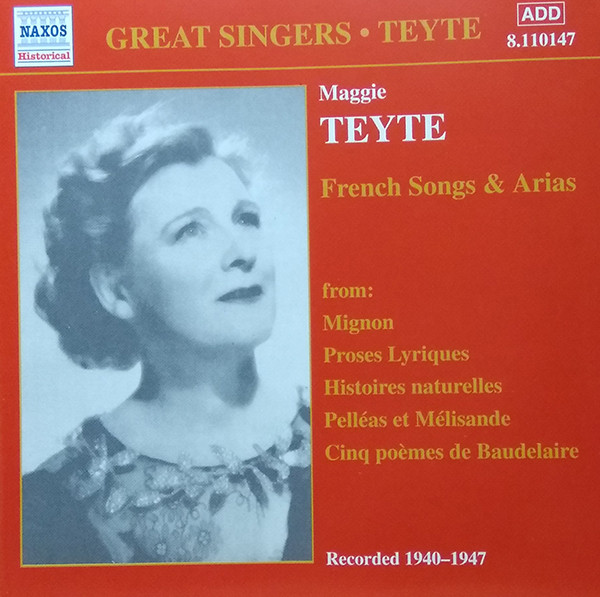
This compilation is of recordings made bewteen 1940 and 1947, when Teyte was approaching 60. Three tracks (Mignon’s Connais-tu le pays?, one of two versions of Duparc’s L’invitation au voyage and the bonus track, Cherubino’s Voi lo sapete) are from a 1947 radio broadcast with the San Francisco Symphony Orchestra under Pierre Monteux, and the rest are of studio recordings made for EMI, some of which were unpublished at the time. Most are with Gerald Moore on the piano, but the second recording of L’invitation au voyage is with the London Philharmonic Orchestra under Leslie Heward. I’d suggest that this is the better of the two recordings. By the time of the second one with Monteux she has to take more breaths, though the tempi are virtually identical. Even so, even in 1947 the voice remains incredibly firm and totally free of wobble or excessive vibrato. Her singing throughout in fact is wonderfully clean and precise and her intonation is perfect.
So too, of course is her French, though we shouldn’t be surprised when we remember that she spent a good deal of her early career in Paris, was coached by Debussy himself for her début as Mélisande and worked with Chausson, Duparc and Reynaldo Hahn, who evidently had a great deal of affection for her. When she said to Hahn once about the tempo of one of his songs. ‘ You play it quicker than I thought,’ he replied, ‘ma chère, any way you sing it will always be right.’
This is a valuable collection and includes recordings that were either not published or had only a limited circulation in their 78 format, though some of them also appear on EMI’s two disc set entitled, Mélodies françaises . The excerpts from Hahn’s Mozart and Ciboulette are absolutely charming, and we get to hear her speak in perfectly accented French too. The other songs are by Debussy, Chausson and Duparc. Debussy was always a particualr speciality and she somehow makes the three songs she sings here from Debussy’s rather obscure Proses lyriques (she had already recorded the fourth with Cortot) come across as quite simple and direct. She also sings a couple of extracts from Pelléas et Mélisande with piano, which gives us a direct link to Debussy himself.
Teyte should be better known than she is these days. She was one of the greatest ever interpreters of the French song repertoire.
 Philip's Assortment Box
Without Philip’s guidance many of these historic voices would be lost. Exceptional voice, especially given her age at the time of recording. Here is a link to Plaisir d’amour: https://youtu.be/4KdgoLkaEUQ
LikeLike