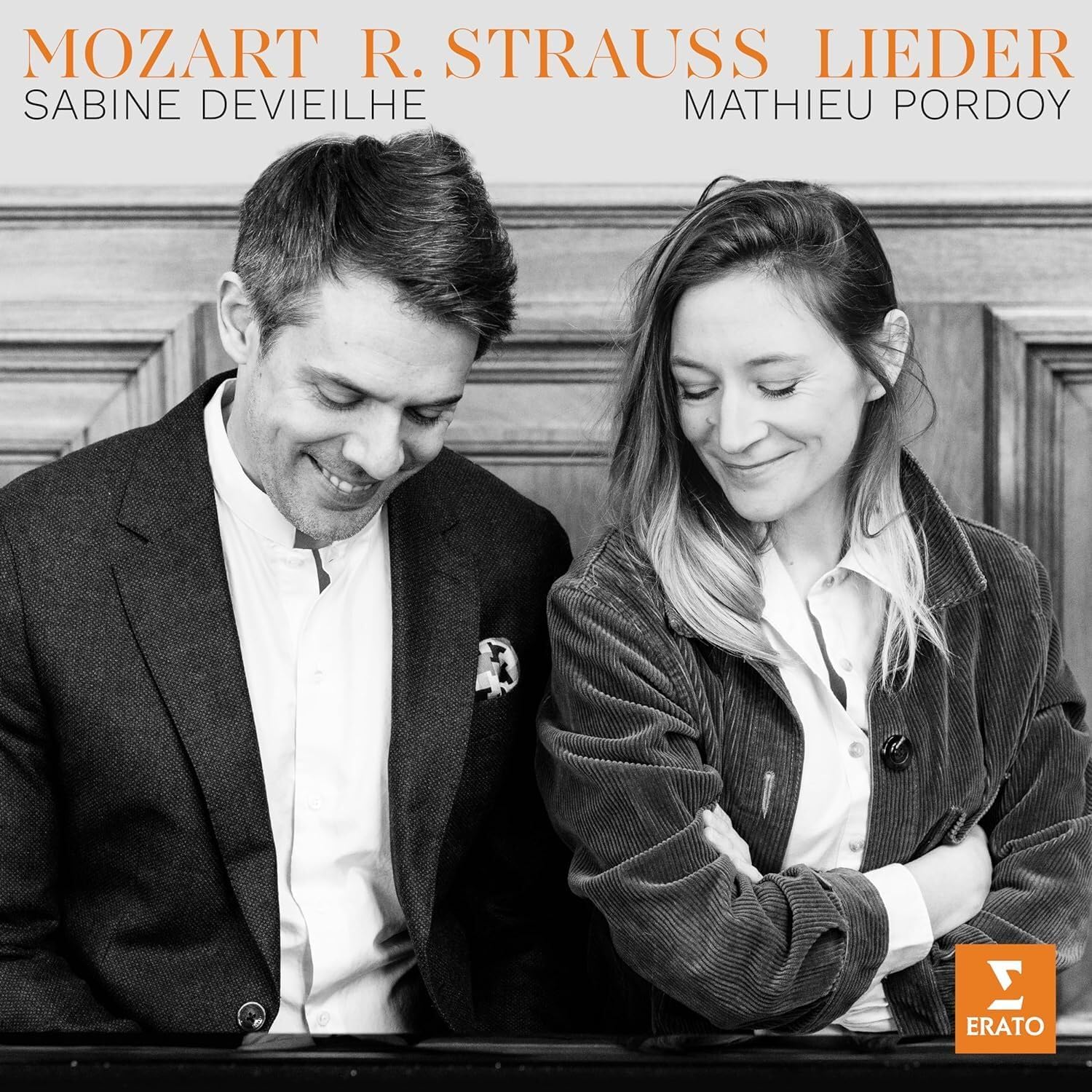
I listened to this recital quite a few times before setting down my thoughts, and, on each occasion, I reacted differently to it. I was looking forward to hearing it having hugely enjoyed Sabine Devieilhe in the theatre, as a wonderfully tomboyish Marie in Donizetti’s La fille du Régiment, but the recording made me aware of a problem with Devieilh’s vocal production, which I hadn’t noticed in the theatre, namely her tendency to use what I can only describe as a squeeze-box method of production which impedes a natural legato. It is particularly noticeable in songs like Strauss’s Die Nacht and Morgen, but once noticed, I found it hard to ignore. I listened to the recital several times and my impressions changed from one listening to the next. I am sure that there are those who will not be bothered by it at all, but, once noticed, it began to grate.
Which is a pity, because this is a well put together programme and for the most part well executed by Devieilh and her brilliant accompanist, Mathieu Pordoy.
For once we get no catchy title for this disc of Mozart and Strauss Lieder, and Devieilhe tells us in the notes that their two instruments are “pared back and at the service of illuminating the lieder of Mozart and Strauss.” So far so good, and it was a nice idea to intersperse the songs with each other rather than giving us a group of Mozart songs, followed by a group of Strauss. For the most part, the juxtapositions work well, but I did wonder why, at the beginning of the recital, Strauss’s Die Nacht was placed rather uncomfortably between Mozart’s Komm, Zither, komm and his Das Kinderspiel, on which Devieilhe’s son charmingly contributes a few lines in his boy soprano. If the Strauss exposes Devieilhe’s weakness, in the Mozart songs one notes the bright, forwardly placed tone and her communicative way with the text.
The next Strauss group plays to her strengths and weaknesses with both Nichts and Ständchen nicely done, but the following three songs require the kind of seamless legato she appears not to be capable of and where the squeeze is most noticeable.
We return to Mozart with a heartfelt performance of An die Einsamkeit. The voice is lovely, but, yet again, it needs a better legato, which we hear in performances by Barbara Hendricks and Elly Ameling. Still, she has bags of charm in Mozart’s Oiseaux, si tous les ans and bags of personality for Strauss’s Schlagendes Herzen, as well as being well up to the Zerbinetta-like demands of Strauss’s Amor, though her tone becomes a little pinched at the very top. I note that I am noticing less and less the peculiarities of her vocal production and concentrating more on the music. Maybe I am just getting used to it, or maybe it is becoming less pronounced.
Whatever the reason, I was able to relax and enjoy the music making more in the second part of the recital, whilst noting that Allerseelen really needs a richer tone than Devieilhe can muster and that there was a return to the squeeze-box in Das Velichen.
I should also commend the excellent pianist, Mathieu Pordoy, whose playing is pellucidly clear and who supports his soloist brilliantly in a true collaboration. If I have equivocal feelings about some of the singing, I am sure that others will find otherwise and will find this a thoroughly enjoyable and rewarding disc.
 Philip's Assortment Box
Another illuminating and insightful post by incisive Philip. Great piano from Mathieu Pordoy. https://youtu.be/ASq3NZNwyIU?si=5u5TIW9l_DSiFTi5.
LikeLike