Colin Davis conducts La Damnation de Faust

51uqyihlall

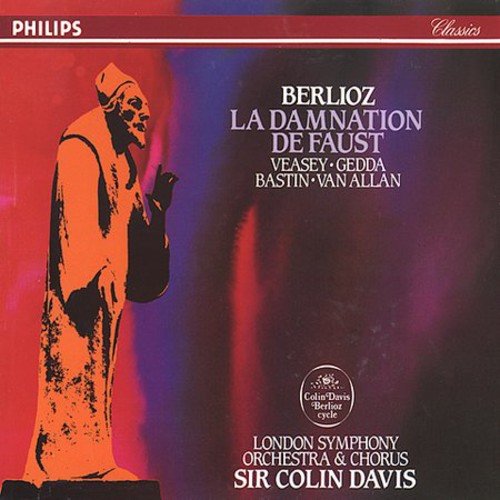
Davis’s classic Philips recording of La Damnation de Faust, better cast I think than his later LSO Live version, is still one of the most recommendable versions of Berlioz’s non-opera. This tragédie-lyrique was never intended to be staged and therefore is particularly well suited to the gramophone, which leaves one’s imagination clear to fill in the stage set and scenery.

Gedda is a great Faust. He may have been just a little past his vocal best but he still manages a gorgeous pianissimo top C sharp in the duet with Marguerite, which no other Faust can quite pull off, added to which his singing is always stylish and intelligently thought through. There are better Margeurite’s on disc than Veasey (Baker, Von Stade and Von Otter come to mind); the difficult Roi de Thulé doesn’t quite come off, but she is better in the duet and sings a fine Romance. Bastin makes a superb Méphistophélès, mercurial, sardonic and ultimately evil and Richard Van Allan puts in one of his best recorded performances as Brander.

Davis, as so often in Berlioz, has a wonderful sense of structure and paces the score just right, and the LSO play brilliantly for him, the brass powerful, woodwind and strings deliciously light in the Menuet des Follets, plus some wonderfully sensitive cor anglais playing in the introduction to D’amour l’ardente flamme.

Every time I listen to this piece, I am struck by its originality. Berlioz was and is unique, with an unmistakable voice. No other composer is remotely like him.

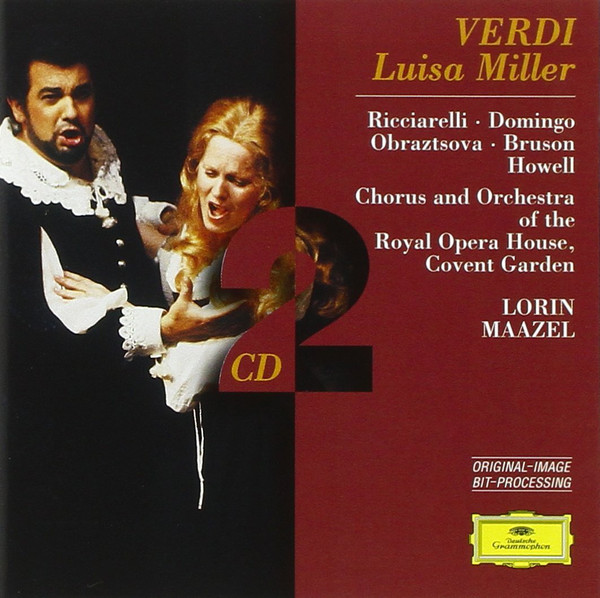
Ricciarelli in Luisa Miller

r-9910923-1488394480-3768.jpeg

The front runners for this opera are probably Maag with Caballé and Pavarotti and Cleva with Moffo and Bergonzi, but this one has its attractions too, not least the affecting Luisa of Katia Ricciarelli. Vocally she is a little more fallible than either Caballé or Moffo, but she is very much inside the character and makes a vulneraby moving Luisa, no doubt helped by the fact that this recording was made during a highly successful run of performances at Covent Garden (actually a revival of a production that had been new the previous year). Much as I admire the two aforementioned ladies, I think ultimately I’d prefer Ricciarelli.

For the rest, honours are about even. Of the conductors, Maag is often revelatory and Cleva, whilst less imaginative, in the best Italian lyric tradition, but Maazel can be somehwat brash and vulgar. All three tenors are excellent and in their best form, as are the three baritones, Milnes, MacNeil and Bruson, so choice will depend on personal preference.

Federica was sung by Elizabeth Connell in the Covent Garden performances, but for some reason it was deemed necessary to bring in Obraztsova for the recording, who oversings and overpowers the role. The best Federica is Verrett on the Cleva; Reynolds on the Maag is completelyel anonymous. Richard Van Allan was Wurm in the stage performances but he is replaced by Ganzarolli, presumably because he had already recorded the role for Maag.

Still, for the three principals, this is a recommendable version of the opera and I’d be hard pressed to make a choice between it, Maag and Cleva.

De Los Angeles in La Traviata

51ust0qa2nl._ac_

Victoria De Los Angeles has long been a favourite singer of mine and her Violetta satisfies on so many levels. She is a little strained by the tessitura of the first act, but the voice is generally clear and beautiful, her singing always musical and deeply felt. As in everything she did, the sensitivity and sincerity of the performance are most affecting and she is without doubt one of the best Violettas on disc. What I miss is that sense of desperation and impulsiveness inherent in the character. Her Violetta is touching, but not overwhelmingly tragic as it is with Callas, who does tend to spoil me for all comers.

She has a good supporting cast with Carlo Del Monte a manly and forthright Alfredo and Sereni a sympathetic Germont, as he is in Callas’s Lisbon performance.

I sometimes feel Serafin’s virtues are rather underestimated. He paces the score brilliantly, particularly good in the choruses, which can sometimes outstay their welcome. If I’m honest, I rather prefer his approach to the more interventionist Kleiber. The cuts traditional at the time are observed, so no cabalettas to Alfredo’s and Germont’s arias.

If Callas, particularly in London, remains my yardstick for this opera, this is nevertheless one of my favourite studio sets and I might even place it just above Cotrubas/Kleiber.

Two Contrasting Vocal Recitals

71mojlgie4l._ac_sl1073_

Dame Maggie Teyte in concert, at the age of sixty no less! Teyte, a famous Mélisande who studied the role with Debussy himself, sings extended excerpts from the opera with piano accompaniment, singing all the roles. It shouldn’t work, but somehow it does. It takes her the first song in the recital (Grétry’s Rose chérie) to warm up, but thereafter you would never believe this was the voice of a sixty year old woman. The disc also includes privately recorded excerpts from Strauss’s Salome also with piano, from when Teyte was preparing the role for Covent Garden about fifteen years earlier, a project that unofrtunately never came to fruition. Her bright, slivery soprano might just have been the voice Strauss imagined.

She also sings Britten’s Les Illuminations in a version for piano, making me wish she had recorded the orchestral version, although preferably a few years earlier. Just occasionally there is a flicker of frailty in the middle voice, although the top register remains firm and clear as a bell. The encores include a lovely performance of Hahn’s popular Si mes vers avaient des ailes.

r-2563085-1290611066.jpeg

Another enterprising disc from Dawn Upshaw, who seems to have disappeared from the scene now. The centrepiece is Earl Kim’s Where grief slumbers written in 1982 for voice, harp and string orchestra, but here presented in a 1990 arrangement for voice, double string quartet and harp, and Upshaw is an ideal interpreter. She is equally at home in the rest of the programme; Falla’s Psyché, Ravel’s Trois poèmes de Stéphane Mallarmé, Stravinsky’s Two poems of Konstantin Bel’mont and Three Japanese Lyrics and Delage’s Quatre poèmes hindous, though here I slightly prefer the warmer tones of Dame Janet Baker, who is much more languidly erotic in the worldess vocalise of Lahore. Nevertheless a thoroughly absorbing disc.

As with so many of these Nonsuch discs, documentation is slight, and, though we do get lyrics and translations, the layout is confusing and a little more information about the provenance of these songs, especially the less famous Kim cycle, would have been much appreciated.

Dawn Upshaw – The World So Wide

r-2563268-1290619230.jpeg

A few weeks ago I reviewed Renée Fleming’s excellent disc of American opera arias and today I turn to Dawn Upshaw’s disc, which takes its title, The World So Wide, from the first item in the recital, Laurie’s Song from Aaron Copland’s The Tender Land. It makes a lovely opener and Upshaw is perfectly cast as the young girl who yearns to escape and see the world.

At about 45 minutes, the disc is quite short measure, however, and not everything is as good as the first track. The piece from Tanía León’s Scourge of Hyacinths is tediously declamatory and afforded me the least enjoyment on the disc. I’d also suggest that Upshaw’s is not the right voice for Barber’s Cleopatra, a role that was written for the much more opulent voice of Leontyne Price. Upshaw’s lighter, brighter sounds do not conjure up the woman of whom Enobarbus says,

Age cannot wither her, nor custom stale
Her infinite variety. Other women cloy
The appetites they feed, but she makes hungry
Where most she satisfies, for vilest things
Become themselves in her, that the holy priests
Bless her when she is riggish.

I enjoyed the excerpt from John Adams Nixon in China rather more than the Gramophone reviewer, who found it “tediously protracted”, and I suppose you either like Adams’s style or you don’t. Whatever your feelings, Upshaw delivers Pat Nixon’s This is prophetic brilliantly. She is also superb in the more Broadway influenced What a movie from Bernstein’s Trouble in Tahiti, but I thought her singing of Lonely house (an aria sung by the male character of Sam Kaplan in Street Scene) just a little too overtly operatic. Teresa Stratas manages it better on her second disc of Weill songs and arias.

After the Copland and Benstein, the most successful item on the disc is Willow Song from Douglas Moore’s The Ballad of Baby Doe, which responds well to her charming, uncomplicated manner. So too, one would think, does the final item (and the only item she shares with Fleming on her disc), Ain’t it a pretty night from Carlisle Floyd’s Susannah, but here I have to admit I prefer the rather more sensuos tones of Fleming, who suggests a far more highly charged eroticism behind the apparent simplicity of the music.

A mixed bag, then, and not so successful as her disc of Broadway songs entitled I Wish It So, but worth a listen for the unusual repertoire and for some excellent performances.

Renée Fleming – I Want Magic


Renée Fleming was at her peak when this recital was recorded and this is, without doubt, one of her most successful records. The programme is a varied one too, with familiar items like Gershwin’s Summertime and Bernstein’s Glitter and be gay rubbing shoulders with items from more rarely performed works like Hermann’s Wuthering Heights and Floyd’s Susannah. The inclusion of Anne’s No word from Tom from Stravinsky’s The Rake’s Progress rather stretches the subtitle American Opera Arias a bit, but is possibly justified as Auden, Kallman and Stravinsky were all resident in the US at the time of its composition.

The disc opens with a short extract from Bernard Herrmann’s Wuthering Heights, which was written in 1943 but never staged in Herrmann’s lifetime. In fact it was only premiered in 1982 by Portland Opera, but with the ending changed to one Julius Rudel had proposed several years earlier. It wasn’t performed in full until 2011, by Minnesota Opera. I have dreamt, lusciously sung here by Fleming, woud suggest the opera might be worth further investigation.

The excerpts from Douglas Moore’s The Ballad of Baby Doe and Menotti’s The Medium are both lovely in every way, but the Gershwin items from Porgy and Bess suffer from a lack of spontaneity. Fleming introduces all sorts of jazzy slides and glottal attacks which simply sound affected. Leontyne Price sings this music much more simply and allows it to blossom on its own.

The considerable difficulties of Bernstein’s Glitter and be gay are tossed off with ease and here she captures the irony in the piece marvellously. It’s a piece that, unsurprisingly, many opera singers have added to their repertoire but few of them challenge the original interpreter, Broadway star Barbara Cook, who created the role and whose diction is a good deal more clear. To be honest, the only “operatic” version I’ve heard that does is Dawn Upshaw’s, but Fleming’s is certainly amongst the best.

Next we have two pieces from Carlisle Floyd’s Susannah, which brought back happy memories of seeing Fleming in the role at the Met shortly after she recorded these exceprts. She is at her considerable best here, flooding the gratefully lyrical lines with gorgeous tone, but also capturing the character’s longing for adventure in the first, her loneliness in the second.

Finally we have a reminiscence of her Anne Trulove, which she sang at the Aspen Music Festival in 1987 and a taster of her Blanche Dubois in Previn’s A Streetcar Named Desire, which she premiered soon after making this recording. She has a richer voice than most Annes, but negotiates its complexities with ease and her Blanche is simply hors concours. The aria I want magic was an obvious high spot when she sang the role in London with the LSO, but I rather wish they had also included the final aria, I can smell the sea air, which had a huge effect on me each time I heard it whilst waiting in the wings to make my entrance as the doctor. It was one of the most beautiful things I’ve ever heard.

Sandwiched between the Stravinsky and the Previn we have Vanessa’s passionate Act I aria from Barber’s opera, which left me wondering why nobody had thought to revive the opera with Fleming in the title role. It would have suited her perfectly.

If I have any reservations, aside from those I mentioned about the Gershwin pieces, I’d have to say that her diction could be clearer. Other than that, this is an absorbing and rewarding programme stunningly sung and beautifully executed. Don’t hesitate.
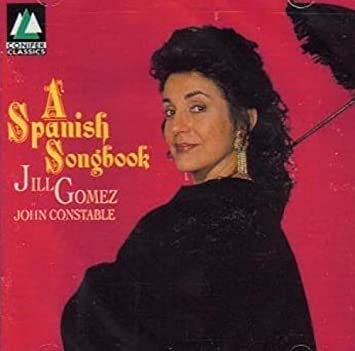
A Spanish Songbook – Jill Gomez

516xghgdgjl._sx355_

What an utterly charmng and delightful disc this is, cleverly planned and beautifully executed.

With her distinctive timbre and wonderfully expressive voice, Gomez’s personality fairly bursts through the speakers and she is superbly supported here by John Constable on the piano, who unerringly captures the mood of the songs. You feel as if these two artists really enjoy making music together, and indeed their association is a long one, having first appeared on disc together twenty years earlier. Gomez would have been in her early fifties when the present disc was recorded but the voice has hardly changed in the intervening years.

What we have here is a compendium of Spanish inflluenced songs by German, French and English composers, as well as songs by Spanish composers, covering a wide range of styles and eras. The programming is eminently sensible and makes for very satisfying listening.

We start with a group of sixteenth century Villancios from the courts of Charles V and Philip II in piano arrangements by Graciano Tarragó, which encourage the kind of decoration and improvisation of the 16th century vilancico. Fuenllana’s De los alamos vengo, madre is no doubt better known from Rodrigo’s orchestral arrangement, but Gomez sparkles quite as much here.

From thence we turn to a group of Spanish influenced songs by Wolf and Schumann, in which Gomez captures perfectly the deep melancholy of Schumann’s Tief im Herzen trag’ ich Pein as well as the girlish coquettishness of Wolf’s In dem Schatten meiner Locken. Spain has always provided a deep vein of inspiration for French composers, so we are next treated to a group of songs by Bizet, Ravel, Saint-Saëns and Délibes in which Gomez’s sense of style is impeccable.

Next come the three Granados Tornadillas, in which we are probably more used to hearing the fuller, chestier sound of someone like Conchita Supervia. Gomez intelligently, rather than copy her style, is more languorous. I might prefer Supervia’s vibrancy, but Gomez’s way is just as valid.

The two Walton songs, both taken from Façade, find Gomez pointing Edith Sitwell’s lyrics deliciously and lead us into the final group, which Gomez calls “Seven Other Popular Songs”. The first three songs are by Roberto Gerhard, who, as an exile from Franco’s Spain, had relocated to Cambridge in the UK in 1942, where he lived until his death in 1970. These are his versions of folk-songs collected by his teacher, Felipe Pedrell. bittersweet souvenirs of a composer in exile. The others are by Tarrago, Rodrigo, Guridi and Obradors. Gomez is yet again a wonderful guide through this musical journey of Spain, brilliantly capturing the mood of each song.

An excellent recital that should be a lot better known than it is.

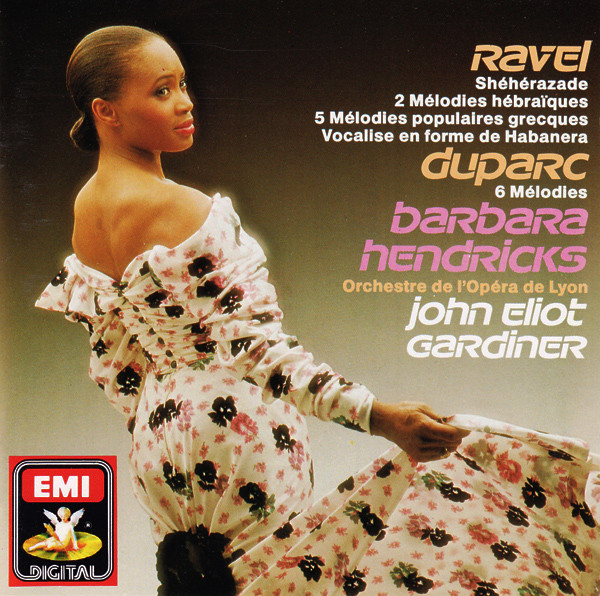
Barbara Hendricks – Ravel and Duparc

r-3319230-1325585118.jpeg

What a gorgeous disc this is. Quite why Hendricks’ version of Ravel’s Shéhérazade is not as famous as those by such as Crespin, Baker and De Los Angeles is beyond me for not only is the singing ravishing, but the orchestral playing under John Eliot Gardener superb, and quite a lot better than that of the Suisse-Romande on Crespin’s recording. Furthermore, though born in America, Hendricks has lived in Europe since 1977 and in Basel, Switzerland since 1985 and her French is virtually flawless.

The disc opens with Ravel’s Shéhérazade and the opening measures of Asie are sung with a gorgeous sensuality, which then gives way to girlish delight when she sings of sailing away on a schooner. What a vivid story-teller she is, alive to every change of mood and how beautifully she is accompanied by Gardiner, who brings out fabulous detail in the orchestral score, without losing its sensuous exoticism. In la flûte enchantée she is suitably languid, until the voice breaks out with a real burst of joy, when she describes the flute alternately pouring forth sadness and joy, whilst L’indifférent is deliciously ambiguous.

The rest of the Ravel programme is hardly less fine. My notes are peppered with words like gorgeous, sensual, exotic for the Mélodies hébraîques, which perfectly suits their colourful musical language, but the singer of the Mélodies populaires grecques is evidently younger, more innocently coquettish, the tone more forwardly produced, though I do slightly miss Victoria De Los Angeles’s delightful simplicity in the final song, Tout gai. The Vocalise en forme de Habanera returns us to the sensuality of the Hebrew songs and is absolutely ravising.

The Duparc songs are not quite up to the standard of the Ravel, but still very worth having. Both L’invitation au voyage and Au pays oû se fait la guerre really require a greater range of tone colour and Le manoir de Rosemonde lacks a little in drama. Best of all are a flowingly lyrical Chanson triste and a sexily indolent Phydilé though others, like Teyte and Baker, have encompassed its climax with greater ease.

Nevertheless this is a gorgeous disc, one of the best versions of the Ravel pieces around and, if the Duparc songs aren’t quite at the same level of excellence, they are still very fine indeed.

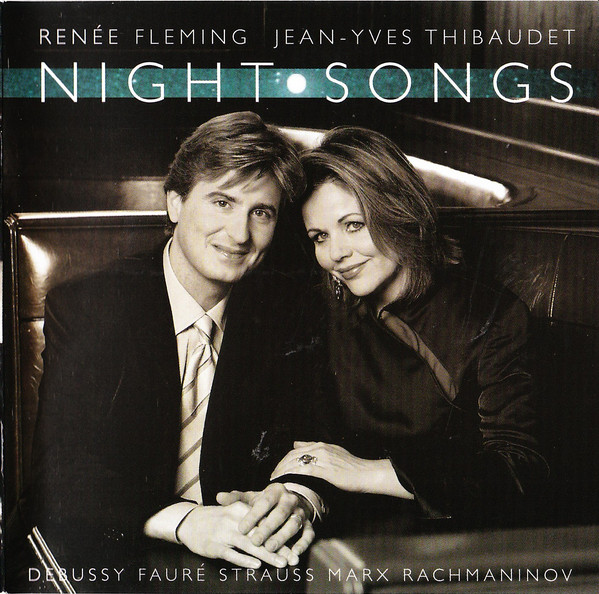
Renée Fleming – Night Songs

r-4527951-1426190336-3065.jpeg

Where does the time go? I can’t believe it is almost twenty years since I worked with Renée Fleming when the London Symphony Orchestra put on a semi-staged production of Previn’s A Streetcar Named Desire at the Barbican Hall with Previn himself conducting. I only had a very minor role, but I found Fleming to be a very gracious lady, an arch professional and a conscientious artist. The rehearsals and performances are amongst my fondest memories and I will never forget the experience of hearing that voice close to, with her literally singing into my ear on occasion. The final Korngold-like aria Blanche sings before being taken away to the asylum was possibly one of the most beautiful things I have ever heard.

I mention this to put into context my reactions to listening to this recital, which I wanted to like much more than I did. The recording was made in 2001 when the voice had acquired a new richness in the middle and lower ranges whilst retaining its beauty and ease up on high, even throughout its compass and admirably firm, with no trace of hardness when singing at full tilt. As it seems now we have said goodbye to Fleming, the classical arists it is good to be reminded that this was one of the most ravishing instruments of the last thirty years or so. She has always had a fairly eclectic repertoire which embraced both opera and song, covering a wide range of different composers and styles, but I’ve always thought her best suited to the music of Mozart and Strauss.

Hence it is the songs by Strauss and Joseph Marx which make the stongest impression, especially Cäcilie, its radiant close easily and ravishingly voiced. The Marx songs suit her well too, their sensuous expressivity responding well to the heady beauty of Fleming’s voice. Thibaudet is also superb in the tricky accompaniments, tossing off their difficulties as if they are the easiest things in the world.

Elsewhere I am not so sure this operatic vocal effulgence is what I want to hear. I found myself longing for the greater simplicity and cleaner vocal production of a Victoria De Los Angeles in the Fauré, the slight touch of irony and cool detachment brought to Debussy’s Chansons de Bilitis by a Régine Crespin. The Rachmaninov, with their heavier accompaniments, perhaps respond better to this operatic treatment, but I find it just too sophisticated and even here I prefer a slightly simpler, more direct approach.

However enjoyable it is to hear one of the most beautiful voices of recent times whatever the circumstances, ultimately there are other discs I would pull out first when wanting to sample Fleming at her best.