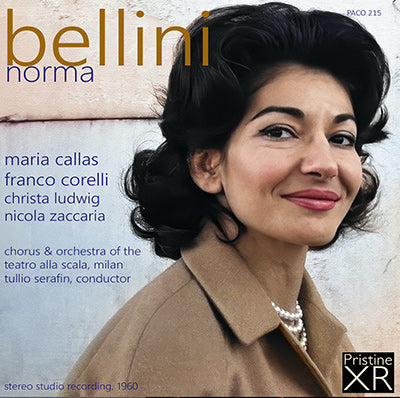
A reappraisal of Callas’s second studio Norma

paco215_530x

The Pristine XR remaster gives us the chance to reappraise a set which is slightly controversial in that it captures Callas in late career with occasional flaps on top notes. Nonetheless it was Ralph Moore’s overall top choice in his opera survey and he had no problem recommending it when he reviewed this Pristine issue in July of this year (review).

For my part, I’ve known the set for over sixty years now. It was actually the first opera set I ever owned, and, for quite a few months, the only opera set I owned, so I got to know it pretty well. Since then of course, I have heard a fair amount of other Normas, Sutherland, Caballé, Scotto, Sills, Eaglen, Bartoli (please, never again), Sass live at Covent Garden (disastrous) and plenty more by Callas herself; the live 1952 Covent Garden, the 1954 studio, the 1955 Rome broadcast and, best of all, the live 1955 La Scala, as well as excerpts from many others, right up to her final performances in the role in Paris in 1964.

So how does it hold up? Well, pretty well actually. Sonically, it was always pretty good, and, if I’m honest, I can’t hear that much difference between the most recent Warner version and the Pristine version. Perhaps there is a bit more space around the voices in the Pristine version, but it is the difference is slight.

As for Callas’s voice, it is true, notes above the stave have taken on a metallic edge, and they don’t always fall easily on the ear, but the middle and lower timbres have a newfound beauty, and a characterisation that was always complex and multi-faceted has taken on an even greater depth, parts of it voiced more movingly here than anywhere else.

There are other gains too. The cast here is a vast improvement on the earlier studio one, Corelli in particular being a shining presence. Fillipeschi was a liability on the earlier set, but, whilst not quite a paragon, and chary of some of the coloratura in his role (Serafin making a further cut in the great In mia man duet to accommodate his lack of flexibility), Corelli’s is a notable presence, and his clarion voice is ample compensation. Zaccaria may be less authoritative than the woolly voiced Rossi-Lemeni, but his tones are distinctly more buttery. Ludwig is an unexpected piece of casting, but she too is an improvement on Stignani, who, great singer though she was, was beginning to sound a bit over the hill by the time of the first Callas recording (she was 50 to Callas’s 30). Ludwig sounds, as she should, like the younger woman. Her coloratura isn’t always as accurate as one would like, certainly no match for Callas, but she sings most sympathetically in duet with her older colleague, and Mira o Norma is, for me, one of the greatest performances on disc. After Ludwig states the main theme, Callas comes in quietly almost imperceptibly and at a slightly slower tempo with an unbearably moving Ah perche, perche, her voice taking on a disembodied pathetic beauty. When Ludwig joins her for the section in thirds, she perfectly matches Callas’s tone on her first note, before Callas joins her in harmony, a real example of artists listening to each other in a sense of true collaboration.

One should I suppose mention the losses from the earlier recording. Yes, some of Callas’s top notes are shrill, and we lose some of the barnstorming heroics that were a part of Callas’s Norma right up to 1955. This Norma is more feminine, more vulnerable, if you like. How much this had to do with interpretive development, and how much with declining vocal resources is a moot point, but there is no doubt Callas is still a great singer, doing the best she can with what she has. Some sections are more moving here than in any of her other performances. I’ve already singled out Mira o Norma but the earlier duet is its equal, with Callas wistfully recalling her own awakening to first love.

The beginning of Act II always brought out the best in her, and here she is sublime. Dormono entrambi is an unusual piece which alternates passages of recitative with arioso, rather like Rigoletto’s Pari siamo. Callas draws on all the colours in her palette to express Norma’s contrasting emotions. You can almost feel the chill that comes over her at un gel me prende e in fronte si solleva il crin followed by the choked emotion of I figli uccidi! The arioso of Teneri figli is couched in a tone of infinite, poignant sadness, but then her tone hardens with her resolve at Di Pollion son figli, before, with a cry she drops the knife (and we can almost hear the precise moment), crying out Ah no, son miei figli! Operatic singing and acting on the highest level.

Serafin’s conducting is much as it was in the first set. He has the virtue of not conducting the opera as if it were Verdi, as so many do. Sometimes I’d like him to get a move on a bit, but his pacing of the final two duets (one in public, one in private) is superb, and he perfectly judges the climaxes in the Grand Finale, one of the greatest in all opera.

I wouldn’t want to be without Callas’s 1955 live La Scala account (also available from Pristine) with Del Monaco and Simionato, which is where voice and art find their greatest equilibrium, but for a studio set, this is now clearly the one to go for. One thing is for sure, Callas remains the quintessential Norma. No singer has yet challenged her hegemony in the role.
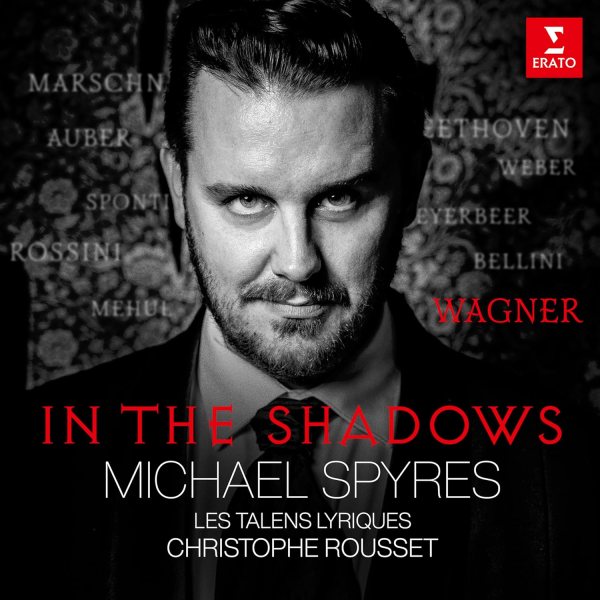
 

Michael Spyres – In The Shadows

81cea-b2zrl._ac_sl1500_

This is a luxury recital indeed. Over 84 minutes, we are presented with twelve operatic scenes, performed complete with chorus when required and another soloist (in the shape of tenor Julien Henric) who plays Flavio in the scene for Pollione from Norma. Furthermore, we are vouchsafed sung texts and translations into English, French and German, which is important as many of the scenes are not exactly familiar. Clearly all concerned have taken their task seriously.

In the accompanying notes, Spyres talks of his journey towards Wagner and states that the album “endeavours to illuminate the composers who languish in Wagner’s shadow: those who formed the foundation of the compositional aesthetic and sculpted the framework of vocal writing that would become the Wagnerian tenor.”

Thus, we start with Joseph Méhul (1763-1817) and work our way forward roughly chronologically via Beethoven, Rossini, Meyerbeer, Weber, Spontini, Bellini and Marschner to Wagner himself in the shape of arias from his early Die Feen and Rienzi, finishing up with Lohengrin. Of the arias chosen, only those from Fidelio, Norma and Lohengrin could be called in any way familiar, so the recital is certainly valuable for introducing us to some little heard music.

The disc has been reviewed in these pages by Göran Forsling (review) and was even a recording of the month back in April, and I largely agree with that review with one or two caveats.

I actually heard Spyres live at a Prom in 2017, in a performance of Berlioz’s La damnation de Faust with the Orchestrre Révolutionnaire et Romantique under Sir John Eliot Gardiner and, whilst impressed with his interpretation and musicality, I didn’t think the voice was particularly large. Now of course this was seven years ago, and there is a good chance that the voice has grown since then, but I’m not so taken with his singing in those roles that require a bit more dramatic thrust, like Florestan and Pollione. I hear a somewhat artificial darkening of the timbre, which results in a rather throaty sound. He sounds as if he is forcing his lyrical voice, and his tone lacks squillo. Comparisons with Vickers in the former and Corelli in the latter find Vickers singing with a deal more intensity and Corelli, whom I had just recently been listening to in the second Callas recording, much freer on top.

When we get to Wagner himself, Mein Lieber Schwann from Lohengrin is sensitively sung, but there is no ring to his tone when he opens out in the more dramatic parts. GF makes comparison with Gedda, who sang Lohengrin a couple of times in his native Sweden. Ultimately Gedda thought it an unsuccessful experiment, and he never sang the role again, evidently thinking the role too heavy for his essentially lyrical voice. However, as can be heard in his recording of the aria, Gedda’s tone had a good deal more squillo. That said, I heard Gedda live in the Verdi Requiem towards the end of his career and his voice had a great deal more cutting power than Spyres.

With his three albums, Batitenor, Contra-Tenor and now In The Shadows, Spyres is showcasing his versatility, but I just wonder how much of that versatility is a product of the gramophone. Given the encomiums he has been receiving of late, I hate to be the one dissenting opinion, but I do wonder if his voice is being forced into places it shouldn’t necessarily go.

Contents
Etienne-Nicolas Méhul (1763 -1817)
1. Joseph en Égypte, « Vainement Pharaon… Champs paternels
Ludwig van Beethoven (1770 – 1827)
2. Fidelio, « Gott! Welch Dunkel hier!… In des Lebens
Gioacchino Rossini (1792 – 1868)
3. Elisabetta, regina d’Inghilterra, « Della cieca fortuna… Sposa amata… Saziati, o sorte ingrata ?
Giacomo Meyerbeer (1791 – 1864)
4. Il crociato in Egitto – « Suona funerea
Carl Maria von Weber (1786 – 1824)
5. Der Freischütz – « Nein, Länger Trag Ich Nicht
Daniel François Esprit Auber (1782 -1871)
6. La muette de Portici- « Spectacle affreux …
Gaspare Spontini (1774 – 1851)
7. Agnes von Hohenstaufen, « Der Strom wälzt ruhig seine dunklen Wogen
Vincenzo Bellini (1801 – 1835)
8. Norma – « Meco all’altar di Venere…Me protegge, me difende (with Julien Henric (tenor))
Heinrich Marschner 1795 – 1861)
9. Hans Heiling op. 80 – “Gonne mir ein wort der Liebe” 
Richard Wagner (1813 – 1883)
10. Die Feen WWV 32 – « Wo find ich dich, wo wird mir Trost?
Richard Wagner
11. Rienzi, der letzte der Tribunen WWV 49, « Allmächt’ger Vater, blick herab
Richard Wagner
12. Lohengrin WWV 75, « Mein lieber Schwan


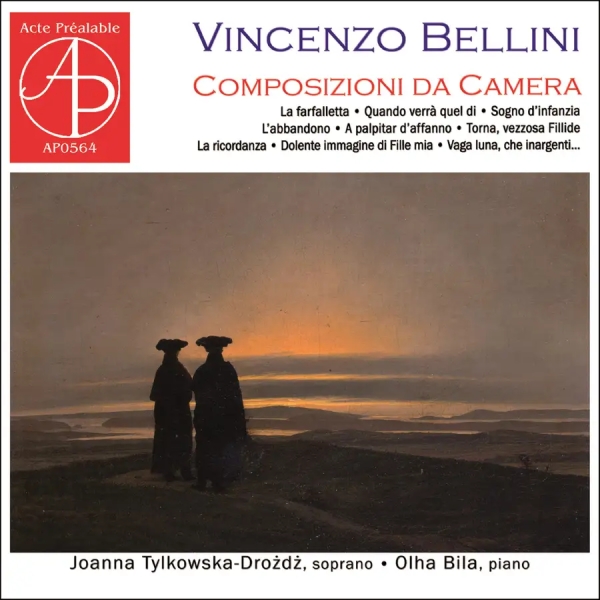
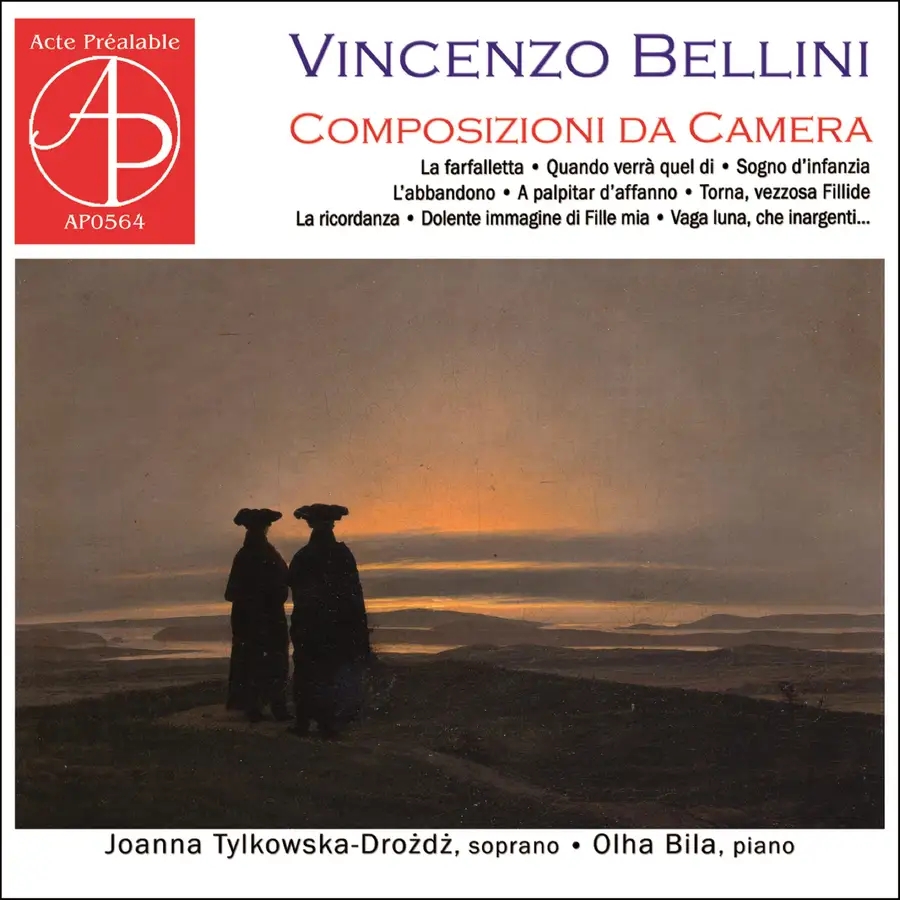
Bellini – Composizione da Camera

An enterprising collection of Bellini songs is unfortunately let down by less than ideal performances.

BelliniSongs

Bellini’s songs are not performed that often and indeed this is only the second recording of his Composizioni da Camera I’ve come across. Veronica Kincses recorded the complete set for Hungaroton back in 1982, though a few of the songs have appeared on various recital discs over the years.

They were probably written some time in the 1820s and it is unlikely that Bellini intended them all to be performed together; in fact, they were not published as a set until 1935, by the Milan publisher Ricordi. The Kincses disc includes all the songs in the Ricordi edition, in the order in which they appear in the score, whereas the present issue substitutes one or two other songs from a different source, such as La ricordanza, which turns out to be the tune of Qui la voce from I Puritani. Texts and translations are provided, some being by Metastasio, but the majority are anonymous.

Most of the songs are quite short, though the longest Torna, vezzosa Fillide,runs to almost eight minutes and is in the style of a mini operatic scena. It is the most complex of the songs and closer in style to the music of Bellini’s operas. However , for the most part, the songs are tuneful and undemanding, and it is not surprising that a few of them have made it into recital programmes of more famous singers, like Pavarotti, Bartoli, Tebaldi and even David Daniels, all of whom have made recordings of the most famous song, Vaga luna, che inargenti, the tune of which kept reminding me of the English folk song, The foggy, foggy dew. 

Any of the above singers would be preferable to the Polish soprano, Joanna Tylkowska-Drożdż, who has a rather hard, bright voice and tends to sing at an unrelenting mezzo-forte throughout, any refinement or tonal nuance only being offered by the pianist Ohla Bila. Nor is she particularly imaginative in her phrasing or her response to the poetry. Listening to the disc in one sitting proved something of a trial. The somewhat reverberant acoustic also tends to exaggerate the hardness of Tylkowska-Drożdż’s timbre.

As it happens, Veronica Kinkses’ Hungaroton recording of the fifteen songs in the 1935 Ricordi edition is still available to stream or as a download and is infinitely preferable if you are looking for a single disc of Bellini’s songs. However, I have a feeling most of us would be content to find the odd song on a mixed recital by a favourite artist. It should be noted that five of the songs appear on a 1997 disc by Cecilia Bartoli, called An Italian Songbook, on which she sings songs by Donizetti, Bellini and Rossini.

Contents

Vincenzo Bellini (1801-1835)

  • La farfaletta (anonymous)
  • 2. Quando verrà quell di (anonymous)
  • Sogno d’infanzia (anonymous)
  • L’abbandono (anonymous)
  • A palpitar d’affanno (anonymous)
  • Torna, vezzosa Fillide (anonymous)
  • La ricordanza (Carlo Pepoli, Conte)
  • Dolente imagine di Fille mia (anonymous)
  • Vaga luna, che inargenti (anonymous)
  • Malinconia, Ninfa gentile (Ippolito Pindemonte)
  • Vanne, o rosa fortunate (Pietro Antonio Domenico Bonaventura Trapassi as Metastasio)
  • Bella nice, che d’amore (anonymous)
  • Alme se non poss’io (Pietro Antonio Domenico Bonaventura Trapassi as Metastasio)
  • Per pietà, bell’ idol mio (Pietro Antonio Domenico Bonaventura Trapassi as Metastasio)
  • Ma rendi pur content (Pietro Antonio Domenico Bonaventura Trapassi as Metastasio)

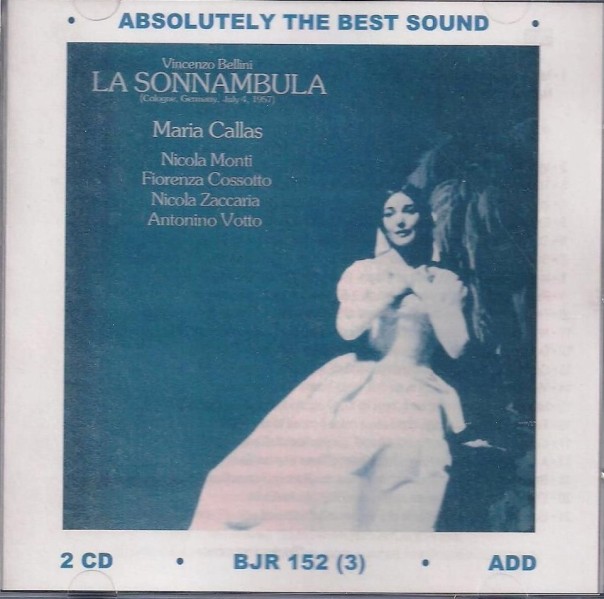
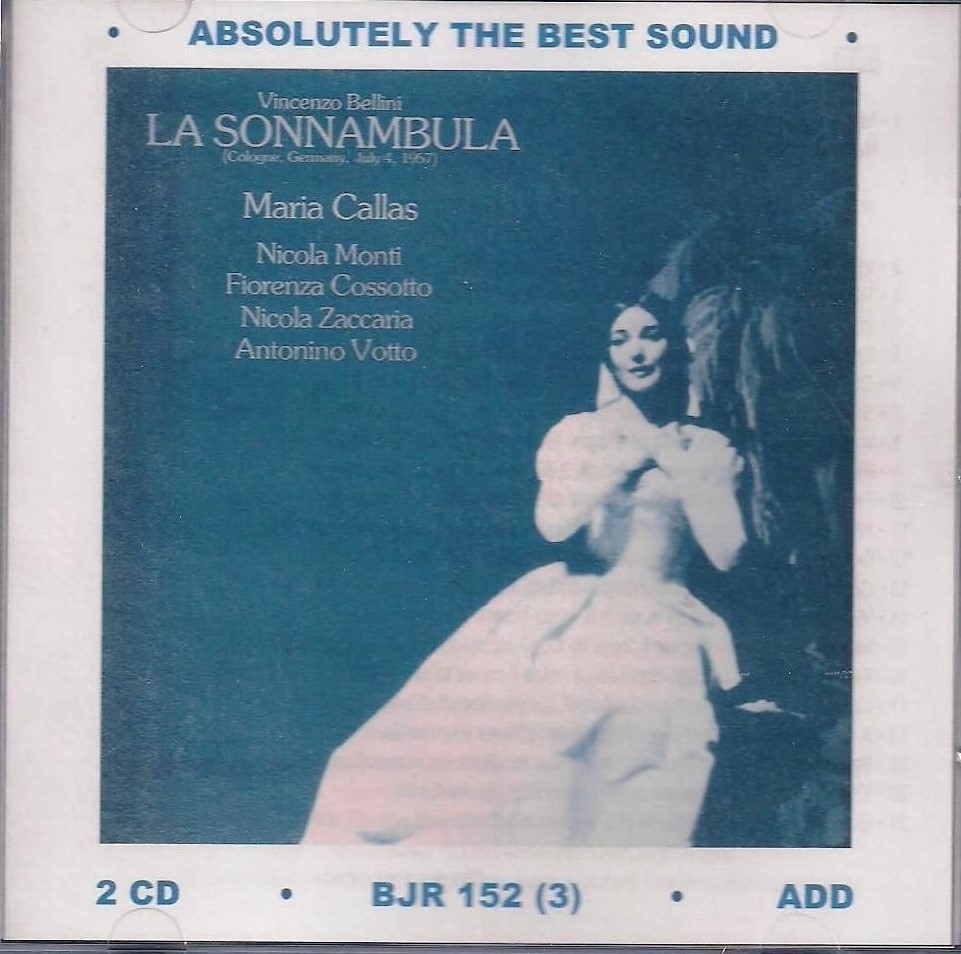
Callas sings Amina in Köln, July 1957

CallasSonnambulaCologne

In March of 1957 La Scala revived the Visconti production of La Sonnambula preparatory to taking it on a short tour to Köln in July and the Edinburgh Festival in August. They had also made a studio recording of the opera in March with the same cast and conductor (Antonino Votto) as the La Scala stage performances. In Köln the acid-voiced Eugenia Ratti has been replaced by Marietta Angioletti and Alessio is now sung by Dino Mantovani, but otherwise the casts of the studio and Köln performances are identical, with Nicola Monti replacing Cesare Valletti as Elvino and Nicola Zaccaria replacing Giuseppe Modesti as Rodolfo from the original 1955 La Scala cast. Fiorenza Cossotto also took over the role of Teresa from Gabriela Carturan. Elsewhere on my site I have reviewed both the 1957 studio set and the 1955 Bernstein performance.

This Ars Vocalis issue is taken from BJR LPs and is probably a composite of the two performances she sang in Germany, as well as the dress rehearsal. That fact does not bother me unduly. After all, when major companies record live performances, they usually record more than one performance in order to come up with an acceptable release. The sound on this Ars Vocalis issue is actually rather good, almost as good as the studio recording and a good deal better than the 1955 Bernstein version.

The audience were clearly excited to have the great diva appearing in their city and her first notes are interrupted by a prolonged burst of applause, meaning she has to repeat them when the tumult has died down. We can’t see how she reacted but, vocally, she doesn’t step out of character for one second. Her voice in this performance has a pearly opalescence, which is perfectly apt for sweet, trusting Amina and her opening cavatina is beautifully shaped. In the cabaletta (Sovra il sen) she continues to keep the voice light and airy and adds a stunning top Eb at its close.

Much as I enjoy the 1955 Bernstein performance, this one possibly takes us closer to the Amina of Bellini’s and Romani’s dreams. Rarely has Callas’s voice sounded so lovely. Indeed the review of the performance in the Kölnische Rundschau talks of

the luminous beauty of the voice: melting sweetness in floating pianos, metallic brilliance in fortes, and in its coloratura, a perfect plasticity that one would only approximate very imprecisely with the usual comparisons from the instrumental realm.

The review also praises her acting, concluding that

the entire nineteenth-century operatic tradition is preserved herein a form that has become foreign to us, but that is, however, truly delightful.

Though some of Bernstein’s embellishments have now been trimmed away, she was obviously in superb voice and here repeats the stupendous cadenza inbetween the two verses of Ah non giunge, where she sweeps up to a fortissimo top Eb, on which she effects a stunning diminuendo before cascading down a perfect string-of pearls scale, a feat I’ve never heard equalled by any other soprano.

Nicola Monti is no Cesare Valletti, but he sounds a lot more confident in this live performance than he does on the studio recording and Zaccaria is a melifluous Rodolfo. Where Votto was a somewhat diffident conductor in the studio, here is he inspired by the live occasion and, given a choice between this and the studio performance, this is the one I would go for, especially in this excellent transfer.