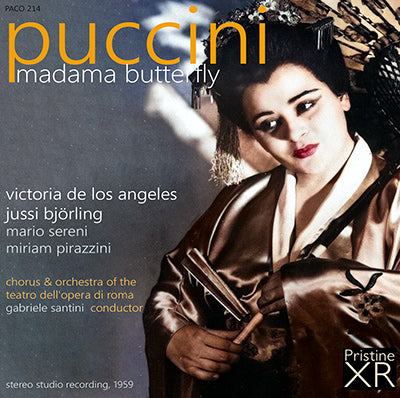
This Pristine XR Remastering of De Los Angeles’ second 1959 recording of Madama Butterfly has already been favourably reviewed twice before on MusicWeb International, once by Ralph Moore (review) and once by Morgan Burroughs (review), and I can add little to what they have said. We have De Los Angeles in one of her best and most conducive roles and Björling singing with golden tone. In Pristine’s newly re-mastered transfer of the stereo original, surely this is self-recommending, and who am I to disagree? However, I should mention that there is an earlier 1955 De Los Angeles recording, in mono sound, with Di Stefano as Pinkerton, Gobbi as Sharpless and conducted by Gianandrea Gavazzeni, which, in some ways, surpasses the performance we have here. It is available at super bargain price from the Regis label and was favourably reviewed by Christopher Howell here.
That earlier recording’s chief asset is the conductor, Gavazzeni, who makes far more of the score than the rather dull and prosaic Santini, and it makes me realise how important the role of the conductor is in Puccini. Indeed, all the best sets have benefited from a great conductor; Karajan, for both Callas and Freni, Serafin for Tebaldi, Barbirolli for Scotto and Pappano for Gheorghiu. And, if Santini has at his disposal an excellent cast, Gavazzeni’s is just as good, and in some respects even better. Björling, for Santini, sings with golden tone, but is just a trifle stiff. This was to be Björling’s last recording, and the heart condition, which would end his life at the early age of 49, was already apparent. Indeed, he collapsed during one recording session of the Act I love duet and needed several days to recover before he was able to continue. This could account for his relative stiffness. Di Stefano, on the other hand creates a real character. Carelessly charming in his exchanges with Sharpless and genuinely seductive in the love duet, he is suitably devastated by what he has done in the last act. I don’t see Pinkerton as a villain or an out and out cad. He is just an impulsive young man, who gives little thought to his actions at the beginning of the opera. Young men like him are ten a penny on any American college campus and Di Stefano portrays him to the life.
Sereni is a sympathetic Sharpless for Santini, but Gobbi, for Gavazzeni, surpasses him in verbal acuity and De Los Angeles is in slightly fresher voice in the earlier recording, though the difference is marginal.
What is not in doubt is the improved sound picture in the later stereo recording, especially in Pristine’s remastering, which opens up the sound quite a bit. I should also mention that Pristine as usual provide downloads of the full score and libretto, whereas the Regis issue of the earlier recording just comes with notes and a synopsis. Whichever version you go for, you will get one of the most touching Butterflies on disc.
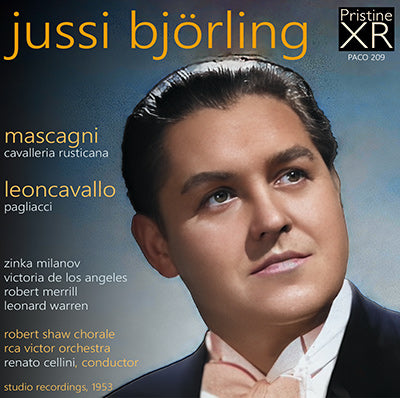
A photo of Jussi Björling graces the cover of this Pristine issue, and he is without doubt the main reason to hear these recordings. It is always a pleasure to hear his beautiful voice, musical phrasing and ringing top notes, though I’m not sure he would ever have been perfectly cast in either role. But before coming to Björling himself, it might be instructive to consider other elements of the recordings.
Both operas were recorded in 1953 in New York with the RCA Victor Orchestra and the Robert Shaw Chorale under Renato Cellini and sound remarkably good in these Pristine transfers, so good, I almost thought they were in stereo. I hadn’t heard either performance before, so I have nothing to compare the Pristine transfers to, but they are admirably clear and spacious and a good deal better than the contemporaneous Serafin recordings with Di Stefano and Callas. The Serafin Pagliacci is in reasonable mono sound, but unfortunately the Cavalleria Rusticana suffers from overload and distortion, which no amount of re-mastering would seem to be able to overcome. Still, I wish that these Cellini performances were half as exciting.
Cellini’s conducting is at least idiomatic, his tempi well chosen, but neither opera really catches fire and they both remain somewhat studio bound. The professional Robert Shaw Chorale sing in both operas. They are faultless in execution, but I couldn’t help picturing them all in prim white shirts and blouses, standing, score in hand, in choir banks. They don’t for one second conjure up the sound of lusty Sicilian peasants or excited Italian village folk. The La Scala Chorus on the Serafin set, may not be so polished, but they have this music in their blood and are much more convincing.
I suppose I should preface my discussion of the solo singers with a confession that I have never much liked Zinka Milanov, or at least not on any of the recordings I have heard, which were all made quite late in her career. From the outset she sounds far too mature, almost indistinguishable from Mamma Lucia in her initial exchanges and completely uninvolved in poor Santuzza’s plight. Björling, who could sometimes be accused of being a little cool, is at his most impassioned in their duet, but she remains phlegmatic and stolid. She is no better in the duet with Robert Merrill’s Alfio, who, in any case, is a bit too jovial and avuncular. Björling’s Turiddu is beautifully sung and, as I mentioned, he does try to inject some passion into his exchanges with Santuzza, but there is something about the inherent nobility in his tone that makes him not quite right for the caddish Turiddu. As always, his singing gives great pleasure, but I can’t quite believe in him.
That said, I find his Turiddu more convincing than his Canio. Yet again, the role is beautifully sung, Vesti la giubba heart-breaking and deeply felt, but can anyone really believe that this is a man who would be driven to double murder? I certainly can’t. I have much the same problem with the Nedda of Victoria De Los Angeles. She is in her best voice, warm and feminine and, like Björling, has the virtue of always being supremely musical. She sings quite beautifully, especially in her Ballatella, but, as with her Carmen, she sounds altogether too ladylike. I don’t necessarily want Nedda to be portrayed as a heartless minx, as was often the case in days gone by, but I need to believe that she has the mettle to defy a bully of a husband and have an affair behind his back.
Nor is there any menace in the Tonio of Leonard Warren, who, in the prologue, could be singing about anything at all really. Gobbi, on the Serafin set, does not have such a beautiful voice, nor such easy top notes, but he makes every word tell. Merrill has here been given the secondary role of Silvio, but his Silvio doesn’t sound much different from his Alfio. Compare Panerai, who sings both roles on the Serafin recordings, utterly menacing as Alfio and ardently seductive as Silvio.
Jussi Björling was, without doubt, one of the greatest tenors of the last century and I always take pleasure in the sheer beauty of his voice, his musical phrasing and his wonderfully free and ringing top notes, so it was a pleasure to hear him here, even if these two roles are not ones to which I think he was really suited. For the rest I derived the most pleasure from De Los Angeles’s beautiful and musical singing as Nedda, even if she too is caught in a role that was not particularly suited to her gifts.
Not a top choice for either of these two operas then. For all that they are in better sound than Serafin’s recordings of the two operas, I would still place the Serafin performances ahead of them. Di Stefano can be a bit wayward, but he is better at expressing the caddish side to Turiddu and the unhinged side of Canio that turns him into a killer. Callas is, as usual, hors concours, both as a wonderfully impassioned Santuzza and a free-spirited and mettlesome Nedda, and she is in fine voice on both recordings. Gobbi is equally brilliant as Tonio and their confrontation bristles with drama. There are also better choices amongst more recent recordings, such as Karajan’s sumptuously recorded La Scala set for DG, which no doubt remains a first choice for many.
As always, Pristine should be commended for including with the CDs a package of downloadable items, which includes a copy of the same recording as an MP3 download, together with full scores, both piano and orchestral, and a full libretto in PDF format. Most major companies these days don’t even include an online link to a libretto.
Pietro Mascagni (1863-1945) Cavalleria Rusticana (1890) Turiddu: Jussi Björling (tenor) Santuzza: Zinka Milanov (soprano) Alfio: Robert Merrill Mamma Lucia: Margaret Roggero (mezzo) Lola: Carol Smith (mezzo)
Ruggero Leoncavallo (1857-1919) Pagliacci (1892) Canio: Jussi Björling (tenor) Nedda: Victoria De Los Angeles (soprano) Tonio: Leonard Warren (baritone) Silvio: Robert Merrill (baritone) Beppe: Paul Franke (tenor
Robert Shaw Chorale RCA Victor Orchestra/Renato Cellini Rec. 1953, Manhattan Centre, New York Full scores and libretto included as downloads Pristine Audio PACO209 (2 CDs 141)


 Philip's Assortment Box