Callas’s 1954 Studio Norma

91q5ogwsokl-_sl1458_

Recorded 23 April & 3 May 1954, Cinema Metropol, Milan

Producer: Walter Legge, Balance Engineer: Robert Beckett

Callas’s greatest role was Norma, the one that she sang more than any other, and one of three operas she recorded twice.

Though I did have this version on LP (when it was reissued in the 1970s), I never had it on CD. The 1960 version was one of the first LP opera sets I ever owned, and, not surprisingly, became one of the first I owned on CD. Later I acquired an Arkadia issue  of the live 1955 La Scala, which I eventually replaced with the Divina Edition one of the same performance. As this was the Norma I most often pulled down off the shelf, I decided I didn’t really need another, so never got round to getting this 1954 recording on CD.

First impression on this set was the sheer presence of the voice. When Callas commandingly sings Sediziose voce she could almost be in the room with you and in fact the sound all round, orchestra and voices, is a lot better than some of the later operas; much less boxy with a real sense of presence. The second (in stereo) is better still of course, but the difference is relatively slight.

So how else does this compare to the second set, which I have already lavished such praise on? Well let’s start with the rest of the cast. Fillipeschi is, let’s face it, second-rate, and nowhere near as good as Corelli, his basic tone is thin and whiney and anything that requires any rapid movement finds him lacking, not that Corelli is much better in this respect, mind you, but there is the clarion compensation of his actual voice. Also I’m afraid I find it hard to join in the general round of praise for Stignani. Though the voice retains its firmness, she sounds too mature by this stage in her career, more like Callas’s mother than the innocent, young priestess she is supposed to be. Considering she was 20 years Callas’s senior at the time, it’s hardly surprising. Nor is her voice anywhere near as responsive as Callas’s, or as accurate, but then whose is? Not Ludwig’s, certainly, but I much prefer her more youthful timbre and her voice blends remarkably well with that of Callas; an unlikely piece of casting that paid off. Rossi-Lemeni’s tone tends to be woolly, but he is an authoritative Oroveso, more so than Zaccaria, whose tones are, however, more buttery.

As for Callas, there is no doubt that she is much more able to encompass the role’s vocal demands in this recording than the later one. I do miss certain more tender moments in the 1960 recording. Her entrance into Mira o Norma (Ah perche, perche), beautifully and touchingly understated is more moving than it is here, and in fact the whole duet works better with Ludwig, but when clarion strength and security are required then this set wins hands down. One might say we get more of the warrior in this one and more of the woman in the second. Given the security and power she evinces here, it seems strange that she does not take the high D at the end of Act I, as she did at previously preserved live performances, and as she would do again the following year in both Rome (also under Serafin) and Milan. It might seem a relief that she doesn’t attempt the note in 1960, but here I missed it.

Both recordings are essential of course. No other Norma in recorded history has come within a mile of her mastery of this role, the most difficult in the repertory according to Lilli Lehmann, and the one she sang more than any other. I am willing to believe that Pasta and Malibran were every bit as great, but I cannot believe they would have been better. I am indebted to John Steane yet again for putting things in a nutshell when he suggested that for Norma with Callas, one should go for the second recording, but for Callas as Norma, the first. Personally I’d want both, as the second, for all its vocal fallibility, searches deeper. I would also add the live 1955 from La Scala, the one in which voice and art find their purest equilibrium, and the one I would no doubt  be clinging to if ever shipwrecked on that proverbial desert island.
Callas as Nedda in Pagliacci

51hyylyexul

Recorded 12-17 June 1954, Teatro alla Scala, Milan

Producer: Walter Legge, Balance Engineer: Robert Beckett

Nedda was the first of four roles Callas recorded in the studio, but never sang on stage, the others being Mimi, Manon and Carmen. Pagliacci is really the tenor’s opera, and one can imagine the role would have held little interest for her on stage, though, as is her wont, she makes a great impression in a role one wouldn’t readily associate with her.

Back in the 50s, Nedda was usually played by a light-voiced soubrette, who, if she provided any characterisation at all, would play her as a two-dimensional heartless little minx, so how like Callas that she should look inside the music and find more facets to Nedda’s personality.

Her very first words Confusa io son strike a note of fear, justified  when she sings of Canio’s temper (brutale com egli’e) and note the accent she gives to the word brutale. She shrugs off her fear, but in her singing of the ensuing aria, with its paean to freedom, it is not difficult to understand that here is a young woman bursting with life but trapped in a loveless marriage with a man prone to violence.

The scene with Tonio, like all Callas’s collaborations with Gobbi, bristles with drama and life. Here it would seem is another man trying to subjugate her to his will, but her relationship with Tonio is different. Here she has the upper hand. At first mockingly dismissive, she taunts him until he responds with violence; but here too she retains the upper hand, lashing out both vocally (Miserabile!) and physically with the whip. Left alone she expresses her distaste with a voice dripping with loathing, only to change in an instant when she lovingly sings the single word Silvio as her lover makes his appearance.

The duet with Silvio is erotically charged, suffused with warmth and passion, then in the ensuing confrontation with Canio, defiant in the face of fear, her voice hardens again.  Is there a suggestion here that this is ground they have been over before?

Also masterful is the way she uses a different, whiter sound for Colombina, and only in the final stages of the opera in her ultimate refusal to submit to Canio does she return to full voice, riding the orchestra with a defiance that goads Canio into his final act of murder. There are parallels here with Callas’s Carmen.

Di Stefano does well as Canio, though I can’t help feeling that such a Nedda really needed a more psychologically complex foil, along the lines of someone like Vickers, or Domingo in his later portrayals, not that either of them were around at the time of the recording of course. Nonetheless, though some might think him a shade light-voiced for the role, Di Stefano is a very effective Canio, singing brilliantly off the words, his diction, as usual, exemplary.

Gobbi, on the other hand is superb as Tonio, as is Panerai as an ardent Silvio, and Monti, much more than a comprimario, makes an excellent Beppe. Serafin is a relatively unassuming presence. He doesn’t do anything wrong, but nowhere is his conducting as revelatory as it often was in Verdi.

Pagliacci probably wouldn’t rank high on any list of essential Callas recordings (certainly not on mine) and I’d have to be honest and admit it’s not one of my favourite operas. Neither the character nor the music really call on Callas’s greater musical gifts, yet, without stage experience,  she creates a rounded character, and, with a superior cast, this recording has held its own for over 50 years now.

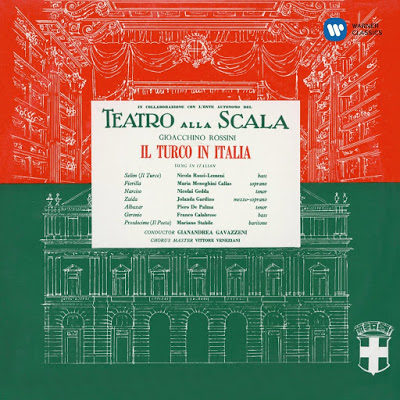
Callas in Il Turco in Italia

81ts9wichpl-_sl1500_

Recorded 31 August – 8 September 1954, Teatro alla Scala, Milan

Producers: Walter Legge & Walter Jellinek, Balance Engineer: Francis Dillnutt

Given Legge’s musical conservatism, it always surprises me Il Turco in Italia was recorded at all; after all, it was not one of Rossini’s better known works. We should be grateful that it was, though, for this set is pure joy from beginning to end. It might not take any prizes for textual accuracy now, and cuts abound, but objections fade away in a performance of such sparkle and wit.

Callas had sung the role of Fiorilla in a production at the tiny Teatro Elisea in Rome in 1950 and would go on to sing it again in Milan in 1955 in a new production by Zeffirelli. Gavazzeni was in the pit on every occasion.

Callas’s only other excursion into comedy was the role of Rosina in Il Barbiere di Siviglia, and, though the studio recording made in London was an outstanding success, her appearance in the role at La Scala was, by all accounts, one of the few low points in her career. No such caveats attach themselves to her Fiorilla, which seems to have been a success from day one. According to the critic Bebeducci, who was there at the opening night of the Rome production, it was “extremely difficult to believe that she can be the perfect interpreter of both Turandot and Isolde,” which was the reputation she had at that time. However, these performances could be seen to be a turning point in her career.

After singing Kundry in concert the following month, she never again sang a Wagner role. The opera also introduced her to Luchino Visconti, who, with his friends of the Anfiparnasso intellectual circle, mounted the production, and who was to become a seminal influence on her in the years to come.

Unlike so many of the operas she sang, and like most of Rossini’s comedies, Il Turco in Italia is an ensemble piece, and Callas is very much part of that ensemble. She has only one aria, Non si da follia maggiore which she sings with masterful ease, and a wonderful sense of the ironic, almost a vocal equivalent of an arched eyebrow. Indeed throughout so vivid is her verbal painting that you feel you can see every fleeting facial expression.

One of the high points is her duet with her husband Geronio, sung with quite the right hangdog tones by Franco Calabrese. At first haughty, then contrite as she attempts to assuage his indignation (No mia vita), then angrily rounding on him, her voice lashing out on Ed osate minacciarmi like a verbal slap, she is the mistress of every comedic turn.

She is surrounded by an excellent cast;  the aforementioned Calabrese, the veteran Stabile, dry voiced but full of personality as the Poet, Rossi-Lemeni an ever vascillating Turk, Gedda a lyrical Narciso, and Gardino as Zaida, the gypsy girl with claws only a mite less sharp than Callas’s; but it has to be said that only Callas has the dexterity, the flexibility and the ease in coloratura to do full justice to Rossini’s florid writing.

Gavazzeni conducts a sparkling version of the score. To get the opera in something like its original text you will have to turn to the Chailly recording with Bartoli. A deeper authenticity, however, lies in this version with Callas. One senses the performers had as much fun making it as we do listening.

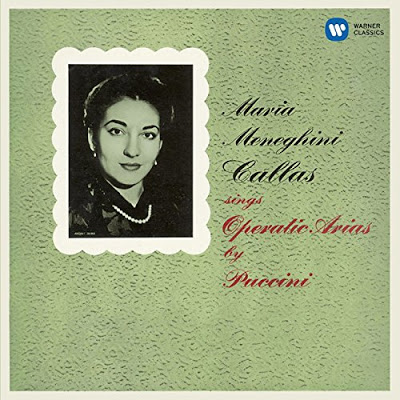
Callas sings Puccini Arias

61qclfmrmgl

Recorded 15-18, 20-21 September 1954, Watford Town Hall, London

Producer: Walter Legge, Balance Engineer: Robert Beckett

This is the first recital record I ever owned , and for some time the only recital record I owned. As such it has quite a lot of sentimental value for me. Most of the music was new to me at that time and I played it constantly. I got to know it so well that I can even now listen without libretto and mime the words. However, as I got older, my tastes changed. I got to love the music of Verdi, Bellini and Donizetti. I felt Callas’s gifts were wasted on Puccini, and so my first love got rather pushed aside. I tended not to listen to this recital quite so often.

To listen to it again now, in this fantastic new re-mastering from Warner (one almost feels as if Callas were in the room with you), was a moving experience and, from the first note, she had me riveted.

Most Puccini recitals tend to the samey, but Callas presents us with a different voice character in each opera. Of the roles represented here, she had at that time only sung Turandot on stage, though she would go on to sing Butterfly in Chicago in 1955. She also went on to record complete performances of Madama Butterfly, La Boheme, and Manon Lescaut, as well as Turandot (though a little too late in her career.

As usual Callas is the mistress of vocal characterisation. Manon, Butterfly, Mimi, Angelica, Lauretta, Liu and Turandot all emerge as completely different characters, but, even within a single aria, she can reveal some hidden depth within the character. Manon, tenderly regretful in In quelle trine moribide, gives way to passion and despair in Sola perduta abbandonata, a despair already hinted at in her voicing of un freddo che m’agghiaccia in the first aria. Butterfly’s wistful imagining of the return of Pinkerton is brilliantly charted, her death scene almost unbearably intense. Mimi is shy and withdrawn, but the warmth which Callas brings to the Ma quando vien lo sgelo section reveals Mimi’s capacity for selfless love.  Angelica’s resigned sadness gives way to a surprisingly sweet and cajoling Lauretta.

Quite the biggest contrast comes when she sings both Liu and Turandot. Liu’s arias are sung feelingly, but possibly with a bit too much muscle, and the ending of Signore ascolta doesn’t eclipse memories of Caballe or Schwarzkopf in the same piece, but Turandot’s In questa reggia is surely one of the best ever recorded. Callas at this time still had the power and security on top to ride its high-lying phrases; and please note she actually sings the words Gli enigmi sono tre on the phrase that takes her up to a top C. Most sopranos, Eva Turner included, reduce them to a vocalise. Furthermore the aria is filled with little details overlooked by most; the almost mystical way she launches the section beginning Principessa Lou-u- Ling, singing with mounting ardour until she vocally points her finger at Calaf with the phrase Un uomo como te. Almost regretful on the section O principe che a lunghe carovane, she strengthens her resolve again at io vendico su voi till her voice cries out with conviction at quell grido e quella morte. Would that she had recorded her complete Turandot at the same time. This is the greatest prize on the recital.

The one uncomfortable moment I remember from the recital (Angelica’s final floated high A) for some reason sounds far less wobbly here than it ever did before, and the voice in this re-mastering has enormous presence. Serafin, as ever, provides invaluable support.

A classic of the gramophone.

Callas at La Scala

51fx5yefo1l

Recorded 9-12 July 1955, Teatro alla Scala, Milan

Producer: Walter Jellinek, Balance Engineer: Robert Beckett

Though recorded in 1955, release of this disc was delayed until 1958. Callas did not approve the arias from La Sonnambula for release and, when the recital was finally issued, it was made up with arias from the complete sets of I Puritani and La Sonnambula. EMI did eventually issue the Sonnambula arias, but not until 1978, on an LP called The Legend which included other unreleased material.

It’s true, there is a slightly studied air about the performances of them (and a chorus would no doubt have done much to enliven the proceedings), but her singing is unfailingly lovely. One misses that stunning cadenza between the two verses of Ah non giunge, with its stupendous ascent to a high Eb, which we get in both the studio and Cologne performances, and both cabalettas are over simplified, completely free of the flights of fancy Bernstein encouraged her to indulge in at La Scala. Serafin had apparently refused to let her do them. Maybe that is the reason she eventually rejected them. I’m glad I’ve heard them, but her Amina is better represented in the various live performances and the complete studio performance.

The Medea and La Vestale arias are more successful. Medea, of course, became one of her greatest stage successes. The opera was almost completely unknown when she first sang it in Florence in 1953 under Gui, but such was her success in the role that La Scala scotched plans for a revival of Scarlatti’s Mitridate Eupatore later that year and replaced it with the Cherubini opera.  Callas’s singing of Dei tuoi figli la madre abounds in contrasts, reminding us that this is an appeal to Giasone. Callas reminds us that it is love, not revenge, that brings Medea to Corinth; notable here the softening of her tone at the repeated pleas of Torna a me, the pain in the cries of Crudel.

The arias from La Vestale are reminders of her one traversal of the role of Giulia at La Scala in 1954, in a stunning production by Visconti, which marked the emergence of the new, slim Callas, and the start of a whole new era, which resulted in the acclaimed Visconti productions of La Traviata, La Sonnambula and Anna Bolena.  Tu che invoco is notable for its long legato line, and the intensity she brings to the turbulent closing section, where her voice rides the orchestra with power to spare. O nume tutelar brings back memories of Ponselle, but Callas in no ways suffers by the comparison, her legato as usual superb, and the aria sung with a classical poise and sure sense of the long line. O caro ogetto has the same virtues.

There exists a complete recording of that La Scala La Vestale, but it is in such wretched sound, that this recital is valuable for Giulia’s arias alone. Her Medea and Amina are better represented elsewhere.

The Callas Karajan Madama Butterfly

81sict7avdl-_sl1500_

Recorded 1-6 August 1955, Teatro alla Scala, Milan

Producer: Walter Legge, Balance Engineer: Robert Beckett

Well I’m a mess! To quote John Steane in his Gramophone review of the first CD issue of this set,

Still feeling the impact of that devastating final chord in the opera, I believe devoutly that Madama Butterfly is the most moving of all works for the stage, that this is the best recording of it, and that it is Callas’s greatest achievement on records. 

I may not go quite that far, but it does remind me how many times I think exactly that after listening to almost every one of Callas’s complete opera sets, so completely does she identify with each role that she sings.

Callas recorded the role of Butterfly a few months before her only stage appearances in the role in Chicago, in November 1955. It was also the occasion of one of the first major scandals of her career, when a process server tried to stuff a court summons into the belt of her kimono just after she exited the stage. Callas exploded, cameramen just happened to be there to record the exact moment she lost her temper, and the rest is history.

This recording also marked one of the three occasions on which Callas worked with Karajan, a powerful combination which also produced those famous La Scala Lucias, which were repeated in Berlin and Vienna, and the studio recording of Il Trovatore.

Now if you’re idea of a perfect Madama Butterfly  is one in which some gorgeous voices sing some beautiful tunes, bathed in lush orchestral sounds, which incidentally happen to accompany  the sad little story of a Japanese girl who ends up committing hari kari, then this recording is probably not for you. There have certainly been more beautifully sung Butterflies, but few that elevate it to the level of real tragedy on a par with those of Shakespeare and Euripides. Here we are treated to a cautionary tale, a moral tale if you like, of how even nice people can do terrible things unthinkingly, and how one thoughtless act can set in motion a whole chain of tragic events. It doesn’t always make for comfortable listening, but who said great art was meant to be comfortable?

Callas’s portrayal is full of miraculous detail, phrases, even single words given a significance you won’t hear in other performances. Take, for instance, the way she manages to suggest all Butterfly’s trust in Pinkerton at Ieri son salita, the final Amore mio sung with a conviction that makes it easy to understand her utter faith in his return. In the love duet she is all shyness until gradually her voice is flooded with warmth and passion, as she succumbs to Pinkerton’s ardour. Here, maybe, I should add a word about Gedda’s Pinkerton, which some have found too uncaddish. But surely that is to miss the point. That nice people can, and do, perpetrate unkind things is surely the crux of the plot. Gedda sounds like his music; a nice, charming young man, who gives no thought to the consequences of his actions. He is not some dreadful villain, just a normal young American jock. His sort are two a penny on most American college campuses. His remorse in the last act is real enough.

But back to Callas, who finds in Butterfly “not the frailty of childhood, but its strength”. According to John Steane in the Gramophone review quoted above,

The keynote is firmness of mind; a simple factuality which sees right and wrong with the clarity of that miraculously rinsed and lightened voice.

She sings Un bel di not as some big soprano show piece, but integrates it into the drama, a simple reiteration of Butterfly’s faith, the details of Pinkerton’s return sung in wistful fashion as something she has gone over and over again in her mind. Che tua madre, with its cries of Morta! Morta!, is almost unbearably intense, Sotto il gran ponte dal cielo unbearably moving. Only in the final scene, when left alone, does she let her full voice out, and the effect is overwhelming, Puccini’s final chords shatteringly played by the orchestra under Karajan, who conducts a tautly dramatic performance of the opera, less inclined to wallow than in his later recording.

Danieli is excellent as Suzuki, Borriello a sympathetic Sharpless, but this, of all Puccini operas, is all about the heroine; even Pinkerton is a supporting role, and Callas, with Karajan’s help, makes sure that all our attention is concentrated on Butterfly.

The sound is a trifle boxy but sounds a lot better here than it did in the 1997 Callas Edition. Still it mystifies me that it is not up to the quality of the Tosca that was recorded two years earlier.

No the real problem with this recording is that it brings us face to face with real life in all its raw pain and tragedy. Listening to it is a deeply unsettling experience, and one I can’t subject myself to too often.

Essential nevertheless, for Callas, for Karajan, and for all those who think Puccini’s opera is more than a sentimental pot boiler.

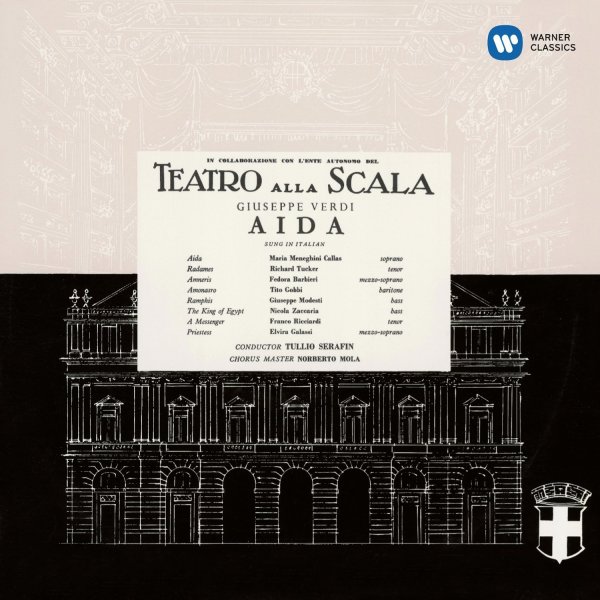
Callas’s Studio Aida

81eycwhmfol-_sl1500_

Recorded 10-12, 16-20, 23-24 August 1955, Teatro alla Scala, Milan

Producer: Walter Legge, Balance Engineer: Robert Beckett

I’m going to make a confession. Aida is not my favourite Verdi opera. I find it hard to identify with any of the characters, and they usually emerge as representatives rather than real people. It is full of great music, but I have to admit I admire it rather than love it. Nor would the role of Aida be considered a natural for Callas, though she sang it, with a great deal of success, quite often between her debut in the role in 1948 and her last stage appearances in it in 1953, this 1955 recording being the last time she would ever sing the complete role, though she returned to the aria Ritorna vincitor and the Nile duet with Radames (with Corelli) late in her career in the mid 1960s. Interestingly enough, though one doesn’t think of Aida as a Callas role, when the now defunct International Opera Collector magazine conducted a poll of its readers to assemble the ideal Aida cast, Callas was one of the favourites, alongside such famous Aidas as Ponselle and Leontyne Price.

The reason for this can only be that she brings the rather placid character of Aida to life like no other. Though she may not have the sweetness of timbre one might ideally want from an Aida, there are plenty of other rewards. She takes a little while to settle down in the first trio, but Ritorna vincitor is alive with meaning and contrast. Just listen to the way she spits out her hatred for del egizii coorti, the power with which she exhorts her compatriots to destroy the legions, with particular emphasis on the word struggete, the complete change of colour at Ah! Sventurata che dissi, the tenderness with which she sings of her love for Radames and the pain and desperation in her voice at Da piu crudeli angosce un core affranto; the last imprecation to the Gods sung with her tone drenched in sorrow, her legato as usual impeccable. Aida’s cruel predicament is set before us in this one aria with a psychological penetration second to none.

There are wondrous little details in the ensuing duet with Amneris too, like the touch of pride that enters her tone at Mia rivale! Ebben sia pure, quickly withdrawn when she realises she could easily give away her true identity.

But it is the Nile Scene that makes the greatest impression in this set. It starts with Aida’s O patria mia, which some commentators have found to be the weak link in her portrayal, but she yearns most wistfully, floating the tone wonderfully at O freschi valli. She always had problems with the ascent to top C, but it is a lot more solid here than she is often given credit for. It may not be dolce as marked by Verdi, but I don’t hear the wobble that so many commentators claim to have problems with. The following duet is magnificent music and magnificently sung by both Callas and Gobbi, and the finest realisation of it on disc. I doubt any singers have come close to them in the way they create drama in sound, and Serafin is at his very best in this scene too. I found it impossible to hold back the tears as Callas launched into that glorious tune at O patria, patria, quanto mi costi, and how brilliantly Serafin makes the violins weep with her.

The duet with Radames is hardly less fine, though Tucker can be a bit graceless at times. Yet again, Callas brings out a wealth of detail, like the insinuating way she sings Pur, se tu m’ami with that slight portamento on the word m’ami. She plays Radames brilliantly here, wonderfully seductive when she sings La tra foreste vergini. This is operatic singing on the highest level. In the last act too, she has something to offer, singing with grace and accuracy the difficult fioriture of Vedi? Di morte l’angelo.

As already mentioned Gobbi is superb as the implacable Amonasro, masculine and forthright of tone,  though still able to inject some tenderness into his duet with Aida. Tucker has the right heroic timbre for the role of Radames, but he can be a bit lachrymose, and tends to aspirate and sob, as if mimicking the mannerisms of a true Italian tenor. Barbieri is more subtle than I remember her, and provides a barnstorming Amneris, though I have come to prefer Baltsa on Karajan’s second recording, who reminds us that Amneris is a young princess and a valid rival for Aida.

Serafin is on top form, conducting in the best Italian tradition, lyrical and dramatic in equal measure. There may not be any great surprises or revelations, but his deep understanding of the music and its style is its own reward.

All in all, it was a great surprise to re-discover this set, to enjoy the opera more than I thought I would, and to find myself appreciating Callas’s very individual take on the role

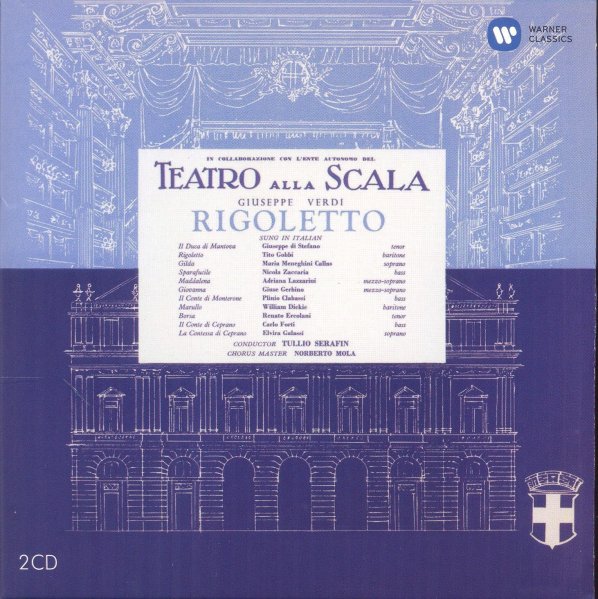
Callas and Gobbi in Rigoletto

91km0olq4ul-_sl1466_

Recorded 3-16 September, 1955, Teatro alla Scala, Milan

Producer: Walter Legge, Balance Engineer: Robert Beckett

Gilda is another role one would not readily associate with Callas. She did sing it on stage for two performances in Mexico in 1952, but, unhappy with her performance, never sang it again except for this recording made in 1955. The Mexico performances are a bit of a mess and sound under-rehearsed, but Callas is superb, and one notes how it is often she who keeps the ensemble together, even though she was so blind on stage she could never see the conductor. It is actually something of a tragedy that she didn’t sing the role more often. If she had, then people may have rethought the role of Gilda, as they did that of Lucia. It is usually sung by a light voiced lyric coloratura, who manages Caro nome well enough, but can’t really muster the power to dominate the ensembles in the last two acts, as she should. It’s something I’ve noticed myself. Not so long ago I saw the opera at Covent Garden with Aleksandra Kurzak as Gilda. She looked ideal, convincingly acted the ingénue, sang a wonderful Caro nome, but tended to be drowned out in the final act, especially in the storm scene.

No problem there for Callas of course, but the miracle is not that she can sing out with a but more power when needed, but that she remains in vocal character when she does. She doesn’t suddenly sound like Norma or Tosca, but continues to think upwards in a voice somehow cleansed of all those heavier associations.

I often think it odd that when people talk about Verdi sopranos, it is the voices of Tebaldi and Leontyne Price they have in mind, but could either of those sopranos have sung Gilda, or Lady Macbeth, or any of Verdi’s early roles? Tebaldi may have sung Violetta, but it wasn’t a natural for her, the coloratura in Sempre libera smudged (and transposed down in live performances). Nor did Tebaldi sing the Trovatore Leonora on stage, as the role lay too high for her. Price did of course, and she was an appreciable Leonora, though she doesn’t sing with the same degree of accuracy as Callas. Callas, on the other hand, sang with equal success Gilda and Lady Macbeth, Abigaille and Elisabeth de Valois, Elena and Aida, both Leonoras, Amelia and Violetta, all on stage not just in the studio, and one regrets that she didn’t get the chance to sing more of Verdi’s early operas. What a superb Luisa Miller she might have made, or Odabella in Attila, Griselda in I Lombardi, or virtually any of those early Verdi heroines. Maybe, after all, it is Callas who is the ideal Verdi soprano.

But back to this Rigoletto, in which Callas yet again completely inhabits an uncharacteristic role. In the first two acts, she presents a shy, innocent young girl, with a touch of wilfulness that explains her disobedience to her father. In the duet with Rigoletto, we feel the warmth of her love for him, and in the one with the Duke, the shy young girl awakening to passion. You can almost see her blushes when the Duke first appears to her. She was asked once why the single word uscitene resounded with such a strange colour. “Because Gilda says go, but wants to say stay,” was her simple answer. Actors might be used to such psychoogical distinctions but it is rare indeed to find it in singers. Caro nome is not just a coloratura showpiece, but a dreamy reverie, and ends on a perfect rapturous trill as she exits the stage. In Act III her voice takes on more colour (Ah, l’onta, padre mio) and it is Tutte le feste that becomes the focal point of her performance, her voice rising with power to the climax (nell’ansia piu crudel) as  she describes the horror of what happened, and note how at the opening she matches her tone to that of the cor anglais introduction. She has the power to ride the orchestra in the storm scene in the last act, and the final duet with Gobbi is unbelievably touching. As usual her legato is superb, phrases prodigious in length, shaped and spun out like a master violinist. It is a great pity she didn’t sing Gilda more often, for it is a considerable achievement.

There are other reasons to treasure this performance of course, chief among them being Gobbi’s superbly characterful, endlessly fascinating and heartrending performance of the title role. Gobbi and Callas always had a striking empathy, and the three duets for father and daughter in this opera, gave that relationship full rein. Some have remarked that Gobbi’s voice was not a true Verdi baritone (whatever that means), but, like Callas, he was successful in a range of different Verdi baritone roles, his most famous probably being Rigoletto. Who has ever matched Gobbi in tonal variety and vocal colour, and psychological complexity? None that I can think of. Pari siamo is superbly introspective and then in Cortigiani! he lashes out like a wounded animal, before breaking down in accents that are pathetically heartrending. To those who say he could not sing with beauty of tone, I would say there are plenty of moments in the score which refute that assertion,  the Piangi section of the Act II duet, where he spins out a pure legato which is both musical and shatteringly moving, being a case in point.

Di Stefano may not be quite in their class, and there are certainly more elegant Dukes on record, but he sings with enormous face and charm. One can imagine why Gilda would be captivated by this Duke. He can be musically inexact (some of the tricky rhythms in Act I go a bit awry), but his voice is in fine shape, and he sounds both charming and sexy, which is as it should be. Nor does he play down the casual cruelty that lies at the heart of his character. I’d say it’s one of his best recordings.

Serafin’s conducting is in the best Italian tradition, both lyrical and dramatically incisive. He is totally at one with Callas and Gobbi in the duets, giving them ample time to make their dramatic points, but whips up quite a storm in the finale to Act II.

The sound is truthful and clear, the voices wonderfully present, and, as in all the Warner sets so far, sounds excellent on my system.

Years ago I remember an acquaintance, not really a voice fan (or a major opera fan, for that matter), asking me which recording of Rigoletto I recommended. He had the Giulini, and quite enjoyed it, but thought there was something missing. I warned him that some were allergic to Callas’s voice, but lent him my set anyway. A couple of days later he excitedly returned it to me, having ordered the recording for himself. “Fantastic,” he said, “Exactly what I was looking for. Suddenly the whole opera came to life.” Well you can’t ask for much more than that.

The Callas Karajan Il Trovatore

91l6fuq3isl-_sl1500_

Recorded 3-4, 6-9 August 1956, Teatro alla Scala, Milan

Producer: Walter Legge, Balance Engineer: Robert Beckett

Though Callas, even in her early days, often courted controversy, there was very little disagreement about her Leonora, which seems to have been universally acclaimed from day one. Schwarzkopf called it “a miracle”, Bjoerling “perfection” and Lauri- Volpi “glorious”. Il Trovatore was of course a staple of the repertoire, but years of lazy singing by less technically accomplished sopranos had removed much of Leonora’s filigree. When Callas sang the role, critics said it was as if an old master had lovingly been restored to its original glory. Writing of her performance of the role in London in 1953, Cecil Smith in Opera wrote,

For once we heard the trills fully executed the scales and arpeggios tonally full-bodied but rhythmically bouncing and alert, the portamentos and long-breathed phrases fully supported and exquisitely inflected.

Used to enlisting Serafin’s support with a new role, she had had to prepare it alone for her first Leonoras in Mexico,  as she would be singing it under a different conductor (Guido Picco). A recording of that performance in 1950 shows that most of Callas’s ideas on the role were her own, and her singing is wonderfully accomplished, though she would eschew some of the interpolated high notes in later performances of the opera. She subsequently sang the role in Naples (under Serafin), at La Scala, in London, in Verona, in Rome and in Chicago (with Bjoerling), and finally for this recording in 1956.

By 1956 Callas’s voice is not what it was even in 1953, when she sang the role at La Scala, and high notes can be strident, but her voice in the middle and lower registers still has a dark beauty absolutely apt for the role. Her breath control is prodigious, her legato superb and throughout she phrases like a violinist rather than a vocalist.  Not only are the trills, scales and arpeggios fully executed, as Cecil Smith points out, but they are bound into the vocal line, becoming expression marks rather than just trills or scales. Even with a great singer, like Ponselle, the cadenza at the end of D’amor sul’ali rosee can seem as if it is just tacked on. With Callas, it becomes the natural conclusion of the aria, a musical expression of Leonora’s voice flying out to Manrico. In this recording we are also vouchsafed the cabaletta after the Miserere, (Tu vedrai) which was usually cut before then, presumably because most lyric-dramatic sopranos would find it beyond their capabilities. Callas is magnificent. Musically, I have no doubt that Leonora was one of her greatest achievements.

The rest of the cast are probably as good as could be assembled at the time. Di Stefano almost convinces his voice is right for the role, though, truth to tell, it’s a notch too small. He doesn’t really have the heroics for Di quella pira, but he is always alive to the drama, always sings off the words. Barbieri is a terrific Azucena, Panerai an intensely obsessive Di Luna, and Zaccaria a sonorous Ferrando.

But if Callas is the star vocalist, then Karajan is the second star of the recording. I’d even go so far as to say this is one of his very best opera recordings. His conducting is thrilling and one is constantly amazed at the many felicities he brings out in the orchestral colour, like the sighing two note violin phrases in Condotta ell’era in ceppi, or the beautifully elegant string tune that underscores Ferrando’s questioning of Azucena in Act III, cleverly noting its kinship with Condotta ell’era in ceppi. His pacing is brilliant, rhythms always alert and beautifully sprung, but suitably spacious and long-breathed in Leonora’s glorious arias. Nor does he shy away from the score’s occasional rude vigour. It is a considerable achievement.

My LP pressing was in the fake stereo re-issue, and I had the 1997 Callas Edition on CD. This Warner re-mastering sounds a good deal better than both, with plenty of space round the voices and plenty of detail coming through from the orchestra.

A classic Il Trovatore then, which has stood the test of time, and has held its place amongst the best. In all but recorded sound, I would prefer it to both the Mehta with Leontyne Price and Domingo and the Giulini with Plowright and Domingo again, though Giulini does have possibly the most interesting Azucena of them all in Brigitte Fassbaender. Callas and Karajan, on those rare occasions they worked together, are a hard act to follow.

Callas in La Boheme

91olgtzbaol-_sl1473_

Recorded 20-25 August, 3-4 September 1956, Teatro alla Scala, Milan

Producers: Walter Legge & Walter Jellinek: Balance Engineer: Robert Beckett

Mimi is a role one would not associate with Callas, and indeed it is one of four roles she learned for the gramophone but never sang on stage. The opera itself makes its effect easily and can withstand even a mediocre performance, the role of Mimi being probably one of the least demanding in the soprano repertoire. Great Normas may always have been thin on the ground; effective Mimis have been, and still are, plentiful. The role’s requirements are slight; sweetness, charm, and a capacity for what the Italians call morbidezza; qualities that come naturally to a De Los Angeles or a Freni, less so, one would have thought, to a Callas.

But of course the miracle of Callas is that she not only scales down her voice and personality to suit the demands of the role, but also finds within it a deeper vein of tragedy one hardly suspected was there, her singing full of little incidental details often overlooked by others. Her first utterances have a weariness that presages her illness, and she fades the voice away most effectively as she faints. The duet with Rodolfo is light and charming, but more of this Mimi’s capacity for love emerges in her aria. Starting shyly, she gradually suffuses her tone with warmth at the section beginning Ma quando vien lo sgelo, not lingering too long on the top As and thereby ruining the shape of the aria, as so many do, and I love the way the last section, from altro di me non saprei narare, is delivered with a slight touch of embarrassment as if Mimi suddenly realises she has revealed too much too soon.

It is in the last two acts, though, that Callas’s Mimi is at its most moving. Never before has Mimi’s despair been so heart-rendingly expressed, but also note how, with a single word (dorme? ) in the duet with Marcello, she conjures up all Mimi’s warmth and tender love for Rodolfo, with the gentlest of upward portamenti. Act IV is almost fail safe, but here too she is wonderfully effective, finding the palest of colours as the pallor of death takes over.

She has a good cast around her; Di Stefano in one of his best roles, Panerai a splendid Marcello, Moffo a sympathetic Musetta, and something of a relief from the sparky soubrettes we so often end up with. Zaccaria and Spatafora are an excellent pair of Bohemians.

Votto doesn’t do anything wrong, but such a cast would have benefited from a stronger hand at the helm. He accompanies well, but it’s a shame, given that Serafin was not an option at the time, Legge couldn’t have persuaded Karajan to stick around after recording Il Trovatore with her.

The sound of this La Boheme has always been good for its period. I owned the original Columbia LPs, which I played to death. These Warner CDs also sound pretty good to me.

There are so many good recordings of La Boheme in the catalogue, that choosing the best one is well-nigh impossible, and choice will no doubt come down to preference for certain singers. However this recording, made 60 years ago now, still holds its place amongst the top recommendations.