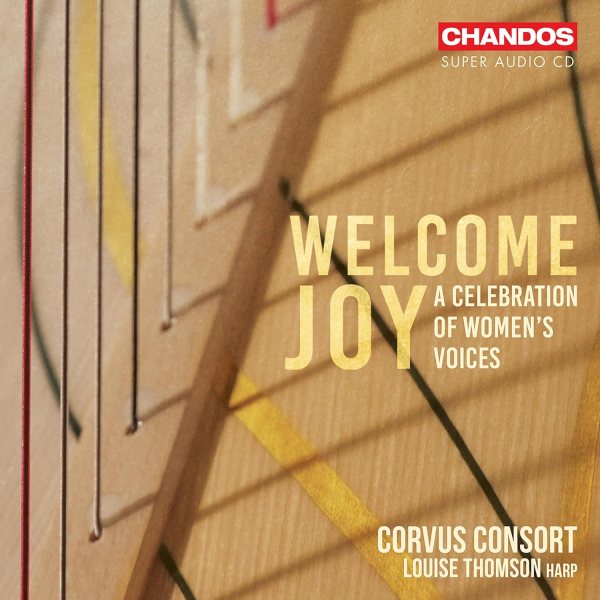
Welcome Joy – The Corvus Consort

81lspxvxnl._ac_sl1500_

The subtitle of this disc is A Celebration of Women’s Voices and a celebration it undoubtedly is, not just of the women’s voices who sing on the record, but of the voices of the women composers who make up the lion’s share of the music. Room is found for Gustav Holst, who was a champion of women’s voices and taught at several girls’ schools, most famously at St Paul’s Girls School, where he taught for almost thirty years.

Its centrepiece, and the longest work on the disc, is Elizabeth Poston’s An English Day-Book, which here receives its première recording of this edition. If it is reminiscent of Britten’s A Ceremony of Carols, then that is because it was conceived to complement it by providing a work suitable for use throughout the year. The Day-Book was unpublished at he time of Poston’s death in 1987, but has since been published by the Arts and Education charity, Multitude of Voyces, which specialises in publishing and promoting works by communities historically or currently underrepresented or marginalised. The charity also published the works here by Hilary Campbell, Olivia Sparkhall, Judith Weir and Gemma McGregor. I was particularly taken by Sparkhall’s Lux Aeterna, which is for two choruses, solo soprano and harp and McGregor’s Love was his meaning with its lovely falling harp introduction.

“Welcome Joy”, sing the Corvus Consort at the beginning of this recital and indeed what a joy it is. Imogen Holst’s commission for the 1951 Aldeburgh Festival is a setting of six poems by John Keats, described by Britten as ‘six little treasures’ when he first received them, and, in this joyful performance, it is easy to see why.

This piece, like most of the music on this CD was completely new to me, but I did know Gustav Holst’s Choral Hymns from the Rig Veda (Third Group) from Imogen Holst’s 1968 recording with the Purcell Singers and Ossian Ellis. I am bound to say that I found that recording a mite more atmospheric, especially in the opening Hymn to the Dawn, which has a mystery and magic that is not quite captured in the clearer, more analytical Chandos digital recording.

Nevertheless, I enjoyed this disc of choral music for women’s voices. The work of the Corvus Consort under their conductor, Freddie Crowley can hardly be faulted, with a superb contribution from harpist, Louise Thomson.

Full texts are provided, and the exemplary notes are extensive. A thoroughly enjoyable disc.

Contents

Imogen Holst (1907 – 1984)  Welcome Joy and Welcome Sorrow (1950)

Gustav Holst (1874 – 1934) Two Eastern Pictures (1911)

Choral Hymns from the Rig Veda (Third Group) (1910)

Dirge and Hymneal (1915)

Judith Weir (b.1954) We sekyn here rest (2019)

Hilary Campbell (b. 1983) Our Endless Day (2017)

Elizabeth Poston (1905 – 1987) An English Day-Book  (1966 – 67)

Olivia M. Sparkhall (b. 1976) Lux Aeterna (2018)

Gemma McGregor (b. 1965) Love was his meaning (2018)

Shruti Rajasekar (b. 1996) Ushãs – Goddess of Dawn (2024)

Priestess (2024)


Mariss Jansons conducts the Mozart Requiem

71sy8aru8il._ac_sl1500_

Mariss Jansons was chief conductor of the Bavarian Radio Symphony Orchestra until his untimely death in 2019, a post he had held since 2003. He had a long and fruitful association with the orchestra and BR Klassik have released many of his live concerts on disc. Indeed, they have recently brought many of these together in a seventy-disc set.

This performance of the Mozart Requiem was recorded at concerts in May of 2017. Jansons uses the famous Süssmayr completion, and the performance is unashamedly in the Romantic tradition. There is nothing controversial about it, speeds for the most part judiciously chosen, and yet, for me, it never quite catches fire, comparing unfavourably with another live Jansons performance with the Concertgebouw from 2011, which was very favourably reviewed on Musicweb International by Simon Thompson (review). Two of the soloists on the present recording, soprano, Genia Kühmeier and tenor, Mark Padmore sing on that performance too. Kühmeier is lovely in both performances, but Padmore sounds marginally fresher and sweeter in the earlier one, which also has a superb Gerard Finley singing the bass role and Bernarda Fink in the alto part. Elisabeth Kulman and Adam Plachetka, on this issue, are fine, but not quite in the same league.

I listened three times, comparing this one to the earlier one, as well as listening to a similarly big-boned interpretation in the form of Karajan’s 1987 performance, both of which I found much more intensely dramatic. The Karajan, which dates from his final years with the Vienna Philharmonic Orchestra is, I think, his finest of the three he has recorded for DG, and has a reverence and spirituality that I found lacking here. It was hard to put my finger on what was missing in the Jansons, but there are times, like the startling opening to the Confutatis, which jolted me out of my seat, when it felt as if Jansons himself knew something was amiss and was trying to inject some drama or extra energy into the performance. The final lux aeterna, on the other hand, rather trundles towards its conclusion and is greeted by a tepidly polite round of applause, making me wonder why this broadcast was considered for release, especially given the competition from Jansons himself in the much finer Concertgebouw performance, which is also better recorded. Even with the volume turned up quite high, the recording of the Bavarian broadcast is a little distant, a little muddy, and I wondered if this too contributed to my muted impressions.

Well worth considering, if you are wanting the Süssmayer version, is John Butt’s superb reconstruction of the first performance, released by Linn in 2014, which of course uses original instruments. (review) Though the forces are much smaller, it is incisively dramatic and brilliantly recorded, though I personally would prefer any of Jansons’ soloists in either of his two recordings. The bass on the Butt recording is particularly weak and tends to growl in the lower register, no match for Finley, nor even for Plachetka.

If you do want Jansons in this work, then I would suggest you stick to the Concertgebouw performance, which can certainly hold its head up amongst the best of the many recordings on modern instruments.