Lorin Maazel’s Il Trittico

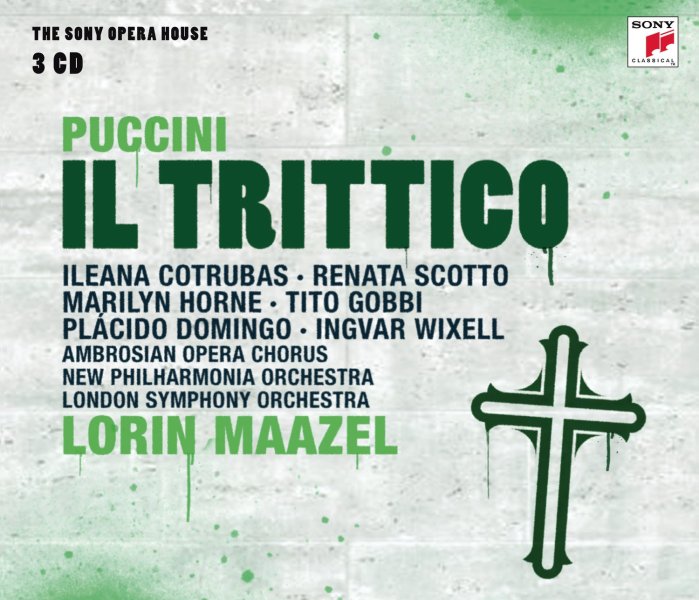
Excellent performances of Puccini’s tryptich, though, of the three, only Suor Angelica would be my absolute top choice.

A word first about the presentation of this budget release. These days I suppose we have become used to not getting texts and translations, but documentation n this reissue is really of the minimum, and tracking of the CDs is a ludicrous; just one track for Il Tabarro, and two each for Suor Angelica and Gianni Schicchi.

Nothing really wrong with Maazel’s conducting. I sometimes find him a fussy conductor, who draws attenttion to himself rather than the music, but I enjoyed these performances. His conducting is spacious and warm throughout, though I’d have to admit he misses some of the high spirits of Gianni Schicchi.
r-13346789-1552503975-9282.jpeg

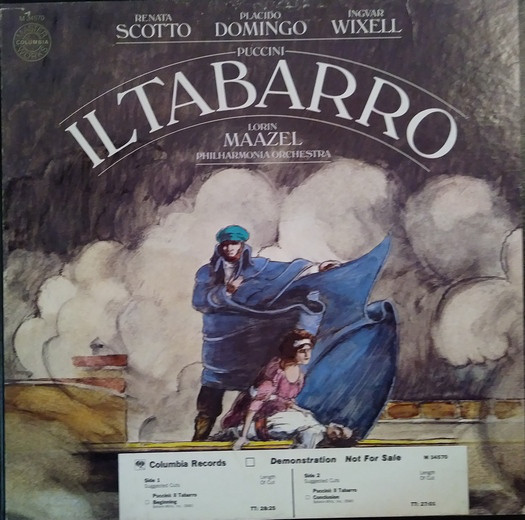
Despite the excellent performances of Scotto and Domingo in Il Tabarro, I still prefer the old mono recording conducted by Vincenzo Bellezza, which is dominated by Gobbi’s darkly menacing, but troubled Michele. It is one of his greatest achievements on disc, and, good though Wixell is, he doesn’t begin to match Gobbi in emotional range. Scotto and Domingo are far preferable to their counterparts on the older recording, but Gobbi is irreplaceable.
r-7947218-1457632772-2563.jpeg

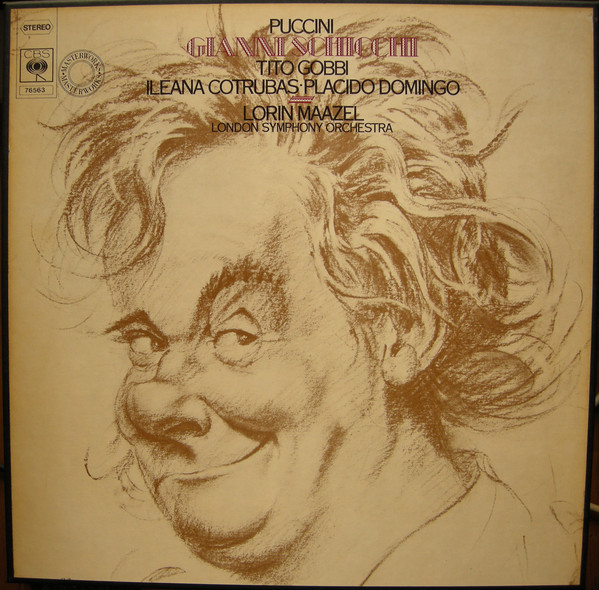
In Gianni Schicci, Gobbi is up against himself in an earlier recording, conducted by Gabriele Santini with a degree more urgency than we get here. Gobbi is as sharply characterful as ever, but the other soloists on that earlier recording are a tad more individual than those on this one, and it just generates a bit more fun and high spirits. Domingo, expertly lightening his voice, manages Rinuccio surprisingly well, but it’s still a bit like getting a sledgehammer to crack a nut, and Ileana Cotrubas is a charming Lauretta, if not quite eclipsing memories of Victoria De Los Angeles on the earlier recording.
r-5103789-1526059147-1145.gif

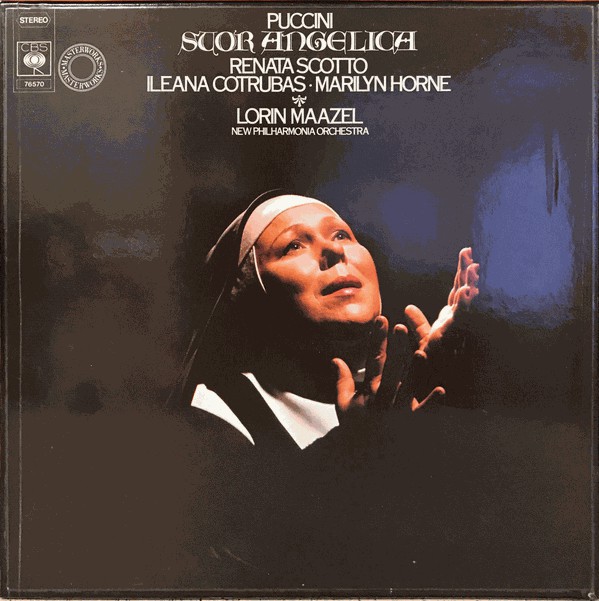
When it comes to Suor Angelica, I would have to admit that Scotto’s top notes can be afflicted with hardness and unsteadiness, but that she presents the most intense, most psycholgically penetrating traversal of the role I’ve heard. Between them Scotto and Maazel turn what is often a piece of quasi religioso sentimentality into a mini psychodrama about the effects of repression, almost echoing some of the themes in Powell and Pressburger’s darly intense movie Black Narcissus. Much as I like recordings featuring De Los Angeles and Ricciarelli, this one is much more gripping as drama. It’s defnitely the prize of the set.
Mehta’s La Fanciulla del West

61ehjocihwl

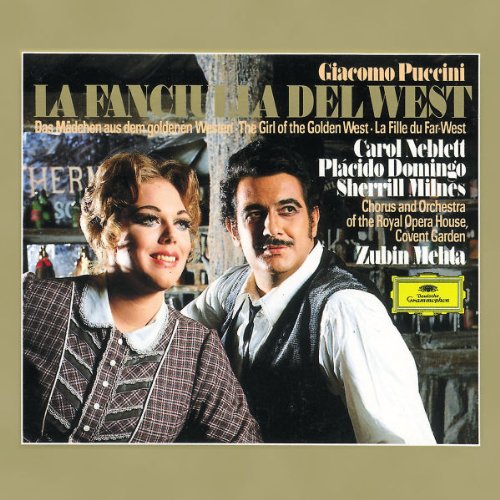
Zubin Mehta’s recording of Turandot with Sutherland, Pavarotti and Caballé is justly famous, but his recording of La Fanciulla del West is arguably just as good, and in fact won a tranche of awards when it was first released back in 1977.

It is based on performances of a spectacular new production at Covent Garden (which I saw in revival with the same two leads). The main difference in the recording from the stage performances is that Sherrill Milnes replaces Silvano Carroli as Jack Rance, presumably because he was a bigger name.

All three stars certainly acquit themselves admirably and Carol Neblett, who for a short time was the Minnie to see is just about perfect in the role, warmer voiced than Nilsson and securer on high than Tebaldi. Supporting roles are all well characterised, with a superb contribution from Gwynne Howell as Jake Wallace, and there is a great feeling of ensemble about the performance.

The score is surely one of Puccini’s finest, though I still find its setting somewhat incongruous. Still, this is a great recording of a very fine work and well worth anyone’s attention.

Giulini’s Il Trovatore

119021080

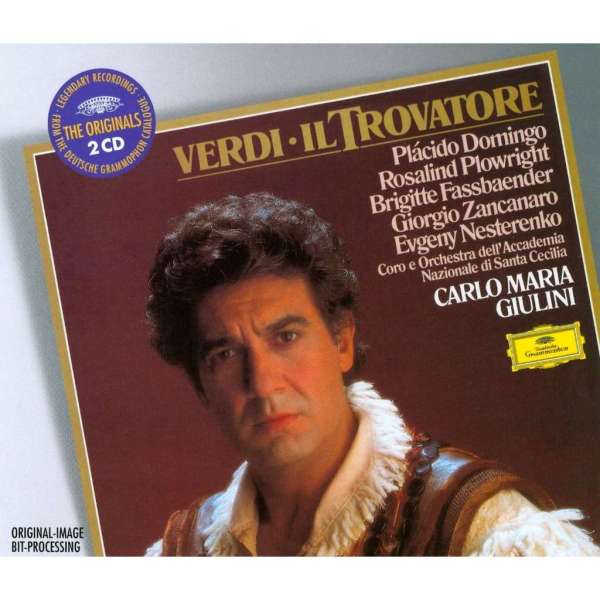
Giulini’s Il Trovatore makes for very enjoyable listening, even if, in the final analysis, it lacks the sheer excitement and thrill of the Callas/Karajan set. As always with Giulini, tempos tend to be measured, giving his singers plenty of room to breathe and expand, but I do miss Karajan’s superb rhythmic swagger and verve. It makes for a more reflective and thoughtful performance than usual, but I’m not sure that is what Il Trovatore needs.

That said there is some excellent singing from an unusual group of singers. Plowright has exactly the right tinta for Leonora, the tone darkly plangent, the coloratura well executed, but nowhere does she light up a phrase the way Callas does and Leonora remains a somewhat two-dimensional character. Domingo is actually better here than he was for Mehta, more inside the role and his voice more free on top, though the (unwritten) top Cs in Di quella pira still sound somewhat strained and I remember there was a bit of a hoo-hah about him omitting them when he sang the role at Covent Garden around the same time this recording was made. Zancanaro is a most musical Di Luna, and Nesterenko gets the opera off to a rousing start.

The most controversial piece of casting is no doubt that of Fassbaender as Azucena, and her intelligent portrayal is thoroughly thought through and beautifully sung, with a lieder singer’s attention to detail. It is a considerable achievement, but she does not erase memories of singers like Simionato and Barbieri in the role, both of whom are more naturally suited to the music.

In short, a musical and thoughtful traversal of the score, which just misses that last degree of passion and excitement. It certainly doesn’t oust the Callas/Karajan set from my affections, but compliments it very nicely.

Domingo’s first recording of Otello

r-7473810-1513790477-2803.jpeg

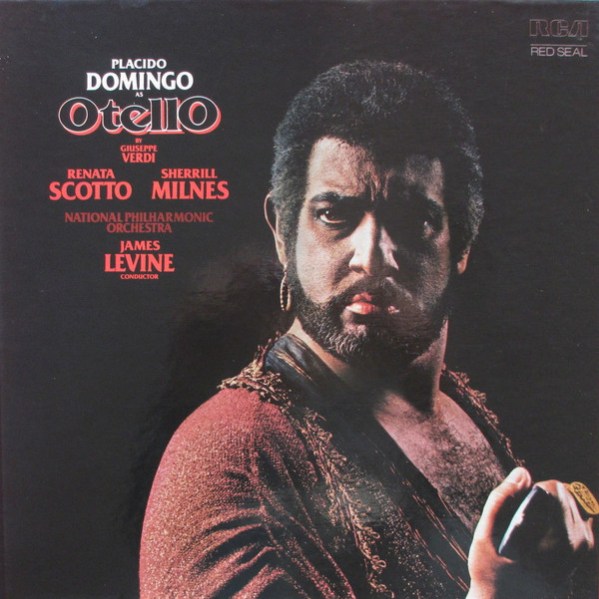
Quite aside from the recent sexual misconduct revelations, Domingo seems to come in for a lot of flak these days, but it is salutary to remember that this, his first recording of a role he became particularly associated with, was made over forty years ago. Towards the end of his career he turned to baritone roles (with qualified success, admittedly), but, by any standards, the man has had a long and illustrious career.

He made two further studio recordings of the role (one of them used for the soundtrack to the Zeffirelli film), and their are at least three official videos of him performing the role on stage, and a number of unofficial live accounts. This recording finds him early in his conquest of this signature role, but it is already well sung in. Records cannot of course capture his superb acting and powerful stage presence, but his Otello is still, even at this early stage of his career, a great performance. Some, and I am probably one of them, would prefer a voice with a bit more squillo on top. My favourite Otello remains Vickers, who has musicality, dramatic intensity and squillo, but I prefer Domingo to Del Monaco, whose singing can indeed be thrilling, but who tends to let volume compensate for a lack of real dramatic awareness.

There are other reasons to enjoy this recording. Levine’s conductiing, which derives from long stage acquaintance with the opera, is definitely one of his best Verdi recordings (though the recording itself is a tad congested in the climaxes) and Milnes is also caught at something close to his best, a suave, guileful and conniving Iago. Scotto, though she may not have Tebaldi’s beauty of tone, is a much more communicative and moving Desdemona, and this is one of her most succesful performances on disc. The voice occasionally spreads on top when under pressure, but her pianissimo singing is exquisite and her phrasing wonderfully musical.

Despite reservations about Rysanek’s Desdemona, the Serafin set with Vickers and Gobbi remains my favourite studio recording. That said, I would always want one of Domingo’s studio recordings as well. Though Domingo himself may be even more moving in his later two recordings and many, I know, would go for his last recording under Chung, with Studer and Leiferkus, I still prefer this early one. I’ve never been a big fan of Studer and Leiferkus sounds unidiomatic to me, for all his intelligence and dramatic acumen. The Maazel is let down by some weird recording balances and Diaz’s well sung but anonymous Iago, though Ricciarelli is also an affectingly touching Desdemona. So the Levine emerges as the winner for me.

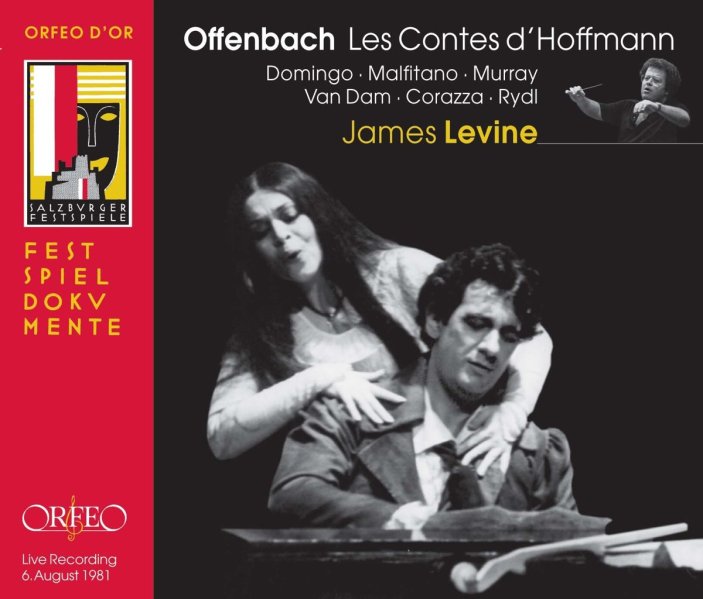
Les Contes d’Hoffmann from the Salzburg Festival 1981

71svq0cjidl._sl1200_

I was keen to hear this set after it was the reviewer’s first choice for the opera in BBC’s Building a Library programme, and it is very good indeed, though the sound of this live recording, made at the Salzburg Festival in 1981, rather lets it down. The solo voices are well recorded, but the sounds becomes boomy and congested when orchestra and chorus are at full tilt. Furthermore there are quite a few bangs and thuds associated with live performance.

That said the performance itself is thrilling with Domingo in superb voice and even more inside the role than he is on the Bonynge set. That of course has Sutherland in the female roles and it has to be said that Malfitano doesn’t command her beauty of tone. On the other hand, she is a much more convincing vocal actress. For all that Offenbach intended the roles to be sung by the same singer, the demands of each are quite different, and I often prefer to hear them sung by different singers as they are in the superb John Schlesinger Covent Garden production with Domingo again as Hoffmann, but with Luciana Serra as Olympia, Ileana Cotrubas as Antonia and Agnes Baltsa (a mezzo) as Giulietta. Malfitano rises to the challenge superbly however and reconciles me to the casting of the same singer.

The rest of the cast is also excellent with Ann Murray superb in the dual role of Niklausse/The Muse and Van Dam perfection in the roles of the four villains, vocally more resplendent than Bacquier on the Bonynge recording. Rémy Corazza is also excellent in the comic roles, if not quite erasing memories of Hugues Cuénod on the Bonynge set.

James Levine, whom I sometimes find too bombastic in Verdi, surprised me, his conducting both exciting and lyrical and the Vienna Philharmonic play superbly.

The Bonynge profits from superb Decca sound of course, but, in all other respects, I think I prefer this one.

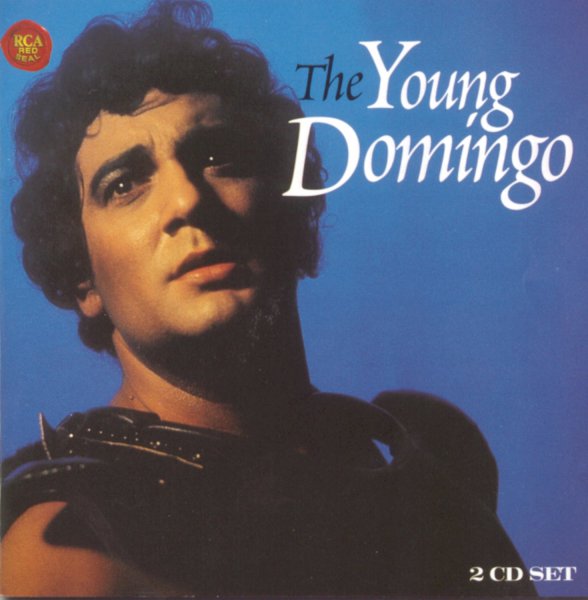
The Young Domingo


These days, with Domingo’s sometimes less successful forays into the baritone repertoire, it is easy to forget just how amazing his career was, not to mention how long it has lasted. This two disc set is a composite of three recitals made in 1968, 1971 and 1972 when Domingo (27 at the time of the first disc) was already an experienced artist, having first appeared on stage at the age of sixteen and singing his first major role (Alfredo) in 1961 at the age of 20.

The earliest of these recitals, which was given the title Romantic Arias heralded the arrival of a major artist, not only a tenor but a musician. The repertoire is wide ranging, taking in music from Handel to Mascagni and he sings in Italian, French, German and Russian. I can’t think of many tenors, even from the golden age of 78s, who could sing Puccini and Mascagni with so much passion and yet give us a wonderfully accomplished Il mio tesoro from Don Giovanni, the longest run sung cleanly and accurately and not only spun out in a single breath but phrased through into the next statement of the opening tune. The only other tenor I’ve come across who manages it as well is John McCormack. In all, whether it be in Lohengrin’s Narration or Lensky’s aria, sung in Russian, his singing is musical and immaginative. If we were to nitpick, it might be to note that, especially in the Italian items, there is a lack of excitement, of real intensity. Both are qualities he later added, along with his fine acting that served to make him the best Otello to be heard for many years. So he may not thrill in the manner of a Franco Corelli, but could Corelli have ever embraced such a wide range of differing music styles with such musicality and sensibility? I dount it very much. So let’s be grateful for what we have.

The second disc entitled Domingo sings Caruso is less wide ranging, most of the arias more well known, though it does include an aria for Marcello from Leoncavallo’s version of La Bohème, and the third La Voce d’Oro, an apt description of the golden tone that pours forth. Again one might note that his singing can be a little generic, but his musical sensibilities are always evident. Nor does he ever indulge in the vulgar mannerisms of some who preceded him. His singing is always tasteful, his musical manners impeccable.

To the three recitals, BMG have added two Leoncavallo arias (another from La Bohème and one from Chatterton) which were originally included as fill-ups for his recording of I Pagliacci under Nello Santi. Both are attractive pieces, wonderfully sung by Domingo.

Looking at Domingo’s website I see his calendar is still pretty full, with engagements, both singing and conducting, booked up to November next year. It is a remarkable achievement for a man approaching his eighties. There is no doubt the promise of these early recitals has been not only fulfilled but surpassed. Now that we have said goodbye to Domingo the tenor, now might be a good time to go backto these early recitals and remember just how good he was.