A Spanish Songbook – Jill Gomez

516xghgdgjl._sx355_

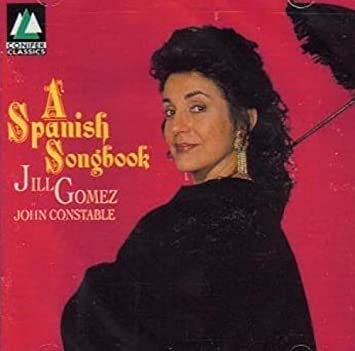
What an utterly charmng and delightful disc this is, cleverly planned and beautifully executed.

With her distinctive timbre and wonderfully expressive voice, Gomez’s personality fairly bursts through the speakers and she is superbly supported here by John Constable on the piano, who unerringly captures the mood of the songs. You feel as if these two artists really enjoy making music together, and indeed their association is a long one, having first appeared on disc together twenty years earlier. Gomez would have been in her early fifties when the present disc was recorded but the voice has hardly changed in the intervening years.

What we have here is a compendium of Spanish inflluenced songs by German, French and English composers, as well as songs by Spanish composers, covering a wide range of styles and eras. The programming is eminently sensible and makes for very satisfying listening.

We start with a group of sixteenth century Villancios from the courts of Charles V and Philip II in piano arrangements by Graciano Tarragó, which encourage the kind of decoration and improvisation of the 16th century vilancico. Fuenllana’s De los alamos vengo, madre is no doubt better known from Rodrigo’s orchestral arrangement, but Gomez sparkles quite as much here.

From thence we turn to a group of Spanish influenced songs by Wolf and Schumann, in which Gomez captures perfectly the deep melancholy of Schumann’s Tief im Herzen trag’ ich Pein as well as the girlish coquettishness of Wolf’s In dem Schatten meiner Locken. Spain has always provided a deep vein of inspiration for French composers, so we are next treated to a group of songs by Bizet, Ravel, Saint-Saëns and Délibes in which Gomez’s sense of style is impeccable.

Next come the three Granados Tornadillas, in which we are probably more used to hearing the fuller, chestier sound of someone like Conchita Supervia. Gomez intelligently, rather than copy her style, is more languorous. I might prefer Supervia’s vibrancy, but Gomez’s way is just as valid.

The two Walton songs, both taken from Façade, find Gomez pointing Edith Sitwell’s lyrics deliciously and lead us into the final group, which Gomez calls “Seven Other Popular Songs”. The first three songs are by Roberto Gerhard, who, as an exile from Franco’s Spain, had relocated to Cambridge in the UK in 1942, where he lived until his death in 1970. These are his versions of folk-songs collected by his teacher, Felipe Pedrell. bittersweet souvenirs of a composer in exile. The others are by Tarrago, Rodrigo, Guridi and Obradors. Gomez is yet again a wonderful guide through this musical journey of Spain, brilliantly capturing the mood of each song.

An excellent recital that should be a lot better known than it is.

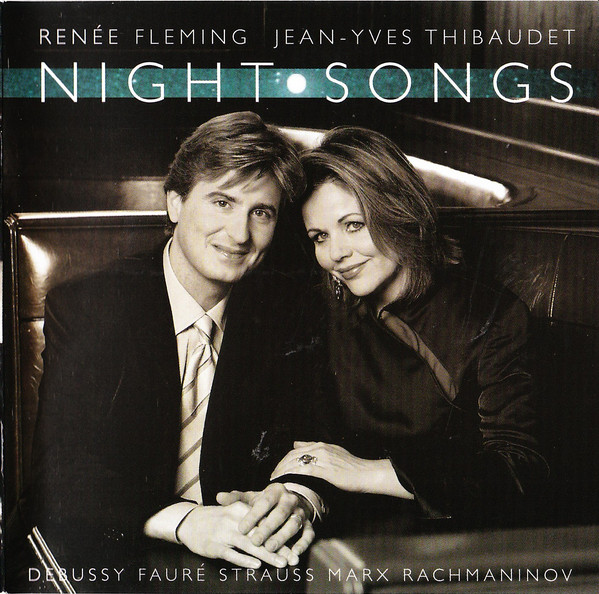
Renée Fleming – Night Songs

r-4527951-1426190336-3065.jpeg

Where does the time go? I can’t believe it is almost twenty years since I worked with Renée Fleming when the London Symphony Orchestra put on a semi-staged production of Previn’s A Streetcar Named Desire at the Barbican Hall with Previn himself conducting. I only had a very minor role, but I found Fleming to be a very gracious lady, an arch professional and a conscientious artist. The rehearsals and performances are amongst my fondest memories and I will never forget the experience of hearing that voice close to, with her literally singing into my ear on occasion. The final Korngold-like aria Blanche sings before being taken away to the asylum was possibly one of the most beautiful things I have ever heard.

I mention this to put into context my reactions to listening to this recital, which I wanted to like much more than I did. The recording was made in 2001 when the voice had acquired a new richness in the middle and lower ranges whilst retaining its beauty and ease up on high, even throughout its compass and admirably firm, with no trace of hardness when singing at full tilt. As it seems now we have said goodbye to Fleming, the classical arists it is good to be reminded that this was one of the most ravishing instruments of the last thirty years or so. She has always had a fairly eclectic repertoire which embraced both opera and song, covering a wide range of different composers and styles, but I’ve always thought her best suited to the music of Mozart and Strauss.

Hence it is the songs by Strauss and Joseph Marx which make the stongest impression, especially Cäcilie, its radiant close easily and ravishingly voiced. The Marx songs suit her well too, their sensuous expressivity responding well to the heady beauty of Fleming’s voice. Thibaudet is also superb in the tricky accompaniments, tossing off their difficulties as if they are the easiest things in the world.

Elsewhere I am not so sure this operatic vocal effulgence is what I want to hear. I found myself longing for the greater simplicity and cleaner vocal production of a Victoria De Los Angeles in the Fauré, the slight touch of irony and cool detachment brought to Debussy’s Chansons de Bilitis by a Régine Crespin. The Rachmaninov, with their heavier accompaniments, perhaps respond better to this operatic treatment, but I find it just too sophisticated and even here I prefer a slightly simpler, more direct approach.

However enjoyable it is to hear one of the most beautiful voices of recent times whatever the circumstances, ultimately there are other discs I would pull out first when wanting to sample Fleming at her best.

Dame Janet Baker – The Great Recordings

51yyk-hlf7l._sy400_ml2_

This exhaustive twenty disc box was, when it was first released on EMI, more properly called The Great EMI Recordings. The deletion of the word EMI from the title has something to do with the conditions of the sale, of EMI to Warner but the original title is more representative of the contents, as Dame Janet also made “great” recordings  for Decca, Philips and Hyperion. Aside from Ottavia’s Lament and Farewell from Monteverdi’s L’Incoronazione di Poppea, and the final scenes from Berlioz’s Les Troyens, this set includes no opera. Still, the range is wide, covering music from Monteverdi to Schoenberg and, as it also includes excerpts from various complete recordings of orotorios, covers just about everything she ever recorded for EMI and later Virgin Classics. The quality is extrordinarily high and it is safe to say that she never made a bad record and many of them are out and out classics.

The lay out is mostly logical, starting with early music and moving forward in time, but cramming shorter LP recordings onto twenty well-filled CDs has inevetably led to the occasional odd juxtaposition. Most of the recordings cover her vocal prime, from 1966 through the 1970s. Shortly after she retired she made a few recordings with Richard Hickox in 1989 and 1990 and only these show a slight decline in her vocal resources, though the artistry remains undimmed.

Disc one starts with a 1969 recording of music by Monteverdi, Alessandro and Domenico Scarlatti with the English Chamber Orchestra under Raymond Leppard rounded off by excerpts from a duet recital with Dietrich Fischer-Dieskau, recorded live at the Royal Festival Hall in 1970. Leppard’s souped up arrangements of the Monteverdi might seem anachronistic now, but Baker’s impassioned singing of Arianna’s Lament and Ottavia’s Lament and Farewell from L’Incoronazione di Poppea transcends any matters of style. The duet items (music by Schütz, Schein and Lilius) have continuo realisations by George Malcolm, who plays the organ with Kenneth Heath on the cello and are delightful in every way.

Disc two gives us the first side of an LP called A Pageant of English Song, which had songs by Dowland and Campion accompanied on the lute, and by Purcell, Monro (I can’t think of his My lovely Cecilia without having Baker’s smiling tone in my head) Boyce and Arne, with accompaniments by Martin Isepp on harpsichord. More duets with Fischer-Dieskau round off the disc, some of these taken from a 1969 Queen Elizabeth Hall recital with Barenboim on the piano.

From here we move to Bach for the next two discs, the wonderful performance of Ich habe genug under Menuhin being particularly noteworthy. A Bach recital, which she recorded with the Academy of St Martin in the Fields under Neville Marriner is spread over the two discs, which finished with the alto arias from Klemperer’s 1967 recording of the Mass in B minor. What a superb Bach singer she was.

We move onto Handel, a composer with whom Baker was particularly associated. Mackerras’s recording of Messiah was one of the first to make a stab in the direction of HIP. It was also the first one I ever owned, Baker’s contribution being particularly memorable. Her version of He was despised is incredibly moving. The two Handel cantatas are listed as arr. Leppard, but I’m not sure what those ‘arrangements’ involve. Baker is, as always, a superb Handelian.

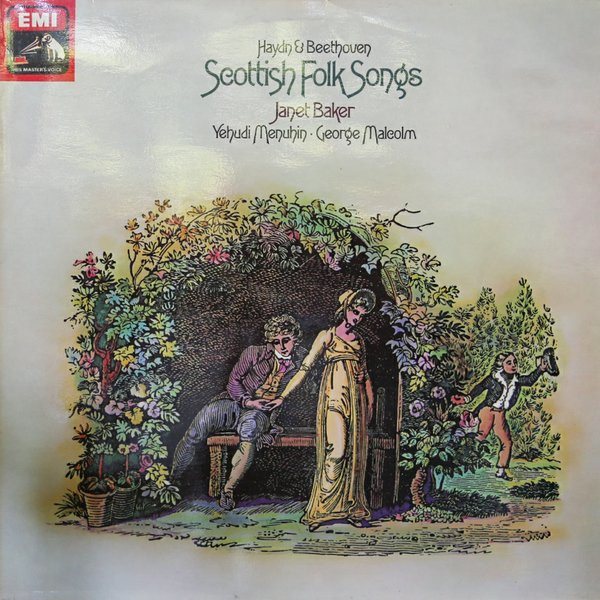
The Haydn and Beethoven Folk Song Arrangements, which follow on the next disc, rather outstay their welcome, for me anyway, even in performances as special and imaginative as these, which means that the ensuing Schumann and Brahms duets from the QEH concert come as something of a relief.
mi0xnzg4lmpwzwc

Discs seven and eight are all Schubert, taken, for the most part, from a two disc set she recorded with Gerald Moore in 1971, which included quite a few rarities and a 1980 recital with Geofrrey Parsons of more popular fare. Baker’s control of dynamics is extraordinary and her breath control stupendous, her legato line beyond reproach. Amongst so many great performances, it’s hard to name favourites, but I doubt I’ve ever heard a better performance of Du bist die Ruh, which is not only deeply felt but also displays the perfection of her tehcnique and her superb breath control.

A few more Schubert songs start the ninth disc, which then continues with a Mendelssohn recital with Geofrrey Parsons and Schumann’s Frauenliebe und Leben with Daniel Barenboim. One of the first records Janet Baker ever made was of the Schumann cycle, for the Saga label before she was contracted to EMI. It was released to much acclaim, but this one delves that much deeper and is indeed one of the greatest recordings of Schumann’s cycle in the catalogue. The Mendelssohn songs are perhaps not so memorable or so wide ranging as Schubert’s but Baker makes the best case for them, but the Schumann cycle is the real prize of this disc.

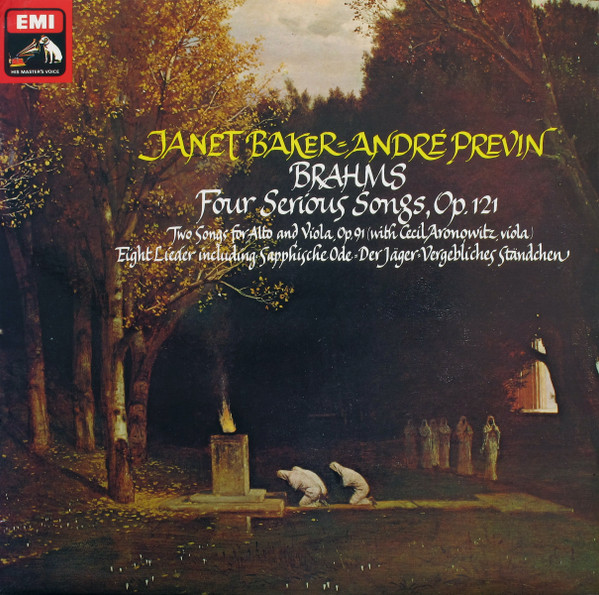
The tenth disc gives us the second side of her Schumann LP with Barenboim, a wonderful performance of the Opus 39 Liederkreis, and the whole of an all Brahms programme with Previn at the piano, the two songs for alto and viola (Cecil Aronowitz) and the Vier ernste Gesänge are deeply felt and wonderfully accompanied.
my03otc4lmpwzwc

A Liszt recital (with Geoffrey Parsons) starts disc eleven, an excellent selection of songs, which are not performed as often as they should be. Baker and Parsons make the very best case for them. These are followed by a small selection from Wolf’s Spanisches Liederbuch and a couple of Mahler’s youthful songs.

Disc twelve is something of a mixed bag and brings together recordings from the beginning and end of Dame Janet’s career, a selection of Strauss songs from an early EMI recital disc, the Song of the Wood Dove from Ferencsik’s 1968 recording of Gurrelieder and Respighi’s La Sensitiva from recording sessions made for Virgin Classics in 1990, a gap of some twenty-three years. I suppose you can detect a slight loosening of the vibrations, but the voice is still very firm and the artistry undimmed. Some may hear a slight lack of spontaneity in the 1967 Strauss songs (absent from the 1973 recording of Ständchen) and I’d have to admit I prefer the sound of a soprano in these songs, but I’d still rather too much care than too little. The Schoenberg might seem an unexpected piece for Dame Janet, but she is absoutely superb here, wonderfully intense and dramatically involved and the Respighi, recorded just after she had retired from the concert platform, is a lovely performance, warmly sung and senisitively phrased.

Disc thirteen is all of song with orchestra. The Brahms Alto Rhapsody was originally used as a filler for Boult’s Brahms Symphony cycle, then reissued as a makeweight for Wagner’s Wesendonck Lieder and a selction of Strauss songs Baker and Boult recorded in 1975. The Alto Rhapsody and the Wagner are absolutely superb, indeed among the most recommendable versions of these songs. The Strauss songs suit her less well, but I’m still glad to have them. Then comes the legendary recording of Elgar’s Sea Pictures, which has never been equalled. It was originally issued with Du Pré’s equally legendary recording of Elgar’s Cello Concerto and is one of the best selling classical records of all time. the original LP was an EMI best seller for as long as I remember, and a record we had on permanent weekly order, when I worked at MDC in London.The disc finishes, fittingly enough with Dame Janet’s wonderfully consoling and radiant singing of the closing pages of The Dream of Gerontius.

Now if I were allowed just one Janet Baker record on that proverbial desert island, I’d be hard pressed to choose between her Mahler and her Berlioz and  the next two discs are dedicated to these two composers.

Disc fourteen gathers together all the Mahler recordings she made with Barbirolli and adds Urlicht from Rattle’s acclaimed recording of the Second Symphony. All three cycles are amongst the best recordings of these songs ever made. The Rückert Lieder were originally issued on the fourth side of Barbirolli’s famous recording of the 5th Symphony with the New Philharmonia, the other two cycles having been recorded a couple of years earlier with the Hallé. Ich bin der Welt abhanden gekommen was recorded at the same time and used as a fill-up, which explains why they recorded the song twice. If I were to use one piece of music to illustrate the genius of Janet Baker, then it would undoubtedly be one of these two versions of Ich bin der Welt abhanden gekommen. The song is not so much sung as experienced and you can really feel the connection between singer and conductor. To be honest, there is very little to choose between the two performances; maybe the later one is even more withdrawn, even more self-communing. When I listen to either I feel as if I too am lost to the world.

Disc fifteen is also one of the most desirable discs in this set. Baker was a great Berlioz singer and it has always been a huge cause for regret that she never recorded the role of Didon, making these excerpts more treasurable than ever and these final scenes are devastating in their impact. She recorded La mort de Cléopâtre again for Philips under Davis, another superbly impassioned and dramatic performance, but she is in slightly fresher voice here.

This Barbirolli recording of Les nuits d’été is, I think, her finest and indeed one of the greatest performances of the songs ever committed to disc. In his survey of the then available recordings for Song on Record 2, David Cairns makes it a top recommendation alongside Steber/Mitropoulos. She is possibly a little stiff in Villanelle but all is glorious after that and, with the inestimable help of Barbirolli, she unerringly captures the mood of each of the four middle songs especially. Le spectre de la rose is taken slowly but never drags, and the tempo gives her ample time to fill out the phrases, its climax gorgeously radiant.

Ravel’s Shéhérazade, which opens disc sixteen, was recorded at the same time as Baker’s superb Les nuits d’été and is wonderfully sung, though I’d say she misses that hint of inuendo in the last song that you get from Crespin. Nonetheless this is a beautiful performance of the cycle. The Chausson and Duparc were recorded ten years later, and there is a slight detioration in the quality of the voice, the vibrations have loosened a bit and there is a slight feeling of strain. She sings the Chausson with a greater sense of freedom in a live performance under Svetlanov only a few years earlier, but this is still a great performance with Previn and the LSO offering superb support as they do in the Duparc.

D’amour l’ardent flamme from La Damnation de Faust, which closes the disc, is one of the greatest ever recorded and it’s too bad that it is taken from a not very recommendable performance of the work under Georges Prêtre. If only Baker had been the Marguerite on Davis’s Philips recording of 1973, in which Gedda got to reprise his Faust under much happier circumstances. Baker joins Callas and Verrett as my favourites for this piece.

Baker was also a renowned interpreter of French song with piano and the lion’s share of disc seventeen is given over to A French Song Recital, which she recorded with Gerald Moore in 1969, songs by Duparc, Fauré and Debussy. It was logical to add the French items from a mixed bag recital of a couple of years later. These songs by Hahn, Massenet, Chabrier and Gounod demonstrate Baker’s prowess in a lighter vein. The Berlioz orchestral songs were originally coupled to her final recording of Les nuits d’été, recorded right at the end of her career. The voice is not quite the same as it was twenty years earlier, admittedly, but to be honest, very few allowances have to be made for the passing years.

One of the first discs Baker ever recorded was a recital of British songs, for the Saga label, and English song would often be a part of her concert recitals. This eighteenth disc brings together the second side of A Pageant of English Song (you might remember the first side was included on Disc 2). This time the composers are Parry, Stanford (a superbly impassion performance of La belle dame sans merci), Vaughan Williams, Quilter, Ireland , Gurney and Warlock, and the English items from her Favourites album. She was also much associated with the music of Benjamin Britten, but all her recordings were made for Decca, so it is good to have this one excerpt from Previn’s recording of his Spring Symphony.

When Walton’s Troilus and Cressida was revived at Covent Garden in 1976, Walton re-wrote the role for a mezzo, specifically so that Baker could sing it. The performances were recorded and the disc is filled out with three excerpts from that recording.

The penultimate disc starts with the remaining item from her 1972 Favourites album (Mendlessohn’s Auf Flügeln des Gesanges) and continues with two arias from the 1968 Frühbeck de Burgos recording of Elijah, her singing of O rest in the Lord sung with a sincerity and compassion that enfolds you in its warm embrace.

It was perhaps an unfortunate idea to present the Mendelssohn Psalm of twenty years later straight after, for she sounds uncharacteristically tentative and strained in the solos, which are, in any case, designated for soprano. The concert aria that follows fares a little better as the tessitura lies slightly lower, but these are not performances I would want to listen to often. On the other hand, the Brahms Alto Rhapsody, recorded the same year, is rather wonderful and probably the gem of these late sessions. It lies a lot lower of course, so the sounds a great deal more comfortable, and it is a wonderful memento of the moving performance I heard these same artists give of the work at the Barbican round about the time of this recording and shortly before she retired. As in the live performance, the moment when the music shifts from the minor to the major is a moment of pure magic. This is definitely the prize of these late recording sessions.

It is perhaps unfortunate that the final disc in this wonderful set is the only one I would call dispensable, though I was actually pleasantly surprised by this 1990 performance of Berlioz’s Les nuits d’été. She takes a little less time over the songs now, and this performance comes in around three minutes shorter than the Barbirolli. She still has an innate understanding of Berlioz and the way to shape and mould the phrases, but there is also a slight feeling of her husbanding her resources where the Barbirolli (and the live Giulini) find her in full vocal plenitude. They are still the ones I would reach for when wanting to hear Baker in this work.

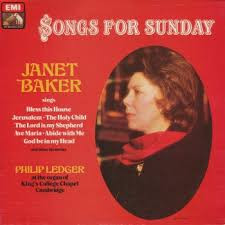
The remaning items are from a 1980 disc called Songs for Sunday which will no doubt be more to some people’s taste than to mine. It’s not a record I ever paid much attention to, though I did buy a copy for my mother when it came out. I am not religious, but Dame Janet’s, singing with  with her customary sincerity and generosity of spirit, completely won me over.
ms00mjy5lmpwzwc

These twenty discs have confirmed for me Baker’s place as one of the greatest singers of the latter half of the twentieth century. Her records continue to educate and enthral. There is something so personal about Baker’s art, a sense of total identification with the composer in question and an innate ability to capture the right mood of each song. This goes hand in hand with a gift for communication which is vouchsafed to only a few. Just occasionally one can be aware of the huge amount of thought that has gone into each interpretation, but I’d rather too much intelligence than too little. It has been  interesting too to hear her collaborations with so many different musicians. For me she is the last of the true greats. How lucky we are that she left behind her such a rich and varied legacy.
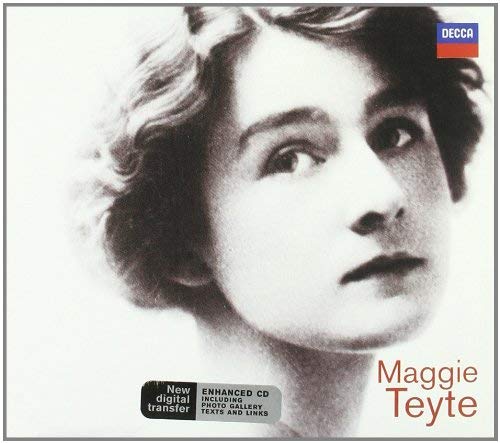
Maggie Teyte – The Singers

These recordings were all made in the 1930s and so pre-date the two disc set of French song I reviewed a few months ago here, with the second part of the disc being taken from a 1937 radio broadcast. One of the songs (Armstrong Gibbs’ The fields are full of summer still) was newly discovered in 2001 and first published on this CD.

We start with one of Dame Maggie’s most famous performances, that of Périchole’s Tu n’es pas beau, sung with great affection, a twinkle in the eye and with that wonderful dip into her inimitably glorious chest voice. Though a light soprano with pure, firm top notes, Teyte’s lower register was admirably rich and full in a manner we rarely hear today, more’s the pity. The orchestra here sounds like a palm court orchestra at a tea dance, but the singing is another matter entirely and alone well worth the price of the disc. The two excerpts from Messager’s Véronique, which follow are almost as good.

Teyte was particularly renowned for her interpretations of French song, but we are vouchsafed only two (very well known) songs from that field, Fauré’s Après un rêve and Hahn’s Si mes vers avaient des ailes. The Fauré is much better than the one on the French song disc mentioned above, where I felt she fussed with the song too much making it lose its natural flow, and the Hahn is as lovely as the later recording with Gerald Moore. These are followed by two Dvorak songs, Christina’s Lament, which turns out to be his Humoresque arranged for voice and piano, and the ubiquitous Songs my mother taught me, both beautifully sung.

These are followed by a group of songs from light musicals, mementoes of her days spent in British Music Hall. They may be musically slight, but Deep in my heart, dear from Romberg’s The Student Prince was actually one of Dame Maggie’s favourite recordings. It crests with a high B, which she thought the most beautiful note she had ever recorded. Certainly the note rings out clear and clean as a bell.

The lion’s share of the disc, however, is given over to a 1937 BBC broadcast recital, which couples popular songs by Schumann and Brahms to a group of English songs by turn of the century composers Quilter, Bridge, Delius, Armstrong Gibbs and (completely new to me) Amherst Webber and Graham Peel. As ever, the voice is bright and pure, her manner direct and disarming, her diction and intonation well-nigh perfect. Admittedly, there are aspects of her singing which some might find quaint and old fashioned today, but her technique is superb and her voice remained firm and clear well into her sixties.

Perhaps because of some of the material, this is not quite so recommendable as the EMI two disc set of French songs, but I would never want to be without it, if only for the wonderful aria from La Périchole.

Ljuba Welitsch – Complete Columbia Recordings

Ljuba Welitsch, for the short time her star was in the ascendant, was undoubtedly a star, glamorous both of voice and personality. Renowned the world over for her Salome, a role in which Strauss himself had coached her, she was also known for her Tosca and Donna Anna. Unfortunately she had developed nodules by 1953 and thereafter, though she didn’t retire completely, confined herself to character roles, like the Duenna in the Schwarzkopf/Karajan recording of Der Rosenkavalier.

This two disc set showcases her Salome, Donna Anna and Tosca, as well as Johann Strauss (the Czardas from Die Fledermaus and Saffi’s Gypsy Song from Der Zigeunerbaron). The rest is devoted to Lieder and songs by Brahms, Schubert, Schumann, Darogmizhsky, Mussorgsky, Marx, Mahler and Strauss, all with piano accompaniment, even the Vier letzte Lieder.

Whilst we get a good impression of the glamour and the silvery purity on high, the recordings do also rather show up her limitations. Best of the items is the 1949 recording of the Final Scene from Salome under Reiner, though, even here, I prefer the earlier performance she made under Lovro von Matacic in 1944, which, to my mind, has a greater degree of specificity. There is just the suspicion here that she had sung the role too many times; there is a touch of sloppiness in the delivery, which is complelely absent from the earlier recording.

She makes an appreciable Tosca, and something of her stage personality comes across here, but, I hear little of Callas’s detail or Price’s or Tebaldi’s vocal opulence and Tucker makes an unseductive Cavaradossi in the Act I Love Duet. A tendency to be careless of note values is even more evident in the Donna Anna excerpts, where we also become aware of an unwillingness to vary the volume or colour of her singing. She also has an annoying tendency to rush the beat. John Steane also had some misgivings in his book The Grand Tradition.

It is hard to think of a voice with a brighter shine to it, or of a singer with greater energy and more sense of joy in that sheer act of producing these glorious sounds. Even here, however, one notes that subtlety is hardly in question; there is little of the lithe seductiveness which Schwarzkopf and Güden bring to the [Fledermaus] Czardas, for instance. And this limits much of her best work, even the Salome in which she made such an exciting impression on her audiences.

We also note the complete absence of a trill in both Donna Anna’s Non mi dir and the Czardas from Die Fledermaus.

These limitations are even more evident in the songs with piano, and, though there is still much to enjoy in disc one, I found much of disc two something of a trial to listen to, the voice just too bright and unrelentingly mezza voce. The Strauss Vier letzte Lieder can work with piano, as witness a recording by Barbara Bonney, but here I just longed for the greater subtlety and range of expression of Schwarzkopf or Popp, of Norman or Fleming. The Mahler had me thinking of the shattering Lorraine Hunt Lieberson in the piano accompanied version, and the Schubert and Schumann songs hardly begin to challenge versions by a range of different sopranos from Welitsch’s time onwards.

If I were to choose but one representation of Welitsch’s art, it would absolutely be the 1949 live recording from the Met of Salome under Reiner, but, for a recital I’d go for EMI’s old LP and CD transfer of the 1944 Salome Final Scene, which also has on it a glorious version of Tatyana’s Letter Scene from Eugene Onegin, a disc I reviewed a couple of months back here. This present two disc set is, I’m afraid, a mite disappointing.

Fritz Wunderlich – A Poet Among Tenors.

71hhanlyugl._sl1200_

As well as for DG, Wunderlich recorded extensively for EMI and this 6 disc set, now on Warner, has very little overlap with the DG set I reviewed earlier. Indeed it is amazing how much Wunderlich recorded in his relatively short career. Most of these EMI recordings were all made in the years 1959 to 1962. The exceptions are the excerpts from Klemperer’s Das Lied von der Erde, which was recorded in 1964. Some have doubted Wunderlich’s ability to ride the Mahlerian orchestra, suggesting that he might have had some studio assistance. Well we now have two live recordings of the work (under Krips and Keilberth, both with Fischer-Dieskau singing the lower songs) to refute that. Whether large or not, the voice had a fine ring to it and its heady beauty remained unimpaired whether at piano or forte. I think there is a discernible increase in its carrying power between 1959 and 1964, and I have no doubt he would have gone on to sing certain Wagner roles – Lohengrin and Walter von Stolzing at least.

So what do we have here? Well disc 1 starts of somewhat surprisingly with early German fifteenth century songs, then progresses through Bach, Handel (a sublime Ombra mai fu), Mozart arias from Die Entführung aus dem Serail and Die Zauberflöte (Dies Bildnis ist bezaubernd schön slightly more diffident here than it is on the later Böhm recording), and excerpts from Lortzing’s Zar und Zimmermann and Der Wildschütz which rather outstayed their welcome for me. It finishes with excerpts from Nicolai’s Die lustigen Weiber von Windsor, including his glorious version of Horch, die Lerche singt im Hain.

Discs 2 and 3 are mostly operetta, with the addition of ecerpts from Flotow’s Martha and Cornelius’s Der Barbier von Bagdad. Wunderlich’s infectious joy in the act of singing made him ideal for operetta and though there is admittedly rather a lot of it here, he makes no concessions to the music; like Schwarzkopf and Gedda, he can make the music sound much better than it is.

However, for me the jewels of the set, with a couple of exceptions noted above, are all to be found on discs 4 and 5. Though all sung in German, we get some ideal performances of excerpts from Italian, French, Czech and Russian opera. Disc 4 starts with the Act I duet for Donna Anna and Don Ottavio (with Elisabeth Grümmer no less), in which he is both aristocratic and ardent, with a touch of the heroic often missing from singers of Don Ottavio. Wunderlich’s Mozartian credentials are further strengthened by the inclusion of both Don Ottavio’s arias and Ferando’s Un aura amorosa from Cosí fan tutte. Nemorino, the Duke and Alfredo’s arias are all treated to his golden tone and winning manner, his liquid legato hardly impeded by the fact that he is singing in German rather than Italian. There are more extended excerpts from La Bohème and Madama Butterfly, in which he is an ardent Rodolfo and Pinkerton (a glorious top C in Che gelida manina), whilst disc 5 gives us some lovely excerpts from French operas (Boieldieu’s La Dame Blanche, Thomas’s Mignon and Massenet’s Manon and wonderful Smetana (The Bartered Bride), though he is hampered here by the gusty singing of Melita Muszely, who sounds rather like Marianne Schech in Konwitschny’s Der fliegende Holländer. This is not a compliment. Best of all perhaps is his plaintive singing of Lensky’s Kuda, kuda, but he is also superb as Hermann in The Queen of Spades.

The last disc concenrates on Lieder; Schubert, Wolf, some glorious Strauss which might just have reconciled the composer to the sound of the tenor voice, and of course his headily free singing of the tenor songs from Das Lied von der Erde. That said, though there is always pleasure in the voice itself, these 1962 performances of Lieder are a little penny plain. He hasn’t yet learnt the Lieder sigers art of colouring the voice to the text. The disc finishes off with a song cycle by his friend Fritz Neumeyer, which unfortunately rather outstays its welcome. No matter, these are wonderful reminders of a gorgeous tenor voice that shot through the operatic firmament only to be silenced too soon.

It remains to be said that the orchestral contrubutions are fine and it is good to also encounter the voices of Aneliese Rothenberger, Lisa Otto, Pilar Lorengar, Rudolf Schock, Hermann Prey and Gottlob Frick in some of the duets and emsembles.

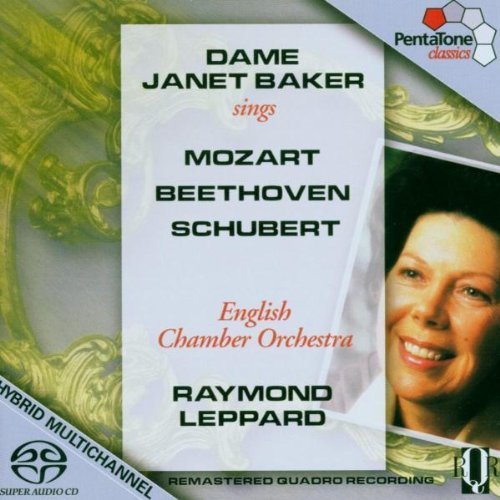
Dame Janet Baker sings Mozart, Beethoven and Schubert

51exmgqxv1l

Essential listening, I’d venture to suggest, even for those who already have the Philips Originals box set I reviewed here. Here we have the whole of Baker’s 1977 Beethoven and Schubert recital, of which three items appear on the Philips box, coupled to the Mozart items from her 1974 Mozart and Haydn recital, none of which do.

The prize of this CD is Dame Janet’s superb rendering of Sesto’s arias from La Clemenza di Tito. Not only is it a technical tour de force, the rapid triplet figures at the end of Parto, parto tossed off with breathtaking ease, but the range of expression is extraordinary and personal. I have never heard another singer differentiate so much between the repeated cries of Guardami!; in the first she pleads almost angrily, but in the second her tone changes completely, becoming meltingly beseeching, as if Sesto realises he has gone too far. Furthermore she has the ability to get to the emotional core of the music without ever disrupting its Classical style. Pure genius.

Elsewhere she is in enviable form in a programme that ranges wide, including rarities like Beethoven’s No, non turbati and arias from Schubert’s Lazarus and Alfonso und Estrella. Leppard’s accompaniments, whether conducting the English Chamber Orchestra or on the piano or harpsichord are discreet rather than revelatory, perhaps happy, with such a patrician artist, to let his soloist take the lead.

The recordings, originally made for Philips in quadrophonic sound, are here issued in SACD, though I was listening in simple stereo. They are wonderfully clear and lucid.

Highly recommended.

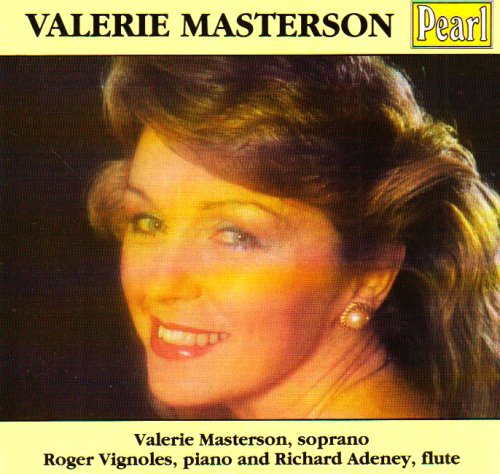
Valerie Masterson – Song Recital

51vle4ved5l

  1. Arne – O ravishing delight
  2. Arne – Under the greenwood tree
  3. Arne – The soldier tir’d
  4. Handel – Nel dolce del’oblio
  5. Bishop – Lo! Here the gentle lark
  6. Gounod – Le premier jour de mai
  7. Gounod – L’absent
  8. Gounod – Sérénade
  9. Bizet – Vieille chanson
  10. Bizet – Pastel
  11. Bizet – Tarantelle
  12. 12 – Satie – La diva de l’empire

The English soprano Valerie Masterson was a mainstay of my early opera going life and I saw her on stage quite a few times. A light lyric soprano with great flexibility and an immediately recognisable voice, she was also much admired in France, having made her French debut in Toulouse in the role of Manon. The following year she created quite a stir at the Aix-en-Provence Festival singing the role of Matilde in Rossini’s Elisabetta, Regina d’Inghilterra opposite Montserrat Caballé. She was an arrestingly beautiful woman with a charming stage presence and I well remember her Semele at Covent Garden which was both vocally and visually stunning. Unfortunately I didn’t get to see her ravishing Cleopatra in ENO’s production of Handel’s Julius Caesar (sung of course in English) with Janet Baker, but at least it was filmed. I did however see her as Manon, Juliette, Margeurite, the Governess in Britten’s Turn of the Screw and as the Marschallin, a role she took into her repertoire quite late in her career, having had enormous success as Sophie when she was younger.

Recorded in 1986 when Masterson was approaching 50, this recital probably catches her just past her best. There is just the suspicion that the lovely voice is thinning out, a trace of a slight taint on its silvery purity. Nevertheless the recital is something of a treasure, especially considering Masterson was so little recorded.

With piano accompaniment provided by Roger Vignoles, it splits neatly into two halves, the first being of music from the baroque era (Arne, Handel and Thomas Bishop), where she is joined by Richard Adeney on the flute, and the second of songs by Gounod, Bizet and Satie. The baroque items display her neat and deft coloratura as well as her ability to shape the long line. When she sings O ravishing delight in Arne’s song, the words mirror exactly the sounds coming from the speakers. It is good also to have the Handel cantata, reminding us of her many successes in his works.

The French items are all fairly light. They are a sung with elegance and style but a little more variety in the material might have been welcome here. She finishes with a delightful performance of Satie’s La Diva de l’Empire which captures a coquettish smile in the voice.

A lovely reminder of a lovely singer.

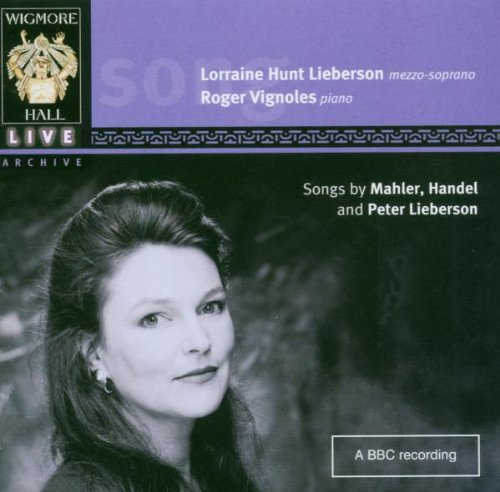
Lorraine Hunt Lieberson – Songs by Mahler, Handel and Peter Lieberson


There are some singers whose emotional connection to the music they are singing is so complete, so all-embracing that such minor details as vocal technique and beauty of voice are completely forgotten. Not that either of those two qualities are in the least bit lacking here, but they don’t really register, so intense, so all-enveloping is the experience of listening.

Lorraine Hunt Lieberson was one such artist and, more than once during the course of this marvelous recital, she managed to reduce me to tears. In her voice, the act of singing becomes as natural as the act of speaking. There is no artifice, no show, just total commitment to the music and that rare gift of communication.

The disc starts with a highly personal and emotionally shattering performance of Mahler’s Rückert Lieder. I prefer Mahler’s orchestral version of these wonderful songs but even with piano accompaniment (wonderfully realised by Roger Vignoles here) I would place this performance with Janet Baker’s of the orchestral versions under Barbirolli as the pinnacle of Mahler interpretation. Indeed the desolation of Um MItternacht is utterly overwhelming and the performance of all the songs totally gripping, with the audience sitting in rapt silence.

The Handel items, though more theatrical, more outwardly dramatic, are no less sincere. She makes musical sense of the vocal leaps in Scherza infida and pours calming balm on the ears in As with rosy steps from Theodora, a reminder of her devastating Glyndeboure performances of Irene.

She married Peter Lieberson the year after this recital and she sings here two of his Rilke settings, written specifically for her as well as an aria from his opera Ashoka’s Dream, which she performed in Santa Fe the previous year. The lovely Rilke songs were recorded complete at the Ravenna Festival in 2004 but it is good to have this tantalising extract from Lieberson’s opera.

To close we have two encores, a stunningly heartfelt performance of the spiritual Deep River which became something of a Hunt Lieberon speciality and a radiantly ecstatic performance of Brahms’s Unbewegte laue Luft.

Hunt Lieberson died at the age of 52 when she was at the absolute height of her career, which makes every recording she made, most of them from live performances, absolutely essential. This one is no exception

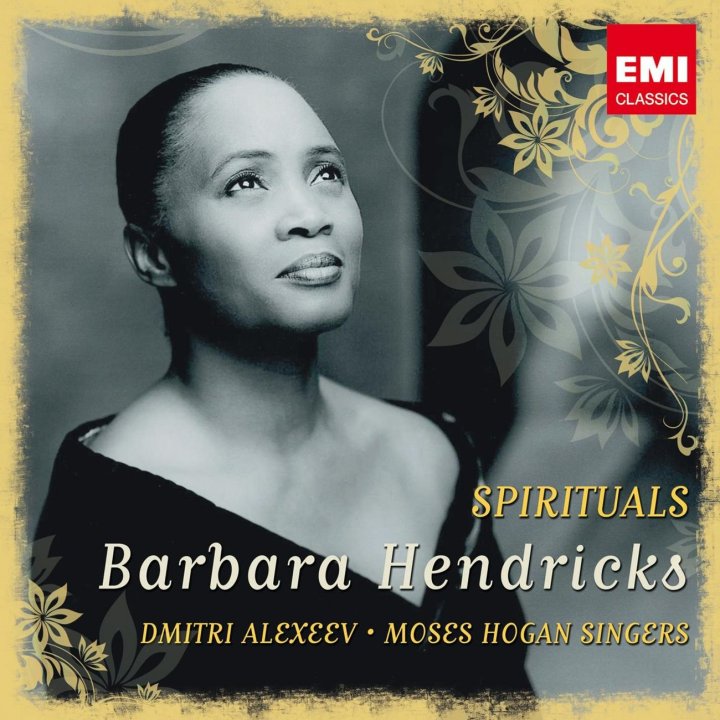
Barbara Hendricks – Spirituals

71ryumiuudl._sl1300_

Fifteen years separates these two discs of Spirituals by Barbara Hendricks and the intervening years have done little to tarnish the voice’s beauty. I suppose if one listens carefully and with a highly critical ear, a slight wear on the top register is detectable, a little of the gloriously rich bloom has gone but, for the most part, the consistency is remarkable.

However the two discs differ quite a lot in other ways. The first one might be seen to have a more sophisticated approach, treating the spirituals more as art song with piano accompaniments beautifully realised by classical pianist and winner of the Leeds Piano Competition in 1975, Dmitri Alexeev, whilst the second adopts what one would consider a more traditional approach with the contribution of the Moses Hogan Singers. You might think, therefore that the second would be the more satisfying, but I prefer the approach of the first, which brings more concentration on the songs and Miss Hendricks’s glorious singing. More than once the second disc, though beautifully executed, has a whiff of Hollywood, and it is the first disc I listen to most often. You might have different preferences.

The first disc has a good cross section of slow and up tempo songs, of the not so well known and favourites like Swing low. sweet chariot and Nobody knows de trouble I’ve seen. Hendricks gorgeous voice is in prime condition here, velvety and rich in the lower and middle registers and opening out into that gleamingly individual top register. Her diction is superb too and she makes no concessions to the music, singing with a burning conviction that suits the material well. Her exhortation of The lord loves a sinner in Roundabout da mountain would convince any sinner to repent whilst her beautifully lulling Swing slow, sweet chariot would rock any baby to sleep. She also has the voice for joy in such songs as Ev’ry time I feel de spirit. A wonderful disc and on its own well worth the price of the two disc set, which closes a disc guaranteed to lift the spirits.

The second disc provides variety by including songs for unaccompanied solo voice and for just the choir, but, for my money, there is more musical variety in the first one.