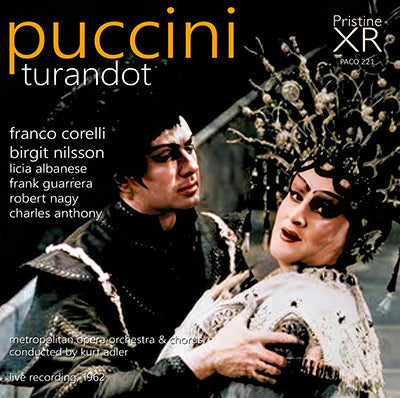
Turandot from the Met with Nilsson and Corelli

La principessa Turandot – Birgit Nilsson (soprano)
Calaf – Franco Corelli (tenor)
Liù – Licia Albanese (soprano)
Ping – Frank Guarrera (baritone)
Pang – Robert Nagy (tenor)
Pong – Charles Anthony (tenor)
Timur: Ezio Flagello (bass)
L’imperatore Altoum – Alessio De Paolis (tenor)
Un mandarino – Calvin Marsh (baritone)
Chorus and Orchestra of the Metropolitan Opera/Kurt Adler
rec. live radio broadcast, 24 February 1962, Metropolitan Opera House, New York City, USA

Well, let’s get this straight. This is an exciting performance of Puccini’s last opera, which puts you in a good seat at the old Metropolitan Opera House on a night when two of its greatest stars were singing two of their greatest roles. You can sense the excitement in the house from the moment the radio announcer, Milton Cross, introduces the opera with the words, “We’ll have the loud, crashing chords, then the curtain will open on the walls of the oriental Imperial palace of Peking.” Indeed the set is loudly applauded by the audience.

After the excitement of those opening chords and the chorus which follows, it is something of a disappointment to be confronted with the Liu of Licia Albanese, who was approaching 53, but quite frankly sounds even older. She compensates by loudly over-singing and over-emoting, and I derived very little pleasure from her performance. Her days at the Met were evidently numbered and she left the company in 1966, following a dispute with Sir Rudolf Bing.

For the rest, we have a sonorous Timur from Ezio Flagello, but the Ping, Pang and Pong tend to over-characterise their music and consequently I found their scenes irritating, as I often do.

However, the main reason for hearing this set remains the splendid singing of Nilsson and, especially Corelli. I am not one of those who think Corelli can do no wrong, but in the right role, and Calaf is undoubtedly the right role for him, he is unbeatable. First of all, there is the sheer splendour of that sound, the thrill of his top notes, which he can fine down to almost a whisper in places. He is absolutely thrilling and the audience go wild after Nessun dorma, with Adler abruptly stopping the orchestral postlude until the pandemonium has died down.

So too, of course, is Nilsson, throwing out those top notes like laser beams. The punishing tessitura holds no terrors for her at all and it is all very exciting, if not particularly subtle. Nor is the conducting of Kurt Adler, for that matter, but he certainly knows how to whip up the excitement.

According to Lee Denham in his exhaustive survey of the opera, there are, or have been, available seven other recordings featuring Nilsson, three of them with Corelli, so how necessary is this particular recording? I’m pleased to have heard it, but I’m not sure I’d want it as my one representation of Nilsson and Corelli in the opera. For that, I’d probably stick with the EMI recording under Molinari-Pradelli, which also has the benefit of including the Act III aria Del primo pianto, which is omitted from all Nilsson’s live accounts. It also has the benefit of the young Renata Scotto as Liu.

I would also not want to be without the Mehta recording with Sutherland, Pavarotti and Caballé, nor the Serafin with Callas, Fernandi and Schwarzkopf, but this one is a great reminder of a thrilling afternoon at the old Met.
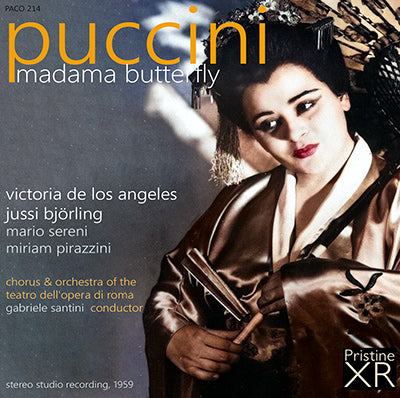
De Los Angeles and Björling in Madama Butterfly

paco214_530x

This Pristine XR Remastering of De Los Angeles’ second 1959 recording of Madama Butterfly has already been favourably reviewed twice before on MusicWeb International, once by Ralph Moore (review) and once by Morgan Burroughs (review), and I can add little to what they have said. We have De Los Angeles in one of her best and most conducive roles and Björling singing with golden tone. In Pristine’s newly re-mastered transfer of the stereo original, surely this is self-recommending, and who am I to disagree? However, I should mention that there is an earlier 1955 De Los Angeles recording, in mono sound, with Di Stefano as Pinkerton, Gobbi as Sharpless and conducted by Gianandrea Gavazzeni, which, in some ways, surpasses the performance we have here. It is available at super bargain price from the Regis label and was favourably reviewed by Christopher Howell here.

That earlier recording’s chief asset is the conductor, Gavazzeni, who makes far more of the score than the rather dull and prosaic Santini, and it makes me realise how important the role of the conductor is in Puccini. Indeed, all the best sets have benefited from a great conductor; Karajan, for both Callas and Freni, Serafin for Tebaldi, Barbirolli for Scotto and Pappano for Gheorghiu. And, if Santini has at his disposal an excellent cast, Gavazzeni’s is just as good, and in some respects even better. Björling, for Santini, sings with golden tone, but is just a trifle stiff. This was to be Björling’s last recording, and the heart condition, which would end his life at the early age of 49, was already apparent. Indeed, he collapsed during one recording session of the Act I love duet and needed several days to recover before he was able to continue. This could account for his relative stiffness. Di Stefano, on the other hand creates a real character. Carelessly charming in his exchanges with Sharpless and genuinely seductive in the love duet, he is suitably devastated by what he has done in the last act. I don’t see Pinkerton as a villain or an out and out cad. He is just an impulsive young man, who gives little thought to his actions at the beginning of the opera. Young men like him are ten a penny on any American college campus and Di Stefano portrays him to the life.

Sereni is a sympathetic Sharpless for Santini, but Gobbi, for Gavazzeni, surpasses him in verbal acuity and De Los Angeles is in slightly fresher voice in the earlier recording, though the difference is marginal.

What is not in doubt is the improved sound picture in the later stereo recording, especially in Pristine’s remastering, which opens up the sound quite a bit. I should also mention that Pristine as usual provide downloads of the full score and libretto, whereas the Regis issue of the earlier recording just comes with notes and a synopsis. Whichever version you go for, you will get one of the most touching Butterflies on disc.


A sonically splendid new recording of Tosca can’t compete with ghosts from the past.

81nx7ewddnl._ac_sl1500_

Tosca (1900)

Floria Tosca: Melody Moore (soprano)
Mario Cavaradossi: Ștefan Pop (tenor) 
Scarpia: Lester Lynch (baritone)

Kinderchor der Deutschen Oper Berlin, Rundfunkchor Berlin. Rundfunk-Sinfonieorchester Berlin/Carlo Montanaro

Rec. April 2022, Haus der Rundfunks, Berlin

Notes and synopsis in English and German included.

Penatone PTC 5187 055 (110)

Tosca is one of the most popular operas in the repertoire and yet there have been remarkably few totally successful recordings over the years, possibly because the mono De Sabata, recorded way back in 1953, is widely considered one of the greatest opera recordings ever made; in fact number one in Ralph Moore’s list of untouchables. The stereo age brought us a couple more, like Karajan’s first with Leontyne Price and Davis’s with Caballé, but the list is quite small, and these too are quite old. A new modern studio recording is certainly timely.

So, let’s start with the positives. I was listening to the stereo layer, which I tried both through speakers and headphones and the sound really is superb, warm and well balanced, though I did wonder whether the off-stage chorus in ACT II were a little too much in the foreground. I suppose it might be dramatically apt to have the on-stage soloists struggling to be heard, but in that case, I would have thought a sound effect of Scarpia impatiently closing the window were necessary. As it is, the chorus just stops abruptly in mid-phrase for no apparent reason.  The Berlin Rundfunk Sinfonieorchester may not be as famous an ensemble as those in Milan and Vienna, but they acquit themselves very well.

Unfortunately, the conductor, Carlo Montanarlo is rather too literal and prosaic. He rarely lets the music flower and flourish, and his conducting comes across as rigid and perfunctory, moving the music along too fast, almost as if apologising for its eroticism. Great Puccini conductors, like De Sabata and Karajan, understand the importance of rubato, but there is no sweeping lyricism in sections like the orchestral accompaniment to Tosca’s exit in Act I or her entrance in Act III. He is also unable to sufficiently rack up the tension in the second act, or in the lead-up to the shooting in Act III. His conducting is altogether too polite and lacking in passion.

Tosca is sung by the American soprano, Melody Moore, who has already recorded the roles of Butterfly, Giorgetta in Il Tabarro and Minnie in La Fanciulla del West. She has also recorded a recital disc, which is a tribute to another erstwhile famous Tosca, Renata Tebaldi. She has a voice of the right size and weight for the role, though it loses colour a little at the very top. Like so many modern-day singers, she is somewhat sparing in her use of chest voice. There is no exciting plunge into chest when she sings the line Io quella lama gli piantai nel cor. And her whispered È morto! Or gli perdono! Is completely ineffective. Vissi d’arte is rather lovely, possibly because Monatanarlo finally relaxes a bit and allows the music to breathe. I found her a plausible Tosca with a beautiful voice, but a little anonymous. At no point does she begin to challenge the likes of Callas, Price, Tebaldi or Caballé.

The tenor, Stefan Pop,, has a pleasant, but essentially lyric voice and I see that, according to his Wikipedia entry, he is more known for the bel canto repertoire. He acquits himself quite well in Recondita armonia and the Act I love duet, but is stretched by Vittoria! Vittoria in Act II. He also sings a sweet-toned O dolci mani but E lucevan le stelle suffers from a surfeit of sobbing and consequent vibrato, possibly to make up for the lack of passion coming from the pit.

But the noose around this Tosca’s neck is the baritone, Lester Lynch as Scarpia. He has an unpleasant, wobbly, woofy baritone that leaks air at every emission. It’s possible, I suppose, that he cuts an imposing figure on stage, but that doesn’t come across on disc and he is a serious blot on the performance, his vocal inadequacies not allowing him to create a real character. Memories of Gobbi and Taddei are not expunged.

Nor, I’m afraid, are memories of Callas, Tebaldi, Price and Caballé or Di Stefano, Carreras, Corelli et al. I suppose that I might have enjoyed this performance of the opera if I’d come across it at a provincial opera house somewhere, but, in all but matters of sound, this set doesn’t begin to compare to those classic recordings of the past that I mentioned above.

Incidentally, most CD issues of the opera have Act I on the first CD and Acts II and III on the second, but Pentatone inexplicably split Act II over the two CDs, the break coming just after Tosca has blurted out the location of Angelotti. Why? This makes no sense at all.

In conclusion, with a different baritone and a more sympathetic conductor, the soprano and tenor might have put in a much more creditable performance. As it is one can rest assured that the De Sabata recording with the exceptional team of Callas, Di Stefano and Gobbi remains “untouchable”. That recording is mono of course (though it sounds remarkably good in the 2014 Warner transfer) so if stereo is I must, I can confidently recommend Karajan with Price, Di Stefano and Taddei or Davis with Caballé, Carreras and Wixell. There is also a recording with Tebaldi, Del Monaco and George London, conducted by Francesco Molinari-Pradelli, who may not be the most imaginative of conductors, but is a great deal preferable to the placid Montanarlo.

Other cast
Angelotti: Kevin Short (bass)
Spoletta: Colin Judson (tenor)
Sacristan: Alexander Köpeczi (bass)
Sciarrone: Georg Streuber (baritone)
Jailer: Axel Scheidig (bass) 
Shepherd boy: Lean Miray Yüksel (soprano)