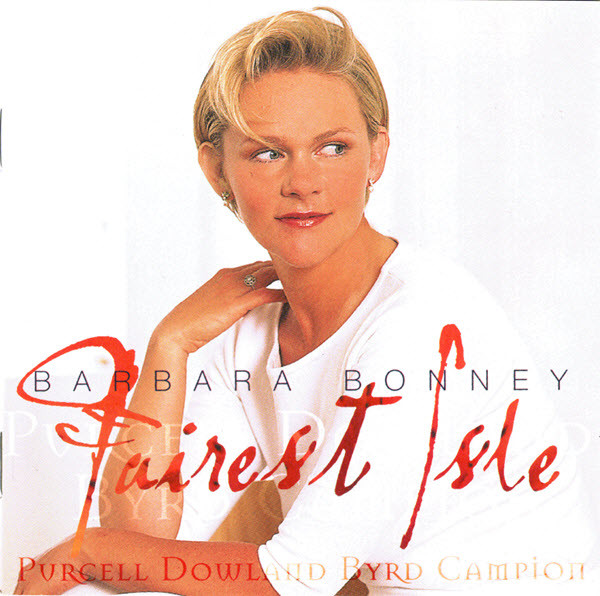
Barbara Bonney – Fairest Isle

r-8615652-1465200442-8858.jpeg

“Come again, sweet love doth now invite,” sings Barbara Bonney at the beginning of this recital, and the invitation is so beguiling that it would be hard to resist.

What follows is just over an hour of pure delight. We start with a selection of lute songs by Dowland, Campion, Morley and Byrd, all accompanied by Jacob Heringman. Bonney’s pure tone and natural, unaffected manner might suggest a lack of personality and yet she has something personal to say about each song, with a lovely smile in the voice for the quirky Away with these self-loving lads, and a deeper vein of melancholy for the famous Flow my tears which in turn is followed by a delightfully charming It was a lover and his lass.

She is joined by the viol quartet Phantasm for Byrd’s O Lord, how vain are all our frail delights, who also provide an instrumental interlude between this and the other Byrd piece Though Amaryllis dance in green with John Jenkins’s Fantasy no 3.

More variety is accorded when, for the Purcell items, Bonney is accompanied by The Academy of Ancient Music under Christopher Hogwood, with Andrew Manze suppling violin obligato in the lovely Plaint from The Fairy Queen, which preceded by couple of instrumental items here (two Airs from Abdelazar) is not taken too slowly for once.

Fairest Isle, both the song and the disc it gives its name to, might possibly be considered a tribute by this American soprano to the land she has made her home, and she finishes with one of the most well known English arias in the repertoire, Dido’s wonderful Lament from Dido and Aeneas. It is perhaps not so powerfully intense as versions by Dame Janet Baker and Lorraine Hunt Lieberson in their complete sets, but, taken out of context, it makes a fitting conclusion to a recital that affords nothing but pleasure.

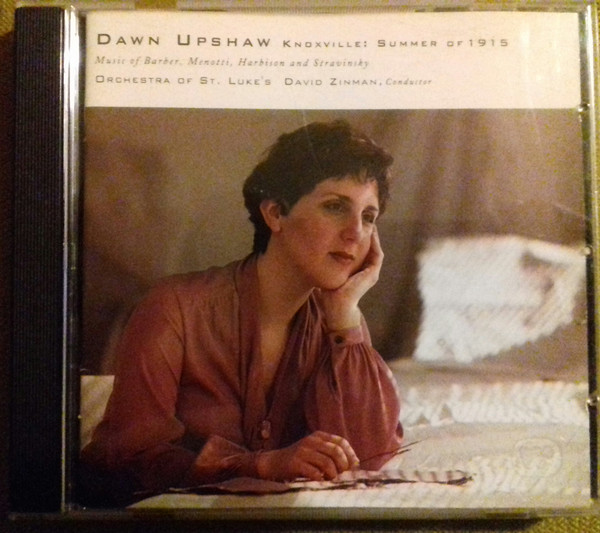
Knoxville: Summer of 1915 – Dawn Upshaw

r-12665160-1539626691-5475.jpeg

It seems incredible now that this disc was released over 30 years ago, but there it is, clearly written in the insert, “Recorded August 1988 at Manhattan Center Studios, New york”, though, IIRC, it had a different cover on its first release.

Barber’s wonderfully nostalgic Knoxville, Summer of 1915, a setting of James Agee’s prose-poem has now, it would seem, become quite popular. It was first recorded by its dedicatee, Eleanor Steber in 1950, a couple of years after its premiere, but had to wait another eighteen years before being recorded again, though very successfully by Leontyne Price. It had to wait a further twenty years for this version by Dawn Upshaw, but its success has led to a spate of others by the likes of Barbara Hendricks, Sylvia McNair, Roberta Alexander, Kathleen Battle, Jill Gomez, Karina Gauvin and, most recently, Renee Fleming.

Steber was a wonderful singer, and her version is very fine, but for me it misses the essential childlike quality of the piece and she can sound a bit mature, even a trifle prim. Price, on the other hand, is surprisingly successful at scaling down her rich velvety voice to the needs of the writing, and her version is deservedly well known. Dawn Upshaw, on the other hand, has by nature what Price had to strive for. She has exactly the light voice and direct manner the piece needs and there is no need for her to characterise; she simply has to be herself, her diction natural and unforced. David Zinman’s tempi are also just right, and it is no surprise to find that this version has been a top recommendation since it was first issued.

The rest of the programme is also attractive, its centrepiece being John Harbison’s Mirabai Songs, originally written for piano, but here given in his chamber orchestra version. The songs are settings of 16th century devotional Indian poems by Mirabai, who, after her husband died, devoted her life to the God Krishna. The texts are alternatively erotic, ecstatic and devotional, the orchestrations colourful, the vocal range wide and Upshaw is fully up to their demands.

The interesting but quite short programme is rounded off with a couple of operatic pieces, a short extract from Menotti’s radio opera The Old Maid and the Thief, and Anne Trulove’s No word from Tom from Sravinsky’s The Rake’s Progress, and Upshaw would seem perfectly cast in both.

Like most of Upshaw’s records the material chosen is refreshingly different and well worth investigating.

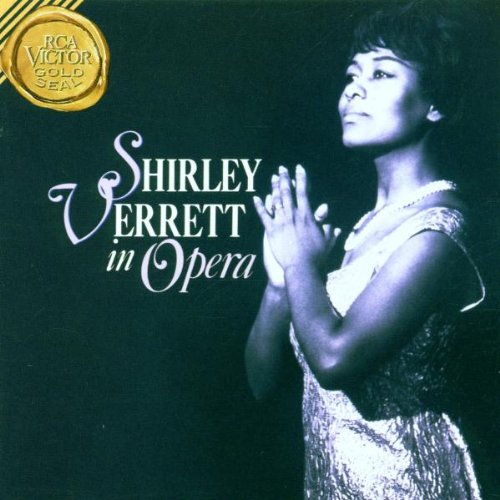
Shirley Verrett In Opera

51ajzxt2szl51wmswrrusl

This is a wonderful recital disc and a great example of the art of Shirley Verrett, dating from 1967, before she ventured into soprano territory.

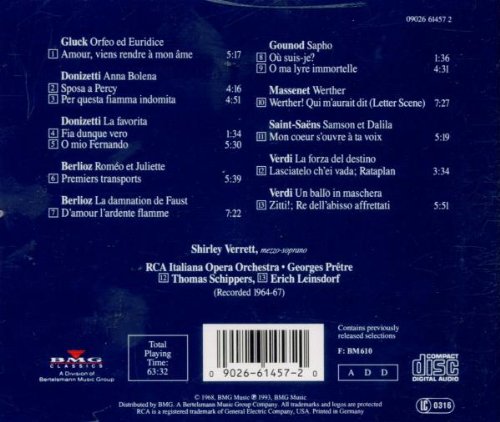
It starts with a stunningly virtuosic rendering of Orphée’s Amour, viens rendre à mon âme from the Berlioz edition of Gluck’s Orfeo ed Euridice. Verrett maintains a true appreciation of the classical style, the chest voice used more sparingly than in Verdi, vibrato kept to a minimum. She also gives the piece a properly heroic dimension. Orpheus is after all srengthening his resolve at this point.

The two Donizetti items showcase her facility in bel canto, though with so many French items in the recital, it’s a shame she sings the aria from La Favorite in Italian. The short scene between Giovanna and Enrico from Anna Bolena gives us the chance to hear her engagement with the text in recitative, her legato line in the cavatina and her felxibility in the cabaletta. The aria from La Favorita also goes well, again displaying her deep legato in O mio Fernando, and her thrilling dramatic thrust in the cabaletta.

She is even better in the French items, giving us a beautifully restrained performance of Premiers transports from Berlioz’s Roméo et Juliette, and one of the best versions I have heard of Margeurite’s D’amour l’ardente flamme, one of the composers greatest inspirations. Verrett’s responses to the text are just that bit more vivid than those of Von Stade, whose eary French recital I listened to recently, with a much greater range of colour. Only Callas surpasses her in creating an atmosphere of utter forlorness and longing, though it has to be admitted that by the time she recorded it her actual tone couldl sound somewhat frayed and thin, where Verrett is firm and rich throughout.

She is grandly eloquent in the aria from Sapho, and wonderfully alive to the many changes of emoton in the Letter Scene from Werther, briliantly charting Charlotte’s mounting anxiety. This too is one of the greatest performances you will ever hear of the scene, and it is a great pity she never recorded the complete role.

It is also nothing short of tragic that she never recorded the role of Dalila, one of her greatest stage successes, and her beautiful reading of the famous Mon coeur s’ouvre à ta voix closes the recital proper. Disappointingly she follows regular performance practice, by splitting the phrase in Ah, réponds à ma tendresse in order to snatch an extra breath. It is so much more effective when sung, as Saint-Saëns indicated, in one long breath, though Callas is one of the only singers to do it that way. Aside from that one slight cavil, her comparative restraint is welcome and all the more seductive for letting the music speak for itself.

The Verdi pieces at the end are taken from complete recordings of the two operas. She is wonderfully vivid as Preziosilla and darkly commanding as Ulrica.

In all Verrett’s superb musicality is evident, and I often wonder why she recorded comparatively little, given the flurry of opera recordings made in the 1970s. That her superb Carmen was never committed to disc is little short of criminal.

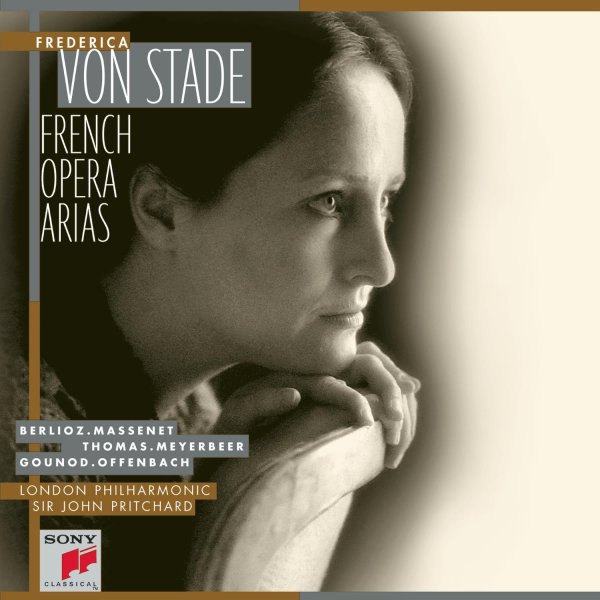
Frederica Von Stade – French Opera Arias

710yvtzhbil._sl1500_

This 1976 recital was, I believe, Von Stade’s first recital disc. In 1970, at the age of 25 she had secured a comprimario contract at the Met, debuting there as one of the Three Boys in Die Zauberflöte, and international acclaim followed in 1973, when she appeared as Cherubino at Glyndbourne in a Peter Hall production that was also televised. Von Stade’s winningly boyish Cherubino catapulted her to stardom alongside Kiri Te Kanawa and Ileana Cotrubas, who played the Countess and Susanna. I remember seeing it on TV, and the impression they all made.

Though American born, Von Stade spent a good deal of her youth in Europe, and later spent some years in France, and so is completely at home in the French language. Indeed French opera and song became a staple of her repertoire though, at this early stage of her career, she doesn’t always use the words to her advantage, and some of the arias could be more clearly characterised. That said, the voice itself, a clear lyric mezzo, is always beautiful and her use of it unfailingly musical. She is best at winning charm and bittersweet sadness, and the least successful item here is Charlotte’s Va, laisse couler mes larmes from Werther, which doesn’t compare to what she achieves in the complete recording under Davis (recorded in 1980).

My favourite performances are of Mignon’s Connais- tu le pays?, which captures to perfection Mignon’s wistful longing for her homeland (I always think it a pity that Von Stade wasn’t the Mignon on the Almeida recording, on which she plays Frédéric) and the aria from Cendrillon, and it is no surprise to find that she went on to have a great success in the complete role. Her natural charm also comes across well in the Offenbach arias and in Urbain’s aria from Les Huguenots.

The aria from Berlioz’s Béatrice et Bénédict for the most part goes well, though her responses are a little less vivid than Janet Baker’s on the complete Davis recording, and the Allegro lacks a little in joyfulness. Her natural plaintiveness is more suited to Marguerite’s D’amour l’ardente flamme, though, here too, there is a sameness of vocal colour which misses the urgency of the middle section.

A very enjoyable recital disc then, the beauty of the voice and her winning personality well caught, if with the proviso that she doesn’t yet quite convey the complete range of emotions required by the music. Nevertheless it always a pleasure to hear such beautiful and musical singing.

Baroque Duet – Kathleen Battle and Wynton Marsalis

r-3155647-1318618949.jpeg

Nobody would deny the honeyed beauty of Kathleen Battle’s pearly soprano, nor her felicity and ease of movement in fast coloratura. Nor would they deny Wynton Marsalis’s stupendous trumpet virtuosity. One would therefore assume that putting the two together would give you a winner. Given that the programme is a welcome mixture of the well-known and the unfamiliar, you might also expect a nicely varied recital.

Well that doesn’t really happen here, I’m afraid. Quite aside from the fact that there is absolutely nothing authentic about the performances (the orchestra made up of modern instruments and Marsalis playing on a valve trumpet), there is a sameness of approach and a preponderance of fast arias that tends to the monotonous, and in the rare slower pieces, the music starts to sound more like Rachmaninov’s Vocalise than anything authentically baroque.

As background music, it is undemanding and pleasant to listen to, especially if you have a sweet tooth, but, aside from showing off the prowess of its two stars, it doesn’t really add up to a satisfactory whole.

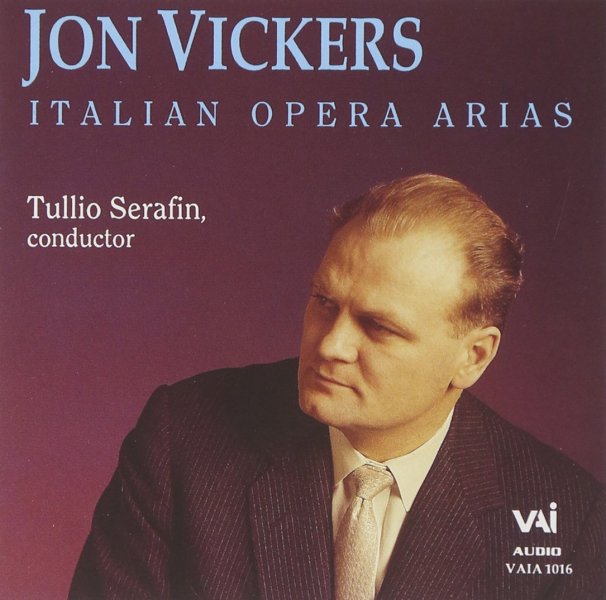
Jon Vickers – Italian Opera Arias

713njx42iel._sl1085_

Now this is great singing.

In the 1993 notes that accompany this re-issue of the one recital record Jon Vickers ever made, Vickers says,

At the time of the Italian Arias recording the field of opera was a totally different world than today. One sought to prove oneself worthy of association with the opera houses, general administartors, conductors, producers and singers one admired – even was in awe of. There was a humbling consciousness of the great history of places like the Metropolitan Opera, the Royal Opera House, Covent Garden, La Scala, Bayreuth, Vienna and Salzburg. Emphasis was upon delving as deeply as possible into the psychological depths of the text illuminated by the genius of the composer’s music. To dare to indulge any particular personal ability was to invite derision from colleagues and thunderous disapproval by public and press alike as being in bad taste and imposing of oneself upon a great work of art.

To be honest, I’ve listened to plenty of live performances from those days when bad taste and personal indulgence brings the house down, but his statement does give you a snapshot into the way the man worked, of his seriousness and dedication to his art.

This recital disc was recorded at the same time as his first recording of Otello under Tullio Serafin, when his only Wagnerian role was Siegmund, and you were more likely to hear him as Riccardo in Un Ballo in Maschera, Radames, Canio or Don Carlo. Later of course he want on to tackle Tristan and Parsifal, though he never sang Siegfried, and he dropped out of scheduled performances of Tannhäuser at Covent Garden, due to his religious scruples, saying he could not empathise with the character and that, in any case, the opera was blasphemous in character.

First impressions when listening to this disc are of the sheer size of the voice, and the power – a power that can be reined back to a merest pianissimo, then unleashed at will, like an organist pulling out all the stops. The other is intensity. Whether singing gently or loudly, there is a concentration and intensity that makes each short aria into a mini monodrama, and an ability to focus in on the meaning of each word and note. Nothing is taken for granted, nothing thrown away.

From a purely vocal point of view, it was still a very beautiful instrument back in 1961, and an aria like Cielo e mar is sung not only with golden tone, but with a true sense of wonder, and a way of pulling in and out of full voice that never destroys the long legato line.

Where many Italian tenors will add extraneous sobs and aspirates to indicate emotion, particularly in an aria like Federico’s Lament from L’Arlesiana, Vickers achieves an even deeper vein of emotion by never straying from the written notes, but simply (as if it was simple) intensifying his sound. In this he ressembles Callas, whom he revered so much having been Giasone to her Medea on many occasions.

One of the stand out tracks on this recital for me is Chénier’s Un di all’azzurro spazio delivered with mounting passion, but also somehow giving us a sense of the intellectual in the man. Canio suffers like no other, and yet he doesn’t have to break down in sobs at the end to make us feel it. His Otello developed into one of the towering creations of his, or any other, age, but even here, with the arias taken out of context, he conveys all the man’s pain and suffering.

Listening to this recital today at a distance of some years has been a peculiarly emotional experience. Jon Vickers was, and remains, unique, and we are unlikely to hear his ilk again.

Cecila Bartoli – Opera Proibita

71yknw4l08l._sl1109_

Like many of Cecilia Bartoli’s releases, this one has a catchy title and cover, but is really just a convenient way of grouping together some arias from orotorios written during a short period when stage performances were banned by the Papacy.

This is the only Bartoli recital I own, a gift from a friend, who loves her unreservedly, and no doubt intended to win me over to the cause. Unfortunately his well-meaning intentions didn’t work. I’ve never been a big fan of Ms Bartoli’s hectoring, over-vibrant manner, especially in fast music, and this recital disc doesn’t do much to help me overcome my prejudice. I dig it out from time to time, in the hope that my reactions might be different and that I will be able to enjoy what so many others obviously do, but to no avail. In some of the slower arias, Handel’s Lascia la spina, for instance (his first thoughts on the famous aria that eventually found its way into his Rinaldo as Lascia ch’io pianga) I begin to capitulate to the way she gently caresses the line and the genuine pathos of the performance, but I simply cannot get on with the rat-a-tat firing off in the faster music, which sounds just un-musical to me.

Even in some of the slower arias, Caldara’s Si piangete pupille dolente, for instance, she presses on individual notes, losing sight of the long legato line, the tone too breathless and vibrating. This must be a conscious decision on her part, because she is quite capable of maintaining the line when she wants to.

For those who respond to her style more sympathetically than I do, I should say that the programme is an interesting one and Mark Minkowski’s accompaniments with Les Musiciens du Louvre are excellent.

I often complain these days about faceless singers with no personality, and Bartoli is certainly not that, easily recognisable from just a few short measures. I just wish that her individual style and personlality were more to my taste.

Ljuba Welitsch – Salome closing scene and other arias

117506465

Tchaikovsky; Eugene Onegin – Tatiana’s Letter Scene
Verdi: Aida – Ritorna vincitor
Puccini: Tosca Vissi d’arte
Puccini: La Boheme – Quando m’en vo
Weber: Der Freschütz – Wie nahthe mir der Schlummer – Leise, leise
Strauss: Salome – Closing Scene

Ljuba Welitsch shot through the operatic firmament like a comet in the late 1940s and early 1950s. Unfortunately she developed nodules on her chords by 1953 and her international career was over almost before it started. In that brief time her Salome at least became the stuff of legend, and to this day is considered one of the greatest of all times, though a prodjected complete recording with Reiner conducting never materialised. There are two live perforances from the Met, from 1949 and 1952. The latter has the best all round cast, but she is in fresher voice in the former.

These recordings all date from the 1940s when her voice was at its silvery best, and the final scene from Salome, conducted by Lovro von Matacic dates from 1944, when Strauss himself chose her to sing the role at the Vienna Opera in a production, which was to celebrate his eightieth birthday. They worked on the piece for six weeks, with Strauss himself attending the rehearsals, so, from that point of view at least, we should consider her performance here as authentic. Indeed this must be exactly the voice Strauss had had in mind. It remains silvery, youthful and light, and yet cuts through the heavy orchestral textures with no apparent effort. Not only that, but her word painting and identification with the role is so vivid that at the end of the scene one literally feels Herod’s distaste when he commands his soldiers to kill her. This scene alone is indispensable, whether one has one of the complete live recordings or not.

The other arias were all recorded between 1947 and 1949, when the voice was still in fine shape, but they do expose some of her weaknesses. The best of them is Tatiana’s Letter Scene from Eugene Onegin, here sung in German, which teems with girlish impulsiveness and teen-angst longing. There is no sense of strain and the high notes ring out gloriously. Please also take note of the wonderful horn playing of Dennis Brain. This scene ranks as highly as the Strauss in the Welitsch discography.

Musetta’s Waltz makes its effect well, with loads of personality, but she misses the anguish and contrasts in Aida’s Ritorna vincitor, and her Vissi d’arte is rather penny plain. Neither scene really registers anything at all and she has a tendency to rush the beat, which can be quite annoying. The Weber is better, but she still lacks the poise and control evinced by such singers as Elisabeth Grümmer and Elisabeth Schwarzkopf.

When the voice started to let her down, she did not retire, but moved to character roles, most famously singing the Duenna in Karajan’s first recording of Der Rosenkavalier. As late as 1972, she played the role of the Duchess of Crakentorp in a Fille du Régiment at the Met.

Not a recital in the true sense of the word, as all these performances were recorded for 78s, this compilaton is essential none the less for the Strauss and Tchaikovsky at least.

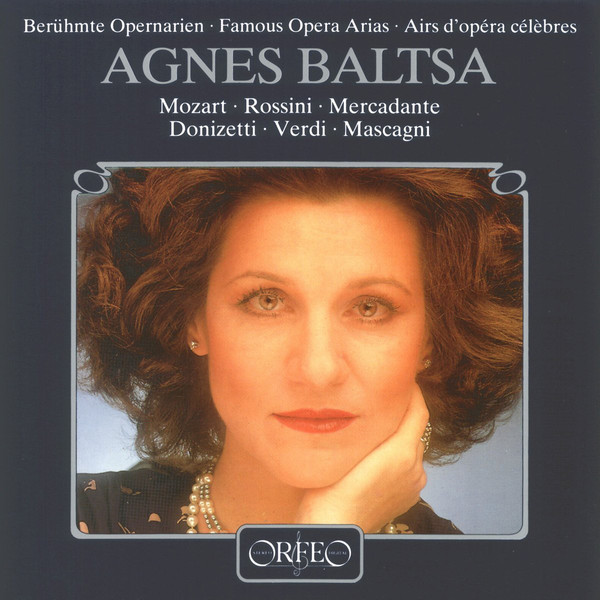
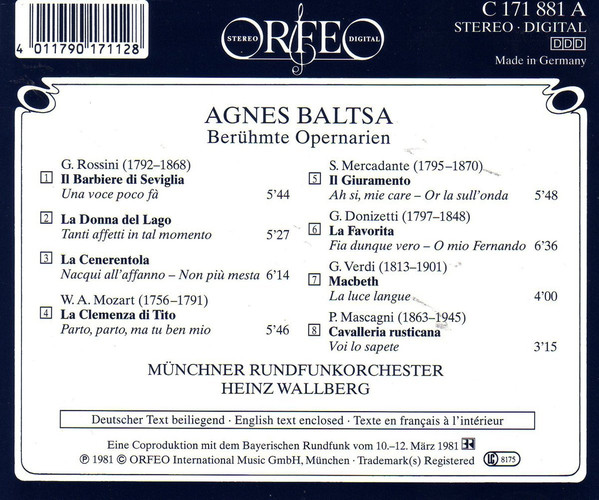
Agnes Baltsa – Famous Opera Arias

r-10771805-1504032686-5609.jpegr-10771805-1504032692-5381.jpeg

Good to be reminded of Baltsa’s pre-eminence as a lyric/dramatic mezzo at the beginning of the 1980s, when this recital was recorded.

The recital shows off to advantage her keen dramatic instinct, a tangily individual timbre, and a voice that was, at this time at least, absolutely seamless from top to bottom. Though she had already recorded Eboli and Amneris for Karajan, this recital concentrates for the most part on her work in the field of bel canto.

Baltsa was an exciting stage performer, as I can attest, having seen her live on many occasions and a great deal of that excitement comes through on disc, the climaxes of the arias from La Favorita and Il Giuamento being particularly thrilling. She has a strong vocal personality, which comes across stunningly on disc, and she realises the different demands of classical, Romantic and verismo music. If there is a limitation, it is that she rarely colours or weights the voice to suit the character she is playing, something more noticeable in a recital disc than it would be in a complete performance.

Stand out tracks for me were the aria from La Donna del Lago, where she gently caresses the opening cavatina, and the aforementioned arias from Il Giuramento and La Favorita. Indeed, on this showing it is a great pity that nobody thought to make a complete recording of the Donizetti opera with her, though preferably in the original French rather than Italian as it is here.

To sum up, this is a great memento of an important singer recorded when the voice was at its peak. I seem to remember that it was issued in the UK originally on EMI, but the recording was made by Orfeo, and it is that issue I have.

Fritz Wunderlich – a DG box set

wunderlichcollectiondg4351452

Before his untimely death at the age of 35, Fritz Wunderlich made a lot of recordings for both DG and EMI, mostly for the German market, hence the reason why all the excerpts from French, Italian and Russian opera are sung in German.

That said, regardless of language, Wunderlich’s gorgeous, lyric, golden-voiced tenor gives us a glimpse of a near ideal Rodolfo, Duke of Mantua, Lensky, Cavaradossi and Elvino.

This 5 disc set gives us 2 discs of operatic fare from Handel and Mozart to Verdi and Puccini, 2 discs of Lieder (complete recordings of Die schöne Müllerin and Dichterliebe and various other Lieder by Schubert, Schumann and Beethoven) and a final disc of popular Italian and German songs, such as Lara’s Granada and Sieczynski’s Wien, Wien, dur du allein.

One of the most disarming elements of Wunderlich’s singing is that sense of pure joy in the act of singing itself, and it’s a quality that is hard to resist. True, there have been deeper, more probing versions of the Schubert and Schumann cycles (even by Wunderlich himself, when captured in concert a year later), but few sung with such consistent beauty of tone.

Stand out tracks for me are the Mozart items (arias from the Böhm Die Zauberflöte, and the Jochum Die Entführung aus dem Serail, Lensky’s Kuda, kuda from Eugene Onegin. His opening lines in the Act IV duet for Rodolfo and Marcello from La Boheme (sung with Hermann Prey) are sung with a poetic beauty of such sorrowful radiance, that questions of language are totally forgotten, and this carries through to Cavaradossi’s great E lucevan le stelle from Tosca. As Elvino (a lovely Prendi, l’anel ti dono from La Sonnambulawith a somewhat quavery Erika Köth) he sings with a shy diffidence that is thoroughly charming, and what Gilda would not be conquered by the seductve tones of this Duke?

My once critcism would that be he occasionally aspirates fast moving moving music, most in evidence in the Lortzing excerpts, but in all he displays a strong personality, and, once heard, there is no mistaking him.

The popular items might not be to everyone’s taste, but it is here that his gift of communication is most in evidence, singing with sheer uninhibited pleasure. One of my favrourite tracks is his performance of Lara’s Granada. You get the feeling that he arrived in the studio feeling pretty good that day, and the golden outpouring of tone, right up to a couple of glorious top Cs, is infectiously enjoyable. It’s hard not to listen with a smile on your face.

In the grand scheme of things, Wunderlich would have gone on to have a great career, no doubt feted as one of the greatest tenors of his day, but it wasn’t to be and he was killed in an accident just a few weeks short of his 36th birthday. How lucky we are that these recordings exist to remind us of what the world lost.