A Spanish Songbook – Jill Gomez

516xghgdgjl._sx355_

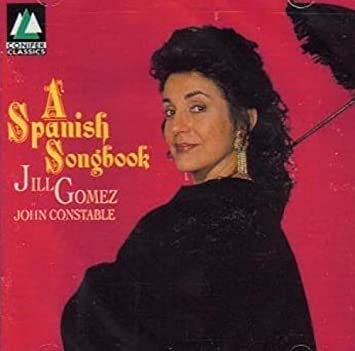
What an utterly charmng and delightful disc this is, cleverly planned and beautifully executed.

With her distinctive timbre and wonderfully expressive voice, Gomez’s personality fairly bursts through the speakers and she is superbly supported here by John Constable on the piano, who unerringly captures the mood of the songs. You feel as if these two artists really enjoy making music together, and indeed their association is a long one, having first appeared on disc together twenty years earlier. Gomez would have been in her early fifties when the present disc was recorded but the voice has hardly changed in the intervening years.

What we have here is a compendium of Spanish inflluenced songs by German, French and English composers, as well as songs by Spanish composers, covering a wide range of styles and eras. The programming is eminently sensible and makes for very satisfying listening.

We start with a group of sixteenth century Villancios from the courts of Charles V and Philip II in piano arrangements by Graciano Tarragó, which encourage the kind of decoration and improvisation of the 16th century vilancico. Fuenllana’s De los alamos vengo, madre is no doubt better known from Rodrigo’s orchestral arrangement, but Gomez sparkles quite as much here.

From thence we turn to a group of Spanish influenced songs by Wolf and Schumann, in which Gomez captures perfectly the deep melancholy of Schumann’s Tief im Herzen trag’ ich Pein as well as the girlish coquettishness of Wolf’s In dem Schatten meiner Locken. Spain has always provided a deep vein of inspiration for French composers, so we are next treated to a group of songs by Bizet, Ravel, Saint-Saëns and Délibes in which Gomez’s sense of style is impeccable.

Next come the three Granados Tornadillas, in which we are probably more used to hearing the fuller, chestier sound of someone like Conchita Supervia. Gomez intelligently, rather than copy her style, is more languorous. I might prefer Supervia’s vibrancy, but Gomez’s way is just as valid.

The two Walton songs, both taken from Façade, find Gomez pointing Edith Sitwell’s lyrics deliciously and lead us into the final group, which Gomez calls “Seven Other Popular Songs”. The first three songs are by Roberto Gerhard, who, as an exile from Franco’s Spain, had relocated to Cambridge in the UK in 1942, where he lived until his death in 1970. These are his versions of folk-songs collected by his teacher, Felipe Pedrell. bittersweet souvenirs of a composer in exile. The others are by Tarrago, Rodrigo, Guridi and Obradors. Gomez is yet again a wonderful guide through this musical journey of Spain, brilliantly capturing the mood of each song.

An excellent recital that should be a lot better known than it is.

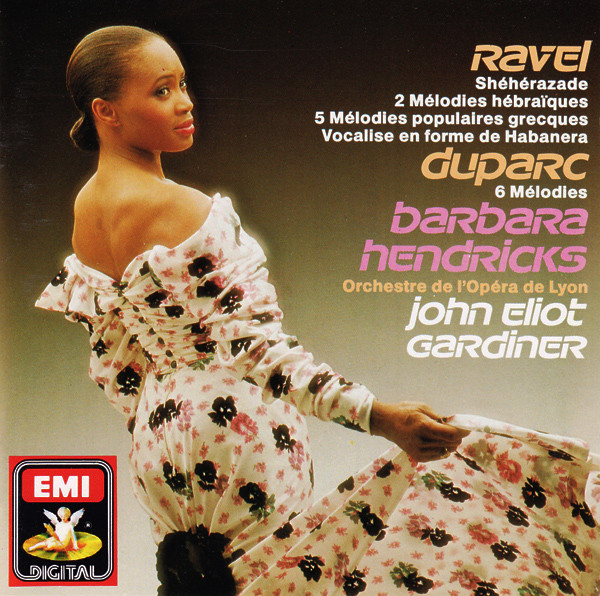
Barbara Hendricks – Ravel and Duparc

r-3319230-1325585118.jpeg

What a gorgeous disc this is. Quite why Hendricks’ version of Ravel’s Shéhérazade is not as famous as those by such as Crespin, Baker and De Los Angeles is beyond me for not only is the singing ravishing, but the orchestral playing under John Eliot Gardener superb, and quite a lot better than that of the Suisse-Romande on Crespin’s recording. Furthermore, though born in America, Hendricks has lived in Europe since 1977 and in Basel, Switzerland since 1985 and her French is virtually flawless.

The disc opens with Ravel’s Shéhérazade and the opening measures of Asie are sung with a gorgeous sensuality, which then gives way to girlish delight when she sings of sailing away on a schooner. What a vivid story-teller she is, alive to every change of mood and how beautifully she is accompanied by Gardiner, who brings out fabulous detail in the orchestral score, without losing its sensuous exoticism. In la flûte enchantée she is suitably languid, until the voice breaks out with a real burst of joy, when she describes the flute alternately pouring forth sadness and joy, whilst L’indifférent is deliciously ambiguous.

The rest of the Ravel programme is hardly less fine. My notes are peppered with words like gorgeous, sensual, exotic for the Mélodies hébraîques, which perfectly suits their colourful musical language, but the singer of the Mélodies populaires grecques is evidently younger, more innocently coquettish, the tone more forwardly produced, though I do slightly miss Victoria De Los Angeles’s delightful simplicity in the final song, Tout gai. The Vocalise en forme de Habanera returns us to the sensuality of the Hebrew songs and is absolutely ravising.

The Duparc songs are not quite up to the standard of the Ravel, but still very worth having. Both L’invitation au voyage and Au pays oû se fait la guerre really require a greater range of tone colour and Le manoir de Rosemonde lacks a little in drama. Best of all are a flowingly lyrical Chanson triste and a sexily indolent Phydilé though others, like Teyte and Baker, have encompassed its climax with greater ease.

Nevertheless this is a gorgeous disc, one of the best versions of the Ravel pieces around and, if the Duparc songs aren’t quite at the same level of excellence, they are still very fine indeed.

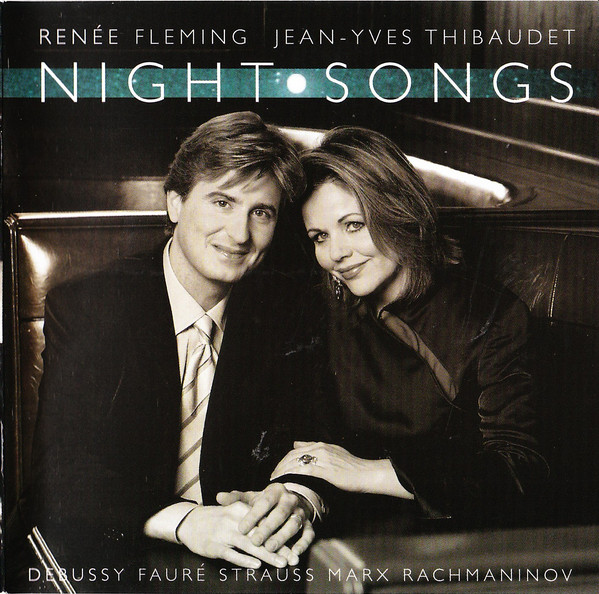
Renée Fleming – Night Songs

r-4527951-1426190336-3065.jpeg

Where does the time go? I can’t believe it is almost twenty years since I worked with Renée Fleming when the London Symphony Orchestra put on a semi-staged production of Previn’s A Streetcar Named Desire at the Barbican Hall with Previn himself conducting. I only had a very minor role, but I found Fleming to be a very gracious lady, an arch professional and a conscientious artist. The rehearsals and performances are amongst my fondest memories and I will never forget the experience of hearing that voice close to, with her literally singing into my ear on occasion. The final Korngold-like aria Blanche sings before being taken away to the asylum was possibly one of the most beautiful things I have ever heard.

I mention this to put into context my reactions to listening to this recital, which I wanted to like much more than I did. The recording was made in 2001 when the voice had acquired a new richness in the middle and lower ranges whilst retaining its beauty and ease up on high, even throughout its compass and admirably firm, with no trace of hardness when singing at full tilt. As it seems now we have said goodbye to Fleming, the classical arists it is good to be reminded that this was one of the most ravishing instruments of the last thirty years or so. She has always had a fairly eclectic repertoire which embraced both opera and song, covering a wide range of different composers and styles, but I’ve always thought her best suited to the music of Mozart and Strauss.

Hence it is the songs by Strauss and Joseph Marx which make the stongest impression, especially Cäcilie, its radiant close easily and ravishingly voiced. The Marx songs suit her well too, their sensuous expressivity responding well to the heady beauty of Fleming’s voice. Thibaudet is also superb in the tricky accompaniments, tossing off their difficulties as if they are the easiest things in the world.

Elsewhere I am not so sure this operatic vocal effulgence is what I want to hear. I found myself longing for the greater simplicity and cleaner vocal production of a Victoria De Los Angeles in the Fauré, the slight touch of irony and cool detachment brought to Debussy’s Chansons de Bilitis by a Régine Crespin. The Rachmaninov, with their heavier accompaniments, perhaps respond better to this operatic treatment, but I find it just too sophisticated and even here I prefer a slightly simpler, more direct approach.

However enjoyable it is to hear one of the most beautiful voices of recent times whatever the circumstances, ultimately there are other discs I would pull out first when wanting to sample Fleming at her best.

Dame Janet Baker – The Great Recordings

51yyk-hlf7l._sy400_ml2_

This exhaustive twenty disc box was, when it was first released on EMI, more properly called The Great EMI Recordings. The deletion of the word EMI from the title has something to do with the conditions of the sale, of EMI to Warner but the original title is more representative of the contents, as Dame Janet also made “great” recordings  for Decca, Philips and Hyperion. Aside from Ottavia’s Lament and Farewell from Monteverdi’s L’Incoronazione di Poppea, and the final scenes from Berlioz’s Les Troyens, this set includes no opera. Still, the range is wide, covering music from Monteverdi to Schoenberg and, as it also includes excerpts from various complete recordings of orotorios, covers just about everything she ever recorded for EMI and later Virgin Classics. The quality is extrordinarily high and it is safe to say that she never made a bad record and many of them are out and out classics.

The lay out is mostly logical, starting with early music and moving forward in time, but cramming shorter LP recordings onto twenty well-filled CDs has inevetably led to the occasional odd juxtaposition. Most of the recordings cover her vocal prime, from 1966 through the 1970s. Shortly after she retired she made a few recordings with Richard Hickox in 1989 and 1990 and only these show a slight decline in her vocal resources, though the artistry remains undimmed.

Disc one starts with a 1969 recording of music by Monteverdi, Alessandro and Domenico Scarlatti with the English Chamber Orchestra under Raymond Leppard rounded off by excerpts from a duet recital with Dietrich Fischer-Dieskau, recorded live at the Royal Festival Hall in 1970. Leppard’s souped up arrangements of the Monteverdi might seem anachronistic now, but Baker’s impassioned singing of Arianna’s Lament and Ottavia’s Lament and Farewell from L’Incoronazione di Poppea transcends any matters of style. The duet items (music by Schütz, Schein and Lilius) have continuo realisations by George Malcolm, who plays the organ with Kenneth Heath on the cello and are delightful in every way.

Disc two gives us the first side of an LP called A Pageant of English Song, which had songs by Dowland and Campion accompanied on the lute, and by Purcell, Monro (I can’t think of his My lovely Cecilia without having Baker’s smiling tone in my head) Boyce and Arne, with accompaniments by Martin Isepp on harpsichord. More duets with Fischer-Dieskau round off the disc, some of these taken from a 1969 Queen Elizabeth Hall recital with Barenboim on the piano.

From here we move to Bach for the next two discs, the wonderful performance of Ich habe genug under Menuhin being particularly noteworthy. A Bach recital, which she recorded with the Academy of St Martin in the Fields under Neville Marriner is spread over the two discs, which finished with the alto arias from Klemperer’s 1967 recording of the Mass in B minor. What a superb Bach singer she was.

We move onto Handel, a composer with whom Baker was particularly associated. Mackerras’s recording of Messiah was one of the first to make a stab in the direction of HIP. It was also the first one I ever owned, Baker’s contribution being particularly memorable. Her version of He was despised is incredibly moving. The two Handel cantatas are listed as arr. Leppard, but I’m not sure what those ‘arrangements’ involve. Baker is, as always, a superb Handelian.

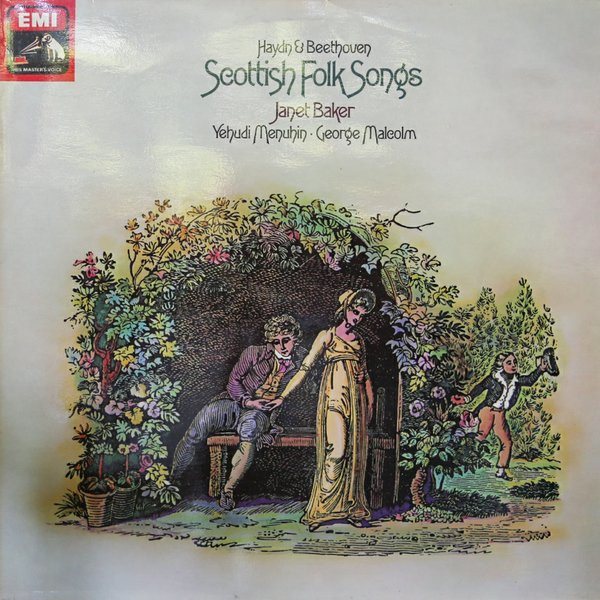
The Haydn and Beethoven Folk Song Arrangements, which follow on the next disc, rather outstay their welcome, for me anyway, even in performances as special and imaginative as these, which means that the ensuing Schumann and Brahms duets from the QEH concert come as something of a relief.
mi0xnzg4lmpwzwc

Discs seven and eight are all Schubert, taken, for the most part, from a two disc set she recorded with Gerald Moore in 1971, which included quite a few rarities and a 1980 recital with Geofrrey Parsons of more popular fare. Baker’s control of dynamics is extraordinary and her breath control stupendous, her legato line beyond reproach. Amongst so many great performances, it’s hard to name favourites, but I doubt I’ve ever heard a better performance of Du bist die Ruh, which is not only deeply felt but also displays the perfection of her tehcnique and her superb breath control.

A few more Schubert songs start the ninth disc, which then continues with a Mendelssohn recital with Geofrrey Parsons and Schumann’s Frauenliebe und Leben with Daniel Barenboim. One of the first records Janet Baker ever made was of the Schumann cycle, for the Saga label before she was contracted to EMI. It was released to much acclaim, but this one delves that much deeper and is indeed one of the greatest recordings of Schumann’s cycle in the catalogue. The Mendelssohn songs are perhaps not so memorable or so wide ranging as Schubert’s but Baker makes the best case for them, but the Schumann cycle is the real prize of this disc.

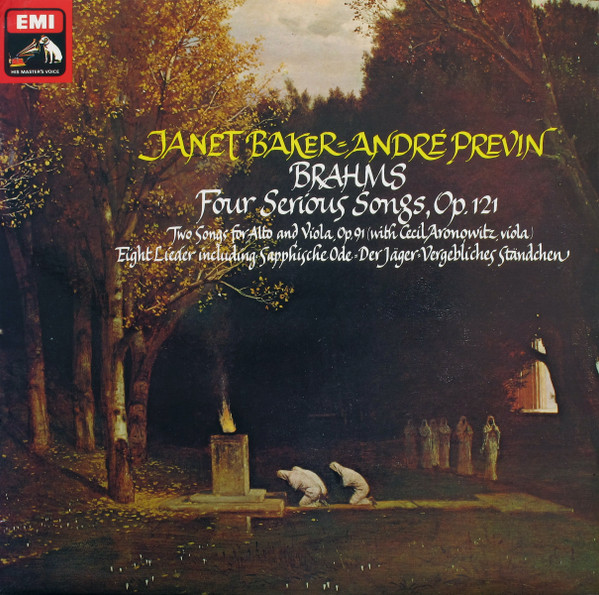
The tenth disc gives us the second side of her Schumann LP with Barenboim, a wonderful performance of the Opus 39 Liederkreis, and the whole of an all Brahms programme with Previn at the piano, the two songs for alto and viola (Cecil Aronowitz) and the Vier ernste Gesänge are deeply felt and wonderfully accompanied.
my03otc4lmpwzwc

A Liszt recital (with Geoffrey Parsons) starts disc eleven, an excellent selection of songs, which are not performed as often as they should be. Baker and Parsons make the very best case for them. These are followed by a small selection from Wolf’s Spanisches Liederbuch and a couple of Mahler’s youthful songs.

Disc twelve is something of a mixed bag and brings together recordings from the beginning and end of Dame Janet’s career, a selection of Strauss songs from an early EMI recital disc, the Song of the Wood Dove from Ferencsik’s 1968 recording of Gurrelieder and Respighi’s La Sensitiva from recording sessions made for Virgin Classics in 1990, a gap of some twenty-three years. I suppose you can detect a slight loosening of the vibrations, but the voice is still very firm and the artistry undimmed. Some may hear a slight lack of spontaneity in the 1967 Strauss songs (absent from the 1973 recording of Ständchen) and I’d have to admit I prefer the sound of a soprano in these songs, but I’d still rather too much care than too little. The Schoenberg might seem an unexpected piece for Dame Janet, but she is absoutely superb here, wonderfully intense and dramatically involved and the Respighi, recorded just after she had retired from the concert platform, is a lovely performance, warmly sung and senisitively phrased.

Disc thirteen is all of song with orchestra. The Brahms Alto Rhapsody was originally used as a filler for Boult’s Brahms Symphony cycle, then reissued as a makeweight for Wagner’s Wesendonck Lieder and a selction of Strauss songs Baker and Boult recorded in 1975. The Alto Rhapsody and the Wagner are absolutely superb, indeed among the most recommendable versions of these songs. The Strauss songs suit her less well, but I’m still glad to have them. Then comes the legendary recording of Elgar’s Sea Pictures, which has never been equalled. It was originally issued with Du Pré’s equally legendary recording of Elgar’s Cello Concerto and is one of the best selling classical records of all time. the original LP was an EMI best seller for as long as I remember, and a record we had on permanent weekly order, when I worked at MDC in London.The disc finishes, fittingly enough with Dame Janet’s wonderfully consoling and radiant singing of the closing pages of The Dream of Gerontius.

Now if I were allowed just one Janet Baker record on that proverbial desert island, I’d be hard pressed to choose between her Mahler and her Berlioz and  the next two discs are dedicated to these two composers.

Disc fourteen gathers together all the Mahler recordings she made with Barbirolli and adds Urlicht from Rattle’s acclaimed recording of the Second Symphony. All three cycles are amongst the best recordings of these songs ever made. The Rückert Lieder were originally issued on the fourth side of Barbirolli’s famous recording of the 5th Symphony with the New Philharmonia, the other two cycles having been recorded a couple of years earlier with the Hallé. Ich bin der Welt abhanden gekommen was recorded at the same time and used as a fill-up, which explains why they recorded the song twice. If I were to use one piece of music to illustrate the genius of Janet Baker, then it would undoubtedly be one of these two versions of Ich bin der Welt abhanden gekommen. The song is not so much sung as experienced and you can really feel the connection between singer and conductor. To be honest, there is very little to choose between the two performances; maybe the later one is even more withdrawn, even more self-communing. When I listen to either I feel as if I too am lost to the world.

Disc fifteen is also one of the most desirable discs in this set. Baker was a great Berlioz singer and it has always been a huge cause for regret that she never recorded the role of Didon, making these excerpts more treasurable than ever and these final scenes are devastating in their impact. She recorded La mort de Cléopâtre again for Philips under Davis, another superbly impassioned and dramatic performance, but she is in slightly fresher voice here.

This Barbirolli recording of Les nuits d’été is, I think, her finest and indeed one of the greatest performances of the songs ever committed to disc. In his survey of the then available recordings for Song on Record 2, David Cairns makes it a top recommendation alongside Steber/Mitropoulos. She is possibly a little stiff in Villanelle but all is glorious after that and, with the inestimable help of Barbirolli, she unerringly captures the mood of each of the four middle songs especially. Le spectre de la rose is taken slowly but never drags, and the tempo gives her ample time to fill out the phrases, its climax gorgeously radiant.

Ravel’s Shéhérazade, which opens disc sixteen, was recorded at the same time as Baker’s superb Les nuits d’été and is wonderfully sung, though I’d say she misses that hint of inuendo in the last song that you get from Crespin. Nonetheless this is a beautiful performance of the cycle. The Chausson and Duparc were recorded ten years later, and there is a slight detioration in the quality of the voice, the vibrations have loosened a bit and there is a slight feeling of strain. She sings the Chausson with a greater sense of freedom in a live performance under Svetlanov only a few years earlier, but this is still a great performance with Previn and the LSO offering superb support as they do in the Duparc.

D’amour l’ardent flamme from La Damnation de Faust, which closes the disc, is one of the greatest ever recorded and it’s too bad that it is taken from a not very recommendable performance of the work under Georges Prêtre. If only Baker had been the Marguerite on Davis’s Philips recording of 1973, in which Gedda got to reprise his Faust under much happier circumstances. Baker joins Callas and Verrett as my favourites for this piece.

Baker was also a renowned interpreter of French song with piano and the lion’s share of disc seventeen is given over to A French Song Recital, which she recorded with Gerald Moore in 1969, songs by Duparc, Fauré and Debussy. It was logical to add the French items from a mixed bag recital of a couple of years later. These songs by Hahn, Massenet, Chabrier and Gounod demonstrate Baker’s prowess in a lighter vein. The Berlioz orchestral songs were originally coupled to her final recording of Les nuits d’été, recorded right at the end of her career. The voice is not quite the same as it was twenty years earlier, admittedly, but to be honest, very few allowances have to be made for the passing years.

One of the first discs Baker ever recorded was a recital of British songs, for the Saga label, and English song would often be a part of her concert recitals. This eighteenth disc brings together the second side of A Pageant of English Song (you might remember the first side was included on Disc 2). This time the composers are Parry, Stanford (a superbly impassion performance of La belle dame sans merci), Vaughan Williams, Quilter, Ireland , Gurney and Warlock, and the English items from her Favourites album. She was also much associated with the music of Benjamin Britten, but all her recordings were made for Decca, so it is good to have this one excerpt from Previn’s recording of his Spring Symphony.

When Walton’s Troilus and Cressida was revived at Covent Garden in 1976, Walton re-wrote the role for a mezzo, specifically so that Baker could sing it. The performances were recorded and the disc is filled out with three excerpts from that recording.

The penultimate disc starts with the remaining item from her 1972 Favourites album (Mendlessohn’s Auf Flügeln des Gesanges) and continues with two arias from the 1968 Frühbeck de Burgos recording of Elijah, her singing of O rest in the Lord sung with a sincerity and compassion that enfolds you in its warm embrace.

It was perhaps an unfortunate idea to present the Mendelssohn Psalm of twenty years later straight after, for she sounds uncharacteristically tentative and strained in the solos, which are, in any case, designated for soprano. The concert aria that follows fares a little better as the tessitura lies slightly lower, but these are not performances I would want to listen to often. On the other hand, the Brahms Alto Rhapsody, recorded the same year, is rather wonderful and probably the gem of these late sessions. It lies a lot lower of course, so the sounds a great deal more comfortable, and it is a wonderful memento of the moving performance I heard these same artists give of the work at the Barbican round about the time of this recording and shortly before she retired. As in the live performance, the moment when the music shifts from the minor to the major is a moment of pure magic. This is definitely the prize of these late recording sessions.

It is perhaps unfortunate that the final disc in this wonderful set is the only one I would call dispensable, though I was actually pleasantly surprised by this 1990 performance of Berlioz’s Les nuits d’été. She takes a little less time over the songs now, and this performance comes in around three minutes shorter than the Barbirolli. She still has an innate understanding of Berlioz and the way to shape and mould the phrases, but there is also a slight feeling of her husbanding her resources where the Barbirolli (and the live Giulini) find her in full vocal plenitude. They are still the ones I would reach for when wanting to hear Baker in this work.

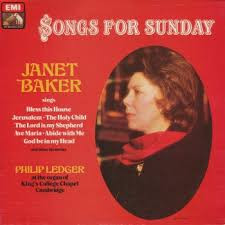
The remaning items are from a 1980 disc called Songs for Sunday which will no doubt be more to some people’s taste than to mine. It’s not a record I ever paid much attention to, though I did buy a copy for my mother when it came out. I am not religious, but Dame Janet’s, singing with  with her customary sincerity and generosity of spirit, completely won me over.
ms00mjy5lmpwzwc

These twenty discs have confirmed for me Baker’s place as one of the greatest singers of the latter half of the twentieth century. Her records continue to educate and enthral. There is something so personal about Baker’s art, a sense of total identification with the composer in question and an innate ability to capture the right mood of each song. This goes hand in hand with a gift for communication which is vouchsafed to only a few. Just occasionally one can be aware of the huge amount of thought that has gone into each interpretation, but I’d rather too much intelligence than too little. It has been  interesting too to hear her collaborations with so many different musicians. For me she is the last of the true greats. How lucky we are that she left behind her such a rich and varied legacy.
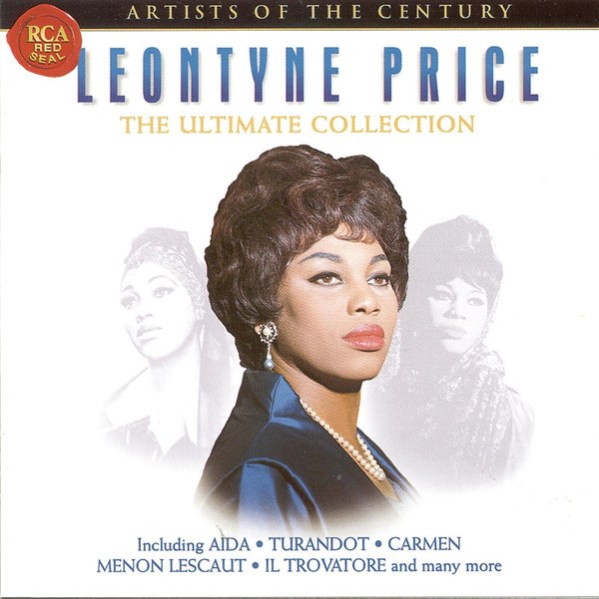
Leontyne Price – The Ultimate Collection

In many ways this is an infuriating compilation, not because of anything to do with Mme Price herself, but because of the shoddy presentation, which does her, and her colleagues on this disc, no service whatsoever. The skimpy booklet lists the arias on the discs, bit not one word about their provenance, who is conducting, what year the record was made or indeed anything at all to place them in context. Even Manon Lescaut is spelled wrongly on the front cover. All we get is a puff about her career and the unhelpful information on the back of the disc that the compilation was issued in 1999. Texts and translations are hardly to be expected these days, but I do like to at least know a bit about the date of the recording, the orchestra, conductor and other singers who appear.

There is a good chance of course that I am not the target audience. Maybe most people who buy the set are happy just to put the discs on, sit back and let the gorgeous voice pour out some familiar tunes, which, for the most part, is what we get, the least well known piece here being the excerpt from Barber’s Antony and Cleopatra.

At least the selection concentrates mostly on her strengths, so we get fine examples of her Aida, both the Leonoras, her Carmen and a liberal sprinkling of Puccini arias, which are beautifully sung if not particularly specific in character. The weakest items here are the Mozart arias and Dido’s Lament, regally voiced but impassively emotionless. However there are some very impressive performances here, particularly those taken, I assume, from complete performances of Il Trovatore, La Forza del Destino and Aida, roles for which she was well suited. The voice was certainly one of the glories of its age, with a dark plangency particularly suited to the melancholy of characters like Aida and Leonora.

That said, I would have to say that, personally, I find this hotchpotch kind of compilation, which concentrates on the singer rather than the music, completely unsatisfactory. As it happens, I am, at the moment, also working my way through the Janet Baker twenty disc Great Recordings box, which I suppose one could also legitimally call a hotchpotch. If I am finding this a much more rewarding listening experience, it presumably has something to do with the better, more logical programming, and also the greater specificity of Baker’s art.

Dipping in and extracting arias here and there from this set will proabably afford the most pleasure and maybe that is what one is supposed to do with a compilation like this.

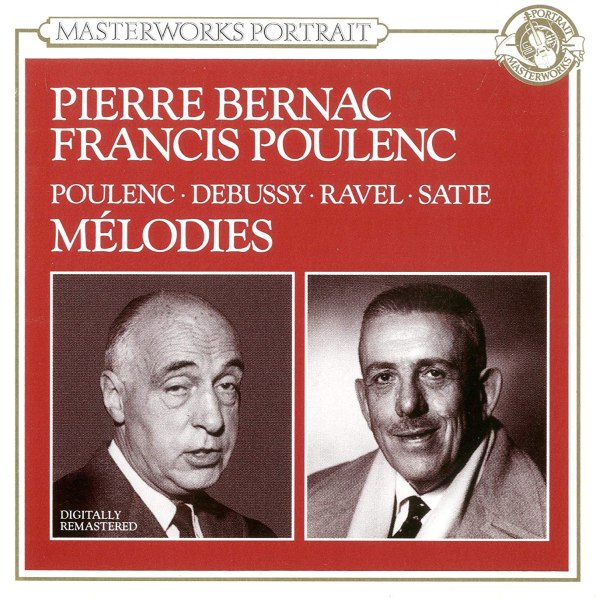
Pierre Bernac & Francis Poulenc – Mélodies

91khamjrtvl._sl1500_

Poulenc:
Banalités
Chansons villageoises
Quatre poèmes de Guillaume Apollinaire
Tu vois le feu du soir
Main dominée par le coeur

Debussy:
Beau soir
L’écheonnement des haies
Le Promenoir des deux amantes

Ravel:
Histoires naturelles
Mélodies hébraïques

Satie:
Trois mélodies

Pierre Bernac and Francis Poulenc had a long and fruitful working relationship, going back to 1926 when Bernac gave the first performance of Poulenc’s Chansons gaillardes (not included on this disc). They first appeared in recital together in 1934 and continued to do so until Bernac retired from public performing in 1960. In fact the majority of Poulenc’s songs were written for Bernac and I suppose one could say that they enjoyed a similar relationship to that of Britten and Pears, without the emotional attachment, apparently always using the polite ‘vous’ with each other at all times.

Bernac’s voice was evidently not large but he had an enormously varied tonal palette which enabled him to capture every shift in mood, every emotion, implied or overt, in each song. Though the voice was not of itself of great natural beauty, its range was wide and Poulenc exploited this to great effect. Bernac was also a great teacher, numbering Gérard Souzay, Elly Ameling and Jessye Norman among his pupils, and he wrote with great insight about the art of singing. His The Interpretation of French Song is an absolute must for anyone interested in performing this repertoire.

Bernac and Poulenc left behind quite a legacy of recordings, most of them recorded for EMI and RCA in 1947. However these Columbia sessions took place in 1950. The Poulenc selection is self recommending, but he is equally at home in the songs of Debussy, Ravel and Satie, embracing the lyricism of Debussy’s Beau soir, the slightly detached irony of Ravel’s Histoires naturelles or the parodic wit of the Satie songs.

Anyone who enjoys the subtle art of French song should definitely hear them.

Elisabeth Schwarzkopf – Unpublished Recordings 1955 – 1958 Bach & Mozart

sbt1178


Schwarzkopf and her husband Legge loved recording, often making several different recordings of the same repertoire and in their case there was almost as much unpublised material in the vaults as they actually issued. Reasons why so much languished without a home could be manifold. It could be that at the time a slightly different emphasis was preferred, or it might simply be that a coupling could not be found, which surely must have been the case with the performance here of Mozart’s Ch’io mi scordi di te, an aria Schwarzkopf returned to in 1968 with Alfred Brendel, George Szell and the LSO and a performance that has been much admired.

However Schwrzkopf herself had misgivings about the 1968 performance. Ever an astute assesor of her own performances, she told John Steane in her retirement years,

You can hear that it’s too late, if you have a discerning ear, but it is musically good, fine, but it is not the young voice any more, and for Mozart that is not so good – it should be the voice in fuller bloom.

In 1955 the voice certainly was in full bloom and the mid 1950s might arguably be considered the high watermark of her career, vocally at least. This was when she recorded the champagne operettas, Strauss’s Ariadne and the Marschallin and Alice Ford in Karajan’s Falstaff. 1955 was also the year in which she made her US debut in San Francisco as the Marschallin.

Geza Anda, like Brendel in 1968, was a fine Mozartian and the the two artists blend and intertwine with each other deliciously. Ackermann, as so often with Schwarzkopf, is a master accompanist, shaping the music beautifully. The 1968 performance with Brendel and Szell is excellent but, if pushed, I think I would go with this one.

Thurston Dart, teacher of Christopher Hogwood and Sir John Eliot Gardiner among others, is in charge of the Bach items, and, though the instruments used are modern, the style is a million miles away from some of the over-Romanticised performances often heard around this time. Indeed Dart could be considered to be one of the pre-cursors of the HIP movement. Tempi are well chosen and Schhwarzkopf’s singing, though expressive is admirably clean and clear, her tone bright and joyful for the Wedding Cantata, but darker for Mein Herze schwimmt in Blut.

The disc also gives us the chance to hear two performances of the recit and aria Schafe können sicher weiden, the first recorded in 1957, the second the following year. To be honest there is very little difference between the two performances of the aria, but in the recitative Schwarzkopf adopts a slightly more expressive style in the later version.

Hardly anything that Schwarzkopf recorded is without interest and it is good that so much of this unpublished material has now become available, though this does mean a fair amount of duplication for Schwarzkopf completists. I’d say that this disc was worth having for the Mozart alone, but the Bach items are very welcome as well.

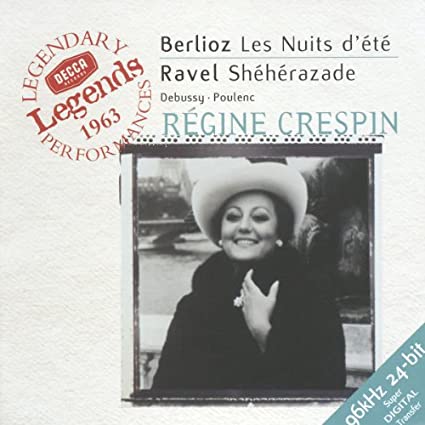
Crespin’s Shéhérazade

513oqn2fqcl._sx425_

Crespin’s recording with Ansermet of Ravel’s Shéhérazade and Berlioz’s Les Nuits d’été is now so famous, so universally acclaimed that there can surely be no more to say about it. Even today, almost 60 years since they were recorded, the performances are still cited by many as a first choice in both works and for many they were no doubt their first exposure to the works, so maybe that is all that needs to be said about them, but is it really so simple?

Both Shéhérazade and, especially, Les nuits d’été are great favourites of mine and I now have ten different recordings of the Berlioz, six of the Ravel. Let us then start with the Ravel. From the thrice repeated call of Asie at the beginning, the third sung with the equivalent of a flirtatiously arched eyebrow, we are in her thrall. She makes a bewitching storyteller, drawing us in with her thrillingly colourful descriptions of the Orient. As I often feel with Crespin, there is a slight air of detachment but here it suits the narrative superbly. She is suitably languid in La flûte enchantée and deliciously ambiguous in L’indifférent. There have been finer versions of the orchestral score (not least the New Philharmonia under Barbirolli for Janet Baker), but Crespin at her best is still a prime recommendation. There is something just so inevitably right about her singing and it places her (just) ahead of the other versions I own, (Teyte, Baker, De Los Angeles, Berganza and Hendricks).

That air of detachment I mentioned also makes her an ideal interpreter of the songs of Poulenc and also Debussy’s Trois chansons de Bilitis with John Wustman on the piano, from a 1967 recording, which are here included as a makeweight, and very welcome they are too. However it works against her in the Berlioz, which requires a degree of involvement and passion that I find lacking in Crespin’s delivery. However musical and tasteful her singing, however elegant her phrasing, she remains aloof and uninvolved. There is no sense of mounting rapture at the arrival of the rose from paradise, no sense of longing in Absence. She is at her best in the final song, L’île inconnue which is blithely insouciant and responds better to her air of suave sophistication. I have no idea why she decided to place Sur les lagunes after Absence but it upsets the balance of the work too.

No, for the Berlioz my prime recommendations would be Baker either with Barbirolli or live with Giulini, Hunt Lieberson with McGegan, Steber with Mitropoulos or De Los Angeles with Munch, Crespin trailing quite a way in their wake.

Essential I would say for Shéhérazade and the Debussy and Poulenc, but look elsewhere for the Berlioz.

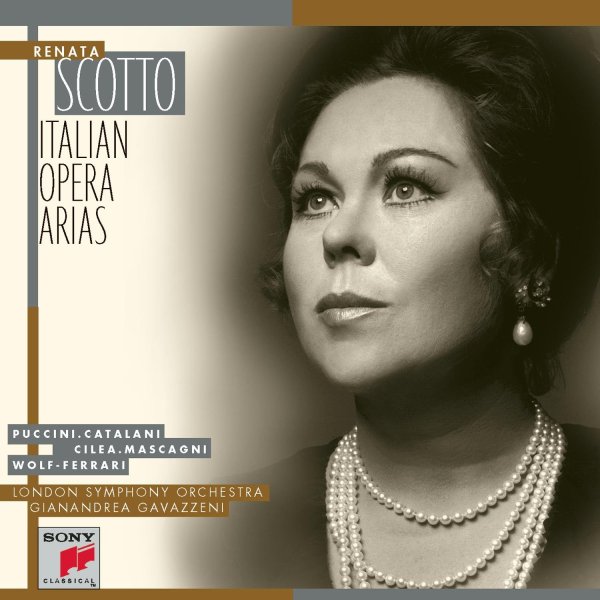
Renata Scotto – Italian Opera Arias


The majority of this disc is taken up with Scotto’s first recital for CBS, recorded in 1974, a recording that might be considered the one which spearheaded the second stage of her career, when she became a mainstay of the Metropolitan Opera in New York. Having been absent from the catalogues for some time, an intense recording schedule followed. There would be another recital (of Verdi arias) for CBS, and throughout the seventies and early eighties she features on many complete opera recordings for CBS, EMI and RCA, often alongside Domingo, with whom she also recorded a recital of duets.

Scotto’s voice always had a slight tang to it. Admirably clean, it would never charm with the full rich tones of a Caballé, a Moffo or a Te Kanawa. The top of the voice, even in her earliest recordings, could glare and it was never the most comfortable part of her range. Nor was it ever a sensual voice, though she could sound sensual enough if necessary (not the same thing), but her command of line, impeccable diction and range of colour are most attractive. She may not quite ravish the ear in the high lying phrases of, for instance, Ch’il bel sogno di Doretta from La Rondine as does Te Kanawa in the famous recording which was used for the movie of A Room with a View, but she shades the line most beautifully and her control of her pianissimo is quite gorgeous. She characterises well too, so that each of these verismo heroines emerge as quite different characters. Occasionally intellect gets in the way and the interpretations can sound too studied, as they never do with Callas, but it would be true to say that, though she has absorbed the lessons of her predecessor in some of this material, she never copies her. Her interpretations are all her own.

In the 1974 items she is wonderfully supported by the London Symphony Orchestra under Gianandrea Gavazzeni and it is good to have some less well known items such as the Mascagni arias and the aria from Le Villi, as it is to have the excerpts from the complete recording of Wolf-Ferrari’s Il segreto di Susanna and Puccini’s Edgar. Her Butterfly is better served by the Barbirolli recording and the duet with Obraztsova from Adrianna Lecouvreur makes very little sense out of context.

Nonetheless one of Scotto’s best recordings, and one that is worth returning to quite often.

José Carreras – Canciones españolas

r-10366837-1583783292-8089.jpeg

Falla: Siete canciones populares españolas
Mompou: Combat deil somni
Ginastera: Canción al árbol del olvido
Guastavino: La rosa y el sauce
Guastavino: Se equivicó la paloma
Obradors: Corazón, porqué pásáis
Obradors: Del cabello más sutil
Turnina: Poema en forma de canciónes

It certainly makes a change to hear Falla’s Siete canciones populares españolas sung by a man, and why not? It is not so unusual to have a father sing a lullaby to his son, and drovers are usually men, aren’t they? Though I might ultimately prefer to hear the cycle sung by Victoria De Los Angeles or Conchita Supervia, I rather enjoyed Carreras’s sensitive performance.

The Mompou cycle, also a favourite of De Los Angeles, also goes well and I especially enjoyed his gently melancholic version of the lovely Damunt de tu nomes los flors. Elsewhere he can be caressingly sensitive or ebulliently passionate, as in the Turina Poema, which brings the recital to a splendidly forthright close.

He is miked fairly close and his diction so precise you can almost taste the words. Martin Katz makes a terrific collaborator rather than accompanist, some of the piano parts being quite fiendishly difficult.

A really enjoyable disc.