Callas’s Covent Garden Traviata

51wr-jbwwjl

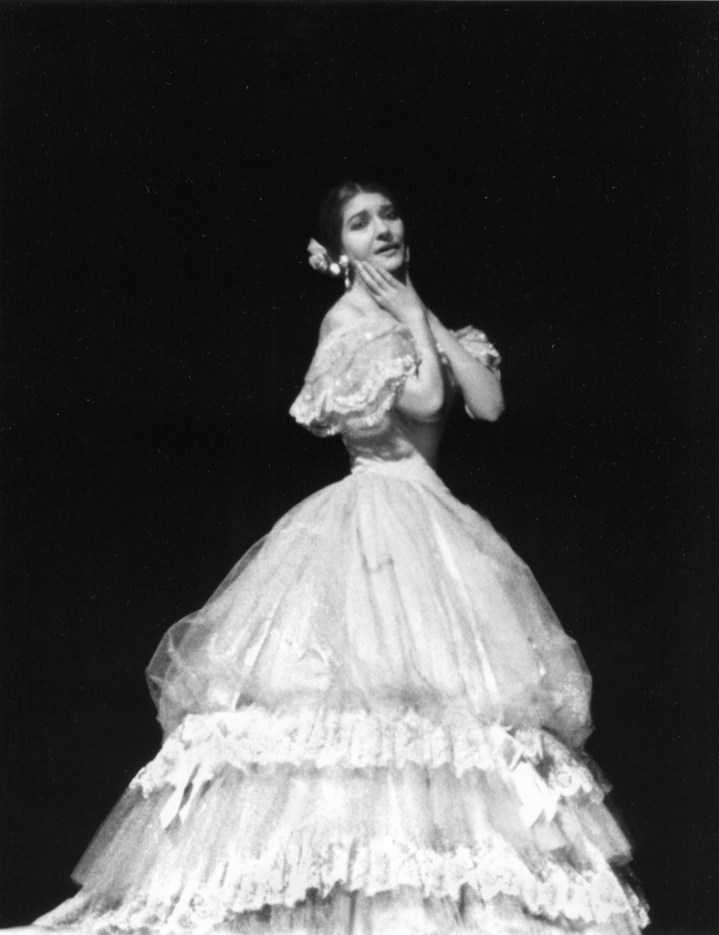
Violetta is one of Callas’s most famous, most exacting characterisations, and a role she sang more than any other except Norma. She first sang it in Florence in January 1951 and finally in Dallas in October 1958 (in a new Zeffirelli production) just a few months after this performance at Covent Garden. In between she had sung it all over Italy, in South America, in Chicago and at the Met, in Lisbon (just a few months before the Covent Garden ones) and of course there was the famous Visconti La Scala production, which changed for all times perceptions of Italian opera production.

Of all the roles in her repertoire, it was Violetta which underwent the greatest refinement, and it is a great shame that her only studio recording of it is the somewhat provincially supported Cetra performance of 1952, made before Visconti’s 1955 production, which substantially changed Callas’s views on performing the role. As you would expect, Callas still makes a profound impression in the set, but from Visconti onwards, her interpretations became ever more subtly inflected, more deeply felt, and her Violetta, especially as heard here at Covent Garden, has never been surpassed, let alone equaled.

It is often said that the role of Violetta requires three different sopranos; a coloratura for Act I, a lyric for Act II and a dramatic for Act III. A soprano comfortable with the demands of Act II and III, will struggle with the coloratura and high tessitura of Sempre libera, and, conversely a soprano happy with Act I’s pyrotechnics, won’t have the necessary weight of voice for the final Act. With Callas, no such provisos needed to be made, and, though earlier in her career, Sempre libera may have had more dash, ease and security on high, she could still, though slightly strained by its demands, sing it with dazzling accuracy in 1958. Furthermore, she invested the scales and runs with a hectic, nervous energy that made them much more than mere display.
78

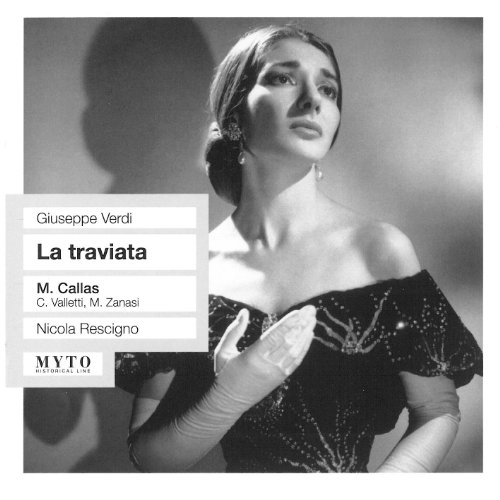
The orchestral prelude of the Covent Garden performance starts with a small piece of operatic history. The microphone manages to pick up Callas quietly singing a couple of notes during the orchestral introduction. No doubt they were inaudible in the auditorium but their presence is one of the ways we Callas fans identify the performance from those first few bars. Indeed Terrence McNally’s play The Lisbon Traviata opens with the character of Mendy listening to the opening bars of this Covent Garden performance, then exploding, “No, no, no! That’s not Lisbon! It’s London 1958!” (I had the same reaction when I saw the play, until I realised it was intentional). Curiously, though, the notes are missing from ICA’s “first official” release. When I contacted ICA about it, they could offer no explanation, and their transfer is, in any case, somewhat muddy, so, for now, I would recommend the Myto transfer pictured above.

Whole tomes could be written about Callas’s interpretive insights in this performance, so inevitably right is her every utterance, so, in the interest of brevity, I will try to restrict myself to a few key points in each Act.
london-trav-1958

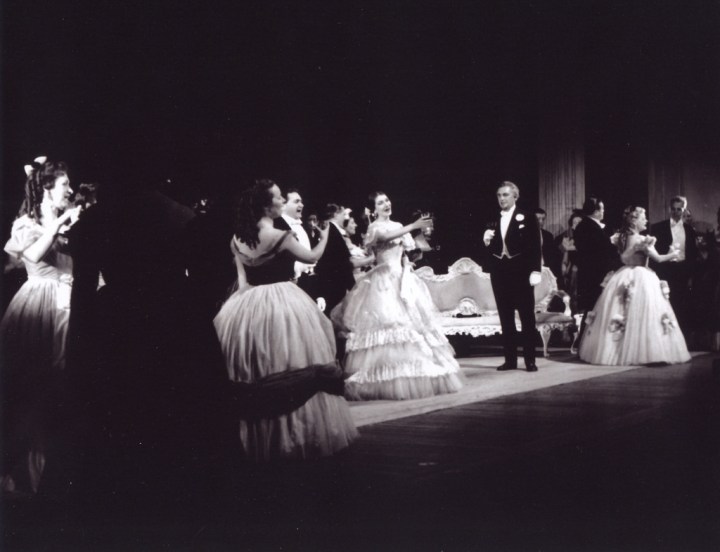
She starts forthrightly as if trying to convince everyone, including herself, that Violetta is over her recent illness, and her exchanges with Alfredo and the Baron have a delicious playfulness about them. Note in the Brindisi how accurately she executes those little grace notes and turns, usually blurred or ignored by other singers. Valletti, who is for the most part a model of elegance and style, misses them completely.

The brief moment when she almost faints, and then privately acknowledges her frailty is masterfully done, though she quickly regains her composure for the duet with Alfredo. Stunningly accurate is her singing Ah, se cio ver, fuggitemi, the coloratura flourishes invested with a carefree insouciance, that somehow also manages to express that she is already falling for Alfredo.

Left alone, the recitative takes us on a journey of conflicting emotions, until, wistfully and reflectively, she sings Ah fors’ e lui, her voice scarcely rising above a mezzo forte that draws the audience in, her legato as usual impeccable, the top notes floated in a gentle pianissimo that never obtrudes on the mood she has created.  She herself tosses such thoughts aside in the Follie! Follie! section, pouring forth cascades of notes as she tries to convince herself that any ideas of love are pure whimsy.

Admittedly, top notes here and in the following cabaletta Sempre libera are a little tight and tense, but her coloratura is still brilliantly precise, and we note how she can make us hear the difference between simple scale passages and those separated into duple quavers. Alfredo’s interjection momentarily catches her off guard, and she launches into the reprise with even more gusto as she tries to block out his protestations. The unwritten final Eb is not exactly a pretty note (though no worse than Cotrubas’s on the Kleiber studio set), and it always seems a pity to me that she felt constrained to sing it at all, given that so many others, before and since, opt for the lower option. Nevertheless it rounds off an almost perfect rendition of this final scene.
m56-page-021-2

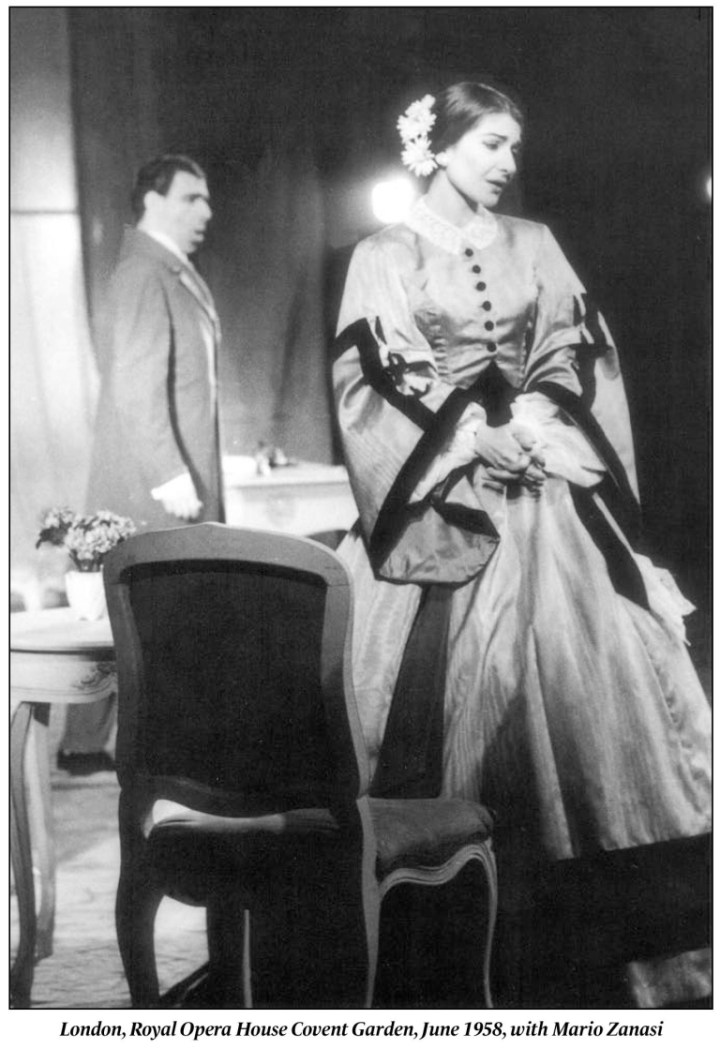
Callas’s range of tone colour and her ability to express different thoughts and attitudes in a very short space of time are amply demonstrated in the first few exchanges of Act II. The single word Alfredo, when she asks as to his whereabouts is suffused with happiness. This quickly gives way to dignified outrage at Germont’s boorish outburst (Donna son io, signore, ed in mia casa) which in turn quickly softens when she realises that, as Alfredo’s father, the man deserves her respect (Ch’io vi lasci assentite, piu per voi, che per me). Later, when Germont questions her past, she responds with a voice of blazing affirmation, Piu non esiste. Or amo Alfredo, e Dio lo cancello col pentiemento mio. Oh come dolce mi suona il vostro accento is sung with a sweet, sadly misplaced, trust, which is quickly replaced with a touch of panic at Ah no! Tacete! Terribil cosa chiedereste certo. This whole scene, the recitatives and the duets, is a locus classicus of Callas’s art and a perfect example of her ability to invest a seemingly unimportant line, or even just a word, with significance.

Non sapete quale affetto is sung with mounting panic, like a butterfly caught indoors beating desperately against a windowpane,  Gran Dio!, when Germont brutally suggests that she will age and Alfredo will not always remain faithful to her, in a tone of blank, pale despair. However the moment of true resignation, the moment Violetta accepts her fate, is enshrined in the one sustained note that leads into Dite alla giovine. Peter Heyworth saw this performance and reviewed it for The Observer. He describes the moment absolutely perfectly in his review.

But perhaps the most marvellous moment of the evening was the long sustained B flat before Violetta descends to the opening phrase of “Dite alla giovine”. This is the moment of decision on which the whole opera turns. By some miracle, Callas makes that note hang suspended in mid air; unadorned and unsupported she fills it with all the conflicting emotions that besiege her. As she descends to the aria, which she opened with a sweet, distant mezza voce of extraordinary poignancy, the die is cast.

One rarely comes across such brilliantly descriptive perception these days, and music criticism is much worse for it.

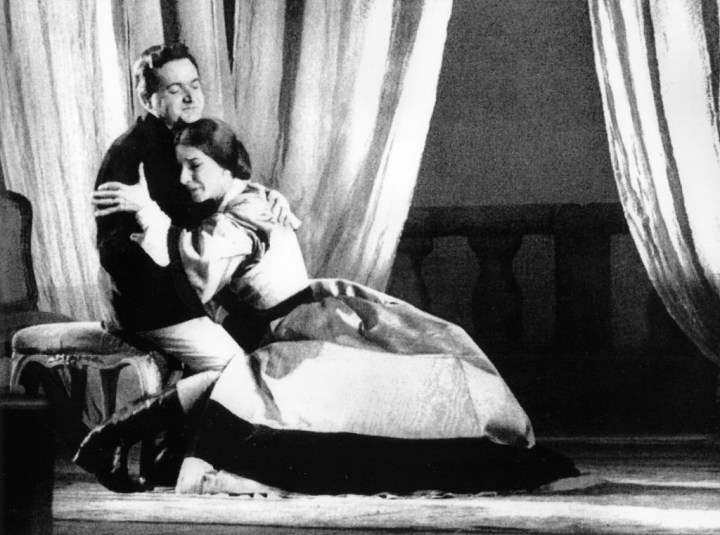
Imponete is uttered in a tone of total dejection, before the outpouring of emotion in which she begs Germont to embrace her like a daughter, and the scene in which she begs Alfredo to love her whatever happens is palpably, upsettingly real, Amami, Alfredo delivered with an intensity that makes you wonder how Alfredo could have doubted her for one second.
london-21-2

The scene at Flora’s party finds her almost sleep-walking, as she attempts to hide her heartbreak. When Alfredo forces out of her a confession that she loves the Baron, we can feel what it costs her, and the thread of sound with which she sings Alfredo, Alfredo, di questa core, after Alfredo has denounced her, is heart-wrenchingly moving.
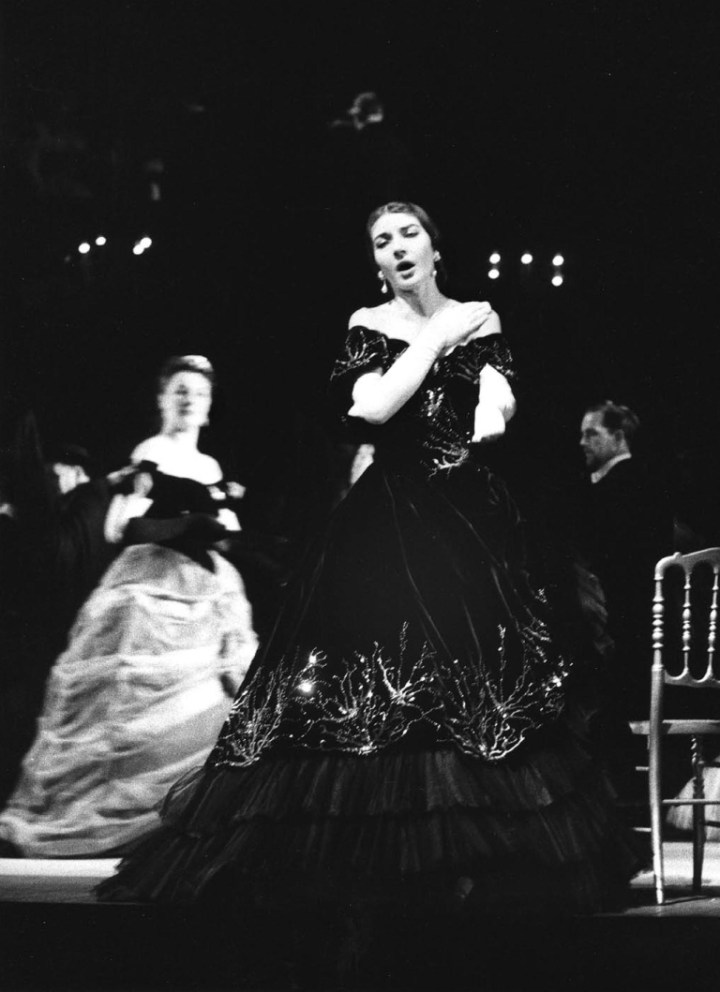
0068-2

The last act is almost too much to bear, and even just thinking about it brings tears to my eyes. What other Violetta makes us feel so deeply her tragedy, her voice drained of all energy in the exchanges with Anina and the doctor? The tragedy really hits home with E tardi! after the reading of the letter; Addio del passato is delivered in a half tone of wondrous expressivity, its final A evaporating in the air. Rescigno recounts that the note kept cracking, and he would tell her to sing it with a little more power in order to sustain it, but she wouldn’t compromise. A firmer top A might have sounded prettier, but it did not reveal so well Violetta’s emotional and physical collapse.
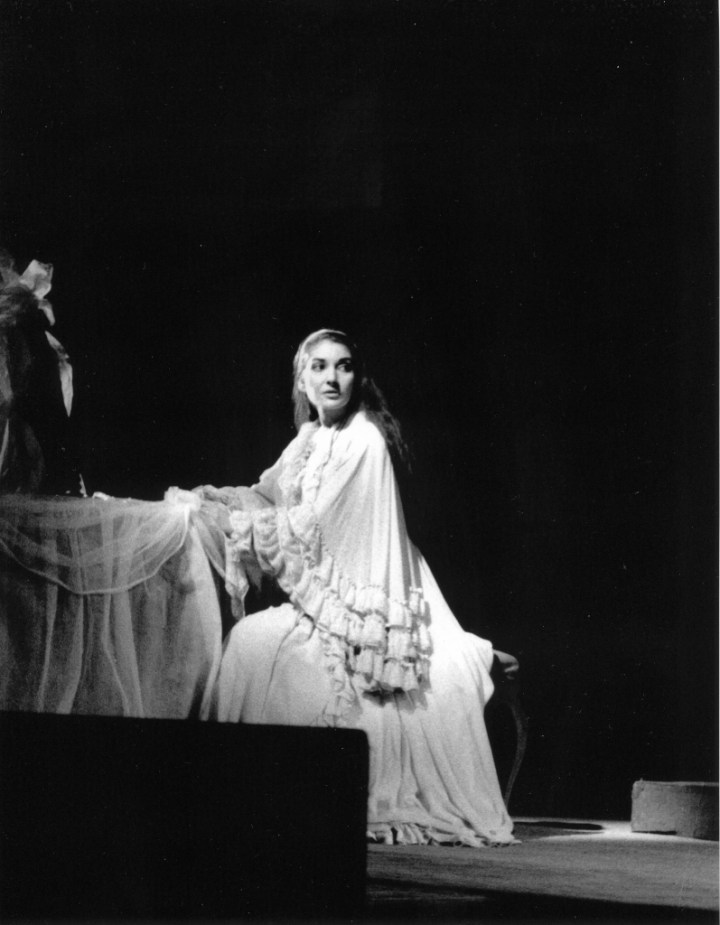
london-36-2

The adrenalin rush of Alfredo’s entrance provokes more energetic attack, and she seems momentarily to recover, but the recovery is short-lived and the realisation that not even Alfredo can stop her from dying provokes an outburst of passionate intensity at Ah! Gran Dio morir si giovine. That intensity is short-lived though and the final section of the opera is delivered in a half-voice of ineffably sweet sadness. According to reports, as Callas’s Violetta rose to greet what she thought was new life, she literally became a standing corpse, her eyes staring sightlessly into the audience. We cannot of course see this on the recording, but the way she simply shuts the breath off on her final  O gioia is an aural equivalent.

I wouldn’t want anyone to think though that spontaneity gets lost in the detail. The miracle of Callas is that not only does she achieve her effects with utmost musicality whilst closely adhering to what is in the printed score, but that she also does so as though the notes were coming newly minted from her mouth. Throughout she maintains her superb legato, never forgetting that, in Italian opera especially, it is the arc of the melody that is paramount. This surely is the art that conceals art.
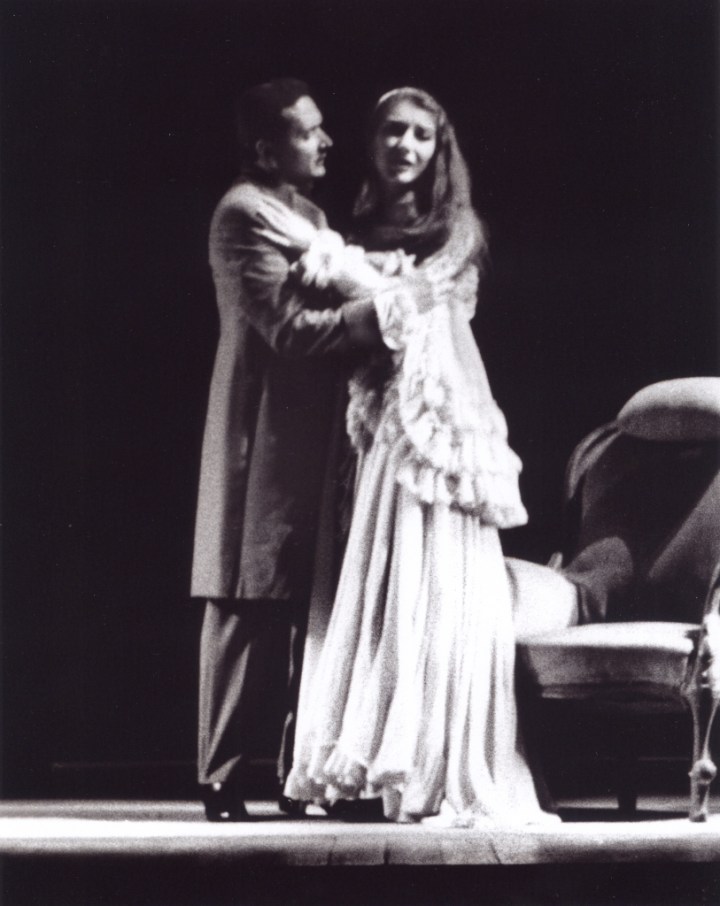
london-trav-valletti-1958

There are other reasons to treasure this set. Valletti, a Schipa pupil, sings with something of his master’s grace and elegance, though his tone is not as sappy as Di Stefano at La Scala or the young Kraus in Lisbon. Nonetheless he is a worthy partner, as is Mario Zanasi, who is my favourite of all the Germonts Callas sang with. His light baritone might sound a little young, but he is a most sympathetic partner in the long Act II duet, and a welcome relief from the four-square, over loud Germont of Bastianini at La Scala, however magnificent his actual voice.

Rescigno, as so often when accompanying Callas, is inspired to give of his very best, and the opera was cast with strength from the Covent Garden resident team, with Marie Collier as Flora and Forbes Robinson as the Baron.

Were I to be vouchsafed but one recording of La Traviata (I actually own six – four with Callas) on that proverbial desert island, then this would assuredly be it. In a performance such as this one forgets opera is artifice and what we are presented with is real life.
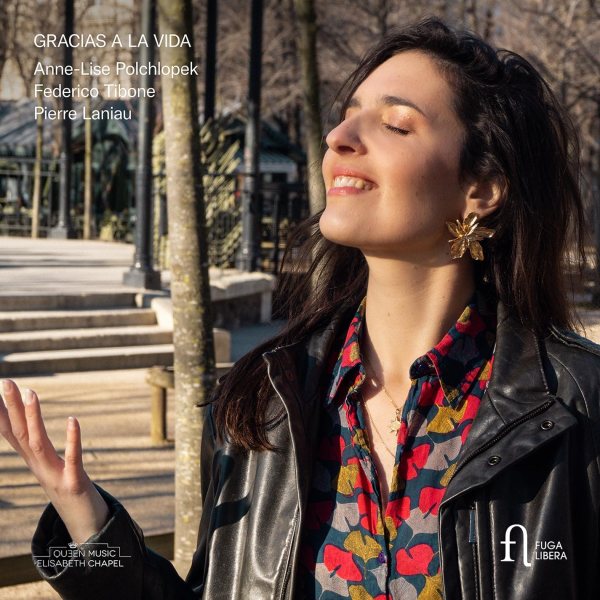
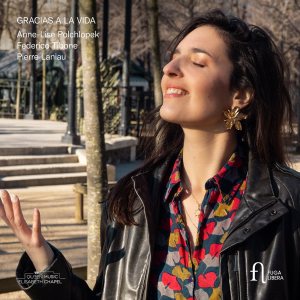
Gracias a la vida – Anne-Lise Polchlopek

It seems not a month goes by without a new recital record from a young artist making an impression. Recently I’ve welcomed recital records from Benjamin Appl, Fatma Said, Harriet Burns, Rachel Fenton and Eva Zalenga , and July saw a recommendation for Julieth Lozano-Rolong’s new disc from Dominy Clements. To this list can now be added the name of French mezzo-soprano, Anne-Lise Polchlopek, a winner of several song competitions, and now an associate artist of the Queen Elizabeth Music Chapel, where this recording was made.

This recital may at first glance appear to be a hotchpotch of different styles, embracing classical Lied, folk and popular music, but Polchlopek somehow integrates these different musical styles into a satisfying whole, and the recital benefits from being listened to at one sitting. It doesn’t get off to the best of starts with her somewhat over-articulated and over-acted singing of Bernstein’s Old Lady Tango (I am easily assimilated) from Candide, but she then sings a beautiful version of Strauss’s Wiegenlied, with a lovely legato line, her mellifluous mezzo wrapping the child in its warm embrace.

From Germany we travel to Spain and France, where we stay for the remainder of the recital. Toldrá is followed by Chaminade, then we switch to guitar accompaniment for Hubert Giraud’s La tendresse, staying with the guitar for an extremely effective performance of Falla’s Nana, from his Siete canciones populares españolas.

We go back to the piano for Fauré’s Les berceaux, in which she builds nicely to the climax, and then we have Messiaen’s early Trois melodies, where she captures to perfection the ecstasy of the writing, especially in the final song, la fiancée perdue.

 These are followed by three songs in a lighter vein by Chaminade, Pauline Viardot and Gerónimo Giménez, all wonderfully characterised. Perhaps incongruously (but somehow it works) Voi che sapete from Mozart’s Le nozze di Figaro acts as a bridge to Michel Polnareff’s Mes regrets, a beautiful song about lost love, which is followed by Fauré’s Toujours.

This in turn is followed by Gérard Jouannest’s La chanson des vieux aimants, with lyrics by Jacques Brel, a song I had previously only known in a version by Judy Collins. Suffice it to say that Polchlopek’s intensely moving performance put any thoughts of Collins out of my mind completely.

Throughout the piano accompaniments of Federico Tibone contribute wonderfully to the success of the disc, as do the guitar accompaniments of Pierre Laniau, who accompanies her on Tamás Méndez’s charming Cucurrucucu paloma, which I seem to remember was a favourite of Nana Mouskouri. He also accompanies her on the Habanera from Bizet’s Carmen and Satie’s La diva de l’empire, though I did feel the Bizet was slightly out of place here, coming, as it did, after the piano accompanied Poulenc Les métamorphoses and before the Satie.

We return to piano accompaniment for Montsalvatge’s Canto negro, which she sings with charm and spirit, relishing the yambambós, as Victoria De Los Angeles did before her.

All three participants come together for the final song, Violetta Parra’s Gracias a la vida, a fitting end to a journey on which Anne-Lise Polchlopek has proved to be a most musical guide. Throughout she clearly and meaningfully enunciates the text, and it is clear she has a rare gift for communication that makes her an ideal recitalist.

Unfortunately, though the notes accompanying the disc are in English, the online texts are only in the original language, French, Spanish, German, or in the case of the Bernstein, English, and translations would have helped for a total appreciation of Polchlopek’s art. However, I thoroughly enjoyed this disc, and I look forward to hearing more of Anne-Lise Polchlopek.

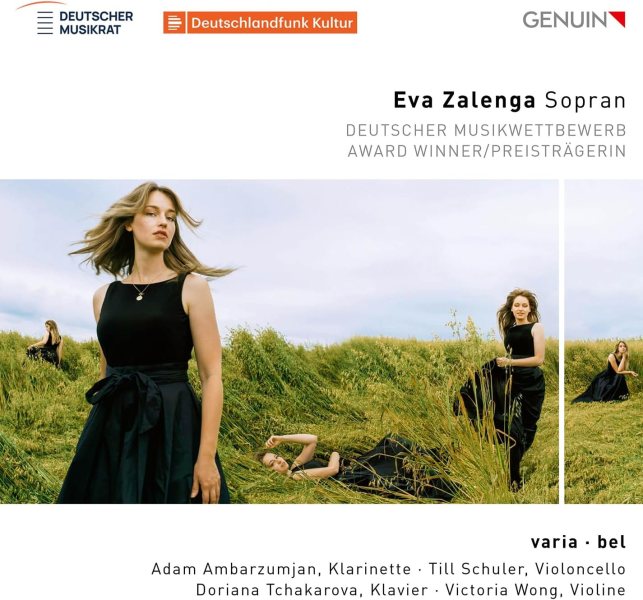
Eva Zalenga – Varia bel

Last month I was welcoming a disc of Lieder with various accompaniments by Fatma Said and here we have another for various forces, which, coincidentally, also includes Schubert’s Der Hirt auf dem Felsen.

In April 2024, I welcomed Zalenga’s debut recital on the Hänssler label, and this new recital on the Genuin label is, if anything, even more successful. Variety is the key note of the disc, in the variety of music (from the 18th to the 21st centuries), the variety of styles from the intimate to the more extrovert, and the variety of instruments accompanying the voice, that nonetheless add up to a convincing whole.

We start with a world premiere recording of Ignaz Lachner’s An die Entfernte (In die Ferne) for soprano, violoncello and piano, in which Zalenga charmingly intertwines with the cello of Till Schuler. We stay with the combination of cello and piano for Schubert’s Auf dem Strom. There is just the suspicion of strain in the upper reaches of the song here, a slight impurity that obtrudes on the silvery beauty of the sound, but it is fleeting, and soon evaporates during the next song, Meyerbeer’s haunting Des Schäfers Lied, in which the cello is swapped for Adam Ambarzumjan’s clarinet.

We stick with this combination for Schubert’s more famous Der Hirt auf dem Felsen, which, whilst not plumbing the deeper meanings of the text, as Said and Meyer do in their version, is nonetheless a delightful and charming performance.

In their earlier recital, Zalenga and Tchakarova championed women composers and it is good to see that they do so here too, first with a lovely song by Pauline Viardot-Garcia, in which we return to the combination of soprano, cello and piano, and then, jumping ahead around 100 years to Rebecca Clarke’s arrangement for soprano and violin of Three Irish Folk Songs. The tricky violin part is played by Victoria Wong. These are sung in English, and we stick with English for Arthur Bliss’s Two Nursery Rhymes, the first for soprano, clarinet and piano and the second for soprano and clarinet. Zalenga sings in perfectly accented English, and seems equally at home in French, which is the language of the next group of songs, four miniatures for soprano and violin by Darius Milhaud, Quatre Poèmes de Catulle.   

Finally all the forces come together for the last item, a new arrangement of contemporary composer Isabelle Aboulker’s Je t’aime, which Zalenga brings off with incredible wit, panache and style to bring this excellent recital to a riotous conclusion.

In all, Zalenga proves herself to be a most musical and intelligent singer and I look forward to seeing where her next enterprise will take us. Highly recommended.

Lines of Life – Schubert and Kurtág


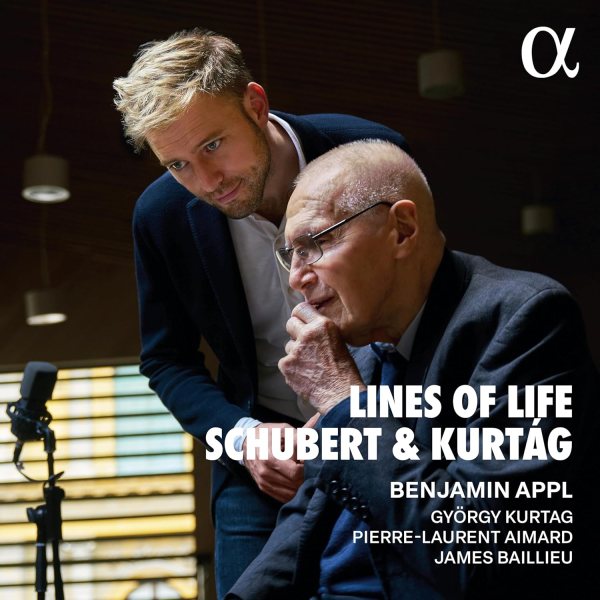
“I believe that Benjamin is currently the most authentic interpreter of my Hölderin Gesänge.” So writes György Kurtág in the notes accompanying this disc and, as he is also credited as recording producer, I think we can lay claim to their authenticity. Kurtág attended all the sessions, which took place in Budapest, apparently producing over 1,300 recording takes and countless repetitions.

The majority of the Kurtág songs on this disc are a capella. Their range, both vocal and emotional, is wide and they are brilliantly performed by Appl, whose range of expression and ability to meld the wide-ranging melismas in the vocal writing are superb. Indeed the very first song, Circumdederunt, which is in Latin and reminiscent of plainchant, homes in directly on the voice, a peculiarly expressive instrument, capable of harshness when required, as in the words et in trubulatione mea, returning to a beautiful, consoling richness for the remainder of the song. All but one of the Hölderin Gesänge are also unaccompanied and the one that isn’t, unusually has a sort of obligato accompaniment for trombone and tuba. The four Ulrike Schuster songs have an atonal piano accompaniment, which is played here by Pierre-Lauent Aimard.

As an interpreter of contemporary song, then, Appl proves himself to have few equals, but he is also a fine interpreter of Schubert and Brahms, as witness the beautiful versions of the Schubert and Brahms songs included on the disc. As befits a student of Fischer-Dieskau, expression is paramount, but never at the expense of a fine legato line and the beauty of the voce is well caught.

James Baillieu is the fine accompanist for most of the Schubert songs, but in the final two songs, Schubert’s Der Jüngling an der Quelle and Brahms’s Sonntag, Appl is touchingly accompanied by György Kurtág himself, though, it must be admitted, with rather too much pedal.

I found this disc an absorbing and challenging experience and would recommend it to anyone with an adventurous appetite.

The disc finishes with a fascinating eighteen-minute interview in German between Appl and Kurtág, for which an English translation is provided in the accompanying booklet.

.

Glen Cunningham’s Heart is in the Highlands

An interesting programme of Scottish inspired songs, but Cunningham’s tenor is a little too much on the dry side for my liking.

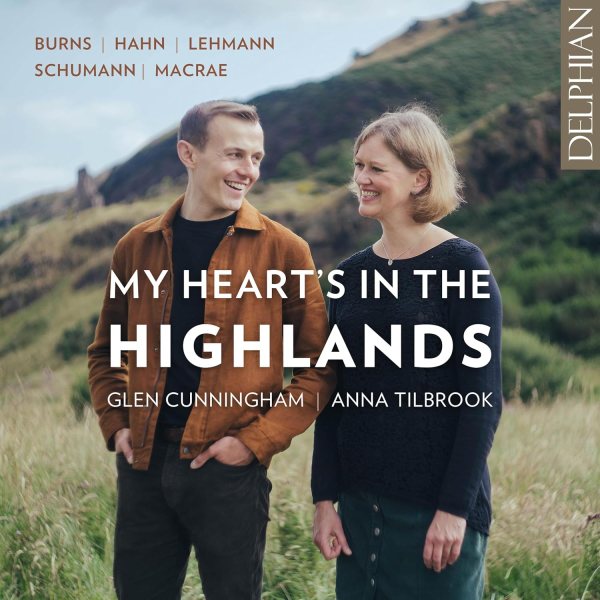
My Heart’s in the Highlands

Glen Cunningham (tenor)  Anna Tilbrook (piano)

The young tenor, Glen Cunningham, and his pianist, Anna Tilbrook, celebrate their Scottish heritage in a programme of music connected to Scotland, not only in the folk orientated songs of Robbie Burns, but also in settings of Burns by Schumann, and Robert Louis Stevenson by Liza Lehmann and Reynaldo Hahn. To these are added a completely new song cycle, also to texts by Robert Louis Stevenson, by the Scottish composer, Stuart MacRae.

It makes for an interesting programme, with the folk song settings framing the songs by Schumann, Lehmann, MacRae and Hahn. Thus, we start with a setting of Burns’s Ca’ the yowes to the knows in an arrangement by Claire Liddell, which segues into the eight songs from Schumann’s Myrthen, which set texts by Burns in German translation. They are possibly less well known than other songs from Myrthen, like Widmung or Der Nussbaum, and I doubt anyone would guess the Scottish provenance of these Schumann songs. Nor, I wager, would anyone guess that the  song Dem Roten Röslein Gleicht Mein Lieb from Schumann’s Opus 27 Lieder und Gesänge is actually a setting in German of the famous My love is like a red, red rosewhich follows it.

Liza Lehmann is less well represented in the catalogue than Schumann, though a selection of the songs from The Daisy-Chain have been recorded by mixed voices and are available on the Naxos label. Cunningham selects four of the five songs to texts by Robert Louis Stevenson. These are children’s songs to be performed by skilled adults, and the vocal writing is often taxing, Stars, for instance, requiring the sort of lyrical outpouring that Cunningham’s rather dry tenor is not quite capable of. Toby Spence manages it slightly better on the above Naxos recording, but it really needs a fuller voice than either of these two tenors can provide.

Two of the texts are also set by Reynaldo Hahn in his Five Little Songs, written while Hahn was a private in the French army during World War I, where he saw action on the front line. These too are settings of Robert Louis Stevenson, ‘children’s songs’, though it is unlikely that any child could sing or play them. They are quite charming, though, yet again, there is nothing particularly Scottish about them.

Not surprisingly, I suppose, the most Scottish sounding of the songs are those by Stuart MacRae, particularly For age an’ youth, which sets a Scots style vocal line against a sort of imitation bagpipe in the piano accompaniment. Cunningham is at his best in these songs, but even here I wanted more of tonal beauty. He compensates with the intelligence of his delivery, but throughout I’m afraid I found his vibrato intrusive and the sound he makes unpleasantly hard and uningratiating.

I should just mention that Anna Tilbrook is a most sensitive accompanist and adapts brilliantly to the style of each composer.

The recital ends with the title song, My heart’s in the Highlands, in an arrangement by Michael Barnett (and supplemented by Tilbrook) that was transcribed from a 1962 Kenneth McKellar recording. I just wish that Cunningham sang it with some of McKellar’s beauty of tone.

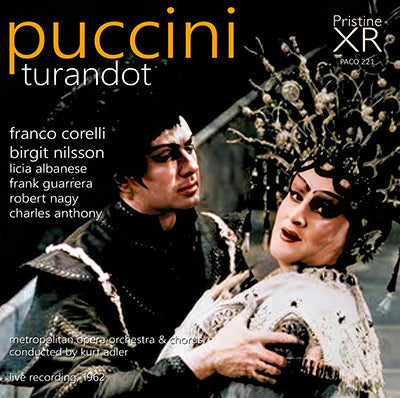
Turandot from the Met with Nilsson and Corelli

La principessa Turandot – Birgit Nilsson (soprano)
Calaf – Franco Corelli (tenor)
Liù – Licia Albanese (soprano)
Ping – Frank Guarrera (baritone)
Pang – Robert Nagy (tenor)
Pong – Charles Anthony (tenor)
Timur: Ezio Flagello (bass)
L’imperatore Altoum – Alessio De Paolis (tenor)
Un mandarino – Calvin Marsh (baritone)
Chorus and Orchestra of the Metropolitan Opera/Kurt Adler
rec. live radio broadcast, 24 February 1962, Metropolitan Opera House, New York City, USA

Well, let’s get this straight. This is an exciting performance of Puccini’s last opera, which puts you in a good seat at the old Metropolitan Opera House on a night when two of its greatest stars were singing two of their greatest roles. You can sense the excitement in the house from the moment the radio announcer, Milton Cross, introduces the opera with the words, “We’ll have the loud, crashing chords, then the curtain will open on the walls of the oriental Imperial palace of Peking.” Indeed the set is loudly applauded by the audience.

After the excitement of those opening chords and the chorus which follows, it is something of a disappointment to be confronted with the Liu of Licia Albanese, who was approaching 53, but quite frankly sounds even older. She compensates by loudly over-singing and over-emoting, and I derived very little pleasure from her performance. Her days at the Met were evidently numbered and she left the company in 1966, following a dispute with Sir Rudolf Bing.

For the rest, we have a sonorous Timur from Ezio Flagello, but the Ping, Pang and Pong tend to over-characterise their music and consequently I found their scenes irritating, as I often do.

However, the main reason for hearing this set remains the splendid singing of Nilsson and, especially Corelli. I am not one of those who think Corelli can do no wrong, but in the right role, and Calaf is undoubtedly the right role for him, he is unbeatable. First of all, there is the sheer splendour of that sound, the thrill of his top notes, which he can fine down to almost a whisper in places. He is absolutely thrilling and the audience go wild after Nessun dorma, with Adler abruptly stopping the orchestral postlude until the pandemonium has died down.

So too, of course, is Nilsson, throwing out those top notes like laser beams. The punishing tessitura holds no terrors for her at all and it is all very exciting, if not particularly subtle. Nor is the conducting of Kurt Adler, for that matter, but he certainly knows how to whip up the excitement.

According to Lee Denham in his exhaustive survey of the opera, there are, or have been, available seven other recordings featuring Nilsson, three of them with Corelli, so how necessary is this particular recording? I’m pleased to have heard it, but I’m not sure I’d want it as my one representation of Nilsson and Corelli in the opera. For that, I’d probably stick with the EMI recording under Molinari-Pradelli, which also has the benefit of including the Act III aria Del primo pianto, which is omitted from all Nilsson’s live accounts. It also has the benefit of the young Renata Scotto as Liu.

I would also not want to be without the Mehta recording with Sutherland, Pavarotti and Caballé, nor the Serafin with Callas, Fernandi and Schwarzkopf, but this one is a great reminder of a thrilling afternoon at the old Met.

Saimir Pirgu sings operatic arias

Ten years ago I saw Saimir Pirgu as the Duke in the Royal Opera House’s David McVicar production of Rigoletto. Though he looked splendid and dashing, he was utterly charmless and I found his singing stiff and monochromatic. Since then, he seems to have ventured into more dramatic repertoire, and this recital of mostly verismo arias comes as a follow-up to a 2015 album of more lyrical fare, which I haven’t heard.

The present recital was very well received by my colleague, Göran Forsling in October of last year (review) but I’m afraid I can’t join in with his praise. For a start, Pirgu’s basic production is terribly ingolata, so much so that his singing was giving me a sore throat. There is no freedom to the sound and, when I compare him to the greats of the past, from Caruso to Björling to Pavarotti, all I hear is his struggle to get the sound out. There is no ring at the top and the middle voice is forced, resulting in a distressing vibrato. Indeed, he sounds a good deal older than his forty-two years.

Added to that, he doesn’t really do anything with the music and here his conductor, Antonio Fogliani, must take some of the blame, for his conducting is dull and prosaic. Most of the arias on the disc are well known but, with so many other versions out there, this just isn’t competitive.

I tried listening to the recital several times, thinking that maybe it had something to do with my mood, but, no, each time my reactions were the same. I just couldn’t get past Pirgu’s basic vocal production and I found it difficult to relax and enjoy the music. I hate to be so negative, but this is a disc for fans of Pirgu only, if indeed they exist.

Contents.

  1. Puccini: Manon Lescaut – “Indietro!… Guardate, pazzo son” 
    2. Puccini: Tosca – “E lucevan le stelle”
    3. Leoncavallo: Chatterton – “Non saria meglio… Tu sola a me” 
    4. Giordano: Andrea Chénier – “Colpito qui m’avete… Un dì all’azzurro spazio” 
    5. Puccini: Le villi – “Ecco la casa… Torna ai felici dì”
    6. Puccini: Manon Lescaut – “Donna non vidi mai” 
    7. Cilea: Adriana Lecouvreur – “L’anima ho stanca”
    8. Wagner: Lohengrin – “In fernem Land”
    9. Berlioz: La Damnation de Faust – “Nature immense”
    10. Tchaikovsky: Eugene Onegin – “Introduction”
    11. Tchaikovsky: Eugene Onegin – “Kuda, kuda, kuda vi udalilis”
    12. Puccini: Il tabarro –  “Hai ben ragione” 
    13. Bizet: Carmen – “La fleur que tu m’avais jetée”
    14. Puccini: Turandot – “Non piangere, Liù”
    15. Jakova: Skenderbeu – “Kjo zemra ime”
    16. Puccini: Tosca – “Recondita armonia” (with Vito Maria Brunetti (bass))
    17. Giordano: Andrea Chénier – “Come un bel dì di maggio” 
    18. Puccini: Madama Butterfly – “Addio, fiorito asil” 
    19. Giordano: Fedora – “Amor ti vieta”
    20. Sorozábal: La taberna del puerto – “No puede ser”
    21. Puccini: Turandot – “Nessun dorma!”


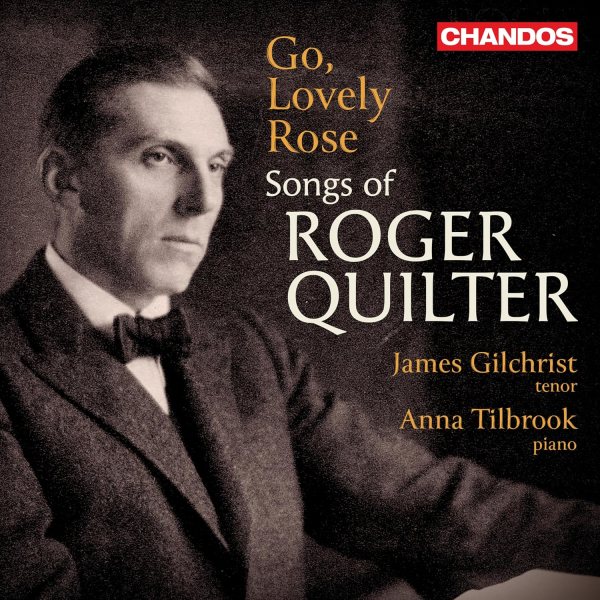
Go Lovely Rose – The songs of Roger Quilter

91aupp0ckgl._ac_sl1500_

James Gilchrist (tenor) Anna Tilbrook (piano)

The songs of Roger Quilter are not performed as often these days as they once were, which is a shame, because they are beautifully crafted and, though perhaps they don’t probe as deeply into the texts as those of Finzi, Delius and Warlock, they are very rewarding for performers and listeners alike. Quilter had a wonderful gift for melody, but it was always melody put at the service of the poetry and the text is sung more or less as if it were spoken. Having performed many of the songs myself in my youth, I can attest to the fact that they are a gift to the performer.

Rather than give us whole opus numbers, Gilchrist and Tilbrook have chosen songs from his complete oeuvre, with the songs grouped into themes. Thus, we have six Shakespeare songs, drawn from the Op. 6, Op. 23 and Op. 32 sets of Shakespeare settings, five songs associated with flowers (A Floral Tribute), four Folk Song settings (all taken from The Arnold Book of Old Songs), four songs associated with the graveside, and four Songs of Love. The only songs performed as a set are the early German songs, written when Quilter was studying in Frankfurt. These are charming, but slight and give little indication of Quilter’s later, more mature style.

Initially alienated by the rather gruff sound of Gilchrist’s voice in the opening robust Blow, blow, thou winter wind (we are at once aware that this is not the voice of a young man, and indeed Gilchrist was approaching sixty at the time of the recording), I was drawn in by his elegiac delivery of Come away, death, and thereafter, I was less aware of any failing resources. Indeed, in the more gently reflective songs, with which the disc proliferates, Gilchrist is often spellbindingly beautiful, spinning out some lovely pianissimi in such songs as Fear no more the heat of the sun, the famous Now sleeps the crimson petal and the song which gives the collection its name, Go lovely rose. He is admirably supported by Anna Tilbrook, who is an excellent accompanist.

I would not be doing my job as a reviewer if I didn’t point out that there is another similar collection of songs available on the Hyperion label. This was recorded in 1996 by the then much younger John Mark Ainsley with Malcolm Martineau at the piano. Some may prefer Ainsley’s much more forthright manner and fresher timbre, as indeed I occasionally do, especially in songs like Blow, blow, thou winter wind and the ebullient Love’s philosophy, but Gilchrist’s more reflective style has its own rewards, and this is a welcome addition to the Quilter discography

Contents
Shakespeare Songs
Blow, blow, though winter wind, from Three Shakespeare Songs (First Set) Op 6, No 3 (1905)
Come away, death, Op 6 No 1 from Three Shakespeare Songs (First Set) (1905, rev 1906)

Fear no more the heat o’ the sun. from Five Shakespeare Songs (Second Set) Op.23 No 1
Orpheus with his lute. from Two Shakespeare Songs (Fourth Set) Op.32 No 1(1919-20)
O mistress mine, from Three Shakespeare Songs (First Set) Op 6 No 2 (1905, rev 1906)

Under the greenwood tree, from Five Shakespeare Songs (Second Set) (1919)
A Floral Tribute
The Fuchsia Tree, Op.25 No.2 (1923)
Go, Lovely Rose, from Five English Love Lyrics Op.24 No.3 (1922)
A last year’s rose, Op 14 No.3 (1909-10)
Now sleeps the Crimson Petal, Op 3 No 2 91897)
To Daisies from To Julia, Op.8 No 3 (1905)
Folksongs
From The Arnold Book of Old Songs
Barbara Allen, No 13 (c 1921)
Drink to me only with thine eyes, No 1 (c 1921)
My Lady’s Garden, No 10 (c 1942)
The Ash Grove, No 16 (c 1942)
At the Graveside
Autumn Evening Op.14 No.1 (1909-10)
Dream Valley, from Three Songs of William Blake, Op.20 No.1 (1917)
Drooping Wings (1943)
Music, when soft voices die, from Six Songs, Op 25 No.5 (1926)
German Songs
Four Songs of Mirza Schaffy, Op 2 (bef. 1903, rev. 1911)
Songs of Love
Love’s Philosophy, from Three Songs, Op 3 No 1 (1905)
Julia’s Hair from To Julia Op 8, No 5 (1905)
The Maiden Blush from To Julia Op 8, No 2 (1905)
It was a lover and his lass, from Five Shakespeare Songs (Second Set), Op

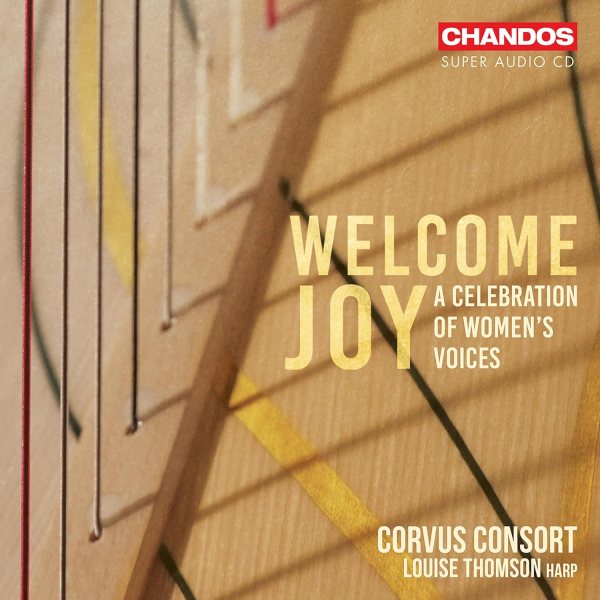
Welcome Joy – The Corvus Consort

81lspxvxnl._ac_sl1500_

The subtitle of this disc is A Celebration of Women’s Voices and a celebration it undoubtedly is, not just of the women’s voices who sing on the record, but of the voices of the women composers who make up the lion’s share of the music. Room is found for Gustav Holst, who was a champion of women’s voices and taught at several girls’ schools, most famously at St Paul’s Girls School, where he taught for almost thirty years.

Its centrepiece, and the longest work on the disc, is Elizabeth Poston’s An English Day-Book, which here receives its première recording of this edition. If it is reminiscent of Britten’s A Ceremony of Carols, then that is because it was conceived to complement it by providing a work suitable for use throughout the year. The Day-Book was unpublished at he time of Poston’s death in 1987, but has since been published by the Arts and Education charity, Multitude of Voyces, which specialises in publishing and promoting works by communities historically or currently underrepresented or marginalised. The charity also published the works here by Hilary Campbell, Olivia Sparkhall, Judith Weir and Gemma McGregor. I was particularly taken by Sparkhall’s Lux Aeterna, which is for two choruses, solo soprano and harp and McGregor’s Love was his meaning with its lovely falling harp introduction.

“Welcome Joy”, sing the Corvus Consort at the beginning of this recital and indeed what a joy it is. Imogen Holst’s commission for the 1951 Aldeburgh Festival is a setting of six poems by John Keats, described by Britten as ‘six little treasures’ when he first received them, and, in this joyful performance, it is easy to see why.

This piece, like most of the music on this CD was completely new to me, but I did know Gustav Holst’s Choral Hymns from the Rig Veda (Third Group) from Imogen Holst’s 1968 recording with the Purcell Singers and Ossian Ellis. I am bound to say that I found that recording a mite more atmospheric, especially in the opening Hymn to the Dawn, which has a mystery and magic that is not quite captured in the clearer, more analytical Chandos digital recording.

Nevertheless, I enjoyed this disc of choral music for women’s voices. The work of the Corvus Consort under their conductor, Freddie Crowley can hardly be faulted, with a superb contribution from harpist, Louise Thomson.

Full texts are provided, and the exemplary notes are extensive. A thoroughly enjoyable disc.

Contents

Imogen Holst (1907 – 1984)  Welcome Joy and Welcome Sorrow (1950)

Gustav Holst (1874 – 1934) Two Eastern Pictures (1911)

Choral Hymns from the Rig Veda (Third Group) (1910)

Dirge and Hymneal (1915)

Judith Weir (b.1954) We sekyn here rest (2019)

Hilary Campbell (b. 1983) Our Endless Day (2017)

Elizabeth Poston (1905 – 1987) An English Day-Book  (1966 – 67)

Olivia M. Sparkhall (b. 1976) Lux Aeterna (2018)

Gemma McGregor (b. 1965) Love was his meaning (2018)

Shruti Rajasekar (b. 1996) Ushãs – Goddess of Dawn (2024)

Priestess (2024)


Schön ist die Welt on CPO

813sjdal._ac_sl1425_

Schön ist die Welt was the last in a series of Lehár’s operettas that were premiered in Berlin. Paganini, had met with a somewhat lukewarm reception in Vienna, but had triumphed in Berlin in 1926 , due to the participation of Richard Tauber, and thereafter Lehár wrote the majority of his operettas for Berlin with Tauber in mind for the leading role. Not that Shön ist die Welt, which premiered in 1930, was an entirely new work, it being a re-working of an earlier operetta, Endlich allein, originally performed twelve years earlier, the second act of which Lehár had been particularly proud, as it was more or less through composed with minimal dialogue. This second act, with the addition of a Tauber-lied, is pretty much lifted from the earlier operetta, but the outer acts underwent substantial revisions.

The action takes place in the Swiss Alps, where Crown Prince Georg arrives at an Alpine resort to meet for the first time his fiancée, Princess Elisabeth. However, on the way he stopped to help a girl, whose name he did not discover, mend a puncture and fell madly in love with her. He announces to his father that he will not marry Elisabeth because he loves another. All turns out well when our unwitting hero and heroine go on a hike and get trapped by an avalanche at an Alpine hut and have to spend the night together. Returning the hotel the next morning, Georg discovers that the girl he helped with the puncture is in fact Princess Elisabeth. There is also a sub plot involving Count Sascha and a Brazilian dancer, called Mercedes della Rossa, which gives Lehár the excuse for some Latin American influenced music in the first and third acts. It’s all pretty insubstantial, but it does give rise to some gloriously lyrical music, especially in the second act, which involves just the two leads.The present recording would seem to derive form stage performances as we hear occasional stage noise, though there is precious little sign of any audience. There was a previous recording, also on CPO, (review), which I see is still available as a download. That was on a single CD, but included none of the dialogue, whereas here we get quite a lot of it, which could prove tedious for all but fluent German speakers, and even they could find it a little too much for repeated listening.That said, the sound is excellent and the playing of the Franz Lehár Orchestra under Marius Burkert most stylish. I also enjoyed the contributions of Katharina Linhard and Jonathan  Hartzendorf as the secondary couple, and of Jospeh Terterian as the Jazz Singer. Where I had a problem was with the contributions of the two leads. Thomas Blondelle as Crown Prince Georg has a pleasing light tenor, but he is no Richard Tauber and he is not really up to the operatic demands of Act II. Nor is Sieglinde Feldhofer as the Princess Elisabeth. She has rather too much vibrato for my taste and tends to lunge at her high notes. I couldn’t help thinking what a difference a Schwarzkopf or a Rothenberger would have made.  Elena Mosuc and Zoran Todorovich who sing the roles of Elisabeth and Georg on the other CPO recording I mentioned above, improve on the present two, but they, rather confusingly, sing the secondary couple as well, so there is no doubt that this present recoding is more cohesive.

Nor would I like to give the impression that I didn’t enjoy the set. I did. Very much indeed, despite the less than stellar contributions of the two main leads. Lehár was such a prolific tunesmith, some of the songs were rattling around in my head for days afterwards. It gets a qualified recommendation from me.

Prinzessin Elisabeth – Sieglinde Feldhofer (soprano)

Kronprinz Georg – Thomas Blondelle (tenor)

Der König – Gerd Vogel (baritone)

Mercedes della Rizza – Katharina Linhard (soprano)

Graf Sascha Karlowitz – Jonathan Hartzendorf (tenor)

Herzogin Maria Brankenhorst – Klára Vincze (soprano)

Ein Jazzsinger – Jospeh Terterian (tenor)

Hoteldirektor – Johannes Hubmeir (tenor)

Chor des Lehár Festivals Bad Ischil

Franz Lehár Orchestra/ Marius Burkert