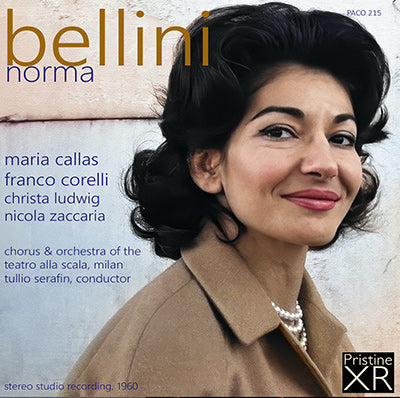
A reappraisal of Callas’s second studio Norma

paco215_530x

The Pristine XR remaster gives us the chance to reappraise a set which is slightly controversial in that it captures Callas in late career with occasional flaps on top notes. Nonetheless it was Ralph Moore’s overall top choice in his opera survey and he had no problem recommending it when he reviewed this Pristine issue in July of this year (review).

For my part, I’ve known the set for over sixty years now. It was actually the first opera set I ever owned, and, for quite a few months, the only opera set I owned, so I got to know it pretty well. Since then of course, I have heard a fair amount of other Normas, Sutherland, Caballé, Scotto, Sills, Eaglen, Bartoli (please, never again), Sass live at Covent Garden (disastrous) and plenty more by Callas herself; the live 1952 Covent Garden, the 1954 studio, the 1955 Rome broadcast and, best of all, the live 1955 La Scala, as well as excerpts from many others, right up to her final performances in the role in Paris in 1964.

So how does it hold up? Well, pretty well actually. Sonically, it was always pretty good, and, if I’m honest, I can’t hear that much difference between the most recent Warner version and the Pristine version. Perhaps there is a bit more space around the voices in the Pristine version, but it is the difference is slight.

As for Callas’s voice, it is true, notes above the stave have taken on a metallic edge, and they don’t always fall easily on the ear, but the middle and lower timbres have a newfound beauty, and a characterisation that was always complex and multi-faceted has taken on an even greater depth, parts of it voiced more movingly here than anywhere else.

There are other gains too. The cast here is a vast improvement on the earlier studio one, Corelli in particular being a shining presence. Fillipeschi was a liability on the earlier set, but, whilst not quite a paragon, and chary of some of the coloratura in his role (Serafin making a further cut in the great In mia man duet to accommodate his lack of flexibility), Corelli’s is a notable presence, and his clarion voice is ample compensation. Zaccaria may be less authoritative than the woolly voiced Rossi-Lemeni, but his tones are distinctly more buttery. Ludwig is an unexpected piece of casting, but she too is an improvement on Stignani, who, great singer though she was, was beginning to sound a bit over the hill by the time of the first Callas recording (she was 50 to Callas’s 30). Ludwig sounds, as she should, like the younger woman. Her coloratura isn’t always as accurate as one would like, certainly no match for Callas, but she sings most sympathetically in duet with her older colleague, and Mira o Norma is, for me, one of the greatest performances on disc. After Ludwig states the main theme, Callas comes in quietly almost imperceptibly and at a slightly slower tempo with an unbearably moving Ah perche, perche, her voice taking on a disembodied pathetic beauty. When Ludwig joins her for the section in thirds, she perfectly matches Callas’s tone on her first note, before Callas joins her in harmony, a real example of artists listening to each other in a sense of true collaboration.

One should I suppose mention the losses from the earlier recording. Yes, some of Callas’s top notes are shrill, and we lose some of the barnstorming heroics that were a part of Callas’s Norma right up to 1955. This Norma is more feminine, more vulnerable, if you like. How much this had to do with interpretive development, and how much with declining vocal resources is a moot point, but there is no doubt Callas is still a great singer, doing the best she can with what she has. Some sections are more moving here than in any of her other performances. I’ve already singled out Mira o Norma but the earlier duet is its equal, with Callas wistfully recalling her own awakening to first love.

The beginning of Act II always brought out the best in her, and here she is sublime. Dormono entrambi is an unusual piece which alternates passages of recitative with arioso, rather like Rigoletto’s Pari siamo. Callas draws on all the colours in her palette to express Norma’s contrasting emotions. You can almost feel the chill that comes over her at un gel me prende e in fronte si solleva il crin followed by the choked emotion of I figli uccidi! The arioso of Teneri figli is couched in a tone of infinite, poignant sadness, but then her tone hardens with her resolve at Di Pollion son figli, before, with a cry she drops the knife (and we can almost hear the precise moment), crying out Ah no, son miei figli! Operatic singing and acting on the highest level.

Serafin’s conducting is much as it was in the first set. He has the virtue of not conducting the opera as if it were Verdi, as so many do. Sometimes I’d like him to get a move on a bit, but his pacing of the final two duets (one in public, one in private) is superb, and he perfectly judges the climaxes in the Grand Finale, one of the greatest in all opera.

I wouldn’t want to be without Callas’s 1955 live La Scala account (also available from Pristine) with Del Monaco and Simionato, which is where voice and art find their greatest equilibrium, but for a studio set, this is now clearly the one to go for. One thing is for sure, Callas remains the quintessential Norma. No singer has yet challenged her hegemony in the role.


Mariss Jansons conducts the Mozart Requiem

71sy8aru8il._ac_sl1500_

Mariss Jansons was chief conductor of the Bavarian Radio Symphony Orchestra until his untimely death in 2019, a post he had held since 2003. He had a long and fruitful association with the orchestra and BR Klassik have released many of his live concerts on disc. Indeed, they have recently brought many of these together in a seventy-disc set.

This performance of the Mozart Requiem was recorded at concerts in May of 2017. Jansons uses the famous Süssmayr completion, and the performance is unashamedly in the Romantic tradition. There is nothing controversial about it, speeds for the most part judiciously chosen, and yet, for me, it never quite catches fire, comparing unfavourably with another live Jansons performance with the Concertgebouw from 2011, which was very favourably reviewed on Musicweb International by Simon Thompson (review). Two of the soloists on the present recording, soprano, Genia Kühmeier and tenor, Mark Padmore sing on that performance too. Kühmeier is lovely in both performances, but Padmore sounds marginally fresher and sweeter in the earlier one, which also has a superb Gerard Finley singing the bass role and Bernarda Fink in the alto part. Elisabeth Kulman and Adam Plachetka, on this issue, are fine, but not quite in the same league.

I listened three times, comparing this one to the earlier one, as well as listening to a similarly big-boned interpretation in the form of Karajan’s 1987 performance, both of which I found much more intensely dramatic. The Karajan, which dates from his final years with the Vienna Philharmonic Orchestra is, I think, his finest of the three he has recorded for DG, and has a reverence and spirituality that I found lacking here. It was hard to put my finger on what was missing in the Jansons, but there are times, like the startling opening to the Confutatis, which jolted me out of my seat, when it felt as if Jansons himself knew something was amiss and was trying to inject some drama or extra energy into the performance. The final lux aeterna, on the other hand, rather trundles towards its conclusion and is greeted by a tepidly polite round of applause, making me wonder why this broadcast was considered for release, especially given the competition from Jansons himself in the much finer Concertgebouw performance, which is also better recorded. Even with the volume turned up quite high, the recording of the Bavarian broadcast is a little distant, a little muddy, and I wondered if this too contributed to my muted impressions.

Well worth considering, if you are wanting the Süssmayer version, is John Butt’s superb reconstruction of the first performance, released by Linn in 2014, which of course uses original instruments. (review) Though the forces are much smaller, it is incisively dramatic and brilliantly recorded, though I personally would prefer any of Jansons’ soloists in either of his two recordings. The bass on the Butt recording is particularly weak and tends to growl in the lower register, no match for Finley, nor even for Plachetka.

If you do want Jansons in this work, then I would suggest you stick to the Concertgebouw performance, which can certainly hold its head up amongst the best of the many recordings on modern instruments.

Elisabeth Schumann’s Swan Song

91ry4lbyuzl._ac_sl1500_

Born in 1888, Elisabeth Schumann’s first recordings were acoustics, made in 1915, although it is probably for her later, electrical recordings that she is better known. She had an illustrious operatic career, famous for such roles as Sophie in Der Rosenkavalier and Eva in Die Meisteringer, also excelling in Mozart with roles such as Pamina, Susanna, Zerlina and Blonde. She was a favourite of Richard Strauss, who even tried to persuade her to sing the role of Salome, creating an edition in which he reduced the size of the orchestra to accommodate her light, lyrical soprano, though she never took up the offer.

She was also highly regarded as a singer of Lieder and Lotte Lehmann, who was perhaps her greatest rival in the field, once said she represented the purest singing style of German Lieder. She has a large discography and many of her recordings, both acoustic and electrical were once issued in a six disc EMI box set, which now appears to be available as a Warner download.

The present recordings were made somewhat later in her home in Manhattan in 1950, when she would have been in her early sixties, and this appears to be the first time the sessions have been issued in their entirety. The accompanying notes are sketchy and inadequate. Included are brief biographies of Schumann herself and of George Schick and George Reeves, who I assume are the accompanists, but there is no indication as to which songs they play, nor which items are completely new to the catalogue.

Being late recordings, this is not a disc to which I would direct anyone interested in hearing “the purest singing style of German Lieder”. Though the bell-like purity of Schumann’s top notes remains more or less intact, quite frankly, in the middle and lower register, she sounds all of her sixty odd years. Certainly, the voice has aged less well than some other sopranos, who also made recordings into their sixties, such as her contemporary Maggie Teyte or, of more recent singers, Renée Fleming. Some of the Wolf songs now clearly stretch her to the limit and I find myself wondering if this is the reason they were not issued before. One should probably make allowances for the way these songs were recorded (probably on a 7.5ips home recorder, according to the notes) but to my ears  she sounds effortful and unsteady for much of the time.

She redeems herself in the final three bonus tracks, first in two acoustic Odeons of her singing Wolf’s Frage und Antwort and Straus’s Morgen (date and accompaniment unknown), followed by a later recording of her delivering in English a master class on Morgen, this time with Ernest Lush on the piano. No date is given, and I wonder if this was from one of her lecture tours of 1950 and 1951. If it was, then she sounds in much better voice here than she does on the home recordings.  and she gives invaluable advice on singing the song, recollecting working on it with Strauss himself.

I hate to be negative about a much-loved artist, but this disc, I would suggest, is for completists only. Anyone wanting to discover the voice and art of this great soprano, will be much better served by the six-disc set detailed above.

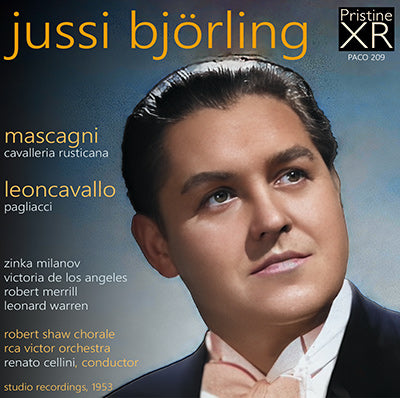
Pristine’s Re-master of Björling’s Cav and Pag.

paco209_fdbcae84-e953-4879-bd72-570e6effee64_530x

A photo of Jussi Björling graces the cover of this Pristine issue, and he is without doubt the main reason to hear these recordings. It is always a pleasure to hear his beautiful voice, musical phrasing and ringing top notes, though I’m not sure he would ever have been perfectly cast in either role. But before coming to Björling himself, it might be instructive to consider other elements of the recordings.

Both operas were recorded in 1953 in New York with the RCA Victor Orchestra and the Robert Shaw Chorale under Renato Cellini and sound remarkably good in these Pristine transfers, so good, I almost thought they were in stereo. I hadn’t heard either performance before, so I have nothing to compare the Pristine transfers to, but they are admirably clear and spacious and a good deal better than the contemporaneous Serafin recordings with Di Stefano and Callas. The Serafin Pagliacci is in reasonable mono sound, but unfortunately the Cavalleria Rusticana suffers from overload and distortion, which no amount of re-mastering would seem to be able to overcome. Still, I wish that these Cellini performances were half as exciting.

Cellini’s conducting is at least idiomatic, his tempi well chosen, but neither opera really catches fire and they both remain somewhat studio bound. The professional Robert Shaw Chorale sing in both operas. They are faultless in execution, but I couldn’t help picturing them all in prim white shirts and blouses, standing, score in hand, in choir banks. They don’t for one second conjure up the sound of lusty Sicilian peasants or excited Italian village folk. The La Scala Chorus on the Serafin set, may not be so polished, but they have this music in their blood and are much more convincing.

I suppose I should preface my discussion of the solo singers with a confession that I have never much liked Zinka Milanov, or at least not on any of the recordings I have heard, which were all made quite late in her career. From the outset she sounds far too mature, almost indistinguishable from Mamma Lucia in her initial exchanges and completely uninvolved in poor Santuzza’s plight. Björling, who could sometimes be accused of being a little cool, is at his most impassioned in their duet, but she remains phlegmatic and stolid. She is no better in the duet with Robert Merrill’s Alfio, who, in any case, is a bit too jovial and avuncular. Björling’s Turiddu is beautifully sung and, as I mentioned, he does try to inject some passion into his exchanges with Santuzza, but there is something about the inherent nobility in his tone that makes him not quite right for the caddish Turiddu. As always, his singing gives great pleasure, but I can’t quite believe in him.

That said, I find his Turiddu more convincing than his Canio. Yet again, the role is beautifully sung, Vesti la giubba heart-breaking and deeply felt, but can anyone really believe that this is a man who would be driven to double murder? I certainly can’t. I have much the same problem with the Nedda of Victoria De Los Angeles. She is in her best voice, warm and feminine and, like Björling, has the virtue of always being supremely musical. She sings quite beautifully, especially in her Ballatella, but, as with her Carmen, she sounds altogether too ladylike. I don’t necessarily want Nedda to be portrayed as a heartless minx, as was often the case in days gone by, but I need to believe that she has the mettle to defy a bully of a husband and have an affair behind his back.

Nor is there any menace in the Tonio of Leonard Warren, who, in the prologue, could be singing about anything at all really. Gobbi, on the Serafin set, does not have such a beautiful voice, nor such easy top notes, but he makes every word tell. Merrill has here been given the secondary role of Silvio, but his Silvio doesn’t sound much different from his Alfio. Compare Panerai, who sings both roles on the Serafin recordings, utterly menacing as Alfio and ardently seductive as Silvio.

Jussi Björling was, without doubt, one of the greatest tenors of the last century and I always take pleasure in the sheer beauty of his voice, his musical phrasing and his wonderfully free and ringing top notes, so it was a pleasure to hear him here, even if these two roles are not ones to which I think he was really suited. For the rest I derived the most pleasure from De Los Angeles’s beautiful and musical singing as Nedda, even if she too is caught in a role that was not particularly suited to her gifts.

Not a top choice for either of these two operas then. For all that they are in better sound than Serafin’s recordings of the two operas, I would still place the Serafin performances ahead of them. Di Stefano can be a bit wayward, but he is better at expressing the caddish side to Turiddu and the unhinged side of Canio that turns him into a killer. Callas is, as usual, hors concours, both as a wonderfully impassioned Santuzza and a free-spirited and mettlesome Nedda, and she is in fine voice on both recordings. Gobbi is equally brilliant as Tonio and their confrontation bristles with drama. There are also better choices amongst more recent recordings, such as Karajan’s sumptuously recorded La Scala set for DG, which no doubt remains a first choice for many.

As always, Pristine should be commended for including with the CDs a package of downloadable items, which includes a copy of the same recording as an MP3 download, together with full scores, both piano and orchestral, and a full libretto in PDF format. Most major companies these days don’t even include an online link to a libretto.

Pietro Mascagni (1863-1945)
Cavalleria Rusticana (1890)
Turiddu: Jussi Björling (tenor)
Santuzza: Zinka Milanov (soprano)
Alfio: Robert Merrill
Mamma Lucia: Margaret Roggero (mezzo)
Lola: Carol Smith (mezzo)

Ruggero Leoncavallo (1857-1919)
Pagliacci (1892)
Canio: Jussi Björling (tenor)
Nedda: Victoria De Los Angeles (soprano)
Tonio: Leonard Warren (baritone)
Silvio: Robert Merrill (baritone)
Beppe: Paul Franke (tenor

Robert Shaw Chorale
RCA Victor Orchestra/Renato Cellini
Rec. 1953, Manhattan Centre, New York
Full scores and libretto included as downloads
Pristine Audio PACO209 (2 CDs 141)


Thibaudet & Feinstein – Gershwin Rhapsody

81vjpukhnrl._ac_sl1500_

George Gershiwn always had a foot in both the classical and Broadway camps and this disc too has a foot in both camps by bringing together Broadway star and cabaret artist, Michael Feinstein and classical pianist Jean-Yves Thibaudet. The two men have known each other socially for some time and hatched the idea of doing this programme over several dinners whilst they were appearing at the Napa Festival in 2021.

One would expect Feinstein to be at home in such a programme, but Thibaudet is no stranger to the jazz idiom, having recorded albums of music by Bill Evans and Duke Ellington, and he has of course, also made recordings of Gershwin’s Piano Concerto and Rhapsody in Blue. Most of the arrangements, and all of those for two pianos, are by Tedd Firth, but Thibaudet also plays some of Gershwin’s own pieces as well as Earl Wild’s wonderful arrangement of Embraceable You, whilst Feinstein sings his own arrangements of three songs  (Someone To Watch Over Me, Embraceable You and They Can’t Take That Away From Me), Tedd Firth providing the arrangement for the fourth (Love Is Here To Stay).

The first eleven tracks comprise the Rhapsody in Blue Medley, in which Tedd Firth has bookended several of Gershwin’s songs with the beginning and end of the Rhapsody in Blue arranged for two pianos. In-between we get to hear Michael Feinstein sing to his own accompaniment, each of his solos complimented by an arrangement of the same song for solo piano played by Thibaudet. The Earl Wild arrangement of Embraceable You is particularly noteworthy and is brilliantly played by Thibaudet.

After the medley, which takes up almost half the length of the whole disc (quite short measure at 48 minutes) we move to a cheeky arrangement of Vincent Youmans’ Tea for Two, before returning to Gershwin. Apart from Love is Here To Stay, which is given a languidly gentle arrangement for Feinstein (this time by Firth), most of the songs on this latter half of the disc are less well-known, and two of the piano pieces (Graceful and Elegant and Under The Cinnamon Tree) are in fact receiving their first ever recording.

It is evident throughout that the two performers have a great rapport and are enjoying themselves immensely and that sense of fun and discovery certainly comes across. Feinstein is of course in his element in this material, but Thibaudet is no stranger to Gershwin either and he too sounds completely at home.

Rather than a programme of music arranged for two pianos, I liked the fact that what we have here is a mixture of solos and duets, with the vocal items adding to the variety. It’s a programme I can imagine going down very well in cabaret. A class act indeed and one that I found thoroughly enjoyable.

In Relations – Eva Zalenga and Doriana Tchakarova

0881488220506

The back page of the booklet that comes with this CD has a complicated diagram, which attempts to display and unravel the various connections between the composers and poets featured in this recital. We all know about the friendship that existed between Mendelssohn and Schumann, but did you know that Loewe, who also made music with Mendelssohn, taught the composer Emilie Mayer, who set poems by Heine, as of course did Loewe and Schumann? So did Meyerbeer, though his only connection with Mendelssohn and Schumann is that they both were vocal in disparaging his music.

The aim is evidently to bring some unity to what is essentially a recital of nineteenth century Romantic songs by both male and female composers, most of which are not exactly regular visitors to the concert platform. It’s a nice idea and it can be fun trying to trace the connections between the various personages represented in this recital, though certainly not necessary for the enjoyment of it.

We begin with Meyerbeer, who is better known for his large-scale operas, none of which have ever held much interest for me. The three songs we get here are rather charming and tuneful, though they don’t quite escape the epithet of parlour music. These are followed by a couple of songs by Loewe, the first a setting of Meine Ruh ist hin, a poem better known to us as Schubert’s Gretchen am Spinnrade. Loewe’s setting is less grippingly intense but it does tell the story well.. Loewe’s accompaniments are worth noting and they are brilliantly played by Doriana Tchakarova, who supports her soloist at every turn.

Mendelssohn’s Hexenlied is better known than the songs we have heard so far and it really calls for a little more variety of timbre than Zalenga has yet at her disposal.  On the other hand Zalenga’s bright, youthful soprano is perfectly apt for the Suleika songs that follow. The Schumann songs go well too, though I would have preferred a little more sense of breathless excitement in Aufträge, such as we hear in older versions by Elisabeth Schumann and Elisabeth Schwarzkopf.

For the rest we are given some rarities by women composers, both of whom were entirely new to me. Emilie Mayer, who died in 1883 (not 1833 as the booklet has it) was the first woman to have her symphonies performed all over Europe. The two songs included here no doubt had an eye on the popular publication market and, like the Meyerbeer, have more than a whiff of the salon about them. Nonetheless I was pleased to make their acquaintance. That said, I found the Heine settings of the English composer, Frances Illitsen, even more interesting. All three are worth investigating, in particular the setting of Heine’s Katherine, which is a glorious outpouring of lyrical melody.

This recital would appear to be the recording debut of the young soprano Eva Zalenga. She has a lovely, light soprano which faintly reminded me of the young Lucia Popp. I see from her website that her operatic roles are Papagena, Barbarina, Susanna, Ännchen, and also Sophie in Werther, all of which would seem right for her at the moment. I can also imagine her making an excellent Sophie in Der Rosenkavalier. As yet the voice doesn’t have a great range of colour at its disposal, but this does not mean she sings without feeling. Throughout she is a most musical singer and keenly responsive to the poetry. You really feel she connects with each of the songs

I wish Hänssler had vouchsafed us translations of the German texts, but, nonetheless, I thoroughly enjoyed this journey through some of the byways of nineteenth century Romantic song. An auspicious recording debut for Eva Zalenga.

Contents:

Giacomo Meyerbeer (1791-1864)

Komm

Meerestille

Suleika

Carl Loewe (1796 – 1869)

Meine Ruh’ ist hin, Op. 9, no. 2

Die verliebte Schläferin, Op. 9, no. 3

Ihr Spaziergang, Op. 9, no.4

Die Schneeflocke, Op. 63, no. 1

Felix Mendelssohn (1809-1847)

Hexenlied, Op 8, no. 8

Suleika, Op. 57, no.3

Suleika, Op. 34, no. 4

Die Nonne, Op. 9 no. 12

Robert Schumann (1810 – 1856)

Liebeslied, Op. 5, no. 5

Aufträge, Op. 77, no. 5

Viel Glück zur Reise, Schwalben! Op. 104, no. 2

Die letzten Blumen starben, Op. 104, no. 6

Aus den östlichen Rosen, Op. 25, no. 5

Singet nicht in Trauertönen, Op. 98a

Emilie Mayer (1812 – 1883)

Du bist wie eine Blume, Op. 71 no. 1

Das Schlüsselloch im Herzen

Frances Allitsen (1848 – 1912)

Katherine

Mag, da draußen Schnee sich thürmen

Die Botschaft

Eilika Wünsch – Romantic Songs

71okpmqmsql._ac_sl1425_

There are times when one wonders how a record came to be released.

According to the accompanying notes, the premise for this album would appear to be “a completely new approach to our lieder recital repertoire … in which voice and piano are enhanced by another melody instrument”. Whether this enhancement is either desirable or necessary is a moot point, but I suppose the idea of the cello taking over the second vocal line in the adaptation of duets is one solution to the non-availability of a second singer. The accompanying notes would also seem to suggest that these arrangements improve in some way on the originals, even of the two songs from Strauss’s Vier letzte Lieder, which of course were written for full orchestra.  I can assure you they do not.

However, the greatest impediment to enjoyment is not the arrangements themselves but the solo singer. According to the biographical notes, Eilika Wünsch has been active since around 2010, when she worked with Jörg Demus. She would appear to have a fairly extensive discography, though I can’t find a single review on the internet for any of her discs, or for any of her public appearances. We are also told that she has sung the roles of Butterfly, Konstanze, Donna Anna, Violetta, Gilda and the Queen of the Night, about all of which I am faintly incredulous.  The first few notes of the opening song, Nacht und Träume, are sung in a white, vibrato-less tone, but thereafter any single sustained note emerges unfocused and unsteady. She struggles so much with the execution of the notes that any attempt at interpretation is completely absent. The cover photo shows us an attractive young woman, but the sounds coming from the speakers are those of a (very) old soprano. I am sorry to be so negative, but I really can’t find anything positive to say about this recital. Listening all the way to the end proved quite a trial, but listen I did, right through to the final song, which is a vocalise arrangement of Schubert’s famous Impromptu, Op.90, no.3. The arrangement takes her well up above the stave, where the sound that emerges is somewhere between a whistle and a theremin and quite unpleasant – to my ears at least.

This is one of those cases where comparisons are irrelevant. One to be avoided, I’m afraid.

Contents, in case anyone is interested.

  1. Schubert: Nacht und Träume
  2. Brahms: Wie Melodien zieht es mir
  3. Reger: Nachts
  4. Schumann: Wenn ich ein Vöglein wär
  5. Brahms: Am Strande
  6. Schumann: In der Nacht
  7. Liszt: O komm im Traum
  8. R. Strauss: Im Abendnrot
  9. Reger: Abendlied
  10. R. Strauss: Beim Schlafengehen
  11. Schumann: Mondnacht
  12. Schubert: Auf dem Strom
  13. Impormpti, Op. 90 no. 3 (as Vocalise)

Rossini’s Elisabetta Regina d’Inghilterra in Wildbad

818f5oblspl._ac_sl1500_

Premiered in 1815, Elisabetta, Regina d’Inghilterra was the first of nine operas Rossini wrote for the San Carlo, Naples. It is based on a play by Carlo Federice, which in turn had been based on a novel by Sophia Lee, called The Recess. Dealing with Elisabeth’s leniency in forgiving Leicester and his secret wife Matilde, it is highly probable that its subject was also meant to celebrate Ferdinand IV, who had recently returned from exile and his ‘leniency’ in not carrying out reprisals against his renegade subjects. At the premiere the roles of Elisabetta and Leicester were sung by Isabella Colbran and Andrea Nozzari, with the role of the villainous Norfolc (sic) going to Manuel Garcia, who would later go on to create the role of Lindoro in Il Barbiere di Siviglia. As is usual with Rossini, there were a lot of self-borrowings in the score. Much of it is from Sigismondo and some from Aureliano in Palmira, including the overture, which would eventually find it’s permanent home as the overture to Il Barbiere di Siviglia. Rosina’s Una voce poco fa in that opera is also a re-working of Elisabetta’s entrance aria.

The opera was a huge success at the time, but, like most of Rossini’s serious operas, fell out of the repertoire until the bel canto revival of the second half of the last century precipitated a spate of revivals.  The present set derives from performances in 2021 in Kraków, Poland and at the Wildbad Rossini festival in Bad Wildbad. However much a rarity on stage, the opera is well represented in the catalogue. We have a 1976 Philips recording, featuring Montserrat Caballé and José Carreras, which was based on performances at the Aix-en-Provence festival and there is also a recording on Opera Rara, with Jennifer Larmore and Bruce Ford, a performance which is absolutely note-complete, though in fact only runs a few minutes longer than the Philips. I haven’t heard the Opera Rara set, nor a live one featuring Leyla Gencer, but I used to own the Philips set on LP and re-listened to some of it on Spotify before writing this review.

Unfortunately, this Naxos set is nothing to write home about. The Kraków Philharmonic Orchestra & Chorus can’t compare to the Ambrosian Singers and the London Symphony Orchestra and Antonio Fogliani whizzes through the score, as if he can’t wait to get it over with. Given what we hear on stage, one can hardly blame him. There is very little of tonal beauty or real vocal accomplishment to be heard. At no point do any of the soloists rival those on the Philips set, where Caballé is in fine voice and has all the grandeur the role of Elisabetta requires. She is in a completely different class from the efficient, but dull Serena Farnocchia, who plays Elisabetta on Naxos. Then on Philips we have the young Carreras. He may not get round the notes quite as easily as Patrick Kabongo, but there is the compensation of the sheer beauty of his voice at that time. Kabongo’s voice becomes thin and wiry as he goes above the stave. That said, Kabongo’s Leicester is at least acceptable but Mert Süngü’s  Norfolc is not. I know the character is extremely unpleasant, but I’m not sure he needs to sound so awful. Ugo Benelli on Philips is much better.

 As Matilde, Philips have the lovely Valerie Masterson, who had played the role in Aix, her bright, light, lyric soprano contrasting well with Caballé’s richer more refulgent tones. You could never mistake one for the other, whereas the voices of Farnocchia and Veronica Marini, who plays Matilde on the Naxos set, aren’t particularly dissimilar.

The tepid applause, which occasionally reminds us that this is a live performance, sounds more dutiful than enthusiastic. One wonders why Naxos decided to issue it unless it were just to complete the Rossini Wildbad series. Unless you absolutely must have CDs, then the old Philips recording, now available as a download and warmly reviewed by Ralph Moore in his Rossini survey, is far preferable.

Reflet – Sandrine Piau sings French orchestral songs

81uc3fhnuwl._ac_sl1500_

I know Sandrine Piau principally as a singer of Baroque and Classical music, but she has recently been venturing into the nineteenth and twentieth centuries and this is the second disc in a series, which began with a disc of orchestral songs by Strauss, Berg and Zemlinsky entitled Clair-Obscur. The notes accompanying the disc tell us that that earlier disc sought to explore “the confrontation between shadow and light,” whilst this one “evokes the nuances and transparencies of the French mélodie.”

Essentially what we have here is a nicely put together programme of French orchestral song, starting with Berlioz and taking us through to Britten’s early Ravelian Quatre chansons Françaises via Duparc, Koechlin, Debussy and Ravel himself. The programme is not long (under an hour) and is fleshed out with André Caplet’s orchestration of Debussy’s Clair de lune and Ernest Ansermet’s of the sixth of his 6 Epigraphes antiques. Admirably as the orchestra plays throughout under Verdier, these add very little to the programme and I would have welcomed more songs, maybe something by Chausson, Delage or Canteloube, or more by Koechlin, who is not so well represented in the catalogue. If I’m honest, I prefer the Debussy items in their original piano guise. Unlike Ravel’s orchestrations of his own piano pieces, the arrangements don’t really improve on the originals.

The Koechlin songs were new to me, and I rather wish Piau had explored more than the three we have here. If they pique your curiosity, as they did mind, then they are available sung by Juliane Banse, along with a lot more of Koechlin’s vocal works with orchestra, in a two disc set in Hänssler’s Koechlin edition. What we have here is two songs from his early 4 poèmes d’Edmond Haraucourt. Op.7, and one from the slightly later 3 mélodies, Op. 17. If they lack some of Duparc’s natural melodic gift, they are nonetheless lushly orchestrated and rather beautiful  and make an excellent partner for the two Duparc songs.

If the Koechlin songs afforded me the most pleasure, that could be because I didn’t know them before and therefore had no point of comparison, whereas I know all the other material rather well. I’ve loved the Britten songs since they were first recorded in the 1980s. Admittedly one can hear the influence of Ravel, particularly of Shéhérazade, but they are remarkably assured from a boy of fourteen and they do not feel out of place here, whilst the sparer textures of Ravel’s Mallarmé settings, written for two clarinets, two flutes, piano and string quartet, provide a nice contrast to the lush orchestrations of the rest.

Piau is now in her fifties and the voice has lost a little of its bloom on high. She also uses what the late John Steane once referred to as a squeeze-box method of vocal production, a tendency to move note by note rather than in a long line, which, once noticed, is hard to ignore. I also hear a slight sense of strain in the Britten songs, particularly at the close of the final song, which is not as radiant as it should be, and as it is in the performances of Jill Gomez, who made the first recording of them for EMI under Simon Rattle, and Felicity Lott, who recorded them for Chandos under Bryden Thomson.

The opening Berlioz Le spectre de la rose is taken a mite too fast for my taste and is a little on the cool side, but it does rather set the general tone of the recital. If you like it, then you will no doubt like the whole disc, but I found Piau a little lacking in involvement, a little detached.

I don’t want to belabour the point too much, because this is a very enjoyable programme, well considered and well put together and, for the most part, Piau’s singing is quite lovely, but, in the Berlioz, Duparc, Ravel and Britten, I found myself inwardly hearing the voices of some of those who have preceded her. Still, if you’re looking for a mixed programme of nineteenth and early twentieth century French orchestral song, then this disc will provide a lot of enjoyment.


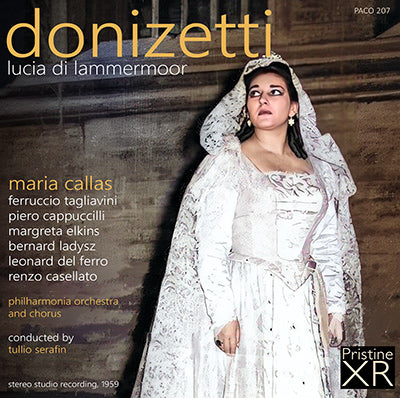
Callas’s 1959 Lucia di Lammermoor gets the Pristine treatment

paco207_9735ee11-e251-4de3-a757-19c9b4ae597a_530x

Callas’s second stereo recording of Lucia di Lammermoor, which I reviewed when it was reissued by Warner , has always been considered one of her best from a sonic point of view, so, as someone who has not always been totally convinced by some of Andrew Rose’s re-mastering methods, I wondered how, if at all, the sound could be improved upon. Let me say straight away that I found this latest addition to Pristine’s Callas catalogue totally convincing. Using the Warner remaster of 2014 for comparison, I found the sound altogether warmer and much more comfortable to listen to, closer in fact to how I remember the LPs that I used to own (a German EMI Electrola issue, bought as an import). The Warner is perhaps slightly clearer, but the digitalisation tends to add glare to Callas’s top register. Often one is prepared to flinch before the topmost notes, but I had no such problems when listening to this Pristine pressing. I couldn’t say which is the more truthful, but I can say that the Pristine is much more comfortable to listen to and this, in turn, affected my impressions of the set, a recording I have known since my youth and was in fact my introduction to the opera.

Lucia was one of the cornerstones of her repertoire, and she first sang it in 1952 in Mexico. The following year she sang the role again in Florence, where she made her first recording of the role under Serafin. It was also the first recording she made for EMI. Back in those days, the opera wasn’t taken very seriously and was most likely considered a silly Italian opera in which a doll-like coloratura soprano ran around the stage showing off her high notes and flexibility. Callas returned a proper tragic dimension to the role, that most hadn’t even suspected was there. There is a touching story of Toti Dal Monti, an erstwhile famous Lucia herself, visiting Callas in her dressing room after a performance of the opera with tears running down her face and confessing she had sung the role for years with no idea of its dramatic potential.

When Callas first sang  Lucia in Mexico and recorded it in Florence, she was at the peak of her vocal plenitude, as she was when she first sang it under Karajan at La Scala in 1954, but by the time she sang the role in Berlin in 1955 post weight loss, when Karajan took the La Scala company there, her voice had started to lighten and her conception of the role had become more inward. We can hear this in the famous live recording of one of the Berlin performances, but, for this 1959 recording, she appears to have taken this approach one step further. This may have had something to do with her by now fading vocal resources, but it results in a particularly touching portrayal of the innocent, young, impressionable girl. She has also trimmed away some of the showier variations in the cadenza in the Mad Scene, and the decorations are in consequence somewhat more modest. Am I alone in preferring it sung this way? Personally, I’d prefer to do without all that duetting with the flute altogether, as happens in the complete recording of the opera with Caballé and when Sylvia Sass sings it on one of her recital records. In any case, apart from a few of Callas’s topmost notes, she is in remarkably good voice and the filigree of the role is brilliantly executed with fluid and elegant ease. All in all, I prefer her performance in this set to the one on the 1953 Florence studio recording, not least because of the improved Pristine sound picture.

However, when it comes to her colleagues on this set, I am a little less well disposed towards them than Göran Forsling in his review of the digital download. Ferrucio Tagliavini was 45 at the time of this recording, but he sounds much older, more like an elderly roué than the Byronic Romantic figure of Scott’s and Donizetti’s imaginings. No amount of elegant phrasing can make up for his lack of sheer physical passion and I find myself longing for Di Stefano’s youthful ardour. As for Cappuccilli, he was at the very beginning of his considerable career, and he has yet to find a way of creating character in pure sound. He is just rather dull and no match for Gobbi on the earlier recording or for Panerai in Berlin. Bernard Ladysz makes very little impression at all and both Rafaele Arie and Nicola Zaccaria are preferable.

Serafin, as always, though he may not make any startling revelations, shapes the score with a perfect sense of its dramatic shape, albeit with the cuts that were traditional at the time. Karajan opened up some of those in his performances, and I would still place the 1955 Berlin performance at the top of all Callas’s recorded Lucias, especially in Divina Records latest remastering, but I enjoyed re-visiting this set and I have a feeling I’ll be reaching for this one more regularly than the earlier 1953 recording, not least because of the superior quality of Pristine’s remastering.

My only criticism is of the cover art, which has a photograph of Callas as Lucia in Florence in 1953, when she was still a rather large lady. One could be forgiven for thinking, at first glance, that this was the earlier recording. Surely a photo of the svelte Callas as Lucia would have been more appropriate. There are plenty of them, after all.