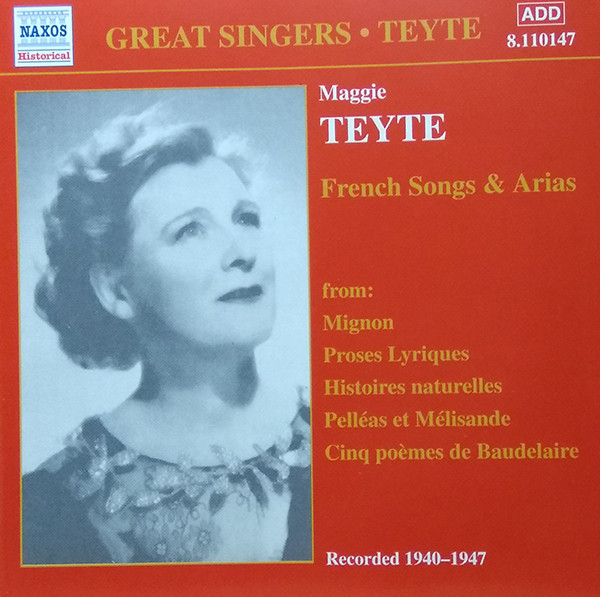
Maggie Teyte sings French Songs and Arias

ni00mzuxlmpwzwc

This compilation is of recordings made bewteen 1940 and 1947, when Teyte was approaching 60. Three tracks (Mignon’s Connais-tu le pays?, one of two versions of Duparc’s L’invitation au voyage and the bonus track, Cherubino’s Voi lo sapete) are from a 1947 radio broadcast with the San Francisco Symphony Orchestra under Pierre Monteux, and the rest are of studio recordings made for EMI, some of which were unpublished at the time. Most are with Gerald Moore on the piano, but the second recording of L’invitation au voyage is with the London Philharmonic Orchestra under Leslie Heward. I’d suggest that this is the better of the two recordings. By the time of the second one with Monteux she has to take more breaths, though the tempi are virtually identical. Even so, even in 1947 the voice remains incredibly firm and totally free of wobble or excessive vibrato. Her singing throughout in fact is wonderfully clean and precise and her intonation is perfect.

So too, of course is her French, though we shouldn’t be surprised when we remember that she spent a good deal of her early career in Paris, was coached by Debussy himself for her début as Mélisande and worked with Chausson, Duparc and Reynaldo Hahn, who evidently had a great deal of affection for her. When she said to Hahn once about the tempo of one of his songs. ‘ You play it quicker than I thought,’ he replied, ‘ma chère, any way you sing it will always be right.’

This is a valuable collection and includes recordings that were either not published or had only a limited circulation in their 78 format, though some of them also appear on EMI’s two disc set entitled, Mélodies françaises . The excerpts from Hahn’s Mozart and Ciboulette are absolutely charming, and we get to hear her speak in perfectly accented French too. The other songs are by Debussy, Chausson and Duparc. Debussy was always a particualr speciality and she somehow makes the three songs she sings here from Debussy’s rather obscure Proses lyriques (she had already recorded the fourth with Cortot) come across as quite simple and direct. She also sings a couple of extracts from Pelléas et Mélisande with piano, which gives us a direct link to Debussy himself.

Teyte should be better known than she is these days. She was one of the greatest ever interpreters of the French song repertoire.

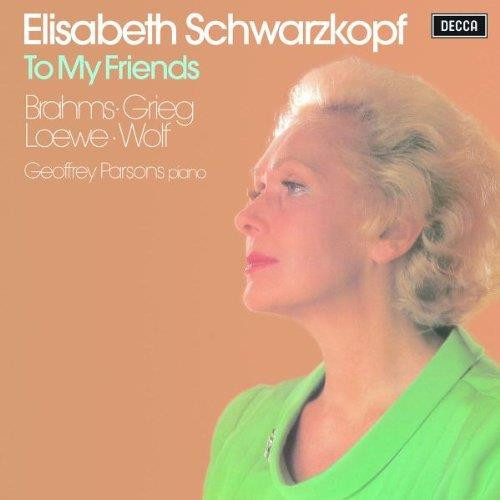
To My Friends – Elisabeth Schwarzkopf

odktndm3nc5qcgvn

So now I come to the end, the very last recording Schwarzkopf made, not, as it happens, for EMI, but for Decca. Walter Legge’s rift with EMI was now complete and Ray Minshull of Decca approached Legge, saying he would like at least one Schwarzkopf recording in their catalogue. It was recorded at sessions in London and Vienna in 1977 and 1979, by which time, Schwarzkopf would have been 63.

It was called simply, To my friends., and Schwarzkopf had this to say about it, “In that there is already the excuse that it’s only for you who like me. Others may find great fault in it and rightly so, but maybe you like me enough to have it.”

Well I do like Mme Schwarzkopf and, having listened almost exclusively to her for the last month, I can safely say the overused description of her singing as ‘mannered’ has never been so far off the mark. What I do hear is a superior intelligence and musicality, allied to an attention to detail, which brings music alive in a way that other more penny plain interpretations do not. Very occasionallly, the intellect gets in the way of the song. One misses, for instance, the natural simplcity of, say, Elisabeth Schumann, but in Lieder, and in Wolf in particular. her quest to find just the right inflections is what makes me keep coiming back. It’s also interesting to note how her interpretations can vary from one performance to another.

The voice on this last record is certainly not the voice of a young woman, but it remains within its slightly reduced range and dynamic, a voice mercifully free of wobble or excessive vibrato. It may not be the disc I would choose to demonstrate Schwarzkopf at her greatest, but I can safely say I am very pleased to have it in my collection as a fitting end to a great career on disc. In songs by Wolf, Loewe, Grieg and Brahms, she still demonstrates her ability to embrace and convey a wide range of emotions.

The record was completed in January 1979 and she gave her last performance at a recital in Zurich the following March. Three days later, Legge died and she abruptly cancelled all further engagements. The voice fell silent without Legge’s constant encouragement. ‘”You can do it, meine Schwatz, you can do it, you sing that – you’ll do it better.” He was wrong there, I wouldn’t have been better than people in full bloom of the voice. He thought there would be some moments which would be more memorable. But if you don’t have the voice you cannot put over what you would like to – you make ways round it technically, and by that time it has already vanished.’ Schwarzkopf was nothing if not pragmatic.

It was often said of her, disparagingly, that she was ‘her master’s voice.’ Maybe, in some ways she was. It was an extraordinary partnership and it is no wonder that the performance side of her life also ended with Legge’s death.

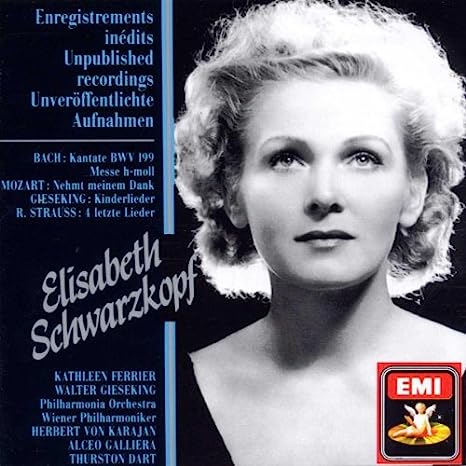
Elisabeth Schwarzkopf – Unpublished Recordings


51zdj0yf6wl._ac_sx466_

An interesting release of material discovered in the EMI vaults and released in 1990.

We start with a really lovely performance of Bach’s Cantata, Mein Herze schwimmt im Blut, which is followed by surviving excerpts from a rehearsal for a performance of Bach’s Mass in B Minor under Karajan, with Ferrier partnering Schwarzkopf in the Christe eleison and Et in unum Dominum. Schwarzkopf sings the Laudamus te.

A charming performance of Mozart’s Nehmt meinen Dank comes next, recorded in 1955 with the Philharmonia under Alceo Galliera.

The Gieseking Kinderlieder were recorded as a favour to the great pianist, recorded at the same time they made their album of Mozart Lieder. Undemanding music perhaps, but Schwarzkopf characterises them brilliantly. I’m sure Gieseking was delighted.

Finally we have a live performance of Strauss’s Vier lerzte Lieder with the Philharmonia under Karajan at the Royal Festival Hall in 1956. It is certainly interesting to hear Schwarzkopf singing them live, but I wouldn’t place this above either of her two studio recordings under Ackermann and Szell. Inexplicably, Karajan places September last, which makes a less satifactory end, especially given the rather fast tempo he takes it at, though it has slowed down a bit by the end. (I assume the wonderful horn playing is by Dennis Brain.) Im Abendrot also starts out rather fast, but again has slowed down towards the end of the song. Schwarzkopf is in wonderful voice and has no trouble riding the orchestra, but it doesn’t replace the recording she made ten years later with George Szell. For me it catches the autumnal glow of these songs like no other. The prize of this version would be Frühling, with Schwarzkopf’s voice soaring out over the orchestra with a bit more ease than it does in 1965.


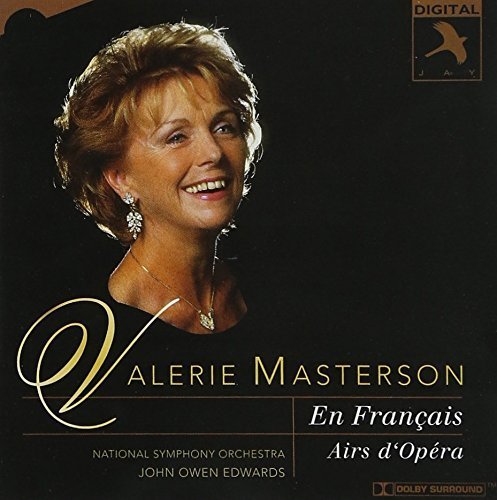
Valerie Masterson – En Français

51jboyyne-l

This is something of an exercise in nostalgia. Valerie Masterson was a mainstay of my opera going in my early days and I saw her quite a few times on stage and in some of the roles she sings on this disc. She was a very beautiful woman with a lovely voice and a charming stage presence and it would have been hard not to fall under her spell. She first came to prominence singing Gilbert and Sullivan with the D’Oyly Carte company, but was soon snapped up by English National Opera, where she sang many of these roles in English. However the French also took her to their heart and she appeared regularly over there too, as well as at the Royal Opera, Covent Garden, where she would have been singing in French and she sings the language very well.

This recital was recorded at three separate sessions in 1991 and 1993 when Masterson would have been in her mid fifties and, though the voice is still beautiful, it is no longer the fresh voice of youth. What a shame she didn’t get to record this material, say, around fifteen years earlier when she sang Matilde to Caballé’s Elisabetta in Rossini’s Elisabetta, Regina d’Inghilterra both in Aix-en-Provence and on record. Two years is a long time when one is nearing the end of one’s career, and it is notable that the arias recorded in 1991 find her in better voice than those recorded in 1993. Still, there is much to enjoy, especially in those roles that Masterson had made very much her own, Manon, Juliette, Marguerite, Louise and Micaëla. The vibrations may have loosened somewhat, but she is mercifullly free of wobble.

Favourite tracks for me were Micaëla’s Je dis que rien m’épouvante, Louise’s Depuis le jour, the brief excerpt from the Saint Sulpice scene in Manon, Margeurite’s Jewel Song and L’Ensoleillad’s lovely little Vive amour qui rêve from Chérubin. To be honest, only in Thaïs’s Mirror Aria, which was recorded at the last sessions, does the beat in the voice start to become distracting and it is notable that she doesn’t take the higher option at the end, whereas a few years before this would have been easily within her voice. Throughout she pays due attention to the text and the mood of each aria, and her voice has its own individual character that I’ve always found instantly recognisable.

The sound is superb, the orchestral conributions under John Owen Edwards excellent, and the booklet comes with texts and translations, an interview with Masterson and stage photos of her looking absolutelty gorgeous as Margeurite, Manon, Juliette and Louise.

So, as I said, a little late for comfort, but still a disc worth hearing for any of us who fell under Masteron’s spell when she was regularly appearing on our stages.


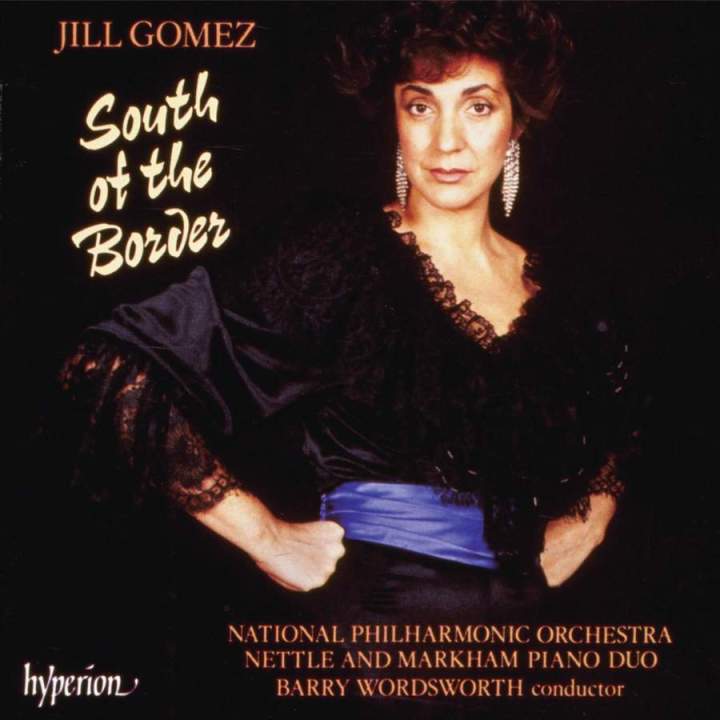
South of the Border with Jill Gomez

South of the Border

Oh what joy! This is one of those rare things, a crossover album that actually works. Opera singers singing more popular fare rarely work, but these songs were composed in the 1920s, 1930s and 1940s, when popular singers sang in a more recognisably classical style, and Jill Gomez, who is half Spanish and was born in what was then British Guiana, immerses herself completely into their style.

There are one or two purely instrumental items dotted around the programme, usually to indicate a change of mood and all the arrangements, most of them by Christopher Parker, but some also by Jeff Atmaijan and Geoffrey Alexander, are superb. At no point do you feel that the pudding has been overegged and they continually evoke the spirit of the movies of that period.

Only in The Peanut Vendor song (one I could in any case have easily done without) did I feel Gomez’s style a mite too sophisticated. Everyhwere else she is the perfect vocalist, but she is paricularly adept at pointing the lyrics in Noel Coward’s wonderfully witty Nina from Argentina and her diction throughout is superb. Her performance of Yradier’s La Paloma is easily as delectable as that of Victoria De Los Angeles, which, for me, can be no higher praise.

Only the most curmudgeonly could fail to be captivated by such wonderfully joyful music making. Ted Perry, of Hyperion Records states in the liner notes, that they discussed enough material to make a second volume, and my only regret is that they didn’t.

Barbra Streisand Live at the Bon Soir

b62af92e-818a-4ddc-a3aa-af0577934e84

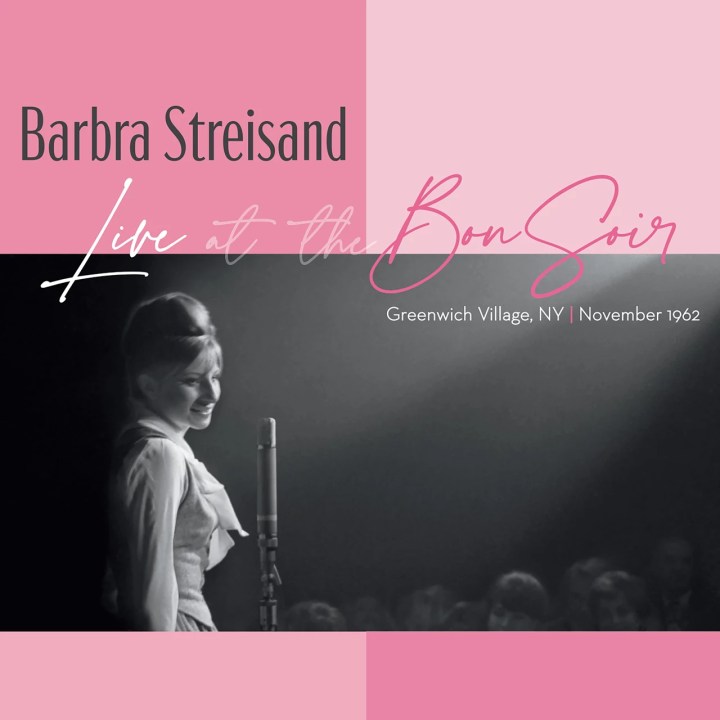
All I can say is wow! This album is a must, not only for Streisand fans, but for anyone. A word of warning, though. This is not an album to be streamed piecemeal, picking out one or two tracks here and there. To get the full experience you need to buy the physical CD or LP, read the liner notes and listen, really listen, from beginning to end to get the full flavour of what it must have been like to experience the young Streisand live at the tiny Bon Soir. To those who actually saw her, I assume you know how lucky you were. You were there experiencing the beginning of one of the greatest careers in all popular music. Though Streisand always thought of herself as an actress who sings, it was the voice and her unique singing style that first introduced most of us to her talent.

Later of course she became more polished, maybe less spontaneous, but here she sounds wonderfully relaxed, joking with the audience and the band and everyone is clearly having a fabulous time. Then there is the voice itself, a miraculously pure sound, which somehow can encapsulate a range of moods and emotions, switching one moment from the goofiness of Who’s Afraid Of The Big Bad Wolf to the quiet inner happiness of I’ll Tell The Man In The Street the next.

As always with Streisand, there’s an eclectic mix of songs, many of them from obscure stage musicals, but with a few standards thrown in. Most of them are well known from her first few studio albums, but here they are given added immediacy by being performed before a live audience. I couldn’t possibly pick out any standout tracks because each and every one of them is an absolute gem, but please do listen to the whole album in one sitting. You can almost see the smoke-filled room, hear the chink of glasses and feel the atmosphere of the Bon Soir.

The disc was recorded over three nights, whilst Streisand was still doing her star show-stopping turn as Miss Marmelstein in I Can Get It For You Wholesale on Broadway. With the energy of the young, she would finish the show and then dash down to the Bon Soir to do her turn there. She had just signed with Columbia and the plan was to make these live performances her first album for the label. However, the final tapes proved unsatisfactory and the electricity generated in the club had somehow failed to come across on the tapes. Though the project was shelved in favour of a studio album (the now famous, multi award winning Barbra Streisand Album), the tapes were preserved and have now been re-mastered with state-of-the-art technology, clarifying the true artistry of Barbra and her band. Bootlegs have been around for decades, but none of them had access to the master tapes and are sonically massively inferior.

Don’t hesitate. Get yourself a seat at a table for one of the most thrilling debuts in the history of show business. I can assure you; you will not be disappointed.


Ravel’s complete Mélodies

oc00odm5lmpwzwc

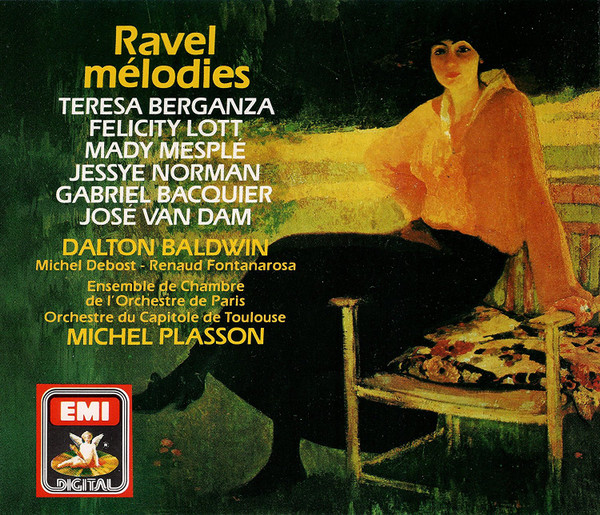
This set was originally issued on three LPs back in 1984, and later condensed into two very well filled CDs and is still available as a download. As such, it is an excellent way of collecting all Ravel’s song settings, the singers all being well chosen for the songs they are allocated. It also has Michel Plasson in charge of the orchestral and chamber accompanied songs and that master accompanist, Dalton Baldwin, at the piano.

We start with Teresa Berganza singing Shéhérazade, orchestrally fine and well sung, but Berganza is just a little anonymous and the performance doesn’t stay in the memory as do those by, say, Crespin, Hendricks or Baker, all of whom are more vivid storytellers. The orchestral contribution by Plasson and his Toulouse orchestra is splendid. This is followed by the Vocalise en forme de Habanera and Chanson espagnole, ideal performances in which Berganza finds the erotic sensuality that had eluded her in Shéhérazade.

Next up is Gabriel Bacquier, who is entrusted with Histoires naturelles, Sur l’herbe and Chanson française. These are superb performances, Bacquier finding just the right sense of ironic derachment for the Renard settings, his enunciation of the text so clear you can all but taste the words.

Mady Mesplé’s clear, bright, very French soprano with its characteristic flutter vibrato is not to everyone’s taste, but I like her, and she is absolutey charming in the Greek songs, including the less regularly performed Tripatos. She also gives us lovely performances of three rarities, Ballade de la reine morte d’aimer, Manteau de fleurs and Rêves. José Van Dam gets the Hebrew settings, Don Quichotte à Dulcinée and five more songs, of which Les grands vents venus d’outre-mer is especially notable. To all he contributes the sterling virtues of his beautiful, firm bass-baritone, coupled to sensitive treatment of the text.

Felicity Lott, charming in the Noël des jouets and Chanson écossaise, also has the Mallarmé poems, in which she is suitably languid, if a little diffident. She is also good in the two Clément Marot settings, but Maggie Teyte gets more out of the words on her recording. Jessye Norman brings the collection to a close with the Chansons madécasses, as well as Chanson du rouet and Si morne. As usual, Norman is never less than involved, but as so often I find she sings with an all-purpose generosity, and I’d have welcomed a little more of Janet Baker specificity. Still this is nitpicking, and hers are still among the best versions of these wonderful songs. Throughout the piano accompanied songs Dalton Baldwin provides superbly idiomatic playing, with the Ensemble de Chambre de l’orchestre de Paris providing the accompaniment for the Mallarmé settings and Michel Debost on flute and Renaud Fontanarosa on cello in the Madegascan songs.

Altogether, this is a wonderfully rewarding set and, if individual performances have been bettered elsewhere, all are more than adequate and many a great deal more than that, though, on this occasion, it is the gentlemen who take the palm. Warmly recommended.

Joyce DiDonato – Eden

joyce-didonato-eden-1200-850-1024x725-1

TRACKLIST – EDEN

Charles Ives 1874-1954
The Unanswered Question

Rachel Portman b.1960
The First Morning of the World*

Gustav Mahler 1860-1911
Rückert-Lieder
“Ich atmet’ einen linden Duft!”

Biagio Marini 1594-1663
Scherzi e canzone Op.5
“Con le stelle in ciel che mai”

Josef Mysliveček 1737–1781
Oratorio Adamo ed Eva (Part II)
Aria: “Toglierò le sponde al mare” (Angelo di giustizia)

Aaron Copland 1900-1990
8 Poems of Emily Dickinson for voice and chamber orchestra
Nature, the gentlest mother

Giovanni Valentini c.1582–1649
Sonata enharmonica

Francesco Cavalli 1602–1676
Opera La Calisto (Act I, Scene 14)
Aria: “Piante ombrose” (Calisto)

Christoph Willibald Gluck 1714–1787
Opera Orfeo ed Euridice Wq. 30
Danza degli spettri e delle furie. Allegro non troppo

Christoph Willibald Gluck 1714–1787
Scena ed aria Misera, dove son! From Ezio Wq. 15 (Fulvia)
Scena: “Misera, dove son!… ”
Aria: “Ah! non son io che parlo…”

George Frideric Handel 1685–1759
Dramatic oratorio Theodora HWV 68 (Part I)
Aria: “As with Rosy steps the morn” (Irene)

Gustav Mahler
Rückert-Lieder
“Ich bin der Welt abhanden gekommen”

Richard Wagner 1813–1883
5 Gedichte für eine Frauenstimme WWV 91 (Wesendonck Lieder)
“Schmerzen”

George Frideric Handel
Opera Serse HWV 40 (Act I, Scene 1)
Recitativo: “Frondi tenere e belle”
Aria: “Ombra mai fù” (Serse)

*World-premiere recording

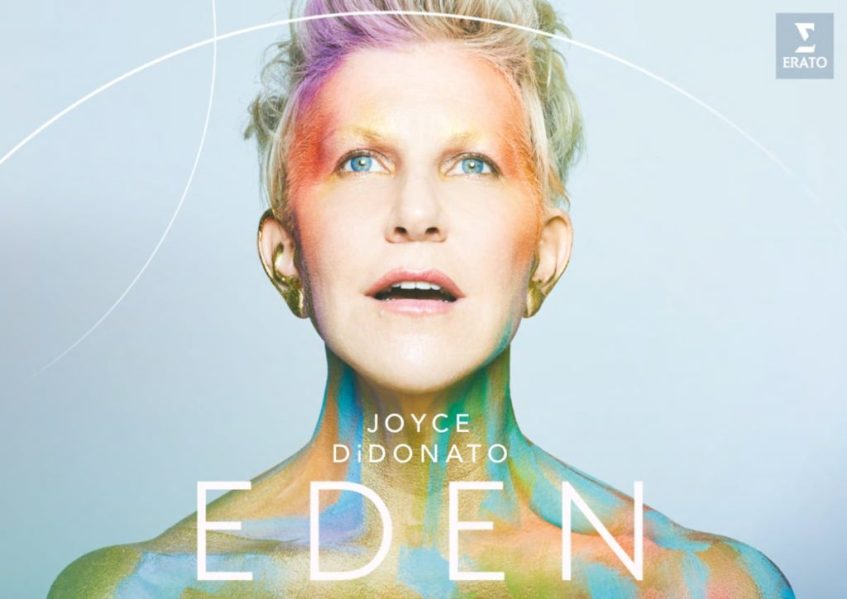
Joyce DiDonato’s new album could probably best be described as a concept album and, despite one or two less than smooth transitions, is best listened to in one sitting and in the order she has set out.

At present DiDonato is in the middle of a twelve city tour, taking in both Europe and the USA and I am very much looking forward to seeing her perform at the Barbican in April. Looking at the photographs from some of the concerts she has already done, DiDonato is using to redefine the the recital format. Apparently every audience member is to receive a seed to plant as they’re asked: ‘In this time of upheaval, which seed will you plant today?’

“With each passing day,” writes DiDonato, “I trust more and more in the perfect balance, astonishing mystery and guiding force of the natural world around us, how much Mother Nature has to teach us. EDEN is an invitation to return to our roots and to explore whether or not we are connecting as profoundly as we can to the pure essence of our being, to create a new EDEN from within and plant seeds of hope for the future.”

As on the album, she is accompanied by her regular collaborators Il Pomo d’Oro under Maxim Emelyanchev.

The programme ranges wide, from the 17th to the 21st century and at least one change, when we go from the 21st century to the 17th strikes me as a little jarring, but for the most part the choices are sensible and the journey well thought out.

The album starts with an absolutely haunting performance of Ives’ The Unanswered Question, in which DiDonato wordlessly sings the trumpet part. This segues into a commission from the Academy Award winning composer Rachel Portman, entitled The First Morning of the World, to a text by American writer Gene Scheer. This is a wonderfully evocative piece, full of sweeping lyricsm and gorgeous harmonies. Portman surely could not have hoped for a more beautiful performance. This is followed by a lovely performance of Mahler’s Ich atmet einen Linden Duft, though we miss the richness of Mahler’s original orchestra in this chamber re-orchestration.

The first slightly incongruous transition happens here with Biagio Marini’s Con le stelle in ciel che mai, though there is nothing wrong with its execution and, once I’d got used to being plunged into an entirely different sound world I enjoyed it and the Mysliveček aria from his orotorio, Adamo ed Eva, which follows.

This first part of the recital finishes with a masterful performance of Nature, the Gentlest Mother from Aaron Copland’s 8 Poems of Emily Dickinson, beautifully played by Il Pomo d’Oro and in which DiDonato sings with excellent diction without compromising her legato line.

It is followed by one of two purely orchestral tracks, the Sonata enharmonica by Giuseppe Valentini. The other is Gluck’s Dance of the Spirits and Furies from Orfeo ed Euridice.

DoDonato is known to us as a great Handel singer and one of the highlights of the album is Irene’s As with rosy steps the morn from Theodora, which is deeply felt, even if ultimately for me it doesn’t quite erase memories of Lorraine Hunt Lieberson in the same music. Handel is also reserved for the final piece, which comes after Mahler and Wagner, leaving us to bask in the peace and calm of his Ombra mai fu.

DiDonato is in fine voice throughout, her fast flicker vibrato, which can sometimes be intrusive, hardly in evidence at all. I must say that I rather like this “concept” and I have no hesitation recommending this album, and I would urge you to listen to it in one sitting. If I have sometimes had reservations about DiDonato’s ability to convey personality and individuality in the studio, I have no such reservations here and would recommend this album unreservedly.

Berlioz’s Les Nuits d’Eté – a comparative review of ten recordings

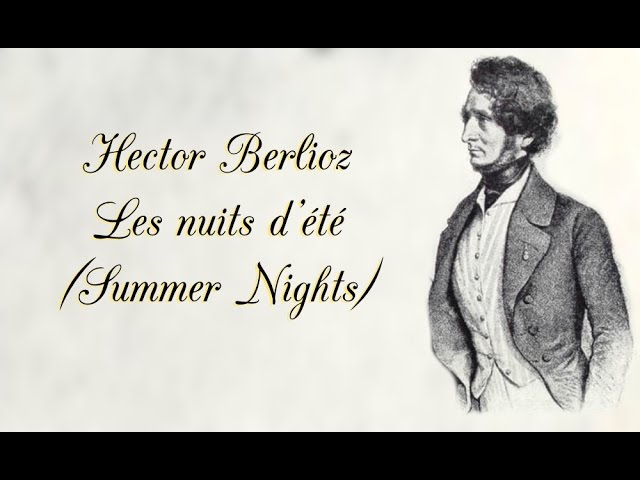
Les Nuits d’Eté is one of my favuorite orchestral song cycles and, along with Strauss’s Vier letzte Lieder, must be one of the most recorded works for voice and orchestra. The songs were originally written to a piano accompaniment and we don’t know why Berlioz chose these six particular texts by his contemporary, Théophile Gautier. Though not really conceived as a cycle, they do make a satsifying programme with two lighter songs framing three deeply emotional outpourings. Berlioz orchestrated Absence in 1846 then orchestrated the remaining songs in 1853, suggesting a mezzo-soprano or tenor for Villanelle, contralto for Le spectre de la rose, baritone (or optionally mezzo or contralto) for Sur les lagunes, mezzo or tenor for Absence, tenor for Au cimetière and mezzo or tenor for L’île inconnue, though nowadays it is more regularly sung by one singer, usually a mezzo or a soprano. It has been recorded by tenors, baritones and bass-baritones and even countertenors.

They have been recorded umpteen times and Ralph Moore has done an exhaustive comparison of most of these recordings, which I recommend to anyone who loves the songs. You can view it at http://musicweb-international.com/classrev/2019/Aug/Berlioz_nuits_survey.pdf.

I have ten recordings in my collection and these are the ten I listened to over a period of two days. The songs respond to a variety of different approaches and I enjoyed my task immensely.

r-17739049-1615146774-6216.jpeg

Vctoria De Los Angeles recorded the cycle in 1955 with Charles Munch and the Boston Symphony Orchestra, when she was in superb voice. As always there is a great deal of pleasure to be derived from her singing, her tone suitably plaintive in the middle songs and smilingly bright and playful in the outer songs, which, predictably, is where she is most successful. What I miss is a deeper vein of tragedy, something more grandiloquent in the middle songs, where what we need is a touch of Cassandre and Didon. De Los Angeles reminds me more of a Marguerite. She is in warm, velvety voice, and this is nonetheless one of the most satisfying accounts around. Sonically it can’t measure up to any of the later stereo recordings.

r-4226020-1359064159-2900.jpeg

Nor, unfortunately can the Steber version with Dimitri Mitropoulos and the Columbia Symphomy Orchestra. The first impression when listening to this version is of the sheer security and perfect focus of Steber’s beautiful voice. The cycle doesn’t get off to a very impressive start, with Mitropoulos’s too deliberate tempo for Villanelle. It is actually close to the metronome mark of crotchet = 96, but it seems plodding and Mitropoulos fails to make the woodwind light enough. But Steber is gorgeous. She can expand the tone gloriously at a phrase like et parmi la fête étoilée in Le spectre de la rose and the quality remains wonderfully rich down below. Throughout Steber is keenly responisve to the poetry. Au cimetière, for instance, has a real sense of tragic foreboding. What a superb Cassandre she might have been. Definitely a prime contender. If only it had been in better sound.

517nnfbtual._ac_

Now here is something rather different. The countertenor voice is not one you would expect to hear in this music, but David Daniels has always had a velvety, rich sound and his version comes as something of a pleasant surprise, though, more used to hearing him in the music of the Baroque, I did wonder if this version might be a product of the gramophone. He did however sing it in the concert hall and his is a voice I’ve never had trouble hearing in the hall or theatre, so maybe I’m wrong. Daniels has excellent French, a perfect legato and is ideally steady throughout, with a much greater range of tone colour than you would expect from a countertenor. As always, his phrasing is wonderfully musical and John Nelson provides excellent support with the Ensemble Orchestral de Paris. Ultimately, for all his musicality and way of commuicating the text, I’m not sure the countertenor voice is what the songs require, but it is a very interesting experiment which Daniels almost pulls off.

r-10811227-1504704037-6832.jpeg

It was quite a shock to plunge from Daniels to the darkly pungent tones of Agnes Baltsa. Her French is often questionable and the voice and manner are arrestingly individual, with her varying her tone from song to song. I suppose you’d call her approach quite operatic. She adopts an almost coy sexuality for Villanelle, choosing a more Dalila-like sensuality for Le spectre de la rose, languidly eliding some of the phrases. Some might find her plunges into chest voice jarring, but I rather like it. The singing can be a bit rough round the edges but you could never call her dull. Ralph Moore suggests that she brings more than a touch of her Carmen to the songs, and I’d agree. It’s not how I’d always like to hear them, but it’s certainly a very individual and occasionally thrilling take on them. Jeffrey Tate and the London Symphony Orchestra provide excellent support.

r-5824261-1403705173-5318.jpeg

Régine Crespin is the only version included here by a French singer and it is really good to hear the language enunciated so clearly, especially after the idiosyncratic French of someone like Baltsa.

Now Crespin’s version is so famous that it has been a prime recommendation for the work ever since it was first issued in 1963 and dissenting opinions are likley to be viewed with incredulity, but, unlike its coupling of Ravel’s Shéhérazade, I’m not sure the Berlioz holds up that well. For a start, there is a deal of sloppy orchestral playing from L’Orchestre de la Suisse-Romande under Ernest Ansermet, and, for another, Crespin’s singing often tends to the lugubrious. There is no sense of mounting rapture at the arrival of the rose, no sense of despair in Sur les lagunes, no plaintive yearning in Absence. The singing is altogether too civilised, and, however musical and tasteful her singing , however elegant her phrasing, Crespin remains aloof and uninvolved. She is at the oppoiste pole from Baltsa’s often wild and wayward version, but I miss Baltsa’s dramatic involvement, which I ultmately prefer. I see that I’m not alone in my opinion, which is supported by both Ralph Moore and David Cairns (in Song on Record, Volume II). A controversial opinion, no doubt, but I’m sticking to it. Crespin is most successful in the final song, which responds to her vocal equivalent of the ironically arched eyebrow. Another mark against her is that she unaccountably alters the order of the songs, placing Absence before Sur les lagunes, which destroys the balance of the cycle. Intonation is occasionally suspect too, especially in Au cometière.

r-5925026-1621620398-8177.jpeg

Colin Davis’s multi-singer version is something of an inconclusive experiment. However ineresting it is to hear the songs sung more or less by the voices Berlioz suggested, I think the cycle hangs together better when captured by a single voice. Nor do any of the singers challenge the best of other versions by single singers. Frank Patterson, who has a rather whiny, nasal timbre is granted two songs, Villanelle and Au cimetiére, neither of which he does justice to. Josephine Veasey, an appreciable Berlioz singer, sings a plausible Le spectre de la rose without really illuminating it, and John Shirley-Quirk tends to growl in the lower regions of Sur les lagunes. The most successful of the singers is soprano Sheila Armstrong, who sings in excellent French and turns in a nicely plaintive Absence as well as a charmingly flirtatious L’île inconnue. One would expect Sir Colin and the London Symphony Orchestra to give a brilliant version of the score, but the effect is somewhat somnolent and low key. Interesting but inconclusive.

r-8458350-1462019569-7396.jpeg

Next we come to the wonderful Lorraine Hunt Lieberson, recorded live at a concert in 1991 or 1995 (the booklet isn’t entirely clear on this point). It has to be said that the Philharmonia Baroque Orchestra under Nicholas McGegan are not quite up to the standard of the ensembles in some of these performances, but they nonetheless provide sensitive accompaniment to Hunt Lieberson’s superbly detailed and deeply heartfelt performances. Throughout she is totally inside the music, her response to the poetry seeming totally spontaneous and natural. Unerringly she captures the mood of each song, certain phrases remaining etched on the memory, for instance the blank, desparing tone at the end of Au cimetière, which, though  she switches to smilingly insouciant joy for L’île inconnue, creeps back into her tone for the closing measures when she reminds us that not all is happy au pays d’amour. The voice is surpassingly beautiful, the singing intensely concentrated and she communicates so much. What a great loss she was to the musical world.

r-15146607-1589535837-3883.jpeg

Finally, I come to three versions by the great Dame Janet Baker. The most recent ( recorded in 1990) and the one I will discuss first, was one of her last (maybe her last ever) recording. made shorly after she had retired from the concert platform. By this time her great artistry cannot quite hide the hint of strain in the upper reaches, the discoloration on certain vowels and the loosening of vibrations on sustained high notes. In no way is this competitive with her two other vesions (one live under Giulini and the famous studio one under Barbirolli), so I will only comment by saying I heard Baker and Hickox perform the cycle not long before this recording was made and, live and in the concert hall, it was still an amazing experience.

r-9879493-1487856491-9833.jpeg

The live Giulini account, taken from a concert at the Royal Festiva Hall in 1975, must be amongst the slowest on disc and it is remarkable that Baker can sustain these speeds; but sustain them she does, luxuriating in the added breadth that Giulini gives her, her breath control quite astonishing. The recorded sound is a trifle muddy and we hear the occasional coughs that go along with live music making, but the specificity of her response to the text is quite extraordinary and there is a concentrated intensity about this performance, which is no doubt enhanced by the presence of a live audience. If I continue to prefer the studio performance, that could be because it is the one by which I got to know the songs and it is no doubt imprinted on my brain. It also, of course enjoys better sound. Both interpretations are absolutely and unequivocally superb. Baker’s stage roles included both Cassandre and Didon and she brings something of the character of their music to these songs too.

r-8436535-1461577724-3437.jpeg

Baker enjoyed a very special relationship with Sir John Barbirolli and of course made a few important recordings with him before he died in 1970.  Apart from the above recording of Ravel and Berlioz they can be heard in famous recordings of Elgar’s Sea Pictures,  Mahler’s three orchestral song cycles and Elgar’s Dream of Gerontius, all very special and irreplaceable.

The New Philharmonia are in fine form and provide some of the best orchestral playing on any of these performances. Villanelle is perhaps a little too determinedly jolly, but after that the performance just gets better and better. Baker starts Le spectre de la rose almost confidingly, as if whispering into the ear of the sleeping girl, swelling into the glorious mini climax at Et parmi le fête étoilée, Tu me promenas tout le soir. Her tone turns both sensual and erotic when the rose arrives from paradise, and then she sings the phrase Mon destin fut digne d’envie in one glorious, long breath. This might just be the most wonderful performance of the song ever put down on record.

From there we are plunged into the blank, desparing tone of Ma belle amie est morte. If she were the Act IV Didon in the previous song here she is Cassandre, singing in stark absolutes. Having reached a desolate climax the song fades away in a whispered close of utter dejection. She yearns sweetly in Absence, the voice taking on a soprano-ish lightness in the upper register, but maintaining its tragic depth for the line Ah, grands désirs inappaisées. Au cimetière is mesmerisingly hypnotic, conjuring up ghostly visions of graveyards at night, until finally gloom is dispelled and a smile enters her voice for L’île inconnue, with a coquettish twinkle on Est-ce dans la Baltique?

After listening to ten different recordings in two days, I find I love the cycle more than ever and all these recordings have something to offer.  I actually enjoyed them all. However if I had to choose but one  on that proverbial desert island, then it would have to be Baker with Barbirolli, though I’d probably find a way to smuggle the Hunt Lieberson with me as well somehow.
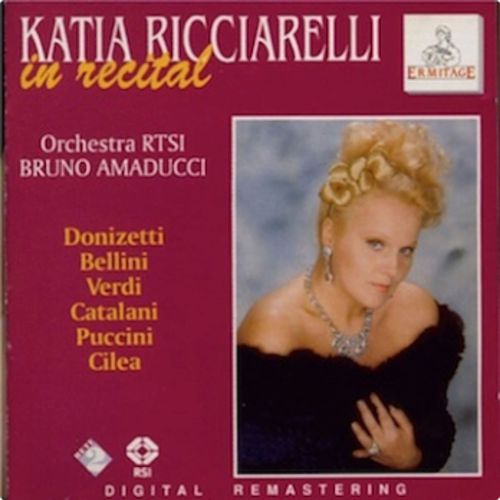
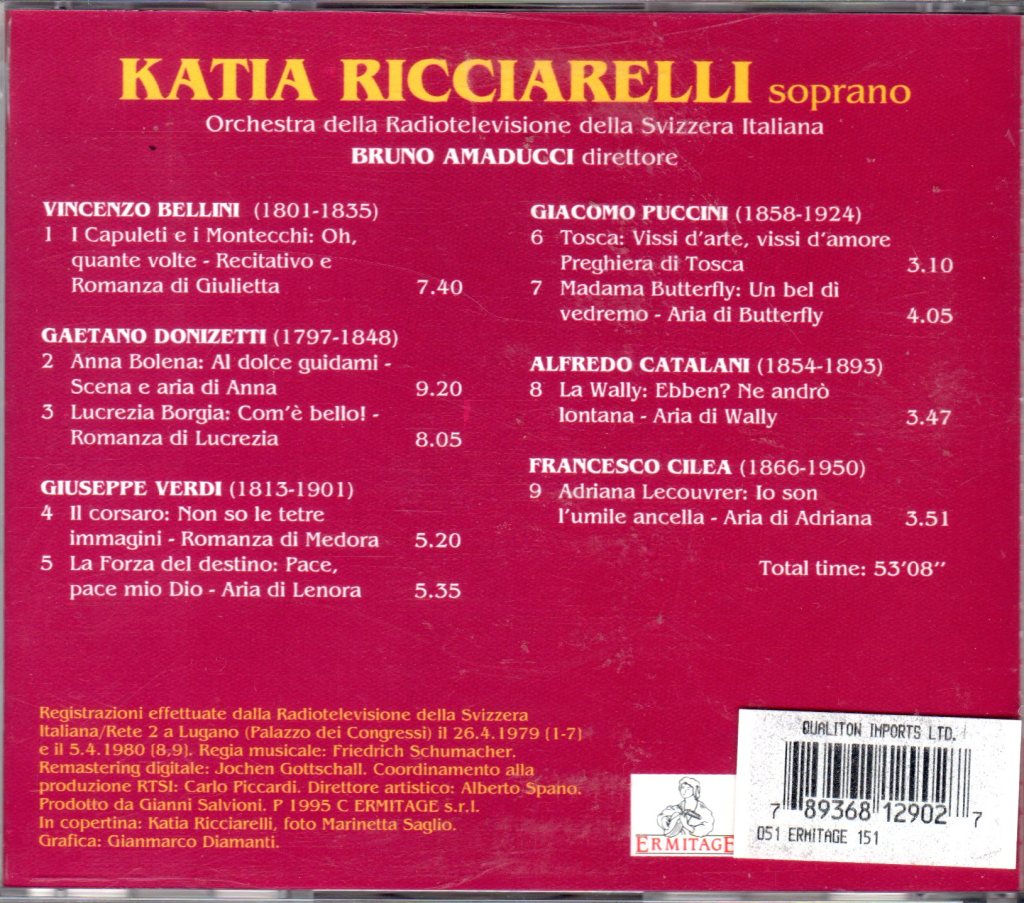
Katia Ricciarelli in Recital

This disc is mostly taken from a recital given by Ricciarelli in Switzerland in 1979, with the final two items from a concert given the following year. The programme is a good one, starting with bel canto items and finishing with verismo, with early and middle period Verdi bridging the gap.

The voice is mostly in good shape, though it develops a slight beat on high when under pressure, more noticeable in the verismo items than it is in the gentler bel canto she chooses, and it is the items by Bellini, Donizetti and Verdi that make the greatest impression.

We start with Giulietta’s Oh quante volte from I Capuleti e i Montecchi, a role that suited her like a glove and for which she receieved rave reviews when she sang it at Covent Garden in a revival of the production first mounted for Gruberova and Baltsa. I also heard her sing the aria at a recital at the Barbican Hall in 1987 in a programme very similar to the one we have here. This aria was undoubtedly the highlight of the night and she was forced to encore it at the end of the evening. She spins out the phrases quite deiciously and with superb musicality and, as she never has to force her voice, the result is mesmerisingly beautiful.

The Donizetti items are also beautifully moulded, the lines caressed, though one notes that she does not sing the more forceful cabaletta to the Anna Bolena aria, and I imagine it would have taxed her limits, though she did sing the role quite a lot, apparently with much success. The Lucreia Borgia is also an elegiac piece and again she fills its phrases with signifcance, her phrasing unfailingly musical.

Of the two Verdi items the first from Il Corsaro suits her better and I rather wish that she had been cast in Gardelli’s Philps recording of 1976. Norman, who sings Medora, isn’t bad by any means, but Ricciarelli is more inside the music, more stylish. The following year she joined the Philips early Verdi stable, singing Lucrezia in I Due Foscari and Lida in La Battaglia de Legnano and she is superb in both.

The Forza aria suggests that the role may have been a bit too big for her and the voice does rather glare on the climactic Bb on Maledizion. The floated one on Invan la pace is better, but still sounds a mite insecure.

The verismo arias also have their attractions and are very well received by the audiences, possibly because they were better known, but again climactic high notes are apt to glare uncomfortably, particularly in the exposed climax to Wally’s lovely Ebben. Ne andro lontana. None the less the aria is beautifully felt and delivered with a sighing loneliness that is most effective. She also differentiates nicely between Tosca’s utter desperation and Butterfly’s single minded conviction that Pinkerton will return.

All in all, then a rewarding programme. Ricciarelli is a singer I have come to admire more with the passing years. More vocally fallible than such  contemporaries as Freni or Caballé, less individual in her response to the text than Scotto, her singing is unfailingly musical and I derived a lot of pleasure from this recital.