Two Contrasting Vocal Recitals

71mojlgie4l._ac_sl1073_

Dame Maggie Teyte in concert, at the age of sixty no less! Teyte, a famous Mélisande who studied the role with Debussy himself, sings extended excerpts from the opera with piano accompaniment, singing all the roles. It shouldn’t work, but somehow it does. It takes her the first song in the recital (Grétry’s Rose chérie) to warm up, but thereafter you would never believe this was the voice of a sixty year old woman. The disc also includes privately recorded excerpts from Strauss’s Salome also with piano, from when Teyte was preparing the role for Covent Garden about fifteen years earlier, a project that unofrtunately never came to fruition. Her bright, slivery soprano might just have been the voice Strauss imagined.

She also sings Britten’s Les Illuminations in a version for piano, making me wish she had recorded the orchestral version, although preferably a few years earlier. Just occasionally there is a flicker of frailty in the middle voice, although the top register remains firm and clear as a bell. The encores include a lovely performance of Hahn’s popular Si mes vers avaient des ailes.

r-2563085-1290611066.jpeg

Another enterprising disc from Dawn Upshaw, who seems to have disappeared from the scene now. The centrepiece is Earl Kim’s Where grief slumbers written in 1982 for voice, harp and string orchestra, but here presented in a 1990 arrangement for voice, double string quartet and harp, and Upshaw is an ideal interpreter. She is equally at home in the rest of the programme; Falla’s Psyché, Ravel’s Trois poèmes de Stéphane Mallarmé, Stravinsky’s Two poems of Konstantin Bel’mont and Three Japanese Lyrics and Delage’s Quatre poèmes hindous, though here I slightly prefer the warmer tones of Dame Janet Baker, who is much more languidly erotic in the worldess vocalise of Lahore. Nevertheless a thoroughly absorbing disc.

As with so many of these Nonsuch discs, documentation is slight, and, though we do get lyrics and translations, the layout is confusing and a little more information about the provenance of these songs, especially the less famous Kim cycle, would have been much appreciated.

Dawn Upshaw – The World So Wide

r-2563268-1290619230.jpeg

A few weeks ago I reviewed Renée Fleming’s excellent disc of American opera arias and today I turn to Dawn Upshaw’s disc, which takes its title, The World So Wide, from the first item in the recital, Laurie’s Song from Aaron Copland’s The Tender Land. It makes a lovely opener and Upshaw is perfectly cast as the young girl who yearns to escape and see the world.

At about 45 minutes, the disc is quite short measure, however, and not everything is as good as the first track. The piece from Tanía León’s Scourge of Hyacinths is tediously declamatory and afforded me the least enjoyment on the disc. I’d also suggest that Upshaw’s is not the right voice for Barber’s Cleopatra, a role that was written for the much more opulent voice of Leontyne Price. Upshaw’s lighter, brighter sounds do not conjure up the woman of whom Enobarbus says,

Age cannot wither her, nor custom stale
Her infinite variety. Other women cloy
The appetites they feed, but she makes hungry
Where most she satisfies, for vilest things
Become themselves in her, that the holy priests
Bless her when she is riggish.

I enjoyed the excerpt from John Adams Nixon in China rather more than the Gramophone reviewer, who found it “tediously protracted”, and I suppose you either like Adams’s style or you don’t. Whatever your feelings, Upshaw delivers Pat Nixon’s This is prophetic brilliantly. She is also superb in the more Broadway influenced What a movie from Bernstein’s Trouble in Tahiti, but I thought her singing of Lonely house (an aria sung by the male character of Sam Kaplan in Street Scene) just a little too overtly operatic. Teresa Stratas manages it better on her second disc of Weill songs and arias.

After the Copland and Benstein, the most successful item on the disc is Willow Song from Douglas Moore’s The Ballad of Baby Doe, which responds well to her charming, uncomplicated manner. So too, one would think, does the final item (and the only item she shares with Fleming on her disc), Ain’t it a pretty night from Carlisle Floyd’s Susannah, but here I have to admit I prefer the rather more sensuos tones of Fleming, who suggests a far more highly charged eroticism behind the apparent simplicity of the music.

A mixed bag, then, and not so successful as her disc of Broadway songs entitled I Wish It So, but worth a listen for the unusual repertoire and for some excellent performances.

Renée Fleming – I Want Magic


Renée Fleming was at her peak when this recital was recorded and this is, without doubt, one of her most successful records. The programme is a varied one too, with familiar items like Gershwin’s Summertime and Bernstein’s Glitter and be gay rubbing shoulders with items from more rarely performed works like Hermann’s Wuthering Heights and Floyd’s Susannah. The inclusion of Anne’s No word from Tom from Stravinsky’s The Rake’s Progress rather stretches the subtitle American Opera Arias a bit, but is possibly justified as Auden, Kallman and Stravinsky were all resident in the US at the time of its composition.

The disc opens with a short extract from Bernard Herrmann’s Wuthering Heights, which was written in 1943 but never staged in Herrmann’s lifetime. In fact it was only premiered in 1982 by Portland Opera, but with the ending changed to one Julius Rudel had proposed several years earlier. It wasn’t performed in full until 2011, by Minnesota Opera. I have dreamt, lusciously sung here by Fleming, woud suggest the opera might be worth further investigation.

The excerpts from Douglas Moore’s The Ballad of Baby Doe and Menotti’s The Medium are both lovely in every way, but the Gershwin items from Porgy and Bess suffer from a lack of spontaneity. Fleming introduces all sorts of jazzy slides and glottal attacks which simply sound affected. Leontyne Price sings this music much more simply and allows it to blossom on its own.

The considerable difficulties of Bernstein’s Glitter and be gay are tossed off with ease and here she captures the irony in the piece marvellously. It’s a piece that, unsurprisingly, many opera singers have added to their repertoire but few of them challenge the original interpreter, Broadway star Barbara Cook, who created the role and whose diction is a good deal more clear. To be honest, the only “operatic” version I’ve heard that does is Dawn Upshaw’s, but Fleming’s is certainly amongst the best.

Next we have two pieces from Carlisle Floyd’s Susannah, which brought back happy memories of seeing Fleming in the role at the Met shortly after she recorded these exceprts. She is at her considerable best here, flooding the gratefully lyrical lines with gorgeous tone, but also capturing the character’s longing for adventure in the first, her loneliness in the second.

Finally we have a reminiscence of her Anne Trulove, which she sang at the Aspen Music Festival in 1987 and a taster of her Blanche Dubois in Previn’s A Streetcar Named Desire, which she premiered soon after making this recording. She has a richer voice than most Annes, but negotiates its complexities with ease and her Blanche is simply hors concours. The aria I want magic was an obvious high spot when she sang the role in London with the LSO, but I rather wish they had also included the final aria, I can smell the sea air, which had a huge effect on me each time I heard it whilst waiting in the wings to make my entrance as the doctor. It was one of the most beautiful things I’ve ever heard.

Sandwiched between the Stravinsky and the Previn we have Vanessa’s passionate Act I aria from Barber’s opera, which left me wondering why nobody had thought to revive the opera with Fleming in the title role. It would have suited her perfectly.

If I have any reservations, aside from those I mentioned about the Gershwin pieces, I’d have to say that her diction could be clearer. Other than that, this is an absorbing and rewarding programme stunningly sung and beautifully executed. Don’t hesitate.

A Spanish Songbook – Jill Gomez

516xghgdgjl._sx355_

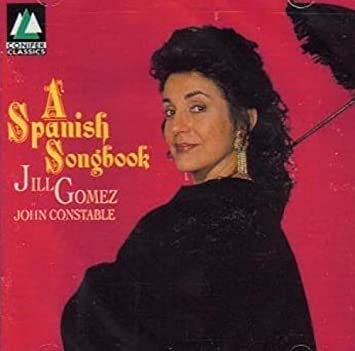
What an utterly charmng and delightful disc this is, cleverly planned and beautifully executed.

With her distinctive timbre and wonderfully expressive voice, Gomez’s personality fairly bursts through the speakers and she is superbly supported here by John Constable on the piano, who unerringly captures the mood of the songs. You feel as if these two artists really enjoy making music together, and indeed their association is a long one, having first appeared on disc together twenty years earlier. Gomez would have been in her early fifties when the present disc was recorded but the voice has hardly changed in the intervening years.

What we have here is a compendium of Spanish inflluenced songs by German, French and English composers, as well as songs by Spanish composers, covering a wide range of styles and eras. The programming is eminently sensible and makes for very satisfying listening.

We start with a group of sixteenth century Villancios from the courts of Charles V and Philip II in piano arrangements by Graciano Tarragó, which encourage the kind of decoration and improvisation of the 16th century vilancico. Fuenllana’s De los alamos vengo, madre is no doubt better known from Rodrigo’s orchestral arrangement, but Gomez sparkles quite as much here.

From thence we turn to a group of Spanish influenced songs by Wolf and Schumann, in which Gomez captures perfectly the deep melancholy of Schumann’s Tief im Herzen trag’ ich Pein as well as the girlish coquettishness of Wolf’s In dem Schatten meiner Locken. Spain has always provided a deep vein of inspiration for French composers, so we are next treated to a group of songs by Bizet, Ravel, Saint-Saëns and Délibes in which Gomez’s sense of style is impeccable.

Next come the three Granados Tornadillas, in which we are probably more used to hearing the fuller, chestier sound of someone like Conchita Supervia. Gomez intelligently, rather than copy her style, is more languorous. I might prefer Supervia’s vibrancy, but Gomez’s way is just as valid.

The two Walton songs, both taken from Façade, find Gomez pointing Edith Sitwell’s lyrics deliciously and lead us into the final group, which Gomez calls “Seven Other Popular Songs”. The first three songs are by Roberto Gerhard, who, as an exile from Franco’s Spain, had relocated to Cambridge in the UK in 1942, where he lived until his death in 1970. These are his versions of folk-songs collected by his teacher, Felipe Pedrell. bittersweet souvenirs of a composer in exile. The others are by Tarrago, Rodrigo, Guridi and Obradors. Gomez is yet again a wonderful guide through this musical journey of Spain, brilliantly capturing the mood of each song.

An excellent recital that should be a lot better known than it is.

Barbara Hendricks – Ravel and Duparc

r-3319230-1325585118.jpeg

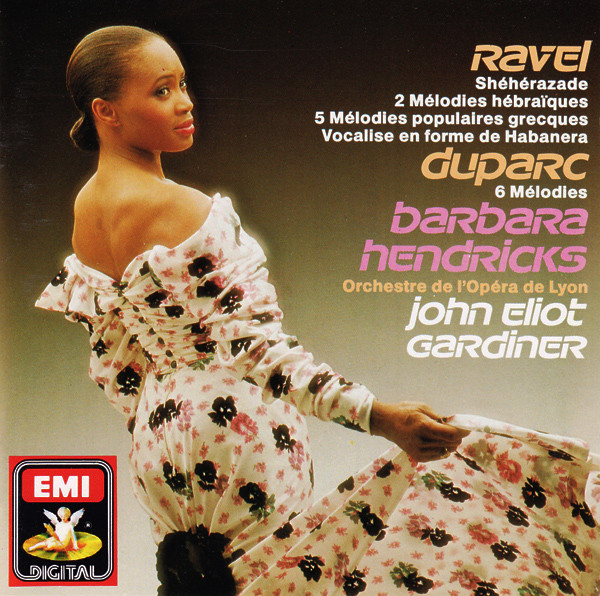
What a gorgeous disc this is. Quite why Hendricks’ version of Ravel’s Shéhérazade is not as famous as those by such as Crespin, Baker and De Los Angeles is beyond me for not only is the singing ravishing, but the orchestral playing under John Eliot Gardener superb, and quite a lot better than that of the Suisse-Romande on Crespin’s recording. Furthermore, though born in America, Hendricks has lived in Europe since 1977 and in Basel, Switzerland since 1985 and her French is virtually flawless.

The disc opens with Ravel’s Shéhérazade and the opening measures of Asie are sung with a gorgeous sensuality, which then gives way to girlish delight when she sings of sailing away on a schooner. What a vivid story-teller she is, alive to every change of mood and how beautifully she is accompanied by Gardiner, who brings out fabulous detail in the orchestral score, without losing its sensuous exoticism. In la flûte enchantée she is suitably languid, until the voice breaks out with a real burst of joy, when she describes the flute alternately pouring forth sadness and joy, whilst L’indifférent is deliciously ambiguous.

The rest of the Ravel programme is hardly less fine. My notes are peppered with words like gorgeous, sensual, exotic for the Mélodies hébraîques, which perfectly suits their colourful musical language, but the singer of the Mélodies populaires grecques is evidently younger, more innocently coquettish, the tone more forwardly produced, though I do slightly miss Victoria De Los Angeles’s delightful simplicity in the final song, Tout gai. The Vocalise en forme de Habanera returns us to the sensuality of the Hebrew songs and is absolutely ravising.

The Duparc songs are not quite up to the standard of the Ravel, but still very worth having. Both L’invitation au voyage and Au pays oû se fait la guerre really require a greater range of tone colour and Le manoir de Rosemonde lacks a little in drama. Best of all are a flowingly lyrical Chanson triste and a sexily indolent Phydilé though others, like Teyte and Baker, have encompassed its climax with greater ease.

Nevertheless this is a gorgeous disc, one of the best versions of the Ravel pieces around and, if the Duparc songs aren’t quite at the same level of excellence, they are still very fine indeed.

Callas sings Medea – Dallas, November 1958

dcc86eb552dbd96c4f07fbc85f0df3b2

This is another of those Callas performances that has acquired legendary status and so first a few details to set it in context. In the weeks prior to her appearance in Dallas Callas had been in dispute with Bing over the scheduled programme for her next Metropolitan Opera season. Though they had agreed the operas (Macbeth and La Traviata) they had not agreed the schedule and it transpired that Rudolf Bing had programmed the two operas to alternate with each other. Callas argued that this would be too hard on her voice, as the requirements for each were so different, asking that all the performances for one should be over before she embarked on the other. Bing avered that he was giving her ample time to rest inbetween operas and that he wasn’t prepared to change the schedule. His complete lack of understanding of the different needs of the tw roles was further exemplified by his suggestion that they replace La Traviata with Lucia di Lammermoor, an opera even further away from the demands of Macbeth. The wrangling continued for some time until Bing very publicly “fired Callas”, issuing a statement to the press in which he was photographed tearing up her contract. This on the eve of her first performance of Medea in Dallas.

Callas was incensed, granting a press conference to give her side of the story in her dressing room as she prepared for the prima, in which, as can be heard on this recording, she sings with a security and power that had recently eluded her. It was as if she was determined to show Bing and New York just what they were missing. The result is a performance of incredible fire and attack and, along with live performances from Florence and La Scala in 1953, one of her greatest recorded performances of the opera.

Dallas was certainly in a high state of excitement and the audience as heard on this recording can be noisy, applauding the sets at the opening of each act and granting Callas an ovation on her entrance that almost stops the show completely. She had opened the season with a beautiful new production of La Traviata directed by Zeffirelli. For Medea a completely Greek team had been assembled. The opera was to be directed by the eminent theatre director, Alexis Minotis (husband of acclaimed classical actress Katina Paxinou) with designs by Yannis Tsarouchis. Minotis, who was famous for his productions of Greek tragedies, in which he sought to recapture the style of expression and gesture used in the time of Aeschylus, was startled one day in rehearsal to see Callas do a movement he and Paxinou had been discussing for future use. Callas was kneeling in a frenzy, beating the floor to summon the gods. Minotis asked her why she had done it. “I felt it would be the right thing to do for this moment in the drama,” she replied. How she felt this, Minotis could not explain but he felt that certain things just flowed in her blood. Certainly one gets a sense of the sheer physicality of the performance from photographs and snippets of film from this and subsequent productions of the opera Callas did with Minotis in London, Epidaurus and at La Scala.

hqdefault

Nicola Rescigno, who prepared his own edition of the score, conducts a tautly dramatic performance, less classically inclined than Gui and Serafin, more akin to Bernstein at La Scala, and his cast is arguably the best ever assembled for a Callas Medea. Jon Vickers, who sang Giasone to her Medea not only here in Dallas, but in London, Epidaurus and at La Scala, easily outclasses the tenors in any of her other recordings and one senses the deep rapport that existed between them. Nicola Zaccaria is a firm, sonorous Creon and Elizabeth Carron, with her clear, bright soprano characterises well as Glauce. One also notes the presence of Judith Raskin, the soprano soloist in George Szell’s famous recording of Mahler’s 4th, as the First Handmaiden, making sure the performance gets off to a fine start. As Neris, the young Teresa Berganza (she was only 25 at the time) was making her US debut, singing her aria with a grave beauty. In later years, she related how Callas took her under her wing and how generous she was in making her acknowledge the applause after her aria. So much for the capricious, unreasonable prima donna, sacked by Rudolf Bing.

Callas herself is in blazing form, her entrance carrying with it a threat of menace that makes not only the people of Corinthrecoil in fear , but the listener too. However in her exchanges with Giasone (Ricordi il giorno tu la prima volta quando m’hai veduta?, which was always a special moment in Callas’s performances, wreathed in melting sounds) and in her plaintive singing of Dei tuoi figli we are made aware that it is love, not vengeance that brings Medea to Corinth.

As usual with Callas, her performance is cumulative and she will give  as much attention to a line of recitative as to the evident high spots. As John Steane says in The Grand Tradition,

She will seize the moment, say of noble or tragic decision, summoning all the dramatic force of what has gone before, evoking our knowledge of what the consequences are to be and focusing precisely upon the moment on which all depends.

He was talking generally, but a superb example of this is in the two Act II duets with Creon and Giasone. In the duet with Creon, when she sings Che mai vi posso far, se il duol mi frange il cor? Come mai rifiutar un giorno al mio dolor, un sol dì al mio dolor? you know that she is formulating a plan, and then subsequently the duet with Giasone is a masterstroke of dramatic timing. Having got Giasone to demonstrate his love for his children, she sings the aside Oh gioia! Ei li ama ancor! Or so che far dovrò! with suppressed joy, before she launches into Figli miei, miei tesor in the most beseeching tones imaginable.

The last act is a lesson of contrasts. Momentarily weakening in the scene with her children, her cries of O figli miei, io v’amo tanto lke those of a wounded soul are silenced by the triumphal viciousness of La uccida, o Numi, l’empio giubilo. From there to the end of the opera, she is a cauldron of evil and revenge, the like of which you will never hear from any other singer.

hqdefault-1

The only alarming thing about this performance is that it is the last time we hear her sing with such power and confidence. There are still some wonderful performances to come, but nowhere does she display the kind of vocal security she does here, which makes it doubly fortunate that the performance has been preserved in sound.

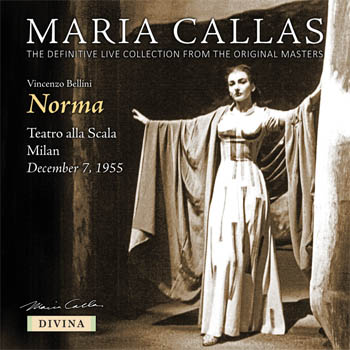
Callas’s Norma – 7 December 1955

dvn017_l

1955 had been a spectacular year for Callas, though its beginning was inauspicious. She had been scheduled to start the year singing one of her speciality roles, Leonora in Il Trovatore, at La Scala, but Del Monaco, who was to have sung Manrico pleaded indisposition, though oddly he felt well enough to sing Andrea Chénier (who knows the vicissitudes of tenors), so La Scala made a substitution. Callas could have stepped down, but learned the role of Maddalena in a few days. The opera, a La Scala favourite, had a big success, but the role was hardly one in which her rarified gifts could shine, and is something of a curiosity in the Callas cannon. Thereafter she went from one major success to another. She sang Medea in Rome and followed it with three productions at La Scala, which have entered the realms of legend, the Visconti productions of La Sonnambula and La Traviata, and, by way of contrast, Zeffirelli’s production of Il Turco in Italia. During the summer she recorded Aida, Madama Butterfly and Rigoletto then in September she had a massive success in Karajan’s La Scala production of Lucia di Lammermoor, when the opera toured to Berlin. The autumn saw her back in Chicago for her second season, where she sang Elvira in I Puritani, Leonora in Il Trovatore (perfection according to her co-star Jussi Bjoerling) and her only stage performances of Madama Butterfly. Truly 1955 had been her annus mirabilis and she closed it with what, by common consent, is the greatest recorded performance of her signature role, Norma.

First a word about the differences between this Divina transfer and most others you will hear. Divina’s remaster is from a first generation master tape and the sound is very good, certainly the best I’ve heard. As the first fifteen minutes were not recorded, like other companies Divina have included music from another performance, but whereas other labels do not credit it, Divina tells us they used a 1965 performance under Gavazzeni for the overture and Oroveso’s first aria, and the Rome broadcast of 1955 under Serafin for part of the recitative before Pollione’s Act I aria. There was some radio interference in Norma’s long solo at the beginning of Act II, and most issues substituted the same scene from the Rome broadcast of the same year, but Divina have left it as it stands to retain the integrity of the La Scala performance, and so as not to lose some of Callas’s most moving singing. It lasts only a few seconds and is easy to live with.

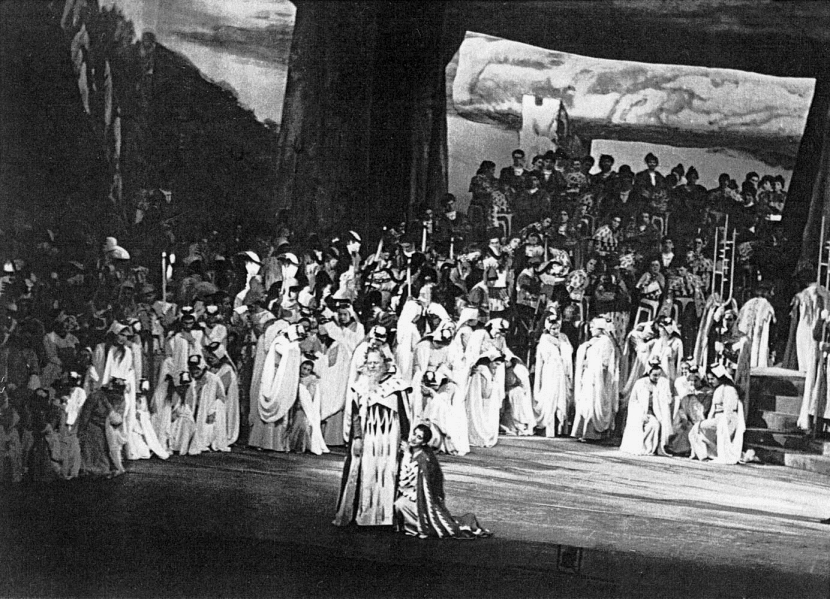
The La Scala season starts every year on December 7th, and for the fourth time in five years, Callas had been given the honour of a new production to open the season. The last time she had sung Norma there was in 1952, the year she first became a permanent member of the La Scala company. The La Scala years saw a period of incredible artistic achievement and there is no doubt that by this time Callas had become the reigning queen of La Scala. The new production was by Margherita Wallman, with designs by Nicola Benois and the starry cast included Mario Del Monaco as Pollione, Giulietta Simionato as Adalgisa and Nicola Zaccaria as Oroveso.

Callas is in fabulous form from the outset, stamping her authority on the performance, and the Druids, in her opening recitatives, her voice taking on a veiled, mysterious quality when she sings about reading the secret books of heaven, before singing a mesmeric Casta diva. The repeated As up to B harden slightly in the first verse, but that hardness has dissipated by the second verse and therafter the voice seems to be responding to her every whim. The linking recitative between cavatina and cabaletta was always a high point of her performances, with that wondrous change of colour at Ma punirlo il cor non sa, leading her into the cabaletta. It’s a jaunty tune with plenty of opportunity for display, but Callas somehow invests it with a private melancholy available to few others. I find it impossible to think of the words Ah riedi ancora, qual eri allora without hearing Callas’s peculiarly plaintive voice in my mind’s ear.

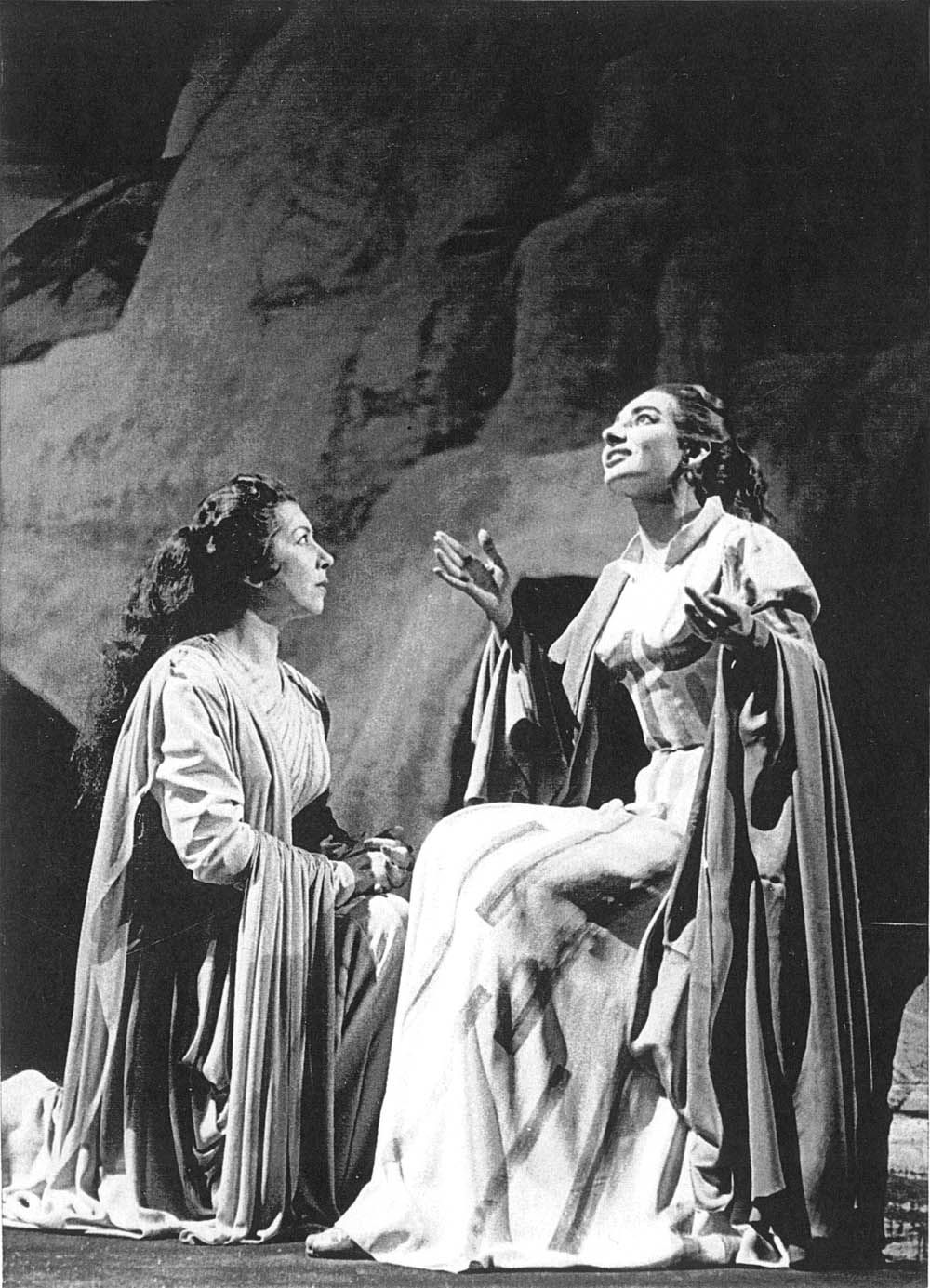
The duets with Simionato are also high points of the performance. The two singers first appeared together in Mexico in 1950 and became life long friends. Before these La Scala performances, they had sung together in the opera in Mexico, Catania, London (in 1953) and Chicago. Though the pairing of Callas with Stignani had become a famous one, Simionato was a better fit for the role than Stignani, who both looked and sounded too mature, and no downward transpositions had to be made to accomodate her. Furthermore their voices blended well, and you can sense the deep rapport that existed between them after so many performances together. It is great cause for regret that Simionato was contracted to Decca and therefore never appeared on any of Callas’s studio recordings.
94d0fb8748ccd64a399db3a0835b913f

There are so many things to cherish in this first duet, particularly the wistful way Callas’s Norma recollects the dawning of her love for Pollione and then the fullness of heart with which she consoles Adalgisa at Ah tergi il pianto. However the most arresting moment is in the cabaletta to the duet when she hits a top C forte, then makes a diminuendo on the note before cascading down a perfect ‘string of pearls’ scale, eliciting audible gasps of disbelief from the audience.

Having been all warmth in the duet, her voice flashes out in anger in the trio, the coloratura flourishes hurled out with terrific force, the top Cs like scalpel attacks. The act comes to an exciting end as Callas takes a thrilling, rock solid top D, which she holds ringingly for several bars.

The opening of Act II, a mixture of recitative and arioso akin in some ways to Rigoletto’s Pari siamo, always provoked some of Callas’s most moving singing. What other singer matches her range of tone colour in this scene? I’m thinking of the hard tone at schiavi d’una matrigna when she contemplates the fate of her children at the hands of a stepmother, and the way she drains the tone of colour at un gel mi prende e in fronte mi si solleva il crin so that it becomes a literal expression of her hair standing up on end. This leads to wonderfully tender singing as she looks at her sleeping children, and of course ultimately she cannot bring herself to kill them, her voice drenched with maternal love at son i miei figli.

The following duet, one of the most famous in the bel canto repertoire is, even more than the Act I duet, a perfect example of two artists at one with each other, their voices intertwining and their timing perfect. Not unsurprisingly it provokes rapturous applause from the audience.
740

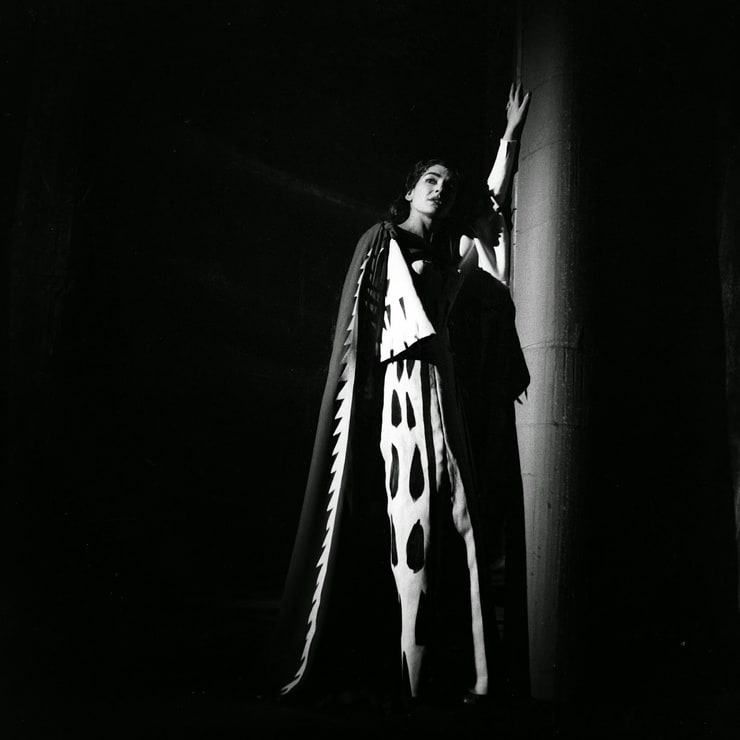
Callas’s performances were always cumulative and the final scene is almost unbearably moving as Callas takes us through the gamut of emotions, from the almost youthful joy with which she sings Ei tornera spinning out the melisma on come del primo amor ai di felici, through suppressed anger and barely contained rage to ultimate peace and magnanimity, heart-wringinly moving in her final plea for her children. But what we should always remember is how musically her effects are made, her phrasing and the way she shapes the musical line, her sense of rubato unparalleled. Another moment that has entered the history books is her singing of the words son io when Norma confesses her guilt. Apparently she would simply take the wreath from her head and you can almost hear the moment she does it. The audience respond with a sort of corporate moan. Was Ponselle ever as moving as this? Was Pasta? We will never know, but at least with Callas we have recorded evidence. So much is Callas’s way with the role imprinted on my subconscious that inevitably I find all others wanting. Her Norma is so complete, so all enveloping that it remains unchallenged to this day and we are fortunate indeed that this performance, which captures that moment in her career when art and technique reached their truest equilibrium, was captured in sound.

For the rest, Simionato is arguably the best Adalgisa Callas ever sang with and is in terrific form here. Zaccaria is a sympathetic and sonorous Oroveso. Del Monaco makes up for his lack of coloratura with a voice of heroic, clarion splendour and Votto, though he pales next to Serafin, is the perfect accompanist, which, with such a cast, is perhaps all he needed to be.

Great Normas have always been thin on the ground, though all sorts of unsuitable singers appear to be attempting it these days, but let no one think they have truly heard the opera until they have heard a performance with a great protagonist. The studio recordings have their value in enjoying better sound, but I have no hesitation giving this one the prize as the best of all Callas’s recorded Normas.

Crespin’s Shéhérazade

513oqn2fqcl._sx425_

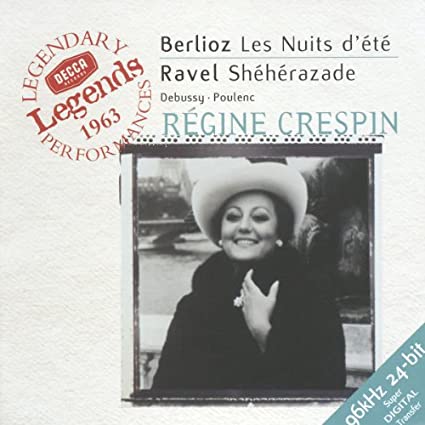
Crespin’s recording with Ansermet of Ravel’s Shéhérazade and Berlioz’s Les Nuits d’été is now so famous, so universally acclaimed that there can surely be no more to say about it. Even today, almost 60 years since they were recorded, the performances are still cited by many as a first choice in both works and for many they were no doubt their first exposure to the works, so maybe that is all that needs to be said about them, but is it really so simple?

Both Shéhérazade and, especially, Les nuits d’été are great favourites of mine and I now have ten different recordings of the Berlioz, six of the Ravel. Let us then start with the Ravel. From the thrice repeated call of Asie at the beginning, the third sung with the equivalent of a flirtatiously arched eyebrow, we are in her thrall. She makes a bewitching storyteller, drawing us in with her thrillingly colourful descriptions of the Orient. As I often feel with Crespin, there is a slight air of detachment but here it suits the narrative superbly. She is suitably languid in La flûte enchantée and deliciously ambiguous in L’indifférent. There have been finer versions of the orchestral score (not least the New Philharmonia under Barbirolli for Janet Baker), but Crespin at her best is still a prime recommendation. There is something just so inevitably right about her singing and it places her (just) ahead of the other versions I own, (Teyte, Baker, De Los Angeles, Berganza and Hendricks).

That air of detachment I mentioned also makes her an ideal interpreter of the songs of Poulenc and also Debussy’s Trois chansons de Bilitis with John Wustman on the piano, from a 1967 recording, which are here included as a makeweight, and very welcome they are too. However it works against her in the Berlioz, which requires a degree of involvement and passion that I find lacking in Crespin’s delivery. However musical and tasteful her singing, however elegant her phrasing, she remains aloof and uninvolved. There is no sense of mounting rapture at the arrival of the rose from paradise, no sense of longing in Absence. She is at her best in the final song, L’île inconnue which is blithely insouciant and responds better to her air of suave sophistication. I have no idea why she decided to place Sur les lagunes after Absence but it upsets the balance of the work too.

No, for the Berlioz my prime recommendations would be Baker either with Barbirolli or live with Giulini, Hunt Lieberson with McGegan, Steber with Mitropoulos or De Los Angeles with Munch, Crespin trailing quite a way in their wake.

Essential I would say for Shéhérazade and the Debussy and Poulenc, but look elsewhere for the Berlioz.

José Carreras – Canciones españolas

r-10366837-1583783292-8089.jpeg

Falla: Siete canciones populares españolas
Mompou: Combat deil somni
Ginastera: Canción al árbol del olvido
Guastavino: La rosa y el sauce
Guastavino: Se equivicó la paloma
Obradors: Corazón, porqué pásáis
Obradors: Del cabello más sutil
Turnina: Poema en forma de canciónes

It certainly makes a change to hear Falla’s Siete canciones populares españolas sung by a man, and why not? It is not so unusual to have a father sing a lullaby to his son, and drovers are usually men, aren’t they? Though I might ultimately prefer to hear the cycle sung by Victoria De Los Angeles or Conchita Supervia, I rather enjoyed Carreras’s sensitive performance.

The Mompou cycle, also a favourite of De Los Angeles, also goes well and I especially enjoyed his gently melancholic version of the lovely Damunt de tu nomes los flors. Elsewhere he can be caressingly sensitive or ebulliently passionate, as in the Turina Poema, which brings the recital to a splendidly forthright close.

He is miked fairly close and his diction so precise you can almost taste the words. Martin Katz makes a terrific collaborator rather than accompanist, some of the piano parts being quite fiendishly difficult.

A really enjoyable disc.

Victoria De Los Angeles sings Chants D’Auvergne


Many of my generation will no doubt have got to know Canteloube’s gorgeous arrangements of Auvergne folk songs through the recordings of Victoria De Los Angeles. On LP I only had the first album recorded in 1969, which had a selection of songs on one side and her recording of Chausson’s Poème de l’amour et de la mer on the other, but this reissue couples only the Canteloube songs to the second all Canteloube album entitled Pastorale and recorded in 1974. Some might also remember that famous Dubonnet advert which used an arrangement of the gorgeous Baïlèro, lazily and yearningly sensuous in the performance under review. I can’t now think of this song without the De Los Angeles version coming into my mind’s ear.

De Los Angeles is in many ways the songs’ ideal interpreter, steering a sort of midway course between the more abrasive style of Madeleine Grey and the senusality of Anna Moffo. She has great fun with the colourful language and folk elements, exuding the bright eyed charm for which she is famous, but is also wonderfully expressive in the more melancholy songs, and the Lamoureux Orchestra under Jean-Pierre Jacquillat provide excellent support, all bathed in a warm acoustic.

There are now a lot of recordings of these songs out there (when the first album was released, I’m pretty sure there were only the early recordings of the aforementioned Madeleine Grey, a small selection by Anna Moffo and a couple of discs on the Vanguard label by Netania Davrath) and there are now a lot more sets out there by the likes of Kiri Te Kanawa, Jill Gomez, Dawn Upshaw, Véroniqe Gens, Frederica Von Stade and others, and all of them have their attractions, but these performances by De Los Angeles will always have a special place in my heart.