
Gracias a la vida – Anne-Lise Polchlopek

It seems not a month goes by without a new recital record from a young artist making an impression. Recently I’ve welcomed recital records from Benjamin Appl, Fatma Said, Harriet Burns, Rachel Fenton and Eva Zalenga , and July saw a recommendation for Julieth Lozano-Rolong’s new disc from Dominy Clements. To this list can now be added the name of French mezzo-soprano, Anne-Lise Polchlopek, a winner of several song competitions, and now an associate artist of the Queen Elizabeth Music Chapel, where this recording was made.

This recital may at first glance appear to be a hotchpotch of different styles, embracing classical Lied, folk and popular music, but Polchlopek somehow integrates these different musical styles into a satisfying whole, and the recital benefits from being listened to at one sitting. It doesn’t get off to the best of starts with her somewhat over-articulated and over-acted singing of Bernstein’s Old Lady Tango (I am easily assimilated) from Candide, but she then sings a beautiful version of Strauss’s Wiegenlied, with a lovely legato line, her mellifluous mezzo wrapping the child in its warm embrace.

From Germany we travel to Spain and France, where we stay for the remainder of the recital. Toldrá is followed by Chaminade, then we switch to guitar accompaniment for Hubert Giraud’s La tendresse, staying with the guitar for an extremely effective performance of Falla’s Nana, from his Siete canciones populares españolas.

We go back to the piano for Fauré’s Les berceaux, in which she builds nicely to the climax, and then we have Messiaen’s early Trois melodies, where she captures to perfection the ecstasy of the writing, especially in the final song, la fiancée perdue.

 These are followed by three songs in a lighter vein by Chaminade, Pauline Viardot and Gerónimo Giménez, all wonderfully characterised. Perhaps incongruously (but somehow it works) Voi che sapete from Mozart’s Le nozze di Figaro acts as a bridge to Michel Polnareff’s Mes regrets, a beautiful song about lost love, which is followed by Fauré’s Toujours.

This in turn is followed by Gérard Jouannest’s La chanson des vieux aimants, with lyrics by Jacques Brel, a song I had previously only known in a version by Judy Collins. Suffice it to say that Polchlopek’s intensely moving performance put any thoughts of Collins out of my mind completely.

Throughout the piano accompaniments of Federico Tibone contribute wonderfully to the success of the disc, as do the guitar accompaniments of Pierre Laniau, who accompanies her on Tamás Méndez’s charming Cucurrucucu paloma, which I seem to remember was a favourite of Nana Mouskouri. He also accompanies her on the Habanera from Bizet’s Carmen and Satie’s La diva de l’empire, though I did feel the Bizet was slightly out of place here, coming, as it did, after the piano accompanied Poulenc Les métamorphoses and before the Satie.

We return to piano accompaniment for Montsalvatge’s Canto negro, which she sings with charm and spirit, relishing the yambambós, as Victoria De Los Angeles did before her.

All three participants come together for the final song, Violetta Parra’s Gracias a la vida, a fitting end to a journey on which Anne-Lise Polchlopek has proved to be a most musical guide. Throughout she clearly and meaningfully enunciates the text, and it is clear she has a rare gift for communication that makes her an ideal recitalist.

Unfortunately, though the notes accompanying the disc are in English, the online texts are only in the original language, French, Spanish, German, or in the case of the Bernstein, English, and translations would have helped for a total appreciation of Polchlopek’s art. However, I thoroughly enjoyed this disc, and I look forward to hearing more of Anne-Lise Polchlopek.


Eva Zalenga – Varia bel

Last month I was welcoming a disc of Lieder with various accompaniments by Fatma Said and here we have another for various forces, which, coincidentally, also includes Schubert’s Der Hirt auf dem Felsen.

In April 2024, I welcomed Zalenga’s debut recital on the Hänssler label, and this new recital on the Genuin label is, if anything, even more successful. Variety is the key note of the disc, in the variety of music (from the 18th to the 21st centuries), the variety of styles from the intimate to the more extrovert, and the variety of instruments accompanying the voice, that nonetheless add up to a convincing whole.

We start with a world premiere recording of Ignaz Lachner’s An die Entfernte (In die Ferne) for soprano, violoncello and piano, in which Zalenga charmingly intertwines with the cello of Till Schuler. We stay with the combination of cello and piano for Schubert’s Auf dem Strom. There is just the suspicion of strain in the upper reaches of the song here, a slight impurity that obtrudes on the silvery beauty of the sound, but it is fleeting, and soon evaporates during the next song, Meyerbeer’s haunting Des Schäfers Lied, in which the cello is swapped for Adam Ambarzumjan’s clarinet.

We stick with this combination for Schubert’s more famous Der Hirt auf dem Felsen, which, whilst not plumbing the deeper meanings of the text, as Said and Meyer do in their version, is nonetheless a delightful and charming performance.

In their earlier recital, Zalenga and Tchakarova championed women composers and it is good to see that they do so here too, first with a lovely song by Pauline Viardot-Garcia, in which we return to the combination of soprano, cello and piano, and then, jumping ahead around 100 years to Rebecca Clarke’s arrangement for soprano and violin of Three Irish Folk Songs. The tricky violin part is played by Victoria Wong. These are sung in English, and we stick with English for Arthur Bliss’s Two Nursery Rhymes, the first for soprano, clarinet and piano and the second for soprano and clarinet. Zalenga sings in perfectly accented English, and seems equally at home in French, which is the language of the next group of songs, four miniatures for soprano and violin by Darius Milhaud, Quatre Poèmes de Catulle.   

Finally all the forces come together for the last item, a new arrangement of contemporary composer Isabelle Aboulker’s Je t’aime, which Zalenga brings off with incredible wit, panache and style to bring this excellent recital to a riotous conclusion.

In all, Zalenga proves herself to be a most musical and intelligent singer and I look forward to seeing where her next enterprise will take us. Highly recommended.

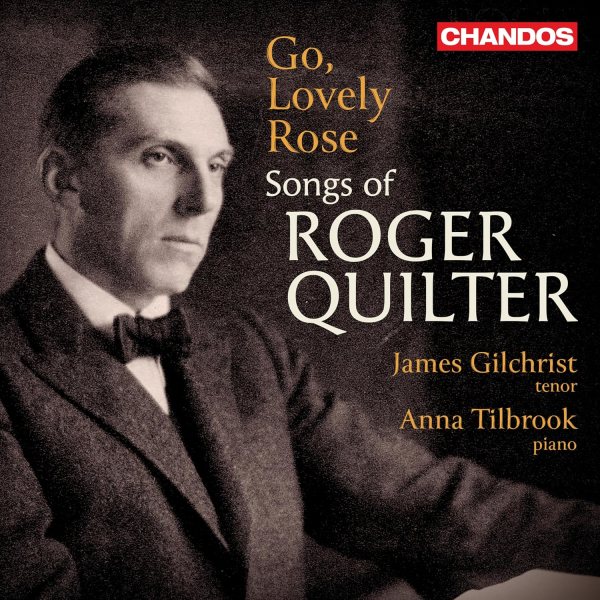
Go Lovely Rose – The songs of Roger Quilter

91aupp0ckgl._ac_sl1500_

James Gilchrist (tenor) Anna Tilbrook (piano)

The songs of Roger Quilter are not performed as often these days as they once were, which is a shame, because they are beautifully crafted and, though perhaps they don’t probe as deeply into the texts as those of Finzi, Delius and Warlock, they are very rewarding for performers and listeners alike. Quilter had a wonderful gift for melody, but it was always melody put at the service of the poetry and the text is sung more or less as if it were spoken. Having performed many of the songs myself in my youth, I can attest to the fact that they are a gift to the performer.

Rather than give us whole opus numbers, Gilchrist and Tilbrook have chosen songs from his complete oeuvre, with the songs grouped into themes. Thus, we have six Shakespeare songs, drawn from the Op. 6, Op. 23 and Op. 32 sets of Shakespeare settings, five songs associated with flowers (A Floral Tribute), four Folk Song settings (all taken from The Arnold Book of Old Songs), four songs associated with the graveside, and four Songs of Love. The only songs performed as a set are the early German songs, written when Quilter was studying in Frankfurt. These are charming, but slight and give little indication of Quilter’s later, more mature style.

Initially alienated by the rather gruff sound of Gilchrist’s voice in the opening robust Blow, blow, thou winter wind (we are at once aware that this is not the voice of a young man, and indeed Gilchrist was approaching sixty at the time of the recording), I was drawn in by his elegiac delivery of Come away, death, and thereafter, I was less aware of any failing resources. Indeed, in the more gently reflective songs, with which the disc proliferates, Gilchrist is often spellbindingly beautiful, spinning out some lovely pianissimi in such songs as Fear no more the heat of the sun, the famous Now sleeps the crimson petal and the song which gives the collection its name, Go lovely rose. He is admirably supported by Anna Tilbrook, who is an excellent accompanist.

I would not be doing my job as a reviewer if I didn’t point out that there is another similar collection of songs available on the Hyperion label. This was recorded in 1996 by the then much younger John Mark Ainsley with Malcolm Martineau at the piano. Some may prefer Ainsley’s much more forthright manner and fresher timbre, as indeed I occasionally do, especially in songs like Blow, blow, thou winter wind and the ebullient Love’s philosophy, but Gilchrist’s more reflective style has its own rewards, and this is a welcome addition to the Quilter discography

Contents
Shakespeare Songs
Blow, blow, though winter wind, from Three Shakespeare Songs (First Set) Op 6, No 3 (1905)
Come away, death, Op 6 No 1 from Three Shakespeare Songs (First Set) (1905, rev 1906)

Fear no more the heat o’ the sun. from Five Shakespeare Songs (Second Set) Op.23 No 1
Orpheus with his lute. from Two Shakespeare Songs (Fourth Set) Op.32 No 1(1919-20)
O mistress mine, from Three Shakespeare Songs (First Set) Op 6 No 2 (1905, rev 1906)

Under the greenwood tree, from Five Shakespeare Songs (Second Set) (1919)
A Floral Tribute
The Fuchsia Tree, Op.25 No.2 (1923)
Go, Lovely Rose, from Five English Love Lyrics Op.24 No.3 (1922)
A last year’s rose, Op 14 No.3 (1909-10)
Now sleeps the Crimson Petal, Op 3 No 2 91897)
To Daisies from To Julia, Op.8 No 3 (1905)
Folksongs
From The Arnold Book of Old Songs
Barbara Allen, No 13 (c 1921)
Drink to me only with thine eyes, No 1 (c 1921)
My Lady’s Garden, No 10 (c 1942)
The Ash Grove, No 16 (c 1942)
At the Graveside
Autumn Evening Op.14 No.1 (1909-10)
Dream Valley, from Three Songs of William Blake, Op.20 No.1 (1917)
Drooping Wings (1943)
Music, when soft voices die, from Six Songs, Op 25 No.5 (1926)
German Songs
Four Songs of Mirza Schaffy, Op 2 (bef. 1903, rev. 1911)
Songs of Love
Love’s Philosophy, from Three Songs, Op 3 No 1 (1905)
Julia’s Hair from To Julia Op 8, No 5 (1905)
The Maiden Blush from To Julia Op 8, No 2 (1905)
It was a lover and his lass, from Five Shakespeare Songs (Second Set), Op

Elisabeth Schumann’s Swan Song

91ry4lbyuzl._ac_sl1500_

Born in 1888, Elisabeth Schumann’s first recordings were acoustics, made in 1915, although it is probably for her later, electrical recordings that she is better known. She had an illustrious operatic career, famous for such roles as Sophie in Der Rosenkavalier and Eva in Die Meisteringer, also excelling in Mozart with roles such as Pamina, Susanna, Zerlina and Blonde. She was a favourite of Richard Strauss, who even tried to persuade her to sing the role of Salome, creating an edition in which he reduced the size of the orchestra to accommodate her light, lyrical soprano, though she never took up the offer.

She was also highly regarded as a singer of Lieder and Lotte Lehmann, who was perhaps her greatest rival in the field, once said she represented the purest singing style of German Lieder. She has a large discography and many of her recordings, both acoustic and electrical were once issued in a six disc EMI box set, which now appears to be available as a Warner download.

The present recordings were made somewhat later in her home in Manhattan in 1950, when she would have been in her early sixties, and this appears to be the first time the sessions have been issued in their entirety. The accompanying notes are sketchy and inadequate. Included are brief biographies of Schumann herself and of George Schick and George Reeves, who I assume are the accompanists, but there is no indication as to which songs they play, nor which items are completely new to the catalogue.

Being late recordings, this is not a disc to which I would direct anyone interested in hearing “the purest singing style of German Lieder”. Though the bell-like purity of Schumann’s top notes remains more or less intact, quite frankly, in the middle and lower register, she sounds all of her sixty odd years. Certainly, the voice has aged less well than some other sopranos, who also made recordings into their sixties, such as her contemporary Maggie Teyte or, of more recent singers, Renée Fleming. Some of the Wolf songs now clearly stretch her to the limit and I find myself wondering if this is the reason they were not issued before. One should probably make allowances for the way these songs were recorded (probably on a 7.5ips home recorder, according to the notes) but to my ears  she sounds effortful and unsteady for much of the time.

She redeems herself in the final three bonus tracks, first in two acoustic Odeons of her singing Wolf’s Frage und Antwort and Straus’s Morgen (date and accompaniment unknown), followed by a later recording of her delivering in English a master class on Morgen, this time with Ernest Lush on the piano. No date is given, and I wonder if this was from one of her lecture tours of 1950 and 1951. If it was, then she sounds in much better voice here than she does on the home recordings.  and she gives invaluable advice on singing the song, recollecting working on it with Strauss himself.

I hate to be negative about a much-loved artist, but this disc, I would suggest, is for completists only. Anyone wanting to discover the voice and art of this great soprano, will be much better served by the six-disc set detailed above.

Sir Bryn Terfel – Sea Songs

91war9hkol._ac_sl1500_

It’s been a few years since Sir Bryn visited a recording studio and here he lets his hair down in a programme of sea songs, shanties and maritime folk songs. In the notes he explains that, as a North Wales farmer’s son, he has always been somewhat obsessed with the 360-mile coastline of northern Wales. However, his journey takes him much further than the shores of Wales, with songs originating from the Shetlands, New Zealand and the Bahamas (Sloop John B, which no doubt most people will probably know in the version recorded by The Beach Boys in the 1960s).

Along the way, Terfel is joined by friends and colleagues, Sir Simon Keenlyside, Sting, singer-songwriter Eve Goodman, the folk group Calan and the male vocal group Fisherman’s Friends from Cornwall. Arrangements are by Patrick Rimes, who also plays a variety of different instruments, from piano to fiddle to whistle. The whole disc has an atmosphere of companionship, as if a group of friends just got together to reminisce and make music, almost as if they’d gathered in a portside pub one evening, though I doubt one would ever come across quite such accomplished music making by chance. The songs range from the rumbustious to the gently nostalgic and, whether singing in Welsh, Breton, Norn or English, Terfel’s diction is so crisp you can all but taste the words. Terfel’s bass-baritone may have acquired a slightly rougher edge when singing out full voice, but in the quiet songs, he can still spin out a gently caressing legato line of great beauty, and, in any case, that touch of roughness is not out of place in songs like Whisky, Johnny and The Green Willow Tree on which he duets with Sting. A word of praise too for all the various musicians and backing singers not mentioned by name in the recording details above.

I suppose one would call this a crossover album, not a genre I particularly enjoy opera singers doing but, like Agnes Baltsa singing the songs of her native Greece, Terfel makes no concessions to the music and sings with a sincerity and a big open-hearted personality that I found thoroughly disarming. In some of the gentler songs, like Codi angor or the plaintive Unst Boat Song, this time accompanied simply by piano and melodeon, I found it hard to suppress a tear. Though this is not a disc I would probably have considered buying if I were not reviewing it, I was very pleasantly surprised and I enjoyed it immensely.

Surely a disc to be enjoyed by all but the most curmudgeonly, but beware. These songs are purposefully catchy. I had several ear worms rattling round in my head for days after just a couple of listens.

Dreams Desires Desolation – and Diffidence.

71zl57gifrl._ac_sl1425_

Dreams Desires Desolation

English Song

Trevor Alexander (baritone), Peter Crockford (piano)

Rec. 2021 Henry Wood Hall, London.

This is a disc of English song which re-creates an evening of Parlour Ballads, such as one might have heard in an Edwardian aristocratic home. Even the more contemporary songs fit quite comfortably into this category and in fact the most forward reaching and original song is by Frank Bridge; his last song, Journey’s End,written in 1925 to a text by Humbert Wolfe. Startlingly, the song almost sounds as if it might have been written by Bridge’s pupil, Benjamin Britten and in fact Pears did record the song with Britten at the piano in 1963. Some of the songs are old favourites, that we don’t hear very often these days, though we might know them from older recordings, whilst others are brand new. Indeed, Peter Gelhorn’s Autumn and two songs by Clive Pollard (b. 1959) are here receiving their first commercial recordings. However they are tuneful and tonal and do not sound out of place in a programme of songs mostly written in the early part of the last century.

As you would expect with a title like Dreams. Desires, Desolation the mood is mostly melancholy or dreamlike and I can’t help feeling one or two more lively songs would have created a little more variety in the programme. What would also have helped to enliven the recording is a bit more energy in the performances. Trevor Alexander has a pleasant, light, tenorish baritone and he has excellent diction. Though his is obviously not the voice of a man in the first flush of youth, it is mercifully free of excessive vibrato or wobble. Unfortunately, it is also a little lacking in colour and personality. The performances are somewhat diffident, rather lacking in substance and imagination. Take the opening song, Butterworth’s Is my team ploughing? Alexander commendably attempts to differentiate between the ghost and the young man, but whereas his ghost is convincingly eerie, the young man’s responses need to be more healthily robust. It is also true that many of the older songs tap into a vein of sentimentality that is perhaps not so fashionable today.  Even so, one wants a more open-hearted, outgoing emotional response to both words and music, such as we can hear in some of the old recordings of Jonn McCormack, Richard Tauber, Rosa Ponselle and Kathleen Ferrier. Where their voices and personalities fly out from even the crackliest old 78s, Alexander remains earthbound, nice but dull.

Reading the notes that come with the disc, one appreciates that it was obviously a labour of love for the two artists involved and one doesn’t doubt their sincerity for a moment, but, though there are some interesting discoveries (and re-discoveries) here, the performances need a little more personality and variety to sustain interest throughout a whole disc.

Contents

  1. George Butterworth (1995-1916) – Is my team ploughing?
  2. Frank Bridge (1879-1941) -Come to me in my dreams
  3. Charles Marshall (1857-1927) -I hear you calling me
  4. Roger Quilter (1877-1953) – Now sleeps the crimson petal
  5. Clive Pollard (b.1959) – Go, song of mine
  6. Richard Hageman (1881-1966) -Do not go my love
  7. Ralph Vaughan Williams (1872-1958) -Silent noon
  8. James Frederick Keel (1871-1954) – Remembrance
  9. Victor Hely-Hutchinson (1901-1947) – Dream song
  10. Frank Bridge (1879-1941) – What shall I your true love tell?
  11. Haydn Wood (1882-1959) – Love’s garden of roses
  12. Peter Gelhorn (1912-2004) – Autumn
  13. John Ireland (1879-1962) – If there were dreams to sell
  14. Cecil Armstrong Gibbs (1889-1960) – Silver
  15. Clive Pollard (b. 1959) The cloths of heaven
  16. Ralph Vaughan Williams (1872-1958) – The sky above the roof
  17. Cyril Scott (1879-1970) – Lullaby
  18. Amy Woodforde-Finden (1860-1919) – Kashmiri song
  19. Roger Quilter (1877-1953) – I arise from dreams of thee
  20. Frank Bridge (1879-1941) – Journey’s End
  21. Lucy Elisabeth Simon (1940-2022) – How could I ever know (from the Secret Garden)

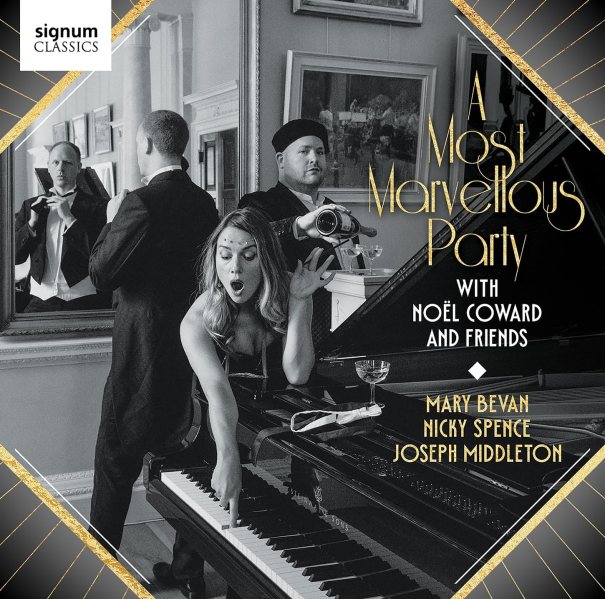
A Most Marvellous Party

81wftltatgl._ac_sl1450_

This highly entertaining programme is the sort of thing that would go down well at a country house or in a small hall, and indeed I see that these artists performed it at the Leeds Conservatoire in March this year, shortly before making this recording. Mary Bevan should not be confused with her sister, Sophie, also a soprano with quite a career herself, nor Nicky Spence with tenor Toby Spence, to whom he is not related. Both singers are active on the operatic stage as well as on the concert platform and here let their hair down in some lighter music.

The “party” seeks to place Noel Coward among other contemporary composers, all of whom have a connection with Coward, however slight. Thus, the other guests turn out to be Ned Rorem, who claimed to have once had a one-night stand with Coward, Poulenc for whom Coward once did the narration on a recording of his Babar, the elephant and Stravinsky, who apparently once asked Coward to collaborate with him. Gershwin’s music Coward had known for some time and even played snatches of it on stage in the first production of his play, The Vortex. The connections with Satie, Messager, Britten and Walton would seem to be a little more tenuous, but I’m nonetheless delighted that they came along. It’s also good to encounter some songs by Roger Quilter and Liza Lehmann, especially given Bevan’s rapturous account of Lehmann’s gorgeous Love, If You Knew The Light, and Spence’s lovely singing of Quilter’s famous setting of Tennyson’s Now Sleeps The Crimson Petal, which is nicely contrasted to Ned Rorem’s sparer, but equally valid setting of the same poem sung by Bevan, a song that was new to me. It slightly reminded me of Britten’s version, which he eventually cut from the Serenade for Tenor, Horn and Strings.

Both Bevan and Spence are rather better in the more lyrical songs by Coward than they are at the patter songs, and there are a couple of misses in the sequence. Spence can’t resist the temptation to overplay the comedy in Don’t Put Your Daughter on The Stage, Mrs Worthington and I have a feeling this rendition would become rather triresome on repeated listening. One only has to compare the Master, with his brilliantly understated and clipped delivery to hear how it should be done. Nor can Bevan quite cast off the slightly jolly-hockey-sticks quality she has adopted in the opening Coward medley when she turns to Kurt Weill’s Complainte de la Seine, a song which is absolutely harrowing when sung by Teresa Stratas. I also rather wish that Spence, rather than Bevan, had been allowed to sing Mad About The Boy, given that we now know the song was written by Coward about a man he had fallen in love with. However, Spence does get to sing If Love Were All, a song that was originally written for the character of Manon in Coward’s operetta Bitter Sweet, but which Coward himself later made very much his own.

Britten is represented by two early W, H, Auden settings, one of which, As it is, plenty, sounded strangely like something by Stephen Sondheim, though it was written only a few years after Sondheim was born. I wonder if he knew it. I rather wish room had been found for Bevan to sing Coward’s Zigeuner from Bitter Sweet and that perhaps it would have been better to close the recital with the gently wistful The party’s over now rather than the slightly over-rumbustious I went to a marvellous party, but apart from these and a few other minor reservations expressed above, the two singers acquit themselves very well and the pianist, Joseph Middleton is a wonderful collaborator, both as accompanist and when playing solo in pieces by Poulenc, Satie, Stravinsky and Gershwin.

All in all, this is a highly enjoyable disc and one which I will definitely be returning to from time to time.

Full programme

  1. Coward Medley (all three artists)
  2. Coward: Mad about the boy (Bevan)
  3. Rorem: Early in the morning (Spence)
  4. Rorem: For Poulenc (Spence)
  5. Poulenc: Pastorale calme et mystérieux (Middleton)
  6. Poulenc: Hotel (Bevan)
  7. Coward: Parisian Pierrot (Spence)
  8. Weill: Complainte de la Seine (Bevan)
  9. Messager: De ci, de là (Bevan and Spence)
  10. Satie: Gnossiene No. 1 (Middleton)
  11. Coward: Any little fish ((spence and Bevan)
  12. Stravinsky: Valse pour les enfants (Middleton)
  13. Coward: Something to do with Spring (Spence and Bevan)
  14. Quilter: Love calls through the summer night (Bevan and Spence)
  15. Quilter: Now sleeps the crimson petal (Spence)
  16. Rorem: Now sleeps the crimson petal (Bevan)
  17. Coward: World weary/Twentieth century blues (Bevan and Spence)
  18. Gershwin: The man I love (Middleton)
  19. Coward: If love were all (Spence)
  20. Gershwin: By Strauss (Bevan)
  21. Coward: Don’t put your daughter on the stage, Mrs Worthington (Spence)
  22. Britten: When you’re feeling like expressing your affection (Bevan)
  23. Walton: Popular Song (Spence)
  24. Britten: As it is, plenty (Bevan)
  25. Lehmann: Love, if you knew the light (Bevan)
  26. Coward: The party’s over now (Bevan and Spence)
  27. I went to a marvellous party (Bevan and Spence)

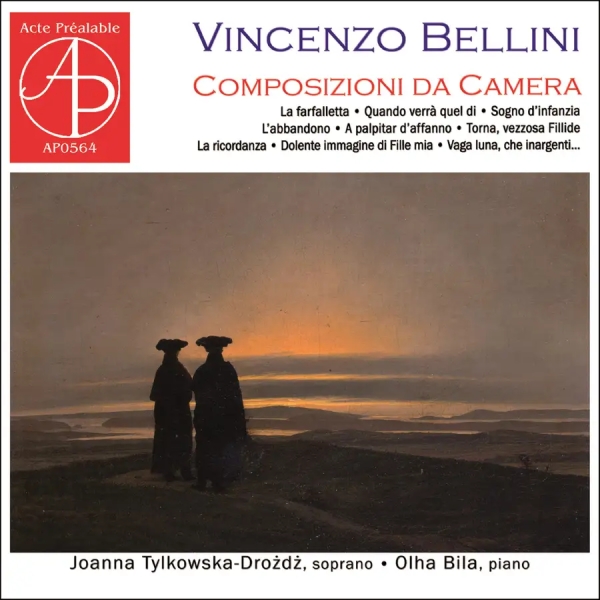
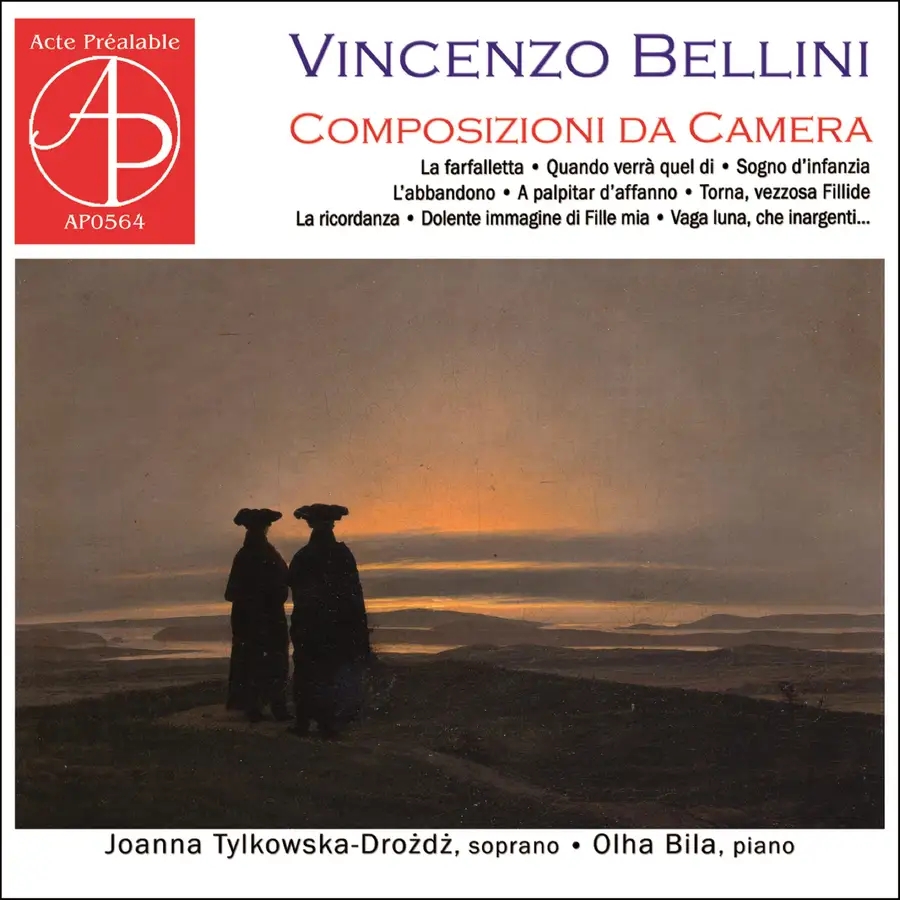
Bellini – Composizione da Camera

An enterprising collection of Bellini songs is unfortunately let down by less than ideal performances.

BelliniSongs

Bellini’s songs are not performed that often and indeed this is only the second recording of his Composizioni da Camera I’ve come across. Veronica Kincses recorded the complete set for Hungaroton back in 1982, though a few of the songs have appeared on various recital discs over the years.

They were probably written some time in the 1820s and it is unlikely that Bellini intended them all to be performed together; in fact, they were not published as a set until 1935, by the Milan publisher Ricordi. The Kincses disc includes all the songs in the Ricordi edition, in the order in which they appear in the score, whereas the present issue substitutes one or two other songs from a different source, such as La ricordanza, which turns out to be the tune of Qui la voce from I Puritani. Texts and translations are provided, some being by Metastasio, but the majority are anonymous.

Most of the songs are quite short, though the longest Torna, vezzosa Fillide,runs to almost eight minutes and is in the style of a mini operatic scena. It is the most complex of the songs and closer in style to the music of Bellini’s operas. However , for the most part, the songs are tuneful and undemanding, and it is not surprising that a few of them have made it into recital programmes of more famous singers, like Pavarotti, Bartoli, Tebaldi and even David Daniels, all of whom have made recordings of the most famous song, Vaga luna, che inargenti, the tune of which kept reminding me of the English folk song, The foggy, foggy dew. 

Any of the above singers would be preferable to the Polish soprano, Joanna Tylkowska-Drożdż, who has a rather hard, bright voice and tends to sing at an unrelenting mezzo-forte throughout, any refinement or tonal nuance only being offered by the pianist Ohla Bila. Nor is she particularly imaginative in her phrasing or her response to the poetry. Listening to the disc in one sitting proved something of a trial. The somewhat reverberant acoustic also tends to exaggerate the hardness of Tylkowska-Drożdż’s timbre.

As it happens, Veronica Kinkses’ Hungaroton recording of the fifteen songs in the 1935 Ricordi edition is still available to stream or as a download and is infinitely preferable if you are looking for a single disc of Bellini’s songs. However, I have a feeling most of us would be content to find the odd song on a mixed recital by a favourite artist. It should be noted that five of the songs appear on a 1997 disc by Cecilia Bartoli, called An Italian Songbook, on which she sings songs by Donizetti, Bellini and Rossini.

Contents

Vincenzo Bellini (1801-1835)

  • La farfaletta (anonymous)
  • 2. Quando verrà quell di (anonymous)
  • Sogno d’infanzia (anonymous)
  • L’abbandono (anonymous)
  • A palpitar d’affanno (anonymous)
  • Torna, vezzosa Fillide (anonymous)
  • La ricordanza (Carlo Pepoli, Conte)
  • Dolente imagine di Fille mia (anonymous)
  • Vaga luna, che inargenti (anonymous)
  • Malinconia, Ninfa gentile (Ippolito Pindemonte)
  • Vanne, o rosa fortunate (Pietro Antonio Domenico Bonaventura Trapassi as Metastasio)
  • Bella nice, che d’amore (anonymous)
  • Alme se non poss’io (Pietro Antonio Domenico Bonaventura Trapassi as Metastasio)
  • Per pietà, bell’ idol mio (Pietro Antonio Domenico Bonaventura Trapassi as Metastasio)
  • Ma rendi pur content (Pietro Antonio Domenico Bonaventura Trapassi as Metastasio)