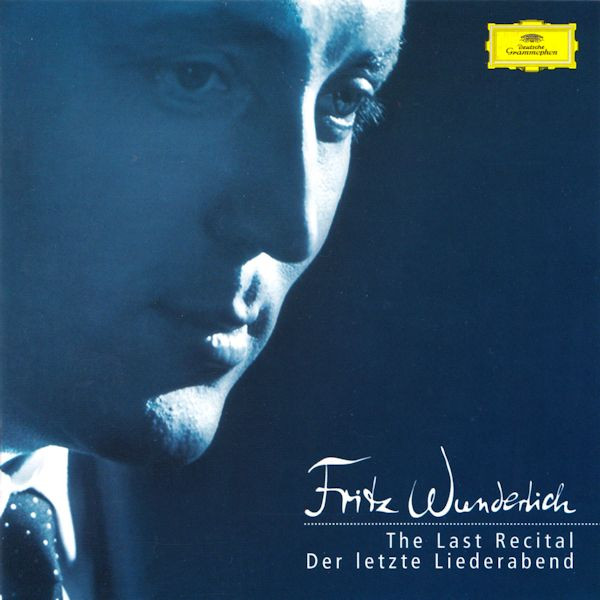

This CD was released in 2003 and was, I think, the first time this Edinburgh recital was being released in toto. The only known extant recording of it was a BBC recording, a second or third generation mono copy and DG have attempted to correct the pitch which, in previous issues of parts of the concert, was too slow and fluctuated substantially. They were not able to eliminate wow and flutter, which was probably introduced in the first copying process. Nevertheless this is an important document of the last ime Wunderlich ever sang in public and, for anybody used to listening to historical live recordings, the sound won’t be an impediment to enjoyment.
We should of course be careful of attaching too much valedictory significance to this recital. We listen to the final recordings of such as Ferrier and Hunt Lieberson, with the added knowledge that they were aware of their mortality and knew that their time was limited. Wunderlich, on the other hand, was at the height of his powers and his international career was just taking off. He was a few months away from his Met debut as Don Ottavio, and he was finding the performance of Lieder recitals so fulfilling that he wanted to do more in that area. In fact, after this concert, he told Hubert Giesen that they should start working on Winterreise. He had absolutely no reason to think that his life would be prematurely cut short.
Wunderlich was apparently very happy with how the recital went, and Giesen told him after the concert that he thought he had achieved perfection. He had only recently turned to Lieder, making his first studio recordings of Lieder by Beethoven, Schubert and Schumann the previous year for DG, performances that have sometimes been criticised for lacking emotional depth. He evidently took these criticisms to heart for this recording of Dichterliebe is profoundly moving and in a different world of interpretation from his studio recording. It is now my preferred recording of the cycle.
The programme is similar to the one he sang in Sazlburg the previous year, but he is now a much more experienced Lieder singer and his singing now has much more significance and specificity. The first half of the recital consists of Lieder by Beethoven and Schubert, with Adelaide and Nachtstück showing of his superb legato line. His diction is well-nigh perfect throughout, showing that you don’t need to sacrifice verbal clarity to achieve a smoothly lyrical line. The second half, as in his Sazlburg recital of 1965, is taken up with the complete Dichterliebe. This is an extremely intense reading, with the young man seeming much akin to Goethe’s Werther. True, we as listeners, knowing that he was only to live a couple more weeks, no doubt give some of he lyrics a significance that Wunderlich could not have intended. Nevertheless it adds to the appreciation of this performance.
The encores, as so often at a live recital, are when the performer relaxes most. Thus we get an ebulliently joyful Ungdeduld and a gorgeously sustained Ich trage meine Minne by Richard Strauss, which would surely have changed Strauss’s attitude towards the tenor voice, though unfortuantely the BBC recording fades out just before the end of the song.
Finally, after a charming bit of banter with the audience, Wunderlich sings his heartfelt tribute An die Musik. Call me sentimental, but I find it impossible to listen to it without tears in the eyes. Though he didn’t know it and his audience didn’t know it, this was the last time the golden voice would ever be heard in public.
 Philip's Assortment Box