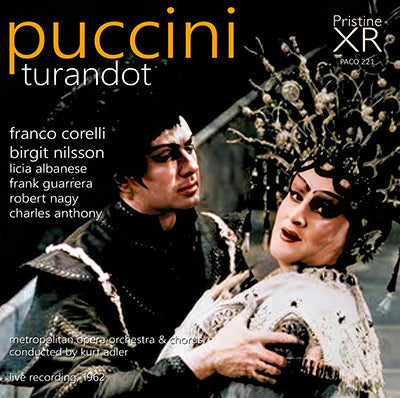
Turandot from the Met with Nilsson and Corelli

La principessa Turandot – Birgit Nilsson (soprano)
Calaf – Franco Corelli (tenor)
Liù – Licia Albanese (soprano)
Ping – Frank Guarrera (baritone)
Pang – Robert Nagy (tenor)
Pong – Charles Anthony (tenor)
Timur: Ezio Flagello (bass)
L’imperatore Altoum – Alessio De Paolis (tenor)
Un mandarino – Calvin Marsh (baritone)
Chorus and Orchestra of the Metropolitan Opera/Kurt Adler
rec. live radio broadcast, 24 February 1962, Metropolitan Opera House, New York City, USA

Well, let’s get this straight. This is an exciting performance of Puccini’s last opera, which puts you in a good seat at the old Metropolitan Opera House on a night when two of its greatest stars were singing two of their greatest roles. You can sense the excitement in the house from the moment the radio announcer, Milton Cross, introduces the opera with the words, “We’ll have the loud, crashing chords, then the curtain will open on the walls of the oriental Imperial palace of Peking.” Indeed the set is loudly applauded by the audience.

After the excitement of those opening chords and the chorus which follows, it is something of a disappointment to be confronted with the Liu of Licia Albanese, who was approaching 53, but quite frankly sounds even older. She compensates by loudly over-singing and over-emoting, and I derived very little pleasure from her performance. Her days at the Met were evidently numbered and she left the company in 1966, following a dispute with Sir Rudolf Bing.

For the rest, we have a sonorous Timur from Ezio Flagello, but the Ping, Pang and Pong tend to over-characterise their music and consequently I found their scenes irritating, as I often do.

However, the main reason for hearing this set remains the splendid singing of Nilsson and, especially Corelli. I am not one of those who think Corelli can do no wrong, but in the right role, and Calaf is undoubtedly the right role for him, he is unbeatable. First of all, there is the sheer splendour of that sound, the thrill of his top notes, which he can fine down to almost a whisper in places. He is absolutely thrilling and the audience go wild after Nessun dorma, with Adler abruptly stopping the orchestral postlude until the pandemonium has died down.

So too, of course, is Nilsson, throwing out those top notes like laser beams. The punishing tessitura holds no terrors for her at all and it is all very exciting, if not particularly subtle. Nor is the conducting of Kurt Adler, for that matter, but he certainly knows how to whip up the excitement.

According to Lee Denham in his exhaustive survey of the opera, there are, or have been, available seven other recordings featuring Nilsson, three of them with Corelli, so how necessary is this particular recording? I’m pleased to have heard it, but I’m not sure I’d want it as my one representation of Nilsson and Corelli in the opera. For that, I’d probably stick with the EMI recording under Molinari-Pradelli, which also has the benefit of including the Act III aria Del primo pianto, which is omitted from all Nilsson’s live accounts. It also has the benefit of the young Renata Scotto as Liu.

I would also not want to be without the Mehta recording with Sutherland, Pavarotti and Caballé, nor the Serafin with Callas, Fernandi and Schwarzkopf, but this one is a great reminder of a thrilling afternoon at the old Met.

Callas’s Studio La Traviata

81bx7aswvql-_sl1500_

Recorded September 1953, Auditorium RAI, Turin

Producer & Balance Engineer: Unknown

In one sense it’s a shame this Cetra recording of La Traviata was ever made. Had it not been, Callas would have been the Violetta on the Serafin La Scala recording with Di Stefano and Gobbi instead of Stella. Her contract stipulated that she could not re-record the role for 5 years. Legge presumably felt he couldn’t wait any longer to add a recording of such a central Italian classic to his catalogue.

Whatever the reasons, Callas was furious with Legge for engaging Stella and with Serafin for conducting it without her. For a while she and Serafin didn’t speak and he is notably absent from her recording schedule for the following year, 1956.

In retrospect maybe Legge should have waited till Callas was free to record Violetta again in 1958, the year of Callas’s most searchingly complex stage performances in the role (Lisbon and London). Had he done so EMI would no doubt have had the best-selling La Traviata of all time. As it is, the Stella recording was never a big seller, and only received a CD issue, when Testament unearthed it some years ago. Bad call, Walter.

Of all the roles in Callas’s repertoire, it was Violetta that went through the greatest transformation from her debut in the role in 1950, through the famous Visconti production at La Scala in 1955 to those last, movingly poetic performances in 1958 in Lisbon and London. It was the role she sang most often after Norma, and the role she most often considered for a comeback. There were discussions of a recording for EMI even as late as 1969, when, vocally, it would have been out of the question. Callas considered it very much her role, that of the woman who gave up everything for love. Maybe there was a parallel here with her own life. Didn’t she give up everything for love?

This recording of La Traviata was the first one I owned and the first of her Violettas I heard. It wasn’t that easy to get hold of, and my copy was a reissue on Pye Ember. I had no idea of the existence of any of the live recordings, and, had I never heard any of them, I would no doubt have been happy enough with her Violetta, as recorded here, though not necessarily with its surroundings. Compared to her EMI releases, this is a decidedly provincial affair. Santini’s conducting is leaden and neither Albanese as Alfredo nor Savarese as Germont are in the first rank. But at least we have Callas, and, if not as subtle or as heart-rending as she was to become, she is still a great Violetta, and still better than anyone else in the role.

The demands of the first act are more easily encompassed here than they were to become in later performances, though the top Cs in Sempre libera seem slightly tense, as does the concluding Eb. Still it’s freer and more open here than it is in any of the later sets and scale passages are wonderfully fluid. She is tremendously affecting in the duet with Germont, and fails here only in comparison to her later self. Other than this, her traversal of the role is not as complete as it is later to become. There are plenty of affecting moments to be sure, some in the duet with Germont, (the desperation with which she sings Non sapete, for instance) and especially the farewell to Alfredo with the lead up to Amami, Alfredo which seethes with that intensity so peculiar to her. In the second scene the great arching phrase, Che fia? Morir mi sento is too much of an outward sentiment as is Alfredo, Alfredo, di questo core, beautifully though they are sung.

Act III has its moments too. Addio del passato ends on a much more secure pianissimo high A than we get at Covent Garden, but how much more moving is that thread of tone with which she ends the aria in London. Parigi o cara is saddled with  Santini’s leaden conducting, but Gran Dio morir si giovane strikes the right note of despair and Prendi quest’e l’immagine is eloquently moving, if not so eloquent as it was to become.

In short, if no other recording of Callas as Violetta existed, this would be my first choice for the opera. But the fact of the matter is that by 1958, she had refined her interpretation so much that this 1953 performance seems unfinished beside it, almost like a rehearsal for the main event.

Furthermore, in both Lisbon and London, she has a better supporting cast and conductors, and the sound, in London at least, is excellent. I was pleased to hear this performance again, and delighted to have it once more in my collection. Callas’s Violetta, in any of its incarnations is a major achievement after all, but I know it is still to Covent Garden that I will most often return.

I might just add that Warner have done wonders with the sound compared to what I remember of my rather muddy Pye Ember LP version.