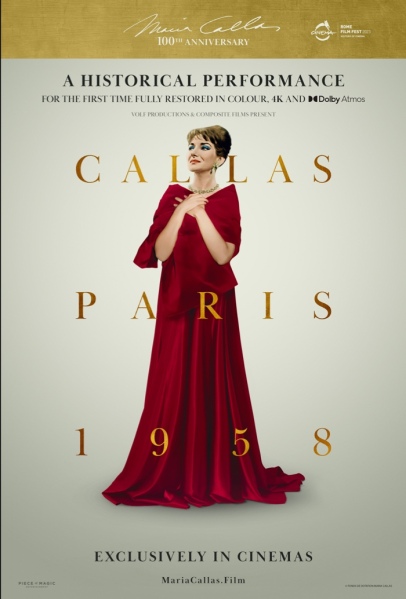
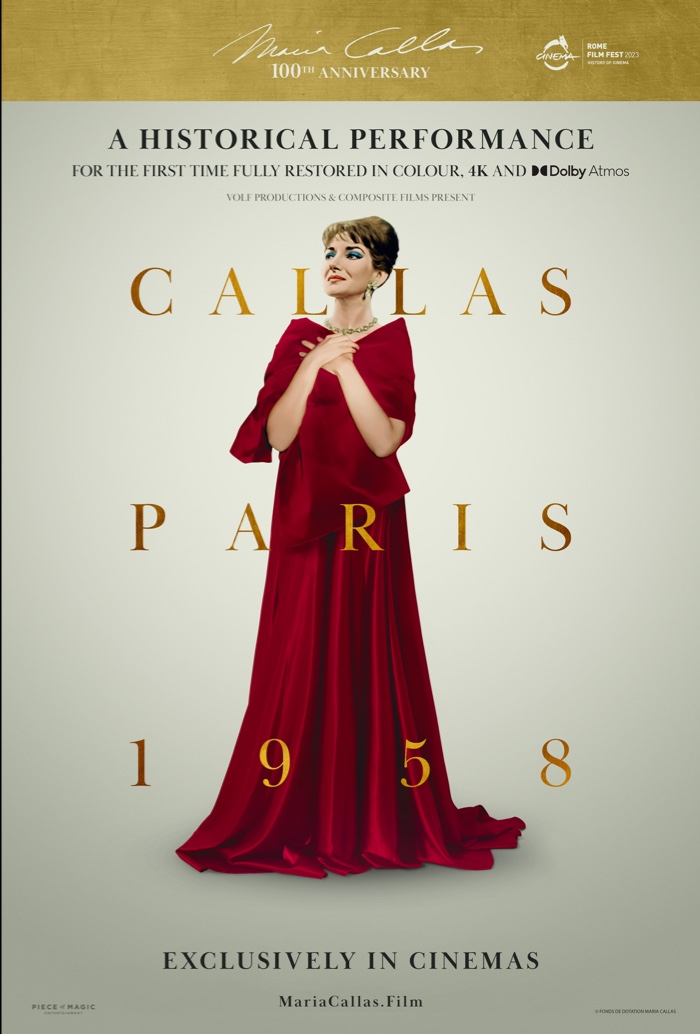
This newly restored film of the famous Paris Gala Concert is playing in cinemas around the world over the next couple of months and I caught up with at the weekend.
First a word about the provenance of the present release. In the words of the producer, Tom Volf,
the newly discovered 16 mm reels were those belonging to Callas herself, most probably brought by her & Meneghini from Paris; Having worked with the copies from INA (Institut national de l’audiovisuel) for Maria by Callas, when I found those reels (truly in a basement in Athens, kept for years by friends of Callas in boxes with other reels & tapes belonging to her – now all in Paris under the Callas Foundation) I immediately compared them to the INA versions, not believing myself that those ‘other’ 16 mm reels could be better than those preserved by INA, and to my astonishment they were indeed. Comparing the two sources side by side there was no doubt that the newly found ones were actually the original ones whilst those kept by INA were 16 mm copies, called in French “internégatif” a method commonly used in the late 50s and 60s before magnetic tapes. Therefore, what you will see in the upcoming film is as close as it gets to the original footage and the original performance. I have chosen to partner with the same team that undertook the colourisations for Maria by Callas, after I undertook myself for the newly found original reels to be digitised in 4K using the latest technologies available. The colorisation process took nearly two years as it was done frame by frame and based on all original colour photographs in our archives, plus first hand testimonies of people who had attended (some of them are still alive fortunately). The result intended was for the audiences of 2023 to be immersed in that unique evening and to see it with their own eyes as if they were there – and as we see in colour in real life, this was the reason for undertaking this challenging work, with, I believe, an astonishing result.
Certainly I am happy to report that it looks a lot better than any release I have seen up to this date. Long shots are still a little blurry but close-ups come up with a new clarity that has to be seen to be believed and it was quite a thrill to see Callas looking so fabulous up there on the big screen. The sound is astonishingly clear as well, though I’m willing to bet that some of her more piercing high notes were less so in the theatre. The colourisation was, for the most part, subtly and beautifully done, but I do question whether her eyeshadow would have been quite that shade of bright blue. What is remarkable to see in close-up is her concentration, her intensity and those eyes….! So expressive. At no point was she just a singer singing an aria. Whether in the concert of the first half or in the fully staged Tosca of the second part, she was always completely inside the character she was portraying.
In places you can tell that the concert was hastily put together and sketchily rehearsed. Apparently when Callas arrived at the first rehearsal, the scene was quite chaotic with nobody taking charge of proceedings. She quickly put Gobbi in charge and he basically directed the whole thing. Still, he couldn’t prevent a wong entry by the chorus in Casta diva, which Callas corrects herself with an imperious gesture of her right hand. She was not in her best voice and in the Trovatore the top notes are a little strained and tense. Still, this strikes me as the most impressive section of this first half, her phrasing wonderfuly elastic and her sense of Verdian style unparalleled. She moves very little, but when she does, such as a sudden turn of her head when she hears the monks singing, she immediately arrests attention and her eyes are unforgettable.
This first half ends with a wonderfully characterful Rosina, singing Una voce poco from Il Barbiere di Siviglia. The explosive way she sings the single word ma and the expression that goes with it says more about the character than many a singer manages in the whole aria. This Rosina is sweet and gentle, but a real viper when crossed. She is more relaxed here too and her smile when she acknowledges the tumultuous reception at the end, positively radiant.
When it comes to the second act of Tosca, I will say straight away that I prefer the Covent Garden performance of 1964. She may be in better voice here in 1958, but the Covent Garden performance was from a thoroughly rehearsed and meticulously prepared production where this one was thrown together specifically for this event. Gobbi obviously did what he could to direct in the time available to them, but the acting and rapport between these two singers reaches even greater heights at Covent Garden. Vissi d’arte loses some of its impact by the fact that she starts it upstage and the camera doesn’t hone in on her as it does at Covent Garden. Though I thought she looked very beautiful in some of the close-ups, she is more becomingly costumed at Covent Garden too. Albert Lance is actually quite impressive vocally, as he is off stage in the Trovatore, but he overacts like mad.
The cinema, when I went, was depressingly empty and I was one of about a dozen in the auditorium, most, like me, sitting on their own and most of a similar age. I found that rather sad.
A friend of mine went to see it in a cinema near where she lives. She told me she has had had a fascination with Callas since childhood, though she had never seen the concert in any form before. She was totally knocked out so I guess you could say the film certainly makes its impact.
I assume it will come out on DVD or BluRay at some point, but if you can get to see it in the cinema, I would definitely go. It is a fitting tribute on her 100th birthday and we are lucky that it has now been made available to a wider public in much improved sound and vision.
What next? Dare we hope that there is a pristine copy of the Covent Garden Tosca Act II locked away in the vaults somewhere?
For showings, check out https://mariacallas.film/
 Philip's Assortment Box