Callas at La Scala

51fx5yefo1l

Recorded 9-12 July 1955, Teatro alla Scala, Milan

Producer: Walter Jellinek, Balance Engineer: Robert Beckett

Though recorded in 1955, release of this disc was delayed until 1958. Callas did not approve the arias from La Sonnambula for release and, when the recital was finally issued, it was made up with arias from the complete sets of I Puritani and La Sonnambula. EMI did eventually issue the Sonnambula arias, but not until 1978, on an LP called The Legend which included other unreleased material.

It’s true, there is a slightly studied air about the performances of them (and a chorus would no doubt have done much to enliven the proceedings), but her singing is unfailingly lovely. One misses that stunning cadenza between the two verses of Ah non giunge, with its stupendous ascent to a high Eb, which we get in both the studio and Cologne performances, and both cabalettas are over simplified, completely free of the flights of fancy Bernstein encouraged her to indulge in at La Scala. Serafin had apparently refused to let her do them. Maybe that is the reason she eventually rejected them. I’m glad I’ve heard them, but her Amina is better represented in the various live performances and the complete studio performance.

The Medea and La Vestale arias are more successful. Medea, of course, became one of her greatest stage successes. The opera was almost completely unknown when she first sang it in Florence in 1953 under Gui, but such was her success in the role that La Scala scotched plans for a revival of Scarlatti’s Mitridate Eupatore later that year and replaced it with the Cherubini opera.  Callas’s singing of Dei tuoi figli la madre abounds in contrasts, reminding us that this is an appeal to Giasone. Callas reminds us that it is love, not revenge, that brings Medea to Corinth; notable here the softening of her tone at the repeated pleas of Torna a me, the pain in the cries of Crudel.

The arias from La Vestale are reminders of her one traversal of the role of Giulia at La Scala in 1954, in a stunning production by Visconti, which marked the emergence of the new, slim Callas, and the start of a whole new era, which resulted in the acclaimed Visconti productions of La Traviata, La Sonnambula and Anna Bolena.  Tu che invoco is notable for its long legato line, and the intensity she brings to the turbulent closing section, where her voice rides the orchestra with power to spare. O nume tutelar brings back memories of Ponselle, but Callas in no ways suffers by the comparison, her legato as usual superb, and the aria sung with a classical poise and sure sense of the long line. O caro ogetto has the same virtues.

There exists a complete recording of that La Scala La Vestale, but it is in such wretched sound, that this recital is valuable for Giulia’s arias alone. Her Medea and Amina are better represented elsewhere.
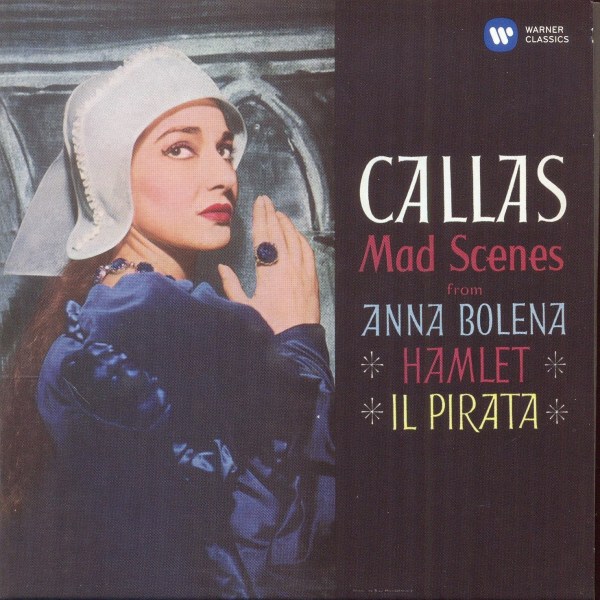
Callas Mad Scenes

917ij8qd0vl-_sl1500_

Recorded 24-25 September 1958, Kingsway Hall, London

Producer: Walter Legge, Balance Engineer: Harold Davidson

I’m going to stick my neck out and say that this is the best recital record Callas ever recorded, and by default one of the classic recital discs of all time. The 1954 Puccini disc and Lyric and Coloratura will find her in better voice, but this one sums up more than any other her greatness, her ability to bring alive music that can seem formulaic, and even plain dull in the hands of lesser artists.

I know I’ve said this elsewhere, but her singing has an improvisatory air about it, almost as if she is extemporising on the spot; how she achieves this whilst closely adhering to what is on the printed page is a mystery beyond solving. In the Anna Bolena finale, the recitative alone provides a lesson in how to bind together disparate thoughts and ideas. She brilliantly conveys Anna’s drifting mental state, whilst still making musical sense of the phrases and the long line. We can only imagine what she might have achieved in Monteverdi’s recitativo cantavo.

Once into the first aria, Al dolce guidami, her voice takes on a disembodied sound, as if the singing is coming from the far recesses of her soul. Her legato is as usual superb, her breath control stupendous, those final melismas spun out to the most heavenly lengths.  In the cabaletta Coppia iniqua, her voice takes on a majestic power, and she manages the rising set of trills with more force than anyone (Suliotis doesn’t even attempt them).

In the magnificent Final Scene from Il Pirata, she traces a long Bellinian line second to none; spinning out the delicate tracery of the decorations from Digli ah digli che respiri  onwards with magical fluency. A complete contrast is afforded when she rears back with the words Qual suono ferale, before launching into the thrillingly exciting cabaletta.

Ophelia’s scene from Hamlet is quite different. There is no formal recitative, aria, recitative, cabaletta construction. The scene is more a series of arioso segments interspersed with recitative and can often sound disjointed as a result. Callas binds together its disparate elements with masterly ease. Her voice is lighter here than in either the Bellini or Donizetti, and though the very upper reaches tax her somewhat, she sings with delicacy and consummate skill. The switch from Italian to French causes her no problems at all, her enunciation of the French text admirably clear. Yet again every fleeting expression, every change of thought is mirrored in her voice.

A listening companion of the eminent vocal critic John Steane once said to him regarding Callas, “Of course you had to see her,” to which he replied, “Oh, but I can, and I do.” This was her genius, amply displayed in this recital; the ability to make us see as well as hear.

I did try to make sound comparisons with my other CD issues of this recital, but, as usual, I had little sympathy for the task. Callas drew me in and all I wanted to do was listen. Without making direct comparisons then, I can only state that the sound here is very satisfactory, with plenty of space round the voice.

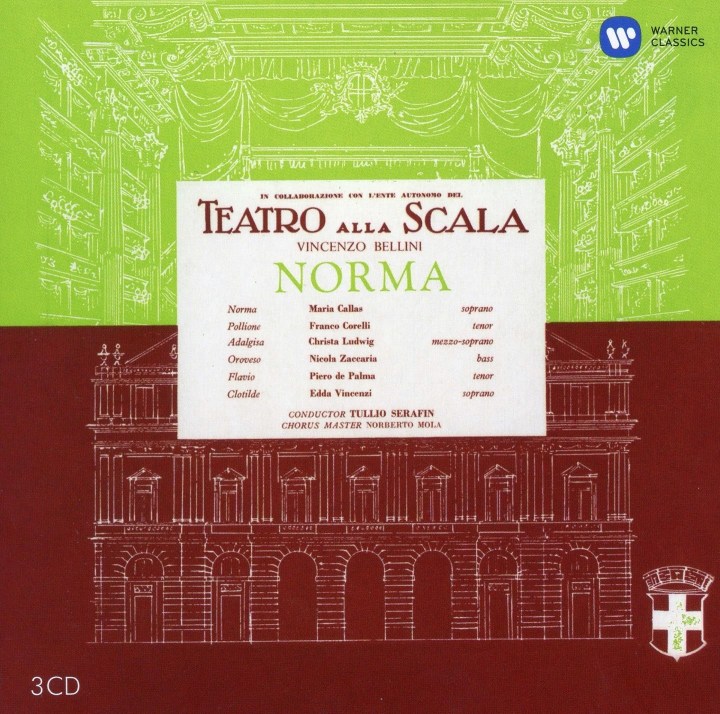
Callas’s 1960 Studio Norma

91pj158binl-_sl1500_

Recorded 5-12 September 1960, Teatra alla Scala, Milan

Producers: Walter Legge & Walter Jellineck, Balance Engineer: Robert Gooch

This was actually the first opera set I ever owned, and, so it comes with a host of memories. I was only 18. Why Norma for a first opera, you might ask. Well I had recently discovered Callas, and at that time very little of her recorded repertoire was available. I knew that Norma was considered her greatest role, so I thought it would be a good place to start. Collecting opera was expensive in those days, and my older brother, who was working by this time, bought the set for me for Christmas. I was unbelievably excited, my excitement only slightly tempered by the discovery that no libretto was included, only a synopsis, and that I would have to send off for it, not of course that I waited for its arrival before sampling the set.

It being my one and only opera set for a good few months, I got to know the opera pretty well, and of course Callas’s unique inflections will for ever be part of that knowledge. Since then of course, I have heard a fair amount of other Normas, Sutherland, Caballe, Eaglen, Bartoli (please, never again), Sass live at Covent Garden (disastrous) and plenty more by Callas herself; the live 1952 Covent Garden, the 1954 studio, the 1955 Rome broadcast and, best of all, the live 1955 La Scala, as well as excerpts from many others, right up to her final performances in the role in Paris in 1964.

So how does it hold up? Well, pretty well actually. True, notes above the stave have taken on a metallic edge, and they don’t always fall easily on the ear, but the middle and lower timbres have a new found beauty, and a characterisation that was always complex and multi-faceted has taken on an even greater depth, parts of it voiced more movingly here than anywhere else.

There are other gains too. The cast here is a vast improvement on the earlier studio one, Corelli in particular being a shining presence. Fillipeschi was a liability on the earlier set, but, whilst not quite a paragon, and chary of some of the coloratura in his role (Serafin making a further cut in the great In mia man duet to accommodate his lack of flexibility), Corelli’s is a noble presence, and his clarion voice is ample compensation. Zaccaria may be less authoritative than the woolly voiced Rossi-Lemeni, but his tones are distinctly more buttery. Ludwig is an unexpected piece of casting, but she too is an improvement on Stignani, who, great singer though she was, was beginning to sound a bit over the hill by the time of the first Callas recording (she was 50 to Callas’s 30). Ludwig sounds, as she should, like the younger woman. Her coloratura isn’t always as accurate as one would like, certainly no match for Callas, but she sings most sympathetically in duet with her older colleague, and Mira o Norma is, for me, one of the greatest performances on disc. After Ludwig states the main theme, Callas comes in quietly almost imperceptibly and at a slightly slower tempo with an unbearably moving Ah perche, perche, her voice taking on a disembodied pathetic beauty. When Ludwig joins her for the section in thirds, she perfectly matches Callas’s tone on her first note, before Callas joins her in harmony, a real example of artists listening to each other in a sense of true collaboration.

One should I suppose mention the losses from the earlier recording. Yes, some of Callas’s top notes are shrill, and we lose some of the barnstorming heroics that were a part of Callas’s Norma right up to 1955. This Norma is more feminine, more vulnerable, if you like. How much this had to do with interpretive development, and how much with declining vocal resources is a moot point, but there is no doubt Callas is still a great singer, doing the best she can with what she has. Some sections are more moving here than in any of her other performances. I’ve already singled out Mira o Norma but the earlier duet is its equal, Callas wistfully recalling her own awakening to first love.

The beginning of Act II always brought out the best in her, and here she is sublime. Dormono entrambi is an unusual piece which alternates passages of recitative with arioso, rather like Rigoletto’s Pari siamo. Callas draws on all the colours in her palette to express Norma’s contrasting emotions. You can almost feel the chill that comes over her at un gel me prende e in fronte si solleva il crin followed by the choked emotion of I figli uccidi! The arioso of Teneri figli is couched in a tone of infinite, poignant sadness, but then her tone hardens with her resolve at Di Pollion son figli, before, with a cry she drops the knife (and we can almost hear the precise moment), crying out Ah no, son miei figli! Operatic singing and acting on the highest level.

Serafin’s conducting is much as it was in the first set. He has the virtue of not conducting the opera as if it were Verdi, as so many do. Sometimes I’d like him to get a move on a bit, but his pacing of the final two duets (one in public, one in private) is superb, and he perfectly judges the climaxes in the Grand Finale, one of the greatest in all opera.

I’ve always found it difficult to choose between Callas’s studio recordings of Norma. I wouldn’t want to be without either. Nor would I want to be without her 1955 live La Scala account, with Del Monaco and Simionato, which is where voice and art find their greatest equilibrium. One thing is for sure, Callas remains the quintessential Norma. No singer has yet challenged her hegemony in the role.