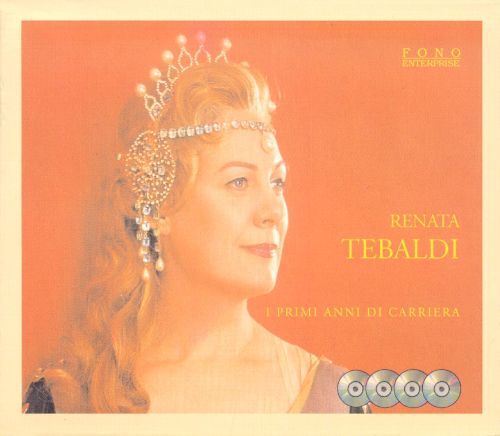
This four disc set is of recordings made in the 1940s and early 1950s, when Tebaldi was in her twenties. It is a mixture of live and studio recordings, so sound quality varies quite a bit. It is also a convenient grouping together of four different discs issued by Fonit Cetra in 2002, which no doubt explains why we get so many different performances of the same aria. Given that there is little difference between them, you may decide you don’t need to listen to four different performances of La mamma morta and of Desdemona’s Willow Song.
And of course the first thing we need to say is that it was an extraordnarily beautiful voice, even throughout its range, firm and rich, her diction admirably clear, though, even at the beginning the very top could sound strained and off pitch. The top C climax to her 1950 Cetra studio recording of Aida’s O patria mia is hard won and slightly under the note and the voice’s greatest beauty lies in the middle register, though many of today’s sopranos would also kill for the richness down below. Nor is she an unfeeling performer, though, at this stage in her career, it can tempt her into excess, especially when singing live, and she tends to sound lacrymose rather than truly moving. She goes way over the top in Desdemona’s Willow Song, and she is much more restrained, and consequently more moving, in the Decca Karajan recording. The other thing to say about Tebaldi is that, however beautiful the voice, however firm the delivery, however musical her singing, her performances rarely stay in the memory, nor does she ever really light up a phrase or a line the way others can. Performances of some of this same music, by such as Muzio, Callas, Caballé, De Los Angeles and Schwarzkopf resonate in my mind’s ear, and I can often recall individual details. With Tebaldi I never can. I can recall the sound of the voice, but little that is specific to the music she is singing. In these early performances, I found that she often over-characterises the music, introducing sobs and emphases which detract from the beauty of the sound, rather than make it more dramatic. It is somewhat akin to watching a hammy actor.
A few specifics then about the discs themselves. I got muddled and listened to them in reverse order. Disc 4 is entitled Gli Inediti, and is presumably of previously unissued recordings. In concert she sings the Countess’s Porgi amor but, though more suited to the character than she is to Susanna, who puts in an appearance on Disc 3, Mozart is not really her métier. The excerpts from a 1949 performance of Andrea Chénier wih Del Monaco are prime examples of that hamminess I alluded to, though all the singers go way over the top. The audience lap it up, so they no doubt give them what they want. A poised 1949 performance of the Ave Maria from Otello is ruined by a surfeit of little sobs, but she gives us a lovely performance of Louise’s Depuis le jour (in Italian). It lacks Callas’s quiet intensity and mounting rapture, but is much more securely sung and works well on its own terms. The disc closes with a small piece of history; a 1945 performance of the love duet from Otello, with the then almost sixty year old Francesco Merli, though recording here is at its dimmest. Nevertheless it affords us a glimpse of the great tenor in one of his most famous roles.
Disc 3 covers studio recordings made for Decca and Fonit Cetra in 1949 and 1950, arias from Aida, Madama Butterfly, Faust, Manon Lescaut, Tosca, Il Trovatore, La Traviata, Otello, La Boheme, Mefistofele, La Wally, Andrea Chénier and, most surprisingly Susanna’s Deh vieni from Le Nozze di Figaro, though she makes a very heavyweight Susanna, and this is the least successful item on the first disc. Recorded sound here is fine and there is no doubt that this is an extraordinary voice the like of which we don’t hear anymore, and perhaps haven’t since. Her legato is mostly superb as is her diction. On the other hand, as one aria follows another, we don’t really get a gallery of different characters. Her Aida isn’t really very different from her Butterfly, her Manon no different from her Mimi, and, in an attempt to be dramatic, she often over-emotes. The reading of the letter before Addio del passato is hopelessly melodramatic and she ends the aria forte rather than in the fil di voce Verdi asks for.
The prize of Disc 2, entitled La nascita d’una leggenda, is some extended excerpts from a 1951 concert performance of Verdi’s Giovanna d’Arco with Carlo Bergonzi and Rolando Panerai. Though she is taxed by some of the coloratura, and she tends to aspirate when the music asks her to move a little faster, the role suits her well. Also excellent are the two extracts from a 1950 performance of the Verdi Requiem under Toscanini, with Giacinto Pradelli, Cloe Elmo and Cesare Siepi. It is somewhat dimly recorded, but you can hear how fine she was in this work. Why Decca never recorded her in it is a mystery to me. A welcome surprise is Elisabeth’s Dich, teure Halle (in Italian) from Tannhäuser. It is also good to hear the young Di Stefano in a 1950 concert performance of the Act I duet from Madama Butterfly. The concert also included Margherita’s L’altra notte in fondo al mare from Mefistiofele. In both the aria and the duet, Tebaldi oversings and overacts and her singing as Butterfly is so powerful that she sounds more like a Tosca or Minnie to me. Many will respond to the beauty of the voice, but she doesn’t conjure up an image of Butterfly for me at least.
The first disc pits Tebaldi against her teacher, Carmen Melis. Excerpts from Tebaldi’s first recordings of La Boheme and Madama Butterfly under Alberto Erede and arias from Manon Lescaut and Tosca. Many will no doubt revel in the glory of that voice filling out Puccini’s wonderful melodies, but for me she too often oversings and the finale to La Boheme, which is given in its entirety has both Tebaldi and Giacinto Pradelli over-emoting like mad. The love duet from Madama Butterfly with Giuseppe Campora likewise has no sense of the young girl’s gradual awakening to love and sounds as if it could have been lifted from Tosca. Melis is caught in excerpts from Tosca and Massenet’s Manon. She is a singer who is new to me, and I must say I found her very impressive, though the top C at the line Io quella lama gli piantai nel cor is a little precarious, and she takes the upper option on the word cor. The Manon excerpt is Manon’s N’est-ce plus ma main (in Italian) from the duet with Des Grieux, and she is wonderfully seductive and persuasive.
Tebaldi is a central singer in that she demonstrates most of the virtues of good singing. The voice is a beautiful one, the line always firmly held, her legato generally excellent. Her only faults are a lack of a trill and clumsy execution of fast moving music (hardly necessary in most of the music she sang) and a slightly short top. (I remember that in her interview with Luca Rasponi for the book The Last of the Prima Donnas, she bemoans the ever rising pitch of modern orcehstras, which must have been a nightmare for her.) My preferences are well know, and I prefer singers who have something more specific to say about the music they assay, but the set is one I still enjoy dipping into from time to time.
 Philip's Assortment Box