Fatma Said – Lieder

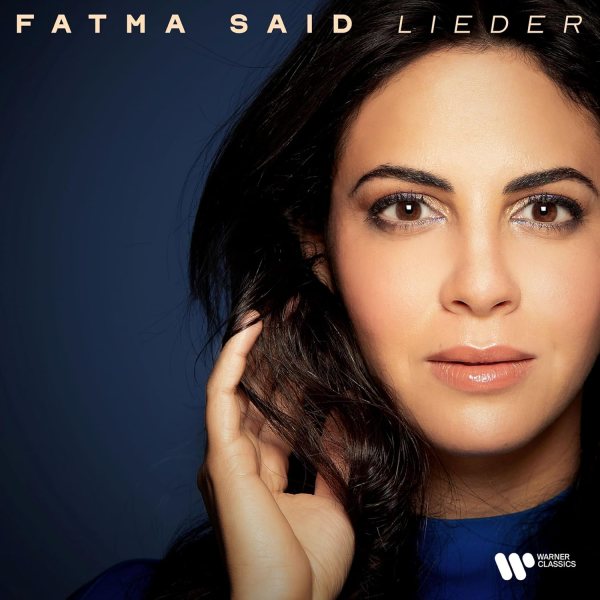
Fatma Said follows up her award winning debut recital, El Nour, and her equally successful second album, Kaleidoscope, with a more conventional album of German Lieder, except that with this gifted artist, it isn’t quite that simple. For a start, she has collaborated with an array of different musicians, bringing in clarinettist Sabine Meyer for Schubert’s Der Hirt auf dem Felsen, the men’s choir, Walhalla zum Seidlwirt, for his Ständchen, harpist Anneleen Lenaerts for four of the Brahms songs, the Quator Arod for Brahms’s Ophelia-Lieder, baritone Huw Montague Rendall for some duets and three different pianists in Malcolm Martineau, Yonathan Cohen and Joseph Middleton. In the notes accompanying the disc, Said says that all of these artists were friends or became friends during the sessions, and, in a positive way it would seem so, as there is a real sense of joy and discovery in the music making.

In a disc of so many delights, it is difficult to highlight specific performances, and for once I found myself not making comparisons with other singers, so compelling is the artistry on display here. Said has a surpassingly beautiful voice, but she uses it for expressive ends and is not afraid to make the occasional ugly sound, as in the vividly characterised Hexenlied by Mendlessohn, and in Schubert’s Der Zwerg. The nocturne Ständchen is delivered as a dramatic dialogue between Said and the men’s chorus, with a touch of breathless excitement, which perfectly captures the meaning of the words, and the words are evidently very important to Said. Her diction is excellent, and indeed, in the notes accompanying the disc, Said states that she wanted there to be a strong emphasis on the text. This she has achieved, whilst maintaining a lovely legato line.

The harp accompaniment brings a touch of delicacy to the Brahms songs and his Ophelia- Lieder are performed in Aribert Reimann’s arrangement for string quartet, which somehow contrives to make the songs sound more archaic. Sabine Meyer plays with great beauty of tone in Der Hirt auf dem Felsen, which here receives a performance of ineffable longing, which is totally dispelled in the joyful final measures.

I can’t close without mentioning the terrific contributions of her three pianists, Malcolm Martineau, Yonatan Cohen and Joseph Middleton, nor Huw Monatgue Rendall’s wonderful contribution to the duets, his voice blending beautifully with Said’s, particularly in the final song on the disc, Schumann’s In der Nacht, where his mellifluous tones blend beautifully with Said’s – a fitting end to a disc that had me spellbound throughout.

Highly recommended and, I know it’s early days yet, but likely to be one of my discs of the year.

Eilika Wünsch – Romantic Songs

71okpmqmsql._ac_sl1425_

There are times when one wonders how a record came to be released.

According to the accompanying notes, the premise for this album would appear to be “a completely new approach to our lieder recital repertoire … in which voice and piano are enhanced by another melody instrument”. Whether this enhancement is either desirable or necessary is a moot point, but I suppose the idea of the cello taking over the second vocal line in the adaptation of duets is one solution to the non-availability of a second singer. The accompanying notes would also seem to suggest that these arrangements improve in some way on the originals, even of the two songs from Strauss’s Vier letzte Lieder, which of course were written for full orchestra.  I can assure you they do not.

However, the greatest impediment to enjoyment is not the arrangements themselves but the solo singer. According to the biographical notes, Eilika Wünsch has been active since around 2010, when she worked with Jörg Demus. She would appear to have a fairly extensive discography, though I can’t find a single review on the internet for any of her discs, or for any of her public appearances. We are also told that she has sung the roles of Butterfly, Konstanze, Donna Anna, Violetta, Gilda and the Queen of the Night, about all of which I am faintly incredulous.  The first few notes of the opening song, Nacht und Träume, are sung in a white, vibrato-less tone, but thereafter any single sustained note emerges unfocused and unsteady. She struggles so much with the execution of the notes that any attempt at interpretation is completely absent. The cover photo shows us an attractive young woman, but the sounds coming from the speakers are those of a (very) old soprano. I am sorry to be so negative, but I really can’t find anything positive to say about this recital. Listening all the way to the end proved quite a trial, but listen I did, right through to the final song, which is a vocalise arrangement of Schubert’s famous Impromptu, Op.90, no.3. The arrangement takes her well up above the stave, where the sound that emerges is somewhere between a whistle and a theremin and quite unpleasant – to my ears at least.

This is one of those cases where comparisons are irrelevant. One to be avoided, I’m afraid.

Contents, in case anyone is interested.

  1. Schubert: Nacht und Träume
  2. Brahms: Wie Melodien zieht es mir
  3. Reger: Nachts
  4. Schumann: Wenn ich ein Vöglein wär
  5. Brahms: Am Strande
  6. Schumann: In der Nacht
  7. Liszt: O komm im Traum
  8. R. Strauss: Im Abendnrot
  9. Reger: Abendlied
  10. R. Strauss: Beim Schlafengehen
  11. Schumann: Mondnacht
  12. Schubert: Auf dem Strom
  13. Impormpti, Op. 90 no. 3 (as Vocalise)

To My Friends – Elisabeth Schwarzkopf

odktndm3nc5qcgvn

So now I come to the end, the very last recording Schwarzkopf made, not, as it happens, for EMI, but for Decca. Walter Legge’s rift with EMI was now complete and Ray Minshull of Decca approached Legge, saying he would like at least one Schwarzkopf recording in their catalogue. It was recorded at sessions in London and Vienna in 1977 and 1979, by which time, Schwarzkopf would have been 63.

It was called simply, To my friends., and Schwarzkopf had this to say about it, “In that there is already the excuse that it’s only for you who like me. Others may find great fault in it and rightly so, but maybe you like me enough to have it.”

Well I do like Mme Schwarzkopf and, having listened almost exclusively to her for the last month, I can safely say the overused description of her singing as ‘mannered’ has never been so far off the mark. What I do hear is a superior intelligence and musicality, allied to an attention to detail, which brings music alive in a way that other more penny plain interpretations do not. Very occasionallly, the intellect gets in the way of the song. One misses, for instance, the natural simplcity of, say, Elisabeth Schumann, but in Lieder, and in Wolf in particular. her quest to find just the right inflections is what makes me keep coiming back. It’s also interesting to note how her interpretations can vary from one performance to another.

The voice on this last record is certainly not the voice of a young woman, but it remains within its slightly reduced range and dynamic, a voice mercifully free of wobble or excessive vibrato. It may not be the disc I would choose to demonstrate Schwarzkopf at her greatest, but I can safely say I am very pleased to have it in my collection as a fitting end to a great career on disc. In songs by Wolf, Loewe, Grieg and Brahms, she still demonstrates her ability to embrace and convey a wide range of emotions.

The record was completed in January 1979 and she gave her last performance at a recital in Zurich the following March. Three days later, Legge died and she abruptly cancelled all further engagements. The voice fell silent without Legge’s constant encouragement. ‘”You can do it, meine Schwatz, you can do it, you sing that – you’ll do it better.” He was wrong there, I wouldn’t have been better than people in full bloom of the voice. He thought there would be some moments which would be more memorable. But if you don’t have the voice you cannot put over what you would like to – you make ways round it technically, and by that time it has already vanished.’ Schwarzkopf was nothing if not pragmatic.

It was often said of her, disparagingly, that she was ‘her master’s voice.’ Maybe, in some ways she was. It was an extraordinary partnership and it is no wonder that the performance side of her life also ended with Legge’s death.

Maggie Teyte – The Singers

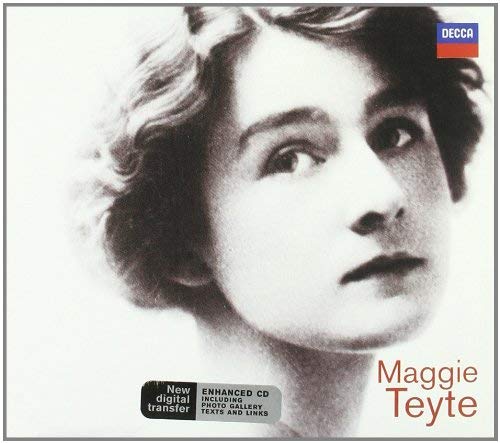
These recordings were all made in the 1930s and so pre-date the two disc set of French song I reviewed a few months ago here, with the second part of the disc being taken from a 1937 radio broadcast. One of the songs (Armstrong Gibbs’ The fields are full of summer still) was newly discovered in 2001 and first published on this CD.

We start with one of Dame Maggie’s most famous performances, that of Périchole’s Tu n’es pas beau, sung with great affection, a twinkle in the eye and with that wonderful dip into her inimitably glorious chest voice. Though a light soprano with pure, firm top notes, Teyte’s lower register was admirably rich and full in a manner we rarely hear today, more’s the pity. The orchestra here sounds like a palm court orchestra at a tea dance, but the singing is another matter entirely and alone well worth the price of the disc. The two excerpts from Messager’s Véronique, which follow are almost as good.

Teyte was particularly renowned for her interpretations of French song, but we are vouchsafed only two (very well known) songs from that field, Fauré’s Après un rêve and Hahn’s Si mes vers avaient des ailes. The Fauré is much better than the one on the French song disc mentioned above, where I felt she fussed with the song too much making it lose its natural flow, and the Hahn is as lovely as the later recording with Gerald Moore. These are followed by two Dvorak songs, Christina’s Lament, which turns out to be his Humoresque arranged for voice and piano, and the ubiquitous Songs my mother taught me, both beautifully sung.

These are followed by a group of songs from light musicals, mementoes of her days spent in British Music Hall. They may be musically slight, but Deep in my heart, dear from Romberg’s The Student Prince was actually one of Dame Maggie’s favourite recordings. It crests with a high B, which she thought the most beautiful note she had ever recorded. Certainly the note rings out clear and clean as a bell.

The lion’s share of the disc, however, is given over to a 1937 BBC broadcast recital, which couples popular songs by Schumann and Brahms to a group of English songs by turn of the century composers Quilter, Bridge, Delius, Armstrong Gibbs and (completely new to me) Amherst Webber and Graham Peel. As ever, the voice is bright and pure, her manner direct and disarming, her diction and intonation well-nigh perfect. Admittedly, there are aspects of her singing which some might find quaint and old fashioned today, but her technique is superb and her voice remained firm and clear well into her sixties.

Perhaps because of some of the material, this is not quite so recommendable as the EMI two disc set of French songs, but I would never want to be without it, if only for the wonderful aria from La Périchole.

Lorraine Hunt Lieberson – Songs by Mahler, Handel and Peter Lieberson


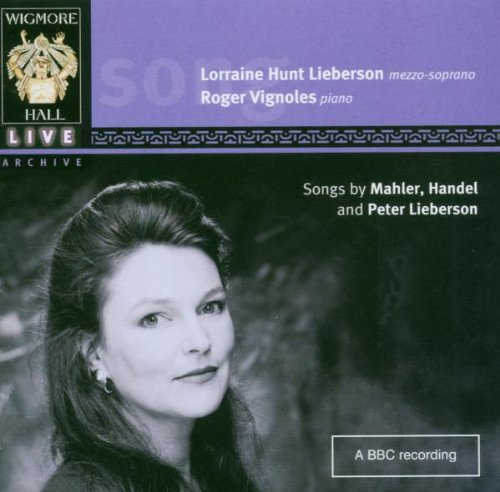
There are some singers whose emotional connection to the music they are singing is so complete, so all-embracing that such minor details as vocal technique and beauty of voice are completely forgotten. Not that either of those two qualities are in the least bit lacking here, but they don’t really register, so intense, so all-enveloping is the experience of listening.

Lorraine Hunt Lieberson was one such artist and, more than once during the course of this marvelous recital, she managed to reduce me to tears. In her voice, the act of singing becomes as natural as the act of speaking. There is no artifice, no show, just total commitment to the music and that rare gift of communication.

The disc starts with a highly personal and emotionally shattering performance of Mahler’s Rückert Lieder. I prefer Mahler’s orchestral version of these wonderful songs but even with piano accompaniment (wonderfully realised by Roger Vignoles here) I would place this performance with Janet Baker’s of the orchestral versions under Barbirolli as the pinnacle of Mahler interpretation. Indeed the desolation of Um MItternacht is utterly overwhelming and the performance of all the songs totally gripping, with the audience sitting in rapt silence.

The Handel items, though more theatrical, more outwardly dramatic, are no less sincere. She makes musical sense of the vocal leaps in Scherza infida and pours calming balm on the ears in As with rosy steps from Theodora, a reminder of her devastating Glyndeboure performances of Irene.

She married Peter Lieberson the year after this recital and she sings here two of his Rilke settings, written specifically for her as well as an aria from his opera Ashoka’s Dream, which she performed in Santa Fe the previous year. The lovely Rilke songs were recorded complete at the Ravenna Festival in 2004 but it is good to have this tantalising extract from Lieberson’s opera.

To close we have two encores, a stunningly heartfelt performance of the spiritual Deep River which became something of a Hunt Lieberon speciality and a radiantly ecstatic performance of Brahms’s Unbewegte laue Luft.

Hunt Lieberson died at the age of 52 when she was at the absolute height of her career, which makes every recording she made, most of them from live performances, absolutely essential. This one is no exception

The Fabulous Victoria De Los Angeles

41lkah6q4pl

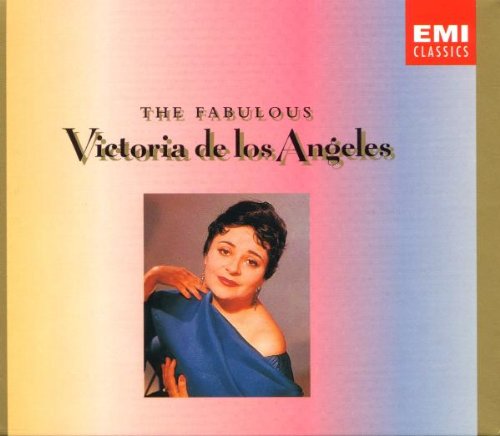
This well-filled four disc set was issued to time in with De Los Angeles’s seventieth birthday in 1993, when, incredibly, she was still active on the concert platform, having made her stage debut in 1941. I don’t know when she officially retired, but she died just over ten years later. The set dates from the good old days, when notes texts and translations were included. Not all of this material is that familiar, so they are absolutely essential. Nowadays you are lucky to even get a web link to them.

The set concentrates on the recital side of De Los Angeles’s career and all the recordings date from the 1960s and early 1970s, with two discs of song with orchestra and two with piano or, as in the case of Falla’s Psyché chamber ensemble.

Disc 1 covers French song with orchestra (though not her wonderful recording of Les Nuits d’Eté, which was recorded for RCA). We start with one of the most recommendable of all versions of Ravel’s Shéhérazade, in which she is a vivid narrator, taking an almost childlike pleasure in the sights she describes. In the Cinq Mélodies populaires grecques she is the epitome of a young village girl, whilst the Deux Mélodies hébraïques bring out a more seductive quality in her voice. Chausson’s Poème de l’amour et de la mer exposes the occasional fragility in the voice, but is still a beautiful performance.

Disc 2, which concentrates on Spanish song with orchestra, would probably be my favourite of the four. It almost exactly reproduces a disc called The Maiden and the Nightingale, released in EMI’s Great Recordings of the Century, though it omits that Granados title track. Favrouites here are the Montsalvatge Cinco canciones negras; wonderfully soothing in the Cancio de cuna para dormir a un negrito and irresistibly playful in the Yambambos of the Canto Negro. I also love Mompou’s El combat del Somni, especially the soulful Damunt de tu nomes los flors. Another joyful performance is Rodrigo’s De los alamos vengo, madre. We are reminded that De Los Angeles probably did more than any other singer to put Spanish song on the map.

Disc 3 brings us more French and Spanish repertoire, this time with piano accompaniment, or chamber ensemble as in Falla’s Psyché. Though her French isn’t entirely idiomatic, she is an ideal interpreter of Debussy, Ravel, Fauré and Hahn. The performance here of Falla’s Sietes canciones populares españolas, with Gonzalo Soriano at the piano, is not generally considered her best, and it is true she is not as fierily earthy as Conchita Supervia, but equally valid in its more playful style.

Disc 4 is more mixed, and presumably covers material likely to turn up in her recitals as openers or encores. I have always treasured her performances of Fauré’s Chanson d’amour, which is sung with a delightful smile in the voice, and her ideal performance of Clair de lune, which captures to perfection its ancien style, but includes a wonderful change of colour when the accompaniment switches to a more fluid figure at Au calme clair de lune. All the piano accompaniment on this disc is provided by Gerald Moore and it also includes a group of duets (from Purcell to Tchaikovsky) with Dietrich Fischer-Dieskau, finishing off with a couple of extracts from Moore’s farewell concert at the Royal Festival Hall, with Schwarzkopf joining the pair for Mozart’s La Partenza.

To get a fuller picture of this lovely artist, one would ideally want some representation of her operatic career, but this one captures well many elements of the recital side of her career. As in all such compilations, I might cavil at some of the choices, but the programme over the fours discs is varied and enjoyable, and De Los Angeles always brings her inimitable individual stamp to all she sings.