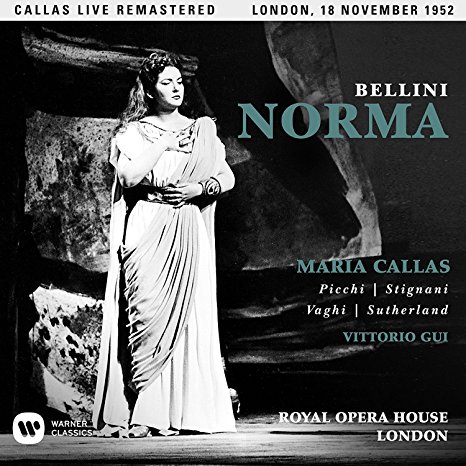
Callas sings Norma at Covent Garden 1952

81vXfqdoUFL._SX466_

This recording captures Callas’s debut before one of her most loyal audiences. She returned the following Coronation season, reprising the role of Norma and adding Aida and Leonora in Il Trovatore. She was back for Norma in 1957, then La Traviata in 1958,  Medea in 1959, and finally the legendary Zeffirelli production of Tosca in 1964 and 1965, her last ever performance on stage.

Callas sang Norma more than any other role, and is particularly associated with it and there are quite a few extant recordings of her singing it.. Aside from the studio recordings of 1954 and 1960, we have live performances from Mexico in 1950, Covent Garden in 1952, Trieste in 1953, Rome and La Scala 1955, Rome in 1958 (the infamous walk out), and also of her final performances in the role in Paris in 1965.

Though this Covent Garden performance is very good, I would have preferred it if Warner had chosen the La Scala performance of 1955 with Simionato and Del Monaco, a performance in which art and voice find their truest equilibrium, and without doubt the greatest performance of the opera I have ever heard. In its Divina incarnation it is also, apart from some radio interference during the opening of Act II, in much clearer sound than this Covent Garden performance. It is the recording  I turn to most often when I want to hear Norma.

That said, it is a long time since I heard this 1952 set, and I certainly enjoyed listening to it. The sound is not too bad, but not great, and a bit boomy in places, though the solo voices come across reasonably well. The chorus sound a bit muffled. I don’t have any other version I can compare it to though, so can’t tell you if it’s any worse or better than others.

To deal with elements other than Callas first, Vittorio Gui has an excellent grasp of the score, and has the merit of not conducting it as if it were Verdi. His tempi are, for the most part, judicially chosen, and he supports his singers admirably, though very occasionally I felt he hurried things along a little too much.  There are one or two lapses between stage and pit, but, in general, the performance is well prepared and executed.

Giacomo Vaghi is a sonorous, firm voiced Oroveso, and Mirto Picchi, who sings Giasone on Callas’s studio recording of Medea a welcome surprise as Pollione. He doesn’t have Del Monaco’s or Corelli’s heroic sound, nor their clarion top Cs, but he is a good deal more stylish than Mario Filippeschi, the Pollione of Callas’s 1954 studio recording.

The Adalgisa is Ebe Stignani, one of the most acclaimed mezzos of her age, who was much praised at the time. She has a voice that is seamless from top to bottom, firm and beautifully produced, but she was twenty years Callas’s senior, and to my ears at least, doesn’t sound in the least the giovinetta Norma refers to. We should remember that, though Adalgisa takes the lower line in the duets, the role was originally created by the soprano Giulia Grisi, who, by all accounts, had a lighter voice than Giuditta Pasta, who created the role of Norma. Also, though reasonably flexible, she doesn’t execute the florid music with quite Callas’s accuracy. In the duets (both sung down a tone) it is only when Callas sings that you can hear when Bellini separates descending scales into duplets. Stignani also ducks some of her high notes. The downward transpositions were presumably made to accommodate her, as they are not used when Simionato plays Adalgisa to Callas’s Norma. Apparently it used to annoy Callas that critics never noticed that Simionato sang them in the right keys.

Clotilde is sung by a young Joan Sutherland, and it is interesting to hear what she had to say about what it was like to appear alongside Callas in these performances.

[Hearing Callas in Norma in 1952] was a shock, a wonderful shock. You just got shivers up and down the spine. It was a bigger sound in those earlier performances, before she lost weight … It was thrilling. I don’t think that anyone who heard Callas after 1955 really heard the Callas voice.

Callas’s voice does indeed sound huge in these performances (“colossal” Sutherland referred to it elsewhere), but, maybe because of that, her Norma here is more the warrior, whereas at La Scala 1955, her singing is more subtle, with more of the woman emerging. What is remarkable is how this large voice gets round the notes, the fastest of coloratura passages holding no terrors for her whatsoever. The top of the voice is also absolutely solid and the top D that ends Act I, held ringingly and freely for several bars, is an absolute stunner.

Her Norma here is vocally stunning, her voice flashing out in anger with scalpel-like attack in the Act I finale, powerful and commanding in her public scenes with the Druids, but in 1955 at La Scala she is infinitely more moving in the private scenes and in the finale. Furthermore in 1955 her voice still had power and security at the top.

This Covent Garden performance is a great memento of her London debut, but it is still the 1955 La Scala performance I will listen to most often. The cast (Simionato, Del Monaco and Zaccaria) is just about as good as you could get at the time. Votto, who conducts, is not Gui’s equal, but he does at least understand the score and knows how to support his singers. I’d say it’s one of those rare occasions in the opera house where everything went right.

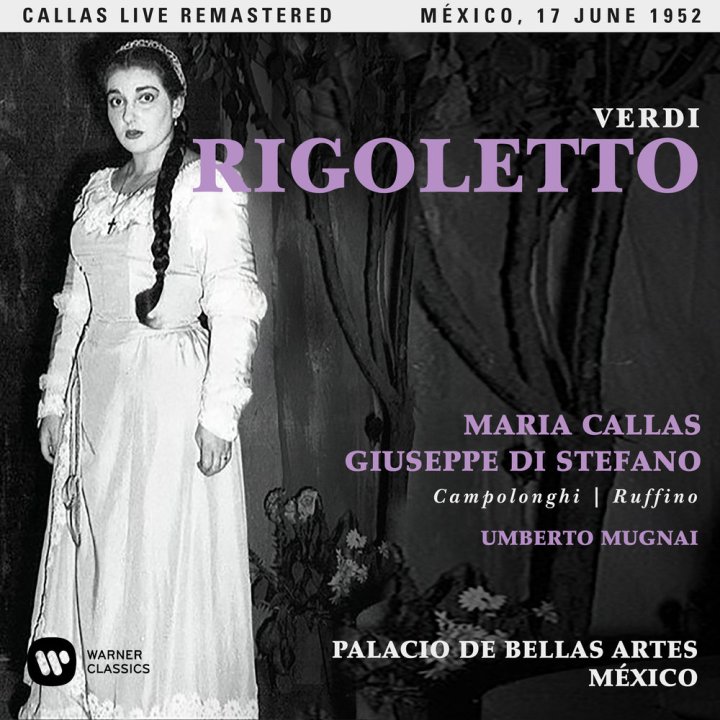
 

Callas sings Gilda in Rigoletto – Mexico 1952

1498838629118

This is actually the first time I’d heard this performance complete. Previously I’d only heard excerpts in wretched sound, which hadn’t encouraged me to investigate further, especially given the excellence of Callas’s studio recording with Gobbi and Di Stefano and Serafin at the podium.

Well the first thing to say is that the sound is actually quite good, the voices well caught and much clearer than anything I’d heard before. Unfortunately the performance itself, save for Callas’s miraculous Gilda, is something of a mess, and I wonder why Warner decided to include it, especially as they omitted the superb live La Scala Un Ballo in Maschera of 1957.

One should also note that the prompter is a palpable presence, shouting rather than whispering the lines to the soloists. Oddly enough he disappears completely at the beginning of Tutte le feste and Callas muffs her first lines.

So let’s get the problems, and there are plenty of them, out of the way first. Umberto Mugnai doesn’t appear to have any control over his resources whatsoever, and frequently coordination between pit and stage falls apart completely. The score is also cut to ribbons, far more than was traditional at the time. It is notable that when things go awry, it is usually Callas, who presumably couldn’t even see the conductor, who brings things back on track. Even in such chaotic surroundings, her innate musicality shines through.

The last act is the biggest mess of all, and all the singers go out of sync with the orchestra in the storm ensemble, despite Callas’s best efforts to bring everything back under control. The quartet isn’t much better, and ends with all the singers, save Callas, out of tune, not that it bothers the audience who give it a rapturous reception. Nor does it concern them that just before that Di Stefano had ended La donna e mobile seriously flat. Forced to encore the aria, his second attempt isn’t much better.

Piero Campolonghi, who plays Rigoletto, has a fine enough voice, but, oh dear, what a ham! He delights in holding onto notes longer than he has to, adding extraneous sobs whilst others are singing and shamelessly playing up to the audience, who, it has to be said, lap it all up with enthusiasm. He has absolutely no idea who or what Rigoletto is. Oh how I missed Gobbi.

Di Stefano does at least have the measure of the Duke. He has charm in abundance, and we can understand why Gilda could be taken in by such a man, but, without a strong hand at the helm, he can be careless of note values and rhythm, and he too plays shamelessly to the gallery. The rest of the cast is decidedly provincial.

That Callas’s Gilda, a role she was singing for the first time, should emerge virtually unscathed from this shambles of a performance is a miracle indeed. She makes a couple of decisions she would later regret, such as taking an upward ending in Caro nome, which allows her to finish on a secure, but unpoetic top Eb in alt, rather than Verdi’s written rapturous trill on the lower E  (something she does to brilliant effect in the studio recording). She also ends the Quartet on a powerful (and unwritten) top Db (but then, with all the singers belting out their lines, the written quiet ending would have been out of the question).

Aside from these miscalculations, made to appease the Mexican audience’s love for high notes, her Gilda is one of her most exacting characterisations, and it is a great pity that she was never tempted to sing the role on stage again. Had she done so, we might well have completely rethought the role, much as we did that of Lucia.

Her voice is in superb condition, infinitely responsive and wonderfully limpid, the tone wondrously lightened to dispel any associations with Abigaille, Kundry, Elena, Aida and Armida, the roles we have heard her sing so far in this live set. Furthermore her Gilda is a character of real flesh and blood, with a fullness of heart in her duets with her father that prepares us for the sacrifice she makes later; a closeted romantic dreamer suddenly propelled into a world far beyond anything in her experience. Not only is her characterisation of the role a revelation, but her singing qua singing is exquisitely realised, her musical instincts unfailingly right, and ultimately her Gilda rises like a phoenix from the ashes of its crude surroundings.

Callas in Armida – Florence 1952

1498830639973

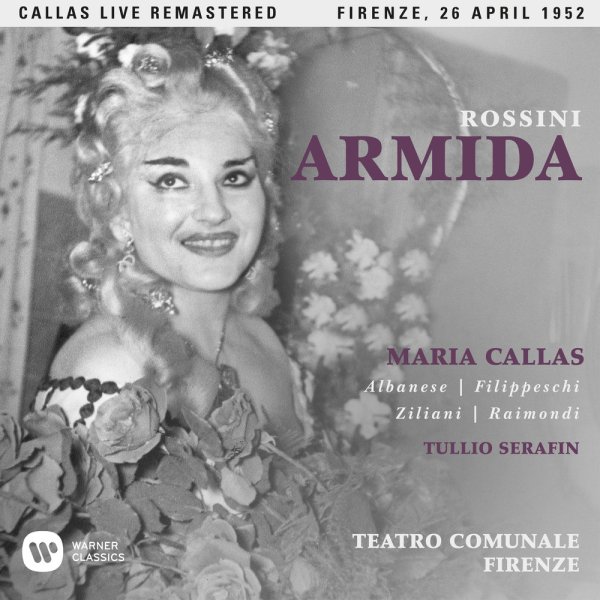
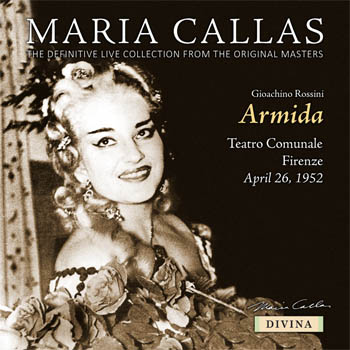
With this set, I was able to make a direct comparison between the new Warner transfer and that by Divina Records, and have to say I prefer Divina. Neither version can eliminate the overloading and distortion at tutti climaxes, but to my ears the voices are much more clearly captured in the Divina version. The Warner isn’t bad, but possibly in an attempt to provide a more comfortable listening experience, they have removed some of the presence of the voices. Other ears and other equipment may have a different reaction of course, but I quickly abandoned Warner and continued listening on Divina. Furthermore Divina includes about 12 minutes of music, omitted by Warner, where you can hear a speaking male voice overlaid onto the music. Though admittedly irritating, it means we lose some of Callas’s singing. Divina also includes fuller notes, fuller documentation, photos and a libretto. I suppose you might see it as the luxury compliment to Warner’s cheaper offering. Personally I prefer Divina’s warts and all approach. Divina is of course more expensive, and others may have different priorities, so choice will reside with the individual listener.

But choice must be made, for this has to be some of the most astonishing dramatic coloratura singing ever committed to disc, and it is a great shame that Callas never sang the role again, nor felt able to take on any more of the roles written specifically with Isabella Colbran in mind.

In 1952 Callas undertook a punishing schedule. In January she sang her final performance of Elena in I Vespri Siciliani in Milan, followed it with I Puritani in Florence, then her first Normas at La Scala. February saw more performances of Norma at La Scala, with a few concerts sandwiched between. In March she gave three performances of Violetta in Catania, whilst rehearsing for a new production of Il Ratto del Seraglio (the first ever at La Scala). This opened at the beginning of April, and this production of Armida on April 26th after a further performance of Norma at La Scala. Incredibly, though you’d never guess it from her confident delivery, she learned the role of Armida in 5 days!

Astonishing though the vocal pyrotechnics are, Callas not only sings the role with consummate ease, but makes musical sense of its difficulties, so it becomes much more than a vocal showcase. She is by turns, imperious, commanding, sensuous, elegant and powerful, cascading up and down two-octave chromatic scales with fluent ease. A critic of the Giornale delle Due Sicilie described Colbran’s singing of the aria D’amore al dolce impero thus.

She proves herself superior to any other singer in some variations in which she embellishes a delightful tune of Rossini’s with all the graces of the art of song, now running through chains of triplets of extraordinary and …insuperable difficulty, now giving a vocal imitation of the most difficult arpeggios of stringed instruments, and finally, with superb nonchalance, executing a formidable ascending and descending scale of two octaves.

The critic might well be talking of Callas’s performance, which is absolutely electrifying, as it is throughout the opera.

Unfortunately, none of the other singers is anywhere near her achievement and Serafin heavily cuts the opera, presumably to accommodate their deficiencies. All of the tenors have trouble with the florid writing, aspirating the runs in what’s left of it, and their singing is clumsy and effortful.

Essential listening, none the less, for Callas’s superbly commanding singing of the title role. There are of course more modern recordings out there, more textually accurate and more complete, but nowhere else will you hear such a thrilling portrayal of the title role, nor one so brilliantly sung. The cumulative power of the finale is simply staggering, where, with a voice of massive power, Callas peals forth vengeful coloratura flourishes with insouciant ease, capping it with a top Eb of huge proportions. You have to hear it to believe it, indeed, were it not for recorded evidence, you would not believe it possible.

dvn016_l

Callas in Aida – Mexico City 1951

1498817188915

A few months ago, I reviewed this performance HERE as part of a comparative review of five different Aida recordings, so I don’t propose to go into too much detail, as you can read that review by clicking on the above link.

As for the sound, this Warner re-master is a good deal better than the old Virtuoso version I owned before, which was almost unlistenable, but, yet again, in conversation with other Callas fans on the net, I am told that there are better versions than Warner out there, not least Ars Vocalis. The problem with this is that these can be difficult to come by (only available for a short time on ebay) and the Warners are readily and cheaply available from Amazon and the like. As such, this Warner re-master is not at all bad, and easily more listenable than what I had before, the voices coming through much more clearly.

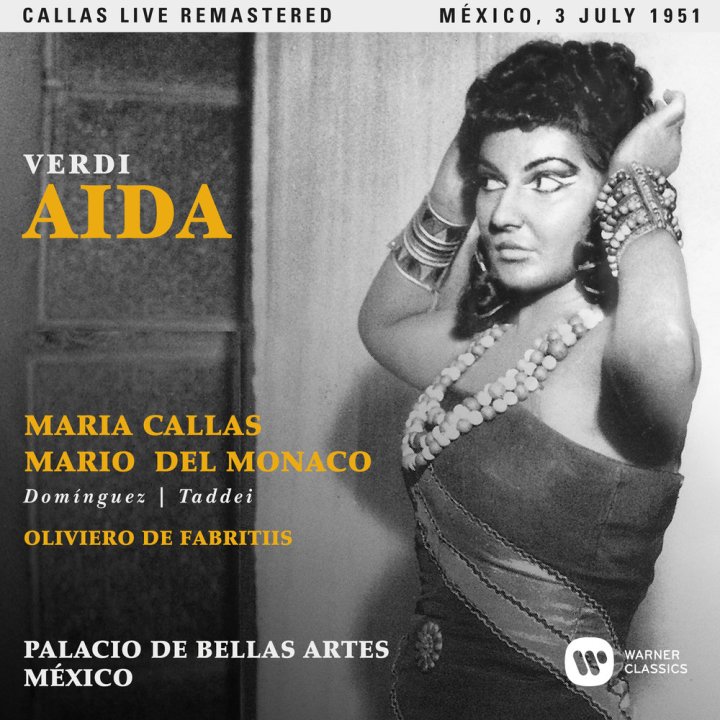
To reiterate what I said back in March, this is a performance in primary colours, which befits its surroundings. The audience is a palpable presence, and when Callas hurls out that magnificent top Eb in the Triumphal Scene, they almost tear the place apart. Subtlety, from any of the singers, is not to be expected, though Callas of course sings with her customary musical intelligence. She is in superb voice throughout, though the top C climax to O patria mia, a firm but not exactly dolce note, is not ideal. She recovers quickly to sing a seethingly dramatic Nile Scene with Giuseppe Taddei’s excellent, implacable and forceful Amonasro. My yardstick for this duet has always been the Callas/Gobbi confrontation on the studio set, but this one is almost its equal. What it lacks is Serafin’s superbly sympathetic conducting (I know of no other conductor who makes the violins weep the way he does in those repeated figures as Aida sings about how much her country costs her). In any case, no other soprano digs as deeply into the words as she does at O patria, patria, quanto mi costi. On this occasion, unusually for her, she adds some extraneous sobs, which she will eschew in both the performance under Barbirolli at Covent Garden in 1953, and for the studio recording of 1955 (the last time she sang the role).

Del Monaco tends to sing everything forte, but the voice itself is in spendid shape. The local girl, Oralia Dominguez, in her role debut, and Giuseppe Taddei both display voices in full bloom and are thoroughly involved in the drama. All in all it isn’t the most subtle of performances you will hear but it is full of thrills and undenyably exciting and I can only imagine what it would have been like in the audience.

Back in March, when I reviewed this alongside the live Barbirolli from Covent Garden, the studio recording, Karajan’s second recording of the opera and the latest one from Pappano, I ultimately came down in favour if the 1955 Callas studio recording, and, though in somewhat leaner voice, there are still moments I prefer the greater subtlety she brings to her performance there. However, by 1955 Aida was no longer in her repertoire. This one gives us a better idea of how thrilling her Aida must have been in the theatre. A character who can sometimes seem no more than a cypher, the archetype of the woman torn between love and duty, becomes a real, passionate flesh and blood woman. Even taking into consideration the distinctly lo-fi sound, this would be my favourite performance of the opera.


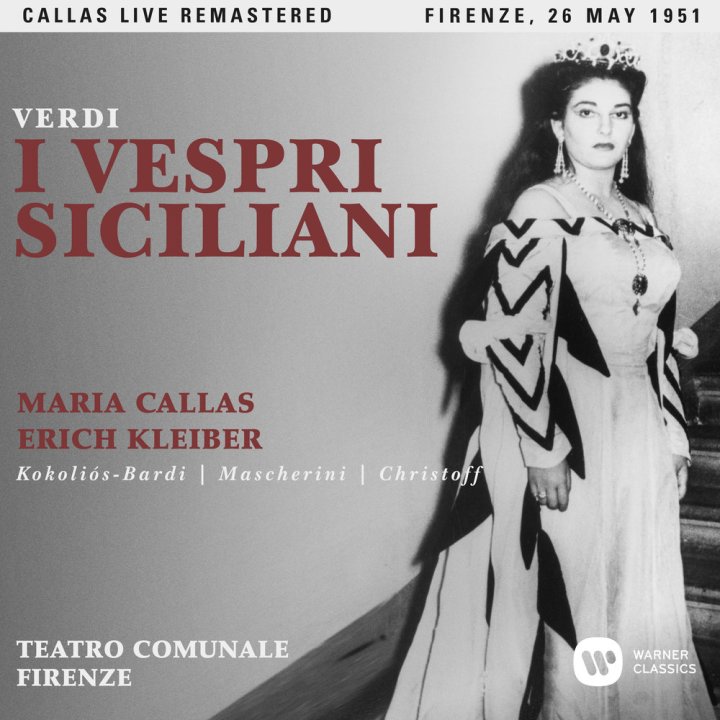
Callas in I Vespri Siciliani – Florence 1951

1498830100011

Florence and the Maggio Musicale, Fiorentino played a great part in Callas’s early career. It was at Florence’s Teatro Comunale that she debuted Norma, Violetta and Medea all of which were to become quintessential Callas roles. Other roles she sang there were Elvira in I PuritaniArmida (in which she had a spectacular success, though she never sang the role again), Lucia di Lammermoor (around the time of her first complete recording, which also used Florence resources),  and her first Elena in I Vespri Siciliani, under Erich Kleiber. That year she also undertook the role of Euridice in Haydn’s Orfeo ed Euridice (its first ever performance, given at the tiny Teatro della Pergola, also under Kleieber).

The success of this production of I Vespri Siciliani finally made Antonio Ghiringhelli, the Sovrintendete of La Scala, Milan, who had for some reason taken an instant dislike to Callas, offer her her first season at La Scala. Later that year she would open the La Scala season in the same opera, I Vespri Siciliani, though this time under the baton of Victor De Sabata. For that same season she was also engaged for Norma and the role of Costanze in Die Entführung aus dem Serail, its first ever performance at La Scala. The opera was sung in Italian, and this was to be the only Mozart opera Callas ever sang. La Scala became her artistic, and geographical, home for the next seven years, and it became a period of extrordinary artistic achievement, allowing Callas to work with directors like Luchino Visconti, Franco Zeffirelli, Margarita Wallmann, Carl Ebert and Herbert Graf; conductors like Herbert von Karajan, Leonard Bernstein, Victor De Sabata and Carlo Maria Giulini. Most of her recordings were also made under the imprimatur of La Scala too, and she is to this day indelibly associated with the theatre.

No recording exists of the La Scala I Vespri Siciliani, so we are fortunate indeed that we have this recording from Florence. Like most of her live recordings from Florence, the sound has never been good, though in 2007 Testament issued a clearer transfer from tapes made for Walter Legge, who was using them to audition Callas. This Warner issue would appear to be a clone of the Testament transfer, with the overture, which wasn’t recorded for Legge, tacked on from another source. As such, I found it no better nor worse than the Testament issue, but, though the sound distorts and overloads quite a bit, it is worth persevering for Callas is in superb voice, in a wide-ranging role that takes her from a low F# in Arrigo, ah parli a un core to a top E in the Siciliana in Act V.

Lord Harewood was in the audience for one of the rehearsals of the Florence production  and recalls precisely the effect of her entrance aria,

Act I of Vespri begins slowly; rival parties of occupying French and downtrodden Sicilians take up their positions on either side of the stage and glare at each other. The French have been boasting for some time of the privileges which belong by right to an army of occupation, when a female figure – the Sicilian Duchess Elena – is seen slowly crossing the square. Doubtless the music and the production helped to spotlight Elena, but, though Callas had not yet sung and was not even wearing her costume, one was straight away impressed by the natural dignity of her carriage, the air of quiet, innate authority which went with every movement. The French order her to sing for their entertainment, and mezza voce she starts a song, a slow cantabile melody; there is as complete control over the music as there had been over the stage. The song is a ballad, but it ends with the words “Il vostro fato è in vostra man” (Your fate is in your hand), delivered with concentrated meaning. The phrase is repeated with even more intensity, and suddenly the music becomes a cabaletta of electrifying force, the singer peals forth arpeggios and top notes and the French only wake up to the fact that they have permitted a patriotic demonstration under their very noses once it is under way. It was a completely convincing operatic moment, and Callas held the listeners in the palm of her hand to produce a tension that was almost unbearable until exhilaratingly released in the cabaletta.

Though we cannot see the impression she made, her very first words, Si canteró exude calm authority, with an undercurrent that suggests that, though she has agreed to sing, the French will not necessarily like what they hear. She starts almost mystically, gradually as Harewood describes, suffusing her tone with more pointed meaning at the words Il vostro fato è in vostro man. She then launches the cabaletta, Coraggio, su coraggio, almost sotto voce, building the tension as she starts to sing out with more force, her command of the wide leaps and coloratura staggering in its ease, the top of her voice gleaming and powerful. It is, as Lord Harewood suggests, a masterclass in how to use music to dramatic ends.

There is a good deal more to her Elena than that, though. She can be meltingly lyrical in the love music, such as in the beautiful mini aria Arrigo, ah parli a un core (though she only touches the low F# in its cadenza) and blithely suave and elegent in the Act V Siciliana, Merce, dilette amiche, notable for its light, breezy runs and an interpolated high E at its close. Few singers before or since can have so easily encompassed its vocal demands, whilst creating a character both sympathetic and imposing. There is never any doubt, from first note to last, that this Elena is an aristocrat; there are parallels here with Callas’s superb Leonora in Il Trovatore.

Of the supporting cast, Christoff, who also played the role at La Scala is a vocally resplendent and authoratative Procida, Mascherini a not particularly interesting Monforte. Giorgio Kokolios-Bardi, who sings the role of Arrigo, was a Greek tenor, whom Callas no doubt knew from her Athens Opera days. Occasionaly he phrases with a real sense of line, but just as often his singing lacks distinction. He was replaced by Eugene Conley at La Scala.

Erich Kleiber makes quite a few cuts in the sprawling score, but has a sure sense of its dramatic shape. There is a story that, at one point in rehearsals, he shouted out to Callas, “Maria, watch me,” to which she replied, “No, maestro, your eye sight is better than mine. You watch me.” Whatever the truth of this, they seem entirely at one in the performance, though I did wonder if Kleiber took the aforementioned Arrigo, ah parli a un core a tad to fast.

As I mentioned earlier in this review, I didn’t detect much improvement in the sound from the Testament issue of the performance, which in turn was quite a bit better than any heard before it was released. Nevertheless, this is essential Callas, and I wouldn’t want to be without it.


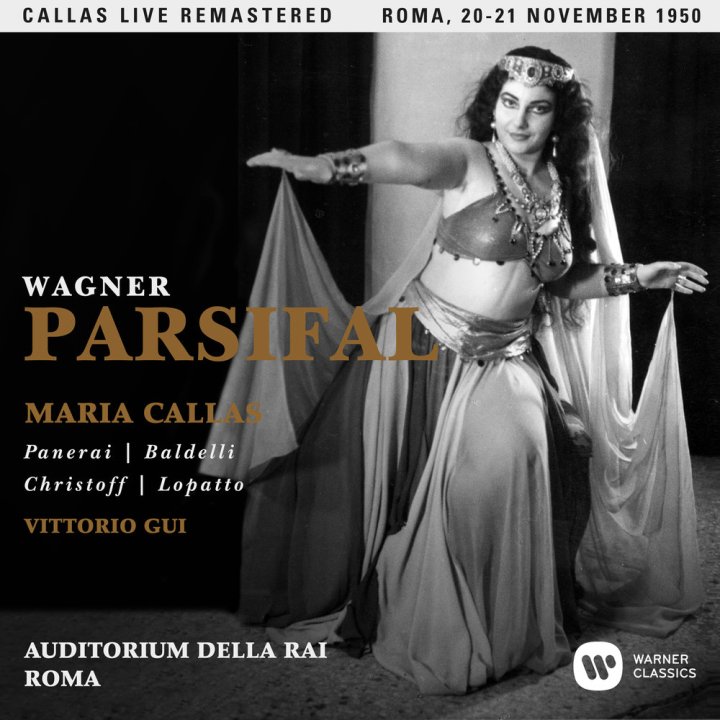
Callas in Parsifal – Rome 1950

callas_live_parsifalsq

Chronologically the second recording in the Warner box set is Parsifal, which many no doubt will find an oddity. However one should remember that in the early part f her career, Callas sang quite a bit of Wagner. The next role after her Italian debut, was Isolde, which she sang in Venice, and then the following year in Genoa (with Max Lorenz as Tristan), and in Rome in 1950. She added the Walküre Brünnhilde in 1949, singing the role in Venice (when she famously deputised for an ailing Marherita Carosio in I Puritani, learning the role of Elvira whilst still singing Brünnhilde). She first sang the role of Kundry in 1949 in Rome, but this RAI concert performance heralded her farewell to Wagner, though she was supposed to sing Kundry again at La Scala in 1956 under Erich Kleiber, a project that was abandoned when the maestro died. It was rather surprisingly replaced by Fedora. Like all Italian Wagner productions in those days, the opera was sung in Italian.

Wagnerites will no doubt be put off by the language. They will no doubt be further bothered by the poor recording of the orchestra, though the singers are well caught. I can’t in all honesty say  that this Warner issue is a marked improvement on the Verona transfer I had before, and, though there are some fine singers amongst the cast (Boris Christoff, no less, as Gurnemanz, Rolando Panerai as Amfortas), I found enjoyment of much of the opera seriously compromised by the dim orchestral sound.

However, it is wonderful to have this one example of Callas in a complete Wagner role, and Act II, where Kundry has the lion’s share of her music, had me gripped. Admittedly it is strange to hear the libretto in Italian, but the language does enable Callas to sing a more sensuously silken line than we often hear in the role and her Kundry is a true siren. She uses her superb legato to display the music’s beauty, a million miles from the barking Sprechgesang we often hear.

Despite the cuts to the score, Gui displays a firm understanding of the score, and, aside from Callas, has some excellent singers at his disposal; Boris Christoff as Gurnemanz, Rolando Panerai as Amfortas and Giuseppe Modesti as Klingsor. We even get Lina Pagliughi as the First Flower Maiden. Africo Baldelli’s Parsifal is adequate, no more no less.

The dimly recorded orchestral sound is a problem, especially in Wagner, and this recording could never be considered a contender for that reason. However it is much more than a curiosity, and Callas’s superbly sung Kundry certainly deserves to be heard.

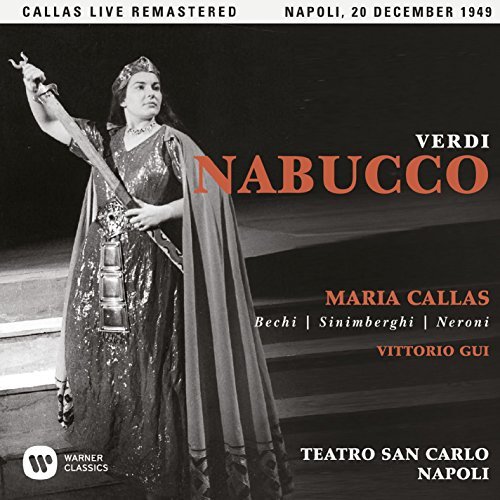
Callas in Nabucco – Naples 1949

51ek3ptyfil-_ss500

One might think Abigaille a Callas role par excellence, but in fact she only ever sang the role at this series of performance in Naples in 1949, though she often programmed Anch’io dischiuso into her concert programmes. She is on record as calling the role a voice wrecker and advised Caballé against singing it. “It would be like putting a precious Baccarat glass in a box and shaking it. It would shatter,” she told her. Caballé heeded the advice and never sang the role. Callas’s words may seem a surprising statement, given Callas’s astounding assurance and brilliant execution of the role’s difficulties, but maybe she was right. After all, Giusppina Strepponi, the role’s creator and eventually Verdi’s second wife, retired practically voiceless at the age of 31, only a couple of years after she had such a success in it. Elena Souliotis forged her career in the role and had burned herself out in less than five years.

In terms of sound, this is one of the worst extant Callas broadcasts, and no amount of tweaking by the engineers is going to disguise that. It is at its worst in the last act, but, as Abigaille has so little to do in the last act, this affects Callas the least. That said, the Warner issue is clearer than any I’d heard before, though I’m told the one on Ars Vocalis is even better, if you can get your hands on it.

It is worth persevering with the sound, though, for this is the most thrilling performance of the role of Abigaille you are ever likely to hear. The young Callas ( she was 26 at the time) is in full command of the role’s many difficulties, tossing off the coloratura with demonic force as if it were the easiest thing in the world, the top of her voice rock solid and gleaming. She even exacerbates the role’s difficulties by interpolating a free and ringing high Eb in the Act III duet with Nabucco.

However there is much more than just power and ferocity to Callas’s Abigaille, and it is full of lovely details often overlooked by other singers. Note, after her barnstorming entrance, the way she softens her tone at the words Io t’amava, with a suggestion that she loves Ismaele still. The recitative Ben io t’invenni is thrillingly powerful, but she spins out the ensuing aria Anch’io dischiuso with Bellinian grace, tracing its filigree to heavenly lengths. In the duet with Nabucco she is exultantly triumphant, but this gives way to her most meltingly moving tones in the death scene, which unfortunately loses some of its effect due to the crackly recording. All in all, Callas’s Abigaille is a considerable achievement, and it is incredible that she can sing with such power, but with such needle fine accuracy in the coloratura.

Vittorio Gui conducts a tautly dramatic performance, but something strange happens during the chorus Va, pensiero, the end of which is drowned out by a cacophony of boos. He reprises the chorus and this time the audience go berserk cheering. This is presumably what going to the opera in Italy in those days was like.

Gino Bechi, a well-known baritone at the time, is an effective Nabucco, but not in Callas’s class, and no match for such as Gobbi, who recorded the role for Decca late in his career. The rest of the cast is perfectly adequate without being outstanding, but the recording, dreadful sound or not, is a must for Callas’s superb, vocally resplendent Abigaille.


Maria Callas Live

2r76cut

Most Callas fans have known of the existence of these live recordings for some times, and they have proliferated on many different labels over the years, with variable results. On the one hand there are companies like Divina Records and Ars Vocalis meticulously transferring these recordings in the best possible sound, and others with a more slapdash approach. Regrettably EMI generally adopted the latter approach, often just copying what were bad sources in the first place, in their attempt to cash in on the pirate market.

So how does the new Warner set measure up? I have yet to hear the whole set, but it would at least seem that they have adopted a more serious approach. Though they have not always found the best sources (there will often be more than one source tape for a single performance), they have at least done what they could with often intransigent sound. Though these transfers may ultimately not turn out to be the last word in Callas Live, at the price they are good value, and, with this release, Warner is at least making some amazing performances available to a wider audience. That said, the set should come with a warning for first timers that most of these recordings are not even up to the standard of reasonable mono studio recordings of the time. Perseverance is rewarded, though you do have to learn to listen through the sound, as it were. If you can , you will discover some truly remarkable singing.

In many ways this set gives a truer reflection of Callas’s stage career than the studio set, which includes operas she never sang on stage, as well as some that were only peripheral to her success. Of the operas represented here, twelve of them (NabuccoParsifalI Vespri SicilianiArmidaMacbethAlcesteLa VestaleAndrea ChenierAnna BolenaIfigenia in TaurideIl Pirata and Poliuto) were never recorded in the studio. Of these Andrea Chenier is an oddity. Callas sang the role of Maddalena only once at La Scala in 1955. She had been scheduled to sing Leonora in Il Trovatore, one of her greatest roles, but Del Monaco, who was to be the Manrico, suddenly professed himself not well enough to sing the role and offered Andrea Chenier instead! Maybe, as Callas didn’t know the role, he expected her to stand down, but, typically for her, she learned the role in a couple of days and was a very effective Maddalena. It’s very much the tenor’s opera though, and one wonders why she bothered. The production followed Visconti’s superb production of La Vestale, which opened the La Scala season, and she would go on to have spectacular successes at the house that same season in Visconti’s  La Sonnambula and La Traviata and in a Zeffirelli production of Il Turco in Italia. The role of Maddalena hardly offered her the kind of challenge she was used to.

One might think Parsifal (sung in Italian as all Wagner was in Italy in those days) an oddity too, but we forget that Callas sang a good deal of Wagner in her early days. Aside from Kundry, she also sang Isolde and the Walküre Brünhilde, famously deputising for an ailing Margherita Carosio in I Puritani whilst still performing the role, a feat that dramatically changed the direction of her career. Her Kundry is much more than a curiosity, her singing sensuously beautiful as it should be, though the orchestra is muddily recorded in this 1950 broadcast.

I have a few gripes about some of the performances chosen. Rather than Covent Garden 1952, I’d have gone for the La Scala Norma of 1955, with Simionato and Del Monaco, arguably the greatest of all her recorded Normas, recorded on a night when her voice was responding to her every whim. For me it is the one where voice and art find their greatest equilibrium. It also sounds pretty good, at least in Divina Records’ transfer. For Medea I tend to turn to Florence 1953 or Dallas 1958, though it’s a close run thing, and for La Sonnambula I prefer the 1957 Cologne performance, which also enjoys better sound. The Lisbon Traviata is also a justly renowned performance, but Covent Garden from the same year is even better, and also in better sound.

I wonder about the inclusion of the Mexico Rigoletto, which is a bit of a mess of a performance, especially when the studio recording with Gobbi remains one of the greatest in the catalogue. Why not the 1957 La Scala Un Ballo in Maschera under Gavazzeni, which is a superb performance, in much better sound? On the other hand the inclusion of the Covent Garden Tosca, despite the existence of the classic De Sabata studio performance, is warranted by its fame and it being the last of her great successes.

Warner have also included BluRay discs of all the concert material, including the complete Act II of Tosca from Covent Garden, though I haven’t yet sampled these to find if they are any better than the DVD copies I already own.

Presentation is, mostly, exemplary, each opera enclosed in a hard cardboard gatefold sleeve, the cover graced with a photo from the production (though it should be noted that the photo on the cover of the Lisbon Traviata is actually from Covent Garden the same year). Inside the cover is a note on the recording itself, though Warner doesn’t go into much detail about sources or methods of transfer, the booklet that comes with each opera, restricts itself to a track listing, opera synopsis and essay on the opera in English, French, German and Italian.

The accompanying book would have benefited from a hard cover. I have a feeling its thin paper cover will become tattered in all too short a time. The book itself includes an essay on each performance and its history, and I was very pleased to see the name of the late John Steane amongst the contributors. However I regret the absence of a CD-Rom with libretti and translations, such as was offered with the Warner Studio set.

I intend to review each opera individually later in my blog, when I will discuss both sound and performance.


Callas in Anna Bolena- La Scala, Milan April 14 1957

dvn018_l

This live recording captures a great moment in operatic history, a moment when bel canto opera was finally taken seriously. As Montserrat Caballé once stated,

She opened a new door for us, for all the singers in the world, a door that had been closed. Behind it was sleeping not only great music but great ideas of interpretation. She has given us the chance, those who follow her, to do things that were hardly possible before her.

Sutherland, Caballé, Sills, Gencer, Scotto, even today’s DiDonato and Radvanovsky should all give thanks to Callas, for without this one production, their careers might have taken very different paths. True, Callas had by this time made people re-evaluate operas such as Lucia di Lammermoor and La Sonnambula, and she had had an enormous personal success as Rossini’s Armida in Florence in 1952, but it was La Scala’s spectacular production of this one opera, Anna Bolena which paved the way for the bel canto revival, and for the next few decades, long forgotten operas by Rossini, Donizetti and Bellini would be revived all over the world.

Such was the anticipation and excitement surrounding the production that it was covered in the international press, the UK’s Opera Magazine dedicating seven pages of its June 1957 issue to Desmond Shawe Taylor’s review.

There is no doubt that La Scala wanted to make a splash, and there is ample photographic evidence of Nicola Benois’ stunning sets, and the superb costumes. It was also the apogee of Callas’s collaboration with Visconti, though unfortunately, after the production of Gluck’s Iphigenie en Tauride, which followed they never worked together again. Visconti recalls.

It was rather beautiful, if I do say so myself. But not sublime as everyone else has said. It had atmosphere. Benois and I used only black, white and grey – like the grey of London – for the sets. The castle interiors, such as the broad staircase down which Callas made her entrance, were filled with enormous portraits. The colours of the costumes – Jane Seymour, the king’s new love, wore red, for example, and the guards scarlet and yellow – played off these sombre sets. But for Anna Bolena, you need more than sets and costumes. You need Callas. Each day I went with her to the tailor to watch over every detail of her gowns, which were in all shades and nuances of blue. Her jewels were huge. They had to be to go with everything about her – her eyes, head features, her stature. And believe me, onstage, Callas had stature.

Anna_18

The opera was heavily cut, so if you are looking for some ur-text version, you would have to go to studio recordings featuring Sutherland, Sills, Souliotis or Gruberova, but you would be missing out on the greatest Anna on disc, who, according to Richard Fairman in Opera on Record III,  “alone, of latter-day artists, has the power to grasp the emotional crux of every line and put it across.”

First off I should mention that this Divina Records transfer is in a different world of clarity from the murky EMI version, which unfortunately is also the source for the recent Warner transfer. Available as a download, I recommend it unreservedly.

Callas’s conception of the character of Anna is absolutely right from the word go. When asked by Rescigno, who conducted her in several concert performances of the final scene, why she phrased something in a certain way, she replied simply, “Because she is a Queen,” and it is this simple statement of fact that informs and shapes her portrayal. Callas’s Anna, though she suffers like any other woman, never forgets that she is a queen. In Callas’s own words.

Now history has its Anna Bolena, which is quite different from Donizetti’s. Donizetti made her a sublime woman, a victim of circumstance, nearly a heroine. I couldn’t bother with history’s story; it really ruined my insight. I had to go by the music, by the libretto. The music itself justifies it, so the main thing is not the libretto, though I give enormous attention to the words. I try to find truth in the music.

Contemporary reviews (and photographs) attest to the nobility of Callas’s bearing, and her first entrance vocally reflects that. Her first words have a natural authority and regal reserve, which gives way to deep private melancholy in the aria Come innocente giovane, which she sings in a gentle, perfectly focused half voice, her command of line and legato as usual superb. In the cabaletta, which is addressed to the court, she uses more voice, but the voice remains supple and she never loses for a moment that sense of regal composure.

In the following scene, where she unexpectedly meets Percy for the first time, she publicly retains her composure, though the conflicting emotions running through her heart are exposed in the many asides, and she starts the ensemble Io seniti sulla mia mano in a movingly intimate tone of infinite sadness.

These first scenes have introduced us to the character of Anna, regal, melancholy, troubled and noble, but the next scene is the one that will seal her fate and the one in which Anna will show her mettle. Alternately tender, then anxious, then truly terrified with Percy (who, it has to be said, behaves like a lovesick schoolboy throughout the opera), she is found in compromising circumstances by Enrico. Overcome with emotion she faints, but wakes to plead in melting tones her innocence in the superb ensemble In quegli sguardi impresso. Deaf to her pleas, Enrico asserts that the judges will decide her fate, and this is where Callas’s Anna really rises to her full stature, bringing to bear her queenly outrage in the words Giudice ad Anna! Guidice ad Anna! Ad Anna! Guidice! before launching the final stretta with an intensity that has to be heard to be believed. Singing with all the force at her command, she caps the ensemble with a free and secure high D, held ringingly for several bars. Anna_6

The first scene of Act II (or Act III in this performance) contains the magnificent duet for Anna and Giovanna, prototype for so many of those female voice duets that pepper the operas of Donizetti and Bellini. In it Giovanna confesses her guilt, is at first repulsed by Anna, and then magnanimously forgiven. No doubt Bellini had this duet in mind when he penned the first duet for Norma and Adalgisa in Norma. Simionato, superb throughout the opera, is a worthy foil here, but Callas again transcends the music. Her interjections into Giovanna’s confession run the gamut of emotions from shock and revulsion to resignation and acceptance, until, in one of the most moving moments in the opera, she forgives Giovanna in a voice quivering with emotion. Always notable is the way Callas achieves her effects without once disturbing the musical line. She recognises that in bel canto opera it is the arc of the melody which carries the emotional impact, her sense of line and rubato always instinctively right.

Anna_15

The final scene in the tower is one she programmed into recitals on several occasions and recorded (in its entirety) for EMI on what is arguably her most successful recital disc Mad Scenes. Many have since recorded it, so it has become relatively familiar, but one should remember that it was practically unknown at the time of this performance. In Al dolce guidami Callas’s voice takes on an unearthly, eerie beauty, the music seeming to emerge from the very depths of her soul. Though closely adhering to the score, she sounds almost as if she is extemporising on the spot, and the audience listens in rapt silence, hanging on her every note, until it erupts in a corporate outpouring of applause and cheers at its quiet close. Her delivery of the recitatives in the scene is again a lesson in how to weight and measure the proportions of each line. The final Coppia iniqua is sung with massive force, the famous rising set of trills, either ignored or sketchily sung by others, sung with both accuracy and intensity, her voice rising with power to the top Cs. This is Callas at her best.

She is ably, and brilliantly, supported by Gianandrea Gavazzeni, who gives her ample rein to play with the music in the quiet, reflective moments and urges the ensemble to absolutely thrilling heights in the big finales. Rossi-Lemeni’s Enrico is authoritative but woolly-toned and Raimondi’s Percy pleasingly Italianate without being particularly individual. Simionato, inspired to give of her very best, is the only other singer who comes close to Callas’s achievement, singing with glorious tone and dramatic involvement, but even she is less specific, more generalised, in her responses than Callas.

Anyone who has any interest in bel canto opera has to hear this set, which puts you in the stalls on one of the greatest nights in Callas’s career. At the end of his review Desmond Shawe-Taylor, asked if Anna Bolena could enter the international repertory.

With Callas, yes; without her, or some comparable soprano of whom as yet there is no sign, no. Many people think it a flaw in these old operas that they depend on the availability of great singer; but what would be the fate of the standard violin and piano concertos if there were scarcely a player who could get his fingers round the notes, let alone fill them with a lulling charm or a passionate intensity?

Well, eventually other sopranos did take it on, with varying degrees of success, and the opera is still performed occasionally today, but none of these other sopranos has quite matched the genius of Maria Callas, who was, without any doubt, not only a great singer and actress, but also one of the greatest musicians of the twentieth century.

Anna_10


Callas’s First Medea – Florence 1953

MedeaFlorence

Having discussed Callas’s live Macbeth from La Scala a few posts ago, I thought I would start reviewing some of the many live Callas performances that exist. I do not propose to go into which are the best versions of these live recordings, as it can be quite a minefield, but I would just mention that, in any cases where they are available, Divina Records will be your best bet. In September Warner will be issuing a deluxe box set of many of Callas’s live performances, and, until it is, we will not know what the sound will be like. If they just re-hash the EMI versions, which should be avoided, by the way, then the news is not quite as exciting as it might have been. It remains to be seen.

z7gis

This Medea was recorded in house from a single microphone at the front of the stage, which means that voices can disappear when at the back. However I found this Ars Vocalis transfer from Cetra LPs not at all bad, and so intense is the performance that it draws you in and the ear readily adjusts.

Unbelievably, considering Callas’s total mastery of the role’s difficulties, this was the first time she ever sang Medea. So successful was her assumption that La Scala ditched plans to stage Scarlatti’s Mitridate Eupatore with her later that year and replaced it with Cherubini’s Medea. Subsequently the opera was revived for her in productions at La Scala (twice), in Venice, Rome, Dallas, London and at the ancient theatre of Epidaurus in Greece. So much associated was she with the role, that when she came to make her non singing cinematic debut, it was in the role of Medea in the movie directed by Pasolini.

Cherubini’s Medée is actually a French language opéra comique with spoken dialogue, and was much admired by Beethoven and Schubert. It premiered in Paris in 1797, the first performance in Italian translation being given in Vienna in 1802. In 1855 Franz Lachner prepared a German version, for which he wrote his own recitatives. This Lachner version was first performed, in an Italian translation by Carlo Zangarini, in 1909, and it is essentially this version which Callas sang, though each of the conductors she performed the work with (Gui, Bernstein, Santini, Serafin, Rescigno and Schippers) prepared their own version of the work, making different cuts in the score. Apart from the studio recording with Serafin, we can hear live performances from Florence with Gui, La Scala with Bernstein, Dallas and London with Rescigno and La Scala again with Schippers.

d_zpstvvf66ap

Gui’s view of the work is essentially Classical, closest in conception to Serafin, who was to conduct the studio recording, though more propulsive in the work’s many exciting climaxes. His cuts are less extensive than the other conductors’, and this is the only time we get to hear Medea’s last scene complete. However, there are times where some judicious snipping might have helped. He leaves in the orchestral bars before Medea’s final Pieta in her aria Dei tuoi figli, which makes the ending of the aria anticlimactic, and leaves the audience uncertain when to applaud. Still, I prefer this to Bernstein’s solution of cutting the final Pieta as well. All the others cut just the orchestral bars, which seems to me the better solution. There are also times, particularly in the scenes before Medea’s first entrance, where Gui’s speeds are just too slow. The overture is dramatic and exciting, but the long first scene which sets the idyllic atmosphere that Medea bursts into, drags on interminably. There are times later on too, notably the duet between Medea and Creon, where his speeds are on the slow side, but the ends of each act and the finale itself are absolutely thrilling.

Callas herself is in superb voice, the top rock solid and gleaming, managing the treacherous demands of the role (it was said that Mme Scio, its creator, died singing it) with consummate ease. She sings with a wide range of colour, though her conception of the role is a deal more subtle by the time she sings it in Dallas in 1958. No complaints about her entrance, though, which is sheer brilliance, the veiled sound of her middle voice carrying with it a threat of menace which gives way to beguilingly feminine pleading in her first aria Dei tuoi figli. The aria itself is magnificently sung, its wide leaps and high tessitura expertly managed, and it provokes a spontaneous burst of applause from the audience, unfortunately cut short when they realise the aria isn’t quite over.

In the ensuing duet with Giasone I feel she slightly overplays her hand, and this scene is not as effective as it was to become in later performances. Nor does the duet with Creon have quite the subtle play of light and shade it will have on the studio recording and in Dallas, but the final scene is mind blowingly, blazingly terrifying, her voice cutting through the orchestra with coruscating force, and there is a great deal to be gained from hearing this scene in its entirety. Gui, too, supports her brilliantly at this point. Not surprisingly the audience go wild.

Barbieri is a superb Neris, Gui making of her aria, that still, calm centre of the score, a beautiful duet between voice and cello, which Gui substitutes for the more usual bassoon. Guichandut, an Argentinian tenor I’ve never heard of before or since, is good, but no match for Vickers, who would sing the role with Callas in all productions from 1958 onwards. Gabriela Tucci is a lovely Glauce, though she is a little taxed by Gui’s slow tempo in the ensemble before Medea’s entrance and gets a slittle shireky in the upper reaches. Mario Petri is perfectly acceptable as Creon, but the great moments are all with Callas. That she is so much associated with the role (even in this hybrid version of the score, which misrepresents what Cherubini actually wrote) is hardly surprising, for no other singer, before or since has made Cherubini’s score live and breathe as she has done. There have been occasional revivals, both of the Lachner version Callas sang, and the original opera comique, but none have caught the imagination the way that Callas’s performances did, and it seems likely that the opera is again to become the museum piece it once was.