Maggie Teyte sings French Songs and Arias

ni00mzuxlmpwzwc

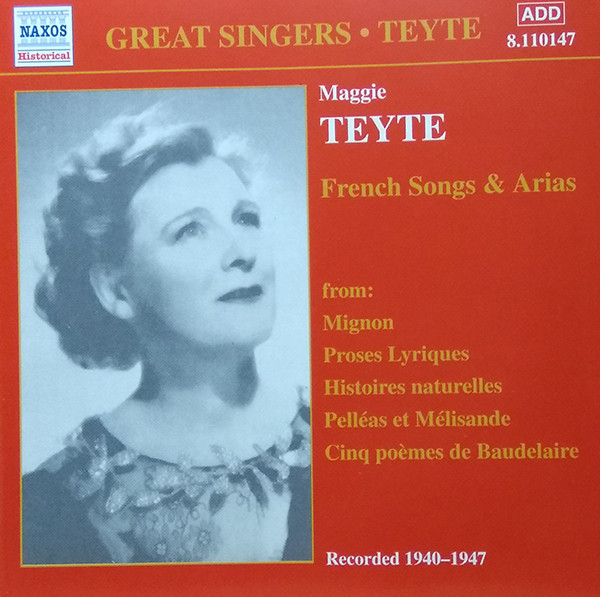
This compilation is of recordings made bewteen 1940 and 1947, when Teyte was approaching 60. Three tracks (Mignon’s Connais-tu le pays?, one of two versions of Duparc’s L’invitation au voyage and the bonus track, Cherubino’s Voi lo sapete) are from a 1947 radio broadcast with the San Francisco Symphony Orchestra under Pierre Monteux, and the rest are of studio recordings made for EMI, some of which were unpublished at the time. Most are with Gerald Moore on the piano, but the second recording of L’invitation au voyage is with the London Philharmonic Orchestra under Leslie Heward. I’d suggest that this is the better of the two recordings. By the time of the second one with Monteux she has to take more breaths, though the tempi are virtually identical. Even so, even in 1947 the voice remains incredibly firm and totally free of wobble or excessive vibrato. Her singing throughout in fact is wonderfully clean and precise and her intonation is perfect.

So too, of course is her French, though we shouldn’t be surprised when we remember that she spent a good deal of her early career in Paris, was coached by Debussy himself for her début as Mélisande and worked with Chausson, Duparc and Reynaldo Hahn, who evidently had a great deal of affection for her. When she said to Hahn once about the tempo of one of his songs. ‘ You play it quicker than I thought,’ he replied, ‘ma chère, any way you sing it will always be right.’

This is a valuable collection and includes recordings that were either not published or had only a limited circulation in their 78 format, though some of them also appear on EMI’s two disc set entitled, Mélodies françaises . The excerpts from Hahn’s Mozart and Ciboulette are absolutely charming, and we get to hear her speak in perfectly accented French too. The other songs are by Debussy, Chausson and Duparc. Debussy was always a particualr speciality and she somehow makes the three songs she sings here from Debussy’s rather obscure Proses lyriques (she had already recorded the fourth with Cortot) come across as quite simple and direct. She also sings a couple of extracts from Pelléas et Mélisande with piano, which gives us a direct link to Debussy himself.

Teyte should be better known than she is these days. She was one of the greatest ever interpreters of the French song repertoire.

Janet Baker – Chausson, Berlioz and Schoenberg

r-9879493-1487856491-9833.jpeg

These are all live performances of material Baker recorded in the studio (twice in the case of Les Nuits d’Eté, so one might wonder if they are really essential listening.

Well, though Baker was a superb recording artist, who never really made a bad record, she was also a great communicator and collaborator and these performances, all with different conductors from the studio ones, bring with them the added frisson that comes with a live event, and the sound, though not as clear as in her studio performances, is more than acceptable.

It starts with a 1975 performance of Chausson’s almost Wagnerian Poème del’amour et de la mer, which she recorded two years later under André Previn. This one has, somehwat suprisingly you might think, Evgeni Svetlanov at the helm, who takes great care over dynamics and shapes the work beautifully. Baker’s range of expression, her concenration, her breath control and command of the long line are exemplary, filling its pages with rapt expression. A marvelous performance.

Baker’s recording of Les Nuits d’Eté with Barbirolli, recorded in 1967 is justly famous and has hardly been out of the catalogue. She recorded it again under Richard Hickox in 1990, but by this time her voice was beginning to show signs of wear (more noticeable in a recording than when I heard them perform the work together in concert at around the same time) and the second recording has never enjoyed the acclaim of the first. This performance under Giulini was taped at the Royal Festival Hall a month after the Chausson and it is good to hear how Baker’s interpretation changed depending on whom she was singing with. Giulini’s speeds are expansive (Le spectre de la rose at 8’29” must be one of the slowest on disc) and would tax most singers beyond their limits, but here they never flag and Baker luxuriates in the extra room she is given to make her interpretive points. As in the Chausson, her breath control is astonishing and the range of expression wide. My notes are peppered with words like searing, delicate, passionate abandon, yearning. Though it doesn’t entirely supplant the Barbirolli in my affections, it is nonetheless a performance I would never want to be without.

The earliest performance here is a 1963 recording of the Song of the Wood Dove from Schoenberg’s Gurrelieder, a work she recorded five years later under Janos Ferencsik. Baker was not yet 30 when she gave this performance and, superbly supported by Norman Del Mar, her singing is urgently free and impassioned, even better than that on the Ferencsik.

Essential listening then? Absolutely and unequivocally, yes.

The Fabulous Victoria De Los Angeles

41lkah6q4pl

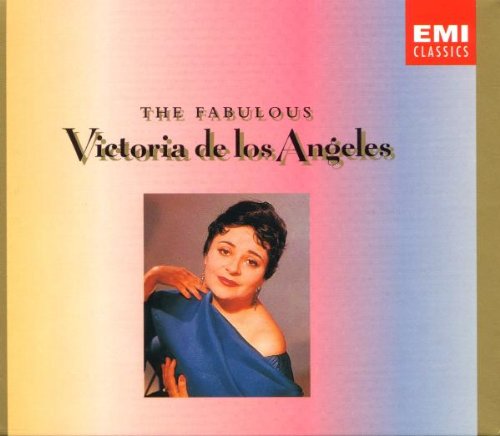
This well-filled four disc set was issued to time in with De Los Angeles’s seventieth birthday in 1993, when, incredibly, she was still active on the concert platform, having made her stage debut in 1941. I don’t know when she officially retired, but she died just over ten years later. The set dates from the good old days, when notes texts and translations were included. Not all of this material is that familiar, so they are absolutely essential. Nowadays you are lucky to even get a web link to them.

The set concentrates on the recital side of De Los Angeles’s career and all the recordings date from the 1960s and early 1970s, with two discs of song with orchestra and two with piano or, as in the case of Falla’s Psyché chamber ensemble.

Disc 1 covers French song with orchestra (though not her wonderful recording of Les Nuits d’Eté, which was recorded for RCA). We start with one of the most recommendable of all versions of Ravel’s Shéhérazade, in which she is a vivid narrator, taking an almost childlike pleasure in the sights she describes. In the Cinq Mélodies populaires grecques she is the epitome of a young village girl, whilst the Deux Mélodies hébraïques bring out a more seductive quality in her voice. Chausson’s Poème de l’amour et de la mer exposes the occasional fragility in the voice, but is still a beautiful performance.

Disc 2, which concentrates on Spanish song with orchestra, would probably be my favourite of the four. It almost exactly reproduces a disc called The Maiden and the Nightingale, released in EMI’s Great Recordings of the Century, though it omits that Granados title track. Favrouites here are the Montsalvatge Cinco canciones negras; wonderfully soothing in the Cancio de cuna para dormir a un negrito and irresistibly playful in the Yambambos of the Canto Negro. I also love Mompou’s El combat del Somni, especially the soulful Damunt de tu nomes los flors. Another joyful performance is Rodrigo’s De los alamos vengo, madre. We are reminded that De Los Angeles probably did more than any other singer to put Spanish song on the map.

Disc 3 brings us more French and Spanish repertoire, this time with piano accompaniment, or chamber ensemble as in Falla’s Psyché. Though her French isn’t entirely idiomatic, she is an ideal interpreter of Debussy, Ravel, Fauré and Hahn. The performance here of Falla’s Sietes canciones populares españolas, with Gonzalo Soriano at the piano, is not generally considered her best, and it is true she is not as fierily earthy as Conchita Supervia, but equally valid in its more playful style.

Disc 4 is more mixed, and presumably covers material likely to turn up in her recitals as openers or encores. I have always treasured her performances of Fauré’s Chanson d’amour, which is sung with a delightful smile in the voice, and her ideal performance of Clair de lune, which captures to perfection its ancien style, but includes a wonderful change of colour when the accompaniment switches to a more fluid figure at Au calme clair de lune. All the piano accompaniment on this disc is provided by Gerald Moore and it also includes a group of duets (from Purcell to Tchaikovsky) with Dietrich Fischer-Dieskau, finishing off with a couple of extracts from Moore’s farewell concert at the Royal Festival Hall, with Schwarzkopf joining the pair for Mozart’s La Partenza.

To get a fuller picture of this lovely artist, one would ideally want some representation of her operatic career, but this one captures well many elements of the recital side of her career. As in all such compilations, I might cavil at some of the choices, but the programme over the fours discs is varied and enjoyable, and De Los Angeles always brings her inimitable individual stamp to all she sings.


Maggie Teyte – Mélodies Françaises

41lhudrbaxl

The first time I heard Maggie Teyte was when I was just starting to enjoy French song. I was learning Duparc’s Chanson triste and a friend played me her recording of the song with Gerald Moore at the piano. I was absolutely entranced and it has remained my yardstick ever since. First of all the flowing tempo they adopt is aboslutely right (so many take it too slowly) and she responds perfectly to all Duparc’s markings – floating the tone beautifully on the mon of mon amour (it is marked doux by Duparc) an effect I have tried, not too successfully, to emulate myself. Her high A is clear, clean and true, but she takes the lower option on the words de tes bras, dipping down into that gloriously rich lower register she had. As you listen, you feel the song is addressed to you personally and you want to just lie back in the warm embrace of her comforting words. The French christened her L’Exquise Maggie Teyte, and the adjective suits her perfectly.

She was born in 1888 in Woverhampton, but went to Paris in 1903 to study with the famous tenor Jean De Reszke. She made her first public appearanc in 1906, singing Cherubino and Zerlina under Reynaldo Hahn, making her first professional appearance in Monte Carlo the following year. She then joined the company at the Opéra-Comique in Paris and was shortly after chosen to replace Mary Garden in the role of Mélisande, for which she was coached by Debussy himself. She is the only singer ever to have been accompanied in public by Debussy himself, and she is an invaluable link to so many musicians of the past. Despite her early success however, she didn’t really establish herself with the main opera houses, and went into semi-retirement after her second marriage (to Canadian millionaire Walter Sherwin Cottingham) in 1921.

In 1930 she tried to resuscitate her career, but ended up singing in variety and music hall (24 performances a week!) until, in 1930, she made some recordings of Debussy songs with Alfred Cortot, which were so successful that she then became known as the leading French song interpreter of her time. She also sang at Covent Garden in such roles as Butterfly, Hänsel and Eurydice in Gluck’s opera, as well as Manon in English (with Heddle Nash).

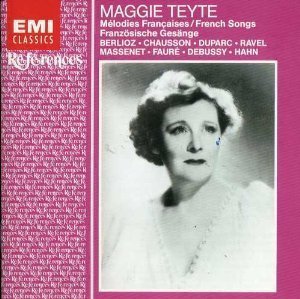
The present set concentrates on recordings of French song with orchestra and piano made between 1940 and 1948, making her 60 when she recorded Ravel’s Schéhérazade, not that you would ever suspect it. The voice is still absolutely firm with no trace of wobble or excessive vibrato, top notes pure and true (a thrilling top B flat in Asie), the inimitable lower register gloriously rich.

It starts with a rather hectic recording of Berlioz’s Le spectre de la rose. The fast tempo was presumably adopted so that they could fit the song onto a single 78, but it does remind us that it is in waltz time and she brings a peculiarly intimate touch to the closing lines,which are sung with an ineffable sadness. Absence is sweetly touching.

Occasionally her attention to the meaning of the words can get in the way of the music, and the tempo fluctuations in Fauré’s Après un rêve are just too much, rather too slow at the beginning, with an unwritten accelerando on Reviens, reviens. I’d also suggest that Duparc’s Extase is taken far too slowly throughout. On the other hand the tempo for Fauré’s Clair de lune is absolutely spot on with a moment of pure magic as she infuses her tone with warmth at Au calme clair de lune and Gerald Moore switches to a more free flowing style in the accompaniment.

Over the two discs there is scarcely a performance that doesn’t warrant attention, but I single out for special consideration Duparc’s gorgeous Phidylé, which is lazily erotic as it should be (note her telling observation of the diminuendo on baiser – most singers miss it completely) and the aforementioned Chanson triste, the former with the LSO under Leslie Heward, the latter with Gerald Moore on the piano. Also on disc 1 is a superb performance of Chausson’s Chanson perpétuelle, whilst she breathes new life into Hahn’s popular Si me vers avaient des ailes on Disc 2.

In all she remains inimitable and individual, though, it seems these days, only known to connoisseurs. This set is no longer available, nor are the Debussy songs she recorded with Cortot. John Steane says in his wonderful book The Grand Tradition,

But basically the point about Maggie Teyte is the very simple one, that her singing is so good: that is, her voice is so clear, its production so even, its intonation so faultless, its movement in big upward leaps so clean and athletic, and its excellence was so well preserved for so long.

Not only is her actual singing so good, but she has something personal to say in all she does, and voice and style are instantly recognisable.

There are other examples of her art more readily available on other lablels but this old EMI set is a treasure and I urge Warner to reissue it along with the Debussy songs with Cortot. It should be in the collection of anyone who is interested in French song.