There are times when one wonders how a record came to be released.
According to the accompanying notes, the premise for this album would appear to be “a completely new approach to our lieder recital repertoire … in which voice and piano are enhanced by another melody instrument”. Whether this enhancement is either desirable or necessary is a moot point, but I suppose the idea of the cello taking over the second vocal line in the adaptation of duets is one solution to the non-availability of a second singer. The accompanying notes would also seem to suggest that these arrangements improve in some way on the originals, even of the two songs from Strauss’s Vier letzte Lieder, which of course were written for full orchestra. I can assure you they do not.
However, the greatest impediment to enjoyment is not the arrangements themselves but the solo singer. According to the biographical notes, Eilika Wünsch has been active since around 2010, when she worked with Jörg Demus. She would appear to have a fairly extensive discography, though I can’t find a single review on the internet for any of her discs, or for any of her public appearances. We are also told that she has sung the roles of Butterfly, Konstanze, Donna Anna, Violetta, Gilda and the Queen of the Night, about all of which I am faintly incredulous. The first few notes of the opening song, Nacht und Träume, are sung in a white, vibrato-less tone, but thereafter any single sustained note emerges unfocused and unsteady. She struggles so much with the execution of the notes that any attempt at interpretation is completely absent. The cover photo shows us an attractive young woman, but the sounds coming from the speakers are those of a (very) old soprano. I am sorry to be so negative, but I really can’t find anything positive to say about this recital. Listening all the way to the end proved quite a trial, but listen I did, right through to the final song, which is a vocalise arrangement of Schubert’s famous Impromptu, Op.90, no.3. The arrangement takes her well up above the stave, where the sound that emerges is somewhere between a whistle and a theremin and quite unpleasant – to my ears at least.
This is one of those cases where comparisons are irrelevant. One to be avoided, I’m afraid.
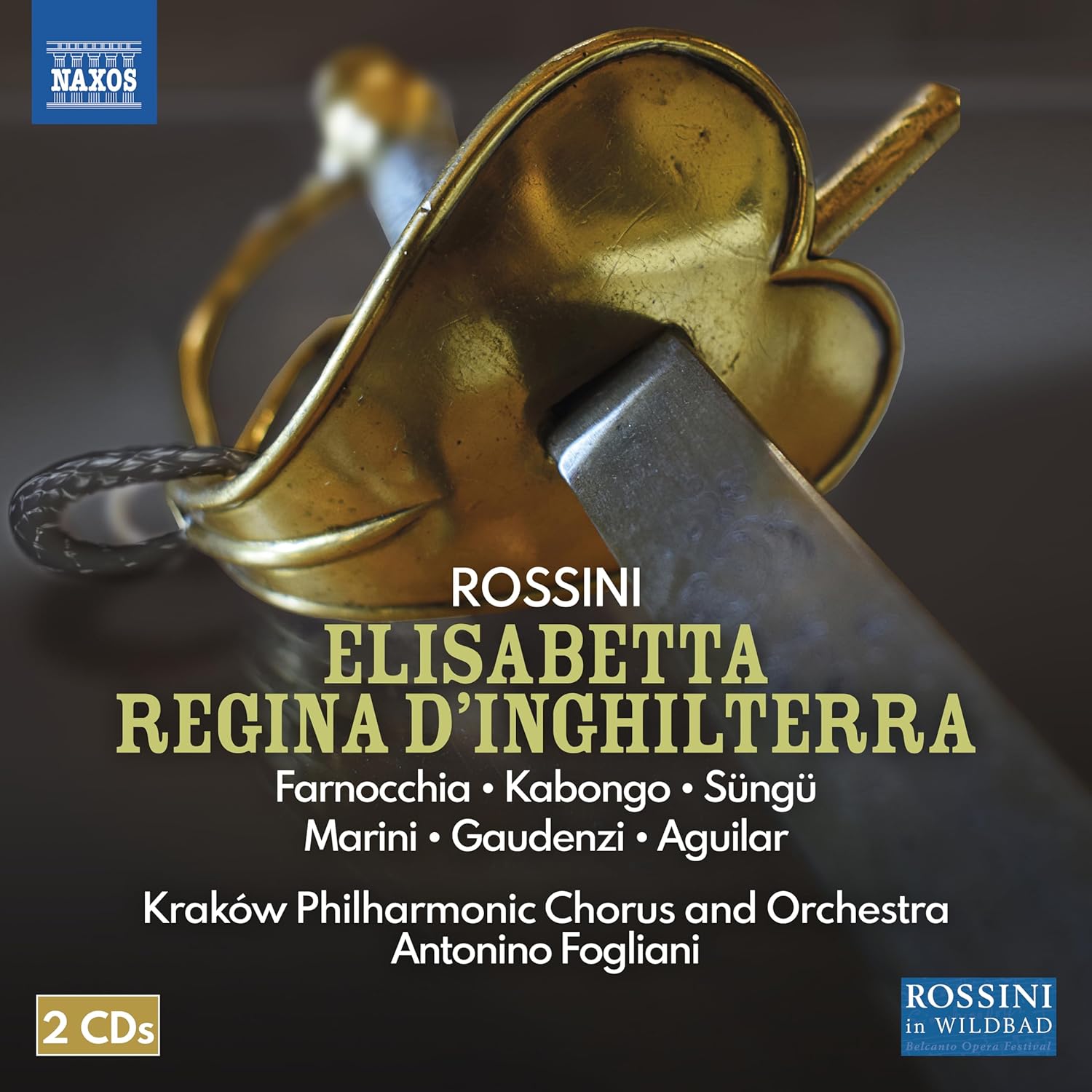
Premiered in 1815, Elisabetta, Regina d’Inghilterra was the first of nine operas Rossini wrote for the San Carlo, Naples. It is based on a play by Carlo Federice, which in turn had been based on a novel by Sophia Lee, called The Recess. Dealing with Elisabeth’s leniency in forgiving Leicester and his secret wife Matilde, it is highly probable that its subject was also meant to celebrate Ferdinand IV, who had recently returned from exile and his ‘leniency’ in not carrying out reprisals against his renegade subjects. At the premiere the roles of Elisabetta and Leicester were sung by Isabella Colbran and Andrea Nozzari, with the role of the villainous Norfolc (sic) going to Manuel Garcia, who would later go on to create the role of Lindoro in Il Barbiere di Siviglia. As is usual with Rossini, there were a lot of self-borrowings in the score. Much of it is from Sigismondo and some from Aureliano in Palmira, including the overture, which would eventually find it’s permanent home as the overture to Il Barbiere di Siviglia. Rosina’s Una voce poco fa in that opera is also a re-working of Elisabetta’s entrance aria.
The opera was a huge success at the time, but, like most of Rossini’s serious operas, fell out of the repertoire until the bel canto revival of the second half of the last century precipitated a spate of revivals. The present set derives from performances in 2021 in Kraków, Poland and at the Wildbad Rossini festival in Bad Wildbad. However much a rarity on stage, the opera is well represented in the catalogue. We have a 1976 Philips recording, featuring Montserrat Caballé and José Carreras, which was based on performances at the Aix-en-Provence festival and there is also a recording on Opera Rara, with Jennifer Larmore and Bruce Ford, a performance which is absolutely note-complete, though in fact only runs a few minutes longer than the Philips. I haven’t heard the Opera Rara set, nor a live one featuring Leyla Gencer, but I used to own the Philips set on LP and re-listened to some of it on Spotify before writing this review.
Unfortunately, this Naxos set is nothing to write home about. The Kraków Philharmonic Orchestra & Chorus can’t compare to the Ambrosian Singers and the London Symphony Orchestra and Antonio Fogliani whizzes through the score, as if he can’t wait to get it over with. Given what we hear on stage, one can hardly blame him. There is very little of tonal beauty or real vocal accomplishment to be heard. At no point do any of the soloists rival those on the Philips set, where Caballé is in fine voice and has all the grandeur the role of Elisabetta requires. She is in a completely different class from the efficient, but dull Serena Farnocchia, who plays Elisabetta on Naxos. Then on Philips we have the young Carreras. He may not get round the notes quite as easily as Patrick Kabongo, but there is the compensation of the sheer beauty of his voice at that time. Kabongo’s voice becomes thin and wiry as he goes above the stave. That said, Kabongo’s Leicester is at least acceptable but Mert Süngü’s Norfolc is not. I know the character is extremely unpleasant, but I’m not sure he needs to sound so awful. Ugo Benelli on Philips is much better.
As Matilde, Philips have the lovely Valerie Masterson, who had played the role in Aix, her bright, light, lyric soprano contrasting well with Caballé’s richer more refulgent tones. You could never mistake one for the other, whereas the voices of Farnocchia and Veronica Marini, who plays Matilde on the Naxos set, aren’t particularly dissimilar.
The tepid applause, which occasionally reminds us that this is a live performance, sounds more dutiful than enthusiastic. One wonders why Naxos decided to issue it unless it were just to complete the Rossini Wildbad series. Unless you absolutely must have CDs, then the old Philips recording, now available as a download and warmly reviewed by Ralph Moore in his Rossini survey, is far preferable.
The English soprano, Harriet Burns, still in her early 30s, has been getting some great reviews in the music press of late, some of them for this recital of Schubert Lieder, and indeed there is a great deal to celebrate here. She and her accompanist, Ian Tindale, were recent winners of the Contemporary Song Prize in the International Vocal Competition at ‘s-Hertogenbosch and this is their debut recital. They have put together a group of Schubert Lieder on the subject of love in all its guises, from, as the notes tell us, “many-splendoured and joyous to tragic and rejected.” Some of the songs will be familiar, some maybe less so, but it is a very well-considered and thoughtful programme.
First impressions are of the sheer beauty of Burns’ voice, which is a full, lyric soprano. Its creamy richness would no doubt be perfect for Strauss’s soaring soprano lines, and I see she is soon to add the Vier letzte Lieder to her repertoire, though initially in a recital with piano accompaniment. I would also highlight her musicality and her thoughtful response to the text, though here I would appreciate crisper diction. Sometimes the words are not clear enough. However, all in all, there is a great deal of pleasure to be derived from this recital and I thoroughly enjoyed it.
That said, when getting a little more specific in my listening, one or two doubts started to creep in. Take for example the longest song on the disc, Viola. This song, which is almost 13 minutes long, is in the nature of a mini-scena, its many changes of attitude signposted by the accompaniment and masterfully managed by Tindale. These changes of mood cry out for a change of colour or attitude from the singer but Burns rarely responds accordingly and when one turns to the same song as sung by Anne-Sophie von Otter, it is to hear a much more specific response to the text and the accompaniment.
Comparisons are invidious, but perhaps inevitable, and it was the same story with most of the other songs I sampled in different performances. I would like more characterisation and personality in Die Männer sind méchant and that is what we get from, for instance, Lotte Lehmann and Janet Baker. There is also much more complexity to be found in Suleika I. Though the sounds of nature depicted in the poem are gentle and reassuring they don’t quell the anxiety in the poet’s heart in the absence of his lover. We hear this in the accompaniment, and we hear it in the voice of Janet Baker, but not in the voice of Burns.
I sampled a few more versions of one of the most well-known songs here Der Jüngling and der Quelle and it was to find that Elisabeth Schumann, Lottle Lehmann, Elisabeth Schwarzkopf, Elly Ameling and Lucia Popp are all more communicative with the text and much more specific in their response to it. Burns is beautiful, expressive, but more generalised and this is the only criticism I have of a recital which is, in all other respects, more than promising from an artist, who is no doubt still developing.
The final song is Seligkeit, one of those songs which is often taken much too fast, but for which she and Tindale find the perfect tempo here. Burns is delightful, responding well to its note of blithely carefree happiness. A perfect way to end a highly enjoyable recital. Both soprano and accompanist are clearly ones to watch.
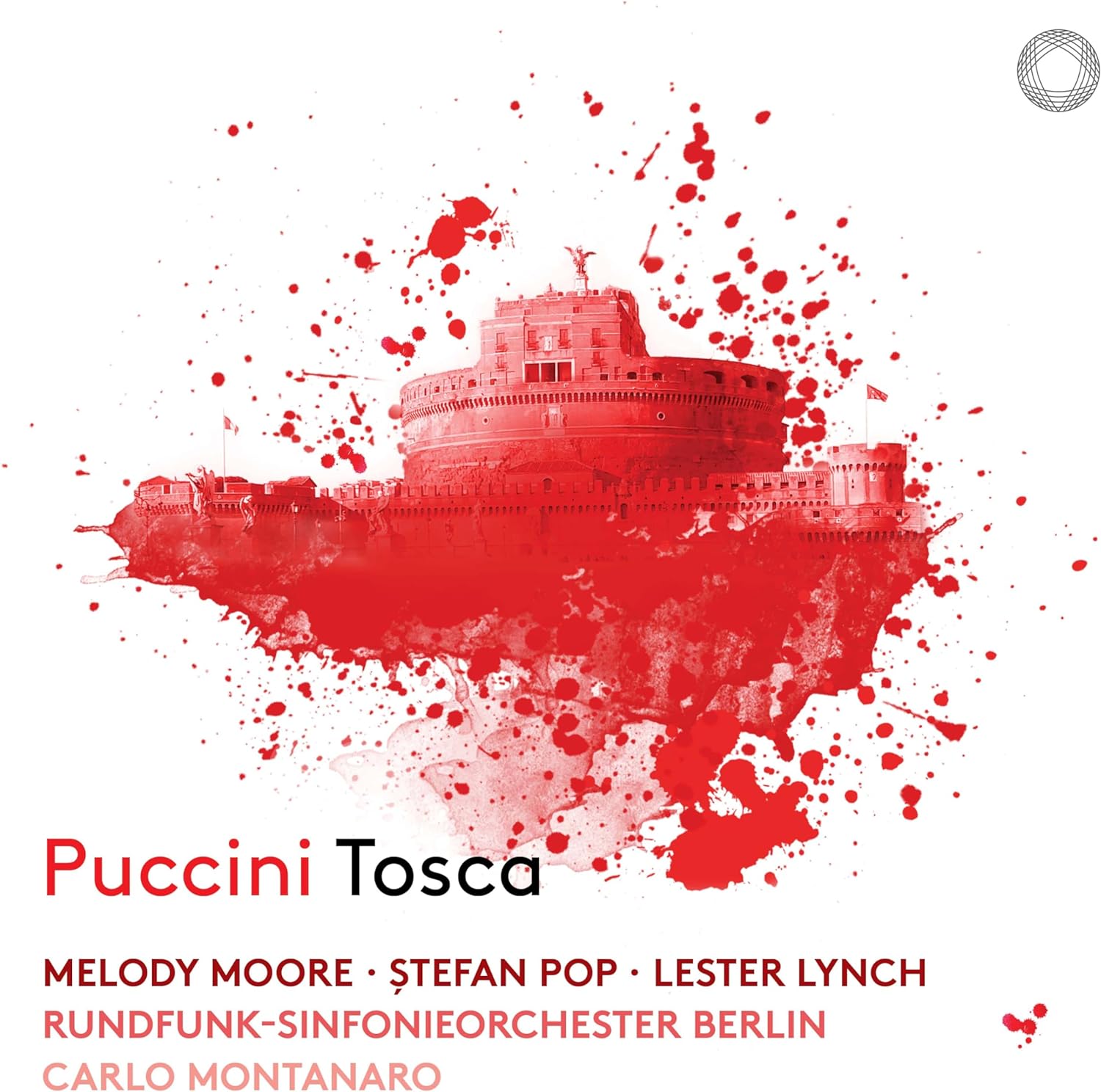
Floria Tosca: Melody Moore (soprano) Mario Cavaradossi: Ștefan Pop (tenor) Scarpia: Lester Lynch (baritone)
Kinderchor der Deutschen Oper Berlin, Rundfunkchor Berlin. Rundfunk-Sinfonieorchester Berlin/Carlo Montanaro
Rec. April 2022, Haus der Rundfunks, Berlin
Notes and synopsis in English and German included.
Penatone PTC 5187 055 (110)
Tosca is one of the most popular operas in the repertoire and yet there have been remarkably few totally successful recordings over the years, possibly because the mono De Sabata, recorded way back in 1953, is widely considered one of the greatest opera recordings ever made; in fact number one in Ralph Moore’s list of untouchables. The stereo age brought us a couple more, like Karajan’s first with Leontyne Price and Davis’s with Caballé, but the list is quite small, and these too are quite old. A new modern studio recording is certainly timely.
So, let’s start with the positives. I was listening to the stereo layer, which I tried both through speakers and headphones and the sound really is superb, warm and well balanced, though I did wonder whether the off-stage chorus in ACT II were a little too much in the foreground. I suppose it might be dramatically apt to have the on-stage soloists struggling to be heard, but in that case, I would have thought a sound effect of Scarpia impatiently closing the window were necessary. As it is, the chorus just stops abruptly in mid-phrase for no apparent reason. The Berlin Rundfunk Sinfonieorchester may not be as famous an ensemble as those in Milan and Vienna, but they acquit themselves very well.
Unfortunately, the conductor, Carlo Montanarlo is rather too literal and prosaic. He rarely lets the music flower and flourish, and his conducting comes across as rigid and perfunctory, moving the music along too fast, almost as if apologising for its eroticism. Great Puccini conductors, like De Sabata and Karajan, understand the importance of rubato, but there is no sweeping lyricism in sections like the orchestral accompaniment to Tosca’s exit in Act I or her entrance in Act III. He is also unable to sufficiently rack up the tension in the second act, or in the lead-up to the shooting in Act III. His conducting is altogether too polite and lacking in passion.
Tosca is sung by the American soprano, Melody Moore, who has already recorded the roles of Butterfly, Giorgetta in Il Tabarro and Minnie in La Fanciulla del West. She has also recorded a recital disc, which is a tribute to another erstwhile famous Tosca, Renata Tebaldi. She has a voice of the right size and weight for the role, though it loses colour a little at the very top. Like so many modern-day singers, she is somewhat sparing in her use of chest voice. There is no exciting plunge into chest when she sings the line Io quella lama gli piantai nel cor. And her whispered È morto! Or gli perdono! Is completely ineffective. Vissi d’arte is rather lovely, possibly because Monatanarlo finally relaxes a bit and allows the music to breathe. I found her a plausible Tosca with a beautiful voice, but a little anonymous. At no point does she begin to challenge the likes of Callas, Price, Tebaldi or Caballé.
The tenor, Stefan Pop,, has a pleasant, but essentially lyric voice and I see that, according to his Wikipedia entry, he is more known for the bel canto repertoire. He acquits himself quite well in Recondita armonia and the Act I love duet, but is stretched by Vittoria! Vittoria in Act II. He also sings a sweet-toned O dolci mani but E lucevan le stelle suffers from a surfeit of sobbing and consequent vibrato, possibly to make up for the lack of passion coming from the pit.
But the noose around this Tosca’s neck is the baritone, Lester Lynch as Scarpia. He has an unpleasant, wobbly, woofy baritone that leaks air at every emission. It’s possible, I suppose, that he cuts an imposing figure on stage, but that doesn’t come across on disc and he is a serious blot on the performance, his vocal inadequacies not allowing him to create a real character. Memories of Gobbi and Taddei are not expunged.
Nor, I’m afraid, are memories of Callas, Tebaldi, Price and Caballé or Di Stefano, Carreras, Corelli et al. I suppose that I might have enjoyed this performance of the opera if I’d come across it at a provincial opera house somewhere, but, in all but matters of sound, this set doesn’t begin to compare to those classic recordings of the past that I mentioned above.
Incidentally, most CD issues of the opera have Act I on the first CD and Acts II and III on the second, but Pentatone inexplicably split Act II over the two CDs, the break coming just after Tosca has blurted out the location of Angelotti. Why? This makes no sense at all.
In conclusion, with a different baritone and a more sympathetic conductor, the soprano and tenor might have put in a much more creditable performance. As it is one can rest assured that the De Sabata recording with the exceptional team of Callas, Di Stefano and Gobbi remains “untouchable”. That recording is mono of course (though it sounds remarkably good in the 2014 Warner transfer) so if stereo is I must, I can confidently recommend Karajan with Price, Di Stefano and Taddei or Davis with Caballé, Carreras and Wixell. There is also a recording with Tebaldi, Del Monaco and George London, conducted by Francesco Molinari-Pradelli, who may not be the most imaginative of conductors, but is a great deal preferable to the placid Montanarlo.
Other cast Angelotti: Kevin Short (bass) Spoletta: Colin Judson (tenor) Sacristan: Alexander Köpeczi (bass) Sciarrone: Georg Streuber (baritone) Jailer: Axel Scheidig (bass) Shepherd boy: Lean Miray Yüksel (soprano)




 Philip's Assortment Box