De Los Angeles and Björling in Madama Butterfly

paco214_530x

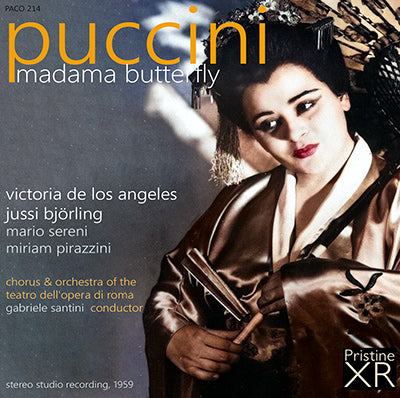
This Pristine XR Remastering of De Los Angeles’ second 1959 recording of Madama Butterfly has already been favourably reviewed twice before on MusicWeb International, once by Ralph Moore (review) and once by Morgan Burroughs (review), and I can add little to what they have said. We have De Los Angeles in one of her best and most conducive roles and Björling singing with golden tone. In Pristine’s newly re-mastered transfer of the stereo original, surely this is self-recommending, and who am I to disagree? However, I should mention that there is an earlier 1955 De Los Angeles recording, in mono sound, with Di Stefano as Pinkerton, Gobbi as Sharpless and conducted by Gianandrea Gavazzeni, which, in some ways, surpasses the performance we have here. It is available at super bargain price from the Regis label and was favourably reviewed by Christopher Howell here.

That earlier recording’s chief asset is the conductor, Gavazzeni, who makes far more of the score than the rather dull and prosaic Santini, and it makes me realise how important the role of the conductor is in Puccini. Indeed, all the best sets have benefited from a great conductor; Karajan, for both Callas and Freni, Serafin for Tebaldi, Barbirolli for Scotto and Pappano for Gheorghiu. And, if Santini has at his disposal an excellent cast, Gavazzeni’s is just as good, and in some respects even better. Björling, for Santini, sings with golden tone, but is just a trifle stiff. This was to be Björling’s last recording, and the heart condition, which would end his life at the early age of 49, was already apparent. Indeed, he collapsed during one recording session of the Act I love duet and needed several days to recover before he was able to continue. This could account for his relative stiffness. Di Stefano, on the other hand creates a real character. Carelessly charming in his exchanges with Sharpless and genuinely seductive in the love duet, he is suitably devastated by what he has done in the last act. I don’t see Pinkerton as a villain or an out and out cad. He is just an impulsive young man, who gives little thought to his actions at the beginning of the opera. Young men like him are ten a penny on any American college campus and Di Stefano portrays him to the life.

Sereni is a sympathetic Sharpless for Santini, but Gobbi, for Gavazzeni, surpasses him in verbal acuity and De Los Angeles is in slightly fresher voice in the earlier recording, though the difference is marginal.

What is not in doubt is the improved sound picture in the later stereo recording, especially in Pristine’s remastering, which opens up the sound quite a bit. I should also mention that Pristine as usual provide downloads of the full score and libretto, whereas the Regis issue of the earlier recording just comes with notes and a synopsis. Whichever version you go for, you will get one of the most touching Butterflies on disc.


Pristine’s Re-master of Björling’s Cav and Pag.

paco209_fdbcae84-e953-4879-bd72-570e6effee64_530x

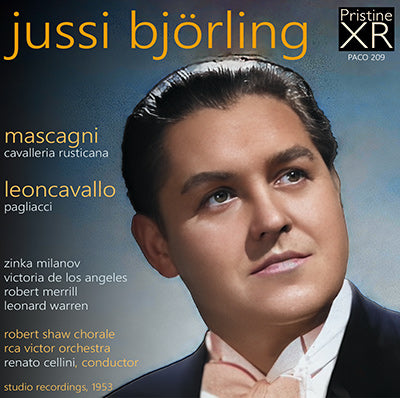
A photo of Jussi Björling graces the cover of this Pristine issue, and he is without doubt the main reason to hear these recordings. It is always a pleasure to hear his beautiful voice, musical phrasing and ringing top notes, though I’m not sure he would ever have been perfectly cast in either role. But before coming to Björling himself, it might be instructive to consider other elements of the recordings.

Both operas were recorded in 1953 in New York with the RCA Victor Orchestra and the Robert Shaw Chorale under Renato Cellini and sound remarkably good in these Pristine transfers, so good, I almost thought they were in stereo. I hadn’t heard either performance before, so I have nothing to compare the Pristine transfers to, but they are admirably clear and spacious and a good deal better than the contemporaneous Serafin recordings with Di Stefano and Callas. The Serafin Pagliacci is in reasonable mono sound, but unfortunately the Cavalleria Rusticana suffers from overload and distortion, which no amount of re-mastering would seem to be able to overcome. Still, I wish that these Cellini performances were half as exciting.

Cellini’s conducting is at least idiomatic, his tempi well chosen, but neither opera really catches fire and they both remain somewhat studio bound. The professional Robert Shaw Chorale sing in both operas. They are faultless in execution, but I couldn’t help picturing them all in prim white shirts and blouses, standing, score in hand, in choir banks. They don’t for one second conjure up the sound of lusty Sicilian peasants or excited Italian village folk. The La Scala Chorus on the Serafin set, may not be so polished, but they have this music in their blood and are much more convincing.

I suppose I should preface my discussion of the solo singers with a confession that I have never much liked Zinka Milanov, or at least not on any of the recordings I have heard, which were all made quite late in her career. From the outset she sounds far too mature, almost indistinguishable from Mamma Lucia in her initial exchanges and completely uninvolved in poor Santuzza’s plight. Björling, who could sometimes be accused of being a little cool, is at his most impassioned in their duet, but she remains phlegmatic and stolid. She is no better in the duet with Robert Merrill’s Alfio, who, in any case, is a bit too jovial and avuncular. Björling’s Turiddu is beautifully sung and, as I mentioned, he does try to inject some passion into his exchanges with Santuzza, but there is something about the inherent nobility in his tone that makes him not quite right for the caddish Turiddu. As always, his singing gives great pleasure, but I can’t quite believe in him.

That said, I find his Turiddu more convincing than his Canio. Yet again, the role is beautifully sung, Vesti la giubba heart-breaking and deeply felt, but can anyone really believe that this is a man who would be driven to double murder? I certainly can’t. I have much the same problem with the Nedda of Victoria De Los Angeles. She is in her best voice, warm and feminine and, like Björling, has the virtue of always being supremely musical. She sings quite beautifully, especially in her Ballatella, but, as with her Carmen, she sounds altogether too ladylike. I don’t necessarily want Nedda to be portrayed as a heartless minx, as was often the case in days gone by, but I need to believe that she has the mettle to defy a bully of a husband and have an affair behind his back.

Nor is there any menace in the Tonio of Leonard Warren, who, in the prologue, could be singing about anything at all really. Gobbi, on the Serafin set, does not have such a beautiful voice, nor such easy top notes, but he makes every word tell. Merrill has here been given the secondary role of Silvio, but his Silvio doesn’t sound much different from his Alfio. Compare Panerai, who sings both roles on the Serafin recordings, utterly menacing as Alfio and ardently seductive as Silvio.

Jussi Björling was, without doubt, one of the greatest tenors of the last century and I always take pleasure in the sheer beauty of his voice, his musical phrasing and his wonderfully free and ringing top notes, so it was a pleasure to hear him here, even if these two roles are not ones to which I think he was really suited. For the rest I derived the most pleasure from De Los Angeles’s beautiful and musical singing as Nedda, even if she too is caught in a role that was not particularly suited to her gifts.

Not a top choice for either of these two operas then. For all that they are in better sound than Serafin’s recordings of the two operas, I would still place the Serafin performances ahead of them. Di Stefano can be a bit wayward, but he is better at expressing the caddish side to Turiddu and the unhinged side of Canio that turns him into a killer. Callas is, as usual, hors concours, both as a wonderfully impassioned Santuzza and a free-spirited and mettlesome Nedda, and she is in fine voice on both recordings. Gobbi is equally brilliant as Tonio and their confrontation bristles with drama. There are also better choices amongst more recent recordings, such as Karajan’s sumptuously recorded La Scala set for DG, which no doubt remains a first choice for many.

As always, Pristine should be commended for including with the CDs a package of downloadable items, which includes a copy of the same recording as an MP3 download, together with full scores, both piano and orchestral, and a full libretto in PDF format. Most major companies these days don’t even include an online link to a libretto.

Pietro Mascagni (1863-1945)
Cavalleria Rusticana (1890)
Turiddu: Jussi Björling (tenor)
Santuzza: Zinka Milanov (soprano)
Alfio: Robert Merrill
Mamma Lucia: Margaret Roggero (mezzo)
Lola: Carol Smith (mezzo)

Ruggero Leoncavallo (1857-1919)
Pagliacci (1892)
Canio: Jussi Björling (tenor)
Nedda: Victoria De Los Angeles (soprano)
Tonio: Leonard Warren (baritone)
Silvio: Robert Merrill (baritone)
Beppe: Paul Franke (tenor

Robert Shaw Chorale
RCA Victor Orchestra/Renato Cellini
Rec. 1953, Manhattan Centre, New York
Full scores and libretto included as downloads
Pristine Audio PACO209 (2 CDs 141)


Berlioz’s Les Nuits d’Eté – a comparative review of ten recordings

Les Nuits d’Eté is one of my favuorite orchestral song cycles and, along with Strauss’s Vier letzte Lieder, must be one of the most recorded works for voice and orchestra. The songs were originally written to a piano accompaniment and we don’t know why Berlioz chose these six particular texts by his contemporary, Théophile Gautier. Though not really conceived as a cycle, they do make a satsifying programme with two lighter songs framing three deeply emotional outpourings. Berlioz orchestrated Absence in 1846 then orchestrated the remaining songs in 1853, suggesting a mezzo-soprano or tenor for Villanelle, contralto for Le spectre de la rose, baritone (or optionally mezzo or contralto) for Sur les lagunes, mezzo or tenor for Absence, tenor for Au cimetière and mezzo or tenor for L’île inconnue, though nowadays it is more regularly sung by one singer, usually a mezzo or a soprano. It has been recorded by tenors, baritones and bass-baritones and even countertenors.

They have been recorded umpteen times and Ralph Moore has done an exhaustive comparison of most of these recordings, which I recommend to anyone who loves the songs. You can view it at http://musicweb-international.com/classrev/2019/Aug/Berlioz_nuits_survey.pdf.

I have ten recordings in my collection and these are the ten I listened to over a period of two days. The songs respond to a variety of different approaches and I enjoyed my task immensely.

r-17739049-1615146774-6216.jpeg

Vctoria De Los Angeles recorded the cycle in 1955 with Charles Munch and the Boston Symphony Orchestra, when she was in superb voice. As always there is a great deal of pleasure to be derived from her singing, her tone suitably plaintive in the middle songs and smilingly bright and playful in the outer songs, which, predictably, is where she is most successful. What I miss is a deeper vein of tragedy, something more grandiloquent in the middle songs, where what we need is a touch of Cassandre and Didon. De Los Angeles reminds me more of a Marguerite. She is in warm, velvety voice, and this is nonetheless one of the most satisfying accounts around. Sonically it can’t measure up to any of the later stereo recordings.

r-4226020-1359064159-2900.jpeg

Nor, unfortunately can the Steber version with Dimitri Mitropoulos and the Columbia Symphomy Orchestra. The first impression when listening to this version is of the sheer security and perfect focus of Steber’s beautiful voice. The cycle doesn’t get off to a very impressive start, with Mitropoulos’s too deliberate tempo for Villanelle. It is actually close to the metronome mark of crotchet = 96, but it seems plodding and Mitropoulos fails to make the woodwind light enough. But Steber is gorgeous. She can expand the tone gloriously at a phrase like et parmi la fête étoilée in Le spectre de la rose and the quality remains wonderfully rich down below. Throughout Steber is keenly responisve to the poetry. Au cimetière, for instance, has a real sense of tragic foreboding. What a superb Cassandre she might have been. Definitely a prime contender. If only it had been in better sound.

517nnfbtual._ac_

Now here is something rather different. The countertenor voice is not one you would expect to hear in this music, but David Daniels has always had a velvety, rich sound and his version comes as something of a pleasant surprise, though, more used to hearing him in the music of the Baroque, I did wonder if this version might be a product of the gramophone. He did however sing it in the concert hall and his is a voice I’ve never had trouble hearing in the hall or theatre, so maybe I’m wrong. Daniels has excellent French, a perfect legato and is ideally steady throughout, with a much greater range of tone colour than you would expect from a countertenor. As always, his phrasing is wonderfully musical and John Nelson provides excellent support with the Ensemble Orchestral de Paris. Ultimately, for all his musicality and way of commuicating the text, I’m not sure the countertenor voice is what the songs require, but it is a very interesting experiment which Daniels almost pulls off.

r-10811227-1504704037-6832.jpeg

It was quite a shock to plunge from Daniels to the darkly pungent tones of Agnes Baltsa. Her French is often questionable and the voice and manner are arrestingly individual, with her varying her tone from song to song. I suppose you’d call her approach quite operatic. She adopts an almost coy sexuality for Villanelle, choosing a more Dalila-like sensuality for Le spectre de la rose, languidly eliding some of the phrases. Some might find her plunges into chest voice jarring, but I rather like it. The singing can be a bit rough round the edges but you could never call her dull. Ralph Moore suggests that she brings more than a touch of her Carmen to the songs, and I’d agree. It’s not how I’d always like to hear them, but it’s certainly a very individual and occasionally thrilling take on them. Jeffrey Tate and the London Symphony Orchestra provide excellent support.

r-5824261-1403705173-5318.jpeg

Régine Crespin is the only version included here by a French singer and it is really good to hear the language enunciated so clearly, especially after the idiosyncratic French of someone like Baltsa.

Now Crespin’s version is so famous that it has been a prime recommendation for the work ever since it was first issued in 1963 and dissenting opinions are likley to be viewed with incredulity, but, unlike its coupling of Ravel’s Shéhérazade, I’m not sure the Berlioz holds up that well. For a start, there is a deal of sloppy orchestral playing from L’Orchestre de la Suisse-Romande under Ernest Ansermet, and, for another, Crespin’s singing often tends to the lugubrious. There is no sense of mounting rapture at the arrival of the rose, no sense of despair in Sur les lagunes, no plaintive yearning in Absence. The singing is altogether too civilised, and, however musical and tasteful her singing , however elegant her phrasing, Crespin remains aloof and uninvolved. She is at the oppoiste pole from Baltsa’s often wild and wayward version, but I miss Baltsa’s dramatic involvement, which I ultmately prefer. I see that I’m not alone in my opinion, which is supported by both Ralph Moore and David Cairns (in Song on Record, Volume II). A controversial opinion, no doubt, but I’m sticking to it. Crespin is most successful in the final song, which responds to her vocal equivalent of the ironically arched eyebrow. Another mark against her is that she unaccountably alters the order of the songs, placing Absence before Sur les lagunes, which destroys the balance of the cycle. Intonation is occasionally suspect too, especially in Au cometière.

r-5925026-1621620398-8177.jpeg

Colin Davis’s multi-singer version is something of an inconclusive experiment. However ineresting it is to hear the songs sung more or less by the voices Berlioz suggested, I think the cycle hangs together better when captured by a single voice. Nor do any of the singers challenge the best of other versions by single singers. Frank Patterson, who has a rather whiny, nasal timbre is granted two songs, Villanelle and Au cimetiére, neither of which he does justice to. Josephine Veasey, an appreciable Berlioz singer, sings a plausible Le spectre de la rose without really illuminating it, and John Shirley-Quirk tends to growl in the lower regions of Sur les lagunes. The most successful of the singers is soprano Sheila Armstrong, who sings in excellent French and turns in a nicely plaintive Absence as well as a charmingly flirtatious L’île inconnue. One would expect Sir Colin and the London Symphony Orchestra to give a brilliant version of the score, but the effect is somewhat somnolent and low key. Interesting but inconclusive.

r-8458350-1462019569-7396.jpeg

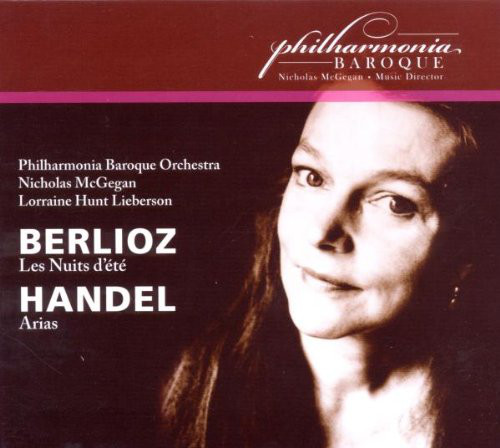
Next we come to the wonderful Lorraine Hunt Lieberson, recorded live at a concert in 1991 or 1995 (the booklet isn’t entirely clear on this point). It has to be said that the Philharmonia Baroque Orchestra under Nicholas McGegan are not quite up to the standard of the ensembles in some of these performances, but they nonetheless provide sensitive accompaniment to Hunt Lieberson’s superbly detailed and deeply heartfelt performances. Throughout she is totally inside the music, her response to the poetry seeming totally spontaneous and natural. Unerringly she captures the mood of each song, certain phrases remaining etched on the memory, for instance the blank, desparing tone at the end of Au cimetière, which, though  she switches to smilingly insouciant joy for L’île inconnue, creeps back into her tone for the closing measures when she reminds us that not all is happy au pays d’amour. The voice is surpassingly beautiful, the singing intensely concentrated and she communicates so much. What a great loss she was to the musical world.

r-15146607-1589535837-3883.jpeg

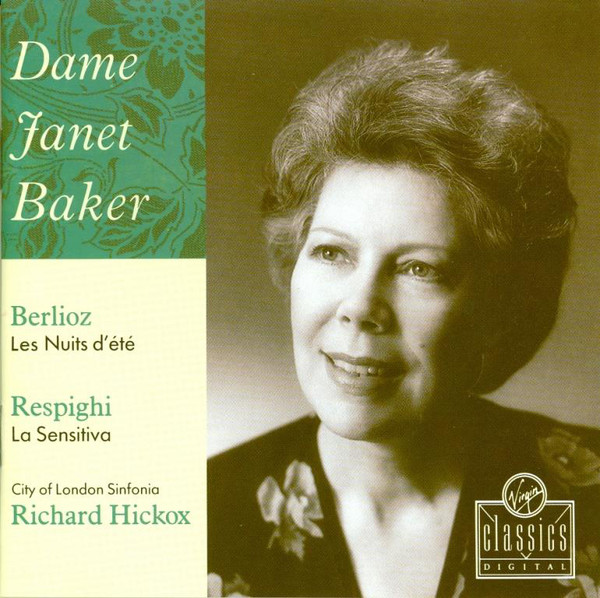
Finally, I come to three versions by the great Dame Janet Baker. The most recent ( recorded in 1990) and the one I will discuss first, was one of her last (maybe her last ever) recording. made shorly after she had retired from the concert platform. By this time her great artistry cannot quite hide the hint of strain in the upper reaches, the discoloration on certain vowels and the loosening of vibrations on sustained high notes. In no way is this competitive with her two other vesions (one live under Giulini and the famous studio one under Barbirolli), so I will only comment by saying I heard Baker and Hickox perform the cycle not long before this recording was made and, live and in the concert hall, it was still an amazing experience.

r-9879493-1487856491-9833.jpeg

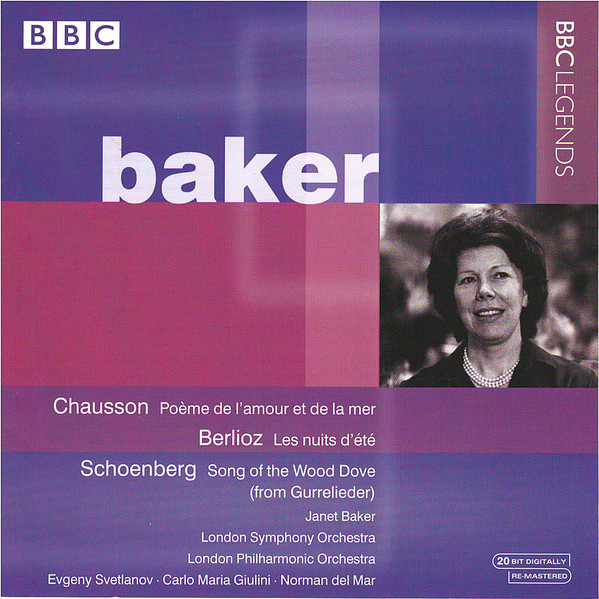
The live Giulini account, taken from a concert at the Royal Festiva Hall in 1975, must be amongst the slowest on disc and it is remarkable that Baker can sustain these speeds; but sustain them she does, luxuriating in the added breadth that Giulini gives her, her breath control quite astonishing. The recorded sound is a trifle muddy and we hear the occasional coughs that go along with live music making, but the specificity of her response to the text is quite extraordinary and there is a concentrated intensity about this performance, which is no doubt enhanced by the presence of a live audience. If I continue to prefer the studio performance, that could be because it is the one by which I got to know the songs and it is no doubt imprinted on my brain. It also, of course enjoys better sound. Both interpretations are absolutely and unequivocally superb. Baker’s stage roles included both Cassandre and Didon and she brings something of the character of their music to these songs too.

r-8436535-1461577724-3437.jpeg

Baker enjoyed a very special relationship with Sir John Barbirolli and of course made a few important recordings with him before he died in 1970.  Apart from the above recording of Ravel and Berlioz they can be heard in famous recordings of Elgar’s Sea Pictures,  Mahler’s three orchestral song cycles and Elgar’s Dream of Gerontius, all very special and irreplaceable.

The New Philharmonia are in fine form and provide some of the best orchestral playing on any of these performances. Villanelle is perhaps a little too determinedly jolly, but after that the performance just gets better and better. Baker starts Le spectre de la rose almost confidingly, as if whispering into the ear of the sleeping girl, swelling into the glorious mini climax at Et parmi le fête étoilée, Tu me promenas tout le soir. Her tone turns both sensual and erotic when the rose arrives from paradise, and then she sings the phrase Mon destin fut digne d’envie in one glorious, long breath. This might just be the most wonderful performance of the song ever put down on record.

From there we are plunged into the blank, desparing tone of Ma belle amie est morte. If she were the Act IV Didon in the previous song here she is Cassandre, singing in stark absolutes. Having reached a desolate climax the song fades away in a whispered close of utter dejection. She yearns sweetly in Absence, the voice taking on a soprano-ish lightness in the upper register, but maintaining its tragic depth for the line Ah, grands désirs inappaisées. Au cimetière is mesmerisingly hypnotic, conjuring up ghostly visions of graveyards at night, until finally gloom is dispelled and a smile enters her voice for L’île inconnue, with a coquettish twinkle on Est-ce dans la Baltique?

After listening to ten different recordings in two days, I find I love the cycle more than ever and all these recordings have something to offer.  I actually enjoyed them all. However if I had to choose but one  on that proverbial desert island, then it would have to be Baker with Barbirolli, though I’d probably find a way to smuggle the Hunt Lieberson with me as well somehow.

De Los Angeles as Manon

51n11kghrxl

Sir Thomas Beecham once quipped,

I would give the whole of Bach’s Brandenburg Concertos for Massenet’s Manon and would think that I had profited by the exchange

He was proabably only half serious, but I’ve always preferred Massenet’s setting of L’Abbé Prévost’s novel to Puccini’s. The Puccini tends to over-sentimentalise, where Massenet is much closer to the source material. Admittedly Massenet has Manon die before the couple sail to America, but in all other respects I’ve always felt that Massenet is much closer to the spirit of the original novel, and shows him in complete mastery of his craft, whereas Puccini’s opera is the work of a less experienced composer.

This classic  1955 recording has never really been bettered, and captures a style of performance practice you would never come across in today’s more international climate. Monteux, who conducted the work many times in the theatre, had the score in his bones as did his Opéra-Comique resources, and cast of French singers. The only non French singer is Manon herself, in the shape of Victoria De Los Angeles, who was nevertheless totally at home in French music, and well known the world over for her portrayal of Manon. She is unrivalled at conveying both the childlike innocence and worldly sensuality of the heroine, and she is here at her vocal best. Henri Legay might be considered a little too light of voice for Des Grieux, but he sings with elegance and style, and is totally convincing at suggesting the youth’s inexperience as well as his passion and obsession. The rest of the cast is as well nigh ideal as you could get, which leaves the small matter of the sound. EMI’s transfer is somewhat harsh and shrill, though it didn’t deter me from enjoying the set. It has also been reissued on Naxos and Testament, but I haven’t heard either of those, so can’t comment on whether they are any better.

Werther with Gedda and De Los Angeles

r-6908104-1564329145-1229.jpeg

Werther is an opera I like more each time I hear it. I first saw it back in 1970, in a lovely Glyndebourne production by Sir Michael Redgrave, when it toured to Newcastle-upon-Tyne. Werther was sung by David Hughes, who had enjoyed quite a success as a pop singer before retraining as an opera singer. He suffered from heart problems and sadly died from heart failure the day after collapsing on stage during a performance of Madama Butterfly at the London Coliseum. He was only 47. Looking at the Glyndeboure archives for 1970, I see the role of Charlotte was sung by Yvonne Fuller, who looks absolutely ideal in photographs. I wonder what happened to her.

To be honest I can’t remember all that much about the performance other than that I enjoyed it immensely and it has remiained one of my favourite operas ever since. These days I often hear people berating the character of Werther for being so “wet”, for want of a better word, but surely that is a rather glib reaction, which betrays a lack of understanding of the whole Romantic movement, and especically the Sturm und Drang movement that the original Goethe novel partly inspired. Musically, it is one of Massenet’s best operas and I like it a lot more than some of his crowd pleaser operas, like Esclarmonde and Le roi de Lahore.

Werther has been extraordinarliy lucky on disc, right from its first recording, made in 1931 and featuring Georges Thill and Ninon Vallin under Elie Cohen. Other strong contenders include Alfredo Kraus and Tatiana Troyanos under Michel Plasson, José Carreras and Frederica Von Stade under Colin Davis and, possibly best of all, Roberto Alagna and Angela Gheorghiu under Antonio Pappano.

Though the title role has been sung by lyric tenors such as Tito Schipa and Ferrucio Tagliavini, it still needs a fair amount of heft, as was demonstrated when I saw the opera not long ago at Covent Garden. Both musically and dramatically Juan Diego Florez was underpowered and the opera consequently failed to make its usual effect. Gedda was also a lyric tenor, but his essentially lyric voice had a great deal more carrying power than that of Florez and he is an effective Werther, his singing, as always, musical and involved.

By his side is one of the best Charlottes on disc, maybe even the best. Though a soprano, De Los Angeles’s lower and middle voice has the richness the role demands and her characterisation is spot on. Only Von Stade on the Davis recording approaches her for charm and vulnerability. This is a great performance. There is also excellent support from Mady Mesplé as a delightful Sophie and Roger Soyer as Albert.

Prêtre tends to overdo the histrionics and the Cohen, Davis and Pappano are all much better conducted, with the Davis and Pappano also enjoying better sound. Nonetheless this is one of the best recordings of the opera around, and absolutely essential for De Los Angeles’s superb Charlotte.

Gobbi as Simon Boccanegra

51hq2bkp62dl

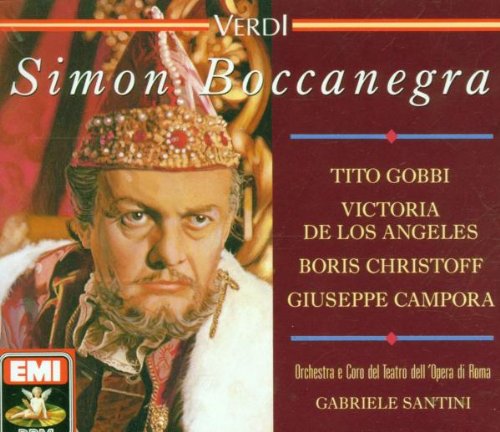
Abbado’s superb La Scala recording of Verdi’s great masterpiece pretty much sweeps aside all others, but this one, despite less than brilliant mono sound with an orchestra and chorus dimly recorded, despite Santini’s ploddingly prosaic conducting, demands to be heard, due to three distinguished, transforming performances.

Gobbi was in prime vocal form when the set was recorded, and though he does not quite have the vocal reserves of Cappuccilli, he creates the most rounded, most movingly tortured Doge you are ever likely to hear. Christoff, too, could hardly be bettered, brilliantly charting the change from implacable revenge to conciliation in the final scene with Gobbi’s Doge. To make our cup runneth over, we have De Los Angeles in one of her rare excursions into Verdi, singing with total communication, commitment and of course beauty of tone, particularly in the middle register, where most of the role lies. The downward runs in the final ensemble are absolutely exquisite. Campora may not be quite on their level (and Carreras on Abbado’s set is almost ideal) but he isn’t bad at all.

All three principals, I’d take (just) over their DG counterparts, but that recording benefits from Abbado’s superb pacing of the score, the wonderful playing of the La Scala orchestra, and warm, beautifully balanced stereo sound. So, for the opera itself, I’d take Abbado, one of the classic opera recordings, but for three superbly characterful performances, I choose Santini.

Il Trittico with Gobbi and De Los Angeles

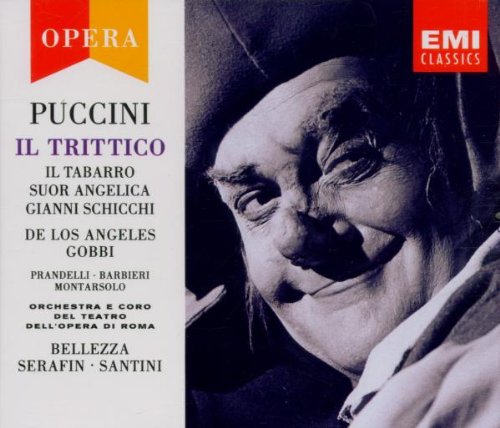
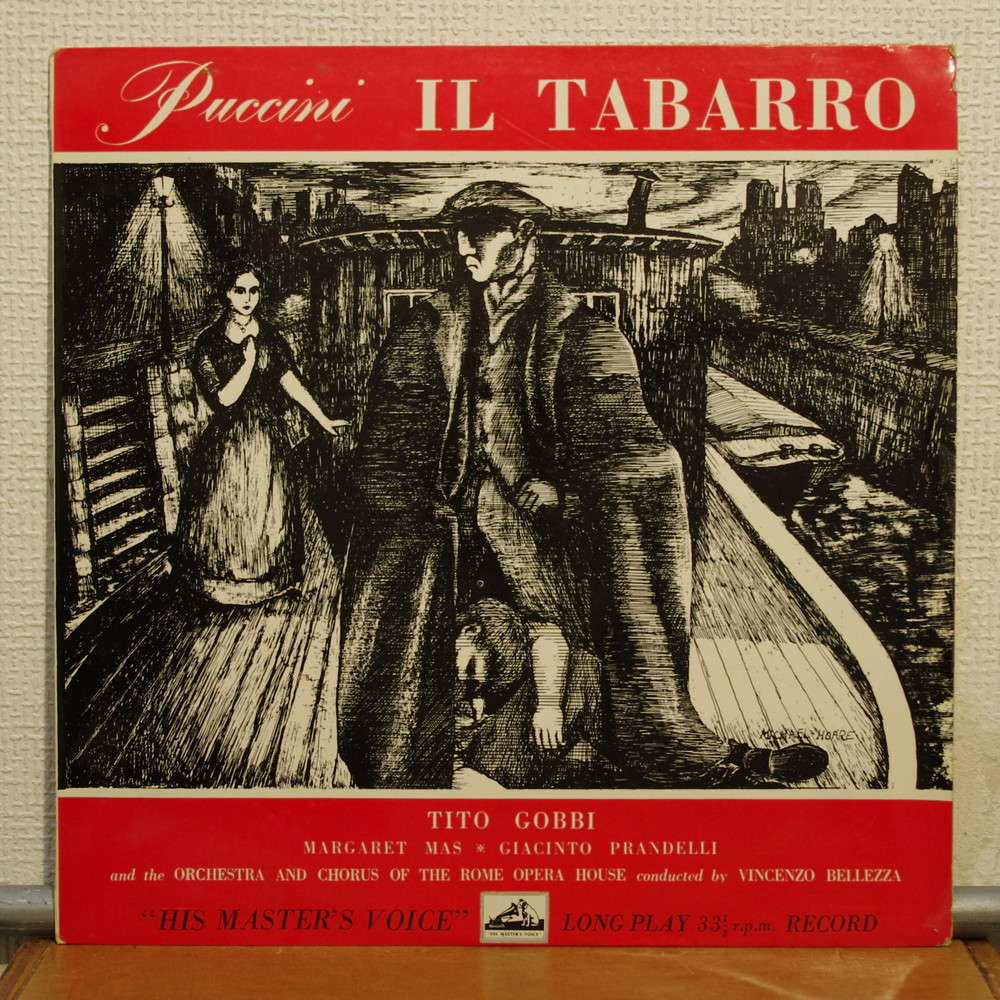
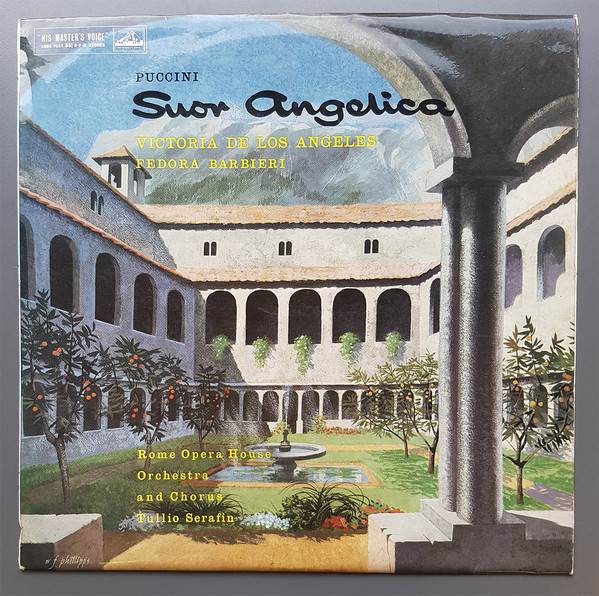
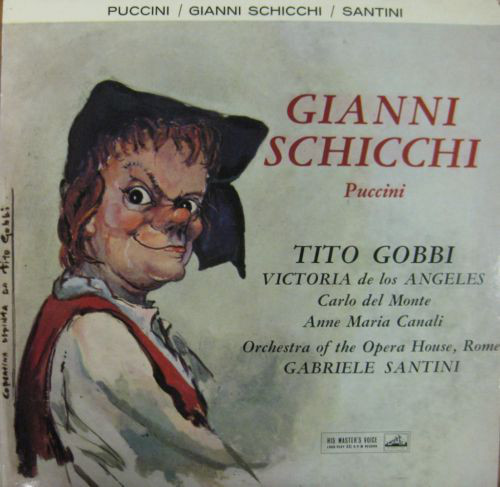
This isn’t a complete recording of Il Trittico. Admittedly all the operas use Rome forces, but each opera is led by a different conductor, and they were all originally issued at different times. The first two, released respectively in 1956 and 1958 are mono, but Gianni Schicchi, released in 1959 is stereo. The only unifying element is that De Los Angeles and Gobbi both appear in two out of the three operas. Still, it was useful and inevitable that the individual releases would eventually be grouped together and, as far as I’m aware, they have not been available singly since.

115770328

Bellezza’s conducting is efficient rather than inspired and the recording is a bit muddy, but this recording of Puccini’s terse piece of grand guignolIl Tabarro, has at its heart one towering performance in the Michele of Tito Gobbi, a characterisation fit to set next to his Scarpia and Rigoletto. Not only is the role powerfully sung, but we see deep into the man’s tortured soul, the violence bubbling beneath. In no other studio performance of the opera do we feel Michele’s pain with quite such terrifying immediacy.

None of the other singers is on his level, but they are apt enough for their roles. Margaret Mas, a singer who appears to have done nothing else on record, sounds a bit mature, but that suits the role of Giorgetta well enough, as does the slightly raw tone of Giacinto Prandelli’s Luigi. The smaller roles are all well characterised, but it is Gobbi who puts the seal on this recording.

r-15484063-1592553930-2863.jpeg

This has always been my least favourite of the triptych, as I find its over-sentimentalised quasi religiosity a bit too much for my taste. However it is difficult not to resist such generous hearted sincerity as we get here from the adorable Victoria De Los Angeles, superbly supported by the veteran Tullio Serafin, who doesn’t overdo the sentimentality. Fedora Barbieri presents a truly magisterial and implacable Zia Principessa, aristocratic, cold and dispassionate in her treatment of Angelica.

However even in a performance as committed as this, the ending stretches my suspension of disbelief just a bit too far and ultimately I prefer the sense of repressed passion and sexuality implied in the Scotto/Maazel version, which plays out almost like a scene from Powell and Pressburger’s Black Narcissus. In their hands, Angelica’s final vision comes across more as a drug-fueled hallucination, which helps to ameliorate my problems with the piece.

On the other hand I wouldn’t want to be without De Los Angeles’ beautifully sung and characterised Angelica. She is a little stretched by the highest reaches of the role, but in general the voice sounds absolutely lovely and her singing is as musical as ever.

r-3214102-1320768570.jpeg

Verdi had his Falstaff and Puccini had his Gianni Schicchi, though Puccini’s comedy is a lot blacker and more cruel than Verdi’s.

Gobbi was brilliant in both comic roles of course, but he presents two very different characters. His Falstaff was all genial bluster, a lovable rogue, where his Schicchi is a clever schemer, with more than a touch of the venal tempered by a genuine love and affection for his daughter.

This is probably one of the best things Santini did for the gramophone, and the performance is superbly paced, with wonderfully pointed characterisations from the supporting cast, the libretto so crisply delivered that you can all but taste the words. I find myself chuckling out loud quite a few times. Carlo Del Monte might seem a bit light of voice, but for once Rinuccio sounds like the young man he is supposed to be, and Victoria De Los Angeles is simply adorable as Lauretta – none better on disc.

Gobbi recorded the role again towards the end of his career (under Maazel, with Domingo as Rinuccio and Cotrubas as Lauretta), but this one, the only one of the operas in this set to be recorded in stereo, remains my first choice.

De Los Angeles in La Traviata

51ust0qa2nl._ac_

Victoria De Los Angeles has long been a favourite singer of mine and her Violetta satisfies on so many levels. She is a little strained by the tessitura of the first act, but the voice is generally clear and beautiful, her singing always musical and deeply felt. As in everything she did, the sensitivity and sincerity of the performance are most affecting and she is without doubt one of the best Violettas on disc. What I miss is that sense of desperation and impulsiveness inherent in the character. Her Violetta is touching, but not overwhelmingly tragic as it is with Callas, who does tend to spoil me for all comers.

She has a good supporting cast with Carlo Del Monte a manly and forthright Alfredo and Sereni a sympathetic Germont, as he is in Callas’s Lisbon performance.

I sometimes feel Serafin’s virtues are rather underestimated. He paces the score brilliantly, particularly good in the choruses, which can sometimes outstay their welcome. If I’m honest, I rather prefer his approach to the more interventionist Kleiber. The cuts traditional at the time are observed, so no cabalettas to Alfredo’s and Germont’s arias.

If Callas, particularly in London, remains my yardstick for this opera, this is nevertheless one of my favourite studio sets and I might even place it just above Cotrubas/Kleiber.

Victoria De Los Angeles sings Chants D’Auvergne


Many of my generation will no doubt have got to know Canteloube’s gorgeous arrangements of Auvergne folk songs through the recordings of Victoria De Los Angeles. On LP I only had the first album recorded in 1969, which had a selection of songs on one side and her recording of Chausson’s Poème de l’amour et de la mer on the other, but this reissue couples only the Canteloube songs to the second all Canteloube album entitled Pastorale and recorded in 1974. Some might also remember that famous Dubonnet advert which used an arrangement of the gorgeous Baïlèro, lazily and yearningly sensuous in the performance under review. I can’t now think of this song without the De Los Angeles version coming into my mind’s ear.

De Los Angeles is in many ways the songs’ ideal interpreter, steering a sort of midway course between the more abrasive style of Madeleine Grey and the senusality of Anna Moffo. She has great fun with the colourful language and folk elements, exuding the bright eyed charm for which she is famous, but is also wonderfully expressive in the more melancholy songs, and the Lamoureux Orchestra under Jean-Pierre Jacquillat provide excellent support, all bathed in a warm acoustic.

There are now a lot of recordings of these songs out there (when the first album was released, I’m pretty sure there were only the early recordings of the aforementioned Madeleine Grey, a small selection by Anna Moffo and a couple of discs on the Vanguard label by Netania Davrath) and there are now a lot more sets out there by the likes of Kiri Te Kanawa, Jill Gomez, Dawn Upshaw, Véroniqe Gens, Frederica Von Stade and others, and all of them have their attractions, but these performances by De Los Angeles will always have a special place in my heart.

Elisabeth Schwarzkopf – The Complete Recitals 1952 – 1974

81szngqwkwl._sl1500_

Issued to mark the one hundredth anniversary of Schwarzkopf’s birth in 2015, this fantastic 31 disc set brings together all the recital discs Schwarzkopf made in the LP age with her husband Walter Legge between the years 1952 and 1974, adding the live 1953 Wolf recital from Salzburg, with Furtwängler and the farewell to Gerlald Moore at the Royal Festival Hall in 1967, in which she shares the platform with Victoria De Los Angeles and Dietrich Fischer-Dieskau. It is a considerable achievement, covering operatic excerpts and a huge range of Lieder and song, both with orchestra and piano. It is not quite the full story, for their was to be one further recital to come, made for Decca in 1977 and 1979, and simply called To My Friends.

Schwarzkopf started out as a coloratura, singing roles such as Zerbinetta, Blonde and Sophie, but the voice was never entirely comfortable in the stratospheres, and she soon graduated from Sophie to the Marschallin, from Susanna to the Countess. A serious and dedicated artist, over the years she wittled down her operatic roles to a mere five (Mozart’s Countess, Donna Elvira and Fiordiligi and Strauss’s Marschallin and Countess Madeleine) so that she could concentrate on her recital work, which was her first love. The voice was not particularly large, but a warm, lyric soprano, shot through with laughter, her technique faultless and, though it lost something of its bloom in later years, it was always firm and true with no trace of excessive vibrato or wobble. She has been saddled for many years with the adjective ‘mannered’, but, listening to these CDs now, what I hear is incredible intelligence and specificity, a voice put at the service of the composer, not the other way round. People love to make fun of the fact that, when invited onto Desert Island Discs she picked all her own records, but, if you listen to the porgramme now, she uses them as illustrations of key points in her life. She was actually severely self-critical and those few records represented the best of herself and her collaborators, for she was quick to give credit to the conductors and accompanists she had worked with, and of course to her husband Walter Legge, who produced all her records. John Steane, who loved Schwarzkopf unreservedly, spent some time listening with her to her records in her retirement, and was surprised at how rarely a recording got her full stamp of approval. Listening sessions were interrupted by continuous cries of  “too much of this, too little of that. Intonation, missy” and so on, and just the occasional “ah yes, missy, that’s good”. In other words she was as hard on herself as she famously was on her students, who could find working with her frustrating, as she barely let them get a few bars out; but this was the only way she knew how to work herself, and what do teachers do other than pass on their experience to others?

There is a lot of music to get through here, though most of the CDs are rather short in length, being exact reissues of the LPs as they appeared, each in its own sleeve with the original artwork. The only cause for regret has nothing to do with the music or the music making, but with the fact that no texts and translations are included. This is a criminal omission with an artist like Scwharzkopf, who paid such attention to the words, colouring her voice to get the maximum amount of meaning from them. These days it should be easy to produce a weblink or CD-Rom with them all, and I’m guessing that most collectors wouldn’t mind paying a little extra just to have them. As it is, I am having to hang on to all my previous issuse of this material, simply to keep the texts.

So on to the actual discs and a potted review of each one.

Disc I. Schubert Song Recital with Edwin Fischer

r-2628987-1330502065.jpeg

This is a classic recital, with Schwarzkopf’s voice at its freshest and loveliest, the lighter songs delivered with a delightful smile in the voice, the darker ones with an arresting sense of their dramatic potential. For instance, in Gretchen am Spinnrade the words sein Kuss are sung almost in horror, as Gretchen recalls the moment which sealed her destiny. Though always alert to the mood and meaning of the songs, however, there is also much that is admirable as pure singing, the legato superb, the line firmly held. Fischer is an estimable partner rather than just an accompanist. I particularly love the way he makes the piano accomaniment in Auf dem Wasser zu singen conjure up the image of moonlight bouncing off the water. A delight from beginning to end.

Disc 2. Mozart Operatic Arias

r-2628957-1519128396-8605.jpeg

Here accompanied by the Philharmonia Orchestra under John Pritchard (no Sir back then), Schwarzkopf sings a collection of arias from roles she did sang on stage as well as some she didn’t. Not many sopranos would attempt in the same recital arias for the Countess, Susanna and Cherubino or for Zerlina and Donna Anna, but, rare in Mozart, she brings a different voice character to each, all boyish eagerness as Cherubino, sensuous charm as Susanna, girlish seduction as Zerlina, who in turn sounds quite different from her Susanna,  and patrician elegance as the Countess. Her Donna Anna is not quite so successful, and of course we are reminded that her stage role was that of Donna Elvira, a role which she made very much her own, but Non mi dir is nonetheless delivered with a resigned sadness and the closing coloratura section rings out with real conviction. Illia’s Zeffiretti lusinghieri is altogether lovely.

Disc 3. Strauss Four Last Songs and Capriccio Closing Scene

r-5864796-1551371617-6728.jpeg

Through her two recordings , Schwarzkopf has always been associated with Strauss’s ever popular Vier letzte Lieder, though very few people can agree on which of the two recordings is the better. I tend to prefer the later one with Szell, both for the improved sound picture and Schwarzkopf’s more mature thoughts on the work, but both are superb, and this one benefits from her greater ease in the upper register. The closing scene from Capriccio, made before she had recorded the full opera under Sawallisch, is lovely in every way with the character superbly delineated and  the voice soaring out over the orchestra.

Disc 4. Strauss – Scenes from Arabella

byub9vljxmgqdj2cpnxicihrgxuq8ikj

Staying with Strauss, these excerpts were recorded in 1954 and it always seems a pity to me that Legge didn’t record the whole opera. That said, the opera has its longeurs, for me anyway, and perhaps this is all that I really need. Schwarzkopf is perfectly cast as Arabella and is well contrasted with Annie Felbermeyer, who plays Zdenka here. Josef Metternich is a superb Mandryka, none better on disc, and the cast is fleshed out with such names as Nicolai Gedda as Matteo, Walter Berry as Lamoral and Murray Dickie as Elemer. Lovro von Matacic is much more in tune with Strauss’s medium than Solti on the roughly contemporaneous set with Lisa Della Casa, and, who knows, if this had been recorded complete, it may well have become the touchstone recording for all time.

Disc 5. A Lieder Recital

r-6257908-1414952376-6290.jpeg

Schwarzkopf returned to Lieder with piano for her next record, a mixed recital with Gerald Moore at the piano. It opens with Bist du bei mir (once attributed to Bach), and continues with mostly popular fare by Mozart, Beethoven, Schubert, Schumann, Brahms, Wolf and Strauss, with Schwarzkopf unerringly catching the mood of each song, whether it be the joyfully youthful exuberance of Schubert’s Ungeduld, or the wistful bliss of Schumann’s Der Nussbaum.

Disc 6. A Mozart Song Recital

r-5424298-1469949413-9765.jpeg

This Mozart recital with the great Walter Gieseking at the piano has deservedly achieved the classic status of the Schwarzkopf/Fischer Schubert recital. Recorded in 1955, it was recorded in stereo, and I put this down to the fact that Christopher Parker, who oversaw the stereo version of Der Rosenkavalier was the balance engineer. It was first issued in mono, and the stereo version emerged several years later.

It certainly deserves its classic status, as Schwarzkopf and Gieseking between them bring these simple songs to life as no other. I hear absolutely no artifice in the way Schwarzkopf characterises the songs, or in the way Gieseking mirrors his playing to her tone, making much more of the sometimes plain accompaniments than you would think was possible. They also manage to vary the approach to individual verses in strophic songs in a way which sounds completely natural. This is a wonderful disc.

Disc 7. A Recital of Duets by Monteverdi, Carissimi and Dvorak.

r-6487756-1420396182-9470.jpeg

Okay, so the Monteverdi and Carissimi duets are hardly authentic, but I can’t imagine anyone other than the most ascetic HIP advocate complaining when the singing is so beautiful, the voices charmingly intertwining and blending in delicious pleasure.

Schwarzkopf and Seefried had sung together on many occasions, and had already made duet recordings of the Presentation of the Silver Rose from Der Rosenkavalier (Schwarzkopf as Sophie, Seefried as Octavian) and excerpts from Hänsel und Gretel. Schwarzkopf was a huge admirer of Seefried, at one time stating that Seefried had naturally what others, including herself, had to work hard to achieve. Seefried’s slightly darker, more mezzoish timbre blended perfectly with Schwarzkopf’s brighter tone. The result is a winning combination, not only in the Dvorak duets that you would expect would suit them, but in the baroque items too, with Gerald Moore providing alert, lively support on the piano.

Disc 8. Walton – Scenes from Troilus and Cressida

640x640

Walton didn’t have much luck with casting for his opera Troilus and Cressida. He had originally wanted Callas for the role of Cressida, but Callas had no interest in contemporary opera and so he offered the role to Schwarzkopf, who was slated to sing in the UK premiere, but she too decided against it, and the role finally went to the Hungarian Magda Laszlo, who spoke no English at all. Scwharzkopf did however record these excerpts with Richard Lewis, the Troilus of the original production, a few months after its premiere.

It is a great pity that she decided not to sing the role, for she fills its soaringly lyrical vocal line with glorious refulgent tone. Her English is clear, if slightly accented, and the recording is a fine memento of what might have been.

Disc 9. Songs You Love

r-6611659-1423069567-5089.jpeg

This 1956 recital is a collection of popular songs of the type that might normally crop up as encores in a recital programme, starting with Quilter’s arrangement of Drink to me only with thine eyes, and continuing with pops by Hahn, Dvorak, Tchaikovsky and Grieg, all much more well known back then than they are now, no doubt. Singing in English, French and German, Schwarzkopf brings as much care to them as she does to the Lieder of Wolf. A lovely disc.

Disc 10. More Songs You Love

r-4554092-1368203657-8221.jpeg

This disc turns out to be the one more commonly known as The Elisabeth Schwarzkopf Christmas Album. This time she is accompanied by the Ambrosian Singers and the Philharmonia Orchestra under Sir Charles Mackerras in often gorgeously over the top arrangements of traditional Chiristmas carols and songs, though the disc starts gently with the original arrangement of Gruber’s popular Stille Nacht, on which Schwarzkopf is double tracked to duet with herself. Some might find it all a bit too sugary, but I love it and it has been a permanent part of my Christmas playlist for many years now.

Disc 11. Elisabeth Schwarzkopf Sings Operetta

r-6932366-1429810098-2485.jpeg

And so to one of the first Schwarzkopf discs I owned, arguably the greatest disc of operetta arias ever recorded, and pure unalloyed joy from beginning to end. Schwarzkopf may have been born in what is now part of Poland and brought up in Germany, but there is something absolutely echt Viennese about her singing of operetta, and her recordings of operettas by Strauss and Lehár remain touchstones against which all others are judged. Schwarzkopf makes no concessions to the material and sings with her customary attention to detail, but there is absolutely no suspician of artifice or over-inflection and the disc is guaranteed to lift the spirits of all but the most curmudgeonly.

Disc 12, 13 & 14. Hugo Wolf – Goethe Lieder, From the Italian Song Book, From the Romantic Poets

Schwarzkopf followed three discs of lighter fare with three discs of Wolf Lieder. The discs are quite short and all the material was reissued at one time on a two disc set in EMI’s Great Recordings of the Century series, and deservedly so. I would urge anyone who gets the present box set to also acquire the GRC release, as that comes with fuill notes, texts and translations, absolutely essential when listening to Wolf, especially in performances as finely nuanced and detailed as these. Schwarzkopf’s name, along with that of Fischer-Dieskau, has been indelibly associated with the songs of Hugo Wolf, and they, more than any other singers, were responsible for bringing Wolf’s name to prominence after the Second World War.

Schwarzkopf’s ability to sing with a sparkling eye and a smile in the voice is particularly suited to Wolf’s lighter songs, but she also has the pathos for the Mignon songs, and her yearningly intense performance of Kennst du das Land is arguably the greatest performance of a Wolf song committed to disc. At almost seven minutes it is the longest song on these three discs, and Schwarzkopf and Gerald Moore build the intensity in masterly fashion, using every colour at her disposal to convey every shade of meaning. Some might say that this attention to detail robs the performances of spontaneity, but I’d disagree. Though obviously thoroughly worked out in rehearsal, Schwarzkopf still experiences the song as it happens. Never have the words “mannered” and “arty” been so off the mark. Would that more singers today could sing with such attention to detail.

Disc 15. Schwarzkopf portrays Romantic Heroines

r-5197163-1441420871-6018.jpeg

Schwarzkopf sang Elsa at La Scala in 1953, but it didn’t appear much in her repertoire after that. These two excerpts from Lohengrin are quite superb, the duet with Christa Ludwig’s Ortrud (well known from the complete Kempe recording) absolutely thrilling. Elsa is sung on that recording by the wonderful Elisabeth Grümmer, and there can be higher praise than stating Schwarzkopf is her equal in every way. She makes a superb Elisabeth too, greeting the Hall of Song in joyful radiance, sincerely sorrowful in the prayer, the tone pure and ideally floated. The arias from Der Freischütz are also qukte wonderful and have a beauty and poise rarely achieved by others.  This is a glorious disc, one of Schwarzkopf’s very best..

Disc 16. Favourite Scenes and Arias

r-5407311-1392733108-8590.jpeg

Though Schwarzkopf sang Mimi early in her career, she didn’t sing any of the other roles featured on this disc. We don’t really associate her with Italian opera, though she made two excellent recordings of the Verdi Requiem and was an infectiously high spirited Alice in Falstaff. She might have made an excellent Desdemona too, if this scene is anything to go by, floating the tone ideally in the Ave Maria and alive to Desdemona’s anxiety and foreboding in the Willow Song. Her Lauretta is all youthful charm and her Mimi lovely in every way. The Smetana and Tchaikovsky are both sung in German. She is radiant in Marenka’s solo and, if Tatyana’s Letter Scene misses something of the girl’s impetuosity, the slow section has a satisfyingly inward quality.

Disc 17. Strauss – Four Last Songs and Five Other Songs with Orchestra

r-8053714-1454257966-6070.jpeg

This is one of the most famous records Schwarzkopf ever made and has remained a best seller ever since its first release. I’ve had it in one form or another since my teens, and, though I’ve listened to countless other versions of the Four Last Songs, and come to love quite a few of them, it is still the one I hear in my mind’s ear whenever I think of Strauss’s great apotheosis to the soprano voice. Schwarzkopf and Szell remind us that these are, after all, Lieder and not merely vocalises. They probe more deeply into the valedictory nature of the songs than any other I know, and the recording has a rich autumnal glow, eminently suited to their approach. In the last song, when Schwarzkopf sings So tief im Abendrot the effect is of a cathartic release, as if the whole cycle had been leading up to that moment. I don’t hear that in any other performance, and for this reason, Schwarzkopf/Szell still, for me, eclipse all competition. The other five songs are hardly less fine. A desert island disc if ever there were one.

Disc 18. Concert Arias and Lieder

r-6912111-1429369809-6057.jpeg

No doubt the success of their Berlin recording of the Four Last Songs prompted Szell to take Schwarzkopf and Szell back into the studio, this time in London with the London Symphony Orchestra. The first side of the LP was devoted to Mozart concert arias and the second to Strauss Lieder, the two cornerstones of Schwarzkopf’s work with orchestra. For Ch’io mi scordi di te she is joined by Alfred Brendel for the piano obbligato, the two artists intertwining their voices deliciously in duet, and she brings her familiar virtues of aristocratic phrasing and dramatic involvement to each aria. Schwarzkopf had her misgivings about the Mozart items, feeling that, though they are musicaly fine, the voice had darkened too much for Mozart. Maybe she has a point, but I’ll put up with the less youthful voice for the dramatic insights she brings to them. The Strauss songs are all gorgeous and wonderfully characterised, the turbulence of Ruhe, meine Seele contrasting immediately with the gently lulling tone of Meinem Kinde, and so on. For Morgen, she is joined by Edith Peinemann on the violin.

Disc 19. Mahler – Des Knaben Wunderhorn

r-6596266-1422781218-3112.jpeg

This was recorded and released before the Mozart/Strauss disc, which made me realise the discs aren’t numbered chronologically. No matter, it has been considered a classic since its release in 1968. Like the Four Last Songs, I’ve owned it since my college days, and it brings back memories of listening in my tiny room in student digs all those years ago. Some feel that the interpretations are too sophisticated for the essential folk-nature of the songs, but I’d argue that Mahler’s wonderful orchestrations, superbly rendered here by Szell and the London Symphony Orchestra, already take them quite a few steps from their folk song roots.

Personally, I marvel at the intelligence, the detail and the sheer beauty of the singing. In comparison others sound just too penny plain. Is it interventionist interpretation? Well, I suppose it depends on how you look at it, but everything these superb artists find is there in the music, if you take the time to look for it. It’s also a real collaboration between all three artists, the duet songs being some of the highlights of the set.

Disc 20. Wolf – Italienisches Liederbuch

r-9854022-1490010992-4657.jpeg

This was originally a two disc set, recorded at sessions in Berlin in 1965, 1966 and 1967, Schwarzkopf re-recording all the songs she had recorded back in 1959. With the two foremost Wolf interpeters of the day accompanied by Gerald Moore it is self-recommending, and remains the set by which all others are judged.

The songs are presented in the order they appear in the book, which really is the best way of doing them, and are mined for every shade of meaning by these two great artists, with the inestimable aid of Gerald Moore at the piano.

Discs 21 & 22 – Brahms – Deutsche Volkslieder

r-6745397-1505306295-7267.jpeg

Before anyone starts complaining of too much sophistication, one should point out that these are not really folk songs at all. Many were inventions of nineteenth century composers, and, in any case, Brahms’s accompaniments turn them into songs by himself. That said, the songs are probably best listened to piecemeal, rather than at one sitting, when they could be said to outstay their welcome.

Schwarzkopf and Fischer-Dieskau bring their familiar virtues of dramatic involvement and characterisation to the songs, and, though some may find their interventionist approach “mannered”, I prefer it to the somewhat penny plain singing we get from so many interpreters these days.

Discs 23 – 26 The Elisabeth Schwarzkopf Songbook Vols 1 – 4

The first of these discs collected together recordings made in 1957, 1958 and 1962 and was issued in 1966. Presumably the intention was to find a home for performances that had not otherwise found their way onto disc, and no doubt the success of the record prompted Legge and Schwarzkopf to put together three more discs in the same manner. It should be noted that Gerald Moore retired from the public platform in 1967 and, aside from a few tracks that were recorded before then, Geoffrey Parsons is the accompanist on volumes 2-4.

The programmes ranged wide. In addition to the more regularly encountered Schubert, Schumann and Wolf, they take in songs by Mozart, Mahler, Brahms, Strauss and Loewe, Debussy, Chopin and Liszt, Rachmaninov, Tchaikovsky, Mussorgsky and Stravinsky, Grieg and Wolf-Ferrari, though the Russian songs are sung in English or German translation.

Disc 27. Songs I Love

r-5425558-1393058255-1618.jpeg

Recorded at sessions in 1970 and 1973, with Geoffrey Parsons at the piano, this was, in all but name, another addition to the Songbook series, though this time concentrating on the two cornerstones of Schwarzkopf’s Lieder repertoire, Schubert and Wolf, with the addition of Schumann’s Der Nussbaum, revisiting material that she had recorded before. Though her artistry remains undimmed, we begin to be aware that this is no longer the voice of a young woman. Still there are rewards to be had in hearing how Schwarzkopf’s ideas on certain songs changed over the years, and we note that each new version is a re-thinking of what she had done before. There is never any suspicion of routine.

Disc 28.  Schumann – Frauenliebe und Leben & LIederkreis, Op.39

r-12878421-1543695515-6808.jpeg

This was Schwarzkopf’s last record for EMI, and she herself had her doubts. Ever the realist and her own strictest critic, she was well aware of the diminution of her vocal powers. In fact, had it not been for Legge urging her on, she would probably have retired sooner. “My voice was on the waning side, and all kinds of muscular powers had gone, and the breathing had gone. You can hear that the voice was getting old, surely. And one doesn’t like that and one tries to make do with all kinds of funny vowels, and oh dear it is really an awful thing.” She was particularly unhappy with Frauenliebe und Leben, which she felt should, in any case, be sung by a mezzo. “I made up by darkening the colour and all sorts of things.”

Of the two cycles, the Liederkreis is the more successful, but no amount of intelligent interpretation can disguise the fact that the voice is not what it was. Her final record was made for Decca a couple of years later, Legge’s rift with EMI being by this time complete. Legge died in 1979, and Schwarzkopf abruptly cancelled all further engagements. Without Legge’s constant encouragement, she was unprepared to continue. “He thought there woud be some moments which would be more memorable. But if you don’t have the voice you cannot put over what you would like to – you make ways round it technically, and by that time it has already vanished.”

Disc 29. A Hugo Wolf Recital

r-11472686-1516950984-6659.jpeg

For Disc 29 we go back almost to the beginning – a recording of a live all Wolf recital given in Salzburg in 1953, which was first released in 1968.

This was quite an occasion and something that Furtwängler himself had suggested. Wolf’s piano parts can be fiendishly difficult, and he apparently practiced hard for the occasion. There are some wrong notes, and some wrong entries here and there, “but it doesn’t matter. Furtwängler accompanying was an event, and so one had to do what one could to make it possibe. It was a service to Wolf, and to music, and a labour of love, that recital. With any other accompanist it matters if he cannot achieve the right tempi, but with Furtwängler it didn’t matter.”

Discs 30 & 31 – Homage to Gerald Moore

r-11272597-1515587597-4715.jpeg

The final two discs in the box are given over to the concert in February 1967, at which the musical world, with the aid of his three most regular collaborators, said goodbye to Gerald Moore. There are duets and trios, and each of the singers gets their solo spot, for Fischer-Dieskau a group of Schubert songs, for De Los Angeles a group of Brahms, and for Schwarzkopf, inevitably, a group of Wolf songs, starting with the song she made so much her own, Kennst du das Land. It is a joyous occasion, and the audience evidently enjoyed themselves enormously. It ends with Moore’s own solo arrangement of Schubert’s An die Musik, which is also a fitting end to this whole enterprise. However Warner have tacked on Schwarzkopf’s renditions of Abscheulicher! from Fidelio and Ah, perfido, which originally appeared as fill-ups for Karajan’s Philharmonia set of the Beethoven symphonies. Leonore may not have been a role for Schwarzkopf but her rendition of the big scena is surprisingly successful, the slow section having a wonderful innigkeit. She is immeasurably helped by Dennis Brain’s superb horn playing.

What a joy it has been listening to these thirty-one discs, all of such  consistent high quality. The word “mannered” has been overused to describe the art of Elisabeth Schwarzkopf, but, having listened to her almost exclusively over the last few weeks, it seems a long way short of the mark. I hear a singer who characterises, who makes choices based on the music and the text, who is never bland or merely pretty, though she can also make ravishing sounds, and these records represent an incredible achievement by one of the greatest singers of the twentieth century.