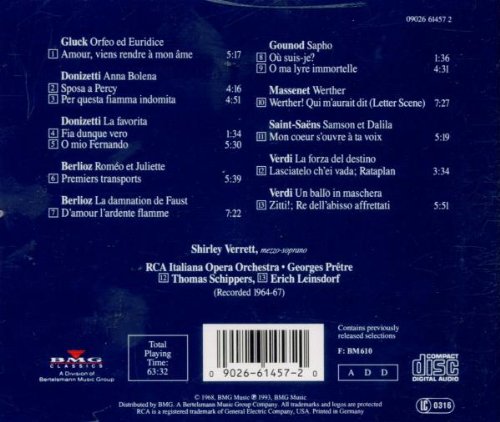
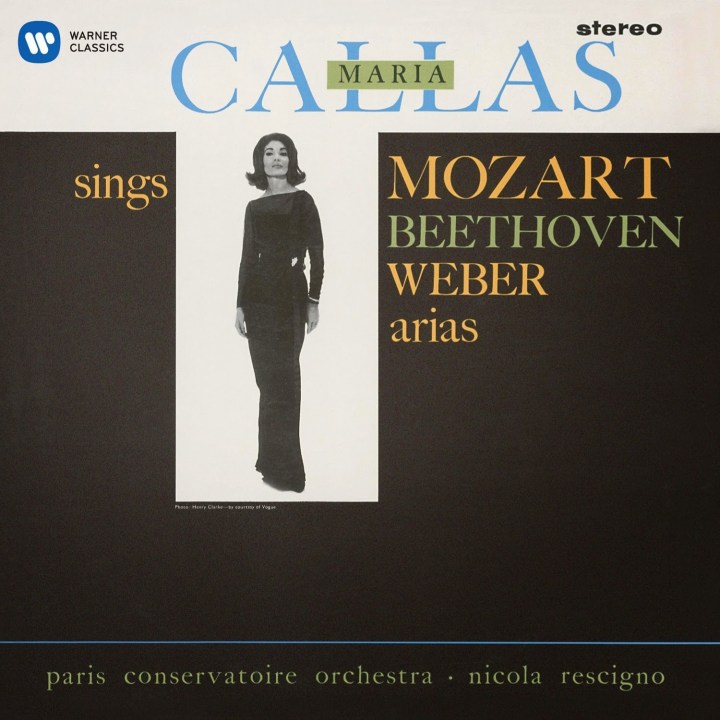
Shirley Verrett In Opera

51ajzxt2szl51wmswrrusl

This is a wonderful recital disc and a great example of the art of Shirley Verrett, dating from 1967, before she ventured into soprano territory.

It starts with a stunningly virtuosic rendering of Orphée’s Amour, viens rendre à mon âme from the Berlioz edition of Gluck’s Orfeo ed Euridice. Verrett maintains a true appreciation of the classical style, the chest voice used more sparingly than in Verdi, vibrato kept to a minimum. She also gives the piece a properly heroic dimension. Orpheus is after all srengthening his resolve at this point.

The two Donizetti items showcase her facility in bel canto, though with so many French items in the recital, it’s a shame she sings the aria from La Favorite in Italian. The short scene between Giovanna and Enrico from Anna Bolena gives us the chance to hear her engagement with the text in recitative, her legato line in the cavatina and her felxibility in the cabaletta. The aria from La Favorita also goes well, again displaying her deep legato in O mio Fernando, and her thrilling dramatic thrust in the cabaletta.

She is even better in the French items, giving us a beautifully restrained performance of Premiers transports from Berlioz’s Roméo et Juliette, and one of the best versions I have heard of Margeurite’s D’amour l’ardente flamme, one of the composers greatest inspirations. Verrett’s responses to the text are just that bit more vivid than those of Von Stade, whose eary French recital I listened to recently, with a much greater range of colour. Only Callas surpasses her in creating an atmosphere of utter forlorness and longing, though it has to be admitted that by the time she recorded it her actual tone couldl sound somewhat frayed and thin, where Verrett is firm and rich throughout.

She is grandly eloquent in the aria from Sapho, and wonderfully alive to the many changes of emoton in the Letter Scene from Werther, briliantly charting Charlotte’s mounting anxiety. This too is one of the greatest performances you will ever hear of the scene, and it is a great pity she never recorded the complete role.

It is also nothing short of tragic that she never recorded the role of Dalila, one of her greatest stage successes, and her beautiful reading of the famous Mon coeur s’ouvre à ta voix closes the recital proper. Disappointingly she follows regular performance practice, by splitting the phrase in Ah, réponds à ma tendresse in order to snatch an extra breath. It is so much more effective when sung, as Saint-Saëns indicated, in one long breath, though Callas is one of the only singers to do it that way. Aside from that one slight cavil, her comparative restraint is welcome and all the more seductive for letting the music speak for itself.

The Verdi pieces at the end are taken from complete recordings of the two operas. She is wonderfully vivid as Preziosilla and darkly commanding as Ulrica.

In all Verrett’s superb musicality is evident, and I often wonder why she recorded comparatively little, given the flurry of opera recordings made in the 1970s. That her superb Carmen was never committed to disc is little short of criminal.

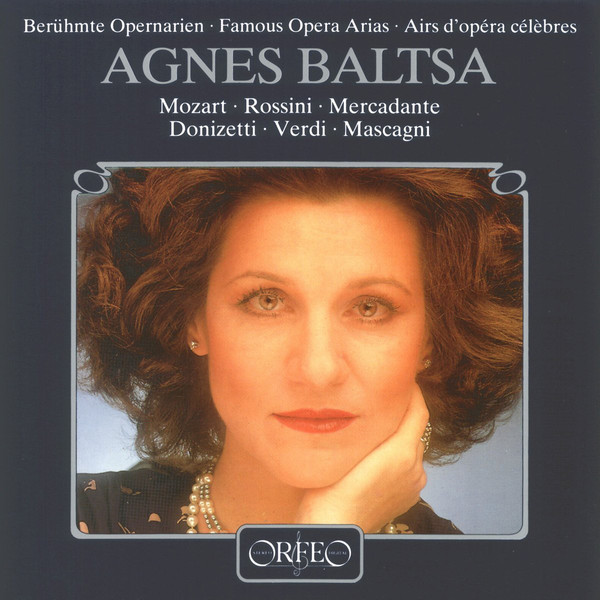
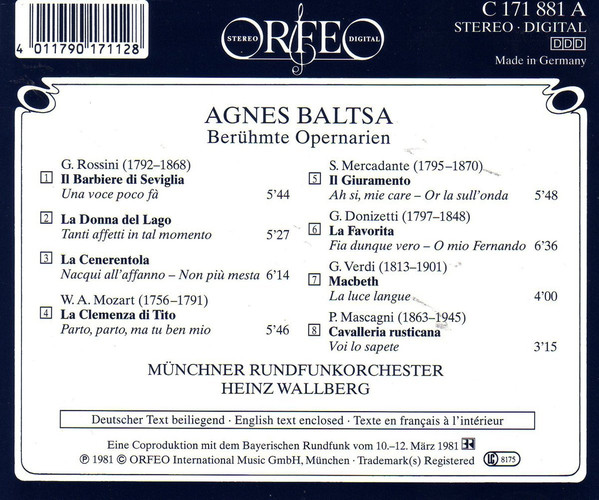
Agnes Baltsa – Famous Opera Arias

r-10771805-1504032686-5609.jpegr-10771805-1504032692-5381.jpeg

Good to be reminded of Baltsa’s pre-eminence as a lyric/dramatic mezzo at the beginning of the 1980s, when this recital was recorded.

The recital shows off to advantage her keen dramatic instinct, a tangily individual timbre, and a voice that was, at this time at least, absolutely seamless from top to bottom. Though she had already recorded Eboli and Amneris for Karajan, this recital concentrates for the most part on her work in the field of bel canto.

Baltsa was an exciting stage performer, as I can attest, having seen her live on many occasions and a great deal of that excitement comes through on disc, the climaxes of the arias from La Favorita and Il Giuamento being particularly thrilling. She has a strong vocal personality, which comes across stunningly on disc, and she realises the different demands of classical, Romantic and verismo music. If there is a limitation, it is that she rarely colours or weights the voice to suit the character she is playing, something more noticeable in a recital disc than it would be in a complete performance.

Stand out tracks for me were the aria from La Donna del Lago, where she gently caresses the opening cavatina, and the aforementioned arias from Il Giuramento and La Favorita. Indeed, on this showing it is a great pity that nobody thought to make a complete recording of the Donizetti opera with her, though preferably in the original French rather than Italian as it is here.

To sum up, this is a great memento of an important singer recorded when the voice was at its peak. I seem to remember that it was issued in the UK originally on EMI, but the recording was made by Orfeo, and it is that issue I have.

Callas in Anna Bolena- La Scala, Milan April 14 1957

dvn018_l

This live recording captures a great moment in operatic history, a moment when bel canto opera was finally taken seriously. As Montserrat Caballé once stated,

She opened a new door for us, for all the singers in the world, a door that had been closed. Behind it was sleeping not only great music but great ideas of interpretation. She has given us the chance, those who follow her, to do things that were hardly possible before her.

Sutherland, Caballé, Sills, Gencer, Scotto, even today’s DiDonato and Radvanovsky should all give thanks to Callas, for without this one production, their careers might have taken very different paths. True, Callas had by this time made people re-evaluate operas such as Lucia di Lammermoor and La Sonnambula, and she had had an enormous personal success as Rossini’s Armida in Florence in 1952, but it was La Scala’s spectacular production of this one opera, Anna Bolena which paved the way for the bel canto revival, and for the next few decades, long forgotten operas by Rossini, Donizetti and Bellini would be revived all over the world.

Such was the anticipation and excitement surrounding the production that it was covered in the international press, the UK’s Opera Magazine dedicating seven pages of its June 1957 issue to Desmond Shawe Taylor’s review.

There is no doubt that La Scala wanted to make a splash, and there is ample photographic evidence of Nicola Benois’ stunning sets, and the superb costumes. It was also the apogee of Callas’s collaboration with Visconti, though unfortunately, after the production of Gluck’s Iphigenie en Tauride, which followed they never worked together again. Visconti recalls.

It was rather beautiful, if I do say so myself. But not sublime as everyone else has said. It had atmosphere. Benois and I used only black, white and grey – like the grey of London – for the sets. The castle interiors, such as the broad staircase down which Callas made her entrance, were filled with enormous portraits. The colours of the costumes – Jane Seymour, the king’s new love, wore red, for example, and the guards scarlet and yellow – played off these sombre sets. But for Anna Bolena, you need more than sets and costumes. You need Callas. Each day I went with her to the tailor to watch over every detail of her gowns, which were in all shades and nuances of blue. Her jewels were huge. They had to be to go with everything about her – her eyes, head features, her stature. And believe me, onstage, Callas had stature.

Anna_18

The opera was heavily cut, so if you are looking for some ur-text version, you would have to go to studio recordings featuring Sutherland, Sills, Souliotis or Gruberova, but you would be missing out on the greatest Anna on disc, who, according to Richard Fairman in Opera on Record III,  “alone, of latter-day artists, has the power to grasp the emotional crux of every line and put it across.”

First off I should mention that this Divina Records transfer is in a different world of clarity from the murky EMI version, which unfortunately is also the source for the recent Warner transfer. Available as a download, I recommend it unreservedly.

Callas’s conception of the character of Anna is absolutely right from the word go. When asked by Rescigno, who conducted her in several concert performances of the final scene, why she phrased something in a certain way, she replied simply, “Because she is a Queen,” and it is this simple statement of fact that informs and shapes her portrayal. Callas’s Anna, though she suffers like any other woman, never forgets that she is a queen. In Callas’s own words.

Now history has its Anna Bolena, which is quite different from Donizetti’s. Donizetti made her a sublime woman, a victim of circumstance, nearly a heroine. I couldn’t bother with history’s story; it really ruined my insight. I had to go by the music, by the libretto. The music itself justifies it, so the main thing is not the libretto, though I give enormous attention to the words. I try to find truth in the music.

Contemporary reviews (and photographs) attest to the nobility of Callas’s bearing, and her first entrance vocally reflects that. Her first words have a natural authority and regal reserve, which gives way to deep private melancholy in the aria Come innocente giovane, which she sings in a gentle, perfectly focused half voice, her command of line and legato as usual superb. In the cabaletta, which is addressed to the court, she uses more voice, but the voice remains supple and she never loses for a moment that sense of regal composure.

In the following scene, where she unexpectedly meets Percy for the first time, she publicly retains her composure, though the conflicting emotions running through her heart are exposed in the many asides, and she starts the ensemble Io seniti sulla mia mano in a movingly intimate tone of infinite sadness.

These first scenes have introduced us to the character of Anna, regal, melancholy, troubled and noble, but the next scene is the one that will seal her fate and the one in which Anna will show her mettle. Alternately tender, then anxious, then truly terrified with Percy (who, it has to be said, behaves like a lovesick schoolboy throughout the opera), she is found in compromising circumstances by Enrico. Overcome with emotion she faints, but wakes to plead in melting tones her innocence in the superb ensemble In quegli sguardi impresso. Deaf to her pleas, Enrico asserts that the judges will decide her fate, and this is where Callas’s Anna really rises to her full stature, bringing to bear her queenly outrage in the words Giudice ad Anna! Guidice ad Anna! Ad Anna! Guidice! before launching the final stretta with an intensity that has to be heard to be believed. Singing with all the force at her command, she caps the ensemble with a free and secure high D, held ringingly for several bars. Anna_6

The first scene of Act II (or Act III in this performance) contains the magnificent duet for Anna and Giovanna, prototype for so many of those female voice duets that pepper the operas of Donizetti and Bellini. In it Giovanna confesses her guilt, is at first repulsed by Anna, and then magnanimously forgiven. No doubt Bellini had this duet in mind when he penned the first duet for Norma and Adalgisa in Norma. Simionato, superb throughout the opera, is a worthy foil here, but Callas again transcends the music. Her interjections into Giovanna’s confession run the gamut of emotions from shock and revulsion to resignation and acceptance, until, in one of the most moving moments in the opera, she forgives Giovanna in a voice quivering with emotion. Always notable is the way Callas achieves her effects without once disturbing the musical line. She recognises that in bel canto opera it is the arc of the melody which carries the emotional impact, her sense of line and rubato always instinctively right.

Anna_15

The final scene in the tower is one she programmed into recitals on several occasions and recorded (in its entirety) for EMI on what is arguably her most successful recital disc Mad Scenes. Many have since recorded it, so it has become relatively familiar, but one should remember that it was practically unknown at the time of this performance. In Al dolce guidami Callas’s voice takes on an unearthly, eerie beauty, the music seeming to emerge from the very depths of her soul. Though closely adhering to the score, she sounds almost as if she is extemporising on the spot, and the audience listens in rapt silence, hanging on her every note, until it erupts in a corporate outpouring of applause and cheers at its quiet close. Her delivery of the recitatives in the scene is again a lesson in how to weight and measure the proportions of each line. The final Coppia iniqua is sung with massive force, the famous rising set of trills, either ignored or sketchily sung by others, sung with both accuracy and intensity, her voice rising with power to the top Cs. This is Callas at her best.

She is ably, and brilliantly, supported by Gianandrea Gavazzeni, who gives her ample rein to play with the music in the quiet, reflective moments and urges the ensemble to absolutely thrilling heights in the big finales. Rossi-Lemeni’s Enrico is authoritative but woolly-toned and Raimondi’s Percy pleasingly Italianate without being particularly individual. Simionato, inspired to give of her very best, is the only other singer who comes close to Callas’s achievement, singing with glorious tone and dramatic involvement, but even she is less specific, more generalised, in her responses than Callas.

Anyone who has any interest in bel canto opera has to hear this set, which puts you in the stalls on one of the greatest nights in Callas’s career. At the end of his review Desmond Shawe-Taylor, asked if Anna Bolena could enter the international repertory.

With Callas, yes; without her, or some comparable soprano of whom as yet there is no sign, no. Many people think it a flaw in these old operas that they depend on the availability of great singer; but what would be the fate of the standard violin and piano concertos if there were scarcely a player who could get his fingers round the notes, let alone fill them with a lulling charm or a passionate intensity?

Well, eventually other sopranos did take it on, with varying degrees of success, and the opera is still performed occasionally today, but none of these other sopranos has quite matched the genius of Maria Callas, who was, without any doubt, not only a great singer and actress, but also one of the greatest musicians of the twentieth century.

Anna_10


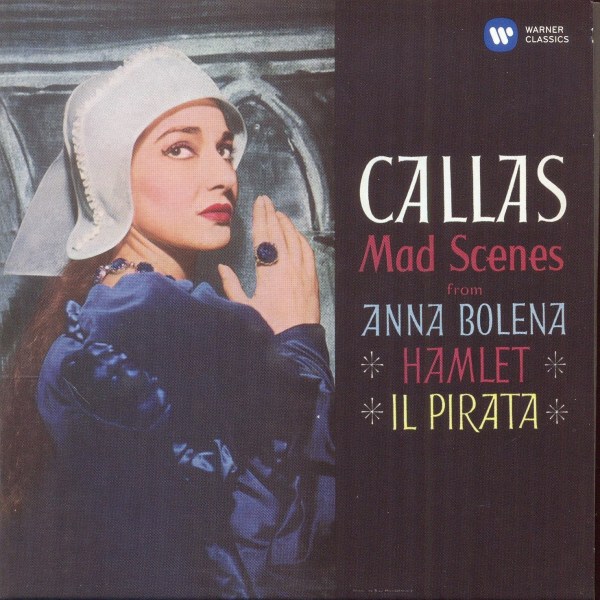
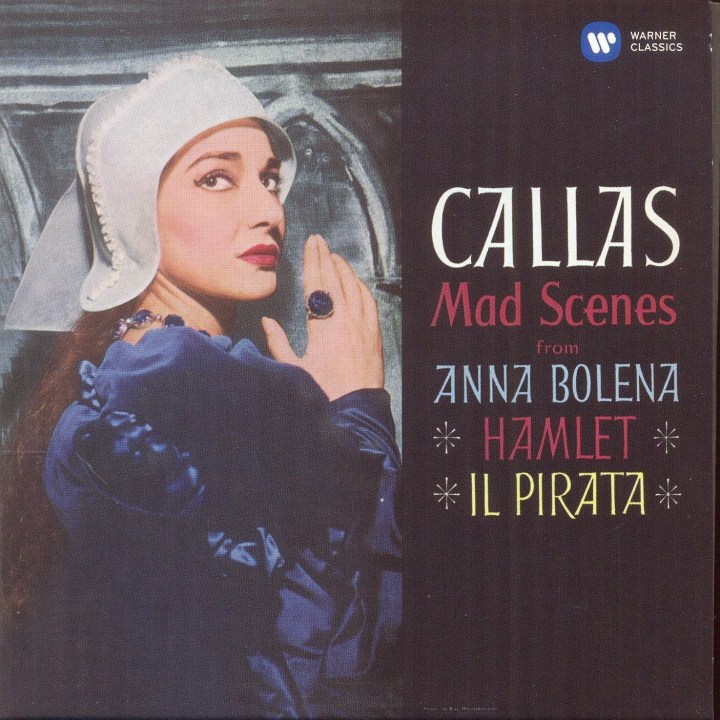
Callas Mad Scenes

917ij8qd0vl-_sl1500_

Recorded 24-25 September 1958, Kingsway Hall, London

Producer: Walter Legge, Balance Engineer: Harold Davidson

I’m going to stick my neck out and say that this is the best recital record Callas ever recorded, and by default one of the classic recital discs of all time. The 1954 Puccini disc and Lyric and Coloratura will find her in better voice, but this one sums up more than any other her greatness, her ability to bring alive music that can seem formulaic, and even plain dull in the hands of lesser artists.

I know I’ve said this elsewhere, but her singing has an improvisatory air about it, almost as if she is extemporising on the spot; how she achieves this whilst closely adhering to what is on the printed page is a mystery beyond solving. In the Anna Bolena finale, the recitative alone provides a lesson in how to bind together disparate thoughts and ideas. She brilliantly conveys Anna’s drifting mental state, whilst still making musical sense of the phrases and the long line. We can only imagine what she might have achieved in Monteverdi’s recitativo cantavo.

Once into the first aria, Al dolce guidami, her voice takes on a disembodied sound, as if the singing is coming from the far recesses of her soul. Her legato is as usual superb, her breath control stupendous, those final melismas spun out to the most heavenly lengths.  In the cabaletta Coppia iniqua, her voice takes on a majestic power, and she manages the rising set of trills with more force than anyone (Suliotis doesn’t even attempt them).

In the magnificent Final Scene from Il Pirata, she traces a long Bellinian line second to none; spinning out the delicate tracery of the decorations from Digli ah digli che respiri  onwards with magical fluency. A complete contrast is afforded when she rears back with the words Qual suono ferale, before launching into the thrillingly exciting cabaletta.

Ophelia’s scene from Hamlet is quite different. There is no formal recitative, aria, recitative, cabaletta construction. The scene is more a series of arioso segments interspersed with recitative and can often sound disjointed as a result. Callas binds together its disparate elements with masterly ease. Her voice is lighter here than in either the Bellini or Donizetti, and though the very upper reaches tax her somewhat, she sings with delicacy and consummate skill. The switch from Italian to French causes her no problems at all, her enunciation of the French text admirably clear. Yet again every fleeting expression, every change of thought is mirrored in her voice.

A listening companion of the eminent vocal critic John Steane once said to him regarding Callas, “Of course you had to see her,” to which he replied, “Oh, but I can, and I do.” This was her genius, amply displayed in this recital; the ability to make us see as well as hear.

I did try to make sound comparisons with my other CD issues of this recital, but, as usual, I had little sympathy for the task. Callas drew me in and all I wanted to do was listen. Without making direct comparisons then, I can only state that the sound here is very satisfactory, with plenty of space round the voice.

Late Callas Recitals

Recorded 1963 and 1964, Salle Wagram, Paros

Producer: Michel Glotz, Balance Engineer: Paul Vavaseur

It’s useful to take these three recitals together. They were recorded over a similar period, and Callas was using the sessions as a way of working on her voice after a long period of inactivity. Indeed in 1962 and 1963 she didn’t appear on stage once, giving only a few scattered concerts.

81unw2ww5cl-_sl1500_

None of these discs could be considered essential, but the Verdi disc is the most recommendable. The most undemanding of the pieces (Desdemona’s Willow Song and Ave Maria) is predictably the one that causes her the least problems, and also yields the most vocal pleasure. As always the mistress of mood, she differentiates clearly between the conversational exchanges and Barbara’s song, her legato impeccable in the Ave Maria. The Aroldo arias are superbly intense and dramatic, as is Eboli’s O don fatale, the O mia regina section beautifully moulded, and benefiting from her deep legato. The top of the voice is no more pleasant here than it is elsewhere on these three discs, but the drama carries her forward and it is easier to forgive. There is not much to commend Elisabetta’s Non pianger mia compagna, and I often wonder why it was included.

81mslzncryl-_sl1500_


The Rossini and Donizetti fails to ignite her dramatic sensibilities quite so much, and there are plenty of uncomfortable moments. However there are still times, when we glimpse what Callas might have done with this music a few years before. Her Cenerentola lacks sparkle, but the scale passages are wonderfully supple and smooth. This is a serious Cenerentola, though, given what she suffers before singing this aria, such a reading is not entirely inapt. That said, there is a much better version of her singing this at a concert in London, where she finds a lightness of touch that eludes her here. Elsewhere, much of the singing sounds tentative, much more so than on the Verdi. Though she unerringly captures Mathilde’s sighing loneliness in the aria from Guglielmo Tell, there is a rather lifeless air about the recording, not helped by the omission of a chorus in some of the items. Nevertheless her sense of style never deserts her.

81jmshecyul-_sl1500_

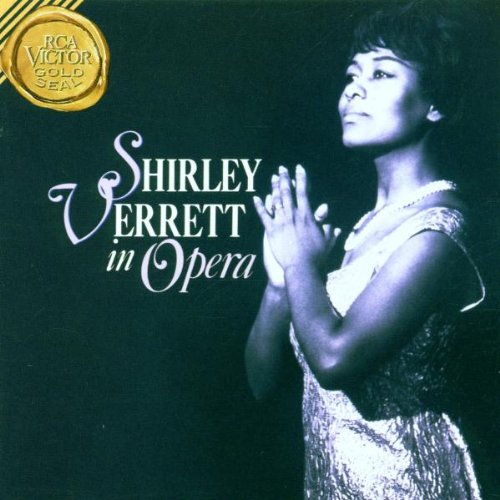
Mozart, Beethoven and Weber are not composers one would naturally associate with Callas. That she could be a great Mozartian is evidenced by her test recording of Donna Anna’s Non mi dir, and a couple of blazingly defiant concert versions of Costanze’s Martern aller Arten, sung in Italian as Tutte le torture. (It is a little known fact that Callas was actually La Scala’s first ever Costanze.) The less said about Porgi amor and Donna Anna’s arias on this album, though the better. Elvira’s Mi tradi goes a lot better, and the recitative, with its contrasting emotions, is superb. It’s mirror piece, Beethoven’s concert aria Ah perfido also goes well, and, as it lies somewhat lower, suits her much better. It is without doubt the most successful item on the recital. Ocean, thou mighty monster is also superbly dramatic, but her peculiarly accented English is somewhat bizarre, and again the climaxes are something of a trial.

I find my attitude to these late recitals can vary each time I listen to them. Sometimes I find the wobbles, the insecure and unsupported top voice, the acidulous tone difficult to take; others I barely notice it, so taken up am I by her musical instincts. The Verdi I would hate to be without, the other two for very occasional listening only.