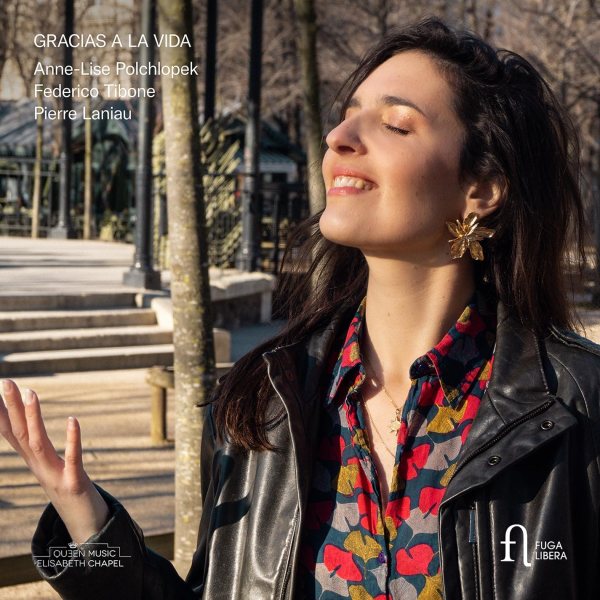
It seems not a month goes by without a new recital record from a young artist making an impression. Recently I’ve welcomed recital records from Benjamin Appl, Fatma Said, Harriet Burns, Rachel Fenton and Eva Zalenga , and July saw a recommendation for Julieth Lozano-Rolong’s new disc from Dominy Clements. To this list can now be added the name of French mezzo-soprano, Anne-Lise Polchlopek, a winner of several song competitions, and now an associate artist of the Queen Elizabeth Music Chapel, where this recording was made.
This recital may at first glance appear to be a hotchpotch of different styles, embracing classical Lied, folk and popular music, but Polchlopek somehow integrates these different musical styles into a satisfying whole, and the recital benefits from being listened to at one sitting. It doesn’t get off to the best of starts with her somewhat over-articulated and over-acted singing of Bernstein’s Old Lady Tango (I am easily assimilated) from Candide, but she then sings a beautiful version of Strauss’s Wiegenlied, with a lovely legato line, her mellifluous mezzo wrapping the child in its warm embrace.
From Germany we travel to Spain and France, where we stay for the remainder of the recital. Toldrá is followed by Chaminade, then we switch to guitar accompaniment for Hubert Giraud’s La tendresse, staying with the guitar for an extremely effective performance of Falla’s Nana, from his Siete canciones populares españolas.
We go back to the piano for Fauré’s Les berceaux, in which she builds nicely to the climax, and then we have Messiaen’s early Trois melodies, where she captures to perfection the ecstasy of the writing, especially in the final song, la fiancée perdue.
These are followed by three songs in a lighter vein by Chaminade, Pauline Viardot and Gerónimo Giménez, all wonderfully characterised. Perhaps incongruously (but somehow it works) Voi che sapete from Mozart’s Le nozze di Figaro acts as a bridge to Michel Polnareff’s Mes regrets, a beautiful song about lost love, which is followed by Fauré’s Toujours.
This in turn is followed by Gérard Jouannest’s La chanson des vieux aimants, with lyrics by Jacques Brel, a song I had previously only known in a version by Judy Collins. Suffice it to say that Polchlopek’s intensely moving performance put any thoughts of Collins out of my mind completely.
Throughout the piano accompaniments of Federico Tibone contribute wonderfully to the success of the disc, as do the guitar accompaniments of Pierre Laniau, who accompanies her on Tamás Méndez’s charming Cucurrucucu paloma, which I seem to remember was a favourite of Nana Mouskouri. He also accompanies her on the Habanera from Bizet’s Carmen and Satie’s La diva de l’empire, though I did feel the Bizet was slightly out of place here, coming, as it did, after the piano accompanied Poulenc Les métamorphoses and before the Satie.
We return to piano accompaniment for Montsalvatge’s Canto negro, which she sings with charm and spirit, relishing the yambambós, as Victoria De Los Angeles did before her.
All three participants come together for the final song, Violetta Parra’s Gracias a la vida, a fitting end to a journey on which Anne-Lise Polchlopek has proved to be a most musical guide. Throughout she clearly and meaningfully enunciates the text, and it is clear she has a rare gift for communication that makes her an ideal recitalist.
Unfortunately, though the notes accompanying the disc are in English, the online texts are only in the original language, French, Spanish, German, or in the case of the Bernstein, English, and translations would have helped for a total appreciation of Polchlopek’s art. However, I thoroughly enjoyed this disc, and I look forward to hearing more of Anne-Lise Polchlopek.


 Philip's Assortment Box