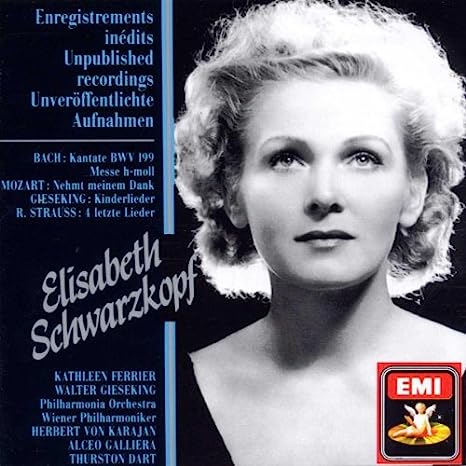
Elisabeth Schwarzkopf – Unpublished Recordings


51zdj0yf6wl._ac_sx466_

An interesting release of material discovered in the EMI vaults and released in 1990.

We start with a really lovely performance of Bach’s Cantata, Mein Herze schwimmt im Blut, which is followed by surviving excerpts from a rehearsal for a performance of Bach’s Mass in B Minor under Karajan, with Ferrier partnering Schwarzkopf in the Christe eleison and Et in unum Dominum. Schwarzkopf sings the Laudamus te.

A charming performance of Mozart’s Nehmt meinen Dank comes next, recorded in 1955 with the Philharmonia under Alceo Galliera.

The Gieseking Kinderlieder were recorded as a favour to the great pianist, recorded at the same time they made their album of Mozart Lieder. Undemanding music perhaps, but Schwarzkopf characterises them brilliantly. I’m sure Gieseking was delighted.

Finally we have a live performance of Strauss’s Vier lerzte Lieder with the Philharmonia under Karajan at the Royal Festival Hall in 1956. It is certainly interesting to hear Schwarzkopf singing them live, but I wouldn’t place this above either of her two studio recordings under Ackermann and Szell. Inexplicably, Karajan places September last, which makes a less satifactory end, especially given the rather fast tempo he takes it at, though it has slowed down a bit by the end. (I assume the wonderful horn playing is by Dennis Brain.) Im Abendrot also starts out rather fast, but again has slowed down towards the end of the song. Schwarzkopf is in wonderful voice and has no trouble riding the orchestra, but it doesn’t replace the recording she made ten years later with George Szell. For me it catches the autumnal glow of these songs like no other. The prize of this version would be Frühling, with Schwarzkopf’s voice soaring out over the orchestra with a bit more ease than it does in 1965.


Blow the Wind Southerly – The Art of Kathleen Ferrier


This 1997 compilation of recordings by Kathleen Ferrier was no doubt leveled at the popular Classic FM market. Not a whiff about the provenance of the various tracks, no texts or translations, nor a mention of the accompanists, amongst whom would be the illustrious name of Bruno Walter.

There is, however, a great deal of pleasure to be had from this hotch potch of songs and arias, even if it would seem that very little thought has gone into the programming.

Kathleen Ferrier died from cancer in 1953, at the age of 41 at the height of her career. She had made her operatic debut at Glyndebourne in 1946, creating the role of Lucretia in Britten’s The Rape of Lucretia and following it with that of Orfeo in Gluck’s Orfeo ed Euridice, a role with which she was particularly associated (and indeed there are two versions of Orpheus’s Lament included here, one in Italian and one in English). She also formed close associations with Sir John Barbirolli and Bruno Walter, who later wrote “I recognised with delight that here potentially was one of the greatest singers of our time.” A memento of their association is included here in a thrillingly intense version of Um Mitternacht from Mahler’s Rückert LIeder and of course most people will be aware of their great recording of Mahler’s Das Lied von der Erde.

Ferrier, a genuine contralto of the sort that seems to have gone out of fashion today, had a voice that one most associates with a grave solemnity, suited to such pieces as Have mercy, Lord, on me from Bach’s St Matthew Passion, but it could equally turn to gaiety and lightness, as it does here in such songs as Bridge’s Go not happy day and the traditional song I know where I am going, both delivered with perfect, natural, unforced diction, which never impedes her natural legato. I also particularly enjoy the beautiful Quilter songs, which we rarely hear these days.

The Handel and Bach items would get no points for authenticity today, but, if the style and voice might seem old-fashioned, her sincerity and gift for communication do not. Her singing has a way of going straight to the heart in a way that should never go out of fashion.

There are better representations of Ferrier’s art out there, but this one serves well as an introduction to a great singer, who died far too young.