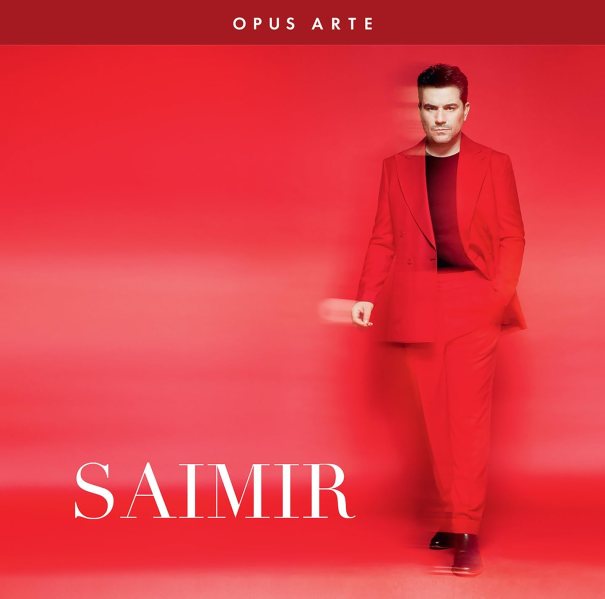
Saimir Pirgu sings operatic arias

Ten years ago I saw Saimir Pirgu as the Duke in the Royal Opera House’s David McVicar production of Rigoletto. Though he looked splendid and dashing, he was utterly charmless and I found his singing stiff and monochromatic. Since then, he seems to have ventured into more dramatic repertoire, and this recital of mostly verismo arias comes as a follow-up to a 2015 album of more lyrical fare, which I haven’t heard.

The present recital was very well received by my colleague, Göran Forsling in October of last year (review) but I’m afraid I can’t join in with his praise. For a start, Pirgu’s basic production is terribly ingolata, so much so that his singing was giving me a sore throat. There is no freedom to the sound and, when I compare him to the greats of the past, from Caruso to Björling to Pavarotti, all I hear is his struggle to get the sound out. There is no ring at the top and the middle voice is forced, resulting in a distressing vibrato. Indeed, he sounds a good deal older than his forty-two years.

Added to that, he doesn’t really do anything with the music and here his conductor, Antonio Fogliani, must take some of the blame, for his conducting is dull and prosaic. Most of the arias on the disc are well known but, with so many other versions out there, this just isn’t competitive.

I tried listening to the recital several times, thinking that maybe it had something to do with my mood, but, no, each time my reactions were the same. I just couldn’t get past Pirgu’s basic vocal production and I found it difficult to relax and enjoy the music. I hate to be so negative, but this is a disc for fans of Pirgu only, if indeed they exist.

Contents.

  1. Puccini: Manon Lescaut – “Indietro!… Guardate, pazzo son” 
    2. Puccini: Tosca – “E lucevan le stelle”
    3. Leoncavallo: Chatterton – “Non saria meglio… Tu sola a me” 
    4. Giordano: Andrea Chénier – “Colpito qui m’avete… Un dì all’azzurro spazio” 
    5. Puccini: Le villi – “Ecco la casa… Torna ai felici dì”
    6. Puccini: Manon Lescaut – “Donna non vidi mai” 
    7. Cilea: Adriana Lecouvreur – “L’anima ho stanca”
    8. Wagner: Lohengrin – “In fernem Land”
    9. Berlioz: La Damnation de Faust – “Nature immense”
    10. Tchaikovsky: Eugene Onegin – “Introduction”
    11. Tchaikovsky: Eugene Onegin – “Kuda, kuda, kuda vi udalilis”
    12. Puccini: Il tabarro –  “Hai ben ragione” 
    13. Bizet: Carmen – “La fleur que tu m’avais jetée”
    14. Puccini: Turandot – “Non piangere, Liù”
    15. Jakova: Skenderbeu – “Kjo zemra ime”
    16. Puccini: Tosca – “Recondita armonia” (with Vito Maria Brunetti (bass))
    17. Giordano: Andrea Chénier – “Come un bel dì di maggio” 
    18. Puccini: Madama Butterfly – “Addio, fiorito asil” 
    19. Giordano: Fedora – “Amor ti vieta”
    20. Sorozábal: La taberna del puerto – “No puede ser”
    21. Puccini: Turandot – “Nessun dorma!”
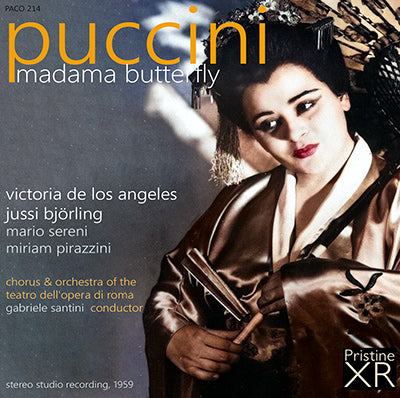
 

De Los Angeles and Björling in Madama Butterfly

paco214_530x

This Pristine XR Remastering of De Los Angeles’ second 1959 recording of Madama Butterfly has already been favourably reviewed twice before on MusicWeb International, once by Ralph Moore (review) and once by Morgan Burroughs (review), and I can add little to what they have said. We have De Los Angeles in one of her best and most conducive roles and Björling singing with golden tone. In Pristine’s newly re-mastered transfer of the stereo original, surely this is self-recommending, and who am I to disagree? However, I should mention that there is an earlier 1955 De Los Angeles recording, in mono sound, with Di Stefano as Pinkerton, Gobbi as Sharpless and conducted by Gianandrea Gavazzeni, which, in some ways, surpasses the performance we have here. It is available at super bargain price from the Regis label and was favourably reviewed by Christopher Howell here.

That earlier recording’s chief asset is the conductor, Gavazzeni, who makes far more of the score than the rather dull and prosaic Santini, and it makes me realise how important the role of the conductor is in Puccini. Indeed, all the best sets have benefited from a great conductor; Karajan, for both Callas and Freni, Serafin for Tebaldi, Barbirolli for Scotto and Pappano for Gheorghiu. And, if Santini has at his disposal an excellent cast, Gavazzeni’s is just as good, and in some respects even better. Björling, for Santini, sings with golden tone, but is just a trifle stiff. This was to be Björling’s last recording, and the heart condition, which would end his life at the early age of 49, was already apparent. Indeed, he collapsed during one recording session of the Act I love duet and needed several days to recover before he was able to continue. This could account for his relative stiffness. Di Stefano, on the other hand creates a real character. Carelessly charming in his exchanges with Sharpless and genuinely seductive in the love duet, he is suitably devastated by what he has done in the last act. I don’t see Pinkerton as a villain or an out and out cad. He is just an impulsive young man, who gives little thought to his actions at the beginning of the opera. Young men like him are ten a penny on any American college campus and Di Stefano portrays him to the life.

Sereni is a sympathetic Sharpless for Santini, but Gobbi, for Gavazzeni, surpasses him in verbal acuity and De Los Angeles is in slightly fresher voice in the earlier recording, though the difference is marginal.

What is not in doubt is the improved sound picture in the later stereo recording, especially in Pristine’s remastering, which opens up the sound quite a bit. I should also mention that Pristine as usual provide downloads of the full score and libretto, whereas the Regis issue of the earlier recording just comes with notes and a synopsis. Whichever version you go for, you will get one of the most touching Butterflies on disc.