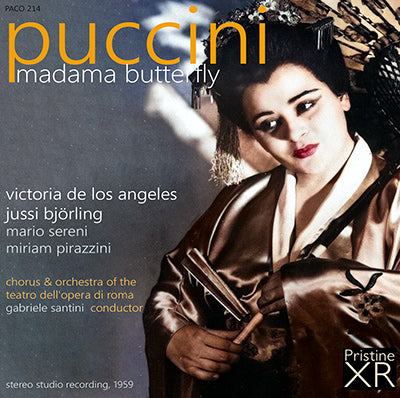
This Pristine XR Remastering of De Los Angeles’ second 1959 recording of Madama Butterfly has already been favourably reviewed twice before on MusicWeb International, once by Ralph Moore (review) and once by Morgan Burroughs (review), and I can add little to what they have said. We have De Los Angeles in one of her best and most conducive roles and Björling singing with golden tone. In Pristine’s newly re-mastered transfer of the stereo original, surely this is self-recommending, and who am I to disagree? However, I should mention that there is an earlier 1955 De Los Angeles recording, in mono sound, with Di Stefano as Pinkerton, Gobbi as Sharpless and conducted by Gianandrea Gavazzeni, which, in some ways, surpasses the performance we have here. It is available at super bargain price from the Regis label and was favourably reviewed by Christopher Howell here.
That earlier recording’s chief asset is the conductor, Gavazzeni, who makes far more of the score than the rather dull and prosaic Santini, and it makes me realise how important the role of the conductor is in Puccini. Indeed, all the best sets have benefited from a great conductor; Karajan, for both Callas and Freni, Serafin for Tebaldi, Barbirolli for Scotto and Pappano for Gheorghiu. And, if Santini has at his disposal an excellent cast, Gavazzeni’s is just as good, and in some respects even better. Björling, for Santini, sings with golden tone, but is just a trifle stiff. This was to be Björling’s last recording, and the heart condition, which would end his life at the early age of 49, was already apparent. Indeed, he collapsed during one recording session of the Act I love duet and needed several days to recover before he was able to continue. This could account for his relative stiffness. Di Stefano, on the other hand creates a real character. Carelessly charming in his exchanges with Sharpless and genuinely seductive in the love duet, he is suitably devastated by what he has done in the last act. I don’t see Pinkerton as a villain or an out and out cad. He is just an impulsive young man, who gives little thought to his actions at the beginning of the opera. Young men like him are ten a penny on any American college campus and Di Stefano portrays him to the life.
Sereni is a sympathetic Sharpless for Santini, but Gobbi, for Gavazzeni, surpasses him in verbal acuity and De Los Angeles is in slightly fresher voice in the earlier recording, though the difference is marginal.
What is not in doubt is the improved sound picture in the later stereo recording, especially in Pristine’s remastering, which opens up the sound quite a bit. I should also mention that Pristine as usual provide downloads of the full score and libretto, whereas the Regis issue of the earlier recording just comes with notes and a synopsis. Whichever version you go for, you will get one of the most touching Butterflies on disc.
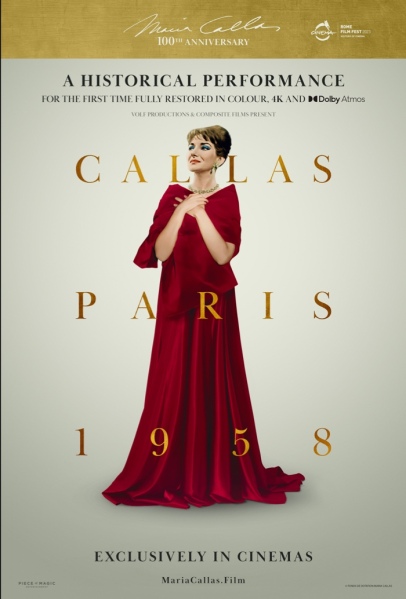
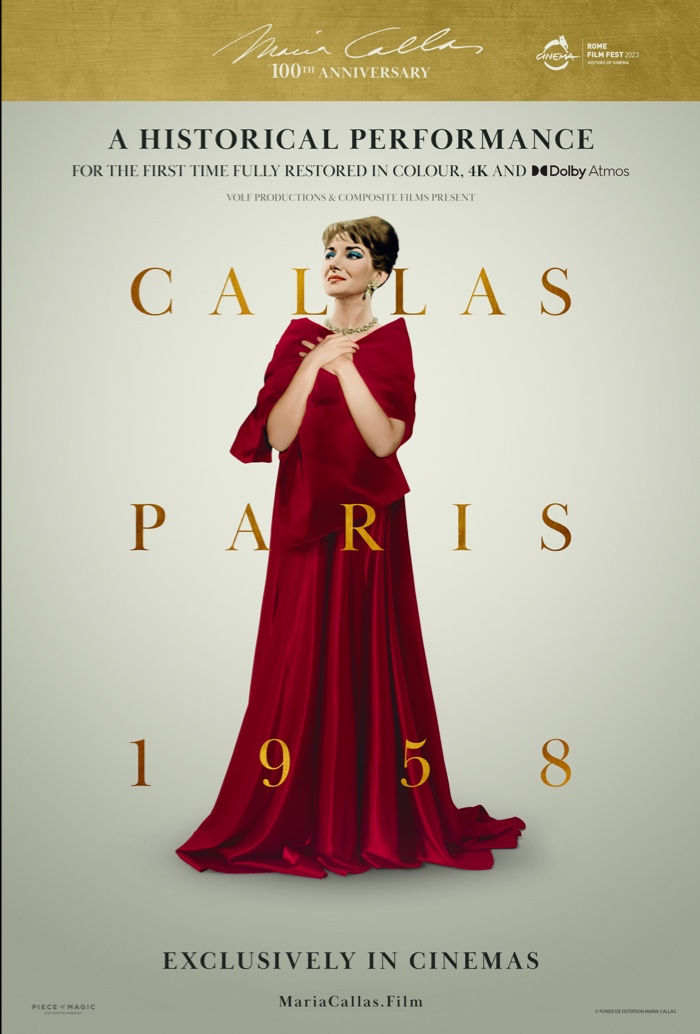
This newly restored film of the famous Paris Gala Concert is playing in cinemas around the world over the next couple of months and I caught up with at the weekend.
First a word about the provenance of the present release. In the words of the producer, Tom Volf,
the newly discovered 16 mm reels were those belonging to Callas herself, most probably brought by her & Meneghini from Paris; Having worked with the copies from INA (Institut national de l’audiovisuel) for Maria by Callas, when I found those reels (truly in a basement in Athens, kept for years by friends of Callas in boxes with other reels & tapes belonging to her – now all in Paris under the Callas Foundation) I immediately compared them to the INA versions, not believing myself that those ‘other’ 16 mm reels could be better than those preserved by INA, and to my astonishment they were indeed. Comparing the two sources side by side there was no doubt that the newly found ones were actually the original ones whilst those kept by INA were 16 mm copies, called in French “internégatif” a method commonly used in the late 50s and 60s before magnetic tapes. Therefore, what you will see in the upcoming film is as close as it gets to the original footage and the original performance. I have chosen to partner with the same team that undertook the colourisations for Maria by Callas, after I undertook myself for the newly found original reels to be digitised in 4K using the latest technologies available. The colorisation process took nearly two years as it was done frame by frame and based on all original colour photographs in our archives, plus first hand testimonies of people who had attended (some of them are still alive fortunately). The result intended was for the audiences of 2023 to be immersed in that unique evening and to see it with their own eyes as if they were there – and as we see in colour in real life, this was the reason for undertaking this challenging work, with, I believe, an astonishing result.
Certainly I am happy to report that it looks a lot better than any release I have seen up to this date. Long shots are still a little blurry but close-ups come up with a new clarity that has to be seen to be believed and it was quite a thrill to see Callas looking so fabulous up there on the big screen. The sound is astonishingly clear as well, though I’m willing to bet that some of her more piercing high notes were less so in the theatre. The colourisation was, for the most part, subtly and beautifully done, but I do question whether her eyeshadow would have been quite that shade of bright blue. What is remarkable to see in close-up is her concentration, her intensity and those eyes….! So expressive. At no point was she just a singer singing an aria. Whether in the concert of the first half or in the fully staged Tosca of the second part, she was always completely inside the character she was portraying.
In places you can tell that the concert was hastily put together and sketchily rehearsed. Apparently when Callas arrived at the first rehearsal, the scene was quite chaotic with nobody taking charge of proceedings. She quickly put Gobbi in charge and he basically directed the whole thing. Still, he couldn’t prevent a wong entry by the chorus in Casta diva, which Callas corrects herself with an imperious gesture of her right hand. She was not in her best voice and in the Trovatore the top notes are a little strained and tense. Still, this strikes me as the most impressive section of this first half, her phrasing wonderfuly elastic and her sense of Verdian style unparalleled. She moves very little, but when she does, such as a sudden turn of her head when she hears the monks singing, she immediately arrests attention and her eyes are unforgettable.
This first half ends with a wonderfully characterful Rosina, singing Una voce poco from Il Barbiere di Siviglia. The explosive way she sings the single word ma and the expression that goes with it says more about the character than many a singer manages in the whole aria. This Rosina is sweet and gentle, but a real viper when crossed. She is more relaxed here too and her smile when she acknowledges the tumultuous reception at the end, positively radiant.
When it comes to the second act of Tosca, I will say straight away that I prefer the Covent Garden performance of 1964. She may be in better voice here in 1958, but the Covent Garden performance was from a thoroughly rehearsed and meticulously prepared production where this one was thrown together specifically for this event. Gobbi obviously did what he could to direct in the time available to them, but the acting and rapport between these two singers reaches even greater heights at Covent Garden. Vissi d’arte loses some of its impact by the fact that she starts it upstage and the camera doesn’t hone in on her as it does at Covent Garden. Though I thought she looked very beautiful in some of the close-ups, she is more becomingly costumed at Covent Garden too. Albert Lance is actually quite impressive vocally, as he is off stage in the Trovatore, but he overacts like mad.
The cinema, when I went, was depressingly empty and I was one of about a dozen in the auditorium, most, like me, sitting on their own and most of a similar age. I found that rather sad.
A friend of mine went to see it in a cinema near where she lives. She told me she has had had a fascination with Callas since childhood, though she had never seen the concert in any form before. She was totally knocked out so I guess you could say the film certainly makes its impact.
I assume it will come out on DVD or BluRay at some point, but if you can get to see it in the cinema, I would definitely go. It is a fitting tribute on her 100th birthday and we are lucky that it has now been made available to a wider public in much improved sound and vision.
What next? Dare we hope that there is a pristine copy of the Covent Garden Tosca Act II locked away in the vaults somewhere?
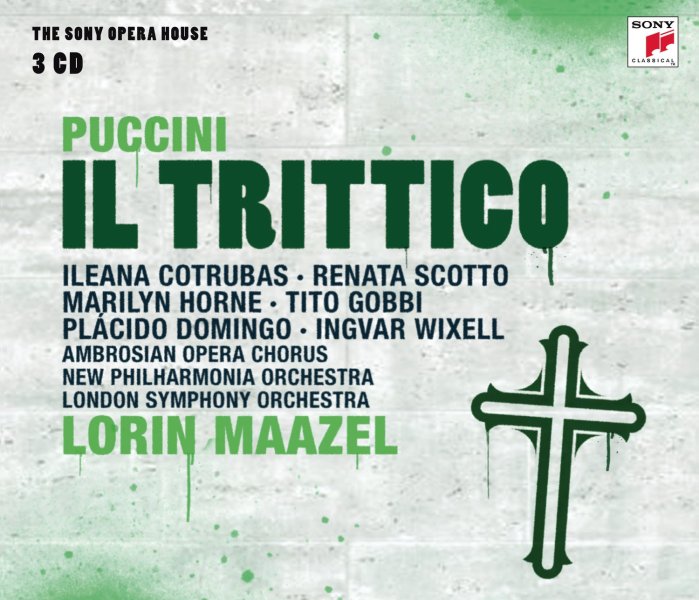
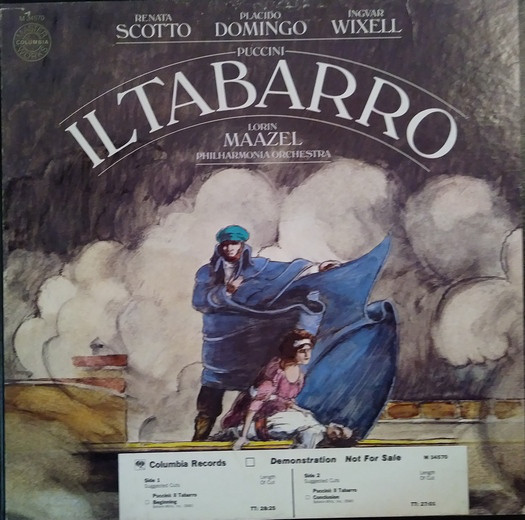
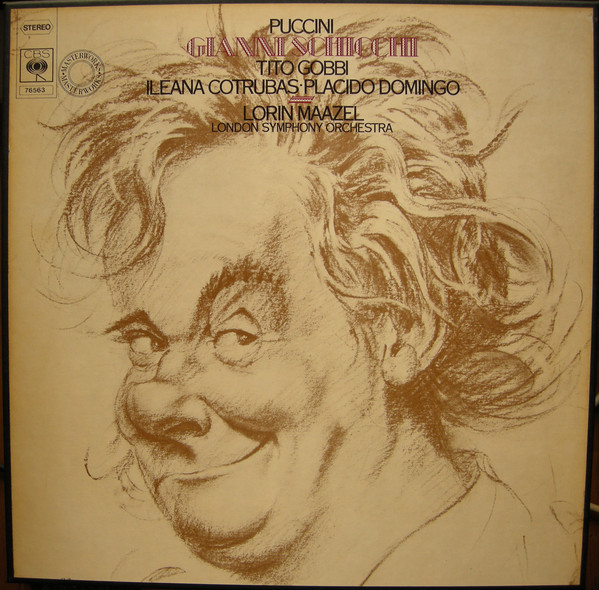
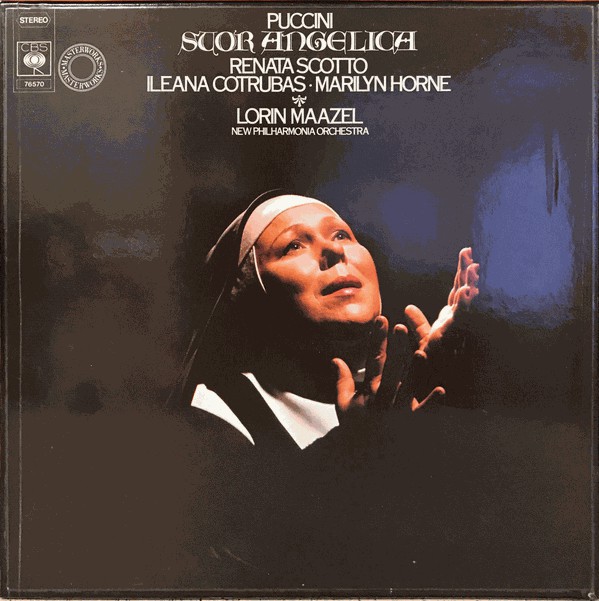
Excellent performances of Puccini’s tryptich, though, of the three, only Suor Angelica would be my absolute top choice.
A word first about the presentation of this budget release. These days I suppose we have become used to not getting texts and translations, but documentation n this reissue is really of the minimum, and tracking of the CDs is a ludicrous; just one track for Il Tabarro, and two each for Suor Angelica and Gianni Schicchi.
Nothing really wrong with Maazel’s conducting. I sometimes find him a fussy conductor, who draws attenttion to himself rather than the music, but I enjoyed these performances. His conducting is spacious and warm throughout, though I’d have to admit he misses some of the high spirits of Gianni Schicchi.
Despite the excellent performances of Scotto and Domingo in Il Tabarro, I still prefer the old mono recording conducted by Vincenzo Bellezza, which is dominated by Gobbi’s darkly menacing, but troubled Michele. It is one of his greatest achievements on disc, and, good though Wixell is, he doesn’t begin to match Gobbi in emotional range. Scotto and Domingo are far preferable to their counterparts on the older recording, but Gobbi is irreplaceable.
In Gianni Schicci, Gobbi is up against himself in an earlier recording, conducted by Gabriele Santini with a degree more urgency than we get here. Gobbi is as sharply characterful as ever, but the other soloists on that earlier recording are a tad more individual than those on this one, and it just generates a bit more fun and high spirits. Domingo, expertly lightening his voice, manages Rinuccio surprisingly well, but it’s still a bit like getting a sledgehammer to crack a nut, and Ileana Cotrubas is a charming Lauretta, if not quite eclipsing memories of Victoria De Los Angeles on the earlier recording.
When it comes to Suor Angelica, I would have to admit that Scotto’s top notes can be afflicted with hardness and unsteadiness, but that she presents the most intense, most psycholgically penetrating traversal of the role I’ve heard. Between them Scotto and Maazel turn what is often a piece of quasi religioso sentimentality into a mini psychodrama about the effects of repression, almost echoing some of the themes in Powell and Pressburger’s darly intense movie Black Narcissus. Much as I like recordings featuring De Los Angeles and Ricciarelli, this one is much more gripping as drama. It’s defnitely the prize of the set.
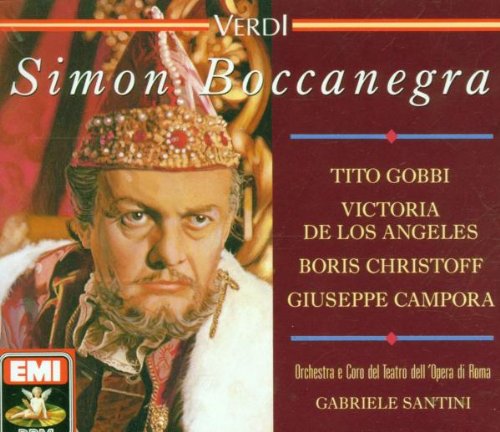
Abbado’s superb La Scala recording of Verdi’s great masterpiece pretty much sweeps aside all others, but this one, despite less than brilliant mono sound with an orchestra and chorus dimly recorded, despite Santini’s ploddingly prosaic conducting, demands to be heard, due to three distinguished, transforming performances.
Gobbi was in prime vocal form when the set was recorded, and though he does not quite have the vocal reserves of Cappuccilli, he creates the most rounded, most movingly tortured Doge you are ever likely to hear. Christoff, too, could hardly be bettered, brilliantly charting the change from implacable revenge to conciliation in the final scene with Gobbi’s Doge. To make our cup runneth over, we have De Los Angeles in one of her rare excursions into Verdi, singing with total communication, commitment and of course beauty of tone, particularly in the middle register, where most of the role lies. The downward runs in the final ensemble are absolutely exquisite. Campora may not be quite on their level (and Carreras on Abbado’s set is almost ideal) but he isn’t bad at all.
All three principals, I’d take (just) over their DG counterparts, but that recording benefits from Abbado’s superb pacing of the score, the wonderful playing of the La Scala orchestra, and warm, beautifully balanced stereo sound. So, for the opera itself, I’d take Abbado, one of the classic opera recordings, but for three superbly characterful performances, I choose Santini.
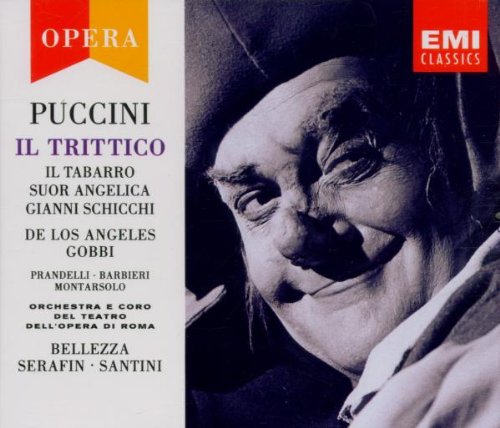
This isn’t a complete recording of Il Trittico. Admittedly all the operas use Rome forces, but each opera is led by a different conductor, and they were all originally issued at different times. The first two, released respectively in 1956 and 1958 are mono, but Gianni Schicchi, released in 1959 is stereo. The only unifying element is that De Los Angeles and Gobbi both appear in two out of the three operas. Still, it was useful and inevitable that the individual releases would eventually be grouped together and, as far as I’m aware, they have not been available singly since.
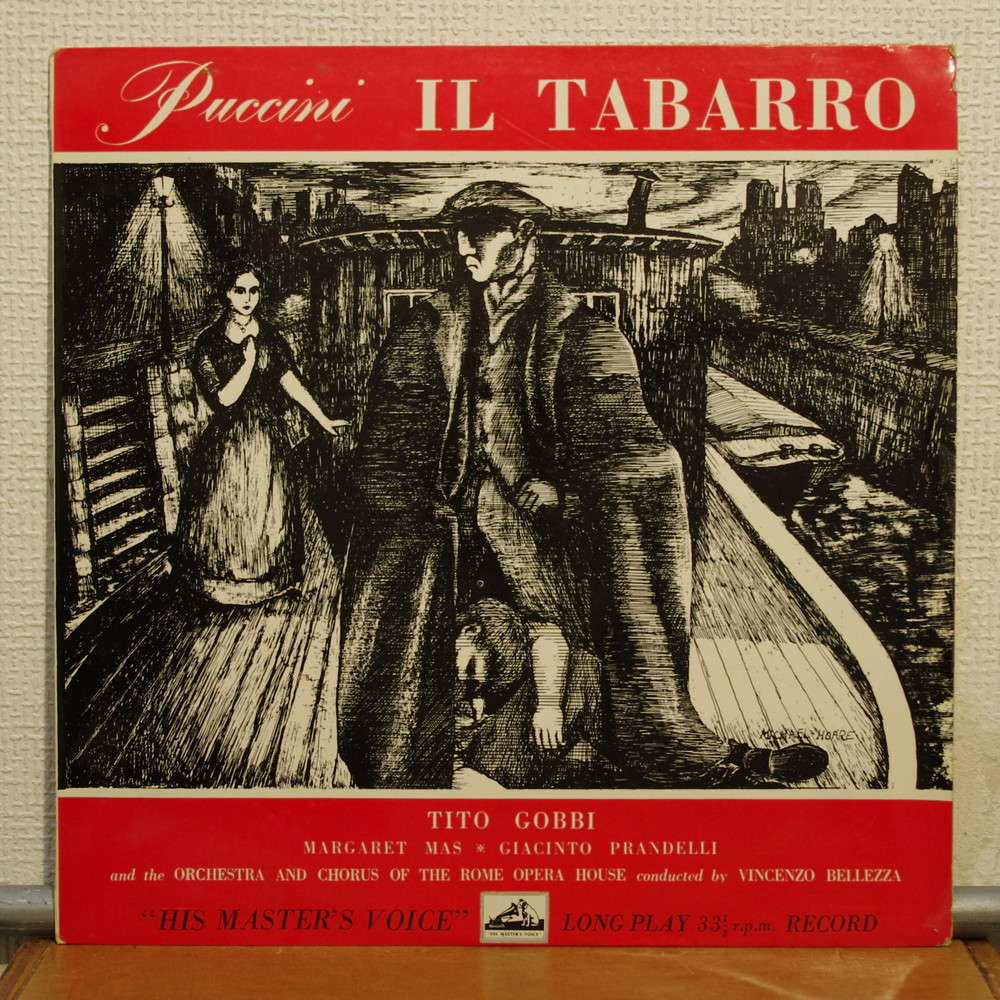
Bellezza’s conducting is efficient rather than inspired and the recording is a bit muddy, but this recording of Puccini’s terse piece of grand guignol, Il Tabarro, has at its heart one towering performance in the Michele of Tito Gobbi, a characterisation fit to set next to his Scarpia and Rigoletto. Not only is the role powerfully sung, but we see deep into the man’s tortured soul, the violence bubbling beneath. In no other studio performance of the opera do we feel Michele’s pain with quite such terrifying immediacy.
None of the other singers is on his level, but they are apt enough for their roles. Margaret Mas, a singer who appears to have done nothing else on record, sounds a bit mature, but that suits the role of Giorgetta well enough, as does the slightly raw tone of Giacinto Prandelli’s Luigi. The smaller roles are all well characterised, but it is Gobbi who puts the seal on this recording.
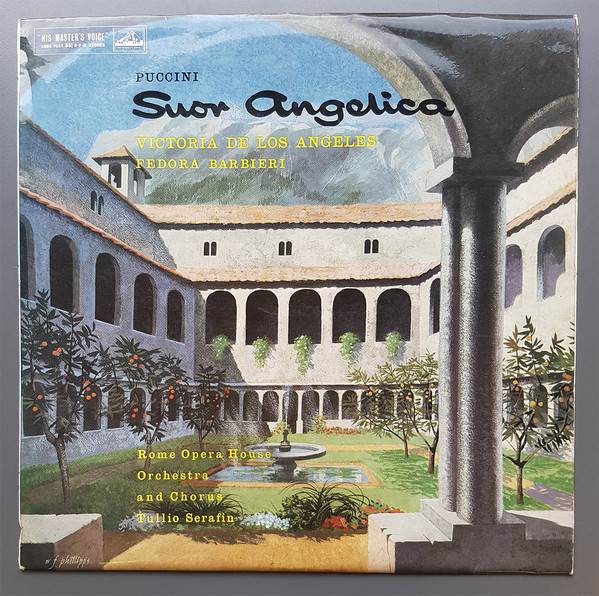
This has always been my least favourite of the triptych, as I find its over-sentimentalised quasi religiosity a bit too much for my taste. However it is difficult not to resist such generous hearted sincerity as we get here from the adorable Victoria De Los Angeles, superbly supported by the veteran Tullio Serafin, who doesn’t overdo the sentimentality. Fedora Barbieri presents a truly magisterial and implacable Zia Principessa, aristocratic, cold and dispassionate in her treatment of Angelica.
However even in a performance as committed as this, the ending stretches my suspension of disbelief just a bit too far and ultimately I prefer the sense of repressed passion and sexuality implied in the Scotto/Maazel version, which plays out almost like a scene from Powell and Pressburger’s Black Narcissus. In their hands, Angelica’s final vision comes across more as a drug-fueled hallucination, which helps to ameliorate my problems with the piece.
On the other hand I wouldn’t want to be without De Los Angeles’ beautifully sung and characterised Angelica. She is a little stretched by the highest reaches of the role, but in general the voice sounds absolutely lovely and her singing is as musical as ever.
Verdi had his Falstaff and Puccini had his Gianni Schicchi, though Puccini’s comedy is a lot blacker and more cruel than Verdi’s.
Gobbi was brilliant in both comic roles of course, but he presents two very different characters. His Falstaff was all genial bluster, a lovable rogue, where his Schicchi is a clever schemer, with more than a touch of the venal tempered by a genuine love and affection for his daughter.
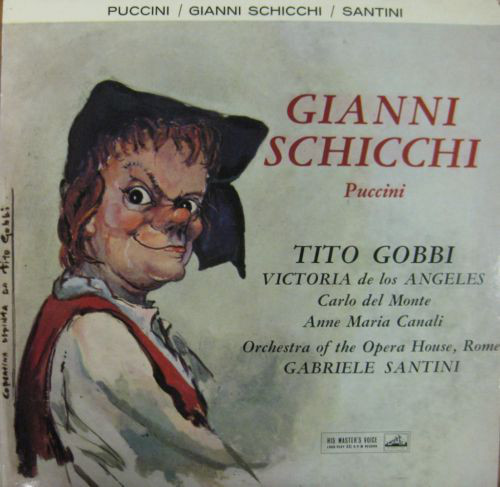
This is probably one of the best things Santini did for the gramophone, and the performance is superbly paced, with wonderfully pointed characterisations from the supporting cast, the libretto so crisply delivered that you can all but taste the words. I find myself chuckling out loud quite a few times. Carlo Del Monte might seem a bit light of voice, but for once Rinuccio sounds like the young man he is supposed to be, and Victoria De Los Angeles is simply adorable as Lauretta – none better on disc.
Gobbi recorded the role again towards the end of his career (under Maazel, with Domingo as Rinuccio and Cotrubas as Lauretta), but this one, the only one of the operas in this set to be recorded in stereo, remains my first choice.
I first reviewed this set when it was reissued by Warner back in 2014 and posted it in my blog shortly after starting it on this platform. You can read that review here and add this review as a sort of codicil.
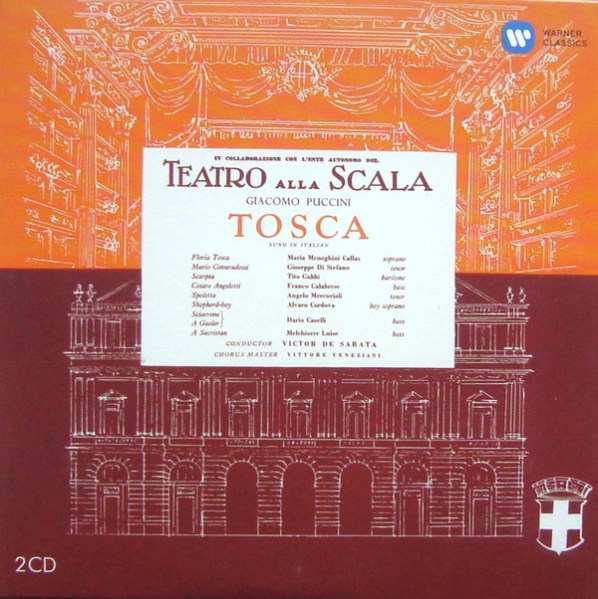
Though now considered one of the greatest opera recordings ever made, this justly famous recording of Tosca was not universally acclaimed when it was first issued, Alec Robertson comparing Callas’s assumption of the title role unfavourably to Tebaldi’s more dramatic performance. He died in 1982. I wonder if he ever ate his words. Dyneley Hussey made the strange observation that much of Callas’s singing was unrhythmical, which, given Callas’s legendary musical exactitude, now seems entirely incredible.
In all respects (conducting and singing) this Tosca is a more musical performance than the Tebaldi/Erede with which it was being compared, where dramatic effect is applied rather than arising from the music itself.
Despite the excellence of the three principals, the star of the recording for me is Victor De Sabata, who doesn’t so much conduct as mould the score, and consequently the real winner is Puccini, as it should be. Apparently Karajan had John Culshaw play sections of the De Sabata recording to him during sessions for his own equally famous recording of the opera with Leontyne Price. According to Culshaw, “One exceptionally tricky passage for the conductor is the entry of Tosca in act 3, where Puccini’s tempo directions can best be described as elastic. Karajan listened to de Sabata several times over during that passage and then said, ‘No, he’s right but I can’t do that. That’s his secret.'”
Of course De Sabata is immeasurably helped by his cast, who in turn are inspired to give of their best. How Alec Robertson could have thought Campora characterised Cavaradossi better than Di Stefano, who sings not only with his customary face but also with a degree of musical accuracy he didn’t always achieve, is beyond me. Gobbi was, is, and no doubt will always be a touchstone for the role of Scarpia, a gentleman thug, smoothly reptilian and much more interesting than the conventional villain he is often portrayed. As for Callas, the objections meted out at the time not only seem churlish, but far off the mark. Infinitely feminine and vulnerable, her Tosca is a long way from the cane-touting, flamboyantly capricious character she was usually portrayed in those days, and maybe that was why AR found her less dramatic. She is in her best voice, with scalpel-like attack on the high notes, the voice wonderfully responsive and she brings a welcome bel canto approach to this verismo role.
66 years after it was recorded, it remains the best of all recorded Toscas, a fact brought home to me recently when I compared five of the recordings at present available on Decca. These were Te Kanawa/Solti, Nilsson/Maazel, Freni/Rescigno, Tebaldi/Molinari-Pradelli and Price/Karajan. You can see my conclusions here.
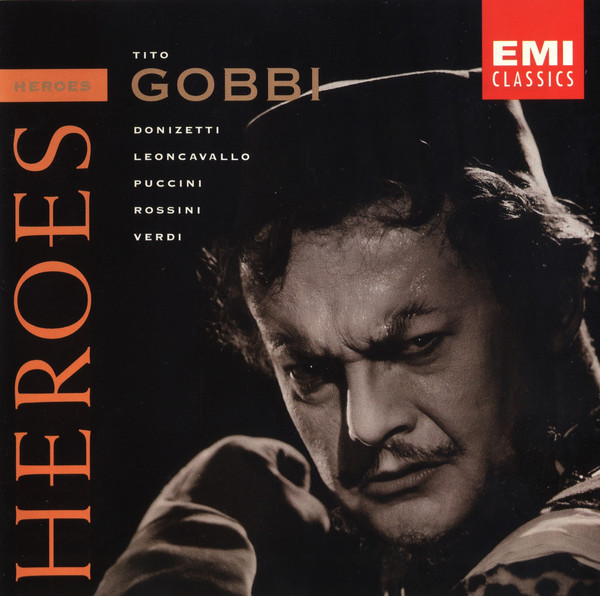
“Heroes”, the title of this disc proclaims, though in honesty only two of the characters represented here (the Marquis de Posa and Simon Boccanegra) might be considered to fall into that category. The rest (Figaro, Enrico, Rigoletto, Germont, Renato, Tonio, Scarpia, Iago and Falstaff) hardly qualify, and some of them are downright villains.
What we do get however (and this is not always evident in compilation or recital records) is eleven sharply differentiated voice characters. Like Callas, Gobbi, though his voice is always recognisable, was adept at the art of vocal make-up and there is a world of difference between his genial, but venal Figaro and his blackly evil Ernesto, which follows. Gobbi’s may not always be the most beautiful voice you will hear in his chosen repertoire, nor the most graceful (though he could indeed sing with both beauty and grace) but it is the one I often hear in my mind’s ear in the roles I have heard him sing. To the characters included here, I could add his Amonasro, his Michele and Schicchi, his Don Giovanni and his Nabucco.
All but Iago’s Credo on this compilation are taken from complete recordings of the operas, and we also hear the voices of Victoria De Los Angeles in the duet from Simon Boccanegra and Callas in part of the Act II duet from Tosca from La povera mia scena fu interrotta, both a locus classicus of Gobbi’s art.
The last item here is Falstaff’s Honour monologue, and I can do no better than quote here John Steane in The Record of Singing
Play, for example Falstaff’s Honour Monologue in a succession of recordings (Scotti, Ruffo, Stabile, Fischer-Dieskau, Gobbi) and Gobbi’s is quite markedly the most satisfying, partly because he attends to what Verdi has written and sees the point of it. The phrase ‘voi coi vostri cenci’ is marked with a crescendo on the first word, followed by three staccato syllables. Scotti takes no notice, Ruffo and Stabile take little; Fischer-Dieskau observes the markings, as ever, but it is Gobbi who sees the pictorial force, the crescendo carrying a comical menace and the staccatos punching or flapping at the despised company as with a broom handle.
Steane’s prose is as ever quite pictorial itself, but he also understands that, as with Callas, Gobbi’s genius is not just to execute the notes, but to understand the point of [them].
That said, isolated excerpts don’t really represent Gobbi at his best, and really one needs the complete sets from which these excerpts are taken.
I’d forgotten that I hadn’t reviewed the final opera in Warner’s Callas Live Remastered, so, rather belatedly, here it is.
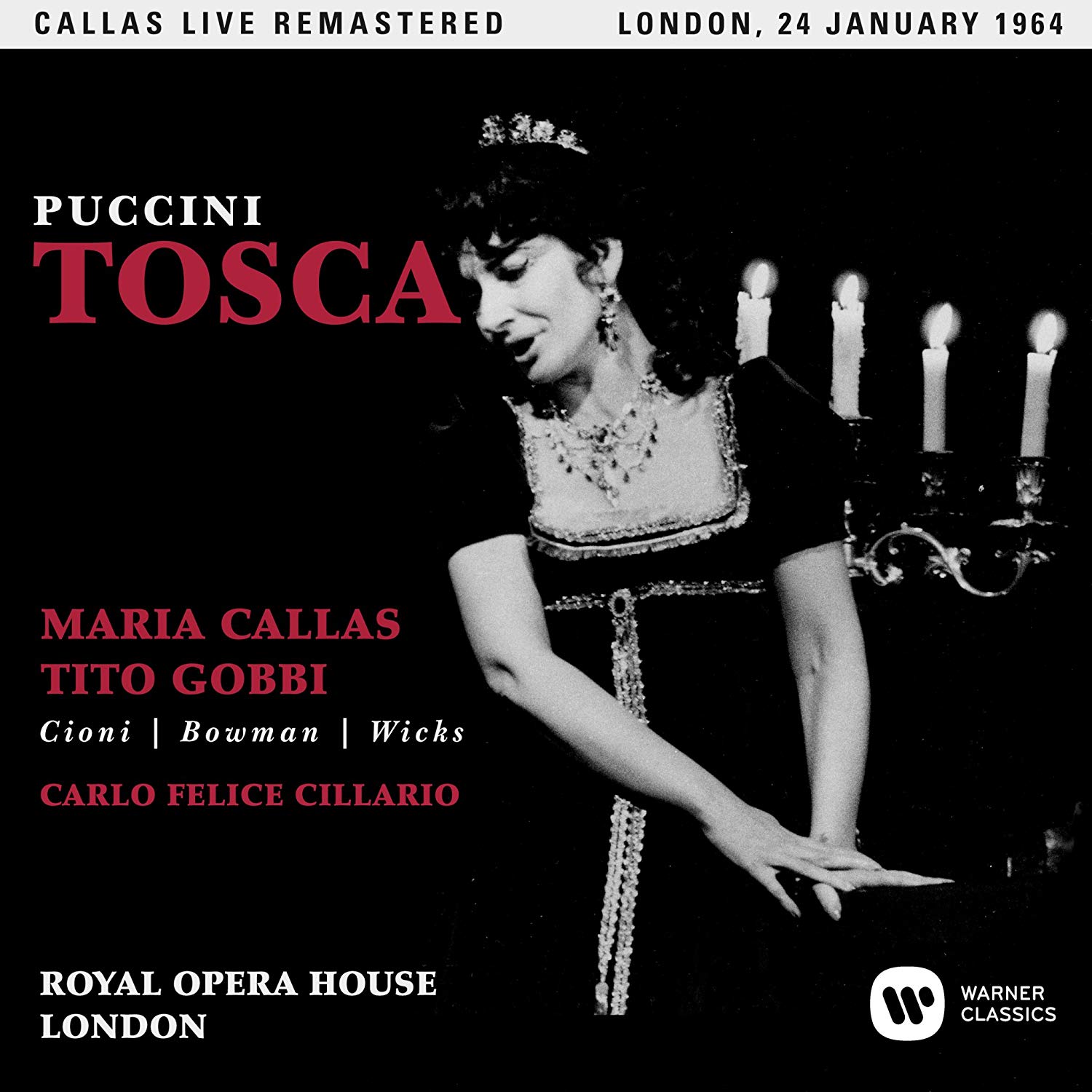
This Tosca marked Callas’s triumphant return to the stage after an almost two year hiatus. She had been lured out of semi-retiremet by Zeffirelli who was also to stage Norma for her in Paris, with the two opera houses sharing the two productions, though, in the event, the Paris Norma never made it to London. Paris did however get to see the Covent Garden Tosca. It was also the vehicle for her last ever stage appearance the following year when she agreed to sing, against doctor’s orders, for a Royal Gala. A couple of months before she had collapsed on stage and was unable to complete a performance of Norma.
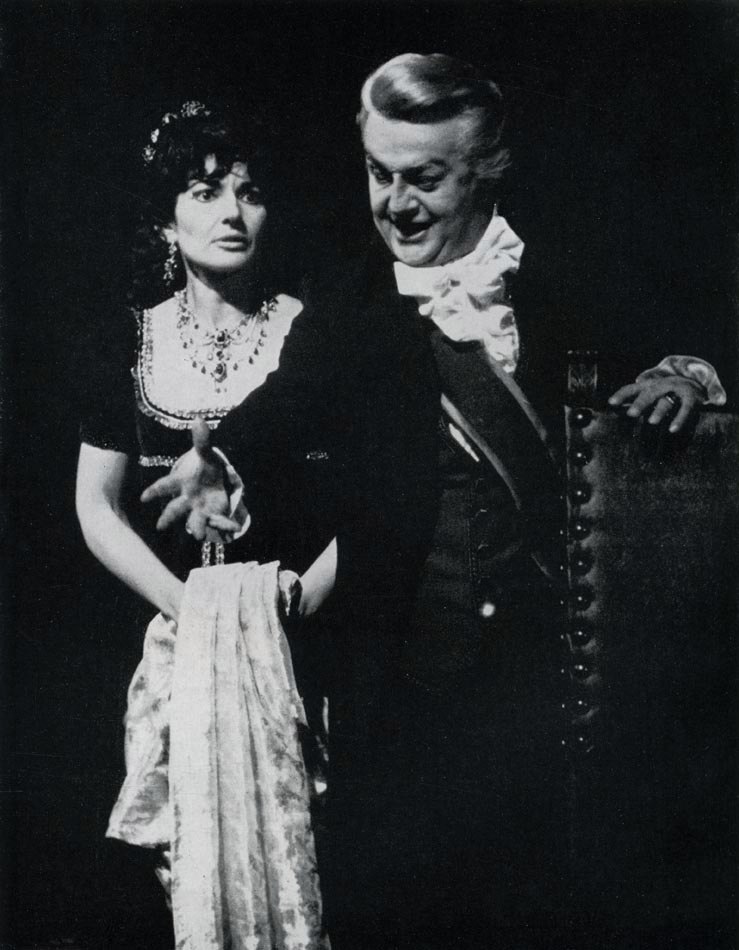
At this performance, though the voice is not what it was when she made the famous De Sabata recording eleven years earlier , she is in remarkably good form, and her interpretation has deepened even further, no doubt the product of weeks of intensive rehearsal and her deep rapport with Tito Gobbi. John Copley, who was Zeffirelli’s assistant on the production, once told me he had never before or since come across such complete actor/singers. At rehearsals, Callas and Gobbi would improvise their scenes and then discuss what had worked, what hadn’t, before returning to the scene to incorporate any new ideas, just as straight actors do on stage. According to Gobbi, so close was their connection that they were even able to do this during a performance, so that if anything unusual happened, as it did one night when Callas’s hairpiece caught fire in one of the candles, they could incorporate it into their stage business.
The production has gone down in history as one of the greatest opera productions of all time, and those who were alive to see it still talk about it today. Act II has been preserved on film and goes some way to revealing the Callas magic on stage, but why oh why didn’t they record the whole thing? What a missed opportunity. The fame of the Zeffirelli staging, the iconic photos taken from it and the 1953 recording are no doubt the reason Callas is so much associated with the role, though it was not a favourite of hers, and, truth to tell, she rarely sang it after making the recording, and never at La Scala during her glory days there.
The first thing to be said for this release is that Warner have discovered a new sound source for the performance, and it is a lot better than anything we have heard before. There is a good deal of stage noise to be sure, but both voices and orchestra come across very clearly. It almost sounds like stereo, so clear is the acoustic.
The performance largely justifies its reputation, and is absolutely gripping from start to finish. Cioni is its weakest link, the voice a little thin and reedy, and, possibly intimidated by appearing alongside two such dramatic giants, with a tendency for empty overacting. He is certainly no replacement for Di Stefano in the 1953 recording, or Bergonzi in the 1964 studio recording, on which Callas is in less secure voice than she is here. He’s not at all bad, just not outstanding.
As for Callas, the voice lacks the beauty and velvet of her 1953 self, but, histrionically she is more inside the role than ever. Her Tosca is more feminine, more vulnerable, even more volatile, but somehow more endearing, and her singing is peppered throughout with wonderful little details. She is particularly charming (not a word one usually associates with Callas) in the Act III duet with Cavaradossi, girlishly happy in the way she looks forward to her future, which contrasts brilliantly with her utter despair when that future is cruelly snatched away from her.
Gobbi’s voice has also lost some of its velvet since 1953, but he too is wonderfully inside the role, his vocal acting so vivid you can almost taste the words. Actually one of the pleasures of the set is being able to hear the words so clearly, not only from the three principals, but also from all the excellent comprimarii. Cillario conducts an exciting performance, if without the many subtleties and revelations of De Sabata in the studio, which remains a first choice for the opera. That said, this one is highly enjoyable and I would place it above Callas’s second studio performance. It may not be not the essential listening of some of the other operas in Warner’s live box set are, but it is certainly worth hearing, and nicely rounds off the set, which thus covers almost all of her international stage career, from Nabucco in 1949, just two years after her Italian debut in Verona, to this Tosca, recorded the year before she sang for the last time on the operatic stage.
This is an expanded version of something I wrote a few years ago.
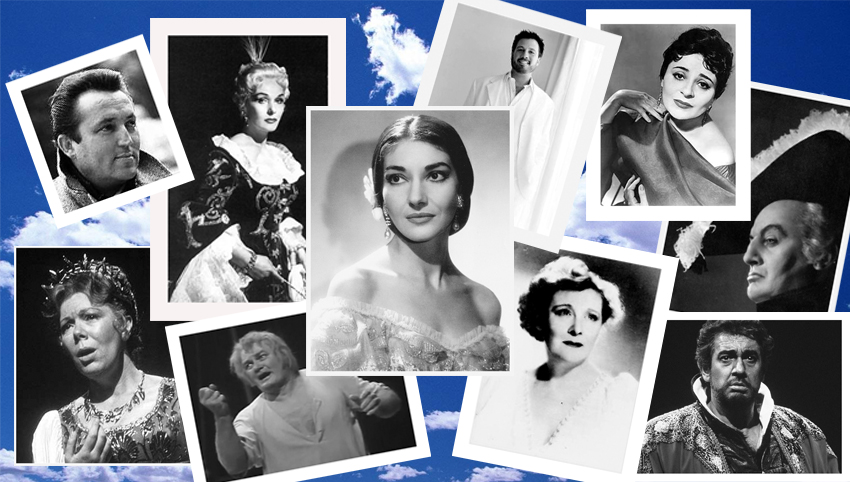
Back in 2011, John Steane, an expert on voices and an eminent critic, died at the age of 83. He had his favourites of course (who doesn’t?), but I learned a lot from JBS over the years, and I do miss his wonderfully constructive musical criticism. When he was still active at Gramophone Magazine, the editor asked him to write an article detailing the twelve singers who had changed his life, the one injunction being that one of them should still be active as a singer. For someone who knew his writing, his choices didn’t come as much of a surprise. I recently re-read this article and it got me to thinking of who mine would be. I’ve stuck to just ten, but these are all singers, who have said something personal to me, the voices that have spoken to me down the years, from when I first started to enjoy opera and lieder as an impressionable teenager, up until now.
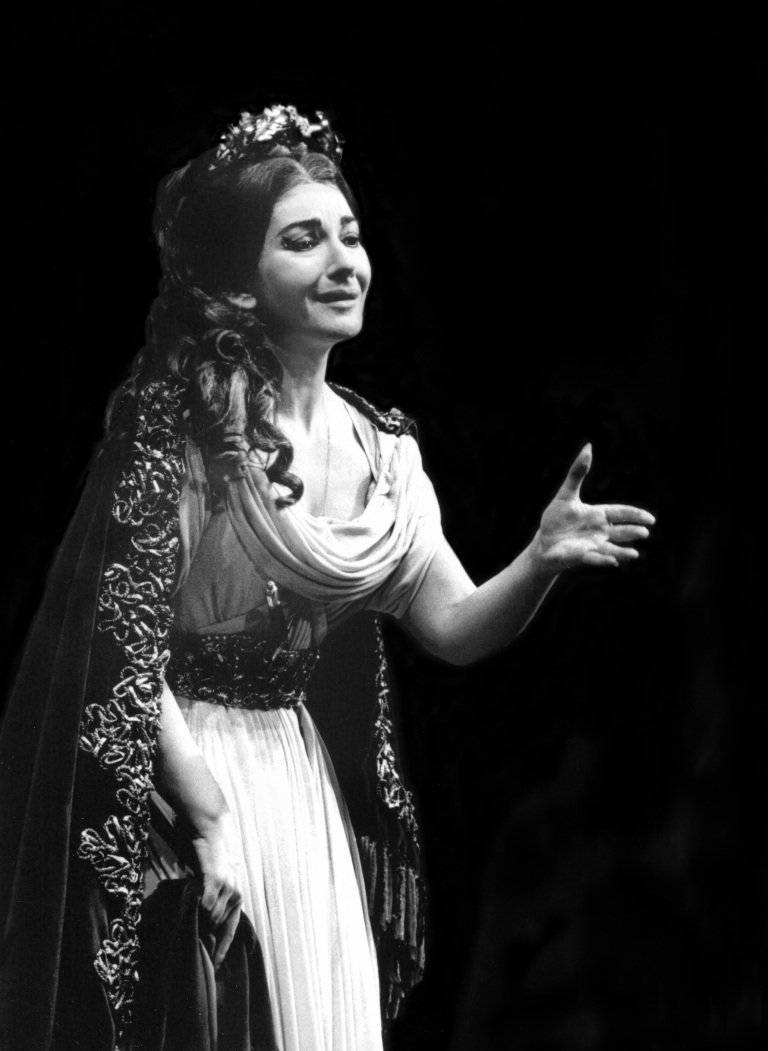
Callas as Norma
Anyone who knows me won’t be in the least surprised by my first choice. I first heard the voice of Maria Callas on an LP reissue of her first recordings, originally issued on 78s. The Mad Scene from Bellini’s I Puritani was coupled with the Liebestod (in Italian) from Wagner’s Tristan und Isolde and excerpts from her early Cetra recordings of La Traviata and La Gioconda. This was a voice like none I’d ever heard. It was a large voice, with dazzling flexibility, a rarity in itself, but what struck me most was the way that voice penetrated your very soul. It was a voice bursting with emotion. I may not have appreciated then her amazing musicality, but I certainly recognised the work of a genius. Callas made you feel that the music sprang from her throat newly minted, that she meant every word, every note. More than that, it was the way the voice could change from the sweet innocent Elvra to the womanly Isolde, from the passion of the courtesan Violetta, to the almost primeval sounds of her Gioconda. It hardly seems believable now, given that Callas’s recordings have formed the backbone of EMI’s (now Warner’s) Italian opera catalogue for years, but most of them were unavailable at the time. I slowly built up my collection by scouring second hand shops and pouncing on any imported issues that made their way into specialist record shops. As I slowly built up my collection, it was Callas who introduced me to the world of Italian opera. Nowadays I can be aware of some of the vocal failings, especially in the later recordings, but nobody has ever come within a mile of her fantastic musicality, and up until at least the mid 1950s, the voice was an amazingly responsive instrument. For evidence of her musical skills, no better example could exist than her Leonora in Il Trovatore, full of aristocratic phrasing and almost Mozartian delicacy. Though a little strained by some of the high lying passages on the Karajan recording of 1956, she still phrases like a master violinist, her sense of line and rubato unparalleled, the trills and cadenzas beautifully bound into the musical fabric of the whole.
She was also an amazing vocal actor, and though she has a voice that is instantly recognisable, she continually changes the weight of that voice to suit the character she is portraying. The woman who sings Lady Macbeth and Medea with such demonic force is hardly recognisable from the one who sings such a virginal and innocent Gilda, and though she may use the same lightness of touch for Amina in La Sonnambula as she does for, say, Rosina in Il Barbiere di Siviglia, they are still two completely different voice characters, and she can make us see that happiness is quite a different thing for Amina from what it is for Rosina.
Callas is still my touchstone for all the roles she sang (I can almost hear her in my mind’s ear in some of the ones she didn’t), and, though I recognise that some have made prettier sounds, there will always be a moment, maybe a single word, where Callas’s unique colouration will suddenly do something to nail the character as no other singer does. I regret that Walter Legge, excellent producer though he was, did not have the foresight to record her in much of the repertoire for which she was famous, and though I treasure all her studio recordings, it is a great pity that she didn’t get to record some of her greatest stage creations, like Lady Macbeth, Anna Bolena, Armida, Imogene in Il Pirata, and perhaps even Alceste and Ifigenia. Legge wouldn’t even touch Medea and Callas only got to record the opera by exercising a get out in her contract with EMI, though EMI did eventually release the recording, which had been made for Ricordi. I might also regret that Legge was so chary of stereo and that Callas was not accorded the kind of good stereo sound Tebaldi was accorded in her early 1950s recordings.
There is no doubt that Callas’s glamour and tempestuous personal life has done much to maintain her popularity, but she has been dead for 40 years now, the dust has settled, and it is surely her musical gifts for which she should be remembered; for Callas was not only a great singer, she was also one of the greatest musicians of the twentieth century. The great conductor Victor De Sabata once said to Walter Legge, her recording producer, “If the public could understand, as we do, how deeply and utterly musical Callas is, they would be stunned.” I have known her recordings now for the best part of fifty years and I continue to be newly stunned each time I listen.
Schwarzkopf as the Marschallin
My next choice might seem a little more surprising, a singer as far away from Callas as it would seem possible to be, though I often think of them as flip sides of the same coin. Elisabeth Schwarzkopf is the singer who introduced me to Mozart, Richard Strauss and lieder. Her recordings of the Marschallin in Der Rosenkavalier, and of the Vier letzte Lieder were my first exposure to these works, and have remained in my collection ever since. Hers was a voice shot through with laughter, and she also made many great recordings of lighter works. Her album of Operetta Arias can lighten the spirits like no other. She and Callas admired each other enormously (their repertoires were very different of course), and though they only made one recording together (Puccini’s Turandot), they met often, as Schwarzkopf was the wife of Callas’s record producer, Walter Legge, on one occasion Schwarzkopf giving Callas an impromptu singing lesson in the middle of the restaurant at Biffi Scala. Schwarzkopf was a good person to ask. She rarely put a foot wrong, and it is this attention to detail, that some find gets in the way of the music. There can be a lack of spontaneity, it is true, and, where Callas is able to conceal the huge amount of work that goes into each of her musical recreations, Schwarzkopf can occasionally be accused of artifice. Her Liu in the above mentioned Turandot may not sound for one moment like a slave girl, but I love her singing of the role, so beautiful and so richly nuanced.
Still, when it comes to opera, I treasure her most in Mozart (an incomparable Donna Elvira, Countess and Fiordiligi) and Strauss (an unbeatable Marschallin and Countess Madeleine) and (in recital) in Agathe’s arias from Weber’s Der Freischütz, though I also prize her delightfully high spirited Alice in Karajan’s recording of Verdi’s Falstaff. In Lieder some find her singing too detailed, and she is often accused of being mannered. Well, I’d aver that all great singers have their mannerisms. It’s one of the things that makes them instantly recognisable, and I prefer to think of them as idiosyncrasies. Warner recently reissued all her EMI recital records in their original programmes, and though it means each disc is rather short for CD, it shows the care that would go into creating these recitals, the same care that would go into her programming of material for her recital programmes. Each of them makes eminently satisfying listening.
I remember many years ago attending one of Schwarzkopf’s Master Classes at the Wigmore Hall with my singing teacher, the late Ian Adam, who adored her incidentally. She was a very hard task master, rarely letting a student sing more than a few bars before stopping them, and watching the classes was a peculiarly frustrating experience. It must have been even more so for the students. But that was the way she studied and rehearsed herself. She was actually severely self critical, as is shown in the book Elisabeth Schwarzkopf: A Career on Record, in which she listens to some of her recorded performances with John Steane. On many occasions she dismisses performances of her own that Steane admires, pointing out faults that none of us can hear. Though Schwarzkopf herself had refrained from singing at the classes, at one point she did sing out for just a few bars, in an attempt to show the student how to bring moonlight into the sound of their voice. Well, as Ian said, to me “You can’t teach that. Either you can do it, or you can’t.”
Janet Baker as Vitellia
Unfortunately I never got to hear Callas or Schwarzkopf live, but I did hear Dame Janet Baker quite a few times, though only in concert, never on the operatic stage, where she was equally at home. The first time was in a performance of Mahler’s Das Lied von der Erde at the Royal Festival Hall, whilst I was at college, a performance that has remained in my memory ever since. In a very different repertoire, she had an almost Callas like intensity and an ability to sing pianissimi that somehow reached the furthest recesses of the hall. Dame Janet introduced me to the music of Monteverdi and Handel, Bach and of course Elgar’s Sea Pictures (memorably coupled to Jacqueline Du Pre’s seminal recording of the Cello Concerto). She was also a great Berlioz singer. I actually prefer her Barbirolli recording of Les Nuits d’Ete (and a live one under Giulini) to Crespin’s famous one, and I doubt her recording of the closing scenes of Les Troyens has ever been bettered.
She recorded extensively for EMI, then Philips and, towards the end of her career, for such independents as Hyperion, Collins Classics and Virgin Classics, singing a vast range of repertoire that took her from the music of Monteverdi and Cavalli to Respighi, Britten and even Schoenberg, taking in Donizetti, Verdi, Schubert, Schumann, Liszt, Wagner and Mahler along the way. Some of her greatest recordings are those she made with Sir John Barbirolli, with whom she had a great rapport, The Dream of Gerontius, Sea Pictures, Les Nuits d’Eté, Shéhérazade and, maybe the greatest of them all, the orchestral Lieder of Mahler, particularly her wonderfully sensitive and inward performance of Ich bin der Welt abhanden gekommen. She was also world renowned for her singing of the lower part in Mahler’s Das Lied von der Erde, which I twice heard her sing live. She recorded it in the studio with Haitink, and there are at least three live recordings knocking around. Best of all of these is a Bavarian Radio broadcast under Rafael Kubelik, in which her singing of the final song, has a quiet intensity , which is almost too much to bear. So palpable is her emotional commitment to the music that I save this performance for rare occasions. Like Callas’s shattering performance of Violetta at Covent Garden in 1958, it reduces me to a quivering wreck.
Domingo as Otello
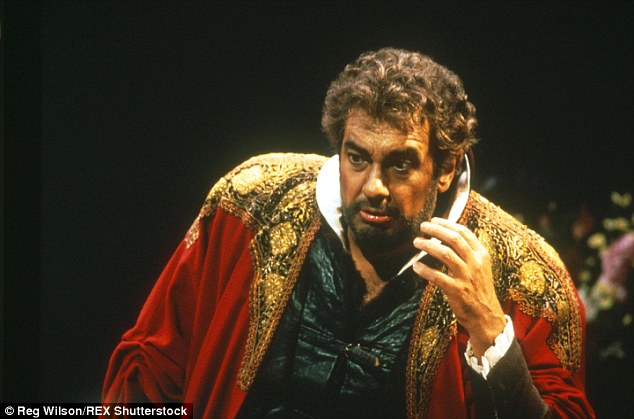
Placido Domingo’s was a voice I first heard on record in an early recital of arias, but I will never forget the thrill of first hearing him live at the Royal Opera House, in La Fanciulla del West, if memory serves me rightly. Domingo certainly had presence and a glamorous voice to go with it. A real singing actor, he seemed to improve as a performer every time I saw him. Incredibly, he is still singing today, though he has moved over to the baritone repertoire recently, taking on such roles as Simon Boccanegra and Rigoletto. True, it is remarkable that a singer, and a tenor at that, can continue to sing into his seventies, but, great stage performer though he is, I am not sure that his excursions into the baritone repertoire have been entirely successful, and I prefer to remember him in the great days of his tenor glory.
In his early days, beautiful though his singing was, he could be accused of a somewhat generalised attitude to characterisation, but, over the years, he became more and more of a committed performer. Some of his roles he recorded several times, and one can hear how he progressed. The voice always had a dark, burnished quality, and the very top of the voice was never as easy as some, but, paradoxically, it sounds freer to me in his middle period than when he was young. Still, he wasn’t ashamed to admit that his top Cs were hard won, and I actually applauded his decision to omit the unwritten ones, in Il Trovatore at Covent Garden, rather than doing what so many do and attempting to trick the audience by transposing Di quella pira down. His Otello is a towering achievement, and, for many years, there was no one around who could challenge his hegemony in the role. He made three recordings of the role at different stages of his career, and there are quite a lot of visual documents of his portrayal, including the controversial Zeffirelli film.
Wunderlich as Tamino
Free, ringing top Cs were never a problem for Fritz Wunderlich, who had a voice of overwhelming heady beauty. He died just before his 36th birthday, at a time when his interpretative artistry would have been reaching its maturity, his final concert in Edinburgh being testament to that. However if you ever want to hear someone just revelling in the sheer joy of singing, then listen to his DG performance of Lara’s Granada. Admittedly it is in German and the splashy arrangement is pretty vulgar, but he sings with a freedom and passion that would be the envy of any Latin tenor. For me, Wunderlich’s singing always conveys a sheer joy in the act of singing itself. Though he died young, he made many recordings, and it is this sense of joy that I most prize.
Interpretively, his recordings of Lieder don’t probe as deeply as some no doubt, but he was still young when he made them and unfortunately hadn’t reached his interpretive maturity before he died. For instance, the Dichteriebe he sings at his final concert in Edinburgh is a great deal more interesting than the recording he made for DG a year or so earlier. He did leave us arguably the greatest Tamino on disc, on Böhm’s Die Zauberflöte, which for once has a truly heroic dimension, a superb rendition of the tenor songs in Mahler’s Das Lied von der Erde (both in the studio under Klemperer and live under Krips), and of the tenor arias in Karajan’s recording of Die Schöpfung. Most of his Italian and French repertoire was sung in German, but still has a golden, Italianate warmth, and we do have at least one recording of him singing Verdi in Italian, a live performance of La Traviata from Munich with the young Teresa Stratas as Violetta. His early death was a tragedy beyond reckoning, as one wonders what he might have gone on to achieve. His Steersman on the Konwitschny recording of Der fliegende Holländer gives notice that he could have gone on to sing Lohengrin at least, and, in Verdi, what a wonderful Duke, Don Carlo or Riccardo he would have made.
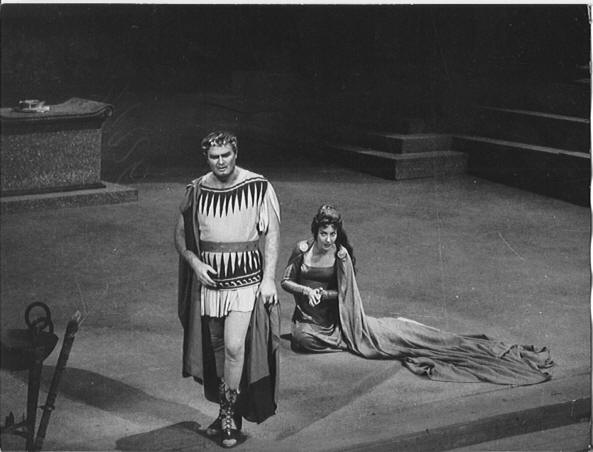
Vickers as Giasone with Callas as Medea
Staying with tenors for the moment, I turn to Jon Vickers, who had a voice and manner of startling individuality, and an intensity of performance that could almost be too painful to listen to. Though well known for his Tristan, his Siegmund, his Florestan and his Grimes, he first came to prominence singing in Italian opera. In 1958 he sang Giasone to Callas’s Medea in Dallas, and then also in London, at La Scala and at the ancient Greek theatre at Epidaurus. He had enormous respect for Callas and named her as one of the two people to have the most profound effect on opera in the post World War II period (the other being Wieland Wagner). He was also Don Carlo in Covent Garden’s legendary Visconti production of Don Carlo, conducted by Giulini, which also had Gobbi and Christoff in the cast. With a voice of such power and penetration he naturally progressed to Wagner, singing towering performances of Tristan and Siegmund. His Otello suffered like no other and his Peter Grimes, mercifully preserved on film, is one of the greatest creations of all time. Like all the singers in this survey, his voice is instantly recognisable, his style somewhat idiosyncratic, but intensely musical. There is always something monumental about a Vickers performance. On disc, I find his Aeneas (in Berlioz’s Les Troyens), his Florestan, his Tristan and his Otello unequalled by any who have followed, and his Grimes, so totally different from Pears, utterly convincing.
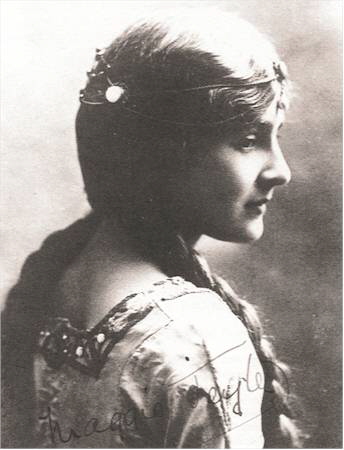
Teyte as Melisande
Next on my list are two more sopranos, one from well before my time and one who died only recently. I first heard the voice of Maggie Teyte in a performance of Duparc’s Chanson Triste and was totally captivated. Her performance of the song remains my yardstick to this day. Born in 1888, she was cast in the role of Mélisande by Debussy himself, replacing the creator of the role, Mary Garden. She prepared the role by studying with Debussy, and is the only singer ever to be accompanied in public by the composer (in a performance of his song Beau soir). She married twice and went into semi-retirement after her second marriage in 1921. Like her first marriage, this ended in divorce and Teyte had some difficulty reviving her career afterwards. For some time she appeared in music hall and variety, which explains much of the lighter repertoire she sang and recorded. However the recordings of Debussy songs she made with Alfred Cortot in 1936 attracted a lot of attention, helping her to gain a reputation as one of the leading interpreters of French song, The voice remained pure, without a hint of excessive vibrato even into her sixties, and she made her final concert appearance at the Royal Festival Hall at the age of 68.
I would recommend any and all of her recordings of French song, as well as her wondrous rendering of ‘Tu n’es pas beau’ from La Périchole, which shows off to advantage her gloriously individual chest tones, and a twinkle in the eye. A private recording of her singing bits of Salome (to a piano accompaniment) show that she might even have been an ideal Salome, the silvery purity of the voice being close to Strauss’s ideal, and it is a great pity that plans for her to sing the role at Covent Garden never came to fruition.
De Los Angeles as Manon
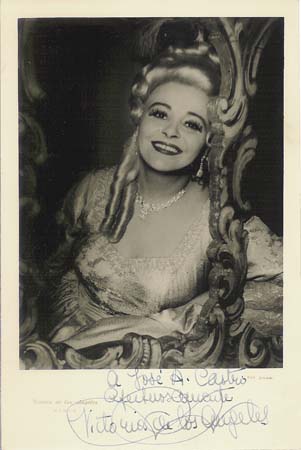
Truth to tell, I hadn’t much liked Victoria De Los Angeleswhen I first heard her (as a rather insecure and out of sorts Hoffmann Antonia) and I think it was probably her record of the Canteloube Chants d’Auvergne that first led me to investigate further. She had a particularly wide song repertoire, which took in early and late Spanish composers, as well as Lieder by Schubert, Schumann and Brahms and French song. One of her greatest quality was her charm and that quality the Italians refer to as morbidezza, meaning that, on the operatic stage, she was most at home playing gentler heroines. That Antonia was misleading and later I discovered she could be the perfect Marguerite (Faust), Butterfly, Rosina and Mimi displaying a golden voice allied to a winning personality. Best of all perhaps is her Manon in Massenet’s opera. Where some make the character too knowing, De Los Angeles emphasises the childlike innocence and delight in pleasure that is at the heart of Manon’s downfall. She was also a superb Desdemona (in a live broadcast from the Met) and it’s a great pity she never got to record the role commercially.
Her Carmen on the Beecham recording has been much praised, but here I find her less convincing, though, as usual, her singing is unfailingly musical. I just can’t imagine De Los Angeles’s Carmen pulling a knife on a fellow worker. She is altogether far too ladylike. She is on record as saying that she based her Carmen on the Andalusian gypsies, who were known for their charm, a quality De Los Angeles had in abundance, but my Carmen is dangereuse est belle (Micaela’s description) and De Los Angeles, charming and adorable as she was, never sounds dangerous to me.
Gobbi as Scarpia with Callas as Tosca
So far the list is rather top heavy with high voices, so I am happy to include as my next choice a baritone, colleague of Callas’s and one who encompassed many of her qualities. Like Callas, Tito Gobbi had an immediately recognisable voice and always sang with a wealth of colour and understanding. I can still remember the shattering effect of my first listen through Rigoletto, actually the first ever time I’d heard the opera. His cries of “Gilda” at the end of Act 2 after she has been abducted went straight to the heart. He may not have had the most beautiful baritone voice in the world, but, like Callas’s, it had a myriad of different colours. And like her, though always recognizably himself, he was always able to change his timbre to suit the role he was playing.
We are fortunate indeed that, though they sang rarely on stage together (most famously in Zeffirelli’s renowned Covent Garden production of Tosca), they made many recordings together; two recordings of Tosca, Lucia di Lammermoor, Aida, Un Ballo in Maschera and Il Barbiere di Siviglia, their collaboration possibly reaching its apogee in Rigoletto, with its long series of duets for father and daughter. Again, like Callas, he could put more meaning into a line of recitative, even into a word, than bars of singing by less dramatically attuned singers. The way he utters the single word Amelia in Verdi’s Un Ballo in Maschera, when he discovers the identity of Riccardo’s midnight tryst, resonates in my mind’s ear even now. Some would aver that he didn’t have a true Verdi baritone voice, but, as I think now of the parade of Verdi roles he sang – Rigoletto, Amonasro, Posa, Simon Boccanegra, Renato, Iago, Germont, Falstaff, Nabucco – they all emerge as distinct and different characters. Of how many other singers can you say that? Scarpia in Puccini’s Tosca might be his most famous creation (a repulsively reptilian character, who is both a gentleman and a thug) but it is in Verdi that his musical skill is most evident. What a tragedy that Walter Legge never had the foresight to record Macbeth with him and Callas as the murderous couple.
David Daniels as Caesar with Natalie Dessay as Cleopatra
Looking back at this list of singers, I realise that they all have certain things in common; the individuality of their voices (you only have to hear a few notes to know who it is) and their ability to make the listener see as well as hear. This is no less true of countertenor, David Daniels, a singer still very much before the public today. Some years ago, I was more or less dragged to a concert of Vivaldi sung by Daniels and accompanied by Europa Galante conducted by Fabio Biondi. Till then, apart from the Four Seasons and the Gloria, I had had little enthusiasm for Vivaldi’s music and had a total antipathy for countertenors in general. Daniels changed all that. Here was a voice of surpassing beauty, coupled to a marvellously natural personality. It was a total conversion and Daniels has now opened the door on a whole world of music I had previously ignored, which shows it is never too late to expand one’s horizons. I have hardly missed any of his appearances in this country, and, like all the singers on this list, he has a gift for communication vouchsafed to just a few.
He has also expanded the repertoire for countertenors, embracing American song, Lieder, French song and even Broadway. Sometimes the experiments don’t quite work. For instance, though his singing is, as ever, unfailingly musical and filled with meaning, the countertenor voice, even one as mellifluous and beautiful as his, just doesn’t have the range of colour required for a piece like Les Nuits d’Eté, and though I appreciate and enjoy his excursions into nineteenth century and modern repertoire, it is for the music of the baroque, and especially Handel, that I turn to him. In his early days his coloratura singing was sensational, but I treasure most his deeply felt singing of some of Handel’s slower arias. In an aria like Scherza infida he holds the line beautifully and firmly, but evinces a pain that is almost palpable. No other singer I have come across quite makes the same effect in this music. I am guessing that he will be coming towards the end of his career now, and I count myself fortunate indeed to have been able to experience his singing live whilst he was in his prime. I saw him so many times, that I swear he actually spotted me in the audience on several occasions, and acknowledged my applause with a nod in my direction.
Of course, apart from these singers, there have been many memorable performances. I recall the excitement of the first time I heard a really world class singer, Helga Dernesch in Fidelio and as the Marschallin (still the best I’ve seen live on stage); Agnes Baltsa’s Carmen with the no less memorable Don Jose of Jose Carreras; ditto Baltsa’s thrilling Eboli; the superb Dejanira of Joyce Di Donato;Angela Gheorgiu’s first Violetta, and Ileana Cotrubas‘s Violetta too; Roberto Alagna’s first Romeo (in the Gounod opera); Kiri Te Kanawa’s exquisitely, if placidly, sung Fiordiligi (with Baltsa again, as an adorably funny Dorabella); Renee Fleming in Previn’s A Streetcar Named Desire; Margaret Price and Lucia Popp in concert. I also regret never seeing live the wonderful Lorraine Hunt Lieberson, who was taken from us far too early and at the height of her artistic maturity, and whom I first remember in a Proms concert on TV, at which she was the radiant soloist in a performance of Elgar’s The Music Makers. These too will always stay in the memory, but I send my gratitude to the ten on my original list, for through them I have discovered a whole world of great music. They may not necessarily be the ten greatest singers of all time but they have enriched and enlightened and can truly be called singers who have changed my life.
Amelia is a role that should probably have figured more in Callas’s career. She sang excerpts as a student, almost got to sing it at La Scala under Toscanini, but actually didn’t tackle the whole role until the recording she made under Antonino Votto in 1956, and after singing it in a lavish new production at La Scala the following year, never sang it again, though she returned to Amelia’s two big solos in the studio in the mid to late 1960s.
We are fortunate that the La Scala live performance was captured in sound, and, though sonically it is not as clear as that on the studio recording, it is one of the best preserved La Scala broadcasts. Common to both the studio and live sets are the La Scala forces, Eugenia Ratti’s Oscar, Callas and Di Stefano. Everything else is different, so which is best?
First off we note that Gianandrea Gavazzeni on the live set is a much more positive presence than the somewhat prosaic Anotonino Votto. It is testament to his soloists that the Votto recording remains one of the most recommendable of studio sets 60 odd years after its release, but Gavazzeni’s performance is definitely more alive to the drama, and, from that point of view at least, the live performance is preferable. One should also note that the audience is a palpable (and vocal) presence, which some may find distracting. Personally I find it all part of the fun. Though one of the best of Callas’s La Scala broadcasts, it still tends to overload at climaxes. The studio set is in good mono sound.
Let’s now take the other differences. What I miss most on the live recording is Gobbi’s Renato. Bastianini on the live set was a fine singer, and probably had what we consider more of a Verdi baritone sound, but he is not nearly as imaginative as Gobbi. Bastianini has the more beautiful voice. Gobbi creates the more interesting character. When Gobbi sings the single word “Amelia” at the moment his wife is revealed to be the Duke’s paramour, he invests it with a wealth of conflicting emotions far beyond the scope of the more forthright Bastianini, so, in this respect at least the studio version is preferable. The conspirators on the studio set are also slightly better at vocal word painting than their live counterparts, but the difference is marginal.
Both the Ulricas are excellent, and if I prefer the magnificent Simionato on the live set, my preference is again only marginal. Barbieri is also excellent on the studio set. Eugenia Ratti is a trifle shrill for my liking on both the studio and live sets.
As for Callas and Di Stefano, I’d find it hard to choose between their performances, as they are both in terrific voice on both sets. Di Stefano is not the most aristocratic of Riccardos, but he has bags of personality. In the live set, he can be guilty of playing to the gallery somewhat, but the audience give him a rapturous reception, so who can blame him?
Callas is in magnificent form on both sets, her singing full of incidental details most singers miss, her command of the role’s difficulties staggering. I often wonder why her voice sounds so much fuller and richer in this role than it does on the studio Aida, which was recorded in 1955, the year before the studio set and two years before the live version. Possibly because Amelia is a transitional role, requiring a full compliment of trills and vocal graces of which Callas was a mistress. However it also requires quite a large voice, which is why the vocal niceties of the role are usually glossed over or ignored. Listen to Callas sing in her first scene the arching phrase Consentimi o signore with a pure legato and refulgent tone, whilst perfectly executing the little turn at the end of the phrase that signifies Amelia’s nervous state. Note also that when Amelia mirrors Oscar’s trills in the Oath Scene, it is Callas, not Ratti, who demonstrates perfect trills. It is moments such as these that make Callas stand out from all others.
A month after the La Scala prima, she was to sing Norma at the Rome Opera at a gala attended by the Italian president. She was unwell and tried to cancel, but, against her better instincts allowed herself to be persuaded by the management to do the performance, as, incredibly, they had not bothered to engage an understudy. During the performance, she felt her voice slipping away from her, and refused to carry on after Act I. This created one of the biggest scandals of her career. The Rome Opera refused to make any announcement on her behalf, and then compounded the problem by cancelling the rest of her contract, even though she had representations from doctors confirming her illness. The press had a field day, even fabricating footage of her supposedly rehearsing in good voice, though the footage was actually from a radio broadcast in 1955. She eventually sued the Rome Opera, a case that was settled entirely in her favour, but the case dragged on for years, and by the time she won the case, the damage done to her personally was irrevocable.
When she returned to La Scala later that year in a revival of Anna Bolena, the La Scala audience greeted her with icy silence, though, as was her wont, by the end of the first performance, she had scored a personal triumph even greater than at the prima the previous year. Unfortunately, when she returned to her villa with Meneghini, it was to find the walls and gates covered and daubed with dog excrement. Is it any wonder she began to doubt whether devoting her life to her art was really worth the trouble? Is it any wonder that the world of the glitterati, empty though it would turn out to be, should suddenly seem so attractive?
After the live La Scala Un Ballo in Maschera, there are of course some stupendous performances to come, the Dallas Medea, the London and Lisbon La Traviatas for instance, but we rarely hear her sing again with such security, and ease. Pure conjecture on my part of course, but I often wonder if that Rome cancellation, and the fall out from it, was when the pressure of performing, of always having to be the best really started to get to her.


 Philip's Assortment Box