Verdi’s Aida – a comparative review of 5 different recordings

I’m not quite sure how I’ve ended up with five different recordings of Verdi’s Aida. It’s not my favourite Verdi opera by a long chalk. Though it has magnificent music, the characters always seem more like human archetypes than flesh and blood people and I admire it rather than love it. Three of my recordings feature Callas, and, though I never think of Aida as a Callas role, she brings more meaning to it than most. Two of the Callas recordings (the ones that find her in the best voice) are live, but the sound on both is, at best tolerable, so the studio one is also a necessity, though the 1955 mono sound on that can’t hope to compare with the fabulous sound accorded the new Pappano set that was recorded in 2015.

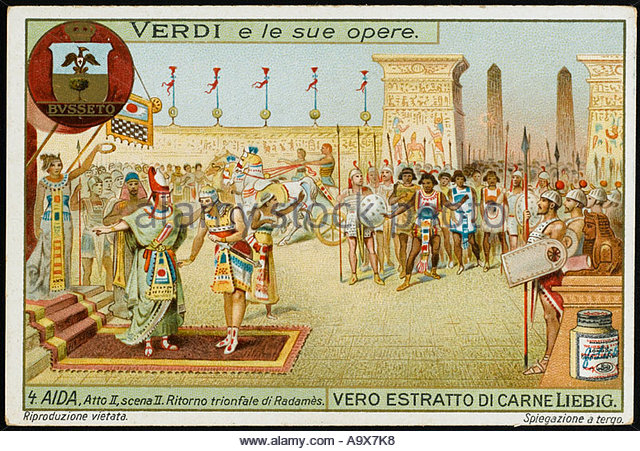
Aida is of course the quintessential grand opera, famed throughout the world for extravagant stagings at the Arena di Verona, but actually, aside from the great Triumphal Scene, many of its scenes are played out in private, behind closed doors.

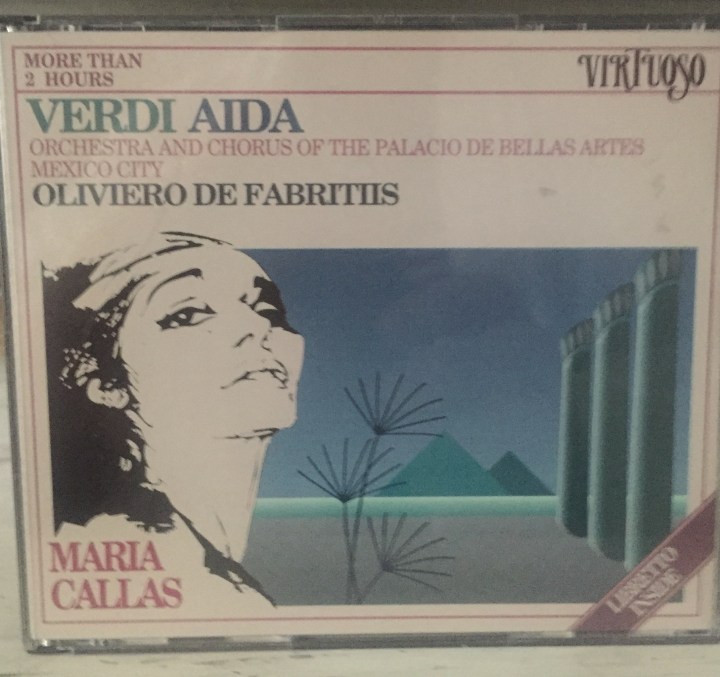
I started my journey with the famous live 1951 performance from Mexico, with Callas, Del Monaco, Dominguez and Taddei, conducted by Oliviero de Fabritiis.
20170209_120338515_iOS

Well let’s get over the caveats. The sound is pretty atrocious; it crumbles and distorts and the balances are all over the place. The voices come through reasonably well, but you do have to listen through the sound, as it were. But what a performance! And a memento of what was undoubtedly a thrilling evening in the theatre.

Callas is in superb voice throughout, and makes more of the somewhat placid character of Aida than any other singer I have come across. The power she was able to summon at this point in her career has to be heard to be believed, a power that goes right up to that unwritten, but absolutely stunning top Eb in alt in the Triumphal Scene, a phenomenal sound, that excites the Mexicans so much you can almost hear them rip the seats apart. Ritorna vincitor is absolutely thrilling, the duet with Dominguez’s Amneris also superb, but, as always with Callas, it is the Nile Scene that provokes her most moving singing.

O patria mia is not her best moment. She seems momentarily preoccupied with the exposed top C at the end, a solid if not exactly dolce as marked note, but once past the aria, she is on more congenial ground, and, with Taddei a worthy partner, alternately stentorian, implacable, insinuating and relentless, runs the gamut of emotions in an exciting Nile Scene. In the ensuing duet with Radames, she finds a wealth of colour as she seduces and cajoles him.

Del Monaco, as usual, is not particularly subtle, but there is the clarion compensation of the voice itself, and, like all the Radames Callas sings with in the three recordings, makes a better hero than lover.

Dominguez is very impressive. This was her debut in the role, and occasionally she overplays her hand, but her singing is very exciting and the Mexicans give her a rousing reception.

De Fabritiis conducts a dramatic, but not particularly subtle, version of the score. Nowhere does he find the delicacy of Karajan or Pappano, or even Serafin, but subtlety is not really what this performance is about.

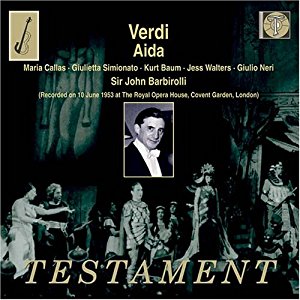
I next moved onto another live Callas performance; this one from Covent Garden in 1953, with Kurt Baum, Giulietta Simionato and Jess Walters, conducted by Sir John Barbirolli.
51M08G0ND7L._SY300_

Unfortunately Barbirolli turned out to be something of a disappointment. More subtle than De Fabritiis in Mexico admittedly, the performance lacks excitement and many of his tempi are unaccountably slow. Maybe his approach was more suited to the reserved Londoners than the excitable Mexicans, but the latter has a thrilling vitality completely missing in London.

There is no thrilling Eb in the Triumphal Scene, but Callas is still in superb voice. However Barbirolli’s slow tempi vitiate against some of her more dramatic moments. The I sacri numi section of Ritorna vincitor lacks the bite Callas usually brings to it, though she is able to spin out the final Numi pieta to even more heavenly lengths at Barbirolli’s slower tempo.

Baum is not quite as bad as his reputation, but he hardly ever phrases with distinction and he sobs and aspirates in what he evidently thought was the Italian manner. He also has a tendency to hold on to every top note as if his life depended on it, so that his duets, both with Callas and Simionato, become somewhat combative. That Callas manages to sing the final duet with the grace and delicacy she does is little short of miraculous, given Baum’s determination to bawl his way to his death.

Simionato, a more experienced Amneris than Dominguez, is magnificent and Barbirolli does finally wake up for her final scene, though you sense Simionato propelling the music forward and they almost become unstuck. Am I being picky, though, when I wonder if a little too much of Azucena creeps into Simionato’s interpretation? Amneris is after all a young princess, but more on that subject later.

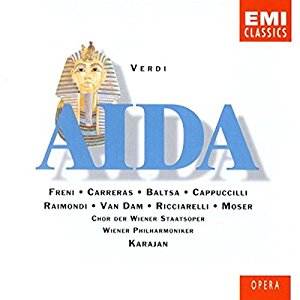
Somewhat disappointed with Barbirolli, I moved on to the second Karajan recording, recorded in Vienna with Mirella Freni, Jose Carreras, Agnes Baltsa and Piero Cappuccilli.
41V5vkkW6hL._SY300_

Karajan’s speeds in this, his second recording, of the opera are also spacious but much more vital. I’ve always found his first effort, with Tebaldi and Bergonzi, a little too self-consciously beautiful. This one is far more alive to the drama. It goes without saying that the Vienna Philharmonic Orchestra play superbly and the sound is excellent analogue stereo, though the voices are a little too recessed for my liking, and are often submerged by the orchestra. Given that Karajan uses lighter, more lyrical voices than we have become used to, this does seem a somewhat perverse decision.

If singers of  Radames tend to break down into the heroic and poetic, Carreras is more in the latter camp. His voice is doubtless a notch too small for the part, but it was still a beautiful instrument at that time, and his is the most attractive Celeste Aida we have heard so far, though he doesn’t manage the pianissimo top B at the end. He is at his best in the final duet, his piano singing a welcome relief from the overloud Del Monaco and Baum.

Freni is very attractive, if a little lacking in personality. Her voice might also be considered a little light for the role, but she never forces and sings within her means, phrasing sensitively and singing cleanly off the text. She does nothing wrong, but set next to Callas, she just isn’t that interesting.

The best of the soloists is, without doubt, Agnes Baltsa. Here at last we have a believably young, spoiled princess, a plausible rival for Aida. Seductively sexy and driven to distraction by jealousy, she is convincingly remorseful at the end of the opera, nor does she sound like an Azucena in disguise. She is superbly effective in her duets with Radames and Aida, and gorgeous in the first scene of Act II. She is my favourite of all the Amnerises.

Cappuccilli I find efficient rather than inspired. He doesn’t stamp his authority on the role of Amonasro the way Taddei and Gobbi do, though, as usual, his breath control is exemplary. In a star studded cast, both Ramfis and the King (Ruggero Raimondi and Jose Van Dam) are excellent and we even get the silken voiced Katia Ricciarelli in the role of the Priestess.

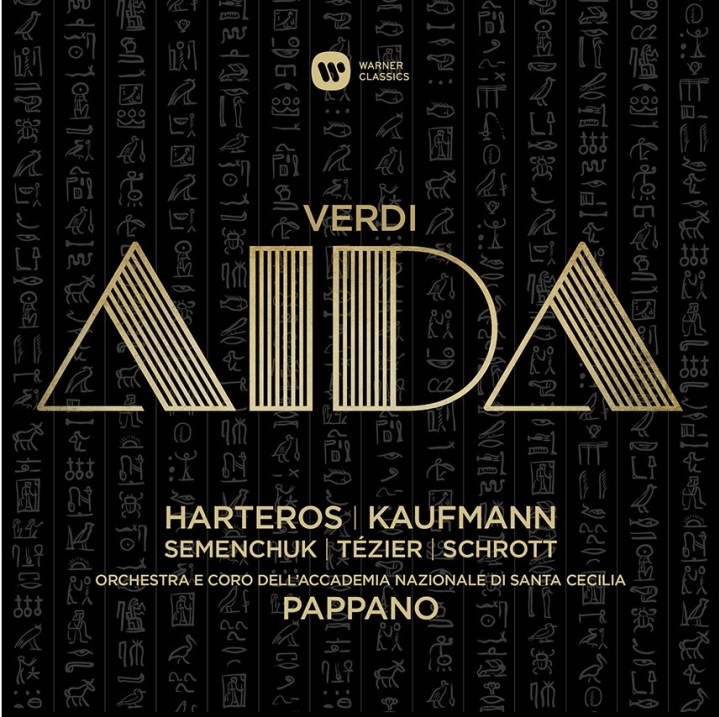
From Karajan I turned to the latest addition to the Aida discography. Recorded in the studio, a rarity for opera recordings these days, it is conducted by Antonio Pappano, and stars Anya Harteros, Jonas Kaufmann, Ekaterina Semenchuk and Ludovic Tezier with Orchestra and Chorus of the Saint Cecilia Academy.
cd-ver_kauf_pappano_2

As one might expect, the sound in this new digital recording is superb, much more naturally balanced than the Karajan, with the voices coming through beautifully. Pappano exerts a superb grip on the opera, and his might just be the best conducted version of the lot, in the best lyric Italian tradition of conductors like Serafin, more of whom below.

Best of the soloists is definitely Jonas Kaufmann, who might just be the best Radames ever to be recorded. He has both the heroics and the poetry (a deliciously ppp close to Celeste Aida) and is vocally the equal of all that Verdi throws at him. Throughout he phrases with sensitivity and imagination, and achieves miracles of grace in the final duet, with some genuine dolce singing. This is a great performance.

Harteros is in the Freni mould, vocally not quite as secure, but a little more interesting. She goes for a dolce top C in O patria mia, but it is a little shaky. She does not erase memories of Caballe (on the Muti recording) in the same music, but hers is nevertheless an attractive performance.

Semenchuk I don’t like at all. She has a typically vibrant Eastern European voice, with a tendency to be squally. She reminded me most of Elena Obrasztsova and sounds a good deal older than she looks in the photographs accompanying the recording. All the other Amnerises under consideration bring something more specific to the role, where she is more generalised, and consequently the big Act IV scene lacks tension.

If not quite in the Gobbi or Taddei class, when it comes to verbal acuity, Ludovic Tezier is a fine Amonasro and together he and Harteros, with Pappano’s inestimable help, deliver a fine Nile Duet. The basses are not quite in the same class as those on Karajan and Serafin.

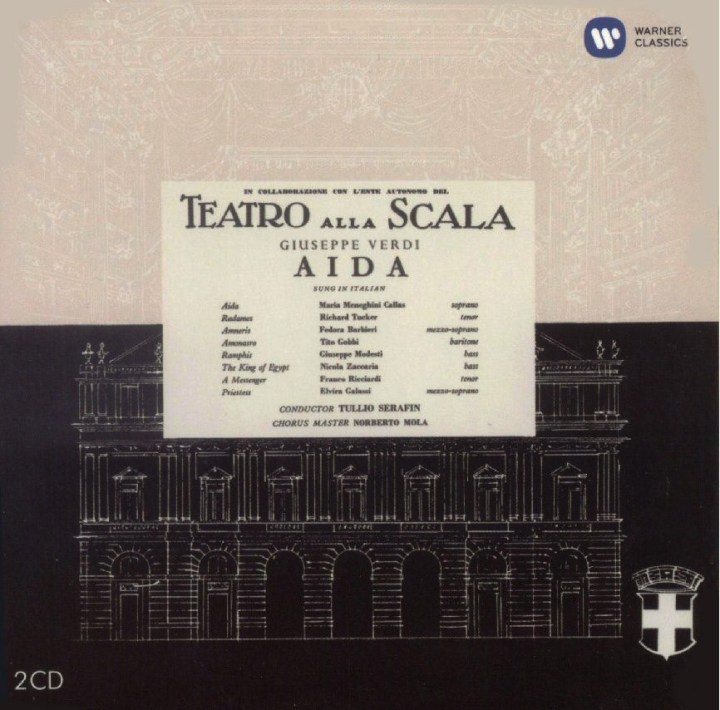
Which brings me to Serafin and Callas’s studio recording of the opera.
cd_callas_aida_1_1

By the time this recording was made in 1955, Callas had given up the role of Aida, singing her last performances in Verona just a few months after the 1953 Covent Garden performances under Barbirolli.

Callas’s voice has thinned out quite a bit, and she sings a much more refined performance of the role, perhaps more in line with conventional interpretations, except of course that Callas can never be conventional. When Tebaldi sings Numi pieta at the end of Ritorna vincitor, she sings a pure lyrical line and it’s very pretty, but Callas reminds us that she is asking the Gods to take pity on her suffering. Time and time again she will illuminate a phrase here, a word there. The duet with Amneris abounds with contrast as the two women play off against each other, but it is the duet with Amonasro in the Nile Scene that holds the heart of this performance, the scene where Aida must choose country before love. Gobbi is at his incisive best as Amonasro, and I doubt I will ever hear this duet done better. Note too how eloquently Serafin makes the strings weep when Aida finally gives in, first with the climbing phrase on the cellos and then in the way he accentuates those stabbing violin figures, when Callas sings O patria, patria quanto mi costi. This is the real stuff of drama.

Tucker isn’t in Callas and Gobbi’s class I’m afraid. He has the right sound for the role, virile and forthright, but for every phrase delivered with just the right degree of slancio, there is another ruined by his tendency to aspirate and sob.

Barbieri is very fine, in the Simionato mould, and, with Serafin letting go a veritable storm in the orchestra, produces a thrillingly dramatic Act IV scena.

Both basses (Giuseppe Modesti as Ramfis, and especially Nicola Zaccaria as the King) are splendid, and Serafin, as you might have gathered, conducts a wonderfully dramatic version of the score, in the best Italian tradition.

So conclusions then. No doubt there will be some wondering why I didn’t include Solti and Muti. Well, Solti I’ve never taken to. I just can’t stand his bombastic, un-Italianate, unlyrical conducting, good though his cast is (though I’ve never quite joined in the general enthusiasm for Gorr’s Amneris). I know the Muti but don’t own it. Until Pappano came along I usually used to recommend it as the safest bet, and Caballe gives one of her finest performances as Aida, and it is still, if memory serves me correctly, worth considering.

From the five under consideration then, I’d say De Fabritiis in Mexico is essential listening, if only as a memento of a historical occasion and a truly thrilling evening in the theatre. It could never be a library version though because of the intransigent sound. From the point of view of a library choice, then the new Pappano would probably be the safest bet, even though it has the weakest Amneris. Forced to choose but one recording, though, I’d go for Serafin, with a rather regretful glance over my shoulder towards Baltsa’s Amneris. The mono sound is sometimes a bit boxy and not a patch on either Karajan or Pappano, but its studio acoustic is a good deal better than either De Fabritiis or Barbirolli, who, in any case, surprisingly trails in last place in this survey, despite the presence of both Callas and Simionato.

Callas’s vocal splendour is best caught in Mexico in 1951, but, the sound is a problem, so it’s Serafin for me, if only for the Amonasro/Aida Nile duet, the most thrilling on all these sets.
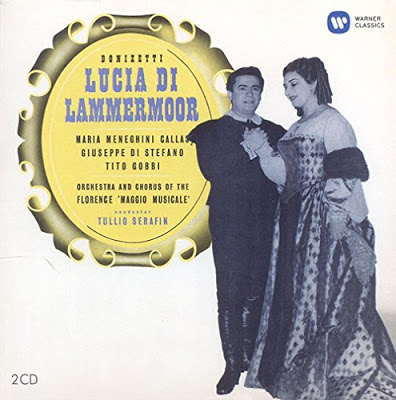


Callas’s 1953 Studio Lucia di Lammermoor

51252bkyvtf8al

Recorded 29-30 January, 3, 4 & 6 February 1953, Teatro Comunale, Florence

Producer: Dino Olivieri, Balance Engineer: Osvaldo Varesca

Of all the roles Callas sang, it was probably Lucia which created the biggest furore. Back in the early 1950s, nobody took the opera very seriously. It was considered a silly Italian opera in which a doll-like coloratura soprano ran around the stage showing off her high notes and flexibility. There is a hilarious description of the characters in E.M. Forster’s Where Angels Fear To Tread attending a provincial performance of Lucia di Lammermoor. Here he describes the prima donna’s first entrance.

Lucia began to sing, and there was a moment’s silence. She was stout and ugly; but her voice was still beautiful, and as she sang the theatre murmured like a hive of happy bees. All through the coloratura she was accompanied by sighs, and its top note was drowned in a shout of universal joy.

For anyone who loves opera or Italy, I heartily recommend this self-mocking tale of the English abroad.

But back to Callas, who first sang the role of Lucia on stage in Mexico  in 1952. A few months earlier she had sung the first part of the Mad Scene at a concert in Rome. After Mexico, she would sing it in Florence, Genoa, Catania and in Rome before appearing in Karajan’s legendary production at La Scala at the beginning of 1954, a production that subsequently travelled to Berlin (one of her most famous recorded live performances) and Vienna.  It was also one of the roles she chose for her U.S. debut in 1954 in Chicago and at the Met in 1956. Her last performances of the role were in Dallas in 1959 (in the same Zefirelli production that made Sutherland a star at Covent Garden) and she made two recordings of the opera;  this one in 1953 in Florence, shortly after stage performances there and the second in 1959 in London. After Norma, Violetta and Tosca it is the role she sang most often, so it is hardly surprising that she is so much associated with it.

Back in the 1950s it must have seemed unthinkable that such a large voice could tackle the role, and not only sing it, but sing it with such accuracy and musicality, giving the opera back a tragic intensity that people had forgotten, or didn’t even know,  was there.  There is a touching story of Toti Dal Monte, an erstwhile famous Lucia herself, visiting Callas in her dressing room after a performance, tears streaming down her face, and confessing she had sung the role for years without really understanding its dramatic potential.

From Callas’s very first notes, she presents a highly-strung, nervous character, but sings with impeccable legato, all the scales and fioriture bound into the vocal line, the tone dark, but plangent, expressive but infinitely subtle. Regnava nel silenzio is a model of grace, but she still manages to invest the words di sangue roseggio with a kind of horror, whilst never resorting to glottal stops or other verismo tricks. She understands that with bel canto it is the arc of the melody, of the musical line that is paramount.

And so it continues, with her consolatory Deh ti placa in the duet with Di Stefano’s Edgardo, a duet of musical contrasts, in which Callas’s Lucia is at its most feminine. The duet with Gobbi, their first encounter on disc together, is also full of contrasts, and Gobbi makes a much more interesting villain than Cappuccilli in her second recording, finding a range of insinuating colour that his younger colleague doesn’t even hint at.

The Mad Scene is a miracle of long breathed phrases, with such lines as Alfin son tua heartbreakingly expressed, and of course here there are none of the problems with the top Ebs that we get in the second recording.

Di Stefano is more suited to Edgardo than he would be to Arturo in I Puritani, which was recorded soon after, and he is much to be preferred to the over-the-hill Tagliavini on the second recording. Serafin conducts a tautly dramatic version of the score.

The sound on this Warner issue still tends to distort and crumble in places. I guess that must be on the master, but the voices ring out with a little more truth.

Of course both Callas and Di Stefano can be heard together in the famous 1955 Berlin performances under Karajan, in sound which is not much worse than this, and that recording would still be my first choice amongst Callas’s Lucias, for all that she eschews the first Eb in the Mad Scene. Under Karajan’s baton and in a live situation she sings with effortless spontaneity, almost as if she is extemporising on the spot.

Still this first Callas studio recording is the one that got people talking and the one that quite possibly changed opinions about bel canto for many years to come. As such it has a historical significance which should never be forgotten.

Callas’s 1953 Studio Tosca

91ntirq8gdl-_sl1500_

Recorded 10-21 August, 1953, Teatro alla Scala, Milan

Producer: Walter Legge, Balance Engineer: Robert Beckett

What can one say about this famous recording of Tosca that hasn’t been said before? It regularly appears in lists of the greatest recordings ever made, and it seems now that its legendary status is confirmed.

Because of it, Tosca has often been considered the quintessential Callas role, but, though she sang it a fair amount in her early career, she pretty much ignored the role after this recording, until it became the vehicle for her operatic comeback in London in 1964. Indeed she never sang it, or any other Puccini role, at La Scala, which was her cultural home at the height of her career. A few months after making this recording she sang the role at a couple of performances in Genoa, then promptly ignored it, except for her two seasons at the Met in 1956 and 1958. In 1964, Zeffirelli managed to get her to choose it as the vehicle for her comeback, but, typically for her, she would only agree if they could do Norma as well, which he staged for her in Paris.

The Zeffirelli production, which was shared by Paris and London, became one of the most famous in operatic history (and in fact Covent Garden only retired it a few years ago). Indeed one could say the photos of Callas in that red velvet dress she wore in Act II have since become iconic, even though Callas herself often voiced her disdain for both the opera and the role.

True, it may not have offered her the vocal challenges of Norma or Medea, of Violetta or Lady Macbeth, but in 1953 her voice was an amazingly limpid and responsive instrument, enabling her to easily encompass its demands, whilst rendering the score with an accuracy the likes of Tebaldi and Milanov could only dream of. Take, for instance, the lightness and grace with which she sings a line like le voce delle cose in Non la sospiri la nostra casetta. Most Toscas are clumsy here, but Callas sings it with elegant ease. Furthermore at this stage in her career, she can swell the tone to a refulgent climax at Arde in Tosca un folle amor, which she can’t quite manage by the time of the second recording, which was recorded around the same time as the London and Paris performances.

Interestingly, though, in terms of interpretation, there are not that many differences between Callas’s Tosca of 1953 and 1964; a few minor details here and there, but for the most part the character of Tosca is as musically finished here as it was to be histrionically in Covent Garden. Though Zeffirelli may have helped her with odd bits of stage business, it seems sure that her conception of the character had changed little in the intervening years. The main differences are vocal, and here she rides the orchestra with power to spare, the top Cs, that emerged as little more than shrieks in 1964, full throated and solid as a rock. Vissi d’arte (which Callas used to say should be cut as it held up the action) is both beautiful and heart-rending. So it is in 1964, but the ending taxes her to the limit there, whereas here it is full throated and easy.

Of course there are other reasons why this set has retained its place as the best of all Tosca recordings. Gobbi is also in fuller, securer voice here than he was in 1964, and his loathsome, reptilian Scarpia is a towering achievement. As usual, he and Callas strike sparks off each other, their confrontations bristling with tension. Di Stefano, who also appears on the first Karajan recording, is here in his best voice, an ardent, youthful and passionate Cavaradossi. Both duets with Callas are erotically charged affairs, as they should be.

Then of course, there is De Sabata on one of his rare excursions to the studio. The La Scala orchestra play superbly for him, and he unerringly paces the score just perfectly, with a sure sense of the work’s inner impetus, his use of rubato  brilliantly controlled. In a performance such as this, the one true winner is Puccini.

Sonically it is surely the best of all Callas’s studio mono sets from La Scala. One hardly notices the lack of stereo; voices are perfectly placed and the orchestra sounds richer and more full-bodied than was often the case. This transfer has also corrected some of the errors that crept into previous CD incarnations, not least the terrible GROC version.

Still the Tosca to have, and blow stereo digital sound.

Callas as Nedda in Pagliacci

51hyylyexul

Recorded 12-17 June 1954, Teatro alla Scala, Milan

Producer: Walter Legge, Balance Engineer: Robert Beckett

Nedda was the first of four roles Callas recorded in the studio, but never sang on stage, the others being Mimi, Manon and Carmen. Pagliacci is really the tenor’s opera, and one can imagine the role would have held little interest for her on stage, though, as is her wont, she makes a great impression in a role one wouldn’t readily associate with her.

Back in the 50s, Nedda was usually played by a light-voiced soubrette, who, if she provided any characterisation at all, would play her as a two-dimensional heartless little minx, so how like Callas that she should look inside the music and find more facets to Nedda’s personality.

Her very first words Confusa io son strike a note of fear, justified  when she sings of Canio’s temper (brutale com egli’e) and note the accent she gives to the word brutale. She shrugs off her fear, but in her singing of the ensuing aria, with its paean to freedom, it is not difficult to understand that here is a young woman bursting with life but trapped in a loveless marriage with a man prone to violence.

The scene with Tonio, like all Callas’s collaborations with Gobbi, bristles with drama and life. Here it would seem is another man trying to subjugate her to his will, but her relationship with Tonio is different. Here she has the upper hand. At first mockingly dismissive, she taunts him until he responds with violence; but here too she retains the upper hand, lashing out both vocally (Miserabile!) and physically with the whip. Left alone she expresses her distaste with a voice dripping with loathing, only to change in an instant when she lovingly sings the single word Silvio as her lover makes his appearance.

The duet with Silvio is erotically charged, suffused with warmth and passion, then in the ensuing confrontation with Canio, defiant in the face of fear, her voice hardens again.  Is there a suggestion here that this is ground they have been over before?

Also masterful is the way she uses a different, whiter sound for Colombina, and only in the final stages of the opera in her ultimate refusal to submit to Canio does she return to full voice, riding the orchestra with a defiance that goads Canio into his final act of murder. There are parallels here with Callas’s Carmen.

Di Stefano does well as Canio, though I can’t help feeling that such a Nedda really needed a more psychologically complex foil, along the lines of someone like Vickers, or Domingo in his later portrayals, not that either of them were around at the time of the recording of course. Nonetheless, though some might think him a shade light-voiced for the role, Di Stefano is a very effective Canio, singing brilliantly off the words, his diction, as usual, exemplary.

Gobbi, on the other hand is superb as Tonio, as is Panerai as an ardent Silvio, and Monti, much more than a comprimario, makes an excellent Beppe. Serafin is a relatively unassuming presence. He doesn’t do anything wrong, but nowhere is his conducting as revelatory as it often was in Verdi.

Pagliacci probably wouldn’t rank high on any list of essential Callas recordings (certainly not on mine) and I’d have to be honest and admit it’s not one of my favourite operas. Neither the character nor the music really call on Callas’s greater musical gifts, yet, without stage experience,  she creates a rounded character, and, with a superior cast, this recording has held its own for over 50 years now.

Callas’s Studio Aida

81eycwhmfol-_sl1500_

Recorded 10-12, 16-20, 23-24 August 1955, Teatro alla Scala, Milan

Producer: Walter Legge, Balance Engineer: Robert Beckett

I’m going to make a confession. Aida is not my favourite Verdi opera. I find it hard to identify with any of the characters, and they usually emerge as representatives rather than real people. It is full of great music, but I have to admit I admire it rather than love it. Nor would the role of Aida be considered a natural for Callas, though she sang it, with a great deal of success, quite often between her debut in the role in 1948 and her last stage appearances in it in 1953, this 1955 recording being the last time she would ever sing the complete role, though she returned to the aria Ritorna vincitor and the Nile duet with Radames (with Corelli) late in her career in the mid 1960s. Interestingly enough, though one doesn’t think of Aida as a Callas role, when the now defunct International Opera Collector magazine conducted a poll of its readers to assemble the ideal Aida cast, Callas was one of the favourites, alongside such famous Aidas as Ponselle and Leontyne Price.

The reason for this can only be that she brings the rather placid character of Aida to life like no other. Though she may not have the sweetness of timbre one might ideally want from an Aida, there are plenty of other rewards. She takes a little while to settle down in the first trio, but Ritorna vincitor is alive with meaning and contrast. Just listen to the way she spits out her hatred for del egizii coorti, the power with which she exhorts her compatriots to destroy the legions, with particular emphasis on the word struggete, the complete change of colour at Ah! Sventurata che dissi, the tenderness with which she sings of her love for Radames and the pain and desperation in her voice at Da piu crudeli angosce un core affranto; the last imprecation to the Gods sung with her tone drenched in sorrow, her legato as usual impeccable. Aida’s cruel predicament is set before us in this one aria with a psychological penetration second to none.

There are wondrous little details in the ensuing duet with Amneris too, like the touch of pride that enters her tone at Mia rivale! Ebben sia pure, quickly withdrawn when she realises she could easily give away her true identity.

But it is the Nile Scene that makes the greatest impression in this set. It starts with Aida’s O patria mia, which some commentators have found to be the weak link in her portrayal, but she yearns most wistfully, floating the tone wonderfully at O freschi valli. She always had problems with the ascent to top C, but it is a lot more solid here than she is often given credit for. It may not be dolce as marked by Verdi, but I don’t hear the wobble that so many commentators claim to have problems with. The following duet is magnificent music and magnificently sung by both Callas and Gobbi, and the finest realisation of it on disc. I doubt any singers have come close to them in the way they create drama in sound, and Serafin is at his very best in this scene too. I found it impossible to hold back the tears as Callas launched into that glorious tune at O patria, patria, quanto mi costi, and how brilliantly Serafin makes the violins weep with her.

The duet with Radames is hardly less fine, though Tucker can be a bit graceless at times. Yet again, Callas brings out a wealth of detail, like the insinuating way she sings Pur, se tu m’ami with that slight portamento on the word m’ami. She plays Radames brilliantly here, wonderfully seductive when she sings La tra foreste vergini. This is operatic singing on the highest level. In the last act too, she has something to offer, singing with grace and accuracy the difficult fioriture of Vedi? Di morte l’angelo.

As already mentioned Gobbi is superb as the implacable Amonasro, masculine and forthright of tone,  though still able to inject some tenderness into his duet with Aida. Tucker has the right heroic timbre for the role of Radames, but he can be a bit lachrymose, and tends to aspirate and sob, as if mimicking the mannerisms of a true Italian tenor. Barbieri is more subtle than I remember her, and provides a barnstorming Amneris, though I have come to prefer Baltsa on Karajan’s second recording, who reminds us that Amneris is a young princess and a valid rival for Aida.

Serafin is on top form, conducting in the best Italian tradition, lyrical and dramatic in equal measure. There may not be any great surprises or revelations, but his deep understanding of the music and its style is its own reward.

All in all, it was a great surprise to re-discover this set, to enjoy the opera more than I thought I would, and to find myself appreciating Callas’s very individual take on the role

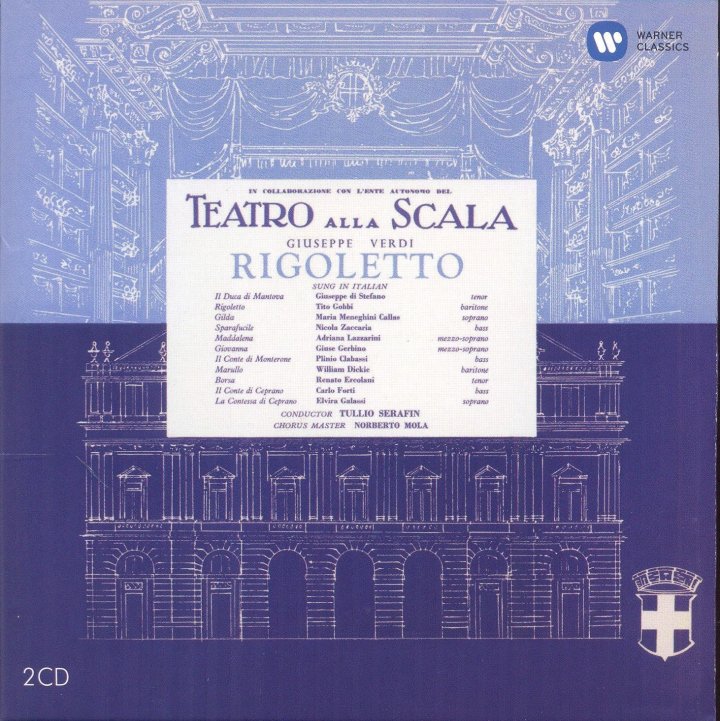
Callas and Gobbi in Rigoletto

91km0olq4ul-_sl1466_

Recorded 3-16 September, 1955, Teatro alla Scala, Milan

Producer: Walter Legge, Balance Engineer: Robert Beckett

Gilda is another role one would not readily associate with Callas. She did sing it on stage for two performances in Mexico in 1952, but, unhappy with her performance, never sang it again except for this recording made in 1955. The Mexico performances are a bit of a mess and sound under-rehearsed, but Callas is superb, and one notes how it is often she who keeps the ensemble together, even though she was so blind on stage she could never see the conductor. It is actually something of a tragedy that she didn’t sing the role more often. If she had, then people may have rethought the role of Gilda, as they did that of Lucia. It is usually sung by a light voiced lyric coloratura, who manages Caro nome well enough, but can’t really muster the power to dominate the ensembles in the last two acts, as she should. It’s something I’ve noticed myself. Not so long ago I saw the opera at Covent Garden with Aleksandra Kurzak as Gilda. She looked ideal, convincingly acted the ingénue, sang a wonderful Caro nome, but tended to be drowned out in the final act, especially in the storm scene.

No problem there for Callas of course, but the miracle is not that she can sing out with a but more power when needed, but that she remains in vocal character when she does. She doesn’t suddenly sound like Norma or Tosca, but continues to think upwards in a voice somehow cleansed of all those heavier associations.

I often think it odd that when people talk about Verdi sopranos, it is the voices of Tebaldi and Leontyne Price they have in mind, but could either of those sopranos have sung Gilda, or Lady Macbeth, or any of Verdi’s early roles? Tebaldi may have sung Violetta, but it wasn’t a natural for her, the coloratura in Sempre libera smudged (and transposed down in live performances). Nor did Tebaldi sing the Trovatore Leonora on stage, as the role lay too high for her. Price did of course, and she was an appreciable Leonora, though she doesn’t sing with the same degree of accuracy as Callas. Callas, on the other hand, sang with equal success Gilda and Lady Macbeth, Abigaille and Elisabeth de Valois, Elena and Aida, both Leonoras, Amelia and Violetta, all on stage not just in the studio, and one regrets that she didn’t get the chance to sing more of Verdi’s early operas. What a superb Luisa Miller she might have made, or Odabella in Attila, Griselda in I Lombardi, or virtually any of those early Verdi heroines. Maybe, after all, it is Callas who is the ideal Verdi soprano.

But back to this Rigoletto, in which Callas yet again completely inhabits an uncharacteristic role. In the first two acts, she presents a shy, innocent young girl, with a touch of wilfulness that explains her disobedience to her father. In the duet with Rigoletto, we feel the warmth of her love for him, and in the one with the Duke, the shy young girl awakening to passion. You can almost see her blushes when the Duke first appears to her. She was asked once why the single word uscitene resounded with such a strange colour. “Because Gilda says go, but wants to say stay,” was her simple answer. Actors might be used to such psychoogical distinctions but it is rare indeed to find it in singers. Caro nome is not just a coloratura showpiece, but a dreamy reverie, and ends on a perfect rapturous trill as she exits the stage. In Act III her voice takes on more colour (Ah, l’onta, padre mio) and it is Tutte le feste that becomes the focal point of her performance, her voice rising with power to the climax (nell’ansia piu crudel) as  she describes the horror of what happened, and note how at the opening she matches her tone to that of the cor anglais introduction. She has the power to ride the orchestra in the storm scene in the last act, and the final duet with Gobbi is unbelievably touching. As usual her legato is superb, phrases prodigious in length, shaped and spun out like a master violinist. It is a great pity she didn’t sing Gilda more often, for it is a considerable achievement.

There are other reasons to treasure this performance of course, chief among them being Gobbi’s superbly characterful, endlessly fascinating and heartrending performance of the title role. Gobbi and Callas always had a striking empathy, and the three duets for father and daughter in this opera, gave that relationship full rein. Some have remarked that Gobbi’s voice was not a true Verdi baritone (whatever that means), but, like Callas, he was successful in a range of different Verdi baritone roles, his most famous probably being Rigoletto. Who has ever matched Gobbi in tonal variety and vocal colour, and psychological complexity? None that I can think of. Pari siamo is superbly introspective and then in Cortigiani! he lashes out like a wounded animal, before breaking down in accents that are pathetically heartrending. To those who say he could not sing with beauty of tone, I would say there are plenty of moments in the score which refute that assertion,  the Piangi section of the Act II duet, where he spins out a pure legato which is both musical and shatteringly moving, being a case in point.

Di Stefano may not be quite in their class, and there are certainly more elegant Dukes on record, but he sings with enormous face and charm. One can imagine why Gilda would be captivated by this Duke. He can be musically inexact (some of the tricky rhythms in Act I go a bit awry), but his voice is in fine shape, and he sounds both charming and sexy, which is as it should be. Nor does he play down the casual cruelty that lies at the heart of his character. I’d say it’s one of his best recordings.

Serafin’s conducting is in the best Italian tradition, both lyrical and dramatically incisive. He is totally at one with Callas and Gobbi in the duets, giving them ample time to make their dramatic points, but whips up quite a storm in the finale to Act II.

The sound is truthful and clear, the voices wonderfully present, and, as in all the Warner sets so far, sounds excellent on my system.

Years ago I remember an acquaintance, not really a voice fan (or a major opera fan, for that matter), asking me which recording of Rigoletto I recommended. He had the Giulini, and quite enjoyed it, but thought there was something missing. I warned him that some were allergic to Callas’s voice, but lent him my set anyway. A couple of days later he excitedly returned it to me, having ordered the recording for himself. “Fantastic,” he said, “Exactly what I was looking for. Suddenly the whole opera came to life.” Well you can’t ask for much more than that.

Callas’s Studio Un Ballo in Maschera

91l5b71tlcl-_sl1453_

Recorded 4-9 September, Teatro alla Scala, Milan

Producer: Walter Jellinek, Balance Engineer: Robert Beckett

It may come as a surprise to find that this 1956 recording of Un Ballo in Maschera was the first time Callas was singing the role of Amelia complete, and that she would not sing it on stage until the following year at La Scala in a lavish new production by Margarita Wallman, her only stage performances of the role. As is her wont, she completely inhabits the role and so deep is her identification with it that one would assume she had been singing it for years.

Amelia is a transitional role in Verdi’s canon, looking forward to Verdi’s later style, but still with a requirement for many of the vocal graces one expects from a bel canto singer, most of them glossed over or ignored by technically less accomplished sopranos. Callas’s voice and technique were well suited to it, her dark timbre uniquely telling, filling out its phrases with true spinto tone. Amelia’s very first phrases are sung with breadth and a deep legato, and yet she executes the little turns Verdi adds to indicate Amelia’s nervous state of mind nimbly and with accuracy, and how beautifully she spins out the arch of the great melody at Consentimi, o Signore.

Act II finds her at her very best, first in the great scena that opens the act, including a secure top C at its close. But note how she phrases onwards and through the top note, so that the final cadenza and its quiet close become the focal point of the aria. Note also how she observes the sforzando markings at Deh mi reggi, whilst at the same time maintaining her impeccable legato. The ensuing duet with Riccardo (one of Verdi’s greatest inspirations) has an erotic charge not heard in any other version, save possibly the live one from the following year; who but Callas can invest the line Ebben si t’amo with so many conflicting emotions? Throughout this recording her voice, rich and dark hued, is more responsive than that of Eugenia’s Ratti’s light voiced soubrette. In the ensemble at the end of the first scene of Act III, it is Callas, not Ratti, who demonstrates perfect trills, and hear in the Oath Quartet just before, how she whips through a series of triplets which take her from a sustained top Bb to D and Eb at the bottom of the stave with dazzling accuracy. This is Callas at her best, both vocally and dramatically.

The rest of the cast could hardly be bettered. Di Stefano may not be the most aristocratic of Riccardos, but it is still one of his best roles, sung with his own brand of slancio and lashings of charm. Gobbi is superb as Renato. Others may better him in the cantabile of Alla vita che t’arride, but few have expressed so eloquently the anguish and conflicts at the heart of Eri tu. Barbieri is a formidable Ulrica, and Ratti a pert, if occasionally too bright-voiced, Oscar. We also get a nicely ironic pair of conspirators in Maionica and Zaccaria.

Votto is, well, a good accompanist, and nowhere near as propulsive as Gavazzeni at La Scala the following year. Serafin would have been the better conductor for the job, but Callas was in a funk with him for agreeing to record La Traviata with Stella instead of her.

This was one of the few La Scala recordings not produced by Walter Legge, though the La Boheme which preceded it was. I have no idea why this should have been the case.  I originally owned the first UK reissue of the set on LP, and later the 1987 EMI Angel CD issue. Callas always sounded well on this set, but it is Ratti who sounds less shrill on the Warner than she did on the previous CD incarnation. Either that or my ears have become more forgiving.

I would never want to be without the live Un Ballo in Maschera from the following year, possibly the last time we hear Callas singing with such power and freedom, but this recording remains one of the most recommendable studio sets around, despite its mono sound. The opera was recently the subject of Radio3’s Building a Library programme. Final choice was eventually narrowed down to Muti with Domingo and Arroyo and this Callas set. If Roger Parker eventually plumped for Muti, that was because of the better, more modern sound and the greater refinement of Domingo’s Riccardo. However he comforted himself by making the Callas recording his historical choice, leaving him the best of both worlds.

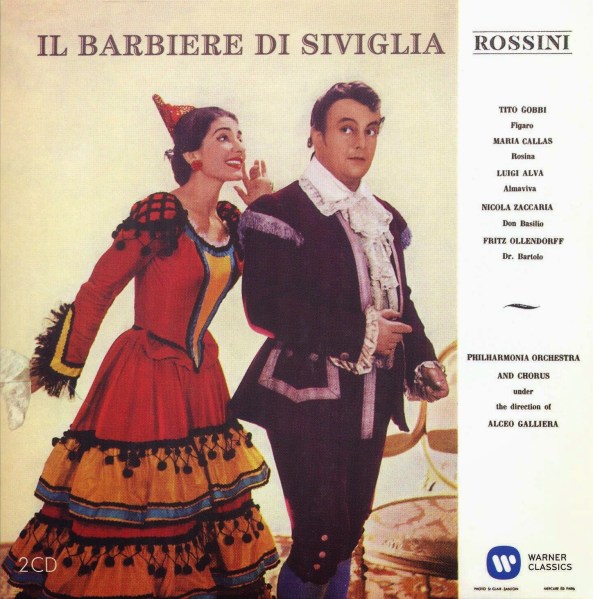
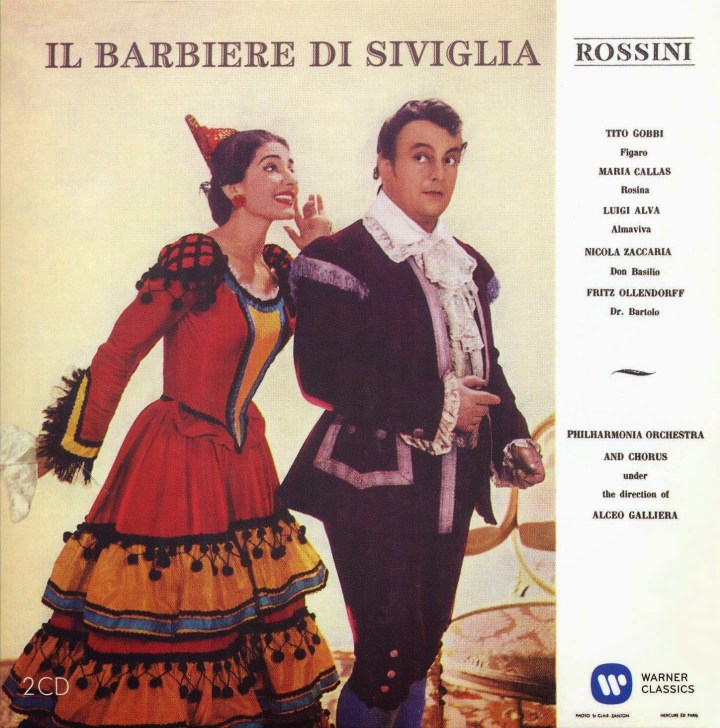
Callas’s Studio Il Barbiere di Siviglia

91be3bm7phl-_sl1465_

Recorded 7-14 February 1957, Kingsway Hall, London

Producer: Walter Legge, Balance Engineer: Robert Gooch

Callas only once sang Rosina on stage, in 1956 in an antiquated production at La Scala, which was, by all accounts, the one big flop of her career. People opined that comedy was obviously not her metier, though they must have had short memories and forgotten all about her success in the Zefirelli production of Il Turco in Italia the previous year, an opera she had originally sung back in 1950 and also recorded.

Giulini, who conducted the La Scala production, recalls the production as the worst memory of his life in the theatre.

I don’t feel it was a fiasco for Maria alone, but for all of us concerned with the performance. It was an artistic mistake, utterly routine, thrown together, with nothing given deep study or preparation.

It was also the last time Giulini ever conducted an opera at La Scala, and in fact he rarely conducted opera at all after that.

Whatever the problems at La Scala, though, the studio recording made the following year in London, with Gobbi and Alva joining Callas from the La Scala cast, is a joyous affair, and still one of the most recommendable recordings of Il Barbiere di Siviglia in the catalogue. The edition used wouldn’t bear scrutiny today, but at least Callas sings in the mezzo keys, though she does sing upward derivatives when the line takes her too low, interpolating a secure top D at the end of her duet with Figaro.

I am reminded that when an opera producer friend of mine was asked to produce the opera in Russia, he acquired a modern recording of the opera, no doubt in some urtext edition, but found the whole thing completely dispiriting. Having very little enthusiasm for his task, he was about to cancel, when he decided he would have a listen to the Callas recording. His ideas were absolutely transformed. Swept away by the sheer exuberance of the recording, he set about his assignment with renewed enthusiasm.

Callas’s Rosina is a mettlesome minx, defiant with Bartolo, flirtatious and seductive with Almaviva, and playfully scheming with Figaro. The whole character is laid out for us in her singing of Una voce poco fa, sweet docile and gentle, but (and just listen to the explosive way she sings that one word ma) a little devil when crossed. Some find her Rosina lacks charm. Well maybe she misses a touch of the coquettish, but, one thing’s for sure, this Rosina would be a lot of fun. Her technical proficiency in the role’s florid writing is little short of staggering, her voice infinitely responsive.

However Callas is no prima donna in this opera, and is very much part of a team, and one of the delights of this recording is in the many duets and ensembles with which the score abounds. You sense that this team of singers really enjoyed working together; there is a real sense of ensemble about it. Individually, they are an excellent bunch, led by Gobbi’s jovial Figaro. Alva is on more than one recording of Il Barbiere di Siviglia and he too works wonderfully well in duet with Gobbi, and also sings with some of the grace one associates with singers of an earlier generation. Zaccaria and Ollendorff are also well in the picture, and don’t overdo the slapstick. The Buona sera ensemble had me chuckling out loud. Gabriella Carturan contributes a nice cameo as Berta too. Alceo Galliera is an unexpected choice of conductor. Known mostly for his role as an accompanist, he conducts a sprightly, fleet and sparkling version of the score.

For all its textual inaccuracies, this Barbiere has held its place as one of the best recordings around, its sense of fun and ensemble almost unrivalled. A joyfully theatrical set, so full of character, that one hardly needs visual aid, so vivid is its storytelling, it fizzes and sparkles like a good champagne.

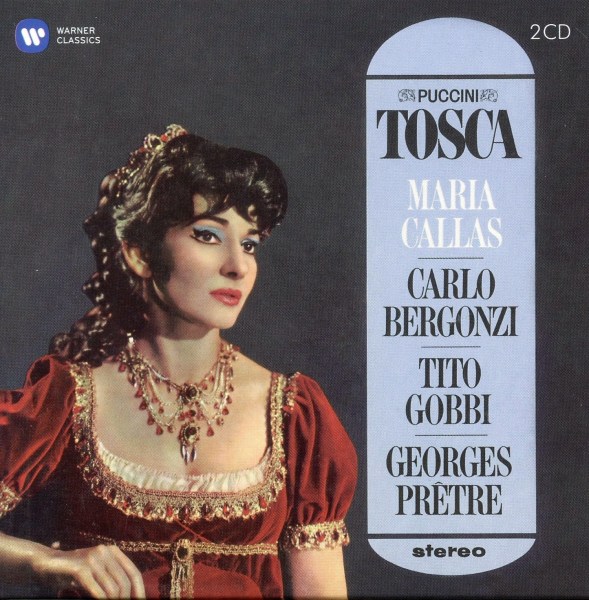
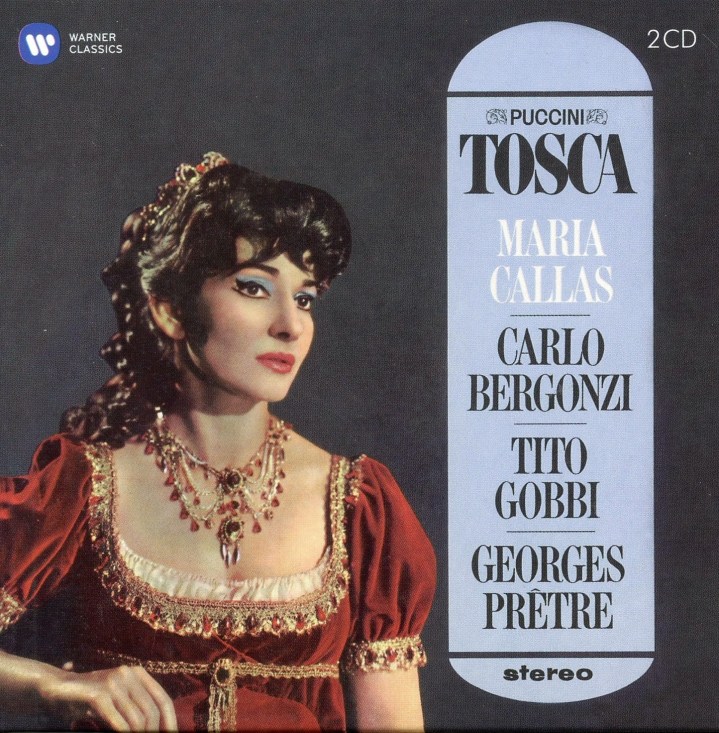
Callas’s 1964 studio Tosca

91idlbhid5l-_sl1500_

Recored July 1964 and January 1965, Salle Wagram, Paris.

Producer: Michel Glotz, Balance Engineer: Paul Vavaseur


I hadn’t heard this set in maybe 20 years. It was actually one of the first complete opera sets I owned, the renowned 1953 De Sabata recording being unavailable when I first started collecting in the late 1960s. According to Zeffirelli, the recording was originally intended to be the soundtrack of a film, a project that unfortunately fell through, but, in any case, EMI obviously wanted to cash in on the success of Callas and Gobbi’s performances together in 1964 and 1965 in London, Paris and New York. Considering how closely they are associated with their respective roles, it is a surprise to find that before the Zeffirelli production at Covent Garden, they had only once before played opposite each other in the opera, and then only in a performance of Act II at a Paris Opera Gala, and yet they cast their shadows over the opera as no others do.

Let’s first get the caveats out of the way. Pretre doesn’t have De Sabata’s grip on the score, but he has his moments, and the torture scene is particularly thrilling; Callas’s voice is considerably trimmed down from the first recording and some of the top Cs are closer to screams than actual notes, though, in this new pressing, they don’t seem anywhere near as bad as I remember them; Gobbi too has lost some of his vocal sheen, but is as authoritative as ever.

However, we should remember that this recording was made at about the same time as Callas and Gobbi were appearing on stage. Even without seeing them, you sense their deep rapport. The producer John Copley was Zeffirelli’s assistant on the Covent Garden production, and he once told me that rehearsing with Callas and Gobbi was not like rehearsing with opera singers at all. Zeffirelli would let them run a whole scene, improvising their moves as you would with actors. They would then sit down and discuss what had worked, what hadn’t and go back over the scene incorporating any new ideas that came up. In all his career, he said, he has never come across such complete actor-singers. This ability to play off each other comes across in all their scenes on disc.

I do miss Callas’s ability to soar and swell the tone at a line such as Egli vedi ch’io piango, but their are compensations. When she cries Non posso piu in Act II, this is literally the sound of a woman at the end of her tether, and her chest tones in son io che cosi torturata rend the heart. In the last act, her recounting of the murder lacks the power of the De Sabata, though she manages Io quella lama gli piantai nel cor better than expected with an exciting plunge into chest voice. Here too the top C sounds better than I remember; I assume this must be something to do with the improved sound picture. Her Tosca on this set is more feminine, more vulnerable, if you like, with dozens of lovely touches in the love duets, if not the ability to ride the orchestra that she had in the first recording.

Gobbi still sounds superb. I doubt I will ever hear another Scarpia to rival him. His Scarpia is a gentleman and a thug and more interesting because of that. A man of impeccable manners, who never gets his hands dirty, making sure he has minions to do his dirty work for him. His performance, too is full of detail. From the unconcerned way he sings La povera mia cena fu interrotta, cruelly feigning surprise at Tosca’s distress, to the ironic tone he adopts at violenza non ti faro, this is a man completely in control.

Cavaradossi? Well Bergonzi sings beautifully, but I missed Di Stefano’s ardour, his winning personality, and he is in especially good voice in the De Sabata recording. Beside him Bergonzi sounds a bit anonymous.

The orchestra play well for Pretre, but they are not the equal of the La Scala players, and of course this set will never replace the classic De Sabata Tosca, which is considered one of the classic opera recordings of all time. This one isn’t entirely without merit, though, and Callas completists will definitely want to have it in their collection.