Glen Cunningham’s Heart is in the Highlands

An interesting programme of Scottish inspired songs, but Cunningham’s tenor is a little too much on the dry side for my liking.

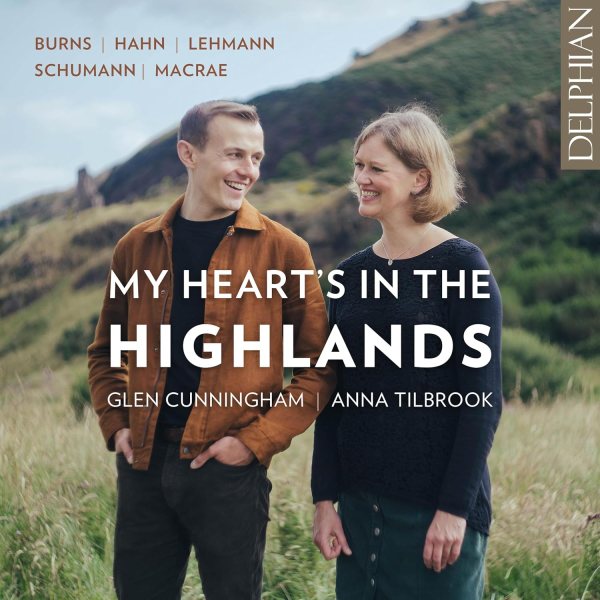
My Heart’s in the Highlands

Glen Cunningham (tenor)  Anna Tilbrook (piano)

The young tenor, Glen Cunningham, and his pianist, Anna Tilbrook, celebrate their Scottish heritage in a programme of music connected to Scotland, not only in the folk orientated songs of Robbie Burns, but also in settings of Burns by Schumann, and Robert Louis Stevenson by Liza Lehmann and Reynaldo Hahn. To these are added a completely new song cycle, also to texts by Robert Louis Stevenson, by the Scottish composer, Stuart MacRae.

It makes for an interesting programme, with the folk song settings framing the songs by Schumann, Lehmann, MacRae and Hahn. Thus, we start with a setting of Burns’s Ca’ the yowes to the knows in an arrangement by Claire Liddell, which segues into the eight songs from Schumann’s Myrthen, which set texts by Burns in German translation. They are possibly less well known than other songs from Myrthen, like Widmung or Der Nussbaum, and I doubt anyone would guess the Scottish provenance of these Schumann songs. Nor, I wager, would anyone guess that the  song Dem Roten Röslein Gleicht Mein Lieb from Schumann’s Opus 27 Lieder und Gesänge is actually a setting in German of the famous My love is like a red, red rosewhich follows it.

Liza Lehmann is less well represented in the catalogue than Schumann, though a selection of the songs from The Daisy-Chain have been recorded by mixed voices and are available on the Naxos label. Cunningham selects four of the five songs to texts by Robert Louis Stevenson. These are children’s songs to be performed by skilled adults, and the vocal writing is often taxing, Stars, for instance, requiring the sort of lyrical outpouring that Cunningham’s rather dry tenor is not quite capable of. Toby Spence manages it slightly better on the above Naxos recording, but it really needs a fuller voice than either of these two tenors can provide.

Two of the texts are also set by Reynaldo Hahn in his Five Little Songs, written while Hahn was a private in the French army during World War I, where he saw action on the front line. These too are settings of Robert Louis Stevenson, ‘children’s songs’, though it is unlikely that any child could sing or play them. They are quite charming, though, yet again, there is nothing particularly Scottish about them.

Not surprisingly, I suppose, the most Scottish sounding of the songs are those by Stuart MacRae, particularly For age an’ youth, which sets a Scots style vocal line against a sort of imitation bagpipe in the piano accompaniment. Cunningham is at his best in these songs, but even here I wanted more of tonal beauty. He compensates with the intelligence of his delivery, but throughout I’m afraid I found his vibrato intrusive and the sound he makes unpleasantly hard and uningratiating.

I should just mention that Anna Tilbrook is a most sensitive accompanist and adapts brilliantly to the style of each composer.

The recital ends with the title song, My heart’s in the Highlands, in an arrangement by Michael Barnett (and supplemented by Tilbrook) that was transcribed from a 1962 Kenneth McKellar recording. I just wish that Cunningham sang it with some of McKellar’s beauty of tone.
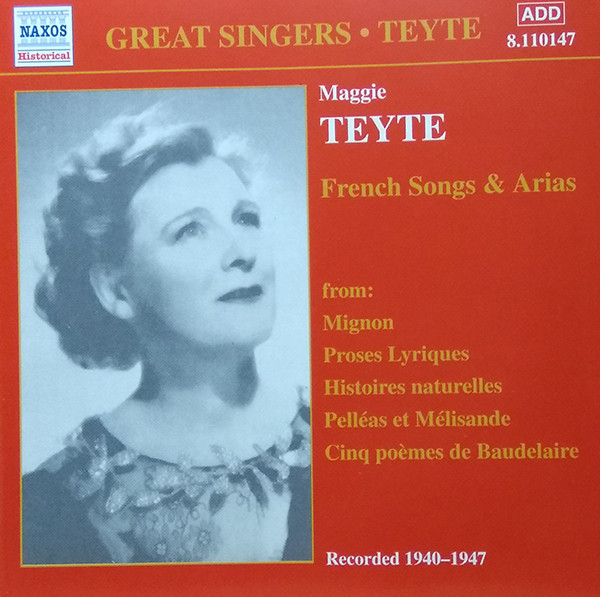
Maggie Teyte sings French Songs and Arias

ni00mzuxlmpwzwc

This compilation is of recordings made bewteen 1940 and 1947, when Teyte was approaching 60. Three tracks (Mignon’s Connais-tu le pays?, one of two versions of Duparc’s L’invitation au voyage and the bonus track, Cherubino’s Voi lo sapete) are from a 1947 radio broadcast with the San Francisco Symphony Orchestra under Pierre Monteux, and the rest are of studio recordings made for EMI, some of which were unpublished at the time. Most are with Gerald Moore on the piano, but the second recording of L’invitation au voyage is with the London Philharmonic Orchestra under Leslie Heward. I’d suggest that this is the better of the two recordings. By the time of the second one with Monteux she has to take more breaths, though the tempi are virtually identical. Even so, even in 1947 the voice remains incredibly firm and totally free of wobble or excessive vibrato. Her singing throughout in fact is wonderfully clean and precise and her intonation is perfect.

So too, of course is her French, though we shouldn’t be surprised when we remember that she spent a good deal of her early career in Paris, was coached by Debussy himself for her début as Mélisande and worked with Chausson, Duparc and Reynaldo Hahn, who evidently had a great deal of affection for her. When she said to Hahn once about the tempo of one of his songs. ‘ You play it quicker than I thought,’ he replied, ‘ma chère, any way you sing it will always be right.’

This is a valuable collection and includes recordings that were either not published or had only a limited circulation in their 78 format, though some of them also appear on EMI’s two disc set entitled, Mélodies françaises . The excerpts from Hahn’s Mozart and Ciboulette are absolutely charming, and we get to hear her speak in perfectly accented French too. The other songs are by Debussy, Chausson and Duparc. Debussy was always a particualr speciality and she somehow makes the three songs she sings here from Debussy’s rather obscure Proses lyriques (she had already recorded the fourth with Cortot) come across as quite simple and direct. She also sings a couple of extracts from Pelléas et Mélisande with piano, which gives us a direct link to Debussy himself.

Teyte should be better known than she is these days. She was one of the greatest ever interpreters of the French song repertoire.

Two Contrasting Vocal Recitals

71mojlgie4l._ac_sl1073_

Dame Maggie Teyte in concert, at the age of sixty no less! Teyte, a famous Mélisande who studied the role with Debussy himself, sings extended excerpts from the opera with piano accompaniment, singing all the roles. It shouldn’t work, but somehow it does. It takes her the first song in the recital (Grétry’s Rose chérie) to warm up, but thereafter you would never believe this was the voice of a sixty year old woman. The disc also includes privately recorded excerpts from Strauss’s Salome also with piano, from when Teyte was preparing the role for Covent Garden about fifteen years earlier, a project that unofrtunately never came to fruition. Her bright, slivery soprano might just have been the voice Strauss imagined.

She also sings Britten’s Les Illuminations in a version for piano, making me wish she had recorded the orchestral version, although preferably a few years earlier. Just occasionally there is a flicker of frailty in the middle voice, although the top register remains firm and clear as a bell. The encores include a lovely performance of Hahn’s popular Si mes vers avaient des ailes.

r-2563085-1290611066.jpeg

Another enterprising disc from Dawn Upshaw, who seems to have disappeared from the scene now. The centrepiece is Earl Kim’s Where grief slumbers written in 1982 for voice, harp and string orchestra, but here presented in a 1990 arrangement for voice, double string quartet and harp, and Upshaw is an ideal interpreter. She is equally at home in the rest of the programme; Falla’s Psyché, Ravel’s Trois poèmes de Stéphane Mallarmé, Stravinsky’s Two poems of Konstantin Bel’mont and Three Japanese Lyrics and Delage’s Quatre poèmes hindous, though here I slightly prefer the warmer tones of Dame Janet Baker, who is much more languidly erotic in the worldess vocalise of Lahore. Nevertheless a thoroughly absorbing disc.

As with so many of these Nonsuch discs, documentation is slight, and, though we do get lyrics and translations, the layout is confusing and a little more information about the provenance of these songs, especially the less famous Kim cycle, would have been much appreciated.

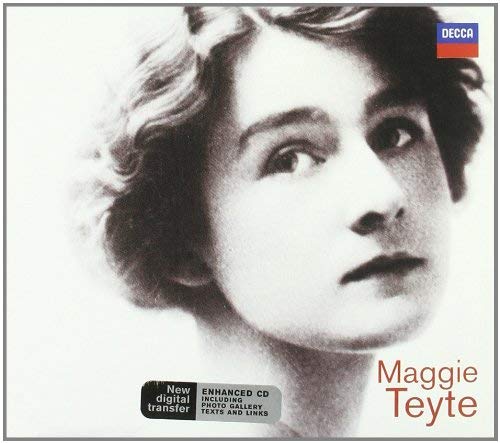
Maggie Teyte – The Singers

These recordings were all made in the 1930s and so pre-date the two disc set of French song I reviewed a few months ago here, with the second part of the disc being taken from a 1937 radio broadcast. One of the songs (Armstrong Gibbs’ The fields are full of summer still) was newly discovered in 2001 and first published on this CD.

We start with one of Dame Maggie’s most famous performances, that of Périchole’s Tu n’es pas beau, sung with great affection, a twinkle in the eye and with that wonderful dip into her inimitably glorious chest voice. Though a light soprano with pure, firm top notes, Teyte’s lower register was admirably rich and full in a manner we rarely hear today, more’s the pity. The orchestra here sounds like a palm court orchestra at a tea dance, but the singing is another matter entirely and alone well worth the price of the disc. The two excerpts from Messager’s Véronique, which follow are almost as good.

Teyte was particularly renowned for her interpretations of French song, but we are vouchsafed only two (very well known) songs from that field, Fauré’s Après un rêve and Hahn’s Si mes vers avaient des ailes. The Fauré is much better than the one on the French song disc mentioned above, where I felt she fussed with the song too much making it lose its natural flow, and the Hahn is as lovely as the later recording with Gerald Moore. These are followed by two Dvorak songs, Christina’s Lament, which turns out to be his Humoresque arranged for voice and piano, and the ubiquitous Songs my mother taught me, both beautifully sung.

These are followed by a group of songs from light musicals, mementoes of her days spent in British Music Hall. They may be musically slight, but Deep in my heart, dear from Romberg’s The Student Prince was actually one of Dame Maggie’s favourite recordings. It crests with a high B, which she thought the most beautiful note she had ever recorded. Certainly the note rings out clear and clean as a bell.

The lion’s share of the disc, however, is given over to a 1937 BBC broadcast recital, which couples popular songs by Schumann and Brahms to a group of English songs by turn of the century composers Quilter, Bridge, Delius, Armstrong Gibbs and (completely new to me) Amherst Webber and Graham Peel. As ever, the voice is bright and pure, her manner direct and disarming, her diction and intonation well-nigh perfect. Admittedly, there are aspects of her singing which some might find quaint and old fashioned today, but her technique is superb and her voice remained firm and clear well into her sixties.

Perhaps because of some of the material, this is not quite so recommendable as the EMI two disc set of French songs, but I would never want to be without it, if only for the wonderful aria from La Périchole.

Susan Graham – French Operetta Arias

71lrl7beerl._sl1050_

With a title like “French Operetta Arias” you’d probably be expecting quite a bit of Offenbach and maybe some Lecocq, but what we get is a disc of largely forgotten music from between the two wars. Quite a bit of Messager and Hahn, but also a couple of tracks from the Cuban composer Moises Simons (both great fun), one by Maurice Yvain, probably best known for his song Mon homme, immortalised as My man by Fanny Brice and Barbra Streisand, and one by, of all people, Arthur Honneger, from his operette Les Aventures du roi Pausole. Annoyingly the track listing just gives the titles of the songs so you have to consult the lyrics to find out the composer and work the song is taken from. With so much rare material I’d have welcomed a little more background.

What we do get, however, is a collection of delicious bonbons, an extravagant melée of delights, all delectably performed by American mezzo-soprano Susan Graham, who has, like her compatriot Frederica Von Stade, made quite a speciality of French music. In fact I remember seeing Graham for the first time in a Covent Garden production of Massenet’s Chérubin. Here she captures to perfection the style of the period and is by turns sexy, playful and coy. At one point, due to the magic of overdubbing, she even trios with herself, on Hahn’s O mon bel inconnu from his operette of the same name, in which three women answer the same lonely-hearts and fall in love with the same man.

Undemanding music, perhaps, but pure joy and wonderfully performed by Graham with the City of Birmingham Symphony Orchestra uder Yves Abel.

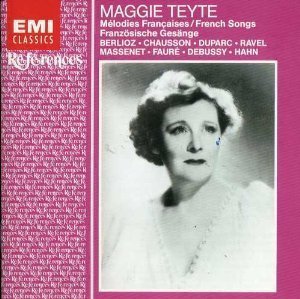
Maggie Teyte – Mélodies Françaises

41lhudrbaxl

The first time I heard Maggie Teyte was when I was just starting to enjoy French song. I was learning Duparc’s Chanson triste and a friend played me her recording of the song with Gerald Moore at the piano. I was absolutely entranced and it has remained my yardstick ever since. First of all the flowing tempo they adopt is aboslutely right (so many take it too slowly) and she responds perfectly to all Duparc’s markings – floating the tone beautifully on the mon of mon amour (it is marked doux by Duparc) an effect I have tried, not too successfully, to emulate myself. Her high A is clear, clean and true, but she takes the lower option on the words de tes bras, dipping down into that gloriously rich lower register she had. As you listen, you feel the song is addressed to you personally and you want to just lie back in the warm embrace of her comforting words. The French christened her L’Exquise Maggie Teyte, and the adjective suits her perfectly.

She was born in 1888 in Woverhampton, but went to Paris in 1903 to study with the famous tenor Jean De Reszke. She made her first public appearanc in 1906, singing Cherubino and Zerlina under Reynaldo Hahn, making her first professional appearance in Monte Carlo the following year. She then joined the company at the Opéra-Comique in Paris and was shortly after chosen to replace Mary Garden in the role of Mélisande, for which she was coached by Debussy himself. She is the only singer ever to have been accompanied in public by Debussy himself, and she is an invaluable link to so many musicians of the past. Despite her early success however, she didn’t really establish herself with the main opera houses, and went into semi-retirement after her second marriage (to Canadian millionaire Walter Sherwin Cottingham) in 1921.

In 1930 she tried to resuscitate her career, but ended up singing in variety and music hall (24 performances a week!) until, in 1930, she made some recordings of Debussy songs with Alfred Cortot, which were so successful that she then became known as the leading French song interpreter of her time. She also sang at Covent Garden in such roles as Butterfly, Hänsel and Eurydice in Gluck’s opera, as well as Manon in English (with Heddle Nash).

The present set concentrates on recordings of French song with orchestra and piano made between 1940 and 1948, making her 60 when she recorded Ravel’s Schéhérazade, not that you would ever suspect it. The voice is still absolutely firm with no trace of wobble or excessive vibrato, top notes pure and true (a thrilling top B flat in Asie), the inimitable lower register gloriously rich.

It starts with a rather hectic recording of Berlioz’s Le spectre de la rose. The fast tempo was presumably adopted so that they could fit the song onto a single 78, but it does remind us that it is in waltz time and she brings a peculiarly intimate touch to the closing lines,which are sung with an ineffable sadness. Absence is sweetly touching.

Occasionally her attention to the meaning of the words can get in the way of the music, and the tempo fluctuations in Fauré’s Après un rêve are just too much, rather too slow at the beginning, with an unwritten accelerando on Reviens, reviens. I’d also suggest that Duparc’s Extase is taken far too slowly throughout. On the other hand the tempo for Fauré’s Clair de lune is absolutely spot on with a moment of pure magic as she infuses her tone with warmth at Au calme clair de lune and Gerald Moore switches to a more free flowing style in the accompaniment.

Over the two discs there is scarcely a performance that doesn’t warrant attention, but I single out for special consideration Duparc’s gorgeous Phidylé, which is lazily erotic as it should be (note her telling observation of the diminuendo on baiser – most singers miss it completely) and the aforementioned Chanson triste, the former with the LSO under Leslie Heward, the latter with Gerald Moore on the piano. Also on disc 1 is a superb performance of Chausson’s Chanson perpétuelle, whilst she breathes new life into Hahn’s popular Si me vers avaient des ailes on Disc 2.

In all she remains inimitable and individual, though, it seems these days, only known to connoisseurs. This set is no longer available, nor are the Debussy songs she recorded with Cortot. John Steane says in his wonderful book The Grand Tradition,

But basically the point about Maggie Teyte is the very simple one, that her singing is so good: that is, her voice is so clear, its production so even, its intonation so faultless, its movement in big upward leaps so clean and athletic, and its excellence was so well preserved for so long.

Not only is her actual singing so good, but she has something personal to say in all she does, and voice and style are instantly recognisable.

There are other examples of her art more readily available on other lablels but this old EMI set is a treasure and I urge Warner to reissue it along with the Debussy songs with Cortot. It should be in the collection of anyone who is interested in French song.