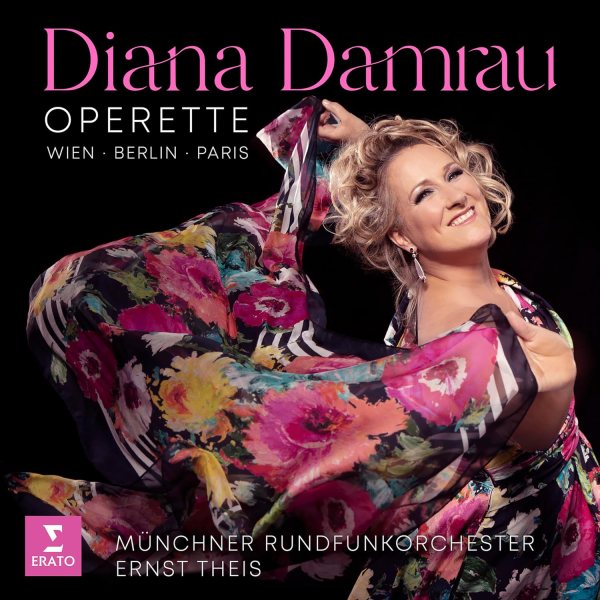
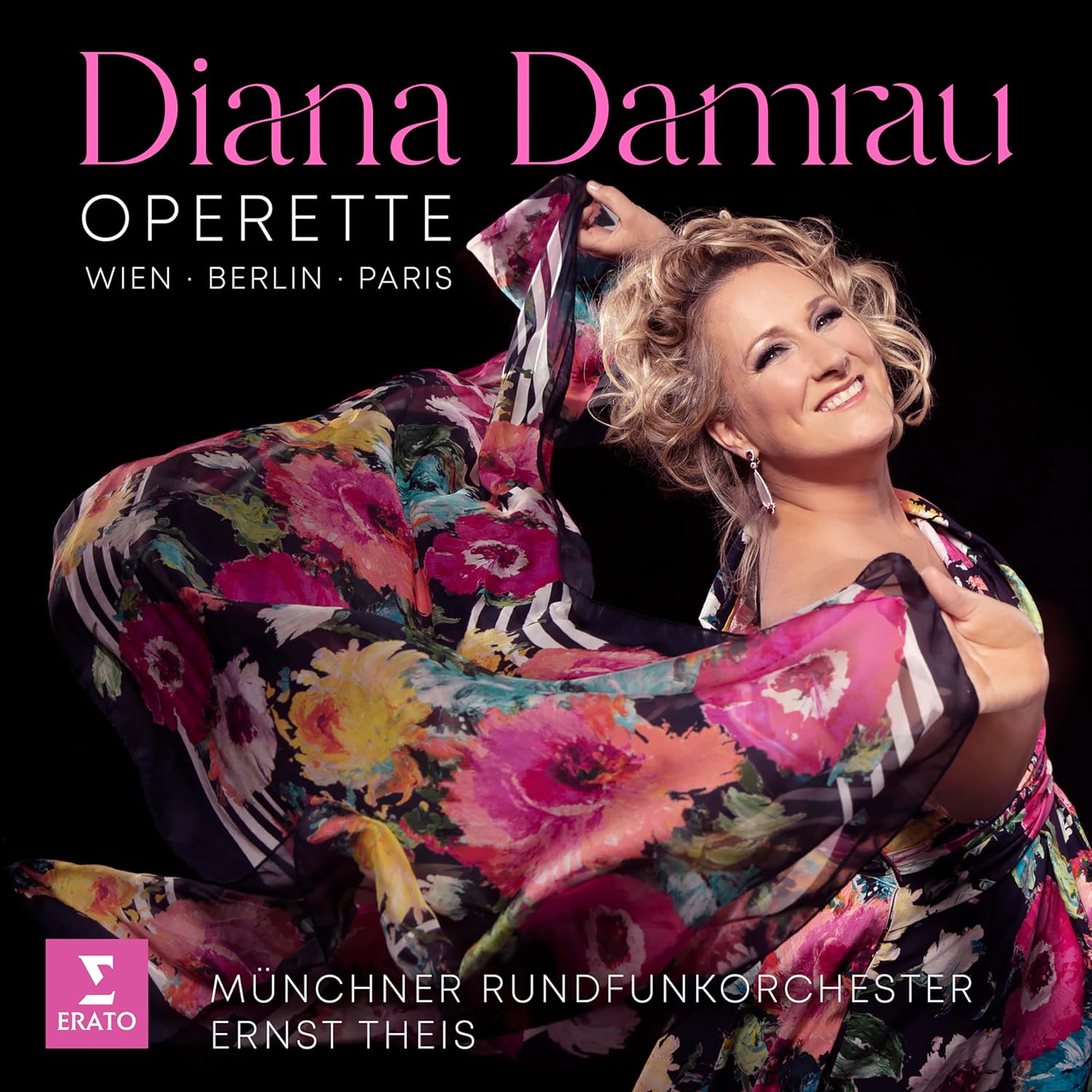
Diana Damrau sings Operetta Arias

81cnwhalnl._ac_sl1500_

Operetta is probably not as popular now as it was around the middle of the last century when amateur productions of popular operettas were ubiquitous. Indeed, back in the 1950s and 1960s my father was musical director of several local operatic societies, conducting a regular fare of Lehár, Strauss and Offenbach alongside American musicals by Rodgers and Hammerstein and the like. Nowadays you’d be more likely to encounter shows by Lloyd Webber or Schönberg & Boubil, or one of the now popular jukebox musicals. Even The Merry Widow and Die Fledermaus, once in the regular repertoire of our professional opera companies, are seldom performed, at least here in the UK.

Maybe the tradition is more alive in Germany and Austria because the Münchner Rundfunkorchester under Ernst Theis here put in splendidly stylish performances of all the chosen arias and duets, sounding totally idiomatic in a wide-ranging programme of music mostly from Vienna, but also taking in Berlin and Paris. There is also some wonderful solo violin playing from, I presume, the leader of the orchestra, notably in the aria from Lehár’s Zigeunerliebe, which exudes a fiery, gypsy passion.

The booklet notes take the form of a (slightly twee) conversation between Damrau and her childhood friend Elke Kottmair, who spent 12 years with the Dresden State Operetta and upon whose expertise and knowledge Damrau drew when compiling this collection. Kotke and mezzo-soprano Emily Sierra join Damrau for a trio from Johann Strauss’s little-known Das Spitzentuch der Königin, and she has also enlisted the support of Jonas Kaufmann for a duet from the same operetta, as well as duets from Stolz’s Im weißen Rössl and the famous Im chambre séparée from Heuberger’s Der Opernball, which some of you may know better as a soprano solo.

These help to add a bit of welcome variety to the programme and here I have to make something of a confession. I have never really liked Damrau’s voice, finding it rather hard and unrelenting. It has never been a particularly luscious instrument, but, to my ears, it is now sounding rather dry and, in the middle register, a little shrewish, where one really wants something more sensuous. Furthermore, when she tries to be charming, she can become excessively coy. Comparing her and Susan Graham in J’ai deux amants from Messager’s L’Amour Masqué, (included in her disc of French Operetta arias) it is to find Graham much warmer and more sexily playful.

When it comes to the Viennese items, you only have to listen to Elisabeth Schwarzkopf in Ich schenk’ mein Herz from Millöcker’s Die Dubarry or in Im chambre séparée to understand the real echt-Viennese style. I doubt there has ever been a finer recital of operetta arias ever recorded, though I also recall a lovely disc by Barbara Bonney, accompanied by solo piano, which is also well worth investigating.

For those who respond better to Damrau’s voice than I do, I have no doubt you will find much to enjoy. I did too. I just wish I had a more positive reaction to the singing.

Scwharzkopf sings Johann Strauss

51i921h4pcl

These two Strauss operettas in Legge’s Champagne Operetta series make an apt couple of bedfellows, neither being quite what Strauss himself  wrote.

Strauss never in fact wrote an operetta called Wiener Blut, but, towards the end of his life, he did give Adolf Müller permission to adapt some of his existing dance music to a text by Victor Léon and Leo Stein. The result is a charming confection of familiar tunes, brilliantly performed here by Legge’s house operetta team of Schwarzkopf, Gedda and Kunz, alongside Emmy Loose, Erika Köth and Karl Dönch, with the Philharmonia under Otto Ackermann. However heavily cut (and this one probably suffers more cuts than the other operettas they recorded), there is no denying the echt-Viennese style in this sparkling performance. No more perfect example could exist than Schwarzkopf and Gedda’s swooning phrasing in the duet Wiener Blut.

Eine Nacht in Venedig has had a somewhat complicated history. The original Strauss operetta enjoyed only a limited success, and was massively revised (by Korngold and Ernst Marischka) for a 1923 production, which is, with one or two re-arrangements, additions and omissions) the version used for this 1954 recording.

Regardless of editions, though, this performance, like the other operettas in this series, is an absolute joy, with superb performances from the house team of Schwarzkopf, Gedda, Loose and Kunz.

Both operettas are absolute joy and thoroughly enjoyable.

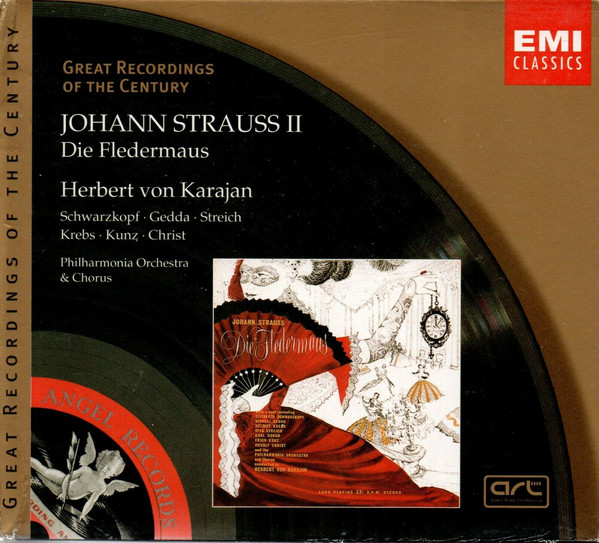
Karajan’s 1955 Die Fledermaus

r-16217851-1605450286-2636.jpeg

Oddly enough, my previous post referred to an opera (Massenet’s Cendrillon) where a female breeches role was given to a tenor and the same thing happens here, though not quite to such detrimental effect. Where Gedda’s Prince Charming sounds all wrong, Rudolf Christ’s languidly effete Orlovsky almost reconciles me to the change and this  is my only slight quibble about a superb, classic recording, which I happen to prefer to Karajan’s later effort for Decca.

Though recorded in London with the Philharmonia, cast and conductor bring an echt Viennese quality to the whole enterprise, the judicially edited dialogue delivered in sparkling fashion. You don’t really need to speak German to understand what’s going on.

Schwarzkopf is a superb Rosalinde, none better, singing her Czardas with appropriate dash and swagger, the voice gloriously rich and firm; Streich a delightfully pert and flirtatious Adele; Gedda a properly tenor Eisenstein, with a fine line in comedy, especially when impersonating Blind in the final scene; Kunz a genially scheming Falke. Excellent contributions also from Krebs as Alfred, Dönch as Frank and Majkut as Blind. This really is a fabulous cast and Legge’s superb production ensures that the recording sounds like a real performance.

Karajan’s conducting is perhaps on the swift side, but the whole performance fizzes and pops like the very best brut champagne that the operetta celebrates and is guaranteed to lift the spirits.

Ljuba Welitsch – Complete Columbia Recordings

Ljuba Welitsch, for the short time her star was in the ascendant, was undoubtedly a star, glamorous both of voice and personality. Renowned the world over for her Salome, a role in which Strauss himself had coached her, she was also known for her Tosca and Donna Anna. Unfortunately she had developed nodules by 1953 and thereafter, though she didn’t retire completely, confined herself to character roles, like the Duenna in the Schwarzkopf/Karajan recording of Der Rosenkavalier.

This two disc set showcases her Salome, Donna Anna and Tosca, as well as Johann Strauss (the Czardas from Die Fledermaus and Saffi’s Gypsy Song from Der Zigeunerbaron). The rest is devoted to Lieder and songs by Brahms, Schubert, Schumann, Darogmizhsky, Mussorgsky, Marx, Mahler and Strauss, all with piano accompaniment, even the Vier letzte Lieder.

Whilst we get a good impression of the glamour and the silvery purity on high, the recordings do also rather show up her limitations. Best of the items is the 1949 recording of the Final Scene from Salome under Reiner, though, even here, I prefer the earlier performance she made under Lovro von Matacic in 1944, which, to my mind, has a greater degree of specificity. There is just the suspicion here that she had sung the role too many times; there is a touch of sloppiness in the delivery, which is complelely absent from the earlier recording.

She makes an appreciable Tosca, and something of her stage personality comes across here, but, I hear little of Callas’s detail or Price’s or Tebaldi’s vocal opulence and Tucker makes an unseductive Cavaradossi in the Act I Love Duet. A tendency to be careless of note values is even more evident in the Donna Anna excerpts, where we also become aware of an unwillingness to vary the volume or colour of her singing. She also has an annoying tendency to rush the beat. John Steane also had some misgivings in his book The Grand Tradition.

It is hard to think of a voice with a brighter shine to it, or of a singer with greater energy and more sense of joy in that sheer act of producing these glorious sounds. Even here, however, one notes that subtlety is hardly in question; there is little of the lithe seductiveness which Schwarzkopf and Güden bring to the [Fledermaus] Czardas, for instance. And this limits much of her best work, even the Salome in which she made such an exciting impression on her audiences.

We also note the complete absence of a trill in both Donna Anna’s Non mi dir and the Czardas from Die Fledermaus.

These limitations are even more evident in the songs with piano, and, though there is still much to enjoy in disc one, I found much of disc two something of a trial to listen to, the voice just too bright and unrelentingly mezza voce. The Strauss Vier letzte Lieder can work with piano, as witness a recording by Barbara Bonney, but here I just longed for the greater subtlety and range of expression of Schwarzkopf or Popp, of Norman or Fleming. The Mahler had me thinking of the shattering Lorraine Hunt Lieberson in the piano accompanied version, and the Schubert and Schumann songs hardly begin to challenge versions by a range of different sopranos from Welitsch’s time onwards.

If I were to choose but one representation of Welitsch’s art, it would absolutely be the 1949 live recording from the Met of Salome under Reiner, but, for a recital I’d go for EMI’s old LP and CD transfer of the 1944 Salome Final Scene, which also has on it a glorious version of Tatyana’s Letter Scene from Eugene Onegin, a disc I reviewed a couple of months back here. This present two disc set is, I’m afraid, a mite disappointing.