Eilika Wünsch – Romantic Songs

71okpmqmsql._ac_sl1425_

There are times when one wonders how a record came to be released.

According to the accompanying notes, the premise for this album would appear to be “a completely new approach to our lieder recital repertoire … in which voice and piano are enhanced by another melody instrument”. Whether this enhancement is either desirable or necessary is a moot point, but I suppose the idea of the cello taking over the second vocal line in the adaptation of duets is one solution to the non-availability of a second singer. The accompanying notes would also seem to suggest that these arrangements improve in some way on the originals, even of the two songs from Strauss’s Vier letzte Lieder, which of course were written for full orchestra.  I can assure you they do not.

However, the greatest impediment to enjoyment is not the arrangements themselves but the solo singer. According to the biographical notes, Eilika Wünsch has been active since around 2010, when she worked with Jörg Demus. She would appear to have a fairly extensive discography, though I can’t find a single review on the internet for any of her discs, or for any of her public appearances. We are also told that she has sung the roles of Butterfly, Konstanze, Donna Anna, Violetta, Gilda and the Queen of the Night, about all of which I am faintly incredulous.  The first few notes of the opening song, Nacht und Träume, are sung in a white, vibrato-less tone, but thereafter any single sustained note emerges unfocused and unsteady. She struggles so much with the execution of the notes that any attempt at interpretation is completely absent. The cover photo shows us an attractive young woman, but the sounds coming from the speakers are those of a (very) old soprano. I am sorry to be so negative, but I really can’t find anything positive to say about this recital. Listening all the way to the end proved quite a trial, but listen I did, right through to the final song, which is a vocalise arrangement of Schubert’s famous Impromptu, Op.90, no.3. The arrangement takes her well up above the stave, where the sound that emerges is somewhere between a whistle and a theremin and quite unpleasant – to my ears at least.

This is one of those cases where comparisons are irrelevant. One to be avoided, I’m afraid.

Contents, in case anyone is interested.

  1. Schubert: Nacht und Träume
  2. Brahms: Wie Melodien zieht es mir
  3. Reger: Nachts
  4. Schumann: Wenn ich ein Vöglein wär
  5. Brahms: Am Strande
  6. Schumann: In der Nacht
  7. Liszt: O komm im Traum
  8. R. Strauss: Im Abendnrot
  9. Reger: Abendlied
  10. R. Strauss: Beim Schlafengehen
  11. Schumann: Mondnacht
  12. Schubert: Auf dem Strom
  13. Impormpti, Op. 90 no. 3 (as Vocalise)

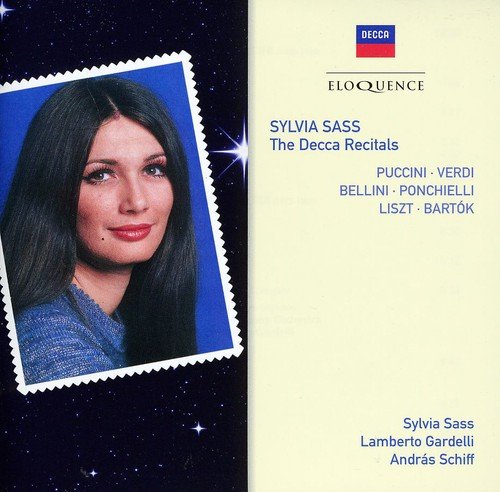
Sylvia Sass – The Decca Recitals


Sylvia Sass shot to stardom at the age of 25 after singing the role of Griselda in a 1975 Covent Garden production of Verdi’s I Lombardi which also starred José Carreras. Decca were quick to sign her up and her first recital LP (one side of Puccini, one of Verdi) followed in 1977. A further opera recital followed in 1979 and finally in 1981 a recital of songs by Liszt and Bartók, in which she got to sing in her native Hungarian. She also appeared on Solti’s recordings of Don Giovanni (as Donna Elvira) and Bluebeard’s Castle and on the Philips recording of Stiffelio. She was hailed as the new Callas and, like others saddled with the epithet before her, her international stardom was short-lived, though she continued to sing in opera (though mostly in Hungary) until 1995 and made many records for Hungaraton.

From the very first notes of Turandot’s In questa reggia it is clear that this is a singer with a personality, always aware of the dramatic possibilities of the music. The voice can caress, but equally it has bite and power and the top can glare when singing at full tilt. The four Puccini heroines given here (Turandot, Tosca, Manon and Butterfly) emerge as distintinctively different characters, which isn’t always the case in a Puccini recital. There is also much that is fine in the Verdi items, the Sleepwalking Scene from Macbeth being particularly good, but here we notice a tendency, also evident in the Puccini items, for there to be too great a gap between her loud and soft singing, where the loud singing can take on a strident, squally edge that contrasts too greatly with the almost disembodied purity of her soft singing.

By the time of the second recital this tendency to veer from ultra soft to ultra loud has become more pronounced, even more noticeable when singing live. I remember seeing her as Norma at Covent Garden in 1980 and you could hardly hear her when she was singing quietly. Not that the second recital doesn’t have its attractions. Lady Macbeth continues to be impressive, and there are some lovely moments in the Il Trovatore aria, with its spectacularly floated high D.

The 1981recital of Liszt and Bartók songs, with András Schiff at the piano, is rather impressive. Sass brings vivid personality to and drama to a song like Liszt’s Die Loreley, as well as a beautiful, comforting quality to Kling leise, mein Lied. She also makes musical sense of Bartók’s sometimes angular vocal lines, brilliantly supported by Schiff’s superb playing of the difficult piano accompaniments.

It is a great shame Sass never really fulfilled the promise of her early successes, but these discs serve to remind us why people found her so exciting when she first burst onto the scene and receive a qualified recommendation from me.