Callas’s 1959 Lucia di Lammermoor gets the Pristine treatment

paco207_9735ee11-e251-4de3-a757-19c9b4ae597a_530x

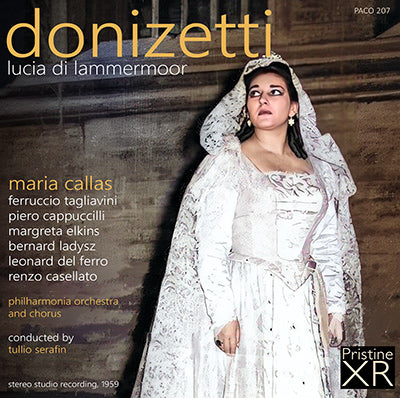
Callas’s second stereo recording of Lucia di Lammermoor, which I reviewed when it was reissued by Warner , has always been considered one of her best from a sonic point of view, so, as someone who has not always been totally convinced by some of Andrew Rose’s re-mastering methods, I wondered how, if at all, the sound could be improved upon. Let me say straight away that I found this latest addition to Pristine’s Callas catalogue totally convincing. Using the Warner remaster of 2014 for comparison, I found the sound altogether warmer and much more comfortable to listen to, closer in fact to how I remember the LPs that I used to own (a German EMI Electrola issue, bought as an import). The Warner is perhaps slightly clearer, but the digitalisation tends to add glare to Callas’s top register. Often one is prepared to flinch before the topmost notes, but I had no such problems when listening to this Pristine pressing. I couldn’t say which is the more truthful, but I can say that the Pristine is much more comfortable to listen to and this, in turn, affected my impressions of the set, a recording I have known since my youth and was in fact my introduction to the opera.

Lucia was one of the cornerstones of her repertoire, and she first sang it in 1952 in Mexico. The following year she sang the role again in Florence, where she made her first recording of the role under Serafin. It was also the first recording she made for EMI. Back in those days, the opera wasn’t taken very seriously and was most likely considered a silly Italian opera in which a doll-like coloratura soprano ran around the stage showing off her high notes and flexibility. Callas returned a proper tragic dimension to the role, that most hadn’t even suspected was there. There is a touching story of Toti Dal Monti, an erstwhile famous Lucia herself, visiting Callas in her dressing room after a performance of the opera with tears running down her face and confessing she had sung the role for years with no idea of its dramatic potential.

When Callas first sang  Lucia in Mexico and recorded it in Florence, she was at the peak of her vocal plenitude, as she was when she first sang it under Karajan at La Scala in 1954, but by the time she sang the role in Berlin in 1955 post weight loss, when Karajan took the La Scala company there, her voice had started to lighten and her conception of the role had become more inward. We can hear this in the famous live recording of one of the Berlin performances, but, for this 1959 recording, she appears to have taken this approach one step further. This may have had something to do with her by now fading vocal resources, but it results in a particularly touching portrayal of the innocent, young, impressionable girl. She has also trimmed away some of the showier variations in the cadenza in the Mad Scene, and the decorations are in consequence somewhat more modest. Am I alone in preferring it sung this way? Personally, I’d prefer to do without all that duetting with the flute altogether, as happens in the complete recording of the opera with Caballé and when Sylvia Sass sings it on one of her recital records. In any case, apart from a few of Callas’s topmost notes, she is in remarkably good voice and the filigree of the role is brilliantly executed with fluid and elegant ease. All in all, I prefer her performance in this set to the one on the 1953 Florence studio recording, not least because of the improved Pristine sound picture.

However, when it comes to her colleagues on this set, I am a little less well disposed towards them than Göran Forsling in his review of the digital download. Ferrucio Tagliavini was 45 at the time of this recording, but he sounds much older, more like an elderly roué than the Byronic Romantic figure of Scott’s and Donizetti’s imaginings. No amount of elegant phrasing can make up for his lack of sheer physical passion and I find myself longing for Di Stefano’s youthful ardour. As for Cappuccilli, he was at the very beginning of his considerable career, and he has yet to find a way of creating character in pure sound. He is just rather dull and no match for Gobbi on the earlier recording or for Panerai in Berlin. Bernard Ladysz makes very little impression at all and both Rafaele Arie and Nicola Zaccaria are preferable.

Serafin, as always, though he may not make any startling revelations, shapes the score with a perfect sense of its dramatic shape, albeit with the cuts that were traditional at the time. Karajan opened up some of those in his performances, and I would still place the 1955 Berlin performance at the top of all Callas’s recorded Lucias, especially in Divina Records latest remastering, but I enjoyed re-visiting this set and I have a feeling I’ll be reaching for this one more regularly than the earlier 1953 recording, not least because of the superior quality of Pristine’s remastering.

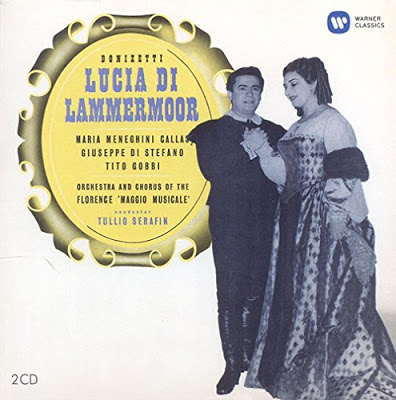
My only criticism is of the cover art, which has a photograph of Callas as Lucia in Florence in 1953, when she was still a rather large lady. One could be forgiven for thinking, at first glance, that this was the earlier recording. Surely a photo of the svelte Callas as Lucia would have been more appropriate. There are plenty of them, after all.

The Callas Karajan Lucia di Lammermoor – Berlin 1955

81ABZEPHN2L._SL1500_

Moving on through the Live Warner Callas box, we come to the legendary night on which she sang Lucia at the Berlin State Opera.

Callas first sang Lucia in Mexico in 1952 and caused such a sensation that she completely changed people’s attitudes to the role. The following year she sang the role again in Florence, Genoa, Catania, Rome, and it was one of the roles she chose for her American debut at the Chicago Opera House in 1954. Also in 1954 she appeared for the first time in Karajan’s La Scala production, which he subsequently took to Berlin in 1955 and to Vienna in 1956, and all those iconic photos of Callas wearing that long, pleated nightdress are taken from this production.

To understand what a sensation the Callas/Karajan Lucia di Lammermoor wrought, one has to remember that, back then, the opera was considered no more than a silly Italian opera, in which a doll-like light voiced coloratura got to show off her high notes and flexibility. That a conductor of the calibre of Herbert von Karajan, famed for his Beethoven and Brahms, was taking it seriously caused people to reassess their perceptions. There is a charming story of Toti dal Monte, an erstwhile famous Lucia herself, visiting Callas in her La Scala dressing room, tears streaming down her face and confessing she had sung the role for years without ever realising its dramatic potential. Indeed it is pretty safe to say that without Callas’s Lucia, Sutherland’s career might never have taken the trajectory it did.

Apparently, though Callas loved making music with Karajan, she hated his production with its dark, murky projections and backdrops. However Zeffirelli thought that he got it just right. In the mad scene, Karajan lowered all the lights and just put a follow spot on her, which, as Zeffirelli stated, was all you had to do with a Callas. Karajan simply allowed her to become music.

Berlin was in a high state of excitement when Karajan took the La Scala production there in 1955, and, as can be heard on this recording of the event, the audience can hardly contain their enthusiasm. Desmond Shawe Taylor reviewed it for Opera magazine.

I dare say she will never sing better than she does now; there is Greek resin in her voice which will never be quite strained away; she will never charm us with the full round ductile tone of Muzio or [Rosa] Raisa or Ponselle. But she has sudden flights, dramatic outbursts of rocketing virtuosity, of which even those more richly endowed singers were hardly capable

His words now seem prophetic as 1955 could well be seen as the apex of Callas’s career. It was the year of the Visconti La Sonnambula and La Traviata, the Zeffirelli Il Turco in Italia, the Chicago Il Trovatore with Bjoerling, the year she made seminal recordings of Rigoletto with Serafin and Madama Butterfly  with Karajan (not universally well received at the time, but now considered a classic), and she closed the year with what many consider her greatest ever performances of Norma, at La Scala with Simionato and Del Monaco, mercifully preserved in sound and best heard in its Divina Records transfer.

The sound of this Berlin broadcast has always been one of the best of all Callas live performances and this Warner transfer, which is from a different source to the EMI one, is very clear, with very little distortion and only a hint of pre-echo. Furthermore, where EMI were somewhat parsimonious with the applause, Warner have left more of it in, which makes more sense of the encored Sextet. This is certainly one of those cases where the side show is almost as gripping as the show itself.

Callas did of course record the role of Lucia twice in the studio under Serafin. The first, in 1953, was her very first recording for EMI and the second, made in 1959, was the first of the four operas she re-recorded in stereo, a set I have a certain affection for it as it was the recording that introduced me to the opera when I was still in my teens. However, if I want to listen to the opera, it is invariably to this live recording with Karajan at the helm to which I turn.

Callas’s rare collaborations with Karajan always reaped gold, and it is greatly to be regretted that they didn’t work together more often. It was a symbiotic relationship and one can hear in this performance how Karajan appears to breathe with her, giving her ample room to spin out the phrases. However, with two such egos, the relationship was never going to be completely harmonious. Callas was apparently furious with Karajan for granting the Berlin audience an encore of the Sextet, meaning that she had to do twice the work before her Mad Scene; so furious that she turned her back on him during the Mad Scene. Years later, when she met him again, she said to him, “What was it you did when I was so bitchy and turned my back on you in the Mad Scene? I knew you were clever. But the accompaniment was so perfect, I decided you were not only a genius, you were also a witch.” “It was very simple,” Karajan replied, ” I watched your shoulders. When they went up I knew you were breathing in, and that was my cue for attack.” Callas, being something of a witch herself, no doubt knew that was only part of the story.

There is no doubt that Callas’s voice is lighter, more airy, than it was in any of her Lucias up to now. How much this had to do with the shift in repertoire, the weight loss or Karajan’s input is a moot point, but her singing is unfailingly lovely, with phrases drawn out to prodigious lengths, spinning them out the way a master violinist might play their violin.

From the outset Callas presents us with a highly-strung, romantic dreamer, a young girl, who would no doubt have been closeted and protected from the real world. Her first solo is sung with wonderful delicacy, the line deliciously drawn out and beautifully held at Karajan’s expansive tempo. As so often with Callas, there is no artifice to her singing, nor any sense of the routine, the music sounding as if it has sprung newly minted from her lips.

How typical that the first climax of the scene, should not be the aria itself, beautifully though it is sung, but a line of recitative that follows, with Lucia’s simple affirmation of her love for Edgardo (Egli e luce a’ giorni miei) just before she launches into the cabaletta Quando rapito in estasi, which is sung with lovely rhythmic buoyancy.

In the ensuing duet with Edgardo, she is all sweet concern, her phrases pouring balm on Edgardo’s troubled utterances, but we get a glimpse of the slightly unhinged Lucia, when, in a voice peculiarly quivering with intensity, she sings Ah no! rimango nel silenzio sepolto per or l’arcano affetto.

Verrano a te sull’aria is sung with prodigious breath control, the legato line spun out to wondrous effect. Di Stefano is here at his honeyed best, and Karajan provides subtly supple support, a superb example of artists listening to each other and working together.

The second act is the turning point for Lucia. In the face of such cruelty from her brother, this is the moment she starts to lose her reason, and you can hear in Callas’s voicing of the words Ahi!.. La folgore piombo! that the poor girl is at the end of her tether. Soffriva nel pianto is almost unbearably moving, as Callas digs deep into its melancholy.

In the following scene, she seems almost to be sleepwalking, until she falls apart completely when Edgardo suddenly appears and condemns her seeming treachery. The whole of this scene is dramatically thrilling, from the superbly sung (and encored) Sextet through to the knife-edge finale, where Karajan has opened up some of the cuts usually made in previous Callas performances.

The Mad Scene is, as it should be, the apex of Callas’s performance. So supple, so exquisite is her singing, that the voice seems to hover in mid air, and she literally seems to be extemporising on the spot. Certain phrases (Alfin son tua, for instance) are so firmly etched on my consciousness that any other singer seems just to be skimming the surface. The miracle is that she can execute all the vocal tricks of the coloratura soprano with such accuracy and skill, whilst at the same time making musical and dramatic sense of the notes. As ever, Karajan provides impeccable support.

We are lucky that such a superb cast was assembled; Di Stefano is at his considerable, lyrical best as Edgardo, Panerai terrifyingly single minded and relentlessly evil as Enrico, and Zaccaria a mellifluous and sympathetic Raimondo.

Aside from the cuts opened up in the Act II finale, the opera is unfortunately cut in the manner traditional back then. However the recording is nonetheless absolutely essential listening, not only for Callas fans, but for all lovers of Italian opera.

Edited to add that I have just acquired the Divina Hi-Res download of this performance and the sound is amazing, much better than in any other version I have heard and easily as good as the EMI studio recording of 1953. Forget Myto or Warner. This is the one to have.

dvn019_l

Callas’s 1953 Studio Lucia di Lammermoor

51252bkyvtf8al

Recorded 29-30 January, 3, 4 & 6 February 1953, Teatro Comunale, Florence

Producer: Dino Olivieri, Balance Engineer: Osvaldo Varesca

Of all the roles Callas sang, it was probably Lucia which created the biggest furore. Back in the early 1950s, nobody took the opera very seriously. It was considered a silly Italian opera in which a doll-like coloratura soprano ran around the stage showing off her high notes and flexibility. There is a hilarious description of the characters in E.M. Forster’s Where Angels Fear To Tread attending a provincial performance of Lucia di Lammermoor. Here he describes the prima donna’s first entrance.

Lucia began to sing, and there was a moment’s silence. She was stout and ugly; but her voice was still beautiful, and as she sang the theatre murmured like a hive of happy bees. All through the coloratura she was accompanied by sighs, and its top note was drowned in a shout of universal joy.

For anyone who loves opera or Italy, I heartily recommend this self-mocking tale of the English abroad.

But back to Callas, who first sang the role of Lucia on stage in Mexico  in 1952. A few months earlier she had sung the first part of the Mad Scene at a concert in Rome. After Mexico, she would sing it in Florence, Genoa, Catania and in Rome before appearing in Karajan’s legendary production at La Scala at the beginning of 1954, a production that subsequently travelled to Berlin (one of her most famous recorded live performances) and Vienna.  It was also one of the roles she chose for her U.S. debut in 1954 in Chicago and at the Met in 1956. Her last performances of the role were in Dallas in 1959 (in the same Zefirelli production that made Sutherland a star at Covent Garden) and she made two recordings of the opera;  this one in 1953 in Florence, shortly after stage performances there and the second in 1959 in London. After Norma, Violetta and Tosca it is the role she sang most often, so it is hardly surprising that she is so much associated with it.

Back in the 1950s it must have seemed unthinkable that such a large voice could tackle the role, and not only sing it, but sing it with such accuracy and musicality, giving the opera back a tragic intensity that people had forgotten, or didn’t even know,  was there.  There is a touching story of Toti Dal Monte, an erstwhile famous Lucia herself, visiting Callas in her dressing room after a performance, tears streaming down her face, and confessing she had sung the role for years without really understanding its dramatic potential.

From Callas’s very first notes, she presents a highly-strung, nervous character, but sings with impeccable legato, all the scales and fioriture bound into the vocal line, the tone dark, but plangent, expressive but infinitely subtle. Regnava nel silenzio is a model of grace, but she still manages to invest the words di sangue roseggio with a kind of horror, whilst never resorting to glottal stops or other verismo tricks. She understands that with bel canto it is the arc of the melody, of the musical line that is paramount.

And so it continues, with her consolatory Deh ti placa in the duet with Di Stefano’s Edgardo, a duet of musical contrasts, in which Callas’s Lucia is at its most feminine. The duet with Gobbi, their first encounter on disc together, is also full of contrasts, and Gobbi makes a much more interesting villain than Cappuccilli in her second recording, finding a range of insinuating colour that his younger colleague doesn’t even hint at.

The Mad Scene is a miracle of long breathed phrases, with such lines as Alfin son tua heartbreakingly expressed, and of course here there are none of the problems with the top Ebs that we get in the second recording.

Di Stefano is more suited to Edgardo than he would be to Arturo in I Puritani, which was recorded soon after, and he is much to be preferred to the over-the-hill Tagliavini on the second recording. Serafin conducts a tautly dramatic version of the score.

The sound on this Warner issue still tends to distort and crumble in places. I guess that must be on the master, but the voices ring out with a little more truth.

Of course both Callas and Di Stefano can be heard together in the famous 1955 Berlin performances under Karajan, in sound which is not much worse than this, and that recording would still be my first choice amongst Callas’s Lucias, for all that she eschews the first Eb in the Mad Scene. Under Karajan’s baton and in a live situation she sings with effortless spontaneity, almost as if she is extemporising on the spot.

Still this first Callas studio recording is the one that got people talking and the one that quite possibly changed opinions about bel canto for many years to come. As such it has a historical significance which should never be forgotten.