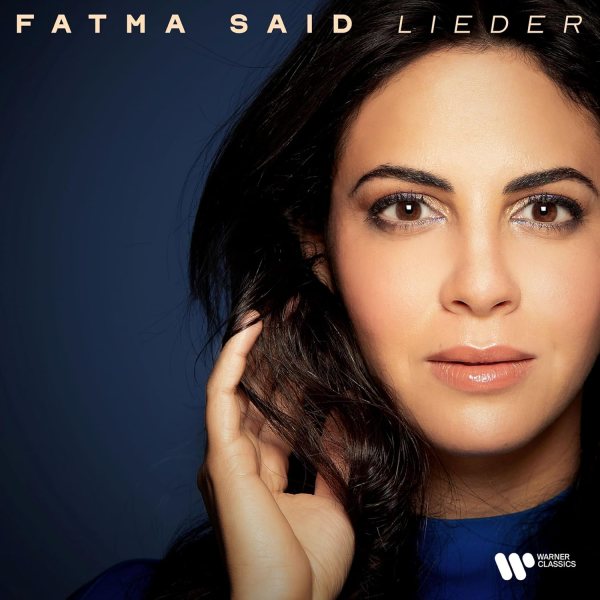
Fatma Said – Lieder

Fatma Said follows up her award winning debut recital, El Nour, and her equally successful second album, Kaleidoscope, with a more conventional album of German Lieder, except that with this gifted artist, it isn’t quite that simple. For a start, she has collaborated with an array of different musicians, bringing in clarinettist Sabine Meyer for Schubert’s Der Hirt auf dem Felsen, the men’s choir, Walhalla zum Seidlwirt, for his Ständchen, harpist Anneleen Lenaerts for four of the Brahms songs, the Quator Arod for Brahms’s Ophelia-Lieder, baritone Huw Montague Rendall for some duets and three different pianists in Malcolm Martineau, Yonathan Cohen and Joseph Middleton. In the notes accompanying the disc, Said says that all of these artists were friends or became friends during the sessions, and, in a positive way it would seem so, as there is a real sense of joy and discovery in the music making.

In a disc of so many delights, it is difficult to highlight specific performances, and for once I found myself not making comparisons with other singers, so compelling is the artistry on display here. Said has a surpassingly beautiful voice, but she uses it for expressive ends and is not afraid to make the occasional ugly sound, as in the vividly characterised Hexenlied by Mendlessohn, and in Schubert’s Der Zwerg. The nocturne Ständchen is delivered as a dramatic dialogue between Said and the men’s chorus, with a touch of breathless excitement, which perfectly captures the meaning of the words, and the words are evidently very important to Said. Her diction is excellent, and indeed, in the notes accompanying the disc, Said states that she wanted there to be a strong emphasis on the text. This she has achieved, whilst maintaining a lovely legato line.

The harp accompaniment brings a touch of delicacy to the Brahms songs and his Ophelia- Lieder are performed in Aribert Reimann’s arrangement for string quartet, which somehow contrives to make the songs sound more archaic. Sabine Meyer plays with great beauty of tone in Der Hirt auf dem Felsen, which here receives a performance of ineffable longing, which is totally dispelled in the joyful final measures.

I can’t close without mentioning the terrific contributions of her three pianists, Malcolm Martineau, Yonatan Cohen and Joseph Middleton, nor Huw Monatgue Rendall’s wonderful contribution to the duets, his voice blending beautifully with Said’s, particularly in the final song on the disc, Schumann’s In der Nacht, where his mellifluous tones blend beautifully with Said’s – a fitting end to a disc that had me spellbound throughout.

Highly recommended and, I know it’s early days yet, but likely to be one of my discs of the year.

In Relations – Eva Zalenga and Doriana Tchakarova

0881488220506

The back page of the booklet that comes with this CD has a complicated diagram, which attempts to display and unravel the various connections between the composers and poets featured in this recital. We all know about the friendship that existed between Mendelssohn and Schumann, but did you know that Loewe, who also made music with Mendelssohn, taught the composer Emilie Mayer, who set poems by Heine, as of course did Loewe and Schumann? So did Meyerbeer, though his only connection with Mendelssohn and Schumann is that they both were vocal in disparaging his music.

The aim is evidently to bring some unity to what is essentially a recital of nineteenth century Romantic songs by both male and female composers, most of which are not exactly regular visitors to the concert platform. It’s a nice idea and it can be fun trying to trace the connections between the various personages represented in this recital, though certainly not necessary for the enjoyment of it.

We begin with Meyerbeer, who is better known for his large-scale operas, none of which have ever held much interest for me. The three songs we get here are rather charming and tuneful, though they don’t quite escape the epithet of parlour music. These are followed by a couple of songs by Loewe, the first a setting of Meine Ruh ist hin, a poem better known to us as Schubert’s Gretchen am Spinnrade. Loewe’s setting is less grippingly intense but it does tell the story well.. Loewe’s accompaniments are worth noting and they are brilliantly played by Doriana Tchakarova, who supports her soloist at every turn.

Mendelssohn’s Hexenlied is better known than the songs we have heard so far and it really calls for a little more variety of timbre than Zalenga has yet at her disposal.  On the other hand Zalenga’s bright, youthful soprano is perfectly apt for the Suleika songs that follow. The Schumann songs go well too, though I would have preferred a little more sense of breathless excitement in Aufträge, such as we hear in older versions by Elisabeth Schumann and Elisabeth Schwarzkopf.

For the rest we are given some rarities by women composers, both of whom were entirely new to me. Emilie Mayer, who died in 1883 (not 1833 as the booklet has it) was the first woman to have her symphonies performed all over Europe. The two songs included here no doubt had an eye on the popular publication market and, like the Meyerbeer, have more than a whiff of the salon about them. Nonetheless I was pleased to make their acquaintance. That said, I found the Heine settings of the English composer, Frances Illitsen, even more interesting. All three are worth investigating, in particular the setting of Heine’s Katherine, which is a glorious outpouring of lyrical melody.

This recital would appear to be the recording debut of the young soprano Eva Zalenga. She has a lovely, light soprano which faintly reminded me of the young Lucia Popp. I see from her website that her operatic roles are Papagena, Barbarina, Susanna, Ännchen, and also Sophie in Werther, all of which would seem right for her at the moment. I can also imagine her making an excellent Sophie in Der Rosenkavalier. As yet the voice doesn’t have a great range of colour at its disposal, but this does not mean she sings without feeling. Throughout she is a most musical singer and keenly responsive to the poetry. You really feel she connects with each of the songs

I wish Hänssler had vouchsafed us translations of the German texts, but, nonetheless, I thoroughly enjoyed this journey through some of the byways of nineteenth century Romantic song. An auspicious recording debut for Eva Zalenga.

Contents:

Giacomo Meyerbeer (1791-1864)

Komm

Meerestille

Suleika

Carl Loewe (1796 – 1869)

Meine Ruh’ ist hin, Op. 9, no. 2

Die verliebte Schläferin, Op. 9, no. 3

Ihr Spaziergang, Op. 9, no.4

Die Schneeflocke, Op. 63, no. 1

Felix Mendelssohn (1809-1847)

Hexenlied, Op 8, no. 8

Suleika, Op. 57, no.3

Suleika, Op. 34, no. 4

Die Nonne, Op. 9 no. 12

Robert Schumann (1810 – 1856)

Liebeslied, Op. 5, no. 5

Aufträge, Op. 77, no. 5

Viel Glück zur Reise, Schwalben! Op. 104, no. 2

Die letzten Blumen starben, Op. 104, no. 6

Aus den östlichen Rosen, Op. 25, no. 5

Singet nicht in Trauertönen, Op. 98a

Emilie Mayer (1812 – 1883)

Du bist wie eine Blume, Op. 71 no. 1

Das Schlüsselloch im Herzen

Frances Allitsen (1848 – 1912)

Katherine

Mag, da draußen Schnee sich thürmen

Die Botschaft

Karita Mattila – German Romantic Arias


The programme is an interesting one, though including Beethoven in a recital called German Romantic Arias might be thought to be stretching the definition a bit, and it’s good to see some rarer items are included amongst the well-known. Accompaniments are in the safe hands of the Staatskapelle Dresden under Sir Colin Davis and Mattilla might be considered to be at her mid-career peak when the disc was recorded in 2001, eighteen years after she was the first winner of the Cardiff Singer of the World at the age of 23.

Unfortunately the recital doesn’t really satisfy. I enjoyed most the scene from Euryanthe and Mendelssohn’s concert aria Infelice!, but this might have more to do with their unfamiliarity than anything else as I had little else to compare them to . In the more familiar items I found myself constantly thinking of versions by other artists. One or two moments of smudged coloratura apart, Mattila gets round the notes easily enough, but her singing can be a bit rigid and lacking in colour and her legato is not always perfect, nor does she ever illuminate a phrase or bring something personal to the piece she is singing in the way the greatest of the past have done. There is no sense of desperation in Leonore’s Abscheulicher! or radiance in the Komm, Hoffnung section, no real appreciation of the contrasting emotions in Ah perfido!. Agathe fares no better. There is no real poise and serenity, such as that achieved by Schwarzkopf, Grümmer or Janowitz. When Schwarzkopf sings Er ist’s in Leise, leise we register the change of expression, the quickening of the pulse, where here the moment passes almost unnoticed.

Commendably she sings Rezia’s Ocean, though mighty monster in English. It is more comfortably vocalised than Callas’s late recording, also in English, but Callas fills its pages with significance where Mattila just sings the notes. She conquers its tehcnical challenges, but makes little impression dramatically.

Something of a disappointment then and a disc that is probably making for the jettison pile

Eleanor Steber sing Les Nuits d’Eté

51xnjtg5rpl

Berlioz’s Les Nuis d’Eté has always been a favourite work of mine. I have ten recordings and have heard quite a few more and this famous recording, one of the earliest, made in 1954, has always rightly been considered one of the best.

The voice itself is a beautiful one, firm and even throughout its range,and she is thoroughly in control of its resources. There is a great deal of pleasure to be had merely from the sound of the voice and the way she weights and measures phrases, but she is also keenly responsive to the poetry, ideally melding the needs of the musical line to the meaning of the words.

True, Villanelle has always seemed a tad too slow to me, a little lacking in gaiety, but it is close to the metronome marking of crotchet = 96, so perhaps the fault lies with Mitropoulos, who fails to make the woodwind light enough. Elsewhere he provides excellent support and speeds are judiciously chosen.

The rest of the disc is taken up with more Berlioz (beautifully sung performances of La Captive, Le jeune pâtre breton and Zaïde conducted by Jean Morel) and orotorio arias by Bach, Handel, Haydn and Mendelssohn. True, these latter, conducted by Max Rudolf, have a slightly old-fashioned, somewhat Victorian air about them, but they are impeccably sung and her diction is exemplary. These were recorded a few years earlier, in 1951, and the voice is at its freshest and most beautiful.

The disc comes with copious notes and photos, but, regrettably, no texts and translations.