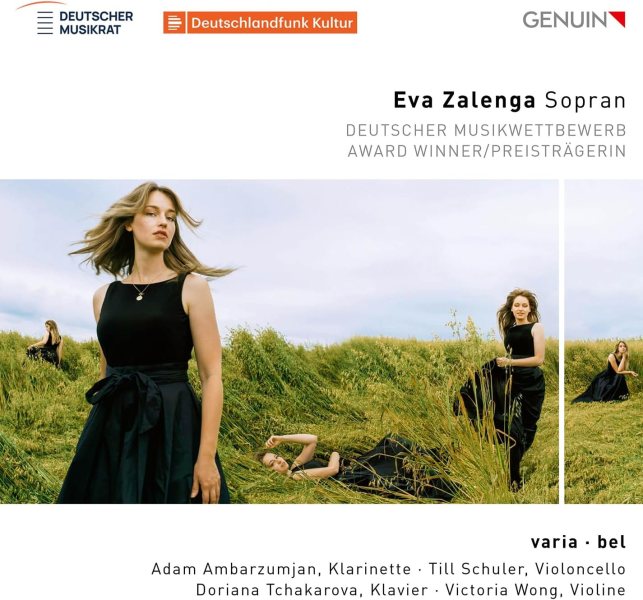
Eva Zalenga – Varia bel

Last month I was welcoming a disc of Lieder with various accompaniments by Fatma Said and here we have another for various forces, which, coincidentally, also includes Schubert’s Der Hirt auf dem Felsen.

In April 2024, I welcomed Zalenga’s debut recital on the Hänssler label, and this new recital on the Genuin label is, if anything, even more successful. Variety is the key note of the disc, in the variety of music (from the 18th to the 21st centuries), the variety of styles from the intimate to the more extrovert, and the variety of instruments accompanying the voice, that nonetheless add up to a convincing whole.

We start with a world premiere recording of Ignaz Lachner’s An die Entfernte (In die Ferne) for soprano, violoncello and piano, in which Zalenga charmingly intertwines with the cello of Till Schuler. We stay with the combination of cello and piano for Schubert’s Auf dem Strom. There is just the suspicion of strain in the upper reaches of the song here, a slight impurity that obtrudes on the silvery beauty of the sound, but it is fleeting, and soon evaporates during the next song, Meyerbeer’s haunting Des Schäfers Lied, in which the cello is swapped for Adam Ambarzumjan’s clarinet.

We stick with this combination for Schubert’s more famous Der Hirt auf dem Felsen, which, whilst not plumbing the deeper meanings of the text, as Said and Meyer do in their version, is nonetheless a delightful and charming performance.

In their earlier recital, Zalenga and Tchakarova championed women composers and it is good to see that they do so here too, first with a lovely song by Pauline Viardot-Garcia, in which we return to the combination of soprano, cello and piano, and then, jumping ahead around 100 years to Rebecca Clarke’s arrangement for soprano and violin of Three Irish Folk Songs. The tricky violin part is played by Victoria Wong. These are sung in English, and we stick with English for Arthur Bliss’s Two Nursery Rhymes, the first for soprano, clarinet and piano and the second for soprano and clarinet. Zalenga sings in perfectly accented English, and seems equally at home in French, which is the language of the next group of songs, four miniatures for soprano and violin by Darius Milhaud, Quatre Poèmes de Catulle.   

Finally all the forces come together for the last item, a new arrangement of contemporary composer Isabelle Aboulker’s Je t’aime, which Zalenga brings off with incredible wit, panache and style to bring this excellent recital to a riotous conclusion.

In all, Zalenga proves herself to be a most musical and intelligent singer and I look forward to seeing where her next enterprise will take us. Highly recommended.
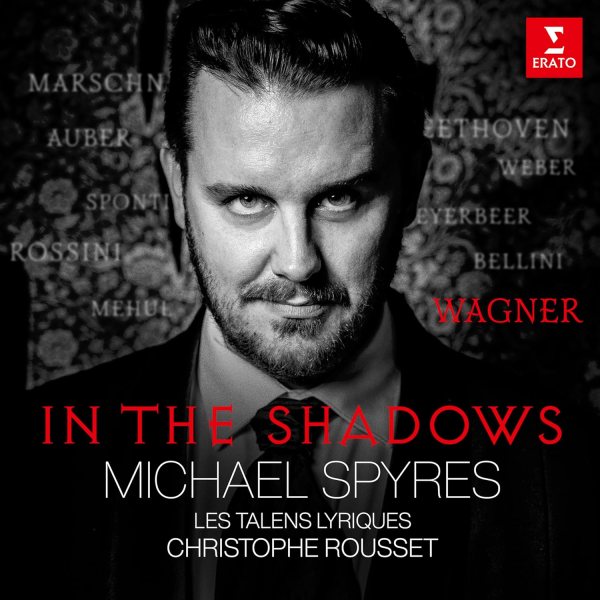
Michael Spyres – In The Shadows

81cea-b2zrl._ac_sl1500_

This is a luxury recital indeed. Over 84 minutes, we are presented with twelve operatic scenes, performed complete with chorus when required and another soloist (in the shape of tenor Julien Henric) who plays Flavio in the scene for Pollione from Norma. Furthermore, we are vouchsafed sung texts and translations into English, French and German, which is important as many of the scenes are not exactly familiar. Clearly all concerned have taken their task seriously.

In the accompanying notes, Spyres talks of his journey towards Wagner and states that the album “endeavours to illuminate the composers who languish in Wagner’s shadow: those who formed the foundation of the compositional aesthetic and sculpted the framework of vocal writing that would become the Wagnerian tenor.”

Thus, we start with Joseph Méhul (1763-1817) and work our way forward roughly chronologically via Beethoven, Rossini, Meyerbeer, Weber, Spontini, Bellini and Marschner to Wagner himself in the shape of arias from his early Die Feen and Rienzi, finishing up with Lohengrin. Of the arias chosen, only those from Fidelio, Norma and Lohengrin could be called in any way familiar, so the recital is certainly valuable for introducing us to some little heard music.

The disc has been reviewed in these pages by Göran Forsling (review) and was even a recording of the month back in April, and I largely agree with that review with one or two caveats.

I actually heard Spyres live at a Prom in 2017, in a performance of Berlioz’s La damnation de Faust with the Orchestrre Révolutionnaire et Romantique under Sir John Eliot Gardiner and, whilst impressed with his interpretation and musicality, I didn’t think the voice was particularly large. Now of course this was seven years ago, and there is a good chance that the voice has grown since then, but I’m not so taken with his singing in those roles that require a bit more dramatic thrust, like Florestan and Pollione. I hear a somewhat artificial darkening of the timbre, which results in a rather throaty sound. He sounds as if he is forcing his lyrical voice, and his tone lacks squillo. Comparisons with Vickers in the former and Corelli in the latter find Vickers singing with a deal more intensity and Corelli, whom I had just recently been listening to in the second Callas recording, much freer on top.

When we get to Wagner himself, Mein Lieber Schwann from Lohengrin is sensitively sung, but there is no ring to his tone when he opens out in the more dramatic parts. GF makes comparison with Gedda, who sang Lohengrin a couple of times in his native Sweden. Ultimately Gedda thought it an unsuccessful experiment, and he never sang the role again, evidently thinking the role too heavy for his essentially lyrical voice. However, as can be heard in his recording of the aria, Gedda’s tone had a good deal more squillo. That said, I heard Gedda live in the Verdi Requiem towards the end of his career and his voice had a great deal more cutting power than Spyres.

With his three albums, Batitenor, Contra-Tenor and now In The Shadows, Spyres is showcasing his versatility, but I just wonder how much of that versatility is a product of the gramophone. Given the encomiums he has been receiving of late, I hate to be the one dissenting opinion, but I do wonder if his voice is being forced into places it shouldn’t necessarily go.

Contents
Etienne-Nicolas Méhul (1763 -1817)
1. Joseph en Égypte, « Vainement Pharaon… Champs paternels
Ludwig van Beethoven (1770 – 1827)
2. Fidelio, « Gott! Welch Dunkel hier!… In des Lebens
Gioacchino Rossini (1792 – 1868)
3. Elisabetta, regina d’Inghilterra, « Della cieca fortuna… Sposa amata… Saziati, o sorte ingrata ?
Giacomo Meyerbeer (1791 – 1864)
4. Il crociato in Egitto – « Suona funerea
Carl Maria von Weber (1786 – 1824)
5. Der Freischütz – « Nein, Länger Trag Ich Nicht
Daniel François Esprit Auber (1782 -1871)
6. La muette de Portici- « Spectacle affreux …
Gaspare Spontini (1774 – 1851)
7. Agnes von Hohenstaufen, « Der Strom wälzt ruhig seine dunklen Wogen
Vincenzo Bellini (1801 – 1835)
8. Norma – « Meco all’altar di Venere…Me protegge, me difende (with Julien Henric (tenor))
Heinrich Marschner 1795 – 1861)
9. Hans Heiling op. 80 – “Gonne mir ein wort der Liebe” 
Richard Wagner (1813 – 1883)
10. Die Feen WWV 32 – « Wo find ich dich, wo wird mir Trost?
Richard Wagner
11. Rienzi, der letzte der Tribunen WWV 49, « Allmächt’ger Vater, blick herab
Richard Wagner
12. Lohengrin WWV 75, « Mein lieber Schwan


In Relations – Eva Zalenga and Doriana Tchakarova

0881488220506

The back page of the booklet that comes with this CD has a complicated diagram, which attempts to display and unravel the various connections between the composers and poets featured in this recital. We all know about the friendship that existed between Mendelssohn and Schumann, but did you know that Loewe, who also made music with Mendelssohn, taught the composer Emilie Mayer, who set poems by Heine, as of course did Loewe and Schumann? So did Meyerbeer, though his only connection with Mendelssohn and Schumann is that they both were vocal in disparaging his music.

The aim is evidently to bring some unity to what is essentially a recital of nineteenth century Romantic songs by both male and female composers, most of which are not exactly regular visitors to the concert platform. It’s a nice idea and it can be fun trying to trace the connections between the various personages represented in this recital, though certainly not necessary for the enjoyment of it.

We begin with Meyerbeer, who is better known for his large-scale operas, none of which have ever held much interest for me. The three songs we get here are rather charming and tuneful, though they don’t quite escape the epithet of parlour music. These are followed by a couple of songs by Loewe, the first a setting of Meine Ruh ist hin, a poem better known to us as Schubert’s Gretchen am Spinnrade. Loewe’s setting is less grippingly intense but it does tell the story well.. Loewe’s accompaniments are worth noting and they are brilliantly played by Doriana Tchakarova, who supports her soloist at every turn.

Mendelssohn’s Hexenlied is better known than the songs we have heard so far and it really calls for a little more variety of timbre than Zalenga has yet at her disposal.  On the other hand Zalenga’s bright, youthful soprano is perfectly apt for the Suleika songs that follow. The Schumann songs go well too, though I would have preferred a little more sense of breathless excitement in Aufträge, such as we hear in older versions by Elisabeth Schumann and Elisabeth Schwarzkopf.

For the rest we are given some rarities by women composers, both of whom were entirely new to me. Emilie Mayer, who died in 1883 (not 1833 as the booklet has it) was the first woman to have her symphonies performed all over Europe. The two songs included here no doubt had an eye on the popular publication market and, like the Meyerbeer, have more than a whiff of the salon about them. Nonetheless I was pleased to make their acquaintance. That said, I found the Heine settings of the English composer, Frances Illitsen, even more interesting. All three are worth investigating, in particular the setting of Heine’s Katherine, which is a glorious outpouring of lyrical melody.

This recital would appear to be the recording debut of the young soprano Eva Zalenga. She has a lovely, light soprano which faintly reminded me of the young Lucia Popp. I see from her website that her operatic roles are Papagena, Barbarina, Susanna, Ännchen, and also Sophie in Werther, all of which would seem right for her at the moment. I can also imagine her making an excellent Sophie in Der Rosenkavalier. As yet the voice doesn’t have a great range of colour at its disposal, but this does not mean she sings without feeling. Throughout she is a most musical singer and keenly responsive to the poetry. You really feel she connects with each of the songs

I wish Hänssler had vouchsafed us translations of the German texts, but, nonetheless, I thoroughly enjoyed this journey through some of the byways of nineteenth century Romantic song. An auspicious recording debut for Eva Zalenga.

Contents:

Giacomo Meyerbeer (1791-1864)

Komm

Meerestille

Suleika

Carl Loewe (1796 – 1869)

Meine Ruh’ ist hin, Op. 9, no. 2

Die verliebte Schläferin, Op. 9, no. 3

Ihr Spaziergang, Op. 9, no.4

Die Schneeflocke, Op. 63, no. 1

Felix Mendelssohn (1809-1847)

Hexenlied, Op 8, no. 8

Suleika, Op. 57, no.3

Suleika, Op. 34, no. 4

Die Nonne, Op. 9 no. 12

Robert Schumann (1810 – 1856)

Liebeslied, Op. 5, no. 5

Aufträge, Op. 77, no. 5

Viel Glück zur Reise, Schwalben! Op. 104, no. 2

Die letzten Blumen starben, Op. 104, no. 6

Aus den östlichen Rosen, Op. 25, no. 5

Singet nicht in Trauertönen, Op. 98a

Emilie Mayer (1812 – 1883)

Du bist wie eine Blume, Op. 71 no. 1

Das Schlüsselloch im Herzen

Frances Allitsen (1848 – 1912)

Katherine

Mag, da draußen Schnee sich thürmen

Die Botschaft

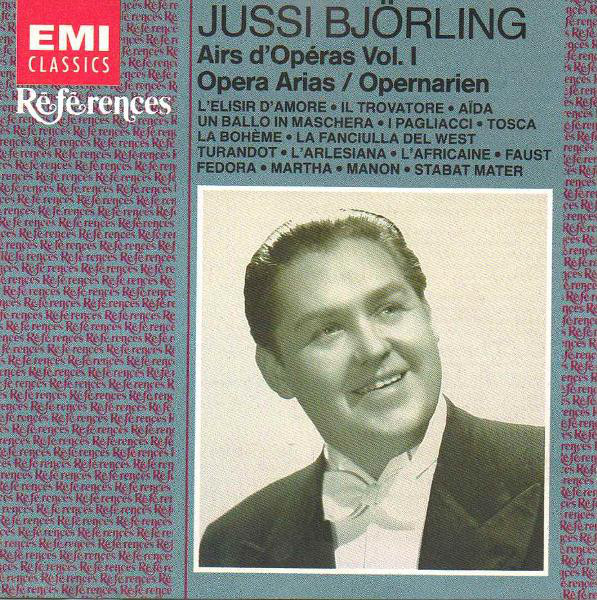
Jussi Björling – A collection of Swedish 78s.

These two CDs gather together most of the 78s the young Björling made in his native Sweden between 1933 and 1949, the earliest made when he was a budding tenor of twenty-two.

Most are vocal gems, but one or two (the rather loud and penny plain Je crois entendre encore, and the unpoetic duet from La Boheme with Anna- Lisa Björling on the second disc, for instance) are less than great.

The voice itself was a magnificent one, no doubt about it, with a silvery purity throughout its range, the high notes free and easy; just listen to his joyfully ebullient 1938 performance of Offenbach’s Au mont Ida from La belle Hélène, sung in Swedish, but with terrific swagger, the top notes flying out like lasers. From a few years ealier we have a plaintively sensitive performance of Valdimir’s Cavatina from Borodin’s Prince Igor, the legato line beautifully held, his mezza voce finely spun out. Also from 1938 we have a thrilling performance of the Cujus animam from Rossini’s Stabat mater, with a free and easy top D flat at the end, and it is prinicpall for Italian and French opera that Bjørling will be remembered and there are plenty of examples here of his wonderfully musical performances in that genre.

We find him ideal in Verdi, Donizetti and Puccini alike, in Myerbeer, in Massenet and in Gounod (a glorious rendering of Faust’s Salut, demeure). Some regret the absence of a true Italianate tone in the Italian items, but he will never resort to sobs and aspirates to express emotion, and, personally, I find his comparative restraint very attractive. It is true, he is not always imaginative with his phrasing, and nowhere will you get the kind of psychological introspection you would hear in a performance by someone like Vickers, but his singing is always musical, and of course there is a great deal of pleasure to be had from the voice itself, which Italianate or not, is a thing of great beauty.

Some of the very best of these 78 recordings are included on Volume 1, stand out items for me being the aforementioned Faust aria, his wonderfully musical and sensitive Ah si, ben mio from Il Ttovatore, and his poetic, but thrilling version of Nessun dorma from Turandot.  There is also plenty to treasure in Volume 2, which includes the Offenbach and Borodin, but also a sensitvely prayerful  Ingemisco from the Verdi Requiem, Des Grieux’s lovely Dream from Manon sung with liquid, honeyed tone (his ardent Ah, fuyez is on the first disc), and his  poetic Cielo e mar, from La Gioconda.

The second disc finishes with a couple of unexpected examples of his work in Lieder, a gorgeously lyrical Beethoven Adelaide, and a beautifully restrained and rapt account of Strauss’s Morgen.

Anyone who loves the tenor voice and gloriously musical and sensitive singing (not always the same thing) should have these recordings in their collections.

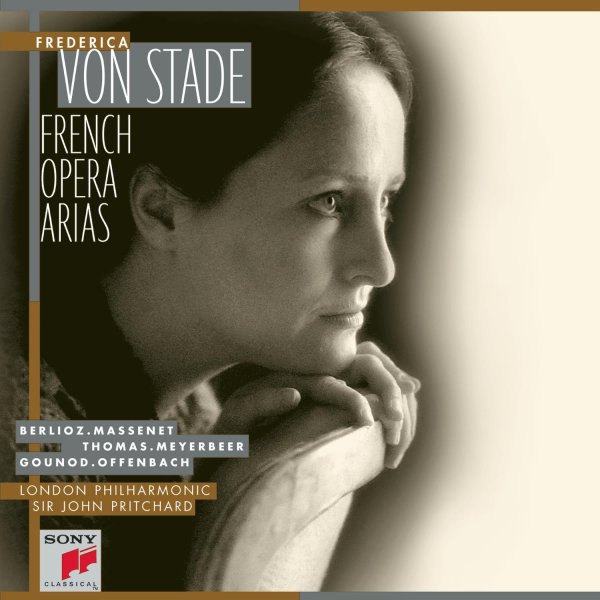
Frederica Von Stade – French Opera Arias

710yvtzhbil._sl1500_

This 1976 recital was, I believe, Von Stade’s first recital disc. In 1970, at the age of 25 she had secured a comprimario contract at the Met, debuting there as one of the Three Boys in Die Zauberflöte, and international acclaim followed in 1973, when she appeared as Cherubino at Glyndbourne in a Peter Hall production that was also televised. Von Stade’s winningly boyish Cherubino catapulted her to stardom alongside Kiri Te Kanawa and Ileana Cotrubas, who played the Countess and Susanna. I remember seeing it on TV, and the impression they all made.

Though American born, Von Stade spent a good deal of her youth in Europe, and later spent some years in France, and so is completely at home in the French language. Indeed French opera and song became a staple of her repertoire though, at this early stage of her career, she doesn’t always use the words to her advantage, and some of the arias could be more clearly characterised. That said, the voice itself, a clear lyric mezzo, is always beautiful and her use of it unfailingly musical. She is best at winning charm and bittersweet sadness, and the least successful item here is Charlotte’s Va, laisse couler mes larmes from Werther, which doesn’t compare to what she achieves in the complete recording under Davis (recorded in 1980).

My favourite performances are of Mignon’s Connais- tu le pays?, which captures to perfection Mignon’s wistful longing for her homeland (I always think it a pity that Von Stade wasn’t the Mignon on the Almeida recording, on which she plays Frédéric) and the aria from Cendrillon, and it is no surprise to find that she went on to have a great success in the complete role. Her natural charm also comes across well in the Offenbach arias and in Urbain’s aria from Les Huguenots.

The aria from Berlioz’s Béatrice et Bénédict for the most part goes well, though her responses are a little less vivid than Janet Baker’s on the complete Davis recording, and the Allegro lacks a little in joyfulness. Her natural plaintiveness is more suited to Marguerite’s D’amour l’ardente flamme, though, here too, there is a sameness of vocal colour which misses the urgency of the middle section.

A very enjoyable recital disc then, the beauty of the voice and her winning personality well caught, if with the proviso that she doesn’t yet quite convey the complete range of emotions required by the music. Nevertheless it always a pleasure to hear such beautiful and musical singing.

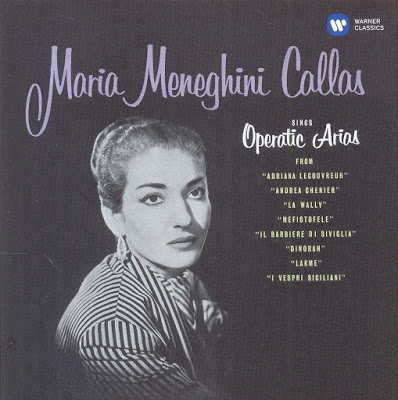
Maria Meneghini Callas Sings Operatic Arias

91epg5zapfl-_sl1465_

Recorded 17-18, 20-21 September 1954, Watford Town Hall, London

Producer: Walter Legge, Balance Engineer: Robert Beckett

This recital, the second Callas recorded for EMI, was designed to show off her versatility, so we get one side of verismo, and one of coloratura, with Boito’s L’altra notte from Mefistofele bridging the gap. It caused quite a stir at the time. The coloratura side was of material more associated with singers like Galli-Curci and Pagliughi; the verismo items more likely to be the preserve of Ponselle and Muzio, or Callas’s contemporary, Tebaldi. There is no doubt that Tebaldi could not have attempted any of the coloratura items on the disc and the gauntlet was effectively laid down. The range too is phenomenal, and takes her up to a high E natural (in the Vespri aria, and the Bell Song), a note unthinkable from a soprano who could bring the power she does to an aria like La mamma morta.

Of the operas represented, Callas had only sung Mefistofele and I Vespri Siciliani on stage at that time, though she would go on to sing Rosina in Il Barbiere di Siviglia (and make a very successful studio recording) and Maddalena in Andrea Chenier. But, as is her wont, even in isolation, Callas is able to enter fully into the character and sound world of each character that she is singing.

She starts with two of Adrianna’s solos from Adrianna Lecouvreur, a role that would no doubt have suited her dramatic gifts down to the ground, though, truth to tell, the opera is pretty tawdry stuff. I have the recording with Scotto and Domingo, who make the very best case for it, but I still have little time for it. That said, Callas is brilliant at conveying Adrianna’s humility in the first aria, her pain and sadness in the second. Her recording of La mamma morta is well known, and became quite a hit after it was featured in the Tom Hanks Oscar winning movie Philadelphia. Notable is the way Callas’s tone colour matches that of the cello in the opening bars, and the way she carefully charts its mounting rapture. Some may prefer a richer, fuller sound. None have sung it with such intensity.

Ebben ne andro lontana, a glorious performances, is full of aching loneliness, its climax solid as a rock, but the prize of this first side is without doubt the crepuscular beauty of Margherita’s L’altra notte from Boito’s Mefistofele, a sort of mini mad scene, which Callas fills with a wealth of colour and imagination. One notes the blank, colourless tone at L’aura e fredda, even more drained and hopeless on its repeat, the baleful sound of her chest voice on E la mesta anima mia; and does any other singer so accurately encompass those coloratura flights of fancy as her soul takes wing on Vola, vola? This is the stuff of genius.

The second side also has its attractions. Rosina’s Una voce poco fa is a mite slower than it was to become in the studio set, but Callas’s ideas on the character are perfectly formed, and she already uses that explosive Ma to underline Rosina’s less than docile temperament. Her runs, scales and fioriture are as elastic as ever, and the little turns on the final faro giocar have to be heard to be believed.

The Dinorah aria is a rather empty piece and I sometimes wonder why she even bothered with it. There are some magical echo effects and her singing is wonderfully fleet and accurate, but it’s not a favourite of mine. I’m not a big fan of the Bell Song either, to be honest. Callas lavishes possibly more attention on it than it’s worth, but in so doing at least makes it a little more interesting than the birdlike warblings we usually get. The opening has a mesmeric , almost improvisational air about it, and the bell imitations are clear and true. I remember once playing this track at a friend’s place one summer evening, the window open, while a bird (I have no idea what it was) sang for all its worth on a branch just outside.  It was as if the bird was singing in response. The high E she sings at its climax is clean as a whistle, but it does sound like the very extreme of her range. Best of all the coloratura items is her breezy, elegantly sung Merce, dilette amiche from Verdi’s I Vespri Siciliani, which is lovely in every way and ends on another epic high E.