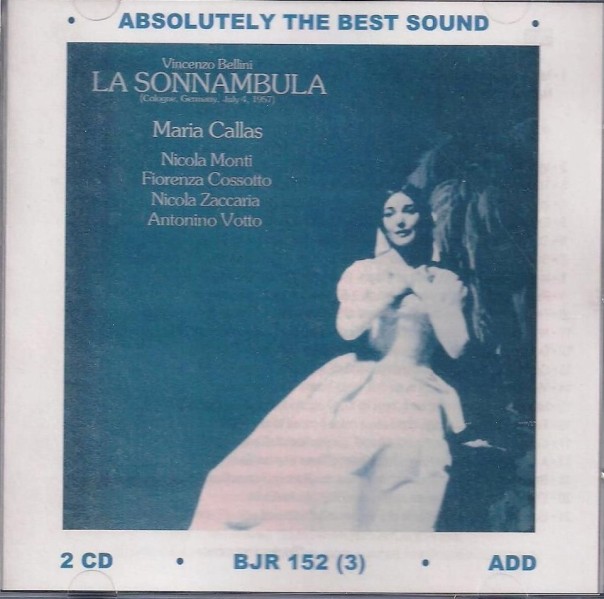
Callas sings Amina in Köln, July 1957

CallasSonnambulaCologne

In March of 1957 La Scala revived the Visconti production of La Sonnambula preparatory to taking it on a short tour to Köln in July and the Edinburgh Festival in August. They had also made a studio recording of the opera in March with the same cast and conductor (Antonino Votto) as the La Scala stage performances. In Köln the acid-voiced Eugenia Ratti has been replaced by Marietta Angioletti and Alessio is now sung by Dino Mantovani, but otherwise the casts of the studio and Köln performances are identical, with Nicola Monti replacing Cesare Valletti as Elvino and Nicola Zaccaria replacing Giuseppe Modesti as Rodolfo from the original 1955 La Scala cast. Fiorenza Cossotto also took over the role of Teresa from Gabriela Carturan. Elsewhere on my site I have reviewed both the 1957 studio set and the 1955 Bernstein performance.

This Ars Vocalis issue is taken from BJR LPs and is probably a composite of the two performances she sang in Germany, as well as the dress rehearsal. That fact does not bother me unduly. After all, when major companies record live performances, they usually record more than one performance in order to come up with an acceptable release. The sound on this Ars Vocalis issue is actually rather good, almost as good as the studio recording and a good deal better than the 1955 Bernstein version.

The audience were clearly excited to have the great diva appearing in their city and her first notes are interrupted by a prolonged burst of applause, meaning she has to repeat them when the tumult has died down. We can’t see how she reacted but, vocally, she doesn’t step out of character for one second. Her voice in this performance has a pearly opalescence, which is perfectly apt for sweet, trusting Amina and her opening cavatina is beautifully shaped. In the cabaletta (Sovra il sen) she continues to keep the voice light and airy and adds a stunning top Eb at its close.

Much as I enjoy the 1955 Bernstein performance, this one possibly takes us closer to the Amina of Bellini’s and Romani’s dreams. Rarely has Callas’s voice sounded so lovely. Indeed the review of the performance in the Kölnische Rundschau talks of

the luminous beauty of the voice: melting sweetness in floating pianos, metallic brilliance in fortes, and in its coloratura, a perfect plasticity that one would only approximate very imprecisely with the usual comparisons from the instrumental realm.

The review also praises her acting, concluding that

the entire nineteenth-century operatic tradition is preserved herein a form that has become foreign to us, but that is, however, truly delightful.

Though some of Bernstein’s embellishments have now been trimmed away, she was obviously in superb voice and here repeats the stupendous cadenza inbetween the two verses of Ah non giunge, where she sweeps up to a fortissimo top Eb, on which she effects a stunning diminuendo before cascading down a perfect string-of pearls scale, a feat I’ve never heard equalled by any other soprano.

Nicola Monti is no Cesare Valletti, but he sounds a lot more confident in this live performance than he does on the studio recording and Zaccaria is a melifluous Rodolfo. Where Votto was a somewhat diffident conductor in the studio, here is he inspired by the live occasion and, given a choice between this and the studio performance, this is the one I would go for, especially in this excellent transfer.

Callas’s Studio La Sonnambula

91k3udjbejl-_sl1461_

Recorded 3-9 March 1957, Teatro alla Scala, Milan

Producer: Walter Legge, Balance Engineer: Robert Beckett

The role of Amina probably seemed a curious one for Callas until it was remembered that Bellini wrote it for the very same singer for whom he wrote Norma, Giuditta Pasta. Where Norma was eventually taken over by big voiced dramatic sopranos, who mostly couldn’t do justice to its coloratura demands, Amina became the province of light, soubrettish high coloratura sopranos, intent on showing off their high notes and flexibility. Callas returned a human dimension to the role that nobody had suspected was there.

She first sang the role at La Scala in 1955 in performances that were a total revelation. Visconti reproduced a picture-book village, a Romantic vision of a time that never was, Callas costumed to look like a reincarnation of the nineteenth century ballerina Maria Taglioni. At the end of the opera, when Callas sang Ah non giunge, the lights on the stage and in the auditorium rose to full intensity, whilst Callas, no longer Amina but the reigning queen of La Scala, came to the front of the stage singing directly into the audience. In a live recording that exists of the night, the audience go mad with applause before the music has even finished. With Leonard Bernstein in the pit and Cesare Valletti as a stylish Elvino, the production was a massive success.

However this recording is more a reflection of the revival in 1957, and was made at the same time. La Scala subsequently took the production, with substantially the same cast, to Cologne and Edinburgh. Votto is now the conductor, Nicola Monti the Elvino and Zaccaria replaces Modesti as Rodolfo.

When considering the role of Amina, it might be wise to take a look at the advice of its librettist Felice Romani:

The role of Amina, even though at first glance it may seem very easy to interpret, is perhaps more difficult than many others which are deemed more important. It requires an actress who is playful, ingenuous and innocent, and at the same time passionate, sensitive and amorous; who has a cry for joy and also a cry for sorrow, an accent for reproach and another for entreaty… This was the role created by Bellini’s intellect.

And this is exactly what we get from Callas. Her first lines of recitative, and the aria that follows, Come per me sereno, are imbued with a deep happiness that radiates from within, her voice taking on a pearly softness. In a single phrase, Il cor soltanto, when the notary asks her what she brings as dowry, she expresses Amina’s deep love and trust in Elvino. In the first sleepwalking scene, her voice seems to come from somewhere inside her, an aural depiction of Amina’s dreamlike state; her confusion when she wakes, and subsequent distress when Elvino rejects her palpably real. I doubt I will ever hear a more moving account of Amina’s Oh se un volta sola and the aria that follows, Ah non credea, than we get from Callas. Here we truly hear the cry for sorrow; Callas’s singing goes beyond the notes to create the stuff of real-life tragedy, with a depth that nobody had even suspected was there when the role was sung by light pale-voiced soubrettes.

Technically her singing is brilliant, her command of line, trills, gruppetti, scale passages peerless. At one point, in the cadenza between the two verses of Ah non giunge, she sweeps up to a fortissimo Eb in alt. Unbelievably she effects a diminuendo on this stratospheric note before cascading down a perfect two octave scale, phrasing onward in one breath through an upwardly rising chain of notes to cap the cadenza. This is no trick of the gramophone, because she does exactly the same thing when she sings the role live in Cologne a few weeks later.

As for the rest, Valletti is a sad loss from the earlier performances. Monti is taxed by the higher reaches of the role, and many cuts are made to accommodate him. He’s also on Sutherland’s first recording, which followed in five years. Presumably light lyric tenors were in short supply in the mid 1950s. I often wonder why Gedda, who sang Pinkerton to Callas’s Butterfly a couple of years before was not engaged. Zaccaria’s mellifluous bass gives us a worthy Cari luoghi. Ratti is a bitchy, minx-like Lisa. Cossotto sings beautifully as Teresa, but sounds too young (which of course she was).

Votto’s conducting, which comes alive in Cologne, is often dull and routine here, particularly in the choruses, which lack energy (compare Bernstein in 1955). When Callas is before the microphone, you feel that it is she who leads, her sense of line, rubato and pace absolutely spot on.

The sound in this Warner issue is admirably open, with plenty of space around Callas’s voice, which, as I mentioned earlier, has a pearly radiance absolutely right for the role of Amina. I may on occasion prefer to listen to the 1955 La Scala performance with Bernstein, a truly thrilling and exciting evening in the theatre, but I feel that by 1957, both here and in Cologne, Callas has captured more of the poetry of Bellini and Romani’s heroine. Her Amina is an achievement to set beside that of her Norma, as, according to contemporary commentators, was that of the creator of the two roles, Giuditta Pasta. There can be no higher praise