Reflet – Sandrine Piau sings French orchestral songs

81uc3fhnuwl._ac_sl1500_

I know Sandrine Piau principally as a singer of Baroque and Classical music, but she has recently been venturing into the nineteenth and twentieth centuries and this is the second disc in a series, which began with a disc of orchestral songs by Strauss, Berg and Zemlinsky entitled Clair-Obscur. The notes accompanying the disc tell us that that earlier disc sought to explore “the confrontation between shadow and light,” whilst this one “evokes the nuances and transparencies of the French mélodie.”

Essentially what we have here is a nicely put together programme of French orchestral song, starting with Berlioz and taking us through to Britten’s early Ravelian Quatre chansons Françaises via Duparc, Koechlin, Debussy and Ravel himself. The programme is not long (under an hour) and is fleshed out with André Caplet’s orchestration of Debussy’s Clair de lune and Ernest Ansermet’s of the sixth of his 6 Epigraphes antiques. Admirably as the orchestra plays throughout under Verdier, these add very little to the programme and I would have welcomed more songs, maybe something by Chausson, Delage or Canteloube, or more by Koechlin, who is not so well represented in the catalogue. If I’m honest, I prefer the Debussy items in their original piano guise. Unlike Ravel’s orchestrations of his own piano pieces, the arrangements don’t really improve on the originals.

The Koechlin songs were new to me, and I rather wish Piau had explored more than the three we have here. If they pique your curiosity, as they did mind, then they are available sung by Juliane Banse, along with a lot more of Koechlin’s vocal works with orchestra, in a two disc set in Hänssler’s Koechlin edition. What we have here is two songs from his early 4 poèmes d’Edmond Haraucourt. Op.7, and one from the slightly later 3 mélodies, Op. 17. If they lack some of Duparc’s natural melodic gift, they are nonetheless lushly orchestrated and rather beautiful  and make an excellent partner for the two Duparc songs.

If the Koechlin songs afforded me the most pleasure, that could be because I didn’t know them before and therefore had no point of comparison, whereas I know all the other material rather well. I’ve loved the Britten songs since they were first recorded in the 1980s. Admittedly one can hear the influence of Ravel, particularly of Shéhérazade, but they are remarkably assured from a boy of fourteen and they do not feel out of place here, whilst the sparer textures of Ravel’s Mallarmé settings, written for two clarinets, two flutes, piano and string quartet, provide a nice contrast to the lush orchestrations of the rest.

Piau is now in her fifties and the voice has lost a little of its bloom on high. She also uses what the late John Steane once referred to as a squeeze-box method of vocal production, a tendency to move note by note rather than in a long line, which, once noticed, is hard to ignore. I also hear a slight sense of strain in the Britten songs, particularly at the close of the final song, which is not as radiant as it should be, and as it is in the performances of Jill Gomez, who made the first recording of them for EMI under Simon Rattle, and Felicity Lott, who recorded them for Chandos under Bryden Thomson.

The opening Berlioz Le spectre de la rose is taken a mite too fast for my taste and is a little on the cool side, but it does rather set the general tone of the recital. If you like it, then you will no doubt like the whole disc, but I found Piau a little lacking in involvement, a little detached.

I don’t want to belabour the point too much, because this is a very enjoyable programme, well considered and well put together and, for the most part, Piau’s singing is quite lovely, but, in the Berlioz, Duparc, Ravel and Britten, I found myself inwardly hearing the voices of some of those who have preceded her. Still, if you’re looking for a mixed programme of nineteenth and early twentieth century French orchestral song, then this disc will provide a lot of enjoyment.
 

Callas’s 1959 Lucia di Lammermoor gets the Pristine treatment

paco207_9735ee11-e251-4de3-a757-19c9b4ae597a_530x

Callas’s second stereo recording of Lucia di Lammermoor, which I reviewed when it was reissued by Warner , has always been considered one of her best from a sonic point of view, so, as someone who has not always been totally convinced by some of Andrew Rose’s re-mastering methods, I wondered how, if at all, the sound could be improved upon. Let me say straight away that I found this latest addition to Pristine’s Callas catalogue totally convincing. Using the Warner remaster of 2014 for comparison, I found the sound altogether warmer and much more comfortable to listen to, closer in fact to how I remember the LPs that I used to own (a German EMI Electrola issue, bought as an import). The Warner is perhaps slightly clearer, but the digitalisation tends to add glare to Callas’s top register. Often one is prepared to flinch before the topmost notes, but I had no such problems when listening to this Pristine pressing. I couldn’t say which is the more truthful, but I can say that the Pristine is much more comfortable to listen to and this, in turn, affected my impressions of the set, a recording I have known since my youth and was in fact my introduction to the opera.

Lucia was one of the cornerstones of her repertoire, and she first sang it in 1952 in Mexico. The following year she sang the role again in Florence, where she made her first recording of the role under Serafin. It was also the first recording she made for EMI. Back in those days, the opera wasn’t taken very seriously and was most likely considered a silly Italian opera in which a doll-like coloratura soprano ran around the stage showing off her high notes and flexibility. Callas returned a proper tragic dimension to the role, that most hadn’t even suspected was there. There is a touching story of Toti Dal Monti, an erstwhile famous Lucia herself, visiting Callas in her dressing room after a performance of the opera with tears running down her face and confessing she had sung the role for years with no idea of its dramatic potential.

When Callas first sang  Lucia in Mexico and recorded it in Florence, she was at the peak of her vocal plenitude, as she was when she first sang it under Karajan at La Scala in 1954, but by the time she sang the role in Berlin in 1955 post weight loss, when Karajan took the La Scala company there, her voice had started to lighten and her conception of the role had become more inward. We can hear this in the famous live recording of one of the Berlin performances, but, for this 1959 recording, she appears to have taken this approach one step further. This may have had something to do with her by now fading vocal resources, but it results in a particularly touching portrayal of the innocent, young, impressionable girl. She has also trimmed away some of the showier variations in the cadenza in the Mad Scene, and the decorations are in consequence somewhat more modest. Am I alone in preferring it sung this way? Personally, I’d prefer to do without all that duetting with the flute altogether, as happens in the complete recording of the opera with Caballé and when Sylvia Sass sings it on one of her recital records. In any case, apart from a few of Callas’s topmost notes, she is in remarkably good voice and the filigree of the role is brilliantly executed with fluid and elegant ease. All in all, I prefer her performance in this set to the one on the 1953 Florence studio recording, not least because of the improved Pristine sound picture.

However, when it comes to her colleagues on this set, I am a little less well disposed towards them than Göran Forsling in his review of the digital download. Ferrucio Tagliavini was 45 at the time of this recording, but he sounds much older, more like an elderly roué than the Byronic Romantic figure of Scott’s and Donizetti’s imaginings. No amount of elegant phrasing can make up for his lack of sheer physical passion and I find myself longing for Di Stefano’s youthful ardour. As for Cappuccilli, he was at the very beginning of his considerable career, and he has yet to find a way of creating character in pure sound. He is just rather dull and no match for Gobbi on the earlier recording or for Panerai in Berlin. Bernard Ladysz makes very little impression at all and both Rafaele Arie and Nicola Zaccaria are preferable.

Serafin, as always, though he may not make any startling revelations, shapes the score with a perfect sense of its dramatic shape, albeit with the cuts that were traditional at the time. Karajan opened up some of those in his performances, and I would still place the 1955 Berlin performance at the top of all Callas’s recorded Lucias, especially in Divina Records latest remastering, but I enjoyed re-visiting this set and I have a feeling I’ll be reaching for this one more regularly than the earlier 1953 recording, not least because of the superior quality of Pristine’s remastering.

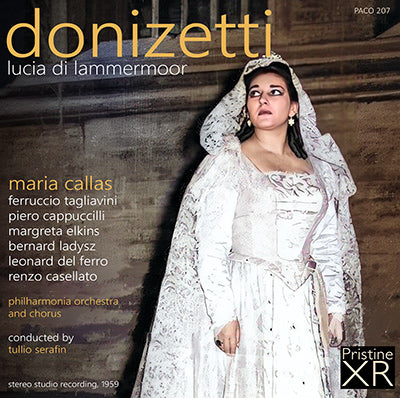
My only criticism is of the cover art, which has a photograph of Callas as Lucia in Florence in 1953, when she was still a rather large lady. One could be forgiven for thinking, at first glance, that this was the earlier recording. Surely a photo of the svelte Callas as Lucia would have been more appropriate. There are plenty of them, after all.

A fascinating arrangement of Schubert’s Winterreise for soloist, chorus and two accordions.

81r0f4d0yfl._ac_sl1425_

Now here’s something a little different. Rearrangements and re-imaginings of Schubert’s Song Cycles are not exactly unusual, but I think Meyer might be the only person to use a chorus and this is actually Gregor Meyer’s second arrangement of Schubert’s popular song cycle. The first was for baritone, chorus and piano and was recorded in 2017 by baritone Daniel Ochoa with Gregor Meyer conducting the Leipzig Vocalconsort and with Christian Peix on the piano. This one unusually substitutes two accordions for the piano. Given that the accordion wasn’t invented until around 1822 in Berlin, it is unlikely that Schubert ever got to see or hear one. However, it does not sound anachronistic and indeed captures the sound of the hurdy-gurdy in the final song even more atmospherically than the piano. The accordions can also add a jaunty, folk-like colour to songs like Frülingstraum. Interestingly, Meyer is not the only person to rearrange the cycle for an accordion. Oboist Normand Forget made a chamber version for accordion and wind quintet (including bass clarinet, oboe d’amore and baroque horn) and this has been recorded by tenor Christoph Prégardien, accordionist Joseph Petric and the Montréal ensemble Pentaèdre.

Meyer’s chorus first appears in the second stanza of the first song, Gute Nacht, almost imperceptibly creeping in on a wordless vocalise, which wonderfully conjures up a bleak, wintry scene. Thereafter they are a constant presence, sometimes joining in with the soloist, sometimes taking over the vocal lead or responding to him, sometimes still in wordless commentary, and sometimes, as in Der stürmische Morgen, taking over the whole song whilst the soloist remains silent. You might think the effect would be to distance us from the solitary traveller’s loneliness, but in fact it reinforces his utter desolation, the voices seeming part of an interior dialogue as the soloist struggles with his own inner demons.

In an arrangement such as this, the soloist’s function is perhaps somewhat different from normal, and Tobias Berndt fulfils his task admirably, knowing when the focus is on him, but realising when he needs to pull back and blend with the choir. He has a light, pleasing baritone which blends beautifully in the total sound picture. He may not make any startling revelations (those tend to come from the chorus and accordions) but nor is he bland or inexpressive.

The GewandhausChor under Gregor Meyer are absolutely splendid, and the two accordion players, Heidi and Uwe Steger, are superb accompanists.

Of course, this arrangement cannot replace the original version for voice and piano, and most people will have their favourites (mine are Fischer-Dieskau and Demus and Kaufmann and Deutsch) but this is a fascinating and rewarding re-thinking of Schubert’s great song cycle. I really enjoyed it and one listening quickly became two and then three. I know it’s only January, but this is very likely to be one of my discs of the year. Highly recommended.

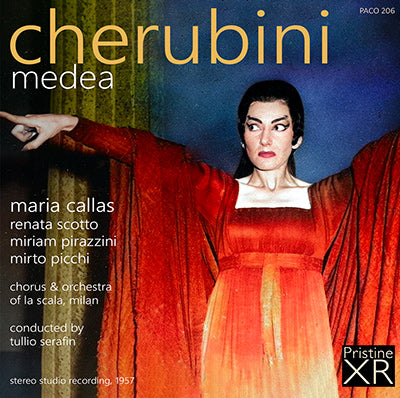
Callas’s Studio Medea gets the Pristine XR treatment

paco206_b39e453c-db98-4327-9fcb-cf071ccd980b_530x

Pristine, having applied their XR method of remastering to many of Callas’s mono recordings and to some of her live ones, now turn to the stereo studio ones. Oddly enough, this was the first of Callas’s complete operas to be recorded in stereo in Milan, though it wasn’t actually recorded by Walter Legge and her Columbia recording team, and all her other Milan recordings that year were mono. Apparently, EMI had no interest in the enterprise and the recording was made by Mercury for Ricordi in September 1957, a few weeks after her performances of La Sonnambula in Edinburgh, when she had not been in her best voice. It was originally issued by Ricordi in Italy, Mercury in the US and Columbia in the UK and since then has appeared on various different labels, including Everest and even Deutsche Gramophon, as well, of course, as Warner when they re-mastered all the Callas studio recordings for their 2014 release.

Considering it was recorded by Mercury, one would have expected the sound to be pretty good, but it has always sounded a bit dry and constricted. I was listening to the Pristine CDs and made comparisons with the 2014 Warner release. To my ears, the differences between the two are fairly slight. Pristine’s XR sound opens up the sound picture a bit and solo voices in particular do sound as if they have a bit more air around them. I also tried listening both through my speakers and through headphones and, oddly, found I preferred the Pristine through my headphones and the Warner through my speakers, though this could have something to do with my equipment. It might also have something to do with the fact that the Pristine release is transferred at a much lower level than the Warner.

Whichever version you go for, there is no doubt this is the best sounding of all Callas’s recorded Medeas, but what about the performance? Apart from this studio recording, we have five live recordings: Florence and La Scala 1953, Dallas 1958, London 1959 and La Scala 1961. Of these, one can safely discount the 1961 La Scala performance. I would also discount the 1959 London performance, a recording that has also been issued by Pristine, though I see that it is Ralph Moore’s first choice in his Medea survey. I feel that it pales in comparison to the Dallas performance, which, though it suffers from poor sound, is blisteringly dramatic, having been recorded just after Bing had “sacked” Callas from the Met. That event seems to have galvanised the whole company to produce a performance of extraordinary dramatic concentration, with Callas in fabulous, secure voice. This Dallas performance is my first choice for the opera, though I wouldn’t want to be without the two 1953 performances either.

This studio recording operates on an altogether lower level of intensity than any of those. However, when I first got to know this opera, and this recording, I had no other point of reference, and it seemed pretty good to me. It was only later, when I heard those barnstorming performances from Florence, La Scala and Dallas, that I found anything lacking, and it is only in comparison with herself that she fails. She is still a good deal better in the part than any other who attempted it, certainly a lot better than Gwyneth Jones and Sylvia Sass, who also made studio recordings of this Italian version. In other hands, Cherubini’s music can seem staid and formulaic, but Callas breathes life into it like no other.

Serafin’s conception is essentially Classical, but his conducting varies from the somnolent to the dramatic. After a tautly conceived overture, the first scene up to Medea’s entrance drags on interminably. I understand the necessity to establish a pastoral air of peace and calm, into which the Colchian Medea bursts, but, quite frankly, at this pace it just becomes a bore. On LP I often used to miss out the first side completely and set the needle down part way through the second LP, when Medea makes her entrance.

Without foreknowledge of other performances by Callas, this is still a great performance of a difficult role. We lose some of the power and ferocity, but there are gains too. Ricordi il giorni tu la prima volta quando m’hai veduta? is couched in the most melting tones, as is the ensuing aria. There is no doubt that it is love, not revenge, that first brings Medea to Corinth. Her duplicity in the scene with Creon, and also in the following duet with Jason, is brilliantly charted, and the scene with the children movingly intense. Vocally, for all that she is not in her best voice, she manages its angular lines and wide leaps with consummate skill, her legato still wondrously intact. Note also how, in this Classical role, her use of portamento is more sparing.

When it comes to the supporting cast, Scotto is less of an advantage than you might expect, Pirazzini rather more (though not quite a match for Barbieri in Florence and at La Scala or Berganza in Dallas). Picchi, who sang Pollione to Callas’s Norma in London in 1952, is rather good, though Vickers is even better in Dallas. Modesti makes a good Creon too, though not as good as Zaccaria in Dallas.

One should of course point out that this is not Médée, as Cherubini imagined it, which was an opéra-comique with spoken dialogue. The version Callas sang is a hybrid, an Italian translation of a German version with recitatives by Franz Lachner, first performed in 1909. It works very well, though, and it is interesting to note that, even in this age of preference for historical authenticity, this was the version that Sondra Radvanovsky sang when the opera was revived for her at the Metropolitan Opera recently.

If you are looking for a studio recording of the opera, then there is little doubt that this is the one to go for.

Dreams Desires Desolation – and Diffidence.

71zl57gifrl._ac_sl1425_

Dreams Desires Desolation

English Song

Trevor Alexander (baritone), Peter Crockford (piano)

Rec. 2021 Henry Wood Hall, London.

This is a disc of English song which re-creates an evening of Parlour Ballads, such as one might have heard in an Edwardian aristocratic home. Even the more contemporary songs fit quite comfortably into this category and in fact the most forward reaching and original song is by Frank Bridge; his last song, Journey’s End,written in 1925 to a text by Humbert Wolfe. Startlingly, the song almost sounds as if it might have been written by Bridge’s pupil, Benjamin Britten and in fact Pears did record the song with Britten at the piano in 1963. Some of the songs are old favourites, that we don’t hear very often these days, though we might know them from older recordings, whilst others are brand new. Indeed, Peter Gelhorn’s Autumn and two songs by Clive Pollard (b. 1959) are here receiving their first commercial recordings. However they are tuneful and tonal and do not sound out of place in a programme of songs mostly written in the early part of the last century.

As you would expect with a title like Dreams. Desires, Desolation the mood is mostly melancholy or dreamlike and I can’t help feeling one or two more lively songs would have created a little more variety in the programme. What would also have helped to enliven the recording is a bit more energy in the performances. Trevor Alexander has a pleasant, light, tenorish baritone and he has excellent diction. Though his is obviously not the voice of a man in the first flush of youth, it is mercifully free of excessive vibrato or wobble. Unfortunately, it is also a little lacking in colour and personality. The performances are somewhat diffident, rather lacking in substance and imagination. Take the opening song, Butterworth’s Is my team ploughing? Alexander commendably attempts to differentiate between the ghost and the young man, but whereas his ghost is convincingly eerie, the young man’s responses need to be more healthily robust. It is also true that many of the older songs tap into a vein of sentimentality that is perhaps not so fashionable today.  Even so, one wants a more open-hearted, outgoing emotional response to both words and music, such as we can hear in some of the old recordings of Jonn McCormack, Richard Tauber, Rosa Ponselle and Kathleen Ferrier. Where their voices and personalities fly out from even the crackliest old 78s, Alexander remains earthbound, nice but dull.

Reading the notes that come with the disc, one appreciates that it was obviously a labour of love for the two artists involved and one doesn’t doubt their sincerity for a moment, but, though there are some interesting discoveries (and re-discoveries) here, the performances need a little more personality and variety to sustain interest throughout a whole disc.

Contents

  1. George Butterworth (1995-1916) – Is my team ploughing?
  2. Frank Bridge (1879-1941) -Come to me in my dreams
  3. Charles Marshall (1857-1927) -I hear you calling me
  4. Roger Quilter (1877-1953) – Now sleeps the crimson petal
  5. Clive Pollard (b.1959) – Go, song of mine
  6. Richard Hageman (1881-1966) -Do not go my love
  7. Ralph Vaughan Williams (1872-1958) -Silent noon
  8. James Frederick Keel (1871-1954) – Remembrance
  9. Victor Hely-Hutchinson (1901-1947) – Dream song
  10. Frank Bridge (1879-1941) – What shall I your true love tell?
  11. Haydn Wood (1882-1959) – Love’s garden of roses
  12. Peter Gelhorn (1912-2004) – Autumn
  13. John Ireland (1879-1962) – If there were dreams to sell
  14. Cecil Armstrong Gibbs (1889-1960) – Silver
  15. Clive Pollard (b. 1959) The cloths of heaven
  16. Ralph Vaughan Williams (1872-1958) – The sky above the roof
  17. Cyril Scott (1879-1970) – Lullaby
  18. Amy Woodforde-Finden (1860-1919) – Kashmiri song
  19. Roger Quilter (1877-1953) – I arise from dreams of thee
  20. Frank Bridge (1879-1941) – Journey’s End
  21. Lucy Elisabeth Simon (1940-2022) – How could I ever know (from the Secret Garden)

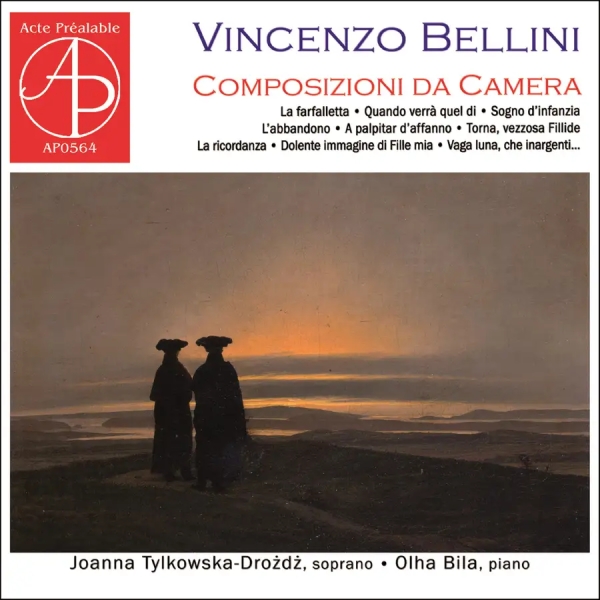
Bellini – Composizione da Camera

An enterprising collection of Bellini songs is unfortunately let down by less than ideal performances.

BelliniSongs

Bellini’s songs are not performed that often and indeed this is only the second recording of his Composizioni da Camera I’ve come across. Veronica Kincses recorded the complete set for Hungaroton back in 1982, though a few of the songs have appeared on various recital discs over the years.

They were probably written some time in the 1820s and it is unlikely that Bellini intended them all to be performed together; in fact, they were not published as a set until 1935, by the Milan publisher Ricordi. The Kincses disc includes all the songs in the Ricordi edition, in the order in which they appear in the score, whereas the present issue substitutes one or two other songs from a different source, such as La ricordanza, which turns out to be the tune of Qui la voce from I Puritani. Texts and translations are provided, some being by Metastasio, but the majority are anonymous.

Most of the songs are quite short, though the longest Torna, vezzosa Fillide,runs to almost eight minutes and is in the style of a mini operatic scena. It is the most complex of the songs and closer in style to the music of Bellini’s operas. However , for the most part, the songs are tuneful and undemanding, and it is not surprising that a few of them have made it into recital programmes of more famous singers, like Pavarotti, Bartoli, Tebaldi and even David Daniels, all of whom have made recordings of the most famous song, Vaga luna, che inargenti, the tune of which kept reminding me of the English folk song, The foggy, foggy dew. 

Any of the above singers would be preferable to the Polish soprano, Joanna Tylkowska-Drożdż, who has a rather hard, bright voice and tends to sing at an unrelenting mezzo-forte throughout, any refinement or tonal nuance only being offered by the pianist Ohla Bila. Nor is she particularly imaginative in her phrasing or her response to the poetry. Listening to the disc in one sitting proved something of a trial. The somewhat reverberant acoustic also tends to exaggerate the hardness of Tylkowska-Drożdż’s timbre.

As it happens, Veronica Kinkses’ Hungaroton recording of the fifteen songs in the 1935 Ricordi edition is still available to stream or as a download and is infinitely preferable if you are looking for a single disc of Bellini’s songs. However, I have a feeling most of us would be content to find the odd song on a mixed recital by a favourite artist. It should be noted that five of the songs appear on a 1997 disc by Cecilia Bartoli, called An Italian Songbook, on which she sings songs by Donizetti, Bellini and Rossini.

Contents

Vincenzo Bellini (1801-1835)

  • La farfaletta (anonymous)
  • 2. Quando verrà quell di (anonymous)
  • Sogno d’infanzia (anonymous)
  • L’abbandono (anonymous)
  • A palpitar d’affanno (anonymous)
  • Torna, vezzosa Fillide (anonymous)
  • La ricordanza (Carlo Pepoli, Conte)
  • Dolente imagine di Fille mia (anonymous)
  • Vaga luna, che inargenti (anonymous)
  • Malinconia, Ninfa gentile (Ippolito Pindemonte)
  • Vanne, o rosa fortunate (Pietro Antonio Domenico Bonaventura Trapassi as Metastasio)
  • Bella nice, che d’amore (anonymous)
  • Alme se non poss’io (Pietro Antonio Domenico Bonaventura Trapassi as Metastasio)
  • Per pietà, bell’ idol mio (Pietro Antonio Domenico Bonaventura Trapassi as Metastasio)
  • Ma rendi pur content (Pietro Antonio Domenico Bonaventura Trapassi as Metastasio)