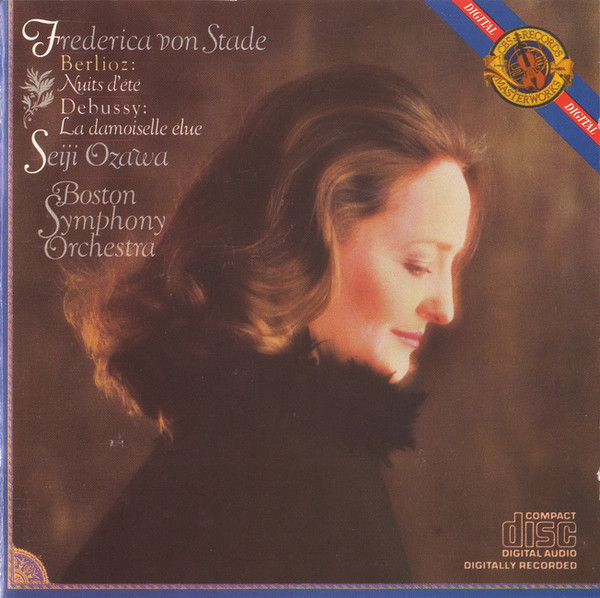

This is a wonderful disc and if it had been in my collection when I did my mini survey of recordings of the Berlioz (Berlioz’s Les Nuits d’Eté – a comparative review of ten recordings) it would no doubt have jostled for top position with my top three of Baker/Barbirolli, Hunt Lieberson/McGegan and Steber/Mitropoulos. My personal favourite would still be the Baker and, like Baker, I would suggest that Von Stade has the perfect voice for this group of songs. Though Berlioz had originally wanted the songs to be sung by different voices, a single voice does bring a certain homogeneity to the cycle, even if few can encompass its demands. Von Stade’s mezzo, with its soprano-ish top and firm lower register (down to a beautifully sounded low F# in Sur les lagunes) seems to me to be the perfect instrument for it. Furthermore she captures the gaiety of the outher songs as easily as she does the deeper emotions of the middle songs. There is a real sense of yearning in Absence, profound despair in Sur les lagunes and a resigned sadness in Au cimetière. Le spectre de la rose is very beautiful, rising to a gorgeous climax before sinking back gently to its bittersweet ending.
The Boston Symphony Orchestra play beautifully for Ozawa, much better than, say, the Suisse- Romande for Crespin and Ansermet or the Philharmonia Baroque for Hunt Lieberson and McGegan and, all in all, this is for me one of the very best versions in the catalogue.
The coupling of Debussy’s La damoiselle élue is equally fine, though I find the timbre of Susanne Mentzer’s Récitant a little too similar to Von Stade’s. Still, Von Stade captures a sort of visionary faith in her singing which is most attractive. Orchestra and chorus are likewise superb and, though the work is not the best of Debussy, it almost seems so in a performance as fine as this one.
A lovely disc.


 Philip's Assortment Box