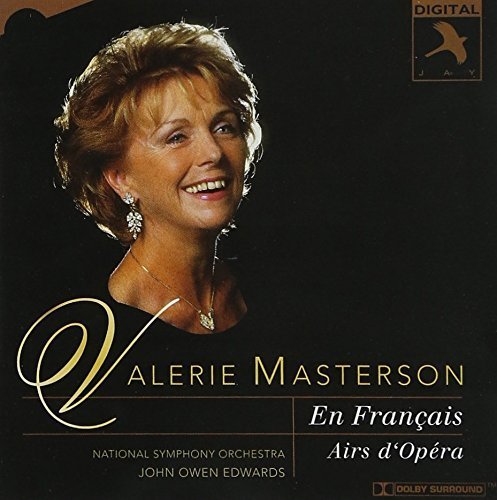
Valerie Masterson – En Français

51jboyyne-l

This is something of an exercise in nostalgia. Valerie Masterson was a mainstay of my opera going in my early days and I saw her quite a few times on stage and in some of the roles she sings on this disc. She was a very beautiful woman with a lovely voice and a charming stage presence and it would have been hard not to fall under her spell. She first came to prominence singing Gilbert and Sullivan with the D’Oyly Carte company, but was soon snapped up by English National Opera, where she sang many of these roles in English. However the French also took her to their heart and she appeared regularly over there too, as well as at the Royal Opera, Covent Garden, where she would have been singing in French and she sings the language very well.

This recital was recorded at three separate sessions in 1991 and 1993 when Masterson would have been in her mid fifties and, though the voice is still beautiful, it is no longer the fresh voice of youth. What a shame she didn’t get to record this material, say, around fifteen years earlier when she sang Matilde to Caballé’s Elisabetta in Rossini’s Elisabetta, Regina d’Inghilterra both in Aix-en-Provence and on record. Two years is a long time when one is nearing the end of one’s career, and it is notable that the arias recorded in 1991 find her in better voice than those recorded in 1993. Still, there is much to enjoy, especially in those roles that Masterson had made very much her own, Manon, Juliette, Marguerite, Louise and Micaëla. The vibrations may have loosened somewhat, but she is mercifullly free of wobble.

Favourite tracks for me were Micaëla’s Je dis que rien m’épouvante, Louise’s Depuis le jour, the brief excerpt from the Saint Sulpice scene in Manon, Margeurite’s Jewel Song and L’Ensoleillad’s lovely little Vive amour qui rêve from Chérubin. To be honest, only in Thaïs’s Mirror Aria, which was recorded at the last sessions, does the beat in the voice start to become distracting and it is notable that she doesn’t take the higher option at the end, whereas a few years before this would have been easily within her voice. Throughout she pays due attention to the text and the mood of each aria, and her voice has its own individual character that I’ve always found instantly recognisable.

The sound is superb, the orchestral conributions under John Owen Edwards excellent, and the booklet comes with texts and translations, an interview with Masterson and stage photos of her looking absolutelty gorgeous as Margeurite, Manon, Juliette and Louise.

So, as I said, a little late for comfort, but still a disc worth hearing for any of us who fell under Masteron’s spell when she was regularly appearing on our stages.
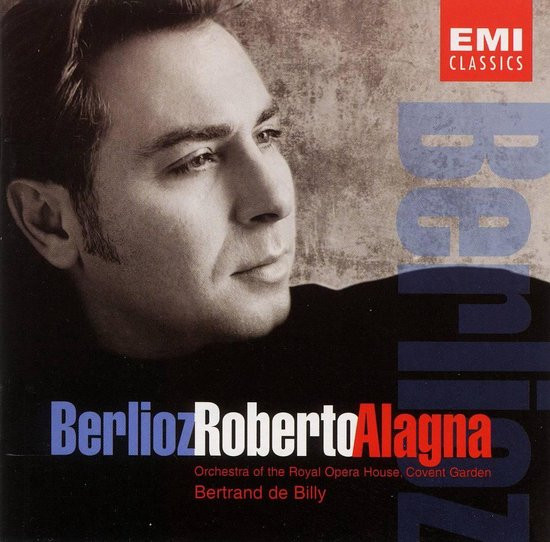
 

Roberto Alagna sings Berlioz

ndctotk3os5qcgvn
An interesting and enterprising recital recorded in 2003, when Alagna was at the top of his game. It’s certainly a pleasure to hear authentically sung French.

As far as I’m aware, Alagna never attempted any of these roles on stage, but, if these excerpts are anything to go by, he’d have made an excellent Faust and Cellini.

Though he negotiates Iopas’s high-lying tessitura well enough, I rather prefer a lighter lyric tenor in this music, and, conversely, I’m not sure he’d have had the heft for Enée on stage. Admittedly I’ve been brought up on the heroic sound of a Vickers here, but the role has recently been taken by Michael Spyres, a tenor with a lighter voice than Alagna. Having heard both Alagna and Spyres live, I’d have said Alagna would be more suited to the role’s demands than Spyres. The few excerpts included here certainly go very well. The excerpt from L’Enfance du Christ is quite charming and direct in its utterance and the Mab scherzo from Roméo et Juliette is suitably deft and witty.

Next come excerpts from La Damnation de Faust, with the addition of a rarity in the shape of a setting for tenor and guitar of Mephisophélès’s serenade, taken from the earlier Huits Scènes de Faust. Alagna is joined by his then wife, Angela Gheorghiu, for the duet Ange adorée, which is sung most beautifully. What a shame he never attempted Berlioz’s Faust on stage.

Like Iopas. Bénédict also probably needs a slightly less beefy voice, but Alagna manages his short aria well enough.

More convincing are the excerpts from Benvenuto Cellini, another role which I would have thought would have suited him well. He was apparently slated to sing it on the Nelson recording, but pulled out for some reason. He may not quite erase memories of Gedda in one of his greatest roles, but, on the evidence of the two arias recorded here (La gloire était ma seule idole and Sur les monts les plus sauvages, his voice had the ideal weight and penetration, not to mention his perfect diction and attentio to the text.

Charming in every way are the excerpts from Lélio, with the addition of texts spoken by Gérard Dépardieu, but Berlioz’s bombastic and over the top arrangement of La Marseillaise, which ends the disc, rather outstays its welcome and was all a bit much for me.

Bertrand de Billy’s accompaniments are all a little too reticent for my liking, and the disc would no doubt have benefited from the presence of a Colin Davis or John Eliot Gardiner in the pit. Nevertheless, if you like Berlioz, and I do, this is a highly enjoyable disc and an excellent reminder of Alagna at his considerable best.