Dame Janet Baker – Philips & Decca Recordings 1961 – 1979

r-10064800-1491163322-4375.jpeg

Dame Janet Baker is without doubt one of the greatest singers of the latter part of the twentieth century, known throughout the world from her recordings and international recitals. Though her range was quite wide, taking in operatic roles from Monteverdi to Richard Strauss, and even embracing the Verdi Requiem and Schoenberg’s Gurrelieder, she was never tempted to sing outside her fach and retired, first from the operatic stage and then from recital work, whilst still at her peak, so that we never saw the slow vocal decline we often hear from great singers. Her Yorkshire firmness of mind and pragmatism also meant that she refused to join the international operatic circus, and in fact only once sang in opera outside the UK (when the Royal Opera took their hugely successful production of La Clemenza di Tito to La Scala, Milan).

This 5 disc set brings together some of the recordings Dame Janet Baker made for Decca, Argo and Philips during the 1960s and 1970s. Though contracted to EMI (and Warner have a pretty exhaustive twenty disc box set of her work for that label, called The Great Recordings), she made a few recordings for Decca/Argo (including her famous recording of Dido and Aeneas) in the early 60s, and then a tranche of recitals for Philips in the 1970s. The range of material here is not quite as wide as that on the aforementioned Warner set, but takes us from 17th century arie through to Britten.

Disc 1 is a selection of what most vocal students would know as Arie Antiche (called here Arie Amorose), accompanied by the Academy of St Martin in the Fields under Sir Neville Marriner. Whilst the somewhat souped-up arrangements can sound somewhat anachronistic today, Baker’s wonderfully varied singing brings each song winningly to life. The disc is rounded off with a couple of arias from Cavalli’s La Calisto recorded shortly after her great success in the role of Diana/Jove at Glyndebourne.

Some of Baker’s greatest early successes were in Handel and Disc 2 is mostly taken up by a superb 1972 Handel recital she made with the English Chamber Orchestra under Raymond Leppard. How brilliantly she charts the changing emotions in the cantata Lucrezia and also in the arioso-like Where shall I fly from Hercules,but each track displays the specificity of her art, the way she can express, on the one hand, the despair in an aria like Scherza infida and, on the other, the joy in Dopo notte, both from Ariodante. The disc is rounded off by a superb 1966 recording of Bach’s Vergnügte Ruh and her incomparable When I am laid in earth from her 1961 recording of Dido and Aeneas.

Disc 3 has excerpts from a 1973 Mozart/Haydn recital and a 1976 Beethoven/Schubert disc, both made with Raymond Leppard, with the addition of arias from her complete recordings of La Clemenza di Tito and Cosí fan tutte under Sir Colin Davis. The two Haydn cantatas (one with piano and one with orchestra) are very welcome, but we do miss her stunning performance of Sesto’s two big arias from La Clemenza di Tito, and her gently intimate performance of Mozart’s Abendempfindung. Fortunately these have been included in a superb selection taken from the same two recitals on the Pentatone label, which includes all the missing Mozart and Schubert items. This disc also includes her recording of Beethoven’s Ah perfido!, a little smaller in scale than some, but beautifully judged none the less. It doesn’t have Callas’s ferocity, it is true, but it is much more comfortably vocalised.

Disc 4 is of music by Rameau (excerpts from her 1965 recording of Hippolyte et Aricie, which well display her impassioned Phèdre), Gluck (arias for Orfeo and Alceste taken from her 1975 Gluck recital) and Berlioz (1979 performances of Cléopâtre and Herminie and Béatrice’s big scene from Davis’s complete 1977 recording of Béatrice et Bénédict). The biggest loss here is of the majority of the Gluck recital, which included many rare items, though the complete reictal was at one time available on one of Philips’s budget labels. Baker is without doubt one of the greatest Berlioz exponents of all time, and the two scènes lyriques are especially welcome. These are fine examples of her dramatic intensity and the range of expression in both is fully exploited.

Disc 5 is of late nineteenth and twentieth century French song and Benjamin Britten; the whole of a disc of French song made with the Melos Ensmble in 1966, excerpts from the composers own recordings of The Rape of Lucretia and Owen Wingrave and the cantata, Phaedra, which was composed specifically for her. The Melos disc includes Ravel’s Chansons Madécasses and Trois poèmes de Stéphane Mallarmé, Chausson’s Chanson perpétuelle and Delage’s Quatre poèmes hindous and is a fine example of Baker’s felicity in French chanson, particularly ravishing in the wordless melismas of Lahore from Quatre poèmes Hindous. The Britten excerpts remind us of her sympathetic portrayal of Lucretia and her unpleasant Kate in Owen Wingrave. The Britten cantata is a great example of her controlled intensity.

Remarkable throughout is the care and concentration of her interpretations. Nothing is glossed over, nothing taken for granted, and she was one of those artists who could bring the frisson of live performance into the studio. Nor do I think she ever made a bad record. I heard her live on many occasions. Hers was not a big voice, but it was one that coud carry to the furthest recesses of a large hall, even when singing pianissimo. Furthermore there was a concentration, and intensity and a gift of communication, vouchsafed to just a few. One of my all time favourite singers.

Maria Callas – Icon

Maria_Callas Icon

This is a slightly edited version of an article I wrote on gay icons for an online gay magazine, so I thought I’d include it in my blog. Please remember to take into account its intended audience.

There may have been divas before Maria Callas, but there is no doubt that the modern idea of what is a diva owes a great deal to the legendary opera singer, who, without ever singing a note of popular music, was as famous during her lifetime as a movie star. Even today, 41 years after her death and over 50 years after she last appeared on stage, her records outsell those of any other female opera singer.

Callas was born in 1923 in a New York hospital to Greek immigrant parents. Her mother, bitterly disappointed not to have had a son, wouldn’t even look at Maria for the first few days after she was born. Maria was an awkward, bespectacled, dumpy child with, in her mother’s eyes, one redeeming feature. She could sing. And, from an early age, Evangelia, Maria’s mother, decided Maria would become a star. No doubt here began the seeds of Callas’s burning desire to succeed, and also, what her record producer Walter Legge called, her superhuman inferiority complex. It was only by singing that she could get approval from her mother. It was a tempestuous relationship, and later they had a very public quarrel, leaving them estranged for the rest of Maria’s life.

41184a04e04b90de3653ed67d1d508c1--maria-callas-opera-singers              12cd6e4320697afc12d98c7e5ccd5bdc

Callas started out as everyone’s idea of the fat lady who sings, but shed 80lbs to become the svelte, elegant, iconic figure we know today, modelling her look on that of Audrey Hepburn. Some say this weight loss was also the reason for her relatively early vocal decline. Paradoxically, the more famous she became, the more her voice let her down, and her brilliance was relatively short, its peak lasting barely ten years, though as American opera star Beverly Sills once said, “Better 10 years like Callas, than twenty like anybody else.” She created a revolution in the staging of opera too, for Callas didn’t just sing, she could act, and it was her burning desire to fulfil all the dramatic demands of her roles, which was behind her decision to lose weight. To her way of thinking, it was crazy to have a fat, healthy looking soprano supposedly dying of consumption.

From the very beginning she caused controversy. Her voice was not conventionally beautiful, but it was better than that. It was a voice like no other, instantly recognisable with an extraordinarily wide expressive range, which she exploited to searingly dramatic ends. It was a large, dramatic voice too, and yet she had the technique to sing roles usually associated with much lighter voices. Those who just wanted to close their eyes and listen to beautiful sounds were jolted out of their complacency, and they didn’t like it. In her early days she enjoyed showing off her versatility, and within a week she alternated one of the heaviest roles in the repertory (Brünnhilde in Wagner’s Die Walküre) with one of the lightest (Elvira in Bellini’s I Puritani). It was a feat unheard of at that time, and she began to be known as the soprano who could sing anything. The traditionalists didn’t like it and battle lines were drawn.

From 1951 until 1958 she was the reigning queen of La Scala, Milan and Luchino Visconti, lured into opera by the prospect of working with her, here mounted some of the greatest opera productions ever in operatic history. It was also at La Scala that she worked with Franco Zeffirelli for the first time, and with conductors such as Victor De Sabata, Carlo Maria Giulini, Herbert von Karajan and Leonard Bernstein. It was a period of amazing artistic achievement, and tenor Jon Vickers, often referred to Callas as one of the people most responsible for the revolution that occurred in opera after the second world war, rescuing it from the fustian stand and deliver concert in costume it had become, and creating living, breathing theatre. The La Scala audience was never an easy one, and she often had to deal with hostility from it, but, such was her genius, she could usually win a hostile audience over by the end of the evening. She was definitely a fighter.

8aec16d6efb7ee6115c2f30e90a2351a

The Callas myth is very much one made by the media. Her musical genius is often lost amongst the details of her private life and the scandals attached to it. The media concentrates on the occasional cancellations, the rows with opera managements, and often forgets the genius which made her a star. They build a picture of the capricious, temperamental, demanding opera singer, which, though partially true, tends to ignore the fact that she was intensely professional, dedicated and respected by most of the musicians she worked with. Her outbursts were usually brought about by what she saw as unprofessionalism. Unlike many divas who flounce in, do their bit and flounce out, Callas was often the first to arrive at rehearsal and the last to leave. She lived for her art. That is, until Aristotle Onassis arrived on the scene. Callas stupidly, blindly, fell in love and from that moment the media hardly ever left her alone.

When she met Onassis, she was still married to a man 51 years older than her, Gian Battista Meneghini. She married him shortly after she arrived in Italy in 1947, still only 23, overweight and gauche, and he had provided inestimable support in the early days of her career. By the time she met Onassis she was a very different person, svelte and elegant, and used to mixing with the artistic elite. Onassis, still married himself, was as taken by her fame as by her beauty and determined to make her his own. Callas, the ugly duckling who became a swan, was flattered by his attention, and became his mistress. She practically gave up her career for him, believing that one day they would marry, until, devastatingly, he married Jackie Kennedy instead. After the affair, Callas did try to pick up the threads of her career, but, along with the growing problems she was having with her voice, much of the fire had gone. During the Onassis years, she severely curtailed her engagements, attempting a comeback in 1964, after Onassis’s marriage. She agreed to appear in two new Zeffirelli productions to be shared with Covent Garden and the Paris Opéra, Tosca and Norma. Though the London performances of Tosca scored her an enormous personal success, the Normas in Paris went less well, and when she returned to the role there in 1965, the final performance of the run was abandoned, as Callas was simply too exhausted and unwell to continue. Later that year she made her final ever appearance in opera at a royal gala performance of Zeffirelli’s Tosca at Covent Garden, the only performance of the scheduled run she felt well enough to sing. She was singing against doctor’s orders, and even then only on condition that she sing only that one performance.

After that she lived as a recluse in Paris, occasionally attempting to revive her career. She played the role of Medea in Pasolini’s non-operatic film. Though her performance was enthusiastically greeted by the critics, the movie was not a commercial success, and she made no further pursuits in the direction of a movie career. She also gave a series of public master classes at the Juilliard in New York (the basis of Terrence McNally’s play Masterclass), and had an unsuccessful attempt at directing, with tenor Giuseppe di Stefano, at the Turin Opera. She was, by this time, in a relationship with Di Stefano, and, probably unwisely, agreed to embark on a world concert tour with him, at which they would sing duets and arias, accompanied by piano only. She had only just turned 50, but her voice was a pale shadow of itself. Only too aware of her shortcomings, she wryly noted how the critics were being much kinder to her then, than they were years ago when she was singing brilliantly. Audiences, though, went mad, screaming for more, besieging the stage with floral tributes, as if finally acknowledging now, in her ruin, the great star that she was.

When the tour came to an end, she holed herself up in her Paris apartment. She never stopped loving Onassis, for all that he treated her so badly. They secretly revived their friendship, though, according to her secretary, Nadia Stancioff, she flatly refused to have any kind of physical relationship with him after he married Jackie. After he died, it was as if all the fight was knocked out of her. Conductor Jeffrey Tate, who was working with her at this time (she never completely gave up the idea of a comeback), felt that she simply gave up living.

She died in 1977 at the age of 53 in circumstances that are still unexplained. Officially she died of a heart attack, but she was on so many uppers and downers by then, that some think it may have been an accidental overdose. Whatever it was, dying young certainly contributed to her legendary status.

Nowadays she continues to enthral and inspire, and her influence goes far beyond the opera house. Aside from the aforementioned Masterclass, Terrence McNally also wrote a play The Lisbon Traviata (taking its title from an at that time unavailable live recording of Callas singing La Traviata in Lisbon), which focuses on two of McNally’s pet subjects; gay relationships and the gay man’s love of opera. During her lifetime she was something of a fashion icon, having fabulous gowns designed for her by Milanese designer Biki, by Pucci, Fendi and Yves St Laurent. Not so very long ago Dolce and Gabbana produced t-shirts with her image on them for their 2009 collection, and recently American designer Zac Posen based an entire collection on costumes Callas wore in Argentina in her early years, and a couple of years ago, Mark Jacobs incorporated  images of Callas onto his designs of capes, t-shirts and bags.

In the world of film her records are frequently used on film soundtracks. Most recently it is the voice of Callas we hear singing Casta Diva in The Iron Lady.  Marvel’s Bruce Banner (the Hulk) listens to her version of the same aria in The Avengers movies and Gus van Sant used her recording of Tosca as a backdrop for much of his brilliant Milk. And who could possibly forget that scene in Philadelphia, in which Andrew Beckett (played by Oscar winner Tom Hanks) attempts to explain to his lawyer, Joe Miller (Denzel Washington), what opera means to him? As Maria Callas’s recording of La mamma morta from Giordano’s Andrea Chénier begins softly in the background and then swells to fill the theatre, Andrew translates the words and conveys the passions and emotional meanings behind this operatic excerpt.

“I am divine, I am oblivion, I am love. “

No wonder the Italians called her La Divina. After her death, baritone and colleague Tito Gobbi, said

“I always thought she was immortal, and she is.”

The Callas Karajan Lucia di Lammermoor – Berlin 1955

81ABZEPHN2L._SL1500_

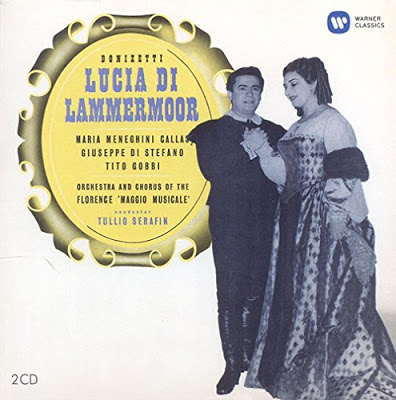
Moving on through the Live Warner Callas box, we come to the legendary night on which she sang Lucia at the Berlin State Opera.

Callas first sang Lucia in Mexico in 1952 and caused such a sensation that she completely changed people’s attitudes to the role. The following year she sang the role again in Florence, Genoa, Catania, Rome, and it was one of the roles she chose for her American debut at the Chicago Opera House in 1954. Also in 1954 she appeared for the first time in Karajan’s La Scala production, which he subsequently took to Berlin in 1955 and to Vienna in 1956, and all those iconic photos of Callas wearing that long, pleated nightdress are taken from this production.

To understand what a sensation the Callas/Karajan Lucia di Lammermoor wrought, one has to remember that, back then, the opera was considered no more than a silly Italian opera, in which a doll-like light voiced coloratura got to show off her high notes and flexibility. That a conductor of the calibre of Herbert von Karajan, famed for his Beethoven and Brahms, was taking it seriously caused people to reassess their perceptions. There is a charming story of Toti dal Monte, an erstwhile famous Lucia herself, visiting Callas in her La Scala dressing room, tears streaming down her face and confessing she had sung the role for years without ever realising its dramatic potential. Indeed it is pretty safe to say that without Callas’s Lucia, Sutherland’s career might never have taken the trajectory it did.

Apparently, though Callas loved making music with Karajan, she hated his production with its dark, murky projections and backdrops. However Zeffirelli thought that he got it just right. In the mad scene, Karajan lowered all the lights and just put a follow spot on her, which, as Zeffirelli stated, was all you had to do with a Callas. Karajan simply allowed her to become music.

Berlin was in a high state of excitement when Karajan took the La Scala production there in 1955, and, as can be heard on this recording of the event, the audience can hardly contain their enthusiasm. Desmond Shawe Taylor reviewed it for Opera magazine.

I dare say she will never sing better than she does now; there is Greek resin in her voice which will never be quite strained away; she will never charm us with the full round ductile tone of Muzio or [Rosa] Raisa or Ponselle. But she has sudden flights, dramatic outbursts of rocketing virtuosity, of which even those more richly endowed singers were hardly capable

His words now seem prophetic as 1955 could well be seen as the apex of Callas’s career. It was the year of the Visconti La Sonnambula and La Traviata, the Zeffirelli Il Turco in Italia, the Chicago Il Trovatore with Bjoerling, the year she made seminal recordings of Rigoletto with Serafin and Madama Butterfly  with Karajan (not universally well received at the time, but now considered a classic), and she closed the year with what many consider her greatest ever performances of Norma, at La Scala with Simionato and Del Monaco, mercifully preserved in sound and best heard in its Divina Records transfer.

The sound of this Berlin broadcast has always been one of the best of all Callas live performances and this Warner transfer, which is from a different source to the EMI one, is very clear, with very little distortion and only a hint of pre-echo. Furthermore, where EMI were somewhat parsimonious with the applause, Warner have left more of it in, which makes more sense of the encored Sextet. This is certainly one of those cases where the side show is almost as gripping as the show itself.

Callas did of course record the role of Lucia twice in the studio under Serafin. The first, in 1953, was her very first recording for EMI and the second, made in 1959, was the first of the four operas she re-recorded in stereo, a set I have a certain affection for it as it was the recording that introduced me to the opera when I was still in my teens. However, if I want to listen to the opera, it is invariably to this live recording with Karajan at the helm to which I turn.

Callas’s rare collaborations with Karajan always reaped gold, and it is greatly to be regretted that they didn’t work together more often. It was a symbiotic relationship and one can hear in this performance how Karajan appears to breathe with her, giving her ample room to spin out the phrases. However, with two such egos, the relationship was never going to be completely harmonious. Callas was apparently furious with Karajan for granting the Berlin audience an encore of the Sextet, meaning that she had to do twice the work before her Mad Scene; so furious that she turned her back on him during the Mad Scene. Years later, when she met him again, she said to him, “What was it you did when I was so bitchy and turned my back on you in the Mad Scene? I knew you were clever. But the accompaniment was so perfect, I decided you were not only a genius, you were also a witch.” “It was very simple,” Karajan replied, ” I watched your shoulders. When they went up I knew you were breathing in, and that was my cue for attack.” Callas, being something of a witch herself, no doubt knew that was only part of the story.

There is no doubt that Callas’s voice is lighter, more airy, than it was in any of her Lucias up to now. How much this had to do with the shift in repertoire, the weight loss or Karajan’s input is a moot point, but her singing is unfailingly lovely, with phrases drawn out to prodigious lengths, spinning them out the way a master violinist might play their violin.

From the outset Callas presents us with a highly-strung, romantic dreamer, a young girl, who would no doubt have been closeted and protected from the real world. Her first solo is sung with wonderful delicacy, the line deliciously drawn out and beautifully held at Karajan’s expansive tempo. As so often with Callas, there is no artifice to her singing, nor any sense of the routine, the music sounding as if it has sprung newly minted from her lips.

How typical that the first climax of the scene, should not be the aria itself, beautifully though it is sung, but a line of recitative that follows, with Lucia’s simple affirmation of her love for Edgardo (Egli e luce a’ giorni miei) just before she launches into the cabaletta Quando rapito in estasi, which is sung with lovely rhythmic buoyancy.

In the ensuing duet with Edgardo, she is all sweet concern, her phrases pouring balm on Edgardo’s troubled utterances, but we get a glimpse of the slightly unhinged Lucia, when, in a voice peculiarly quivering with intensity, she sings Ah no! rimango nel silenzio sepolto per or l’arcano affetto.

Verrano a te sull’aria is sung with prodigious breath control, the legato line spun out to wondrous effect. Di Stefano is here at his honeyed best, and Karajan provides subtly supple support, a superb example of artists listening to each other and working together.

The second act is the turning point for Lucia. In the face of such cruelty from her brother, this is the moment she starts to lose her reason, and you can hear in Callas’s voicing of the words Ahi!.. La folgore piombo! that the poor girl is at the end of her tether. Soffriva nel pianto is almost unbearably moving, as Callas digs deep into its melancholy.

In the following scene, she seems almost to be sleepwalking, until she falls apart completely when Edgardo suddenly appears and condemns her seeming treachery. The whole of this scene is dramatically thrilling, from the superbly sung (and encored) Sextet through to the knife-edge finale, where Karajan has opened up some of the cuts usually made in previous Callas performances.

The Mad Scene is, as it should be, the apex of Callas’s performance. So supple, so exquisite is her singing, that the voice seems to hover in mid air, and she literally seems to be extemporising on the spot. Certain phrases (Alfin son tua, for instance) are so firmly etched on my consciousness that any other singer seems just to be skimming the surface. The miracle is that she can execute all the vocal tricks of the coloratura soprano with such accuracy and skill, whilst at the same time making musical and dramatic sense of the notes. As ever, Karajan provides impeccable support.

We are lucky that such a superb cast was assembled; Di Stefano is at his considerable, lyrical best as Edgardo, Panerai terrifyingly single minded and relentlessly evil as Enrico, and Zaccaria a mellifluous and sympathetic Raimondo.

Aside from the cuts opened up in the Act II finale, the opera is unfortunately cut in the manner traditional back then. However the recording is nonetheless absolutely essential listening, not only for Callas fans, but for all lovers of Italian opera.

Edited to add that I have just acquired the Divina Hi-Res download of this performance and the sound is amazing, much better than in any other version I have heard and easily as good as the EMI studio recording of 1953. Forget Myto or Warner. This is the one to have.

dvn019_l

Callas’s 1952 La Gioconda

71rm8ukuydl-_sl1500_

Recorded 6-10 September 1952, Auditorium RAI, Turin

Producer & Balance Engineer unknown

Callas’s first ever complete studio recording was made for the Italian firm Cetra in 1952, before she had signed with EMI. The role of Gioconda had furnished her with her Italian debut in 1947, and was the occasion she met two of the most important men in her life, her mentor Tullio Serafin and her future husband Battista Meneghini. Paradoxically she would make her second recording of the opera at the time of her affair with Onassis, and when she was separating from Meneghini.

When Callas recorded La Gioconda for Cetra she was still a large lady and at her vocal peak. It was recorded just a couple of months before she made her spectacular debut at Covent Garden in Norma and shortly before her only series of performances as Lady Macbeth at La Scala, a role one wishes had figured more in her career. She then went on to sing Gioconda at La Scala, her last performances in the role until the EMI recording in 1959.

Given the sheer animal power and massive, freewheeling brilliance she could command at this stage in her career, you would think this Cetra recording would, in all but matters of sound, win hands down over the later one, recorded seven years after when her vocal powers were failing, but I’m not sure it’s that simple, and, whilst listening to this one, there were quite a few passages where I found myself hankering after the later recording. True, the singing is often magnificent, and it is easy to be swept away by the coruscating force of her delivery, but I find myself missing some of the refinements she has made by the time of the second recording. This may be a controversial opinion, but this one seems to me to be a series of thrilling highlights, whereas the characterisation on the EMI set feels more of a piece, with a cumulative power I don’t get here, for all the added security of her voice; and actually there are certain, purely vocal moments, she manages better on EMI than she does on Cetra (the pitfalls of Ah come t’amo, the E un di leggiadre section from Suicidio, the whole of the section after she gives Laura the sleeping draught, for instance).

As against that, I should also state that her performance of Suicidio here completely floored me when I first heard it. I had no idea a female voice, a soprano at that, could sing with such passion, could have such powerful chest notes. It was absolutely staggering and one of the things that first turned me on to the genius of Callas in the first place. If I later got to know the opera better from the EMI recording and place that at a slightly higher level of achievement, it is none the less  a close-run thing.

The Warner engineers have done a great job of the re-mastering and it sounds much better than I remember it from my previous CDs, though obviously not so good as the stereo EMI set. One also misses the greater refinement of the La Scala orchestra and chorus.

As for her colleagues, it is largely a case of swings and roundabouts. Barbieri is a much more positive presence than the young Cossotto as Laura, but none of the men on either of the sets are particularly good. Ferraro on EMI isn’t very subtle, but he certainly makes a pleasanter sound than the awful Poggi. Honours are about equal between Silveri and Cappuccilli, Neri and Vinco. Votto’s conducting isn’t much different in the two sets, and remains some of his best work on disc.

One thing is for sure, Callas as Gioconda is an absolute must, and, regardless of any reservations surrounding her colleagues or recording quality, eclipses every other performance of the role on disc.

Callas’s 1953 Studio Lucia di Lammermoor

51252bkyvtf8al

Recorded 29-30 January, 3, 4 & 6 February 1953, Teatro Comunale, Florence

Producer: Dino Olivieri, Balance Engineer: Osvaldo Varesca

Of all the roles Callas sang, it was probably Lucia which created the biggest furore. Back in the early 1950s, nobody took the opera very seriously. It was considered a silly Italian opera in which a doll-like coloratura soprano ran around the stage showing off her high notes and flexibility. There is a hilarious description of the characters in E.M. Forster’s Where Angels Fear To Tread attending a provincial performance of Lucia di Lammermoor. Here he describes the prima donna’s first entrance.

Lucia began to sing, and there was a moment’s silence. She was stout and ugly; but her voice was still beautiful, and as she sang the theatre murmured like a hive of happy bees. All through the coloratura she was accompanied by sighs, and its top note was drowned in a shout of universal joy.

For anyone who loves opera or Italy, I heartily recommend this self-mocking tale of the English abroad.

But back to Callas, who first sang the role of Lucia on stage in Mexico  in 1952. A few months earlier she had sung the first part of the Mad Scene at a concert in Rome. After Mexico, she would sing it in Florence, Genoa, Catania and in Rome before appearing in Karajan’s legendary production at La Scala at the beginning of 1954, a production that subsequently travelled to Berlin (one of her most famous recorded live performances) and Vienna.  It was also one of the roles she chose for her U.S. debut in 1954 in Chicago and at the Met in 1956. Her last performances of the role were in Dallas in 1959 (in the same Zefirelli production that made Sutherland a star at Covent Garden) and she made two recordings of the opera;  this one in 1953 in Florence, shortly after stage performances there and the second in 1959 in London. After Norma, Violetta and Tosca it is the role she sang most often, so it is hardly surprising that she is so much associated with it.

Back in the 1950s it must have seemed unthinkable that such a large voice could tackle the role, and not only sing it, but sing it with such accuracy and musicality, giving the opera back a tragic intensity that people had forgotten, or didn’t even know,  was there.  There is a touching story of Toti Dal Monte, an erstwhile famous Lucia herself, visiting Callas in her dressing room after a performance, tears streaming down her face, and confessing she had sung the role for years without really understanding its dramatic potential.

From Callas’s very first notes, she presents a highly-strung, nervous character, but sings with impeccable legato, all the scales and fioriture bound into the vocal line, the tone dark, but plangent, expressive but infinitely subtle. Regnava nel silenzio is a model of grace, but she still manages to invest the words di sangue roseggio with a kind of horror, whilst never resorting to glottal stops or other verismo tricks. She understands that with bel canto it is the arc of the melody, of the musical line that is paramount.

And so it continues, with her consolatory Deh ti placa in the duet with Di Stefano’s Edgardo, a duet of musical contrasts, in which Callas’s Lucia is at its most feminine. The duet with Gobbi, their first encounter on disc together, is also full of contrasts, and Gobbi makes a much more interesting villain than Cappuccilli in her second recording, finding a range of insinuating colour that his younger colleague doesn’t even hint at.

The Mad Scene is a miracle of long breathed phrases, with such lines as Alfin son tua heartbreakingly expressed, and of course here there are none of the problems with the top Ebs that we get in the second recording.

Di Stefano is more suited to Edgardo than he would be to Arturo in I Puritani, which was recorded soon after, and he is much to be preferred to the over-the-hill Tagliavini on the second recording. Serafin conducts a tautly dramatic version of the score.

The sound on this Warner issue still tends to distort and crumble in places. I guess that must be on the master, but the voices ring out with a little more truth.

Of course both Callas and Di Stefano can be heard together in the famous 1955 Berlin performances under Karajan, in sound which is not much worse than this, and that recording would still be my first choice amongst Callas’s Lucias, for all that she eschews the first Eb in the Mad Scene. Under Karajan’s baton and in a live situation she sings with effortless spontaneity, almost as if she is extemporising on the spot.

Still this first Callas studio recording is the one that got people talking and the one that quite possibly changed opinions about bel canto for many years to come. As such it has a historical significance which should never be forgotten.

Callas in I Puritani

r-12800357-1542200837-6181.jpeg

Recorded 24-30 March 1953, Basilica di Sant’Eufemia Milan

Producer: Dino Olivieri, Balance Engineer: Osvaldo Varesca

I Puritani, Callas’s second opera for EMI was the first recorded under the imprimatur of La Scala, an association which would result in eighteen further opera sets over a period of seven years.

No doubt because of the circumstances surrounding her first Elvira (she learned it in 3 days to replace an ailing Margherita Carosio whilst still singing Brunnhilde in Die Walkure) and because of her famed recording of the Mad Scene, one would expect the role to have played a greater part in her career, but in fact after those first performances in Venice in 1949, it figured rarely in her repertoire.

She sang it again in Florence, in  Rome and  in Mexico in 1952, and in her second season in Chicago in 1955, then never again, though the Mad Scene did occasionally appear in her concert programmes, even as late as 1958 at  a Covent Garden Gala. A recording of her rehearsing the scene for her Dallas inaugural concert in 1957 exists, and shows her still singing an easy, secure and full-throated high Eb.

Maybe the reason she sang it so little is that Elvira offers less dramatic meat than Lucia or even Amina. The libretto is something of a muddle and Elvira seems to spend the opera drifting in and out of madness. Of course she gets some wonderful music to sing, and Callas certainly breathes a lot more life into her than most singers are able to do. She also gives us some of her best work on disc, her voice wonderfully limpid and responsive, the top register free and open. No doubt this is the reason it has remained one of the top choices for the opera since its release over 6o years ago.

We first hear her in the offstage prayer in Act I Scene I, and straight away there is that thrill of recognition as her voice dominates the ensemble. Then in the scene with Giorgio, she finds a wide range of colour, a weight of character, that we don’t normally hear. Her voice, laden with sadness for her first utterances, then defiant when she thinks she is to be wed to someone she doesn’t love, is fused with utter joy when she realises that it is Arturo she is going to marry. She skips through the florid writing with lightness and ease, but invests it with a significance that eludes most others. One moment that stood out in relief for me was her cry of Ah padre mio when Arturo arrives, which bespeaks the fullness of heart that is the main characteristic of this Elvira. Son vergin vezzosa is a miracle of lightness and grace, Ah vieni al tempio heartbreakingly real, though her voice does turn a little harsh when she doubles the orchestral line an octave up.

The Mad Scene needs little introduction. It is one of the most well-known examples of her art out there, the cavatina moulded on a seemingly endless breath; and where have you ever heard such scales in the cabaletta? Like the sighs of a dying soul. The top Eb at its climax is one of the most stunning notes even Callas ever committed to disc, held ringingly and freely without a hint of strain. Words fail me.

She has less to do in the last act, which mostly belongs to the tenor, and this is where I have a problem with the set. Di Stefano is nowhere near stylish enough in a role that was written for the great Rubini, and he lurches at every top note as if his life depended on it. Sometimes the notes sound reasonably free, at others he almost sounds as if he’s holding onto them with his teeth. Mind you, who else was there around to sing it any better at that time? The recording was made too early for Kraus, though Gedda might have been a good idea. After all, he was already singing for EMI by then, and would sing Narciso on Callas’s recording of Il Turco in Italia, which was recorded the following year..

Rossi-Lemeni  is less woolly-toned than I remember him and sings with authority, especially good in the first act duet with Callas; Panerai is a virile presence as Riccardo. Serafin conducts with his usual sense of style, but also invests some drama into the proceedings.

The orchestra and voices sound really good, but the recording of the chorus is a bit muddy. Presumably that was also the case on the original LPs.

I do have a few problems with I Puritani. To my mind the libretto is plain silly, and even Callas’s wonderful singing can’t quite rescue it. That said, as singing qua singing, it’s some of the most amazing work she ever committed to disc, and for that reason it will always be a permanent part of gramophone history. I would never be without it.


Callas’s 1953 Studio Tosca

91ntirq8gdl-_sl1500_

Recorded 10-21 August, 1953, Teatro alla Scala, Milan

Producer: Walter Legge, Balance Engineer: Robert Beckett

What can one say about this famous recording of Tosca that hasn’t been said before? It regularly appears in lists of the greatest recordings ever made, and it seems now that its legendary status is confirmed.

Because of it, Tosca has often been considered the quintessential Callas role, but, though she sang it a fair amount in her early career, she pretty much ignored the role after this recording, until it became the vehicle for her operatic comeback in London in 1964. Indeed she never sang it, or any other Puccini role, at La Scala, which was her cultural home at the height of her career. A few months after making this recording she sang the role at a couple of performances in Genoa, then promptly ignored it, except for her two seasons at the Met in 1956 and 1958. In 1964, Zeffirelli managed to get her to choose it as the vehicle for her comeback, but, typically for her, she would only agree if they could do Norma as well, which he staged for her in Paris.

The Zeffirelli production, which was shared by Paris and London, became one of the most famous in operatic history (and in fact Covent Garden only retired it a few years ago). Indeed one could say the photos of Callas in that red velvet dress she wore in Act II have since become iconic, even though Callas herself often voiced her disdain for both the opera and the role.

True, it may not have offered her the vocal challenges of Norma or Medea, of Violetta or Lady Macbeth, but in 1953 her voice was an amazingly limpid and responsive instrument, enabling her to easily encompass its demands, whilst rendering the score with an accuracy the likes of Tebaldi and Milanov could only dream of. Take, for instance, the lightness and grace with which she sings a line like le voce delle cose in Non la sospiri la nostra casetta. Most Toscas are clumsy here, but Callas sings it with elegant ease. Furthermore at this stage in her career, she can swell the tone to a refulgent climax at Arde in Tosca un folle amor, which she can’t quite manage by the time of the second recording, which was recorded around the same time as the London and Paris performances.

Interestingly, though, in terms of interpretation, there are not that many differences between Callas’s Tosca of 1953 and 1964; a few minor details here and there, but for the most part the character of Tosca is as musically finished here as it was to be histrionically in Covent Garden. Though Zeffirelli may have helped her with odd bits of stage business, it seems sure that her conception of the character had changed little in the intervening years. The main differences are vocal, and here she rides the orchestra with power to spare, the top Cs, that emerged as little more than shrieks in 1964, full throated and solid as a rock. Vissi d’arte (which Callas used to say should be cut as it held up the action) is both beautiful and heart-rending. So it is in 1964, but the ending taxes her to the limit there, whereas here it is full throated and easy.

Of course there are other reasons why this set has retained its place as the best of all Tosca recordings. Gobbi is also in fuller, securer voice here than he was in 1964, and his loathsome, reptilian Scarpia is a towering achievement. As usual, he and Callas strike sparks off each other, their confrontations bristling with tension. Di Stefano, who also appears on the first Karajan recording, is here in his best voice, an ardent, youthful and passionate Cavaradossi. Both duets with Callas are erotically charged affairs, as they should be.

Then of course, there is De Sabata on one of his rare excursions to the studio. The La Scala orchestra play superbly for him, and he unerringly paces the score just perfectly, with a sure sense of the work’s inner impetus, his use of rubato  brilliantly controlled. In a performance such as this, the one true winner is Puccini.

Sonically it is surely the best of all Callas’s studio mono sets from La Scala. One hardly notices the lack of stereo; voices are perfectly placed and the orchestra sounds richer and more full-bodied than was often the case. This transfer has also corrected some of the errors that crept into previous CD incarnations, not least the terrible GROC version.

Still the Tosca to have, and blow stereo digital sound.

Callas’s Studio La Traviata

81bx7aswvql-_sl1500_

Recorded September 1953, Auditorium RAI, Turin

Producer & Balance Engineer: Unknown

In one sense it’s a shame this Cetra recording of La Traviata was ever made. Had it not been, Callas would have been the Violetta on the Serafin La Scala recording with Di Stefano and Gobbi instead of Stella. Her contract stipulated that she could not re-record the role for 5 years. Legge presumably felt he couldn’t wait any longer to add a recording of such a central Italian classic to his catalogue.

Whatever the reasons, Callas was furious with Legge for engaging Stella and with Serafin for conducting it without her. For a while she and Serafin didn’t speak and he is notably absent from her recording schedule for the following year, 1956.

In retrospect maybe Legge should have waited till Callas was free to record Violetta again in 1958, the year of Callas’s most searchingly complex stage performances in the role (Lisbon and London). Had he done so EMI would no doubt have had the best-selling La Traviata of all time. As it is, the Stella recording was never a big seller, and only received a CD issue, when Testament unearthed it some years ago. Bad call, Walter.

Of all the roles in Callas’s repertoire, it was Violetta that went through the greatest transformation from her debut in the role in 1950, through the famous Visconti production at La Scala in 1955 to those last, movingly poetic performances in 1958 in Lisbon and London. It was the role she sang most often after Norma, and the role she most often considered for a comeback. There were discussions of a recording for EMI even as late as 1969, when, vocally, it would have been out of the question. Callas considered it very much her role, that of the woman who gave up everything for love. Maybe there was a parallel here with her own life. Didn’t she give up everything for love?

This recording of La Traviata was the first one I owned and the first of her Violettas I heard. It wasn’t that easy to get hold of, and my copy was a reissue on Pye Ember. I had no idea of the existence of any of the live recordings, and, had I never heard any of them, I would no doubt have been happy enough with her Violetta, as recorded here, though not necessarily with its surroundings. Compared to her EMI releases, this is a decidedly provincial affair. Santini’s conducting is leaden and neither Albanese as Alfredo nor Savarese as Germont are in the first rank. But at least we have Callas, and, if not as subtle or as heart-rending as she was to become, she is still a great Violetta, and still better than anyone else in the role.

The demands of the first act are more easily encompassed here than they were to become in later performances, though the top Cs in Sempre libera seem slightly tense, as does the concluding Eb. Still it’s freer and more open here than it is in any of the later sets and scale passages are wonderfully fluid. She is tremendously affecting in the duet with Germont, and fails here only in comparison to her later self. Other than this, her traversal of the role is not as complete as it is later to become. There are plenty of affecting moments to be sure, some in the duet with Germont, (the desperation with which she sings Non sapete, for instance) and especially the farewell to Alfredo with the lead up to Amami, Alfredo which seethes with that intensity so peculiar to her. In the second scene the great arching phrase, Che fia? Morir mi sento is too much of an outward sentiment as is Alfredo, Alfredo, di questo core, beautifully though they are sung.

Act III has its moments too. Addio del passato ends on a much more secure pianissimo high A than we get at Covent Garden, but how much more moving is that thread of tone with which she ends the aria in London. Parigi o cara is saddled with  Santini’s leaden conducting, but Gran Dio morir si giovane strikes the right note of despair and Prendi quest’e l’immagine is eloquently moving, if not so eloquent as it was to become.

In short, if no other recording of Callas as Violetta existed, this would be my first choice for the opera. But the fact of the matter is that by 1958, she had refined her interpretation so much that this 1953 performance seems unfinished beside it, almost like a rehearsal for the main event.

Furthermore, in both Lisbon and London, she has a better supporting cast and conductors, and the sound, in London at least, is excellent. I was pleased to hear this performance again, and delighted to have it once more in my collection. Callas’s Violetta, in any of its incarnations is a major achievement after all, but I know it is still to Covent Garden that I will most often return.

I might just add that Warner have done wonders with the sound compared to what I remember of my rather muddy Pye Ember LP version.

Callas’s 1954 Studio Norma

91q5ogwsokl-_sl1458_

Recorded 23 April & 3 May 1954, Cinema Metropol, Milan

Producer: Walter Legge, Balance Engineer: Robert Beckett

Callas’s greatest role was Norma, the one that she sang more than any other, and one of three operas she recorded twice.

Though I did have this version on LP (when it was reissued in the 1970s), I never had it on CD. The 1960 version was one of the first LP opera sets I ever owned, and, not surprisingly, became one of the first I owned on CD. Later I acquired an Arkadia issue  of the live 1955 La Scala, which I eventually replaced with the Divina Edition one of the same performance. As this was the Norma I most often pulled down off the shelf, I decided I didn’t really need another, so never got round to getting this 1954 recording on CD.

First impression on this set was the sheer presence of the voice. When Callas commandingly sings Sediziose voce she could almost be in the room with you and in fact the sound all round, orchestra and voices, is a lot better than some of the later operas; much less boxy with a real sense of presence. The second (in stereo) is better still of course, but the difference is relatively slight.

So how else does this compare to the second set, which I have already lavished such praise on? Well let’s start with the rest of the cast. Fillipeschi is, let’s face it, second-rate, and nowhere near as good as Corelli, his basic tone is thin and whiney and anything that requires any rapid movement finds him lacking, not that Corelli is much better in this respect, mind you, but there is the clarion compensation of his actual voice. Also I’m afraid I find it hard to join in the general round of praise for Stignani. Though the voice retains its firmness, she sounds too mature by this stage in her career, more like Callas’s mother than the innocent, young priestess she is supposed to be. Considering she was 20 years Callas’s senior at the time, it’s hardly surprising. Nor is her voice anywhere near as responsive as Callas’s, or as accurate, but then whose is? Not Ludwig’s, certainly, but I much prefer her more youthful timbre and her voice blends remarkably well with that of Callas; an unlikely piece of casting that paid off. Rossi-Lemeni’s tone tends to be woolly, but he is an authoritative Oroveso, more so than Zaccaria, whose tones are, however, more buttery.

As for Callas, there is no doubt that she is much more able to encompass the role’s vocal demands in this recording than the later one. I do miss certain more tender moments in the 1960 recording. Her entrance into Mira o Norma (Ah perche, perche), beautifully and touchingly understated is more moving than it is here, and in fact the whole duet works better with Ludwig, but when clarion strength and security are required then this set wins hands down. One might say we get more of the warrior in this one and more of the woman in the second. Given the security and power she evinces here, it seems strange that she does not take the high D at the end of Act I, as she did at previously preserved live performances, and as she would do again the following year in both Rome (also under Serafin) and Milan. It might seem a relief that she doesn’t attempt the note in 1960, but here I missed it.

Both recordings are essential of course. No other Norma in recorded history has come within a mile of her mastery of this role, the most difficult in the repertory according to Lilli Lehmann, and the one she sang more than any other. I am willing to believe that Pasta and Malibran were every bit as great, but I cannot believe they would have been better. I am indebted to John Steane yet again for putting things in a nutshell when he suggested that for Norma with Callas, one should go for the second recording, but for Callas as Norma, the first. Personally I’d want both, as the second, for all its vocal fallibility, searches deeper. I would also add the live 1955 from La Scala, the one in which voice and art find their purest equilibrium, and the one I would no doubt  be clinging to if ever shipwrecked on that proverbial desert island.

Callas as Nedda in Pagliacci

51hyylyexul

Recorded 12-17 June 1954, Teatro alla Scala, Milan

Producer: Walter Legge, Balance Engineer: Robert Beckett

Nedda was the first of four roles Callas recorded in the studio, but never sang on stage, the others being Mimi, Manon and Carmen. Pagliacci is really the tenor’s opera, and one can imagine the role would have held little interest for her on stage, though, as is her wont, she makes a great impression in a role one wouldn’t readily associate with her.

Back in the 50s, Nedda was usually played by a light-voiced soubrette, who, if she provided any characterisation at all, would play her as a two-dimensional heartless little minx, so how like Callas that she should look inside the music and find more facets to Nedda’s personality.

Her very first words Confusa io son strike a note of fear, justified  when she sings of Canio’s temper (brutale com egli’e) and note the accent she gives to the word brutale. She shrugs off her fear, but in her singing of the ensuing aria, with its paean to freedom, it is not difficult to understand that here is a young woman bursting with life but trapped in a loveless marriage with a man prone to violence.

The scene with Tonio, like all Callas’s collaborations with Gobbi, bristles with drama and life. Here it would seem is another man trying to subjugate her to his will, but her relationship with Tonio is different. Here she has the upper hand. At first mockingly dismissive, she taunts him until he responds with violence; but here too she retains the upper hand, lashing out both vocally (Miserabile!) and physically with the whip. Left alone she expresses her distaste with a voice dripping with loathing, only to change in an instant when she lovingly sings the single word Silvio as her lover makes his appearance.

The duet with Silvio is erotically charged, suffused with warmth and passion, then in the ensuing confrontation with Canio, defiant in the face of fear, her voice hardens again.  Is there a suggestion here that this is ground they have been over before?

Also masterful is the way she uses a different, whiter sound for Colombina, and only in the final stages of the opera in her ultimate refusal to submit to Canio does she return to full voice, riding the orchestra with a defiance that goads Canio into his final act of murder. There are parallels here with Callas’s Carmen.

Di Stefano does well as Canio, though I can’t help feeling that such a Nedda really needed a more psychologically complex foil, along the lines of someone like Vickers, or Domingo in his later portrayals, not that either of them were around at the time of the recording of course. Nonetheless, though some might think him a shade light-voiced for the role, Di Stefano is a very effective Canio, singing brilliantly off the words, his diction, as usual, exemplary.

Gobbi, on the other hand is superb as Tonio, as is Panerai as an ardent Silvio, and Monti, much more than a comprimario, makes an excellent Beppe. Serafin is a relatively unassuming presence. He doesn’t do anything wrong, but nowhere is his conducting as revelatory as it often was in Verdi.

Pagliacci probably wouldn’t rank high on any list of essential Callas recordings (certainly not on mine) and I’d have to be honest and admit it’s not one of my favourite operas. Neither the character nor the music really call on Callas’s greater musical gifts, yet, without stage experience,  she creates a rounded character, and, with a superior cast, this recording has held its own for over 50 years now.