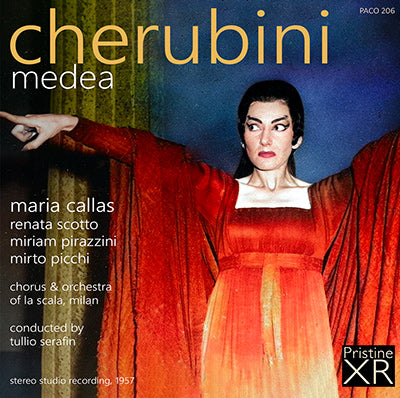
Pristine, having applied their XR method of remastering to many of Callas’s mono recordings and to some of her live ones, now turn to the stereo studio ones. Oddly enough, this was the first of Callas’s complete operas to be recorded in stereo in Milan, though it wasn’t actually recorded by Walter Legge and her Columbia recording team, and all her other Milan recordings that year were mono. Apparently, EMI had no interest in the enterprise and the recording was made by Mercury for Ricordi in September 1957, a few weeks after her performances of La Sonnambula in Edinburgh, when she had not been in her best voice. It was originally issued by Ricordi in Italy, Mercury in the US and Columbia in the UK and since then has appeared on various different labels, including Everest and even Deutsche Gramophon, as well, of course, as Warner when they re-mastered all the Callas studio recordings for their 2014 release.
Considering it was recorded by Mercury, one would have expected the sound to be pretty good, but it has always sounded a bit dry and constricted. I was listening to the Pristine CDs and made comparisons with the 2014 Warner release. To my ears, the differences between the two are fairly slight. Pristine’s XR sound opens up the sound picture a bit and solo voices in particular do sound as if they have a bit more air around them. I also tried listening both through my speakers and through headphones and, oddly, found I preferred the Pristine through my headphones and the Warner through my speakers, though this could have something to do with my equipment. It might also have something to do with the fact that the Pristine release is transferred at a much lower level than the Warner.
Whichever version you go for, there is no doubt this is the best sounding of all Callas’s recorded Medeas, but what about the performance? Apart from this studio recording, we have five live recordings: Florence and La Scala 1953, Dallas 1958, London 1959 and La Scala 1961. Of these, one can safely discount the 1961 La Scala performance. I would also discount the 1959 London performance, a recording that has also been issued by Pristine, though I see that it is Ralph Moore’s first choice in his Medea survey. I feel that it pales in comparison to the Dallas performance, which, though it suffers from poor sound, is blisteringly dramatic, having been recorded just after Bing had “sacked” Callas from the Met. That event seems to have galvanised the whole company to produce a performance of extraordinary dramatic concentration, with Callas in fabulous, secure voice. This Dallas performance is my first choice for the opera, though I wouldn’t want to be without the two 1953 performances either.
This studio recording operates on an altogether lower level of intensity than any of those. However, when I first got to know this opera, and this recording, I had no other point of reference, and it seemed pretty good to me. It was only later, when I heard those barnstorming performances from Florence, La Scala and Dallas, that I found anything lacking, and it is only in comparison with herself that she fails. She is still a good deal better in the part than any other who attempted it, certainly a lot better than Gwyneth Jones and Sylvia Sass, who also made studio recordings of this Italian version. In other hands, Cherubini’s music can seem staid and formulaic, but Callas breathes life into it like no other.
Serafin’s conception is essentially Classical, but his conducting varies from the somnolent to the dramatic. After a tautly conceived overture, the first scene up to Medea’s entrance drags on interminably. I understand the necessity to establish a pastoral air of peace and calm, into which the Colchian Medea bursts, but, quite frankly, at this pace it just becomes a bore. On LP I often used to miss out the first side completely and set the needle down part way through the second LP, when Medea makes her entrance.
Without foreknowledge of other performances by Callas, this is still a great performance of a difficult role. We lose some of the power and ferocity, but there are gains too. Ricordi il giorni tu la prima volta quando m’hai veduta? is couched in the most melting tones, as is the ensuing aria. There is no doubt that it is love, not revenge, that first brings Medea to Corinth. Her duplicity in the scene with Creon, and also in the following duet with Jason, is brilliantly charted, and the scene with the children movingly intense. Vocally, for all that she is not in her best voice, she manages its angular lines and wide leaps with consummate skill, her legato still wondrously intact. Note also how, in this Classical role, her use of portamento is more sparing.
When it comes to the supporting cast, Scotto is less of an advantage than you might expect, Pirazzini rather more (though not quite a match for Barbieri in Florence and at La Scala or Berganza in Dallas). Picchi, who sang Pollione to Callas’s Norma in London in 1952, is rather good, though Vickers is even better in Dallas. Modesti makes a good Creon too, though not as good as Zaccaria in Dallas.
One should of course point out that this is not Médée, as Cherubini imagined it, which was an opéra-comique with spoken dialogue. The version Callas sang is a hybrid, an Italian translation of a German version with recitatives by Franz Lachner, first performed in 1909. It works very well, though, and it is interesting to note that, even in this age of preference for historical authenticity, this was the version that Sondra Radvanovsky sang when the opera was revived for her at the Metropolitan Opera recently.
If you are looking for a studio recording of the opera, then there is little doubt that this is the one to go for.

 Philip's Assortment Box