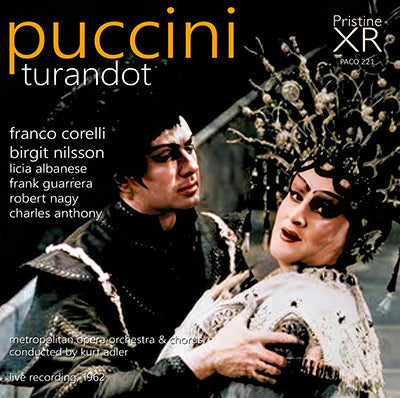
Turandot from the Met with Nilsson and Corelli

La principessa Turandot – Birgit Nilsson (soprano)
Calaf – Franco Corelli (tenor)
Liù – Licia Albanese (soprano)
Ping – Frank Guarrera (baritone)
Pang – Robert Nagy (tenor)
Pong – Charles Anthony (tenor)
Timur: Ezio Flagello (bass)
L’imperatore Altoum – Alessio De Paolis (tenor)
Un mandarino – Calvin Marsh (baritone)
Chorus and Orchestra of the Metropolitan Opera/Kurt Adler
rec. live radio broadcast, 24 February 1962, Metropolitan Opera House, New York City, USA

Well, let’s get this straight. This is an exciting performance of Puccini’s last opera, which puts you in a good seat at the old Metropolitan Opera House on a night when two of its greatest stars were singing two of their greatest roles. You can sense the excitement in the house from the moment the radio announcer, Milton Cross, introduces the opera with the words, “We’ll have the loud, crashing chords, then the curtain will open on the walls of the oriental Imperial palace of Peking.” Indeed the set is loudly applauded by the audience.

After the excitement of those opening chords and the chorus which follows, it is something of a disappointment to be confronted with the Liu of Licia Albanese, who was approaching 53, but quite frankly sounds even older. She compensates by loudly over-singing and over-emoting, and I derived very little pleasure from her performance. Her days at the Met were evidently numbered and she left the company in 1966, following a dispute with Sir Rudolf Bing.

For the rest, we have a sonorous Timur from Ezio Flagello, but the Ping, Pang and Pong tend to over-characterise their music and consequently I found their scenes irritating, as I often do.

However, the main reason for hearing this set remains the splendid singing of Nilsson and, especially Corelli. I am not one of those who think Corelli can do no wrong, but in the right role, and Calaf is undoubtedly the right role for him, he is unbeatable. First of all, there is the sheer splendour of that sound, the thrill of his top notes, which he can fine down to almost a whisper in places. He is absolutely thrilling and the audience go wild after Nessun dorma, with Adler abruptly stopping the orchestral postlude until the pandemonium has died down.

So too, of course, is Nilsson, throwing out those top notes like laser beams. The punishing tessitura holds no terrors for her at all and it is all very exciting, if not particularly subtle. Nor is the conducting of Kurt Adler, for that matter, but he certainly knows how to whip up the excitement.

According to Lee Denham in his exhaustive survey of the opera, there are, or have been, available seven other recordings featuring Nilsson, three of them with Corelli, so how necessary is this particular recording? I’m pleased to have heard it, but I’m not sure I’d want it as my one representation of Nilsson and Corelli in the opera. For that, I’d probably stick with the EMI recording under Molinari-Pradelli, which also has the benefit of including the Act III aria Del primo pianto, which is omitted from all Nilsson’s live accounts. It also has the benefit of the young Renata Scotto as Liu.

I would also not want to be without the Mehta recording with Sutherland, Pavarotti and Caballé, nor the Serafin with Callas, Fernandi and Schwarzkopf, but this one is a great reminder of a thrilling afternoon at the old Met.
Callas’s 1959 Lucia di Lammermoor gets the Pristine treatment

paco207_9735ee11-e251-4de3-a757-19c9b4ae597a_530x

Callas’s second stereo recording of Lucia di Lammermoor, which I reviewed when it was reissued by Warner , has always been considered one of her best from a sonic point of view, so, as someone who has not always been totally convinced by some of Andrew Rose’s re-mastering methods, I wondered how, if at all, the sound could be improved upon. Let me say straight away that I found this latest addition to Pristine’s Callas catalogue totally convincing. Using the Warner remaster of 2014 for comparison, I found the sound altogether warmer and much more comfortable to listen to, closer in fact to how I remember the LPs that I used to own (a German EMI Electrola issue, bought as an import). The Warner is perhaps slightly clearer, but the digitalisation tends to add glare to Callas’s top register. Often one is prepared to flinch before the topmost notes, but I had no such problems when listening to this Pristine pressing. I couldn’t say which is the more truthful, but I can say that the Pristine is much more comfortable to listen to and this, in turn, affected my impressions of the set, a recording I have known since my youth and was in fact my introduction to the opera.

Lucia was one of the cornerstones of her repertoire, and she first sang it in 1952 in Mexico. The following year she sang the role again in Florence, where she made her first recording of the role under Serafin. It was also the first recording she made for EMI. Back in those days, the opera wasn’t taken very seriously and was most likely considered a silly Italian opera in which a doll-like coloratura soprano ran around the stage showing off her high notes and flexibility. Callas returned a proper tragic dimension to the role, that most hadn’t even suspected was there. There is a touching story of Toti Dal Monti, an erstwhile famous Lucia herself, visiting Callas in her dressing room after a performance of the opera with tears running down her face and confessing she had sung the role for years with no idea of its dramatic potential.

When Callas first sang  Lucia in Mexico and recorded it in Florence, she was at the peak of her vocal plenitude, as she was when she first sang it under Karajan at La Scala in 1954, but by the time she sang the role in Berlin in 1955 post weight loss, when Karajan took the La Scala company there, her voice had started to lighten and her conception of the role had become more inward. We can hear this in the famous live recording of one of the Berlin performances, but, for this 1959 recording, she appears to have taken this approach one step further. This may have had something to do with her by now fading vocal resources, but it results in a particularly touching portrayal of the innocent, young, impressionable girl. She has also trimmed away some of the showier variations in the cadenza in the Mad Scene, and the decorations are in consequence somewhat more modest. Am I alone in preferring it sung this way? Personally, I’d prefer to do without all that duetting with the flute altogether, as happens in the complete recording of the opera with Caballé and when Sylvia Sass sings it on one of her recital records. In any case, apart from a few of Callas’s topmost notes, she is in remarkably good voice and the filigree of the role is brilliantly executed with fluid and elegant ease. All in all, I prefer her performance in this set to the one on the 1953 Florence studio recording, not least because of the improved Pristine sound picture.

However, when it comes to her colleagues on this set, I am a little less well disposed towards them than Göran Forsling in his review of the digital download. Ferrucio Tagliavini was 45 at the time of this recording, but he sounds much older, more like an elderly roué than the Byronic Romantic figure of Scott’s and Donizetti’s imaginings. No amount of elegant phrasing can make up for his lack of sheer physical passion and I find myself longing for Di Stefano’s youthful ardour. As for Cappuccilli, he was at the very beginning of his considerable career, and he has yet to find a way of creating character in pure sound. He is just rather dull and no match for Gobbi on the earlier recording or for Panerai in Berlin. Bernard Ladysz makes very little impression at all and both Rafaele Arie and Nicola Zaccaria are preferable.

Serafin, as always, though he may not make any startling revelations, shapes the score with a perfect sense of its dramatic shape, albeit with the cuts that were traditional at the time. Karajan opened up some of those in his performances, and I would still place the 1955 Berlin performance at the top of all Callas’s recorded Lucias, especially in Divina Records latest remastering, but I enjoyed re-visiting this set and I have a feeling I’ll be reaching for this one more regularly than the earlier 1953 recording, not least because of the superior quality of Pristine’s remastering.

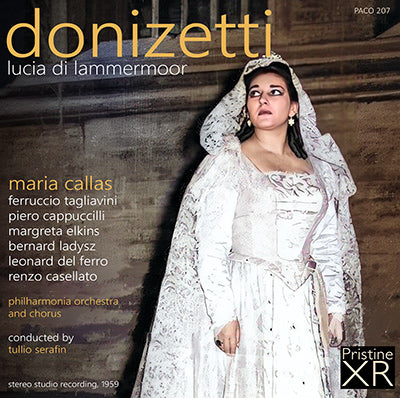
My only criticism is of the cover art, which has a photograph of Callas as Lucia in Florence in 1953, when she was still a rather large lady. One could be forgiven for thinking, at first glance, that this was the earlier recording. Surely a photo of the svelte Callas as Lucia would have been more appropriate. There are plenty of them, after all.

Callas’s Studio Medea gets the Pristine XR treatment

paco206_b39e453c-db98-4327-9fcb-cf071ccd980b_530x

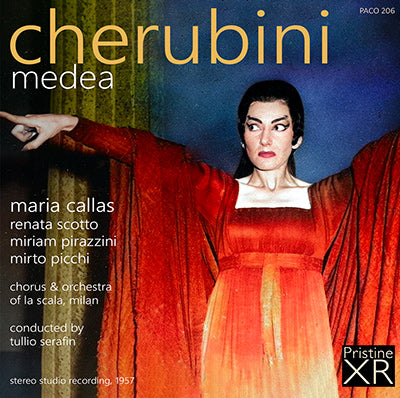
Pristine, having applied their XR method of remastering to many of Callas’s mono recordings and to some of her live ones, now turn to the stereo studio ones. Oddly enough, this was the first of Callas’s complete operas to be recorded in stereo in Milan, though it wasn’t actually recorded by Walter Legge and her Columbia recording team, and all her other Milan recordings that year were mono. Apparently, EMI had no interest in the enterprise and the recording was made by Mercury for Ricordi in September 1957, a few weeks after her performances of La Sonnambula in Edinburgh, when she had not been in her best voice. It was originally issued by Ricordi in Italy, Mercury in the US and Columbia in the UK and since then has appeared on various different labels, including Everest and even Deutsche Gramophon, as well, of course, as Warner when they re-mastered all the Callas studio recordings for their 2014 release.

Considering it was recorded by Mercury, one would have expected the sound to be pretty good, but it has always sounded a bit dry and constricted. I was listening to the Pristine CDs and made comparisons with the 2014 Warner release. To my ears, the differences between the two are fairly slight. Pristine’s XR sound opens up the sound picture a bit and solo voices in particular do sound as if they have a bit more air around them. I also tried listening both through my speakers and through headphones and, oddly, found I preferred the Pristine through my headphones and the Warner through my speakers, though this could have something to do with my equipment. It might also have something to do with the fact that the Pristine release is transferred at a much lower level than the Warner.

Whichever version you go for, there is no doubt this is the best sounding of all Callas’s recorded Medeas, but what about the performance? Apart from this studio recording, we have five live recordings: Florence and La Scala 1953, Dallas 1958, London 1959 and La Scala 1961. Of these, one can safely discount the 1961 La Scala performance. I would also discount the 1959 London performance, a recording that has also been issued by Pristine, though I see that it is Ralph Moore’s first choice in his Medea survey. I feel that it pales in comparison to the Dallas performance, which, though it suffers from poor sound, is blisteringly dramatic, having been recorded just after Bing had “sacked” Callas from the Met. That event seems to have galvanised the whole company to produce a performance of extraordinary dramatic concentration, with Callas in fabulous, secure voice. This Dallas performance is my first choice for the opera, though I wouldn’t want to be without the two 1953 performances either.

This studio recording operates on an altogether lower level of intensity than any of those. However, when I first got to know this opera, and this recording, I had no other point of reference, and it seemed pretty good to me. It was only later, when I heard those barnstorming performances from Florence, La Scala and Dallas, that I found anything lacking, and it is only in comparison with herself that she fails. She is still a good deal better in the part than any other who attempted it, certainly a lot better than Gwyneth Jones and Sylvia Sass, who also made studio recordings of this Italian version. In other hands, Cherubini’s music can seem staid and formulaic, but Callas breathes life into it like no other.

Serafin’s conception is essentially Classical, but his conducting varies from the somnolent to the dramatic. After a tautly conceived overture, the first scene up to Medea’s entrance drags on interminably. I understand the necessity to establish a pastoral air of peace and calm, into which the Colchian Medea bursts, but, quite frankly, at this pace it just becomes a bore. On LP I often used to miss out the first side completely and set the needle down part way through the second LP, when Medea makes her entrance.

Without foreknowledge of other performances by Callas, this is still a great performance of a difficult role. We lose some of the power and ferocity, but there are gains too. Ricordi il giorni tu la prima volta quando m’hai veduta? is couched in the most melting tones, as is the ensuing aria. There is no doubt that it is love, not revenge, that first brings Medea to Corinth. Her duplicity in the scene with Creon, and also in the following duet with Jason, is brilliantly charted, and the scene with the children movingly intense. Vocally, for all that she is not in her best voice, she manages its angular lines and wide leaps with consummate skill, her legato still wondrously intact. Note also how, in this Classical role, her use of portamento is more sparing.

When it comes to the supporting cast, Scotto is less of an advantage than you might expect, Pirazzini rather more (though not quite a match for Barbieri in Florence and at La Scala or Berganza in Dallas). Picchi, who sang Pollione to Callas’s Norma in London in 1952, is rather good, though Vickers is even better in Dallas. Modesti makes a good Creon too, though not as good as Zaccaria in Dallas.

One should of course point out that this is not Médée, as Cherubini imagined it, which was an opéra-comique with spoken dialogue. The version Callas sang is a hybrid, an Italian translation of a German version with recitatives by Franz Lachner, first performed in 1909. It works very well, though, and it is interesting to note that, even in this age of preference for historical authenticity, this was the version that Sondra Radvanovsky sang when the opera was revived for her at the Metropolitan Opera recently.

If you are looking for a studio recording of the opera, then there is little doubt that this is the one to go for.