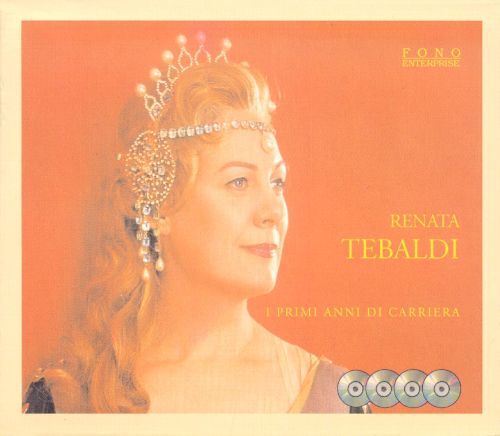
Renata Tebaldi – I Primi Anni di Carriere

mi0001083604

This four disc set is of recordings made in the 1940s and early 1950s, when Tebaldi was in her twenties. It is a mixture of live and studio recordings, so sound quality varies quite a bit. It is also a convenient grouping together of four different discs issued by Fonit Cetra in 2002, which no doubt explains why we get so many different performances of the same aria. Given that there is little difference between them, you may decide you don’t need to listen to four different performances of La mamma morta and of Desdemona’s Willow Song.

And of course the first thing we need to say is that it was an extraordnarily beautiful voice, even throughout its range, firm and rich, her diction admirably clear, though, even at the beginning the very top could sound strained and off pitch. The top C climax to her 1950 Cetra studio recording of Aida’s O patria mia is hard won and slightly under the note and the voice’s greatest beauty lies in the middle register, though many of today’s sopranos would also kill for the richness down below. Nor is she an unfeeling performer, though, at this stage in her career, it can tempt her into excess, especially when singing live, and she tends to sound lacrymose rather than truly moving. She goes way over the top in Desdemona’s Willow Song, and she is much more restrained, and consequently more moving, in the Decca Karajan recording. The other thing to say about Tebaldi is that, however beautiful the voice, however firm the delivery, however musical her singing, her performances rarely stay in the memory, nor does she ever really light up a phrase or a line the way others can. Performances of some of this same music, by such as Muzio, Callas, Caballé, De Los Angeles and Schwarzkopf resonate in my mind’s ear, and I can often recall individual details. With Tebaldi I never can. I can recall the sound of the voice, but little that is specific to the music she is singing. In these early performances, I found that she often over-characterises the music, introducing sobs and emphases which detract from the beauty of the sound, rather than make it more dramatic. It is somewhat akin to watching a hammy actor.

A few specifics then about the discs themselves. I got muddled and listened to them in reverse order. Disc 4 is entitled Gli Inediti, and is presumably of previously unissued recordings. In concert she sings the Countess’s Porgi amor but, though more suited to the character than she is to Susanna, who puts in an appearance on Disc 3, Mozart is not really her métier. The excerpts from a 1949 performance of Andrea Chénier wih Del Monaco are prime examples of that hamminess I alluded to, though all the singers go way over the top. The audience lap it up, so they no doubt give them what they want. A poised 1949 performance of the Ave Maria from Otello is ruined by a surfeit of little sobs, but she gives us a lovely performance of Louise’s Depuis le jour (in Italian). It lacks Callas’s quiet intensity and mounting rapture, but is much more securely sung and works well on its own terms. The disc closes with a small piece of history; a 1945 performance of the love duet from Otello, with the then almost sixty year old Francesco Merli, though recording here is at its dimmest. Nevertheless it affords us a glimpse of the great tenor in one of his most famous roles.

Disc 3 covers studio recordings made for Decca and Fonit Cetra in 1949 and 1950, arias from Aida, Madama Butterfly, Faust, Manon Lescaut, Tosca, Il Trovatore, La Traviata, Otello, La Boheme, Mefistofele, La Wally, Andrea Chénier and, most surprisingly Susanna’s Deh vieni from Le Nozze di Figaro, though she makes a very heavyweight Susanna, and this is the least successful item on the first disc. Recorded sound here is fine and there is no doubt that this is an extraordinary voice the like of which we don’t hear anymore, and perhaps haven’t since. Her legato is mostly superb as is her diction. On the other hand, as one aria follows another, we don’t really get a gallery of different characters. Her Aida isn’t really very different from her Butterfly, her Manon no different from her Mimi, and, in an attempt to be dramatic, she often over-emotes. The reading of the letter before Addio del passato is hopelessly melodramatic and she ends the aria forte rather than in the fil di voce Verdi asks for.

The prize of Disc 2, entitled La nascita d’una leggenda, is some extended excerpts from a 1951 concert performance of Verdi’s Giovanna d’Arco with Carlo Bergonzi and Rolando Panerai. Though she is taxed by some of the coloratura, and she tends to aspirate when the music asks her to move a little faster, the role suits her well. Also excellent are the two extracts from a 1950 performance of the Verdi Requiem under Toscanini, with Giacinto Pradelli, Cloe Elmo and Cesare Siepi. It is somewhat dimly recorded, but you can hear how fine she was in this work. Why Decca never recorded her in it is a mystery to me. A welcome surprise is Elisabeth’s Dich, teure Halle (in Italian) from Tannhäuser. It is also good to hear the young Di Stefano in a 1950 concert performance of the Act I duet from Madama Butterfly. The concert also included Margherita’s L’altra notte in fondo al mare from Mefistiofele. In both the aria and the duet, Tebaldi oversings and overacts and her singing as Butterfly is so powerful that she sounds more like a Tosca or Minnie to me. Many will respond to the beauty of the voice, but she doesn’t conjure up an image of Butterfly for me at least.

The first disc pits Tebaldi against her teacher, Carmen Melis. Excerpts from Tebaldi’s first recordings of La Boheme and Madama Butterfly under Alberto Erede and arias from Manon Lescaut and Tosca. Many will no doubt revel in the glory of that voice filling out Puccini’s wonderful melodies, but for me she too often oversings and the finale to La Boheme, which is given in its entirety has both Tebaldi and Giacinto Pradelli over-emoting like mad. The love duet from Madama Butterfly with Giuseppe Campora likewise has no sense of the young girl’s gradual awakening to love and sounds as if it could have been lifted from Tosca. Melis is caught in excerpts from Tosca and Massenet’s Manon. She is a singer who is new to me, and I must say I found her very impressive, though the top C at the line Io quella lama gli piantai nel cor is a little precarious, and she takes the upper option on the word cor. The Manon excerpt is Manon’s N’est-ce plus ma main (in Italian) from the duet with Des Grieux, and she is wonderfully seductive and persuasive.

Tebaldi is a central singer in that she demonstrates most of the virtues of good singing. The voice is a beautiful one, the line always firmly held, her legato generally excellent. Her only faults are a lack of a trill and clumsy execution of fast moving music (hardly necessary in most of the music she sang) and a slightly short top. (I remember that in her interview with Luca Rasponi for the book The Last of the Prima Donnas, she bemoans the ever rising pitch of modern orcehstras, which must have been a nightmare for her.) My preferences are well know, and I prefer singers who have something more specific to say about the music they assay, but the set is one I still enjoy dipping into from time to time.
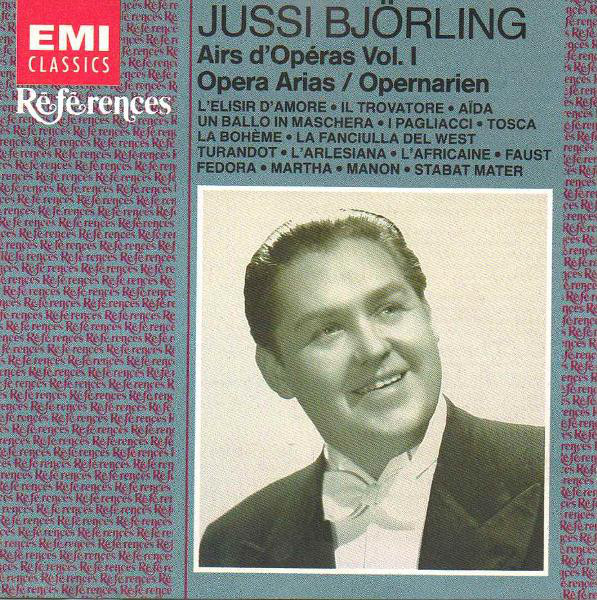
Jussi Björling – A collection of Swedish 78s.

These two CDs gather together most of the 78s the young Björling made in his native Sweden between 1933 and 1949, the earliest made when he was a budding tenor of twenty-two.

Most are vocal gems, but one or two (the rather loud and penny plain Je crois entendre encore, and the unpoetic duet from La Boheme with Anna- Lisa Björling on the second disc, for instance) are less than great.

The voice itself was a magnificent one, no doubt about it, with a silvery purity throughout its range, the high notes free and easy; just listen to his joyfully ebullient 1938 performance of Offenbach’s Au mont Ida from La belle Hélène, sung in Swedish, but with terrific swagger, the top notes flying out like lasers. From a few years ealier we have a plaintively sensitive performance of Valdimir’s Cavatina from Borodin’s Prince Igor, the legato line beautifully held, his mezza voce finely spun out. Also from 1938 we have a thrilling performance of the Cujus animam from Rossini’s Stabat mater, with a free and easy top D flat at the end, and it is prinicpall for Italian and French opera that Bjørling will be remembered and there are plenty of examples here of his wonderfully musical performances in that genre.

We find him ideal in Verdi, Donizetti and Puccini alike, in Myerbeer, in Massenet and in Gounod (a glorious rendering of Faust’s Salut, demeure). Some regret the absence of a true Italianate tone in the Italian items, but he will never resort to sobs and aspirates to express emotion, and, personally, I find his comparative restraint very attractive. It is true, he is not always imaginative with his phrasing, and nowhere will you get the kind of psychological introspection you would hear in a performance by someone like Vickers, but his singing is always musical, and of course there is a great deal of pleasure to be had from the voice itself, which Italianate or not, is a thing of great beauty.

Some of the very best of these 78 recordings are included on Volume 1, stand out items for me being the aforementioned Faust aria, his wonderfully musical and sensitive Ah si, ben mio from Il Ttovatore, and his poetic, but thrilling version of Nessun dorma from Turandot.  There is also plenty to treasure in Volume 2, which includes the Offenbach and Borodin, but also a sensitvely prayerful  Ingemisco from the Verdi Requiem, Des Grieux’s lovely Dream from Manon sung with liquid, honeyed tone (his ardent Ah, fuyez is on the first disc), and his  poetic Cielo e mar, from La Gioconda.

The second disc finishes with a couple of unexpected examples of his work in Lieder, a gorgeously lyrical Beethoven Adelaide, and a beautifully restrained and rapt account of Strauss’s Morgen.

Anyone who loves the tenor voice and gloriously musical and sensitive singing (not always the same thing) should have these recordings in their collections.

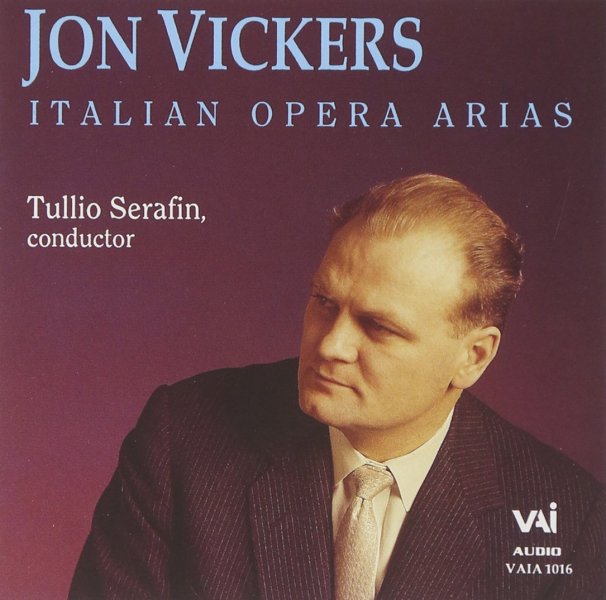
Jon Vickers – Italian Opera Arias

713njx42iel._sl1085_

Now this is great singing.

In the 1993 notes that accompany this re-issue of the one recital record Jon Vickers ever made, Vickers says,

At the time of the Italian Arias recording the field of opera was a totally different world than today. One sought to prove oneself worthy of association with the opera houses, general administartors, conductors, producers and singers one admired – even was in awe of. There was a humbling consciousness of the great history of places like the Metropolitan Opera, the Royal Opera House, Covent Garden, La Scala, Bayreuth, Vienna and Salzburg. Emphasis was upon delving as deeply as possible into the psychological depths of the text illuminated by the genius of the composer’s music. To dare to indulge any particular personal ability was to invite derision from colleagues and thunderous disapproval by public and press alike as being in bad taste and imposing of oneself upon a great work of art.

To be honest, I’ve listened to plenty of live performances from those days when bad taste and personal indulgence brings the house down, but his statement does give you a snapshot into the way the man worked, of his seriousness and dedication to his art.

This recital disc was recorded at the same time as his first recording of Otello under Tullio Serafin, when his only Wagnerian role was Siegmund, and you were more likely to hear him as Riccardo in Un Ballo in Maschera, Radames, Canio or Don Carlo. Later of course he want on to tackle Tristan and Parsifal, though he never sang Siegfried, and he dropped out of scheduled performances of Tannhäuser at Covent Garden, due to his religious scruples, saying he could not empathise with the character and that, in any case, the opera was blasphemous in character.

First impressions when listening to this disc are of the sheer size of the voice, and the power – a power that can be reined back to a merest pianissimo, then unleashed at will, like an organist pulling out all the stops. The other is intensity. Whether singing gently or loudly, there is a concentration and intensity that makes each short aria into a mini monodrama, and an ability to focus in on the meaning of each word and note. Nothing is taken for granted, nothing thrown away.

From a purely vocal point of view, it was still a very beautiful instrument back in 1961, and an aria like Cielo e mar is sung not only with golden tone, but with a true sense of wonder, and a way of pulling in and out of full voice that never destroys the long legato line.

Where many Italian tenors will add extraneous sobs and aspirates to indicate emotion, particularly in an aria like Federico’s Lament from L’Arlesiana, Vickers achieves an even deeper vein of emotion by never straying from the written notes, but simply (as if it was simple) intensifying his sound. In this he ressembles Callas, whom he revered so much having been Giasone to her Medea on many occasions.

One of the stand out tracks on this recital for me is Chénier’s Un di all’azzurro spazio delivered with mounting passion, but also somehow giving us a sense of the intellectual in the man. Canio suffers like no other, and yet he doesn’t have to break down in sobs at the end to make us feel it. His Otello developed into one of the towering creations of his, or any other, age, but even here, with the arias taken out of context, he conveys all the man’s pain and suffering.

Listening to this recital today at a distance of some years has been a peculiarly emotional experience. Jon Vickers was, and remains, unique, and we are unlikely to hear his ilk again.

Ljuba Welitsch – Salome closing scene and other arias

117506465

Tchaikovsky; Eugene Onegin – Tatiana’s Letter Scene
Verdi: Aida – Ritorna vincitor
Puccini: Tosca Vissi d’arte
Puccini: La Boheme – Quando m’en vo
Weber: Der Freschütz – Wie nahthe mir der Schlummer – Leise, leise
Strauss: Salome – Closing Scene

Ljuba Welitsch shot through the operatic firmament like a comet in the late 1940s and early 1950s. Unfortunately she developed nodules on her chords by 1953 and her international career was over almost before it started. In that brief time her Salome at least became the stuff of legend, and to this day is considered one of the greatest of all times, though a prodjected complete recording with Reiner conducting never materialised. There are two live perforances from the Met, from 1949 and 1952. The latter has the best all round cast, but she is in fresher voice in the former.

These recordings all date from the 1940s when her voice was at its silvery best, and the final scene from Salome, conducted by Lovro von Matacic dates from 1944, when Strauss himself chose her to sing the role at the Vienna Opera in a production, which was to celebrate his eightieth birthday. They worked on the piece for six weeks, with Strauss himself attending the rehearsals, so, from that point of view at least, we should consider her performance here as authentic. Indeed this must be exactly the voice Strauss had had in mind. It remains silvery, youthful and light, and yet cuts through the heavy orchestral textures with no apparent effort. Not only that, but her word painting and identification with the role is so vivid that at the end of the scene one literally feels Herod’s distaste when he commands his soldiers to kill her. This scene alone is indispensable, whether one has one of the complete live recordings or not.

The other arias were all recorded between 1947 and 1949, when the voice was still in fine shape, but they do expose some of her weaknesses. The best of them is Tatiana’s Letter Scene from Eugene Onegin, here sung in German, which teems with girlish impulsiveness and teen-angst longing. There is no sense of strain and the high notes ring out gloriously. Please also take note of the wonderful horn playing of Dennis Brain. This scene ranks as highly as the Strauss in the Welitsch discography.

Musetta’s Waltz makes its effect well, with loads of personality, but she misses the anguish and contrasts in Aida’s Ritorna vincitor, and her Vissi d’arte is rather penny plain. Neither scene really registers anything at all and she has a tendency to rush the beat, which can be quite annoying. The Weber is better, but she still lacks the poise and control evinced by such singers as Elisabeth Grümmer and Elisabeth Schwarzkopf.

When the voice started to let her down, she did not retire, but moved to character roles, most famously singing the Duenna in Karajan’s first recording of Der Rosenkavalier. As late as 1972, she played the role of the Duchess of Crakentorp in a Fille du Régiment at the Met.

Not a recital in the true sense of the word, as all these performances were recorded for 78s, this compilaton is essential none the less for the Strauss and Tchaikovsky at least.

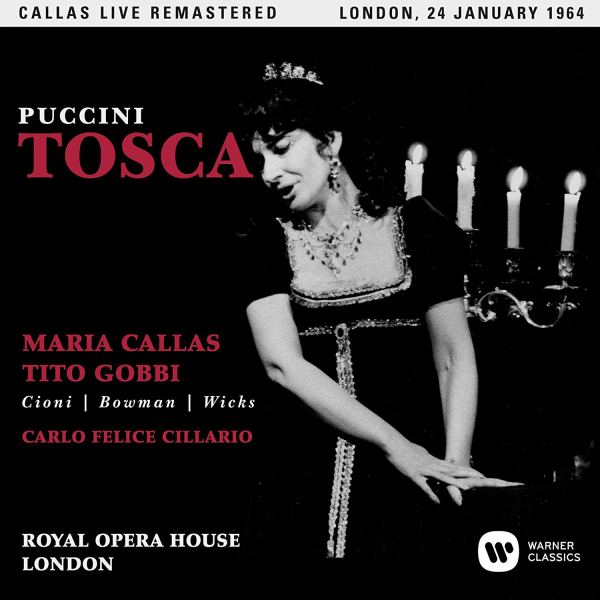
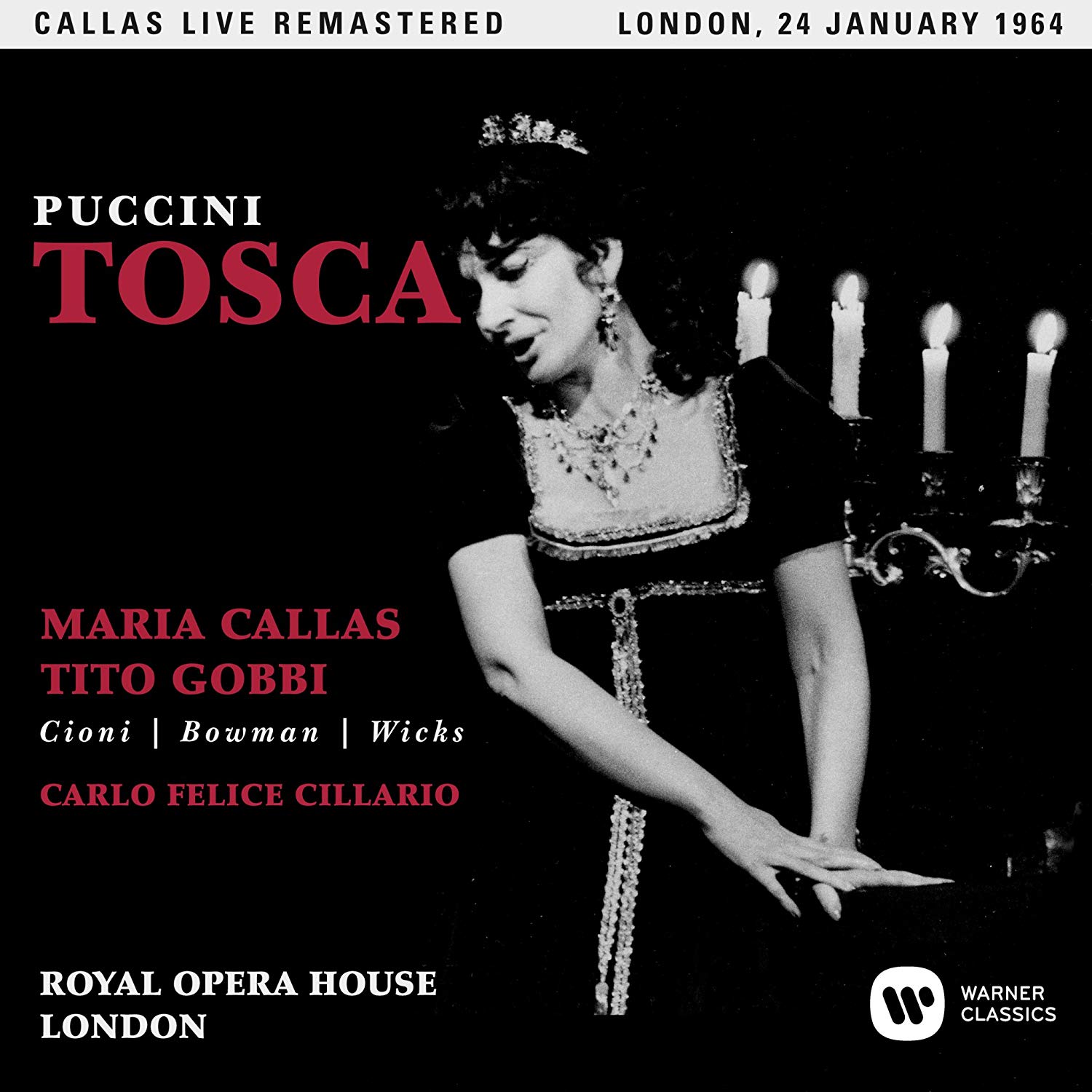
Callas as Tosca – Royal Opera House, Covent Garden 1964

812ZMsD1g5L._SL1500_

I’d forgotten that I hadn’t reviewed the final opera in Warner’s Callas Live Remastered, so, rather belatedly, here it is.

This Tosca marked Callas’s triumphant return to the stage after an almost two year hiatus. She had been lured out of semi-retiremet by Zeffirelli who was also to stage Norma for her in Paris, with the two opera houses sharing the two productions, though, in the event, the Paris Norma never made it to London. Paris did however get to see the Covent Garden Tosca. It was also the vehicle for her last ever stage appearance the following year when she agreed to sing, against doctor’s orders, for a Royal Gala. A couple of months before she had collapsed on stage and was unable to complete a performance of Norma.

At this performance, though the voice is not what it was when she made the famous De Sabata recording eleven years earlier , she is in remarkably good form, and her interpretation has deepened even further, no doubt the product of weeks of intensive rehearsal and her deep rapport with Tito Gobbi. John Copley, who was Zeffirelli’s assistant on the production, once told me he had never before or since come across such complete actor/singers. At rehearsals, Callas and Gobbi would improvise their scenes and then discuss what had worked, what hadn’t, before returning to the scene to incorporate any new ideas, just as straight actors do on stage. According to Gobbi, so close was their connection that they were even able to do this during a performance, so that if anything unusual happened, as it did one night when Callas’s hairpiece caught fire in one of the candles, they could incorporate it into their stage business.

The production has gone down in history as one of the greatest opera productions of all time, and those who were alive to see it still talk about it today. Act II has been preserved on film and goes some way to revealing the Callas magic on stage, but why oh why didn’t they record the whole thing? What a missed opportunity. The fame of the Zeffirelli staging, the iconic photos taken from it and the 1953 recording are no doubt the reason Callas is so much associated with the role, though it was not a favourite of hers, and, truth to tell, she rarely sang it after making the recording, and never at La Scala during her glory days there.

The first thing to be said for this release is that Warner have discovered a new sound source for the performance, and it is a lot better than anything we have heard before. There is a good deal of stage noise to be sure, but both voices and orchestra come across very clearly. It almost sounds like stereo, so clear is the acoustic.

The performance largely justifies its reputation, and is absolutely gripping from start to finish. Cioni is its weakest link, the voice a little thin and reedy, and, possibly intimidated by appearing alongside two such dramatic giants, with a tendency for empty overacting. He is certainly no replacement for Di Stefano in the 1953 recording, or Bergonzi in the 1964 studio recording, on which Callas is in less secure voice than she is here. He’s not at all bad, just not outstanding.

As for Callas, the voice lacks the beauty and velvet of her 1953 self, but, histrionically she is more inside the role than ever. Her Tosca is more feminine, more vulnerable, even more volatile, but somehow more endearing, and her singing is peppered throughout with wonderful little details. She is particularly charming (not a word one usually associates with Callas) in the Act III duet with Cavaradossi, girlishly happy in the way she looks forward to her future, which contrasts brilliantly with her utter despair when that future is cruelly snatched away from her.

Gobbi’s voice has also lost some of its velvet since 1953, but he too is wonderfully inside the role, his vocal acting so vivid you can almost taste the words. Actually one of the pleasures of the set is being able to hear the words so clearly, not only from the three principals, but also from all the excellent comprimarii. Cillario conducts an exciting performance, if without the many subtleties and revelations of De Sabata in the studio, which remains a first choice for the opera. That said, this one is highly enjoyable and I would place it above Callas’s second studio performance. It may not be not the essential listening of some of the other operas in Warner’s live box set are, but it is certainly worth hearing, and nicely rounds off the set, which thus covers almost all of her international stage career, from Nabucco in 1949, just two years after her Italian debut in Verona, to this Tosca, recorded the year before she sang for the last time on the operatic stage.


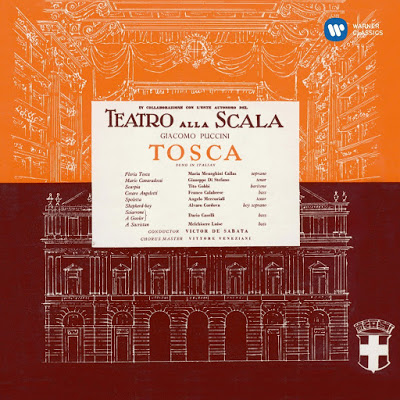
Callas’s 1953 Studio Tosca

91ntirq8gdl-_sl1500_

Recorded 10-21 August, 1953, Teatro alla Scala, Milan

Producer: Walter Legge, Balance Engineer: Robert Beckett

What can one say about this famous recording of Tosca that hasn’t been said before? It regularly appears in lists of the greatest recordings ever made, and it seems now that its legendary status is confirmed.

Because of it, Tosca has often been considered the quintessential Callas role, but, though she sang it a fair amount in her early career, she pretty much ignored the role after this recording, until it became the vehicle for her operatic comeback in London in 1964. Indeed she never sang it, or any other Puccini role, at La Scala, which was her cultural home at the height of her career. A few months after making this recording she sang the role at a couple of performances in Genoa, then promptly ignored it, except for her two seasons at the Met in 1956 and 1958. In 1964, Zeffirelli managed to get her to choose it as the vehicle for her comeback, but, typically for her, she would only agree if they could do Norma as well, which he staged for her in Paris.

The Zeffirelli production, which was shared by Paris and London, became one of the most famous in operatic history (and in fact Covent Garden only retired it a few years ago). Indeed one could say the photos of Callas in that red velvet dress she wore in Act II have since become iconic, even though Callas herself often voiced her disdain for both the opera and the role.

True, it may not have offered her the vocal challenges of Norma or Medea, of Violetta or Lady Macbeth, but in 1953 her voice was an amazingly limpid and responsive instrument, enabling her to easily encompass its demands, whilst rendering the score with an accuracy the likes of Tebaldi and Milanov could only dream of. Take, for instance, the lightness and grace with which she sings a line like le voce delle cose in Non la sospiri la nostra casetta. Most Toscas are clumsy here, but Callas sings it with elegant ease. Furthermore at this stage in her career, she can swell the tone to a refulgent climax at Arde in Tosca un folle amor, which she can’t quite manage by the time of the second recording, which was recorded around the same time as the London and Paris performances.

Interestingly, though, in terms of interpretation, there are not that many differences between Callas’s Tosca of 1953 and 1964; a few minor details here and there, but for the most part the character of Tosca is as musically finished here as it was to be histrionically in Covent Garden. Though Zeffirelli may have helped her with odd bits of stage business, it seems sure that her conception of the character had changed little in the intervening years. The main differences are vocal, and here she rides the orchestra with power to spare, the top Cs, that emerged as little more than shrieks in 1964, full throated and solid as a rock. Vissi d’arte (which Callas used to say should be cut as it held up the action) is both beautiful and heart-rending. So it is in 1964, but the ending taxes her to the limit there, whereas here it is full throated and easy.

Of course there are other reasons why this set has retained its place as the best of all Tosca recordings. Gobbi is also in fuller, securer voice here than he was in 1964, and his loathsome, reptilian Scarpia is a towering achievement. As usual, he and Callas strike sparks off each other, their confrontations bristling with tension. Di Stefano, who also appears on the first Karajan recording, is here in his best voice, an ardent, youthful and passionate Cavaradossi. Both duets with Callas are erotically charged affairs, as they should be.

Then of course, there is De Sabata on one of his rare excursions to the studio. The La Scala orchestra play superbly for him, and he unerringly paces the score just perfectly, with a sure sense of the work’s inner impetus, his use of rubato  brilliantly controlled. In a performance such as this, the one true winner is Puccini.

Sonically it is surely the best of all Callas’s studio mono sets from La Scala. One hardly notices the lack of stereo; voices are perfectly placed and the orchestra sounds richer and more full-bodied than was often the case. This transfer has also corrected some of the errors that crept into previous CD incarnations, not least the terrible GROC version.

Still the Tosca to have, and blow stereo digital sound.

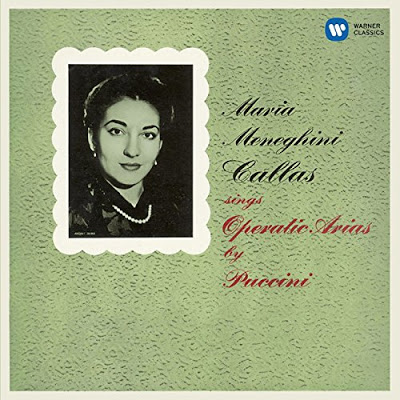
Callas sings Puccini Arias

61qclfmrmgl

Recorded 15-18, 20-21 September 1954, Watford Town Hall, London

Producer: Walter Legge, Balance Engineer: Robert Beckett

This is the first recital record I ever owned , and for some time the only recital record I owned. As such it has quite a lot of sentimental value for me. Most of the music was new to me at that time and I played it constantly. I got to know it so well that I can even now listen without libretto and mime the words. However, as I got older, my tastes changed. I got to love the music of Verdi, Bellini and Donizetti. I felt Callas’s gifts were wasted on Puccini, and so my first love got rather pushed aside. I tended not to listen to this recital quite so often.

To listen to it again now, in this fantastic new re-mastering from Warner (one almost feels as if Callas were in the room with you), was a moving experience and, from the first note, she had me riveted.

Most Puccini recitals tend to the samey, but Callas presents us with a different voice character in each opera. Of the roles represented here, she had at that time only sung Turandot on stage, though she would go on to sing Butterfly in Chicago in 1955. She also went on to record complete performances of Madama Butterfly, La Boheme, and Manon Lescaut, as well as Turandot (though a little too late in her career.

As usual Callas is the mistress of vocal characterisation. Manon, Butterfly, Mimi, Angelica, Lauretta, Liu and Turandot all emerge as completely different characters, but, even within a single aria, she can reveal some hidden depth within the character. Manon, tenderly regretful in In quelle trine moribide, gives way to passion and despair in Sola perduta abbandonata, a despair already hinted at in her voicing of un freddo che m’agghiaccia in the first aria. Butterfly’s wistful imagining of the return of Pinkerton is brilliantly charted, her death scene almost unbearably intense. Mimi is shy and withdrawn, but the warmth which Callas brings to the Ma quando vien lo sgelo section reveals Mimi’s capacity for selfless love.  Angelica’s resigned sadness gives way to a surprisingly sweet and cajoling Lauretta.

Quite the biggest contrast comes when she sings both Liu and Turandot. Liu’s arias are sung feelingly, but possibly with a bit too much muscle, and the ending of Signore ascolta doesn’t eclipse memories of Caballe or Schwarzkopf in the same piece, but Turandot’s In questa reggia is surely one of the best ever recorded. Callas at this time still had the power and security on top to ride its high-lying phrases; and please note she actually sings the words Gli enigmi sono tre on the phrase that takes her up to a top C. Most sopranos, Eva Turner included, reduce them to a vocalise. Furthermore the aria is filled with little details overlooked by most; the almost mystical way she launches the section beginning Principessa Lou-u- Ling, singing with mounting ardour until she vocally points her finger at Calaf with the phrase Un uomo como te. Almost regretful on the section O principe che a lunghe carovane, she strengthens her resolve again at io vendico su voi till her voice cries out with conviction at quell grido e quella morte. Would that she had recorded her complete Turandot at the same time. This is the greatest prize on the recital.

The one uncomfortable moment I remember from the recital (Angelica’s final floated high A) for some reason sounds far less wobbly here than it ever did before, and the voice in this re-mastering has enormous presence. Serafin, as ever, provides invaluable support.

A classic of the gramophone.

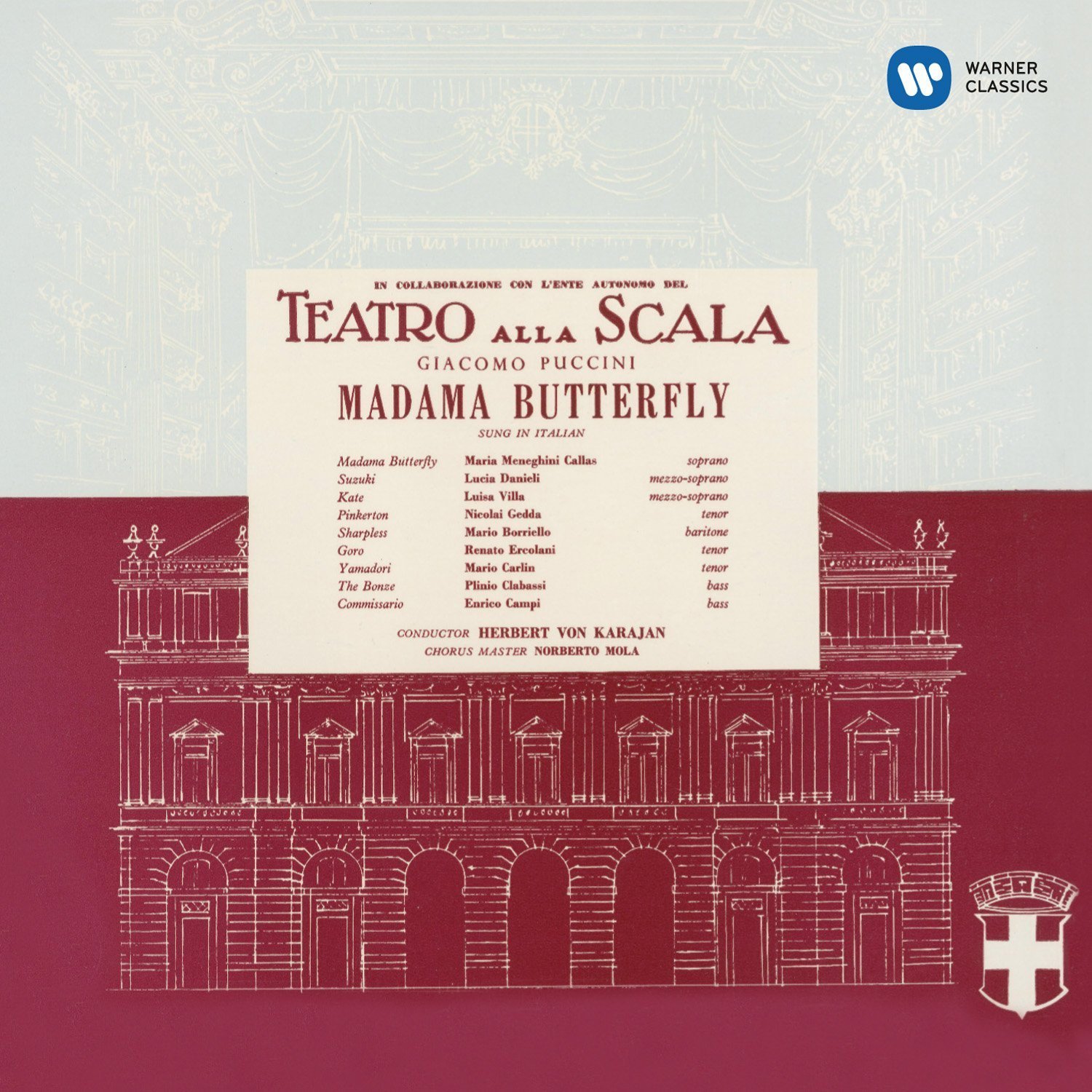
The Callas Karajan Madama Butterfly

81sict7avdl-_sl1500_

Recorded 1-6 August 1955, Teatro alla Scala, Milan

Producer: Walter Legge, Balance Engineer: Robert Beckett

Well I’m a mess! To quote John Steane in his Gramophone review of the first CD issue of this set,

Still feeling the impact of that devastating final chord in the opera, I believe devoutly that Madama Butterfly is the most moving of all works for the stage, that this is the best recording of it, and that it is Callas’s greatest achievement on records. 

I may not go quite that far, but it does remind me how many times I think exactly that after listening to almost every one of Callas’s complete opera sets, so completely does she identify with each role that she sings.

Callas recorded the role of Butterfly a few months before her only stage appearances in the role in Chicago, in November 1955. It was also the occasion of one of the first major scandals of her career, when a process server tried to stuff a court summons into the belt of her kimono just after she exited the stage. Callas exploded, cameramen just happened to be there to record the exact moment she lost her temper, and the rest is history.

This recording also marked one of the three occasions on which Callas worked with Karajan, a powerful combination which also produced those famous La Scala Lucias, which were repeated in Berlin and Vienna, and the studio recording of Il Trovatore.

Now if you’re idea of a perfect Madama Butterfly  is one in which some gorgeous voices sing some beautiful tunes, bathed in lush orchestral sounds, which incidentally happen to accompany  the sad little story of a Japanese girl who ends up committing hari kari, then this recording is probably not for you. There have certainly been more beautifully sung Butterflies, but few that elevate it to the level of real tragedy on a par with those of Shakespeare and Euripides. Here we are treated to a cautionary tale, a moral tale if you like, of how even nice people can do terrible things unthinkingly, and how one thoughtless act can set in motion a whole chain of tragic events. It doesn’t always make for comfortable listening, but who said great art was meant to be comfortable?

Callas’s portrayal is full of miraculous detail, phrases, even single words given a significance you won’t hear in other performances. Take, for instance, the way she manages to suggest all Butterfly’s trust in Pinkerton at Ieri son salita, the final Amore mio sung with a conviction that makes it easy to understand her utter faith in his return. In the love duet she is all shyness until gradually her voice is flooded with warmth and passion, as she succumbs to Pinkerton’s ardour. Here, maybe, I should add a word about Gedda’s Pinkerton, which some have found too uncaddish. But surely that is to miss the point. That nice people can, and do, perpetrate unkind things is surely the crux of the plot. Gedda sounds like his music; a nice, charming young man, who gives no thought to the consequences of his actions. He is not some dreadful villain, just a normal young American jock. His sort are two a penny on most American college campuses. His remorse in the last act is real enough.

But back to Callas, who finds in Butterfly “not the frailty of childhood, but its strength”. According to John Steane in the Gramophone review quoted above,

The keynote is firmness of mind; a simple factuality which sees right and wrong with the clarity of that miraculously rinsed and lightened voice.

She sings Un bel di not as some big soprano show piece, but integrates it into the drama, a simple reiteration of Butterfly’s faith, the details of Pinkerton’s return sung in wistful fashion as something she has gone over and over again in her mind. Che tua madre, with its cries of Morta! Morta!, is almost unbearably intense, Sotto il gran ponte dal cielo unbearably moving. Only in the final scene, when left alone, does she let her full voice out, and the effect is overwhelming, Puccini’s final chords shatteringly played by the orchestra under Karajan, who conducts a tautly dramatic performance of the opera, less inclined to wallow than in his later recording.

Danieli is excellent as Suzuki, Borriello a sympathetic Sharpless, but this, of all Puccini operas, is all about the heroine; even Pinkerton is a supporting role, and Callas, with Karajan’s help, makes sure that all our attention is concentrated on Butterfly.

The sound is a trifle boxy but sounds a lot better here than it did in the 1997 Callas Edition. Still it mystifies me that it is not up to the quality of the Tosca that was recorded two years earlier.

No the real problem with this recording is that it brings us face to face with real life in all its raw pain and tragedy. Listening to it is a deeply unsettling experience, and one I can’t subject myself to too often.

Essential nevertheless, for Callas, for Karajan, and for all those who think Puccini’s opera is more than a sentimental pot boiler.

Callas in La Boheme

91olgtzbaol-_sl1473_

Recorded 20-25 August, 3-4 September 1956, Teatro alla Scala, Milan

Producers: Walter Legge & Walter Jellinek: Balance Engineer: Robert Beckett

Mimi is a role one would not associate with Callas, and indeed it is one of four roles she learned for the gramophone but never sang on stage. The opera itself makes its effect easily and can withstand even a mediocre performance, the role of Mimi being probably one of the least demanding in the soprano repertoire. Great Normas may always have been thin on the ground; effective Mimis have been, and still are, plentiful. The role’s requirements are slight; sweetness, charm, and a capacity for what the Italians call morbidezza; qualities that come naturally to a De Los Angeles or a Freni, less so, one would have thought, to a Callas.

But of course the miracle of Callas is that she not only scales down her voice and personality to suit the demands of the role, but also finds within it a deeper vein of tragedy one hardly suspected was there, her singing full of little incidental details often overlooked by others. Her first utterances have a weariness that presages her illness, and she fades the voice away most effectively as she faints. The duet with Rodolfo is light and charming, but more of this Mimi’s capacity for love emerges in her aria. Starting shyly, she gradually suffuses her tone with warmth at the section beginning Ma quando vien lo sgelo, not lingering too long on the top As and thereby ruining the shape of the aria, as so many do, and I love the way the last section, from altro di me non saprei narare, is delivered with a slight touch of embarrassment as if Mimi suddenly realises she has revealed too much too soon.

It is in the last two acts, though, that Callas’s Mimi is at its most moving. Never before has Mimi’s despair been so heart-rendingly expressed, but also note how, with a single word (dorme? ) in the duet with Marcello, she conjures up all Mimi’s warmth and tender love for Rodolfo, with the gentlest of upward portamenti. Act IV is almost fail safe, but here too she is wonderfully effective, finding the palest of colours as the pallor of death takes over.

She has a good cast around her; Di Stefano in one of his best roles, Panerai a splendid Marcello, Moffo a sympathetic Musetta, and something of a relief from the sparky soubrettes we so often end up with. Zaccaria and Spatafora are an excellent pair of Bohemians.

Votto doesn’t do anything wrong, but such a cast would have benefited from a stronger hand at the helm. He accompanies well, but it’s a shame, given that Serafin was not an option at the time, Legge couldn’t have persuaded Karajan to stick around after recording Il Trovatore with her.

The sound of this La Boheme has always been good for its period. I owned the original Columbia LPs, which I played to death. These Warner CDs also sound pretty good to me.

There are so many good recordings of La Boheme in the catalogue, that choosing the best one is well-nigh impossible, and choice will no doubt come down to preference for certain singers. However this recording, made 60 years ago now, still holds its place amongst the top recommendations.

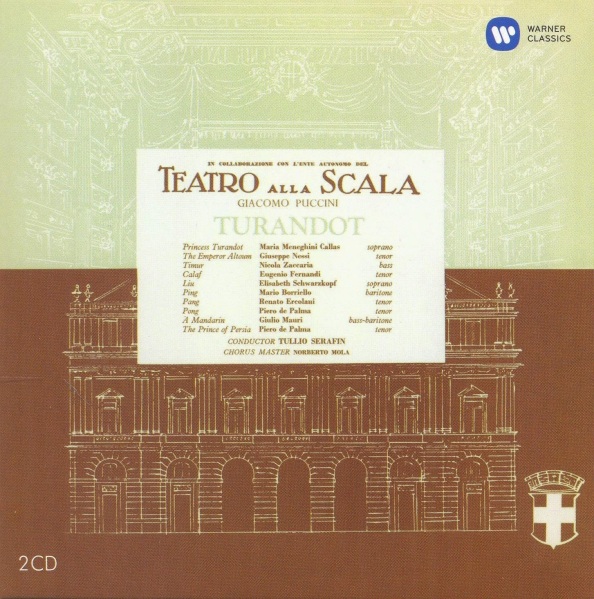
Callas as Turandot

9172j0czwml-_sl1467_

Recorded 9-13, 15 July 1957, Teatro alla Scala, Milan

Producers: Walter Legge and Walter Jellinek, Balance Engineer: Robert Beckett

1957 started well for Callas. She made two of her best recordings (Il Barbiere di Siviglia and La Sonnambula) and had a huge success as Anna in Anna Bolena at La Scala. The Iphigenie en Taurdie which followed may have been more of a succès d’estime but, though her colleagues were decidedly under par, she was superb and in good voice, as she was when La Scala took their production of La Sonnambula to Cologne in Germany.

She then records two operas far less suited to her gifts (Turandot and Manon Lescaut), goes on to sing a concert in Athens, when she is decidedly not in her best voice, sings Amina again with the La Scala company in Edinburgh, where she sounds thoroughly exhausted, and then  compounds the problem by recording Medea. The cracks are definitely beginning to show. After a few week’s rest, she is back on form for a Dallas Opera Inaugural concert (or appears to be on a recording of the rehearsal), and finishes the year well with a stupendous performance of Amelia in Un Ballo in Maschera at La Scala.

Turandot figured quite heavily in Callas’s early career. In 1948 and 1949 she sang it in Venice, Rome Caracalla, Genoa, Verona, Naples and Buenos Aires. She once said in interview that she dropped it as soon as she could, “because it’s not really good for the voice, you know.” All that exists from any of these performances are a couple of short extracts from the Buenos Aires performance, in which her voice is massive and free-wheeling, as far as one can tell through the execrable sound. By 1957 her voice has considerably pared down, and one might wish that she had recorded the role even a few years earlier when she sings a vocally secure and thoroughly commanding version of In questa reggia on the Puccini recital of 1954.

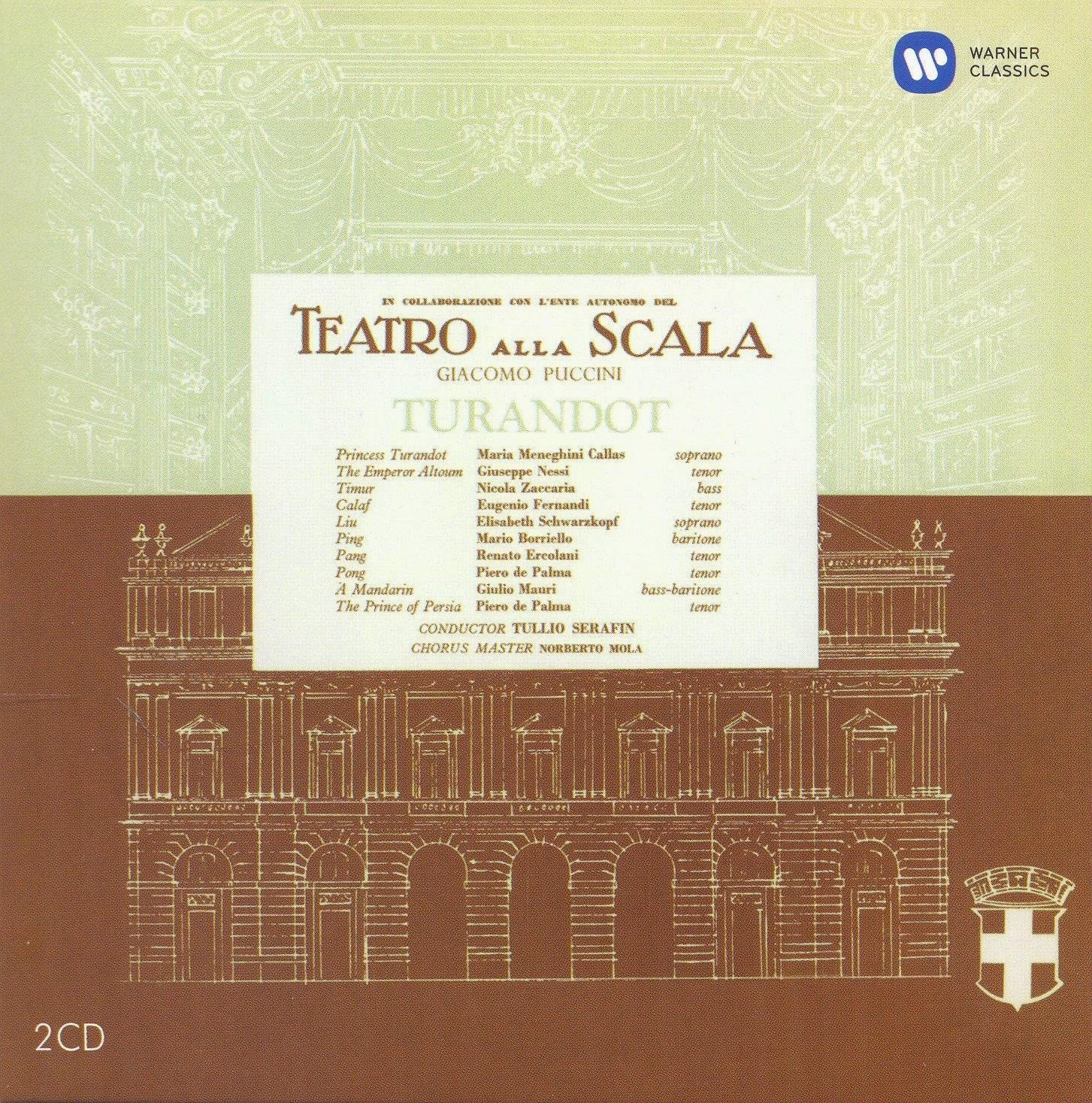
That said, I find the voice less wobbly and ill-supported than I do in the Manon Lescaut, which followed, on which, to my ears, she sounds exhausted, for all her customary musical imagination and insights. She is more secure in this Turandot but she doesn’t really disguise the effort it costs her. Where Nilsson and Sutherland, and Eva Turner before them, soar, Callas is more earth bound. That said, she makes a psychologically more complex heroine than any of them, her singing more subtly layered than we have come to expect from a Turandot. Hear how she vocally points the finger at Calaf in In questa reggia when she sings Un uomo come te, the almost mystical recounting of the story of Lou-u-ling. The first signs of Turandot’s vulnerability come in the Riddle Scene, anxiety creeping into her voice at Si la speranza che delude sempre, and her pleading to her father is almost in the voice of Butterfly, suddenly a daughter trying to get round her father. There are signs of her vulnerability too in the brief scene with Liu, when she asks,  Che posa tanta forza nel tuo core, mirroring Liu’s response with her repetition of the word L’amore. Even the last scene is less of an anti-climax than it usually is. When she sings Che e mai di me? Perduta, we know that she is conquered, and her final aria Del primo pianto is sung with a wealth of detail. For all the evident strain the role makes on her resources, it is a great performance, and she is far less stressed by its demands than Ricciarelli is on Karajan’s recording.

The rest of the cast is interesting. Many have opined that Schwarzkopf sounds as if she had wandered in from the wrong opera, but I like her finely nuanced and beautifully shaded Liu. She is particularly impressive in her exchanges with Turandot and in the mini aria Tanto amore, effecting a wonderful diminuendo on the line Ah come offerta suprema del mio amore. What a pity this is the only time the two most intelligent sopranos of the post war period ever sang together. Fernandi, a strange choice considering he was very little known at the time, and hardly at all since, is rather better than his lack of reputation suggests. Not as exciting as a Corelli (why on earth was he not engaged?) he nevertheless sings a valid Calaf, often phrasing with distinction. Not the best Calaf on record certainly, but not the worst either. Zaccaria is a sympathetic presence as Timur, Ping, Pang and Pong all characterful. There is also a connection with the first ever performance as Nessi, who sings the Emperor, created the role of Pang.

Serafin’s conducting is excellent, urgent and well-paced. What a pity that he doesn’t have the benefit of modern stereo sound, which this of all operas really cries out for. The sound here is, to my ears anyway, less boxy than the sound for Manon Lescaut, though it is not as open as, say, the De Sabata Tosca, which was recorded four years earlier. This Warner pressing sounds a good deal better than my 1997 Callas Edition, with Callas’s voice far less shrill in the upper reaches. It may never be anyone’s library choice for the opera, but I would not want to be without the insights Callas brings to the role. It is, in many respects, a more thoughtful rendering of the score than we often hear.