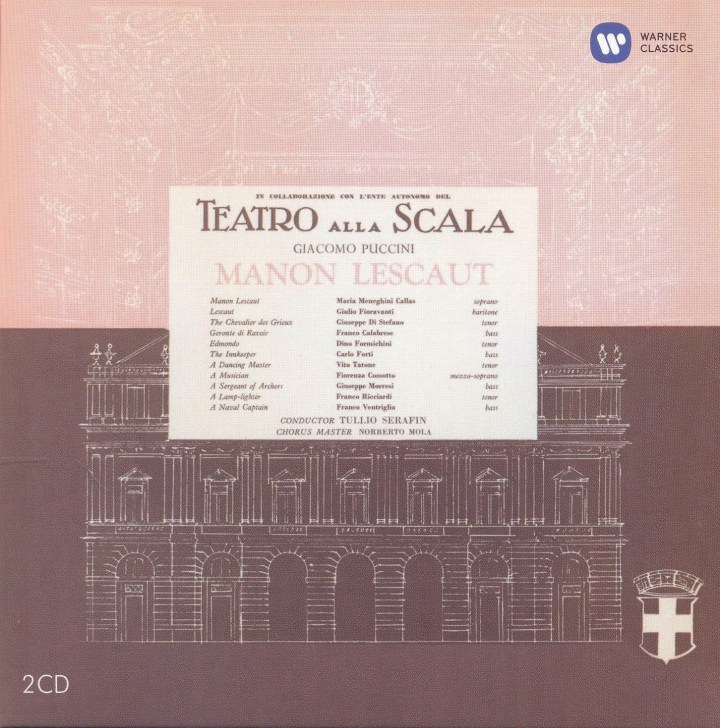
Callas in Manon Lescaut

91nkir4mq2bl-_sl1470_

Recorded 18-27 July 1957, Teatro alla Scala, Milan

Producer: Walter Legge, Balance Engineer: Robert Beckett

Manon Lescaut has never been a favourite opera of mine, and to my mind pales in comparison to Massenet’s work, which is a truer representation of L’Abbe Prevost’s novel, for all that he ends the opera in Le Havre rather than America; nor does this recording rank particularly high in my roll call of Callas recordings. Though recorded in 1957, it waited 3 years before it was released, so presumably Legge and Callas had their doubts too.

For much of the first two acts, the recording itself has a curiously flat sound to it, and though we hear a fair amount of orchestral detail, both strings and voices sound undernourished. I don’t know whether it was me becoming more involved, but things do seem to improve in the last two acts, where Callas also sounds more comfortable vocally.

To my ears, she has always sounded utterly exhausted in this set. It was recorded shortly after Turandot, which she really ought not to have been singing at that stage in her career anyway. She manages Turandot surprisingly well, but the effort it must have cost her shows in the parlous state of her top in much of this Manon Lescaut. She is actually in much better voice in the later complete recordings of La Gioconda, Lucia di Lammermoor and Norma, even the Medea, which followed it, but then in all those she was singing repertoire more suited to her gifts. I’m not sure it was ever the right voice for Puccini, for all her success in the role of Tosca. Not long after this, she sang Amina in Edinburgh and made the studio recording of Medea, neither of which find her in her best form, and it is not until the Dallas Inaugural Recital in November that she recovers form. She is also in stupendous voice for the live La Scala Un Ballo in Maschera in December, so presumably she had benefited from some rest. Even in the middle and lower registers here, much of the velvet is missing from the voice, and even in quieter passages she doesn’t seem to have sufficient energy to support the voice.

Of course, there are, as always, musical compensations aplenty. In the first act, Callas sings with a lightness and purity that mirrors Puccini’s con semplicita markings. Later, her In quelle trine morbide is even more finely nuanced than on the recital disc of 1954, sung more as a reflection to herself than to Lescaut; and the trills and grace notes in L’ora o Tirsi are sung with a lightness and accuracy that eludes most singers of the role; the duet with Des Grieux is full of restrained passion. In Act III she has less to do, but her few exchanges have a weariness and dull despair that is most affecting. However it is in the often anti-climactic final act, where vocally and dramatically she is at her best, with a harrowing Sola perduta and a chillingly moving death scene.

Di Stefano’s singing is variable, occasionally disturbingly tight on top and at other times admirably free, but he does bring personality and face to his singing. Full of youthful joie de vivre in Act I, he becomes a man consumed with love and literally at the end of his tether for Guardate, pazzo son. It’s an appreciable performance, if not the best sung Des Grieux you’ll ever here.

No complaints about the rest of the cast. Fioravanti I have never come across before or since, but he makes an excellent Lescaut and we also get a nice cameo from Fiorenza Cossotto as the madrigal singer.

Serafin, as so often, gets the pacing just right. So much about his conducting is just so unobtrusively right, and in Act III he builds the ensemble leading up to Des Grieux’s outpouring at Guardate, pazzo son in masterly fashion.

Not an opera or a recording that I want to listen to that often, (why oh why didn’t Legge record her in more of the repertoire for which she became famous?) but it certainly has its moments.
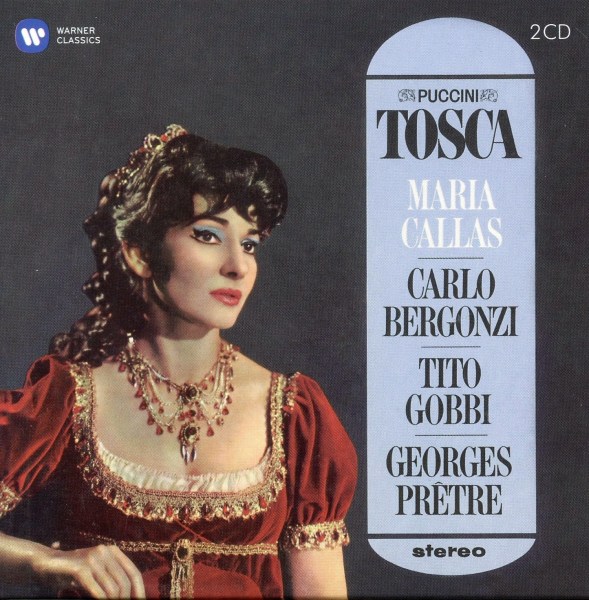
Callas’s 1964 studio Tosca

91idlbhid5l-_sl1500_

Recored July 1964 and January 1965, Salle Wagram, Paris.

Producer: Michel Glotz, Balance Engineer: Paul Vavaseur


I hadn’t heard this set in maybe 20 years. It was actually one of the first complete opera sets I owned, the renowned 1953 De Sabata recording being unavailable when I first started collecting in the late 1960s. According to Zeffirelli, the recording was originally intended to be the soundtrack of a film, a project that unfortunately fell through, but, in any case, EMI obviously wanted to cash in on the success of Callas and Gobbi’s performances together in 1964 and 1965 in London, Paris and New York. Considering how closely they are associated with their respective roles, it is a surprise to find that before the Zeffirelli production at Covent Garden, they had only once before played opposite each other in the opera, and then only in a performance of Act II at a Paris Opera Gala, and yet they cast their shadows over the opera as no others do.

Let’s first get the caveats out of the way. Pretre doesn’t have De Sabata’s grip on the score, but he has his moments, and the torture scene is particularly thrilling; Callas’s voice is considerably trimmed down from the first recording and some of the top Cs are closer to screams than actual notes, though, in this new pressing, they don’t seem anywhere near as bad as I remember them; Gobbi too has lost some of his vocal sheen, but is as authoritative as ever.

However, we should remember that this recording was made at about the same time as Callas and Gobbi were appearing on stage. Even without seeing them, you sense their deep rapport. The producer John Copley was Zeffirelli’s assistant on the Covent Garden production, and he once told me that rehearsing with Callas and Gobbi was not like rehearsing with opera singers at all. Zeffirelli would let them run a whole scene, improvising their moves as you would with actors. They would then sit down and discuss what had worked, what hadn’t and go back over the scene incorporating any new ideas that came up. In all his career, he said, he has never come across such complete actor-singers. This ability to play off each other comes across in all their scenes on disc.

I do miss Callas’s ability to soar and swell the tone at a line such as Egli vedi ch’io piango, but their are compensations. When she cries Non posso piu in Act II, this is literally the sound of a woman at the end of her tether, and her chest tones in son io che cosi torturata rend the heart. In the last act, her recounting of the murder lacks the power of the De Sabata, though she manages Io quella lama gli piantai nel cor better than expected with an exciting plunge into chest voice. Here too the top C sounds better than I remember; I assume this must be something to do with the improved sound picture. Her Tosca on this set is more feminine, more vulnerable, if you like, with dozens of lovely touches in the love duets, if not the ability to ride the orchestra that she had in the first recording.

Gobbi still sounds superb. I doubt I will ever hear another Scarpia to rival him. His Scarpia is a gentleman and a thug and more interesting because of that. A man of impeccable manners, who never gets his hands dirty, making sure he has minions to do his dirty work for him. His performance, too is full of detail. From the unconcerned way he sings La povera mia cena fu interrotta, cruelly feigning surprise at Tosca’s distress, to the ironic tone he adopts at violenza non ti faro, this is a man completely in control.

Cavaradossi? Well Bergonzi sings beautifully, but I missed Di Stefano’s ardour, his winning personality, and he is in especially good voice in the De Sabata recording. Beside him Bergonzi sounds a bit anonymous.

The orchestra play well for Pretre, but they are not the equal of the La Scala players, and of course this set will never replace the classic De Sabata Tosca, which is considered one of the classic opera recordings of all time. This one isn’t entirely without merit, though, and Callas completists will definitely want to have it in their collection.