Go Lovely Rose – The songs of Roger Quilter

91aupp0ckgl._ac_sl1500_

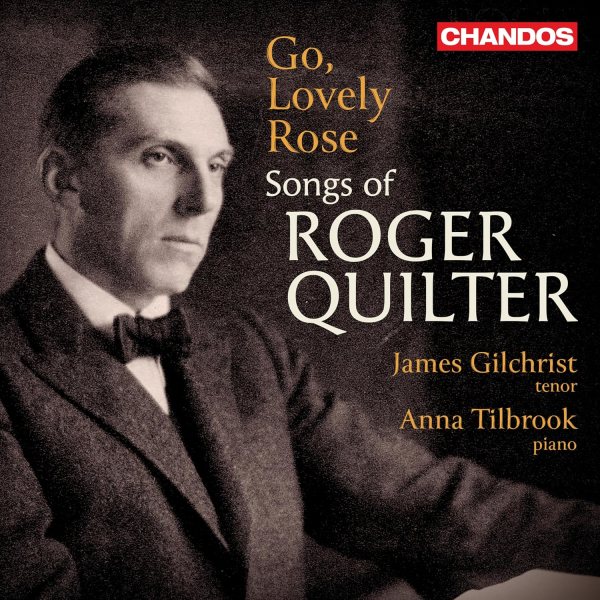
James Gilchrist (tenor) Anna Tilbrook (piano)

The songs of Roger Quilter are not performed as often these days as they once were, which is a shame, because they are beautifully crafted and, though perhaps they don’t probe as deeply into the texts as those of Finzi, Delius and Warlock, they are very rewarding for performers and listeners alike. Quilter had a wonderful gift for melody, but it was always melody put at the service of the poetry and the text is sung more or less as if it were spoken. Having performed many of the songs myself in my youth, I can attest to the fact that they are a gift to the performer.

Rather than give us whole opus numbers, Gilchrist and Tilbrook have chosen songs from his complete oeuvre, with the songs grouped into themes. Thus, we have six Shakespeare songs, drawn from the Op. 6, Op. 23 and Op. 32 sets of Shakespeare settings, five songs associated with flowers (A Floral Tribute), four Folk Song settings (all taken from The Arnold Book of Old Songs), four songs associated with the graveside, and four Songs of Love. The only songs performed as a set are the early German songs, written when Quilter was studying in Frankfurt. These are charming, but slight and give little indication of Quilter’s later, more mature style.

Initially alienated by the rather gruff sound of Gilchrist’s voice in the opening robust Blow, blow, thou winter wind (we are at once aware that this is not the voice of a young man, and indeed Gilchrist was approaching sixty at the time of the recording), I was drawn in by his elegiac delivery of Come away, death, and thereafter, I was less aware of any failing resources. Indeed, in the more gently reflective songs, with which the disc proliferates, Gilchrist is often spellbindingly beautiful, spinning out some lovely pianissimi in such songs as Fear no more the heat of the sun, the famous Now sleeps the crimson petal and the song which gives the collection its name, Go lovely rose. He is admirably supported by Anna Tilbrook, who is an excellent accompanist.

I would not be doing my job as a reviewer if I didn’t point out that there is another similar collection of songs available on the Hyperion label. This was recorded in 1996 by the then much younger John Mark Ainsley with Malcolm Martineau at the piano. Some may prefer Ainsley’s much more forthright manner and fresher timbre, as indeed I occasionally do, especially in songs like Blow, blow, thou winter wind and the ebullient Love’s philosophy, but Gilchrist’s more reflective style has its own rewards, and this is a welcome addition to the Quilter discography

Contents
Shakespeare Songs
Blow, blow, though winter wind, from Three Shakespeare Songs (First Set) Op 6, No 3 (1905)
Come away, death, Op 6 No 1 from Three Shakespeare Songs (First Set) (1905, rev 1906)

Fear no more the heat o’ the sun. from Five Shakespeare Songs (Second Set) Op.23 No 1
Orpheus with his lute. from Two Shakespeare Songs (Fourth Set) Op.32 No 1(1919-20)
O mistress mine, from Three Shakespeare Songs (First Set) Op 6 No 2 (1905, rev 1906)

Under the greenwood tree, from Five Shakespeare Songs (Second Set) (1919)
A Floral Tribute
The Fuchsia Tree, Op.25 No.2 (1923)
Go, Lovely Rose, from Five English Love Lyrics Op.24 No.3 (1922)
A last year’s rose, Op 14 No.3 (1909-10)
Now sleeps the Crimson Petal, Op 3 No 2 91897)
To Daisies from To Julia, Op.8 No 3 (1905)
Folksongs
From The Arnold Book of Old Songs
Barbara Allen, No 13 (c 1921)
Drink to me only with thine eyes, No 1 (c 1921)
My Lady’s Garden, No 10 (c 1942)
The Ash Grove, No 16 (c 1942)
At the Graveside
Autumn Evening Op.14 No.1 (1909-10)
Dream Valley, from Three Songs of William Blake, Op.20 No.1 (1917)
Drooping Wings (1943)
Music, when soft voices die, from Six Songs, Op 25 No.5 (1926)
German Songs
Four Songs of Mirza Schaffy, Op 2 (bef. 1903, rev. 1911)
Songs of Love
Love’s Philosophy, from Three Songs, Op 3 No 1 (1905)
Julia’s Hair from To Julia Op 8, No 5 (1905)
The Maiden Blush from To Julia Op 8, No 2 (1905)
It was a lover and his lass, from Five Shakespeare Songs (Second Set), Op

Dreams Desires Desolation – and Diffidence.

71zl57gifrl._ac_sl1425_

Dreams Desires Desolation

English Song

Trevor Alexander (baritone), Peter Crockford (piano)

Rec. 2021 Henry Wood Hall, London.

This is a disc of English song which re-creates an evening of Parlour Ballads, such as one might have heard in an Edwardian aristocratic home. Even the more contemporary songs fit quite comfortably into this category and in fact the most forward reaching and original song is by Frank Bridge; his last song, Journey’s End,written in 1925 to a text by Humbert Wolfe. Startlingly, the song almost sounds as if it might have been written by Bridge’s pupil, Benjamin Britten and in fact Pears did record the song with Britten at the piano in 1963. Some of the songs are old favourites, that we don’t hear very often these days, though we might know them from older recordings, whilst others are brand new. Indeed, Peter Gelhorn’s Autumn and two songs by Clive Pollard (b. 1959) are here receiving their first commercial recordings. However they are tuneful and tonal and do not sound out of place in a programme of songs mostly written in the early part of the last century.

As you would expect with a title like Dreams. Desires, Desolation the mood is mostly melancholy or dreamlike and I can’t help feeling one or two more lively songs would have created a little more variety in the programme. What would also have helped to enliven the recording is a bit more energy in the performances. Trevor Alexander has a pleasant, light, tenorish baritone and he has excellent diction. Though his is obviously not the voice of a man in the first flush of youth, it is mercifully free of excessive vibrato or wobble. Unfortunately, it is also a little lacking in colour and personality. The performances are somewhat diffident, rather lacking in substance and imagination. Take the opening song, Butterworth’s Is my team ploughing? Alexander commendably attempts to differentiate between the ghost and the young man, but whereas his ghost is convincingly eerie, the young man’s responses need to be more healthily robust. It is also true that many of the older songs tap into a vein of sentimentality that is perhaps not so fashionable today.  Even so, one wants a more open-hearted, outgoing emotional response to both words and music, such as we can hear in some of the old recordings of Jonn McCormack, Richard Tauber, Rosa Ponselle and Kathleen Ferrier. Where their voices and personalities fly out from even the crackliest old 78s, Alexander remains earthbound, nice but dull.

Reading the notes that come with the disc, one appreciates that it was obviously a labour of love for the two artists involved and one doesn’t doubt their sincerity for a moment, but, though there are some interesting discoveries (and re-discoveries) here, the performances need a little more personality and variety to sustain interest throughout a whole disc.

Contents

  1. George Butterworth (1995-1916) – Is my team ploughing?
  2. Frank Bridge (1879-1941) -Come to me in my dreams
  3. Charles Marshall (1857-1927) -I hear you calling me
  4. Roger Quilter (1877-1953) – Now sleeps the crimson petal
  5. Clive Pollard (b.1959) – Go, song of mine
  6. Richard Hageman (1881-1966) -Do not go my love
  7. Ralph Vaughan Williams (1872-1958) -Silent noon
  8. James Frederick Keel (1871-1954) – Remembrance
  9. Victor Hely-Hutchinson (1901-1947) – Dream song
  10. Frank Bridge (1879-1941) – What shall I your true love tell?
  11. Haydn Wood (1882-1959) – Love’s garden of roses
  12. Peter Gelhorn (1912-2004) – Autumn
  13. John Ireland (1879-1962) – If there were dreams to sell
  14. Cecil Armstrong Gibbs (1889-1960) – Silver
  15. Clive Pollard (b. 1959) The cloths of heaven
  16. Ralph Vaughan Williams (1872-1958) – The sky above the roof
  17. Cyril Scott (1879-1970) – Lullaby
  18. Amy Woodforde-Finden (1860-1919) – Kashmiri song
  19. Roger Quilter (1877-1953) – I arise from dreams of thee
  20. Frank Bridge (1879-1941) – Journey’s End
  21. Lucy Elisabeth Simon (1940-2022) – How could I ever know (from the Secret Garden)

A Most Marvellous Party

81wftltatgl._ac_sl1450_

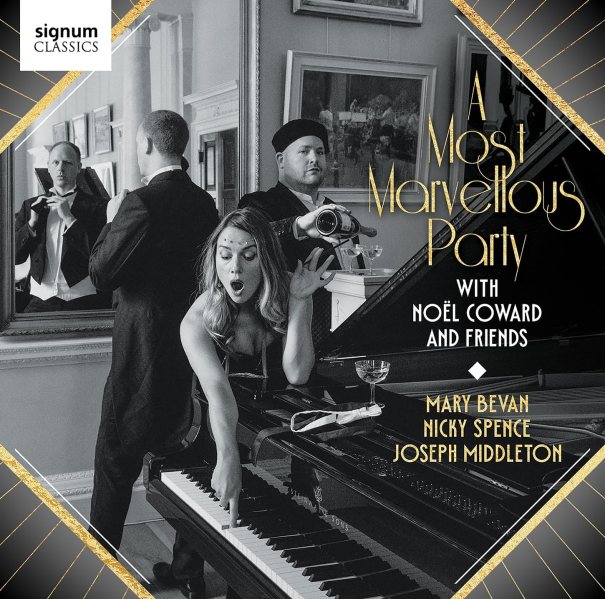
This highly entertaining programme is the sort of thing that would go down well at a country house or in a small hall, and indeed I see that these artists performed it at the Leeds Conservatoire in March this year, shortly before making this recording. Mary Bevan should not be confused with her sister, Sophie, also a soprano with quite a career herself, nor Nicky Spence with tenor Toby Spence, to whom he is not related. Both singers are active on the operatic stage as well as on the concert platform and here let their hair down in some lighter music.

The “party” seeks to place Noel Coward among other contemporary composers, all of whom have a connection with Coward, however slight. Thus, the other guests turn out to be Ned Rorem, who claimed to have once had a one-night stand with Coward, Poulenc for whom Coward once did the narration on a recording of his Babar, the elephant and Stravinsky, who apparently once asked Coward to collaborate with him. Gershwin’s music Coward had known for some time and even played snatches of it on stage in the first production of his play, The Vortex. The connections with Satie, Messager, Britten and Walton would seem to be a little more tenuous, but I’m nonetheless delighted that they came along. It’s also good to encounter some songs by Roger Quilter and Liza Lehmann, especially given Bevan’s rapturous account of Lehmann’s gorgeous Love, If You Knew The Light, and Spence’s lovely singing of Quilter’s famous setting of Tennyson’s Now Sleeps The Crimson Petal, which is nicely contrasted to Ned Rorem’s sparer, but equally valid setting of the same poem sung by Bevan, a song that was new to me. It slightly reminded me of Britten’s version, which he eventually cut from the Serenade for Tenor, Horn and Strings.

Both Bevan and Spence are rather better in the more lyrical songs by Coward than they are at the patter songs, and there are a couple of misses in the sequence. Spence can’t resist the temptation to overplay the comedy in Don’t Put Your Daughter on The Stage, Mrs Worthington and I have a feeling this rendition would become rather triresome on repeated listening. One only has to compare the Master, with his brilliantly understated and clipped delivery to hear how it should be done. Nor can Bevan quite cast off the slightly jolly-hockey-sticks quality she has adopted in the opening Coward medley when she turns to Kurt Weill’s Complainte de la Seine, a song which is absolutely harrowing when sung by Teresa Stratas. I also rather wish that Spence, rather than Bevan, had been allowed to sing Mad About The Boy, given that we now know the song was written by Coward about a man he had fallen in love with. However, Spence does get to sing If Love Were All, a song that was originally written for the character of Manon in Coward’s operetta Bitter Sweet, but which Coward himself later made very much his own.

Britten is represented by two early W, H, Auden settings, one of which, As it is, plenty, sounded strangely like something by Stephen Sondheim, though it was written only a few years after Sondheim was born. I wonder if he knew it. I rather wish room had been found for Bevan to sing Coward’s Zigeuner from Bitter Sweet and that perhaps it would have been better to close the recital with the gently wistful The party’s over now rather than the slightly over-rumbustious I went to a marvellous party, but apart from these and a few other minor reservations expressed above, the two singers acquit themselves very well and the pianist, Joseph Middleton is a wonderful collaborator, both as accompanist and when playing solo in pieces by Poulenc, Satie, Stravinsky and Gershwin.

All in all, this is a highly enjoyable disc and one which I will definitely be returning to from time to time.

Full programme

  1. Coward Medley (all three artists)
  2. Coward: Mad about the boy (Bevan)
  3. Rorem: Early in the morning (Spence)
  4. Rorem: For Poulenc (Spence)
  5. Poulenc: Pastorale calme et mystérieux (Middleton)
  6. Poulenc: Hotel (Bevan)
  7. Coward: Parisian Pierrot (Spence)
  8. Weill: Complainte de la Seine (Bevan)
  9. Messager: De ci, de là (Bevan and Spence)
  10. Satie: Gnossiene No. 1 (Middleton)
  11. Coward: Any little fish ((spence and Bevan)
  12. Stravinsky: Valse pour les enfants (Middleton)
  13. Coward: Something to do with Spring (Spence and Bevan)
  14. Quilter: Love calls through the summer night (Bevan and Spence)
  15. Quilter: Now sleeps the crimson petal (Spence)
  16. Rorem: Now sleeps the crimson petal (Bevan)
  17. Coward: World weary/Twentieth century blues (Bevan and Spence)
  18. Gershwin: The man I love (Middleton)
  19. Coward: If love were all (Spence)
  20. Gershwin: By Strauss (Bevan)
  21. Coward: Don’t put your daughter on the stage, Mrs Worthington (Spence)
  22. Britten: When you’re feeling like expressing your affection (Bevan)
  23. Walton: Popular Song (Spence)
  24. Britten: As it is, plenty (Bevan)
  25. Lehmann: Love, if you knew the light (Bevan)
  26. Coward: The party’s over now (Bevan and Spence)
  27. I went to a marvellous party (Bevan and Spence)

Maggie Teyte – The Singers

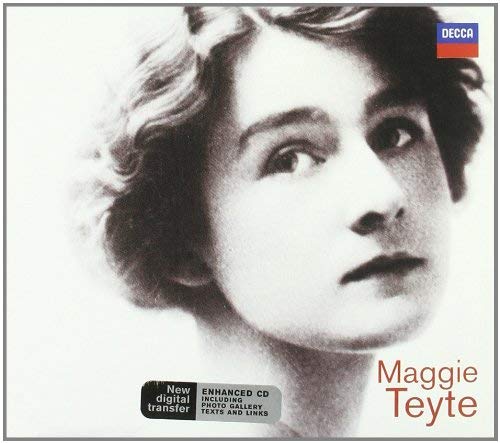
These recordings were all made in the 1930s and so pre-date the two disc set of French song I reviewed a few months ago here, with the second part of the disc being taken from a 1937 radio broadcast. One of the songs (Armstrong Gibbs’ The fields are full of summer still) was newly discovered in 2001 and first published on this CD.

We start with one of Dame Maggie’s most famous performances, that of Périchole’s Tu n’es pas beau, sung with great affection, a twinkle in the eye and with that wonderful dip into her inimitably glorious chest voice. Though a light soprano with pure, firm top notes, Teyte’s lower register was admirably rich and full in a manner we rarely hear today, more’s the pity. The orchestra here sounds like a palm court orchestra at a tea dance, but the singing is another matter entirely and alone well worth the price of the disc. The two excerpts from Messager’s Véronique, which follow are almost as good.

Teyte was particularly renowned for her interpretations of French song, but we are vouchsafed only two (very well known) songs from that field, Fauré’s Après un rêve and Hahn’s Si mes vers avaient des ailes. The Fauré is much better than the one on the French song disc mentioned above, where I felt she fussed with the song too much making it lose its natural flow, and the Hahn is as lovely as the later recording with Gerald Moore. These are followed by two Dvorak songs, Christina’s Lament, which turns out to be his Humoresque arranged for voice and piano, and the ubiquitous Songs my mother taught me, both beautifully sung.

These are followed by a group of songs from light musicals, mementoes of her days spent in British Music Hall. They may be musically slight, but Deep in my heart, dear from Romberg’s The Student Prince was actually one of Dame Maggie’s favourite recordings. It crests with a high B, which she thought the most beautiful note she had ever recorded. Certainly the note rings out clear and clean as a bell.

The lion’s share of the disc, however, is given over to a 1937 BBC broadcast recital, which couples popular songs by Schumann and Brahms to a group of English songs by turn of the century composers Quilter, Bridge, Delius, Armstrong Gibbs and (completely new to me) Amherst Webber and Graham Peel. As ever, the voice is bright and pure, her manner direct and disarming, her diction and intonation well-nigh perfect. Admittedly, there are aspects of her singing which some might find quaint and old fashioned today, but her technique is superb and her voice remained firm and clear well into her sixties.

Perhaps because of some of the material, this is not quite so recommendable as the EMI two disc set of French songs, but I would never want to be without it, if only for the wonderful aria from La Périchole.