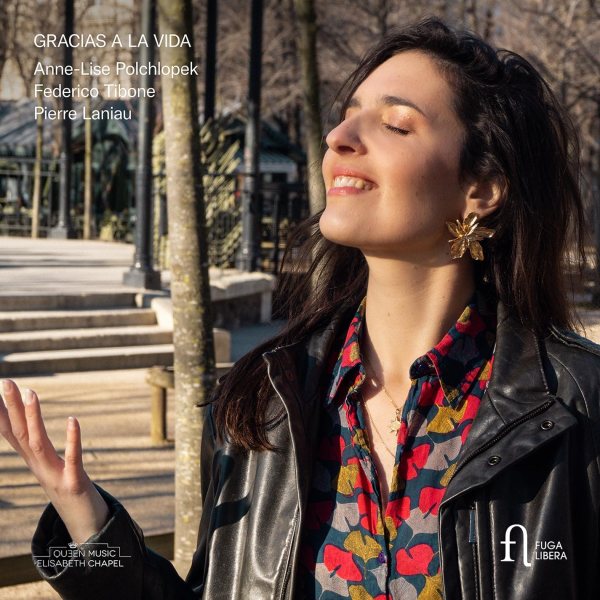
Gracias a la vida – Anne-Lise Polchlopek

It seems not a month goes by without a new recital record from a young artist making an impression. Recently I’ve welcomed recital records from Benjamin Appl, Fatma Said, Harriet Burns, Rachel Fenton and Eva Zalenga , and July saw a recommendation for Julieth Lozano-Rolong’s new disc from Dominy Clements. To this list can now be added the name of French mezzo-soprano, Anne-Lise Polchlopek, a winner of several song competitions, and now an associate artist of the Queen Elizabeth Music Chapel, where this recording was made.

This recital may at first glance appear to be a hotchpotch of different styles, embracing classical Lied, folk and popular music, but Polchlopek somehow integrates these different musical styles into a satisfying whole, and the recital benefits from being listened to at one sitting. It doesn’t get off to the best of starts with her somewhat over-articulated and over-acted singing of Bernstein’s Old Lady Tango (I am easily assimilated) from Candide, but she then sings a beautiful version of Strauss’s Wiegenlied, with a lovely legato line, her mellifluous mezzo wrapping the child in its warm embrace.

From Germany we travel to Spain and France, where we stay for the remainder of the recital. Toldrá is followed by Chaminade, then we switch to guitar accompaniment for Hubert Giraud’s La tendresse, staying with the guitar for an extremely effective performance of Falla’s Nana, from his Siete canciones populares españolas.

We go back to the piano for Fauré’s Les berceaux, in which she builds nicely to the climax, and then we have Messiaen’s early Trois melodies, where she captures to perfection the ecstasy of the writing, especially in the final song, la fiancée perdue.

 These are followed by three songs in a lighter vein by Chaminade, Pauline Viardot and Gerónimo Giménez, all wonderfully characterised. Perhaps incongruously (but somehow it works) Voi che sapete from Mozart’s Le nozze di Figaro acts as a bridge to Michel Polnareff’s Mes regrets, a beautiful song about lost love, which is followed by Fauré’s Toujours.

This in turn is followed by Gérard Jouannest’s La chanson des vieux aimants, with lyrics by Jacques Brel, a song I had previously only known in a version by Judy Collins. Suffice it to say that Polchlopek’s intensely moving performance put any thoughts of Collins out of my mind completely.

Throughout the piano accompaniments of Federico Tibone contribute wonderfully to the success of the disc, as do the guitar accompaniments of Pierre Laniau, who accompanies her on Tamás Méndez’s charming Cucurrucucu paloma, which I seem to remember was a favourite of Nana Mouskouri. He also accompanies her on the Habanera from Bizet’s Carmen and Satie’s La diva de l’empire, though I did feel the Bizet was slightly out of place here, coming, as it did, after the piano accompanied Poulenc Les métamorphoses and before the Satie.

We return to piano accompaniment for Montsalvatge’s Canto negro, which she sings with charm and spirit, relishing the yambambós, as Victoria De Los Angeles did before her.

All three participants come together for the final song, Violetta Parra’s Gracias a la vida, a fitting end to a journey on which Anne-Lise Polchlopek has proved to be a most musical guide. Throughout she clearly and meaningfully enunciates the text, and it is clear she has a rare gift for communication that makes her an ideal recitalist.

Unfortunately, though the notes accompanying the disc are in English, the online texts are only in the original language, French, Spanish, German, or in the case of the Bernstein, English, and translations would have helped for a total appreciation of Polchlopek’s art. However, I thoroughly enjoyed this disc, and I look forward to hearing more of Anne-Lise Polchlopek.

Reflet – Sandrine Piau sings French orchestral songs

81uc3fhnuwl._ac_sl1500_

I know Sandrine Piau principally as a singer of Baroque and Classical music, but she has recently been venturing into the nineteenth and twentieth centuries and this is the second disc in a series, which began with a disc of orchestral songs by Strauss, Berg and Zemlinsky entitled Clair-Obscur. The notes accompanying the disc tell us that that earlier disc sought to explore “the confrontation between shadow and light,” whilst this one “evokes the nuances and transparencies of the French mélodie.”

Essentially what we have here is a nicely put together programme of French orchestral song, starting with Berlioz and taking us through to Britten’s early Ravelian Quatre chansons Françaises via Duparc, Koechlin, Debussy and Ravel himself. The programme is not long (under an hour) and is fleshed out with André Caplet’s orchestration of Debussy’s Clair de lune and Ernest Ansermet’s of the sixth of his 6 Epigraphes antiques. Admirably as the orchestra plays throughout under Verdier, these add very little to the programme and I would have welcomed more songs, maybe something by Chausson, Delage or Canteloube, or more by Koechlin, who is not so well represented in the catalogue. If I’m honest, I prefer the Debussy items in their original piano guise. Unlike Ravel’s orchestrations of his own piano pieces, the arrangements don’t really improve on the originals.

The Koechlin songs were new to me, and I rather wish Piau had explored more than the three we have here. If they pique your curiosity, as they did mind, then they are available sung by Juliane Banse, along with a lot more of Koechlin’s vocal works with orchestra, in a two disc set in Hänssler’s Koechlin edition. What we have here is two songs from his early 4 poèmes d’Edmond Haraucourt. Op.7, and one from the slightly later 3 mélodies, Op. 17. If they lack some of Duparc’s natural melodic gift, they are nonetheless lushly orchestrated and rather beautiful  and make an excellent partner for the two Duparc songs.

If the Koechlin songs afforded me the most pleasure, that could be because I didn’t know them before and therefore had no point of comparison, whereas I know all the other material rather well. I’ve loved the Britten songs since they were first recorded in the 1980s. Admittedly one can hear the influence of Ravel, particularly of Shéhérazade, but they are remarkably assured from a boy of fourteen and they do not feel out of place here, whilst the sparer textures of Ravel’s Mallarmé settings, written for two clarinets, two flutes, piano and string quartet, provide a nice contrast to the lush orchestrations of the rest.

Piau is now in her fifties and the voice has lost a little of its bloom on high. She also uses what the late John Steane once referred to as a squeeze-box method of vocal production, a tendency to move note by note rather than in a long line, which, once noticed, is hard to ignore. I also hear a slight sense of strain in the Britten songs, particularly at the close of the final song, which is not as radiant as it should be, and as it is in the performances of Jill Gomez, who made the first recording of them for EMI under Simon Rattle, and Felicity Lott, who recorded them for Chandos under Bryden Thomson.

The opening Berlioz Le spectre de la rose is taken a mite too fast for my taste and is a little on the cool side, but it does rather set the general tone of the recital. If you like it, then you will no doubt like the whole disc, but I found Piau a little lacking in involvement, a little detached.

I don’t want to belabour the point too much, because this is a very enjoyable programme, well considered and well put together and, for the most part, Piau’s singing is quite lovely, but, in the Berlioz, Duparc, Ravel and Britten, I found myself inwardly hearing the voices of some of those who have preceded her. Still, if you’re looking for a mixed programme of nineteenth and early twentieth century French orchestral song, then this disc will provide a lot of enjoyment.


Ravel’s complete Mélodies

oc00odm5lmpwzwc

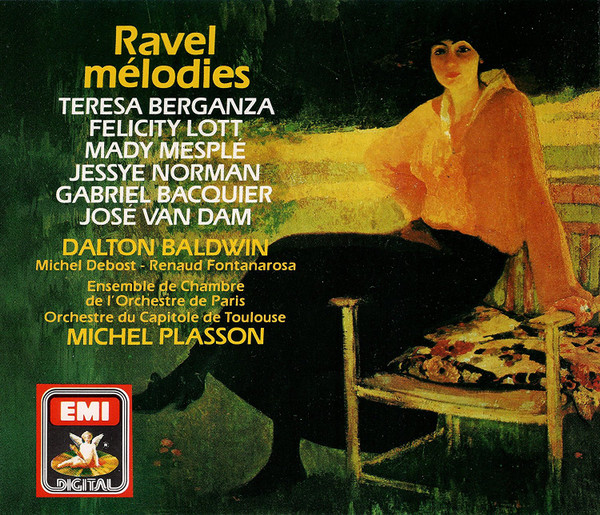
This set was originally issued on three LPs back in 1984, and later condensed into two very well filled CDs and is still available as a download. As such, it is an excellent way of collecting all Ravel’s song settings, the singers all being well chosen for the songs they are allocated. It also has Michel Plasson in charge of the orchestral and chamber accompanied songs and that master accompanist, Dalton Baldwin, at the piano.

We start with Teresa Berganza singing Shéhérazade, orchestrally fine and well sung, but Berganza is just a little anonymous and the performance doesn’t stay in the memory as do those by, say, Crespin, Hendricks or Baker, all of whom are more vivid storytellers. The orchestral contribution by Plasson and his Toulouse orchestra is splendid. This is followed by the Vocalise en forme de Habanera and Chanson espagnole, ideal performances in which Berganza finds the erotic sensuality that had eluded her in Shéhérazade.

Next up is Gabriel Bacquier, who is entrusted with Histoires naturelles, Sur l’herbe and Chanson française. These are superb performances, Bacquier finding just the right sense of ironic derachment for the Renard settings, his enunciation of the text so clear you can all but taste the words.

Mady Mesplé’s clear, bright, very French soprano with its characteristic flutter vibrato is not to everyone’s taste, but I like her, and she is absolutey charming in the Greek songs, including the less regularly performed Tripatos. She also gives us lovely performances of three rarities, Ballade de la reine morte d’aimer, Manteau de fleurs and Rêves. José Van Dam gets the Hebrew settings, Don Quichotte à Dulcinée and five more songs, of which Les grands vents venus d’outre-mer is especially notable. To all he contributes the sterling virtues of his beautiful, firm bass-baritone, coupled to sensitive treatment of the text.

Felicity Lott, charming in the Noël des jouets and Chanson écossaise, also has the Mallarmé poems, in which she is suitably languid, if a little diffident. She is also good in the two Clément Marot settings, but Maggie Teyte gets more out of the words on her recording. Jessye Norman brings the collection to a close with the Chansons madécasses, as well as Chanson du rouet and Si morne. As usual, Norman is never less than involved, but as so often I find she sings with an all-purpose generosity, and I’d have welcomed a little more of Janet Baker specificity. Still this is nitpicking, and hers are still among the best versions of these wonderful songs. Throughout the piano accompanied songs Dalton Baldwin provides superbly idiomatic playing, with the Ensemble de Chambre de l’orchestre de Paris providing the accompaniment for the Mallarmé settings and Michel Debost on flute and Renaud Fontanarosa on cello in the Madegascan songs.

Altogether, this is a wonderfully rewarding set and, if individual performances have been bettered elsewhere, all are more than adequate and many a great deal more than that, though, on this occasion, it is the gentlemen who take the palm. Warmly recommended.

Two Contrasting Vocal Recitals

71mojlgie4l._ac_sl1073_

Dame Maggie Teyte in concert, at the age of sixty no less! Teyte, a famous Mélisande who studied the role with Debussy himself, sings extended excerpts from the opera with piano accompaniment, singing all the roles. It shouldn’t work, but somehow it does. It takes her the first song in the recital (Grétry’s Rose chérie) to warm up, but thereafter you would never believe this was the voice of a sixty year old woman. The disc also includes privately recorded excerpts from Strauss’s Salome also with piano, from when Teyte was preparing the role for Covent Garden about fifteen years earlier, a project that unofrtunately never came to fruition. Her bright, slivery soprano might just have been the voice Strauss imagined.

She also sings Britten’s Les Illuminations in a version for piano, making me wish she had recorded the orchestral version, although preferably a few years earlier. Just occasionally there is a flicker of frailty in the middle voice, although the top register remains firm and clear as a bell. The encores include a lovely performance of Hahn’s popular Si mes vers avaient des ailes.

r-2563085-1290611066.jpeg

Another enterprising disc from Dawn Upshaw, who seems to have disappeared from the scene now. The centrepiece is Earl Kim’s Where grief slumbers written in 1982 for voice, harp and string orchestra, but here presented in a 1990 arrangement for voice, double string quartet and harp, and Upshaw is an ideal interpreter. She is equally at home in the rest of the programme; Falla’s Psyché, Ravel’s Trois poèmes de Stéphane Mallarmé, Stravinsky’s Two poems of Konstantin Bel’mont and Three Japanese Lyrics and Delage’s Quatre poèmes hindous, though here I slightly prefer the warmer tones of Dame Janet Baker, who is much more languidly erotic in the worldess vocalise of Lahore. Nevertheless a thoroughly absorbing disc.

As with so many of these Nonsuch discs, documentation is slight, and, though we do get lyrics and translations, the layout is confusing and a little more information about the provenance of these songs, especially the less famous Kim cycle, would have been much appreciated.

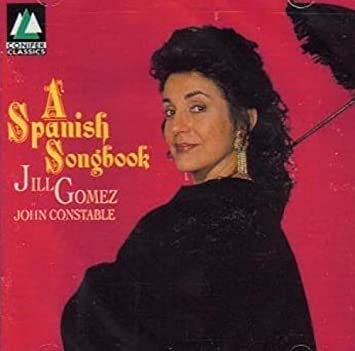
A Spanish Songbook – Jill Gomez

516xghgdgjl._sx355_

What an utterly charmng and delightful disc this is, cleverly planned and beautifully executed.

With her distinctive timbre and wonderfully expressive voice, Gomez’s personality fairly bursts through the speakers and she is superbly supported here by John Constable on the piano, who unerringly captures the mood of the songs. You feel as if these two artists really enjoy making music together, and indeed their association is a long one, having first appeared on disc together twenty years earlier. Gomez would have been in her early fifties when the present disc was recorded but the voice has hardly changed in the intervening years.

What we have here is a compendium of Spanish inflluenced songs by German, French and English composers, as well as songs by Spanish composers, covering a wide range of styles and eras. The programming is eminently sensible and makes for very satisfying listening.

We start with a group of sixteenth century Villancios from the courts of Charles V and Philip II in piano arrangements by Graciano Tarragó, which encourage the kind of decoration and improvisation of the 16th century vilancico. Fuenllana’s De los alamos vengo, madre is no doubt better known from Rodrigo’s orchestral arrangement, but Gomez sparkles quite as much here.

From thence we turn to a group of Spanish influenced songs by Wolf and Schumann, in which Gomez captures perfectly the deep melancholy of Schumann’s Tief im Herzen trag’ ich Pein as well as the girlish coquettishness of Wolf’s In dem Schatten meiner Locken. Spain has always provided a deep vein of inspiration for French composers, so we are next treated to a group of songs by Bizet, Ravel, Saint-Saëns and Délibes in which Gomez’s sense of style is impeccable.

Next come the three Granados Tornadillas, in which we are probably more used to hearing the fuller, chestier sound of someone like Conchita Supervia. Gomez intelligently, rather than copy her style, is more languorous. I might prefer Supervia’s vibrancy, but Gomez’s way is just as valid.

The two Walton songs, both taken from Façade, find Gomez pointing Edith Sitwell’s lyrics deliciously and lead us into the final group, which Gomez calls “Seven Other Popular Songs”. The first three songs are by Roberto Gerhard, who, as an exile from Franco’s Spain, had relocated to Cambridge in the UK in 1942, where he lived until his death in 1970. These are his versions of folk-songs collected by his teacher, Felipe Pedrell. bittersweet souvenirs of a composer in exile. The others are by Tarrago, Rodrigo, Guridi and Obradors. Gomez is yet again a wonderful guide through this musical journey of Spain, brilliantly capturing the mood of each song.

An excellent recital that should be a lot better known than it is.

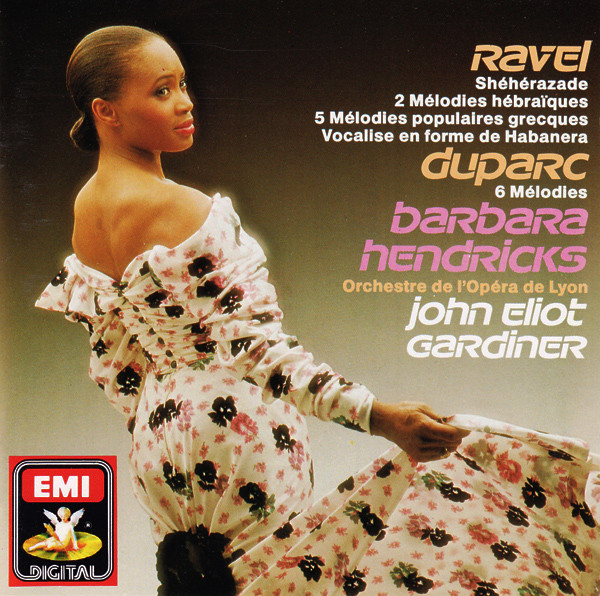
Barbara Hendricks – Ravel and Duparc

r-3319230-1325585118.jpeg

What a gorgeous disc this is. Quite why Hendricks’ version of Ravel’s Shéhérazade is not as famous as those by such as Crespin, Baker and De Los Angeles is beyond me for not only is the singing ravishing, but the orchestral playing under John Eliot Gardener superb, and quite a lot better than that of the Suisse-Romande on Crespin’s recording. Furthermore, though born in America, Hendricks has lived in Europe since 1977 and in Basel, Switzerland since 1985 and her French is virtually flawless.

The disc opens with Ravel’s Shéhérazade and the opening measures of Asie are sung with a gorgeous sensuality, which then gives way to girlish delight when she sings of sailing away on a schooner. What a vivid story-teller she is, alive to every change of mood and how beautifully she is accompanied by Gardiner, who brings out fabulous detail in the orchestral score, without losing its sensuous exoticism. In la flûte enchantée she is suitably languid, until the voice breaks out with a real burst of joy, when she describes the flute alternately pouring forth sadness and joy, whilst L’indifférent is deliciously ambiguous.

The rest of the Ravel programme is hardly less fine. My notes are peppered with words like gorgeous, sensual, exotic for the Mélodies hébraîques, which perfectly suits their colourful musical language, but the singer of the Mélodies populaires grecques is evidently younger, more innocently coquettish, the tone more forwardly produced, though I do slightly miss Victoria De Los Angeles’s delightful simplicity in the final song, Tout gai. The Vocalise en forme de Habanera returns us to the sensuality of the Hebrew songs and is absolutely ravising.

The Duparc songs are not quite up to the standard of the Ravel, but still very worth having. Both L’invitation au voyage and Au pays oû se fait la guerre really require a greater range of tone colour and Le manoir de Rosemonde lacks a little in drama. Best of all are a flowingly lyrical Chanson triste and a sexily indolent Phydilé though others, like Teyte and Baker, have encompassed its climax with greater ease.

Nevertheless this is a gorgeous disc, one of the best versions of the Ravel pieces around and, if the Duparc songs aren’t quite at the same level of excellence, they are still very fine indeed.

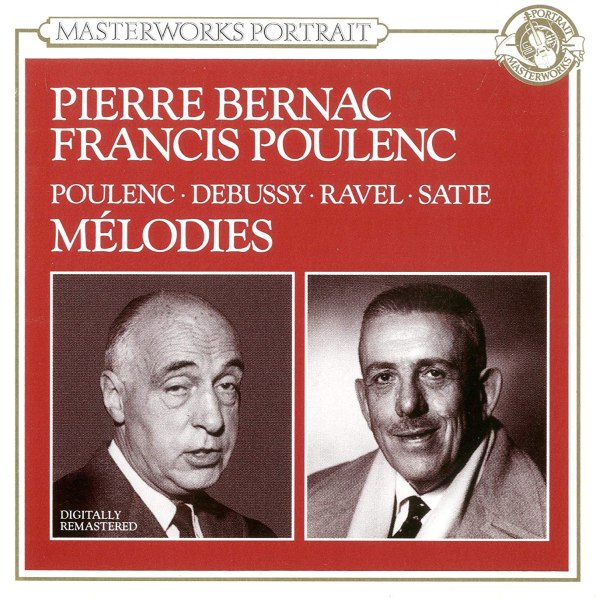
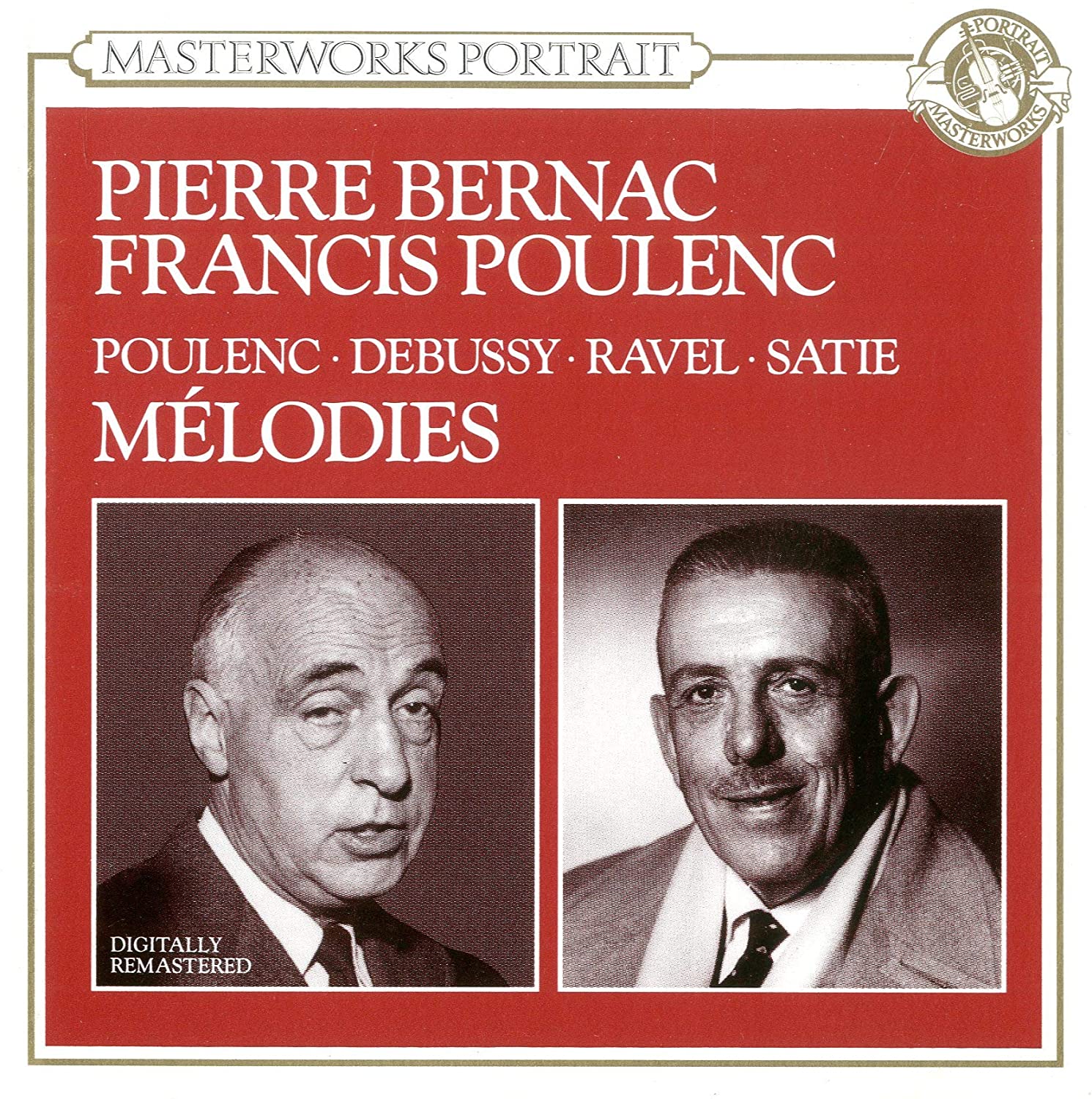
Pierre Bernac & Francis Poulenc – Mélodies

91khamjrtvl._sl1500_

Poulenc:
Banalités
Chansons villageoises
Quatre poèmes de Guillaume Apollinaire
Tu vois le feu du soir
Main dominée par le coeur

Debussy:
Beau soir
L’écheonnement des haies
Le Promenoir des deux amantes

Ravel:
Histoires naturelles
Mélodies hébraïques

Satie:
Trois mélodies

Pierre Bernac and Francis Poulenc had a long and fruitful working relationship, going back to 1926 when Bernac gave the first performance of Poulenc’s Chansons gaillardes (not included on this disc). They first appeared in recital together in 1934 and continued to do so until Bernac retired from public performing in 1960. In fact the majority of Poulenc’s songs were written for Bernac and I suppose one could say that they enjoyed a similar relationship to that of Britten and Pears, without the emotional attachment, apparently always using the polite ‘vous’ with each other at all times.

Bernac’s voice was evidently not large but he had an enormously varied tonal palette which enabled him to capture every shift in mood, every emotion, implied or overt, in each song. Though the voice was not of itself of great natural beauty, its range was wide and Poulenc exploited this to great effect. Bernac was also a great teacher, numbering Gérard Souzay, Elly Ameling and Jessye Norman among his pupils, and he wrote with great insight about the art of singing. His The Interpretation of French Song is an absolute must for anyone interested in performing this repertoire.

Bernac and Poulenc left behind quite a legacy of recordings, most of them recorded for EMI and RCA in 1947. However these Columbia sessions took place in 1950. The Poulenc selection is self recommending, but he is equally at home in the songs of Debussy, Ravel and Satie, embracing the lyricism of Debussy’s Beau soir, the slightly detached irony of Ravel’s Histoires naturelles or the parodic wit of the Satie songs.

Anyone who enjoys the subtle art of French song should definitely hear them.

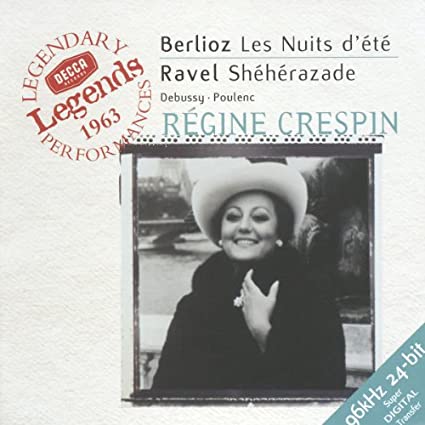
Crespin’s Shéhérazade

513oqn2fqcl._sx425_

Crespin’s recording with Ansermet of Ravel’s Shéhérazade and Berlioz’s Les Nuits d’été is now so famous, so universally acclaimed that there can surely be no more to say about it. Even today, almost 60 years since they were recorded, the performances are still cited by many as a first choice in both works and for many they were no doubt their first exposure to the works, so maybe that is all that needs to be said about them, but is it really so simple?

Both Shéhérazade and, especially, Les nuits d’été are great favourites of mine and I now have ten different recordings of the Berlioz, six of the Ravel. Let us then start with the Ravel. From the thrice repeated call of Asie at the beginning, the third sung with the equivalent of a flirtatiously arched eyebrow, we are in her thrall. She makes a bewitching storyteller, drawing us in with her thrillingly colourful descriptions of the Orient. As I often feel with Crespin, there is a slight air of detachment but here it suits the narrative superbly. She is suitably languid in La flûte enchantée and deliciously ambiguous in L’indifférent. There have been finer versions of the orchestral score (not least the New Philharmonia under Barbirolli for Janet Baker), but Crespin at her best is still a prime recommendation. There is something just so inevitably right about her singing and it places her (just) ahead of the other versions I own, (Teyte, Baker, De Los Angeles, Berganza and Hendricks).

That air of detachment I mentioned also makes her an ideal interpreter of the songs of Poulenc and also Debussy’s Trois chansons de Bilitis with John Wustman on the piano, from a 1967 recording, which are here included as a makeweight, and very welcome they are too. However it works against her in the Berlioz, which requires a degree of involvement and passion that I find lacking in Crespin’s delivery. However musical and tasteful her singing, however elegant her phrasing, she remains aloof and uninvolved. There is no sense of mounting rapture at the arrival of the rose from paradise, no sense of longing in Absence. She is at her best in the final song, L’île inconnue which is blithely insouciant and responds better to her air of suave sophistication. I have no idea why she decided to place Sur les lagunes after Absence but it upsets the balance of the work too.

No, for the Berlioz my prime recommendations would be Baker either with Barbirolli or live with Giulini, Hunt Lieberson with McGegan, Steber with Mitropoulos or De Los Angeles with Munch, Crespin trailing quite a way in their wake.

Essential I would say for Shéhérazade and the Debussy and Poulenc, but look elsewhere for the Berlioz.

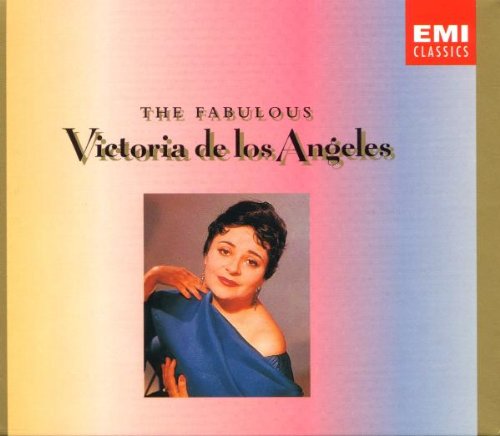
The Fabulous Victoria De Los Angeles

41lkah6q4pl

This well-filled four disc set was issued to time in with De Los Angeles’s seventieth birthday in 1993, when, incredibly, she was still active on the concert platform, having made her stage debut in 1941. I don’t know when she officially retired, but she died just over ten years later. The set dates from the good old days, when notes texts and translations were included. Not all of this material is that familiar, so they are absolutely essential. Nowadays you are lucky to even get a web link to them.

The set concentrates on the recital side of De Los Angeles’s career and all the recordings date from the 1960s and early 1970s, with two discs of song with orchestra and two with piano or, as in the case of Falla’s Psyché chamber ensemble.

Disc 1 covers French song with orchestra (though not her wonderful recording of Les Nuits d’Eté, which was recorded for RCA). We start with one of the most recommendable of all versions of Ravel’s Shéhérazade, in which she is a vivid narrator, taking an almost childlike pleasure in the sights she describes. In the Cinq Mélodies populaires grecques she is the epitome of a young village girl, whilst the Deux Mélodies hébraïques bring out a more seductive quality in her voice. Chausson’s Poème de l’amour et de la mer exposes the occasional fragility in the voice, but is still a beautiful performance.

Disc 2, which concentrates on Spanish song with orchestra, would probably be my favourite of the four. It almost exactly reproduces a disc called The Maiden and the Nightingale, released in EMI’s Great Recordings of the Century, though it omits that Granados title track. Favrouites here are the Montsalvatge Cinco canciones negras; wonderfully soothing in the Cancio de cuna para dormir a un negrito and irresistibly playful in the Yambambos of the Canto Negro. I also love Mompou’s El combat del Somni, especially the soulful Damunt de tu nomes los flors. Another joyful performance is Rodrigo’s De los alamos vengo, madre. We are reminded that De Los Angeles probably did more than any other singer to put Spanish song on the map.

Disc 3 brings us more French and Spanish repertoire, this time with piano accompaniment, or chamber ensemble as in Falla’s Psyché. Though her French isn’t entirely idiomatic, she is an ideal interpreter of Debussy, Ravel, Fauré and Hahn. The performance here of Falla’s Sietes canciones populares españolas, with Gonzalo Soriano at the piano, is not generally considered her best, and it is true she is not as fierily earthy as Conchita Supervia, but equally valid in its more playful style.

Disc 4 is more mixed, and presumably covers material likely to turn up in her recitals as openers or encores. I have always treasured her performances of Fauré’s Chanson d’amour, which is sung with a delightful smile in the voice, and her ideal performance of Clair de lune, which captures to perfection its ancien style, but includes a wonderful change of colour when the accompaniment switches to a more fluid figure at Au calme clair de lune. All the piano accompaniment on this disc is provided by Gerald Moore and it also includes a group of duets (from Purcell to Tchaikovsky) with Dietrich Fischer-Dieskau, finishing off with a couple of extracts from Moore’s farewell concert at the Royal Festival Hall, with Schwarzkopf joining the pair for Mozart’s La Partenza.

To get a fuller picture of this lovely artist, one would ideally want some representation of her operatic career, but this one captures well many elements of the recital side of her career. As in all such compilations, I might cavil at some of the choices, but the programme over the fours discs is varied and enjoyable, and De Los Angeles always brings her inimitable individual stamp to all she sings.


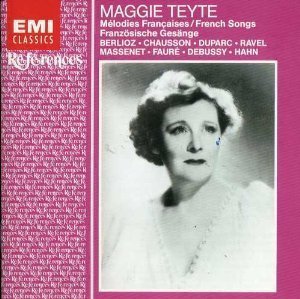
Maggie Teyte – Mélodies Françaises

41lhudrbaxl

The first time I heard Maggie Teyte was when I was just starting to enjoy French song. I was learning Duparc’s Chanson triste and a friend played me her recording of the song with Gerald Moore at the piano. I was absolutely entranced and it has remained my yardstick ever since. First of all the flowing tempo they adopt is aboslutely right (so many take it too slowly) and she responds perfectly to all Duparc’s markings – floating the tone beautifully on the mon of mon amour (it is marked doux by Duparc) an effect I have tried, not too successfully, to emulate myself. Her high A is clear, clean and true, but she takes the lower option on the words de tes bras, dipping down into that gloriously rich lower register she had. As you listen, you feel the song is addressed to you personally and you want to just lie back in the warm embrace of her comforting words. The French christened her L’Exquise Maggie Teyte, and the adjective suits her perfectly.

She was born in 1888 in Woverhampton, but went to Paris in 1903 to study with the famous tenor Jean De Reszke. She made her first public appearanc in 1906, singing Cherubino and Zerlina under Reynaldo Hahn, making her first professional appearance in Monte Carlo the following year. She then joined the company at the Opéra-Comique in Paris and was shortly after chosen to replace Mary Garden in the role of Mélisande, for which she was coached by Debussy himself. She is the only singer ever to have been accompanied in public by Debussy himself, and she is an invaluable link to so many musicians of the past. Despite her early success however, she didn’t really establish herself with the main opera houses, and went into semi-retirement after her second marriage (to Canadian millionaire Walter Sherwin Cottingham) in 1921.

In 1930 she tried to resuscitate her career, but ended up singing in variety and music hall (24 performances a week!) until, in 1930, she made some recordings of Debussy songs with Alfred Cortot, which were so successful that she then became known as the leading French song interpreter of her time. She also sang at Covent Garden in such roles as Butterfly, Hänsel and Eurydice in Gluck’s opera, as well as Manon in English (with Heddle Nash).

The present set concentrates on recordings of French song with orchestra and piano made between 1940 and 1948, making her 60 when she recorded Ravel’s Schéhérazade, not that you would ever suspect it. The voice is still absolutely firm with no trace of wobble or excessive vibrato, top notes pure and true (a thrilling top B flat in Asie), the inimitable lower register gloriously rich.

It starts with a rather hectic recording of Berlioz’s Le spectre de la rose. The fast tempo was presumably adopted so that they could fit the song onto a single 78, but it does remind us that it is in waltz time and she brings a peculiarly intimate touch to the closing lines,which are sung with an ineffable sadness. Absence is sweetly touching.

Occasionally her attention to the meaning of the words can get in the way of the music, and the tempo fluctuations in Fauré’s Après un rêve are just too much, rather too slow at the beginning, with an unwritten accelerando on Reviens, reviens. I’d also suggest that Duparc’s Extase is taken far too slowly throughout. On the other hand the tempo for Fauré’s Clair de lune is absolutely spot on with a moment of pure magic as she infuses her tone with warmth at Au calme clair de lune and Gerald Moore switches to a more free flowing style in the accompaniment.

Over the two discs there is scarcely a performance that doesn’t warrant attention, but I single out for special consideration Duparc’s gorgeous Phidylé, which is lazily erotic as it should be (note her telling observation of the diminuendo on baiser – most singers miss it completely) and the aforementioned Chanson triste, the former with the LSO under Leslie Heward, the latter with Gerald Moore on the piano. Also on disc 1 is a superb performance of Chausson’s Chanson perpétuelle, whilst she breathes new life into Hahn’s popular Si me vers avaient des ailes on Disc 2.

In all she remains inimitable and individual, though, it seems these days, only known to connoisseurs. This set is no longer available, nor are the Debussy songs she recorded with Cortot. John Steane says in his wonderful book The Grand Tradition,

But basically the point about Maggie Teyte is the very simple one, that her singing is so good: that is, her voice is so clear, its production so even, its intonation so faultless, its movement in big upward leaps so clean and athletic, and its excellence was so well preserved for so long.

Not only is her actual singing so good, but she has something personal to say in all she does, and voice and style are instantly recognisable.

There are other examples of her art more readily available on other lablels but this old EMI set is a treasure and I urge Warner to reissue it along with the Debussy songs with Cortot. It should be in the collection of anyone who is interested in French song.